• Don't want to see ads? Install an adblocker like uBlock Origin or use a Europe-based privacy-friendly browser like Vivaldi or Mullvad.

Veneti

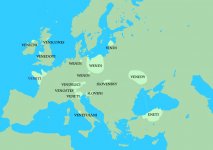
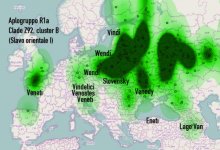
archeogenetica.Z92.jpgPag.14VenetiEUmappa.jpg
Well, I think that this two maps can speak by them self. The big problem to me is timeline because R1a Z92 don't match with Lusatian culture, being more ancient (around 2500 b. C. I guess). Can so old clade remain so long in the maps?
 
Last edited:
View attachment 6937View attachment 6938
Well, I think that this two maps can speak by them self. The big problem to me is timeline because R1a Z92 don't match with Lusatian culture, being more ancient (around 2500 b. C. I guess). Can so old clade remain so long in the maps?

No offense, but you're seriously shooting yourself into the foot there:
- the Vindelici are etymologically unrelated, stemming from the Celtic word for "white", compare it with Irish "fionn" and Welsh "gwyn".
- the same goes for the name "Slovenes". The name comes from the Slavic word for 'to speak', and its indeed etymologically related with the word "Slav".
- on top of that the map is anachronistic, because the medieval Wends (this one clearly was an exonym) were overtly newcomers. In the Antiquity, that region was inhabited by Germanic tribes, such as the Langobards and the Suebi.
 
the Vindelici are etymologically unrelated, stemming from the Celtic word for "white", compare it with Irish "fionn" and Welsh "gwyn".
There is an article from J.Loicq Sur les peuples de nom "Vénète" ou assimilé dans l'occident européen, dans Etudes celtiques (2003) which gives 19 peoples names with the same root (obviously, it doesn't quote the Vindelici for the reason you explained). He thinks that some of them are related, but he excludes the possibility hat the Armorican Veneti and the Venelli could be related to the other ones.
 
@piero,
Maybe you know - was there anything linking any of Venets to ducks?

Edit:
I will explain my question. Basically I was hunting down Antae ethnonime and found that in Lithuanian antis is duck (Latvian is very different - pīle). And wiktionary says that antis etimology is derived from proto-IE ennet/aennet (with common cognates in Germanic with root enned, etc).
Antes and Sclavenes were linked to Baltic Venets/Veneds by at least some sources.
Up to now I only found random reference of "spiritual revolution" in late bronze age/early iron age, appearing as multiple waterbird symbol finds.
 
Last edited:
There is an article from J.Loicq Sur les peuples de nom "Vénète" ou assimilé dans l'occident européen, dans Etudes celtiques (2003) which gives 19 peoples names with the same root (obviously, it doesn't quote the Vindelici for the reason you explained). He thinks that some of them are related, but he excludes the possibility hat the Armorican Veneti and the Venelli could be related to the other ones.

in ancient times the Venelli was written as Uenelli and the resided on th epeninsula where modern cherbourg is..................they are said to have originated from the baltic sea area.
 
In the article from J.Loicq previously referenced, the author explains that it most probably would have been Venelli before Unelli (or Vnelli).
Just for information, what is the source of them coming from the Baltic sea? (J.Loicq says, with considerable uncertainty, they could have been Belgae)
 
"modern" venet from circa 780AD had a reverse of what you state, it had a X which went to a Z which ended up as S ........and it always retain the K

??? What is your arguments here???
I spoke about breton vannetais: the only known celtic language (of today, of course because we know almost nothing of the ancient venetic of gaul) of the Armorican territory of ancient Veneti is 'brezhoneg gwenedeg' of "breton vannetais" - it is not gallic or gaulish, it 's for the most an insular brittonic language - it retained surely some gaulish words but this two languages were very close qat this time - but its phonetic evolution, halfway between insular and french tendancies, is clearly based on a substratum common with other french regions, and noesn' t need a peculiar "venetic" umput different from the rest of gallic dialects -
concerning YOUR venetic of Middle Ages (far later than OUR VENETI of PROTOHISTORY) its surely a latin dialect - but i'm amazed by your affirmations concerning evolution of X to Z (what is the phonetic signification of these signs, please, before debating further on?
 

??? What is your arguments here???
I spoke about breton vannetais: the only known celtic language (of today, of course because we know almost nothing of the ancient venetic of gaul) of the Armorican territory of ancient Veneti is 'brezhoneg gwenedeg' of "breton vannetais" - it is not gallic or gaulish, it 's for the most an insular brittonic language - it retained surely some gaulish words but this two languages were very close qat this time - but its phonetic evolution, halfway between insular and french tendancies, is clearly based on a substratum common with other french regions, and noesn' t need a peculiar "venetic" umput different from the rest of gallic dialects -
concerning YOUR venetic of Middle Ages (far later than OUR VENETI of PROTOHISTORY) its surely a latin dialect - but i'm amazed by your affirmations concerning evolution of X to Z (what is the phonetic signification of these signs, please, before debating further on?

The X is the latin influence, ie Pax etc
 
@piero,
Maybe you know - was there anything linking any of Venets to ducks?

Edit:
I will explain my question. Basically I was hunting down Antae ethnonime and found that in Lithuanian antis is duck (Latvian is very different - pīle). And wiktionary says that antis etimology is derived from proto-IE ennet/aennet (with common cognates in Germanic with root enned, etc).
Antes and Sclavenes were linked to Baltic Venets/Veneds by at least some sources.
Up to now I only found random reference of "spiritual revolution" in late bronze age/early iron age, appearing as multiple waterbird symbol finds.
By Jordanès : “Venetharum natio. . . quorum nomina licet nunc per varias familias et loca mutentur, principaliter tamen Sclavini ac Antes nominantur”. Yes, by Adriatic Veneti the duck is maybe the most important sacred animal.
 
in ancient times the Venelli was written as Uenelli and the resided on th epeninsula where modern cherbourg is..................they are said to have originated from the baltic sea area.
I'm also very curious about the source. Do you know it?
 
No offense, but you're seriously shooting yourself into the foot there:
- the Vindelici are etymologically unrelated, stemming from the Celtic word for "white", compare it with Irish "fionn" and Welsh "gwyn".
- the same goes for the name "Slovenes". The name comes from the Slavic word for 'to speak', and its indeed etymologically related with the word "Slav".
- on top of that the map is anachronistic, because the medieval Wends (this one clearly was an exonym) were overtly newcomers. In the Antiquity, that region was inhabited by Germanic tribes, such as the Langobards and the Suebi.
We can speak long time about linguistic aspects without reaching any definitive result, because linguistic is a "weak" science. Maybe Vindo for Celtic people in "white", but for Veneti is simply their own name (for example welsh Gwyn can refer also to a Veneti tribe, - a colony of Veneti coming from Brittany). Only when languages and genetics match together we are in the right way, so what we can say at the moment is just that Gvozdanovich thesis and the map of R1a Z92 are compatible and coincident. In East Germany you know very well the Bronze age settlements of Lusatian culture. Later happens that German tribes with war and crusades took the lands of pacific and hospitable Wendi people (Ptolomys Venedi).
 
By Jordanès : “Venetharum natio. . . quorum nomina licet nunc per varias familias et loca mutentur, principaliter tamen Sclavini ac Antes nominantur”. Yes, by Adriatic Veneti the duck is maybe the most important sacred animal.
This is from wiktionary about Antis (Lith) etimology:
From Proto-Indo-European *ənət-. More at ennet.

This is interesting also because in Latvian duck is 'pīle', which is not derived from 'antis', and also out of all Slavic languages I checked only Russian has 'utka' from 'antis', all others have different names for duck, although apparently they knew duck at period of common slavic. Coud it be that initial term was replaced by derived ones for some reason?

Another question is if Venets themselves could have been derived directly or indirectly from duck. Either as v...+enet which turned into venet (similar as drake in modern English is from something like enned+reik - duck king), or maybe via term 'boat' which could in turn have been derived from duck.

Just speculating :)
 
We can speak long time about linguistic aspects without reaching any definitive result, because linguistic is a "weak" science.

Linguistics is not a "weak" science. Historic linguistics is, as the name says, a historic science, but that doesn't mean that its any way less scientific (there are such concepts like sound correspondence and sound laws). Its not a free-for-all licence to twist and bend things like you want them...


Maybe Vindo for Celtic people in "white", but for Veneti is simply their own name (for example welsh Gwyn can refer also to a Veneti tribe, - a colony of Veneti coming from Brittany).


Sorry, but that's just hair-raising wrong. The element *windo- is thoroughly attested in the Celtic languages (e.g. "Vindolanda", "Vindomagus", etc.), including - like I said - in modern Celtic languages. What you're doing with the Vindelici is that you ad-hoc dismantle the name in a different way (to basically claim your element) and link it. Again, you're basing this solely on superficial similarity of the names, without any care what language the Vindelici might have spoken based on other sources (place names, personal names, etc.). You just say that they must be related related with the others based on superficial similarity. You are doing the same with the name "Sloveni", and no offense, but what you're doing there - that's not methodologically sound by any means, that's just fooling yourself.

Also, as I mentioned, the linguistic results are there, and they don't offer the room of speculation that you'd like them to have:


1) the Veneti of Gaul are presumed to have been Gaulish based on place names and personal names. There's no evidence for another ("Venetic") ancient language, and Gvozdanovich's analysis of a modern Breton dialect is irrelevant because Breton arrived there only during the Migration Period, and the ancestor language was actually spoken on the other side of the Channel.

2) the Adriatic Venetic language is attested from inscriptions, and can be shown to be an Indo-European language most similar to the Italic languages, although some similarities to the Germanic languages also exist. I should reiterate here that Gvozdanovich's hypothesis that Adriatic Venetic was particularly closer with Celtic appears implausible on the ground that it does not share the key sound developments.

3) For Baltic Veneti (Venedi), about their language is we know the least, but they can be assumed to have been Baltic (ot Balto-Slavic) based on the fact that Baltic-speaking tribes of identical name inhabit the area around 1000 years later.

Only when languages and genetics match together we are in the right way, so what we can say at the moment is just that Gvozdanovich thesis and the map of R1a Z92 are compatible and coincident. In East Germany you know very well the Bronze age settlements of Lusatian culture. Later happens that German tribes with war and crusades took the lands of pacific and hospitable Wendi people (Ptolomys Venedi).

I also would say that genetics, as of the moment still stands on a lot more shaky legs (although that has improved considerably in recent years thanks to more and more samples of ancient DNA) than historical linguistics, mainly by the merit of being a still relatively new science. Still, what you're doing is dubious at best, because, who determines what "the right way" is, it seems very subjective to me. In genetics, find it dubious if you look at modern distribution patterns and try to link that to a single event, or single ethnic group. If anything, modern distribution patterns must be the "sum of all history".

 
I never seen any veneti tribe name themselves Veneti, the name only came via the roman historians who did not knoe who they where so named them after the roman word for sea colour...VENETUS

all veneti live by the sea, and there are no land -locked veneti
 
@Taranis

Could you post some info about the similarities between Germanics and Adriatic Veneti? Thanks.
 
Linguistics is not a "weak" science. Historic linguistics is, as the name says, a historic science, but that doesn't mean that its any way less scientific (there are such concepts like sound correspondence and sound laws). Its not a free-for-all licence to twist and bend things like you want them...

Sorry, but that's just hair-raising wrong. The element *windo- is thoroughly attested in the Celtic languages (e.g. "Vindolanda", "Vindomagus", etc.), including - like I said - in modern Celtic languages. What you're doing with the Vindelici is that you ad-hoc dismantle the name in a different way (to basically claim your element) and link it. Again, you're basing this solely on superficial similarity of the names, without any care what language the Vindelici might have spoken based on other sources (place names, personal names, etc.). You just say that they must be related related with the others based on superficial similarity. You are doing the same with the name "Sloveni", and no offense, but what you're doing there - that's not methodologically sound by any means, that's just fooling yourself.

Also, as I mentioned, the linguistic results are there, and they don't offer the room of speculation that you'd like them to have:

1) the Veneti of Gaul are presumed to have been Gaulish based on place names and personal names. There's no evidence for another ("Venetic") ancient language, and Gvozdanovich's analysis of a modern Breton dialect is irrelevant because Breton arrived there only during the Migration Period, and the ancestor language was actually spoken on the other side of the Channel.

2) the Adriatic Venetic language is attested from inscriptions, and can be shown to be an Indo-European language most similar to the Italic languages, although some similarities to the Germanic languages also exist. I should reiterate here that Gvozdanovich's hypothesis that Adriatic Venetic was particularly closer with Celtic appears implausible on the ground that it does not share the key sound developments.

3) For Baltic Veneti (Venedi), about their language is we know the least, but they can be assumed to have been Baltic (ot Balto-Slavic) based on the fact that Baltic-speaking tribes of identical name inhabit the area around 1000 years later.


I also would say that genetics, as of the moment still stands on a lot more shaky legs (although that has improved considerably in recent years thanks to more and more samples of ancient DNA) than historical linguistics, mainly by the merit of being a still relatively new science. Still, what you're doing is dubious at best, because, who determines what "the right way" is, it seems very subjective to me. In genetics, find it dubious if you look at modern distribution patterns and try to link that to a single event, or single ethnic group. If anything, modern distribution patterns must be the "sum of all history".
Taranis, maybe you mean Vieu for Vindomagus? Real name of Vieu is Venetomagos, from Vénètes + magos (market) from: http://crehangec.free.fr/rhon.htm Veneti were a trades peoples linked to markets, a "White market" is a non sense (today we have only the Black market :-) ).
Venetomagus is along the "tin way" that links Atlantic Veneti with Adriatic Veneti.
Please, I want better understand what you wrote:
1) "Breton arrived there only during the Migration Period". What do you mean as Migration period? Wich century?
2) Which are key sounds of Celtic non shared with Veneti?
3) Who were the Baltic-speaking tribes of identical name inhabit the area around 1000 years later?


I never seen any veneti tribe name themselves Veneti, the name only came via the roman historians who did not knoe who they where so named them after the roman word for sea colour...VENETUS

all veneti live by the sea, and there are no land -locked veneti
Maybe you don't know the famous inscription from Isola Vicentina that is VENETKENS.
 
@Taranis

Could you post some info about the similarities between Germanics and Adriatic Veneti? Thanks.

The parallel mainly concerns a grammatical construction, Venetic "sselboisselboi" and Old High German "selbselbo" ('to oneself', contrasting with Latin "sibi ipsi").

Taranis, maybe you mean Vieu for Vindomagus? Real name of Vieu is Venetomagos, from Vénètes + magos (market) from: http://crehangec.free.fr/rhon.htm Veneti were a trades peoples linked to markets, a "White market" is a non sense (today we have only the Black market :-) ).
Venetomagus is along the "tin way" that links Atlantic Veneti with Adriatic Veneti.


No offense to you but this is complete nonsense. The ancient name of Vieux is "Aregenua" (Ptolemy 2.8), there is no attestation such a name "Venetomagus". Are you seriously making up evidence to back your hypotheses??? The modern name Vieux is derived from the tribal name, Venelli.

The name "Vindomagus" does not only makes quite sense (because the word also has the meaning 'blessed'), but its also attested with Ptolemy (2.10) as a town in Gallia Narbonensis, in the territory of the Volcae Arecomici.

Please, I want better understand what you wrote:
1) "Breton arrived there only during the Migration Period". What do you mean as Migration period? Wich century?

I'm talking about the period between approximately 400 and 600 AD, that is, contemporary to the abandonment of Britain by the Romans, the demise of the Western Roman Empire and Anglo-Saxon invasion of Britain. As I said, the ethnic name "Bretons" should be a giveaway - they originally came from Britain. Before the Migration Period, the Gaulish name for the region was "Aremorica" (including not only modern Brittany, but the also adjacent territory of the Lower Normandy).

2) Which are key sounds of Celtic non shared with Veneti?

Most importantly (there's a number of criteria) the Celtic languages ahre the loss of the *p sound originally inherited from Proto-Indo-European. For example, Irish "athair" (Ø) corresponds regularly with English "father" (*f) and Latin "pater" (*p). The so-called "p-Celtic" languages (such as Gaulish and Brythonic) later re-develop a p-sound, but this corresponds with the *kw sound from Proto-Indo-European.

By the way, Adriatic Venetic preserves both PIE *p and *kw.

3) Who were the Baltic-speaking tribes of identical name inhabit the area around 1000 years later?

The Galindians and the Sudovians.
 
Maybe you don't know the famous inscription from Isola Vicentina that is VENETKENS.

Piero

All I know is that prior to 1150BC the veneto and friuli areas was home to the indigenous EUGANEI tribes ( triumpili, stoeni , camuni and others) . there where 34 towns/settlements.

The veneti arrived and did not wipe out these people, the absorbed them slowly..........my guess is that the veneti was a small warlike group who came from somewhere.

We know in Italy now, there is the 3 venice's ............venesia-eugania ( original veneti )venesia-trentina and venesia-giuliana. Venesia-Eugania is the first area.

There is zero chance the veneti brought any script or language to italy, but used the Euganei script. This script is very similar to east-rhaetic, west-rhaetic and camunic script..........

.............................

on the other issue you stated............Gallia Narbonensis is the last area in france to become gaulish.....documents/historians state in bronze age the iberians and ligurians clashes in battle many times on the border...the Rhone River.
The Volcae, Cenomani, Semones and other tribes all came from near Armorica to Gallia Narbonensis and then to northern Italy ( except Volcae which IIRC went to bavaria )
 
Back
Top