• Don't want to see ads? Install an adblocker like uBlock Origin or use a Europe-based privacy-friendly browser like Vivaldi or Mullvad.

101 Ancient Eurasian Genomes Available Online

Alan, the SW Asian was already in Europe in the early Neolithic, so presumably it was in the border region between south east Anatolia and the Levant coast near Syria even earlier. Whether it was initially in the Armenian highlands is another issue.

Yes but this "Southwest Asian" which shows up in all neolithic farmers is the portion of it which is not contained with Red Sea. It is basically the part of EEF which became Southwest Asian by mixing with Red Sea. Just like how "ASI" in the Mal'ta boy is not a sign that he was admixed with ASI but that ASI itself probably contains some Mal'ta related ancestry.

Southwest Asian is basically EEF with some (10-15%) SSA admixture.

Also keep in mind the geneflow kept going it didn't stop when the genetic shift happened. So it is very likely that some of the Red Sea arrived in Europe during the Late Neolithic- Bronze Age from Anatolia too. And ancient DNA does show European farmer do have a much smaller percentage (1/3 of modern Northern West Asians) of the Red Sea component. So it got deluted after reaching the Levant, than Anatolia and from Anatolia to Europe.
Take in mind Anatolia is actually easier to reach from the Levant than Mesopotamia (The Syrian Desert) and Transcaucasus(Mountains) is. Therefore no wonder that the genetic shift happened in Anatolia already during Late Neolithic while in Transcaucasus very late probably through the Assyrians.
I also don't think those ANE7 numbers are gospel. I was glad to see that someone on Anthrogenica is pointing out what seemed pretty clear to me, which is that the WHG/UHG component "eats up" some of the ENF.
I can only agree.

I'm going to put off making any judgments about many of these things until we have analyzed genomes from Maykop, Central Asia, and from an early Near Eastern farmer as well, and I want to see conclusions using the best statistical methods, not relying totally on ADMIXTURE.

Another Armenian sample was tested and it did also not contain any Southwest Asian/Red Sea. But I agree we should wait for more Results.

Iron Age Armenian
Armenian 397 is giving me too much of a noise. Figures given the SNP count:

14.62% S-Indian
34.51% Baloch
41.86% Caucasian
5.53% NE-Euro
0.00% SE-Asian
0.91% Siberian
0.00% NE-Asian
0.00% Papuan
2.48% American
0.08% Beringian
0.00% Mediterranean
0.00% SW-Asian
0.00% San
0.00% E-African
0.00% Pygmy
0.00% W-African

This particular result here looks Iranian than anything and is even slightly more eastern and less Southern(Southwest Asian) shifted than modern Iranians!
 
Last edited:
RISE416 sample from Bronze Age Armenia appears roughly like an even mix of modern Basque and Adygei/Lezgians.
 
That still doesn't match the modern Sardinian phylogeny, though. Modern Sardinian I2-M26 has less diversity than most other haplogroups in Sardinia. Now, we'll need to get the timing right to see if we're looking at a possible relative to the source population of a later expansion of I2-M26 in Sardinia, or what.

which is the older I2 found, hungarian, remendello or steppe one?
 
All I've had time to do is read the text in the Supplementary Info and look at a few of the admixture chars and the yDna, so maybe that's why I'm confused, but

Using the same "WHG" samples and early farmer samples as Lazaridis and Haak, how do they get to the fact that even early European Neolithic farmers are 50% WHG? I know Lazaridis said the "WHG/UHG" in these people could range from a few percent to 45% but they said any exact figure would have to wait for a Near Eastern early Neolithic farmer. This group doesn't have one does it? So, how do they model that? Is it in the formal stats section? It looks like they just decided to use the Bedouin. I know Lazardis struggled with whether the Bedouin (and which group of Bedouin, with what % of SSA) were a good proxy.

The same thing applies to the "southern" component in Yamnaya. Do they attempt to define it anywhere? I also don't get how the Yamnaya can be half "modern Armenian like" in Lazaridis terms but have no Near Eastern farmer ancestry. Even according to this group's own admixture chart modern Armenians have Yamnaya ancestry and the Neolithic farmer ancestry that went to Europe.

If these "Caucasus" people who mixed with the more northern "steppe" like people (?) to create Yamnaya weren't farmers, were they still of the same general type of ancestry, .i.e. largely of this type of "Basal" Ancestry mixed with some sort of South Eurasian, but weren't part of the Neolithic revolution? But then how does Maykop fit into all of this?

In order to make sense of this doesn't it seem that we really need a Maykop genome? I mean, they talk about all the culture coming through Maykop, the kurgans, the metallurgy, I think they even said the wheel and wagons if I remember correctly, but who were the Maykop people? Are we meant to assume they were the same as the people on the steppe or different? Did they mix?

I'm also confused by their references to CT spreading east onto the steppe. Wouldn't the people of the CT have been European Neolithic farmers? So, why is there no signal of them in Yamnaya? Is it because most of the Yamnaya samples are from the eastern areas? Was it different in the western areas?

I also don't get why they keep talking about this massive influx of genes at least into certain places in Europe when at the most the admixture charts show about, what, 20%?

It doesn't seem to hang together, but maybe it's because I just skimmed it. When I get up tomorrow, all our European members will have figured it all out, yes? :)

Oh, and why did they pick Remedello for the first appearance of the Indo-Europeans in Italy? Ever since it turned out that Oetzi, who was from a related culture, was G2a, it seemed pretty clear, I thought, that Remedello wouldn't be it. The only reason it used to be mentioned as such, I think, is because there was an attempt to link all metallurgy with the Indo-Europeans. Well, maybe they didn't have samples from a later period. Maybe it will turn out that the older scholars were right, and the Italic languages came to Italy from the Balkans, and via the Adriatic.

Angela, I completely agree with all your remarks. My mind exactly.
 
30% percent of Atlantic med in BA Armenians :)
The ancient DNA is so confusing and exciting.
At last Basque cognates question will resurface :)
 
The conclusion is that I2 is in sardinian, northern-italy, "illyria" and Pannonia ( hungary ) was in majority I2 and this got diluted over time my other migrating younger haplogroups ( not all areas though )

I2 spread all over Europe, from east to west before LGM
finding anciant I2 in Europe is telling nothing new unless you know which subclade it is
 
I knew the paper would be political when one of the individuals behind it made a statement like "We don't fear our history in contrast to our neighbors".

Alan
Sometimes the truth must be said. And this remark was not about Iranian people. You know who he mean.
Europeans are financing aDNA research are providing freely data to everybody who wants to make calculations.
And what are doing Near Eastern nations who swim in petrodollars? How much study they financed and put public?
If some nations don't fear their past why there is so little information from Azerbaijan. Where the last time You here news from there? Why the 18th dinasty of Egypt Y dna is kept secret?

And he is right Armenians don't fear their past. Armenian history is so badly written that everything that shakes it's foundations is good for us. I know that Iranian people also don't fear their past.
 
According to Patrick Geary (links below), there is no genetic evidence of large-scale Germanic migrations anywhere except for Anglo-Saxon migration to England:

Part 1:

http://video.ias.edu/node/5304

Part 2:

https://video.ias.edu/topology/2013/1002-PatrickGeary

This lecture above says that there is no genetic evidence of large scale emigration of East Germanic tribes from East-Central Europe to the Roman Empire.

Germanic migrations since when ? It is pretty obvious that Germanic people migrated en masse from Scandinavia to Germany, the Benelux, and to a lower extent also Switzerland, Austria, Bohemia and northern France, then later also to Iceland. So it's not just Britain.
 
Maciamo

Yes it is the summary from Alentoft paper.
I got it from Antrogenica.
 
Concerning this paper.
Overall I agree with what Angela says, I also agree with Alan's remarks.
I must add that this paper created much more confusion than resolved questions. They don't even bother to create a simple table where Y DNA SNPs will be visible in clear manner. It is now the bloggers who are doing this job.

Hopefully they put the data public and further studies will clear this confusion adding also the Haak data.
 
Iron Age Britons were significantly more Northern Shifted than modern Britons, so the Anglo Saxon and Viking genetic legacy in the UK is quite insignificant.Also going by y-dna lineages parts of Italy and parts of the Balkans have more recent Germanic ancestry than Northern French. The Franks themselves were already Romanized before settling in France.Austrian and German Swiss are full blooded Bavarians and Swabians with a touch of Saxon admixture, so I don't get how people can say that they have a "Germanic influence".
 
I just got my copy of the Allentoft paper. I haven't had time to read it yet, but at first sight I see some interesting data on lactase persistence (extended data figure 7), which shows particularly high percentages for Bronze Age IE cultures :

- Mezhovskaya (samples from what is now Udmurtia) : 50% of LP
- Yamnaya : 30%
- Corded Ware : 20%
- Karasuk : 10%

In contrast Mesolithic and Neolithic cultures are at 0%. Oddly enough, the Bell Beaker, Unetice and Nordic Bronze Age are also at 0% of LP, despite the fact that modern Germans and Scandinavians have over 70% of LP.

nature14507-sf7.jpg
 
The surprise that was expected is the BB with full of R1b.
Do this mean that BB spread IE in West Europe?
But then the question is why is BB autosomal data different from Yamna? Or it isn't?
 
Maciamo said:
Germanic migrations since when?

Sorry for being imprecise.

Of course my post was about Germanic migrations into territories of the Roman Empire (and later after it disintegrated into territories of the former Roman Empire) between the 300s AD and the 500s AD. Patrick Geary claimed that there are virtually no traces in DNA, though that could actually be due to a relatively small number of newcomers compared to huge numbers of the locals.

https://en.wikipedia.org/wiki/Germanic_Wars

https://en.wikipedia.org/wiki/Germanic-Roman_contacts


Especially important would be to find traces of settlemet of East Germanic tribes in DNA of modern populations. East Germanic languages are now extinct, but the Crimean Goths preserved their language for a long time, until the Late Middle Ages or even the Early Modern Era - testing ancient DNA samples from their burials (if such burials of Crimean Goths exist) would be a very good idea.


Iron Age Britons were significantly more Northern Shifted than modern Britons, so the Anglo Saxon and Viking genetic legacy in the UK is quite insignificant.

If that was a response to my post - in England about 30% (regional differences between various regions of England range from 10% to 40%) of autosomal DNA is from post-Ancient immigration, according to the most recent (2015) study. This is not all Anglo-Saxon, but also Danish Viking (Danelaw), Norman (those guys were ethnically mixed with local French guys by the time of coming to England), Breton (who came with the Normans in the 11th century - ironically they were to some extent descendants of earlier 4th-6th century Briton immigration from Britain to Bretagne), etc. I would not call that "insignificant" - it is at least noticeable, and a relatively large proportion.

By contrast Patrick Geary claimed that he didn't notice anything like that in Iberia, Italy, or North Africa (Vandals).

=================================

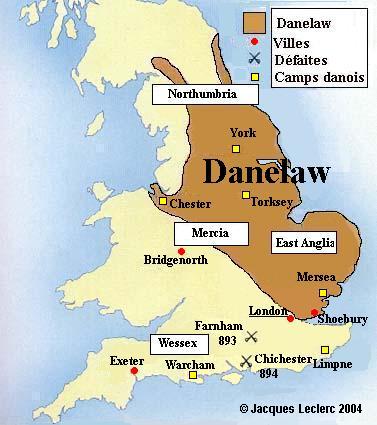
Map showing settlements with names of Scandinavian origin (mostly Danish) in England:

Scandinavian_Settlement_Names.gif


Compared to the Danelaw:

https://en.wikipedia.org/wiki/Danelaw

england-danelaw-map.jpg


I suppose, that Danish DNA is almost indistinguishable from DNA of Angles and Jutes (who came from Denmark). So I find it suspicious that authors of this new study claimed, that Anglo-Saxon admixture is 10%-40%, but Danish admixture is almost non-existent.

Most likely they assumed that all of this is Anglo-Saxon, while in reality some share of this 10%-40% came later with the Danes.

Another possibility is, that the Angles and the Jutes were indeed different genetically from the Danes, who replaced them.

There are archaeological traces of depopulation in parts of Jutland and parts of Angeln, dating back to Anglo-Saxon-Jute migrations.

So after the Angles and the Jutes emigrated to Britain, Danish tribes replaced them and assimilated the leftovers.
 
The surprise that was expected is the BB with full of R1b.
Do this mean that BB spread IE in West Europe?
But then the question is why is BB autosomal data different from Yamna?

BB autosomal is different probably because they were a male-biased immigration (much more males than females) and mostly married local women. Moreover, R1b in Western Europe is a founder effect - the number of BB immigrants was rather relatively small.

Let's remember that Megalithic, Neolithic Western Europe was rather among the sparsely populated parts of Europe. It was inhabited mostly by farmers, but there existed also groups who were still hunter-gatherers, IIRC especially near the Atlantic coast, in the British Isles, and in Ireland. So in those places inhabited mostly by hunter-gatherers, R1b had the best chance of replacing previous Y-DNA, and so it did (Ireland has the highest % of R1b in Europe, IIRC, and vast majority of that is L21, most likely due to a founder effect).

As for the size of Europe's population at the onset of IE expansion - they had just experienced a demographic crisis:

"Regional population collapse followed initial agriculture booms in mid-Holocene Europe":

http://www.nature.com/ncomms/2013/131001/ncomms3486/full/ncomms3486.html

http://www.nature.com/ncomms/2013/131001/ncomms3486/pdf/ncomms3486.pdf

Check also estimated population density (based on intensity of archaeological findings) in Neolithic Europe, by region:

https://www.academia.edu/677271/Exp...re_in_Europe_based_on_Archaeological_Evidence

2ivobcz.png


Or maybe the number of BB immigrants was large, but only some lineages - of the most influential individuals - achieved such a reproductive success, while other individuals were no more successful in spreading their Y-DNA than local Megalithic males.

They managed to mostly replace the Megalithic Y-DNA and father most of their children (with their women), because Megalithic people had low population density, and BB came with new technology, horses, new ideas, etc., above all with alcohol (we know how destructive was alcohol on Native Americans in North America - perhaps it worked the same way on Megalithic males in Western Europe). They also apparently became chieftains of Megalithic people, and had unlimited access to their women, so they could spread their Y-DNA fast:

https://www.youtube.com/watch?v=hmHXBXG7Loo

 
Eurogenes K15 analysis of RISE407 = Armenia 895 BC using Sergei's file on Gedmatch:

North_Sea 14.11%
Atlantic 8.97%
Baltic 12.69%
Eastern_Euro 8.56%
West_Med 5.08%
West_Asian 43.73%
East_Med 3.66%
Red_Sea 2.22%
South_Asian 0.97%
Southeast_Asian -
Siberian -
Amerindian -
Oceanian -
Northeast_African -
Sub-Saharan -

By 900 BC thats the time when Assyrians were starting to conquer regions North of Mesopotamia and other Semites started to appear North and East of the Levant such as the Amorites and Phoenicians. And now we see a slow appearance of Red Sea. coincidence? I don't think so.

Modern People of the region have 5-6% Red Sea.
 
From Eurogenes:

Here the same pattern we see Red Sea Southwest Asian slowly leaking into the region in connection to Late Bronze Age (1200BC)-Iron Age, when the first Semite appearances in the Transcaucasus are well documented.

Dodecad K12b for RISE407 (LBA Armenian):

Code:
# Population Percent
1 Caucasus 29.44
2 Gedrosia 28.53
3 North_European 23.1
4 Atlantic_Med 12.46
5 Southwest_Asian 3.84
6 Sub_Saharan 1.5
7 Northwest_African 1.12


Code:
# Population (source) Distance
1 Turkmens (Yunusbayev) 18.6
2 Lezgins (Behar) 18.72
3 Tajiks (Yunusbayev) 19.18
4 Kumyks (Yunusbayev) 20.32
5 Iranian (Dodecad) 21.6
6 Kurd (Dodecad) 22.07
7 Kurds (Yunusbayev) 22.15
8 Iranians (Behar) 22.35
9 Chechens (Yunusbayev) 23.96
10 Turks (Behar) 24.65
11 Nogais (Yunusbayev) 24.85
12 Turkish (Dodecad) 25.18
13 Uzbekistan_Jews (Behar) 27.71
14 Bulgarian (Dodecad) 27.72
15 Adygei (HGDP) 28.54
16 O_Italian (Dodecad) 28.64
17 Romanians (Behar) 28.72
18 Greek (Dodecad) 28.95
19 Bulgarians (Yunusbayev) 29.6
20 Balkars (Yunusbayev) 29.85

And this one again appears genetically like a typical individual from prehistoric Khorasan (Iranic tribe).
 
Back
Top