@Epoch,
I took a look at the mammoth paper to which Moesan provided a link, and indeed up until around 14,000 YBP, the approximate date of the Villabruna man, there were mammoths still in Europe, although only north of the Alps in central Europe and far to the east on the steppe. Where there were mammoths there were probably mammoth hunters. However, why, absent ancient dna from them, would we assume that they were the same as the Villabrunians?
Let's leave aside for now the fact that the authors of the paper don't see any indication of Mal'ta type gene flow into the Villabrunians.
Looking just at the culture, at approximately the same time that the mammoths died out didn't the Villabrunians already have a very different culture, one adapted to a different climate and different flora and fauna?
The epigravettian in northeastern Italy is dated to 18,000 YBP.
Isn't it the case that only when the climate changed in the north did they themselves move north? Upon reaching those areas they might have encountered some survivors of the prior cultures. Couldn't that be the reason that the hunter-gatherers who show East Asian admixture are in the north?
In terms of Italy itself, there are Aurignacian sites, and Gravettian sites (Bilancino in Toscana is dated to 29,000 to 20,000 YBP)and the conventional wisdom has been that they populated Italy from north to south. I’m not sure that I think that’s necessarily true any longer. Even if it is, that’s no evidence that the same was true of the Villabrunians.
It seems to me that the evidence points to new people, adapted to a new culture, moving from south to north, whether they are the result of admixture or not.
The skeletal features of these Villabrunians/WHGs are quite different from those of the Aurignacians/Gravettians who preceded them according to the researchers who actually examined the remains, more “modern” looking, and indeed from the remains of Mal'ta, who the anthropologists who examined those remains claimed had some "Mongoloid" features. There were howls of denial all over some blogs, but the ancient dna now shows that indeed the anthropologists may have been onto something because there is definitely East Asian affinity in Mal'ta, not to mention the fact that EDAR showed up in the SHG. Indeed, according to this paper, if I'm remembering it correctly, the Mal'ta lineage isn't even considered West Eurasian any longer is it? I practically got virtually attacked for suggesting such a thing when the Lazaridis paper came out. Perhaps, as Rethel mentioned upthread Mal'ta himself is actually a mix of ENA with some more western lineage.
It would certainly help if they tested these earlier remains from Italy.
Not that I know any more than anyone else where that source is actually located. I’m just brainstorming here. Given that their culture, technology, was adapted to southern refugia, somewhere around the Mediterranean and the Black Seas is probably a good bet. So, perhaps indeed Italy, or areas around the Crimea, or parts of Anatolia, despite the fact that Gravetto-Danubian seems to feel there weren't many settlements there. The same was said of Italy, let's not forget.
Everyone had me convinced that Italy was virtually uninhabited in the Paleolithic. Yet there is Villabruna, and the Arene Candide and Pagliacci. Italy and Anatolia and the Balkans have been densely inhabited for millennia. Civilization lies on top of civilization. We can't plow up a field without hitting Roman and Etruscan remains, and in my area, the older statue stele. Who knows what's buried even further down. In Fivizzano about a half hour from where I was born there are natural grottoes and caverns. I’ve seen dates of 57,000 to 29,000 years ago for some of the area, with remains of dhole and leopards, cave bears, wolves and foxes. Lithic assemblages have been found from the Mousterian, but there are some things from the Neolithic as well. The excavations were sporadically and haphazardly done.It may be that it has been so continuously used that it won’t provide very clear answers, but somebody should give it a shot.
(Guido Barbujani, when he was hosting the 2014 Evolution conference in Firenze, took some of the participants to visit the Equi grottoes, and gives an overview here on pages 11-14. There are also come great pictures.
http://eshe.eu/static/eshe/files/PESHE_3_2014_Florence.pdf)
As to how Villabruna like people might have made it to northern Iberia, the modern topographical map you posted gives a slightly wrong impression, I think. This is my backyard, and I’ve hiked this area all my life, and I’m no mountain climber. It’s perfectly normal to hike from Portovenere near LaSpezia to Riomaggiore in the Cinque Terre (5 hours), from there to Monte Rosso al Mare (3 hours), and from there to Levanto in three more hours, and so on to Finale Ligure, near which we find the Arene Candide site. From there it’s a short distance to what is now the French Riviera. (The times I’ve given are on more modern man-made trails-I just posted a video on the travel section- so traversing the trails further inland would be longer, although you can also use the small river valleys.)
http://www.maphill.com/italy/liguria/detailed-maps/terrain-map/
Even the highest points of the Ligurian Alps can be reached relatively easily because the entire area is criss-crossed by small rivers and their valleys, as this guide explains.
https://www.youtube.com/watch?v=xVTnzXoXF4s
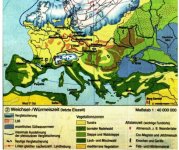
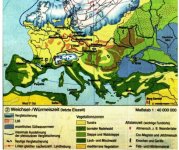
Regardless, in the LGM, while it was a hell of a lot colder, there was a narrow coastal strip.



 That's why I keep posting pictures on the anthropology section and asking questions of Moesan, who knows a heck of a lot more about it than I do. Unfortunately there's no substitute for examining the remains, and even the pictures I find don't show all views, or the measurements aren't posted in the article. Then there's all the disagreement in the field itself.