• Don't want to see ads? Install an adblocker like uBlock Origin or use a Europe-based privacy-friendly browser like Vivaldi or Mullvad.

Mediterranean migration layers in Sicily and southern Italy

Of course there's more "Caucasus" like ancestry in Tuscans than in northern Italians, but the question is, when did this Caucasus like ancestry arrive in Europe? I'll buy Metal Ages...Oetzi had a little bit already, but this doesn't prove that a specific migration in 800 BC brought it!

Also, there's more in southern Italians yet, and more in Greeks. There's the same amount in Balkan people. Were they all settled in the first millennium BC by people from Anatolia?

Take a look at the "Caucasus" proportion in these groups as per the Dienekes K-12b analysis"
https://docs.google.com/spreadsheet/...hl=en_US#gid=0
Northern Italians: 22.9
Romanians: 28.4
Tuscans: 30.5
Bulgarians: 30.7
Southern Italians/Sicilians: 36.5
Greeks: 37.4

Do I think it's possible that there was a late movement from Anatolia (first millenium BC) into Central Italy? Yes, I do; it's just that neither ancient or modern mtdna, is going to prove it, and especially not at the level of resolution which currently exists. A comparision of the full genomes of modern Tuscans to other modern populations doesn't prove it either. Who says this isn't Neolithic era? We need a high quality Etruscan genome and the genome of prior inhabitants from the same area.

I do think that there's generally something to be said for an additional Bronze Age gene flow (and later) into Italy not only from the north, but also from the south east.

Sardinian: 20.9
Northern Italians: 22.9
Romanians: 28.4
TSI 30 (Tuscans): 28.6
Tuscans: 30.5
Bulgarians: 30.7
Southern Italians/Sicilians: 36.5
Greeks: 37.4


On Dienekes K-12b there is another Tuscan sample (TSI30 Metspalu) and it has 28.6 Caucasian, it's the Tuscan HGDP from Southern Tuscany with 30.5. TSI30 Metspalu is a sample of 21 persons from Central Tuscany, likely one of the many subsets of HapMap, while HGDP as known is a sample of 8 persons from Southern Tuscany.

Interestingly more you go north in Tuscany and more the Caucasus component decreases. Caucasus component is 23/24 in Lucchesi (North Tuscany) I've seen, in Lunigiana (Northwestern Tuscany) is around 22/23 like in North Italy. I've also seen also the results of some central Tuscans with 25/26% of Caucasian, even some southern Tuscan with 25%.

What does it mean? In Tuscany exists an internal cline and this Caucasian is stronger in the south of the region, and less strong in the north of the region, with Central Tuscany that seems intermediate between the two but leaning towards southern Tuscany. Like Cato has introduced, there was a possible Chalcolithic or Bronze Age migration from the southern Balkans/Epirus to South Italy that reached Central Italy and has increased the Caucasian-CHG component? If there was a late movement from Anatolia (first millenium BC) into Central Italy, this late movement did not have a significant genetic impact on the whole population. The increase of CHG is most likely due to a migration of the Chalcolithic period, which came through the Balkans into South Italy, and left traces not only in Italy but also in the Balkans, surely among the Albanians and the Greeks, Bulgarians, Romanians, and very likely more north of them.
 
Sardinian: 20.9
Northern Italians: 22.9
Romanians: 28.4
TSI 30 (Tuscans): 28.6
Tuscans: 30.5
Bulgarians: 30.7
Southern Italians/Sicilians: 36.5
Greeks: 37.4


On Dienekes K-12b there is another Tuscan sample (TSI30 Metspalu) and it has 28.6 Caucasian, it's the Tuscan HGDP from Southern Tuscany with 30.5. TSI30 Metspalu is a sample of 21 persons from Central Tuscany, likely one of the many subsets of HapMap, while HGDP as known is a sample of 8 persons from Southern Tuscany.

Interestingly more you go north in Tuscany and more the Caucasus component decreases. Caucasus component is 23/24 in Lucchesi (North Tuscany) I've seen, in Lunigiana (Northwestern Tuscany) is around 22/23 like in North Italy. I've also seen also the results of some central Tuscans with 25/26% of Caucasian, even some southern Tuscan with 25%.

What does it mean? In Tuscany exists an internal cline and this Caucasian is stronger in the south of the region, and less strong in the north of the region, with Central Tuscany that seems intermediate between the two but leaning towards southern Tuscany. Like Cato has introduced, there was a possible Chalcolithic or Bronze Age migration from the southern Balkans/Epirus to South Italy that reached Central Italy and has increased the Caucasian-CHG component? If there was a late movement from Anatolia (first millenium BC) into Central Italy, this late movement did not have a significant genetic impact on the whole population. The increase of CHG is most likely due to a migration of the Chalcolithic period, which came through the Balkans into South Italy, and left traces not only in Italy but also in the Balkans, surely among the Albanians and the Greeks, Bulgarians, Romanians, and very likely more north of them.

Thanks. I don't know how I missed the TSI sample. So, there seems to be even an internal cline in Tuscany. TSI is from around Firenze isn't it?

When all this happened I don't know, and will wait for ancient dna to inform me, but it's clear that whenever it happened, it affected all of the Balkans as well.
 
Thanks. I don't know how I missed the TSI sample. So, there seems to be even an internal cline in Tuscany.

For sure. And it's not just due to the strong presence of ancient Ligurians in northern Tuscany, but this cline in Tuscany is just compatible with everything else that has happened there.


TSI is from around Firenze isn't it?

I was told by a researcher that it is probably from a little town south-east of Florence, in the Valdarno Superiore. TSI sample was collected around 2006/2007.


When all this happened I don't know, and will wait for ancient dna to inform me, but it's clear that whenever it happened, it affected all of the Balkans as well.

Indeed. In Italy it arrived from the Balkans, from the other side of the Adriatic sea. On this, both archaeologists and anthropologists agree.
 
Ok, but why afterwards ? Gaudo and Rinaldone (Remedello appear more autochthonous) are intrusive and different since their beginning from the Italian neolithic cultures. I agree that most of their population was local (EEF), but my guess is that the new brachy types that from the south reached the center of the peninsula were at least in part CHG. Mallegni described the brachy type of Gaudo as "Syrian looking" (unfortunately i have lost the PDF, it was a chapter of this book Dal bronzo al ferro. Sulla possibile origine anatolica degli etruschi).

I do agree with you that these Calcholitic newcomers could have been particularly enriched with Caucasus hunter-gatherer (CHG), but it's a mistake to associate Rinaldone and Gaudo only with these newcomers. Anyway there's too much at stake, let's proceed in an orderly fashion. We have during the Eneolithic/Copper Age/Chalcolithic Remedello culture in North Italy (Lombardy), Rinaldone culture in Central Italy (Northern Lazio) and Gaudo culture in South Italy (Campania). According to Grifoni Cremonesi Tuscany in the early Neolithic is part of the large Western cultural area, while the contributions from southern Italy and middle-Adriatic cultural areas are scarce. This is also true for Lazio.

La Toscana quindi, durante il Neolitico antico, fa parte di un’ampia area culturale decisamente rivolta verso occidente mentre scarsi sono gli apporti dalle aree culturali meridionali e medio-adriatiche.(...) Ben documentato è il momento successivo del neolitico, soprattutto nella Toscana settentrionale, con aspetti riferibili alla cultura di origine francese di Chassey e a quella della Lagozza dell’Italia settentrionale, che hanno un’ampia diffusione nell’Italia settentrionale e centrale.

The relations between the areas of Remedello and Rinaldone are very ancient, so that the copper for the ax of Otzi comes from the area where Rinaldone flourished, but It is equally true that from a certain point onwards Rinaldone had more contacts with Gaudo rather than with Remedello, and Gaudo was influenced by other southern Italian cultures like Laterza.

You lost the pdf, but fortunately I own the whole book "Dal bronzo al ferro. Sulla possibile origine anatolica". Some chapters are extremely questionable and quite airy-fairy, it's enough to read the first chapter where Chiarelli speaks about the Tuscan gorgia as an example of Etruscan legacy, just as only amateur scholars can do. Even children know that the gorgia in Tuscany is more widespread in the less typical Etruscan areas and less widespread in the more traditional Etruscan ones. How can be an Etruscan legacy? The Etruscan expansion in Tuscany started from northern Lazio and southern Tuscany, where the gorgia is non-existent. While other chapters are less vague and unrealistic, but the whole book is too much influenced by the publication of the 2004-2007 studies, and it is clearly obsolete with the conclusions of more recent studies, such as that of Ghirotto.

To begin with these intrusive CHG-like brachy newcomers aren't the Etruscans. Etruscan civilization flourishes two millennia later. At the most these newcomers are responsible for intensifying the relationship with the Balkans and any Aegean-Balkan-Anatolian connection.

These newcomers arrived from the southern Balkans and Epirus to South Italy, likely in an Apulian culture like Laterza, and from there to Gaudo and probably in the rest of southern Italy. From Gaudo they lately arrived to Central Italy.

If they are responsible for bringing an extra input of CHG, this extra CHG is still stronger today in Southern Italy than in rest of Italy. The distribution of this extra input of CHG follows the Italian cline, and Greeks have more CHG ancestry than the Italians.

Mallegni doesn't say that the brachy type of Gaudo are "Syrian looking", anthropologically it does not mean anything, he says that the cranial type and body structure of newcomers in Gaudo's culture remind the forms found also in Anatolia, Syria and Cyprus. And he describes them as high skull cramps, flat skull contours on the occiput, high body structure, robust body, well-developed musculature of the lower limbs (because they presumably walked long distances on foot). Mallegni is not describing a typical farmer, but the rading hordes of nomadic and belligerent warrior-shepherds with a superior copper technology that "who would have subjugated the local Neolitich population", adding that that they arrived in Italy from the other side of the Adriatic sea.

In a 1972 study, Mallegni analyzed some of Rinaldone's burials in central Italy (southern Tuscany and Lazio) and southern Italy (Gaudo in Campania). He argued that in the central Italian burials the average of these brachy newcomers was 15%, with 85% that were more typical dolichos EEF or mesaticephalic. While at Paestum, Gaudo's burials, the percentage of brachyphalic newcomers was 38%.

This 1972 study was resumed in recent times by Mallegni himself, in a book published in 2007. His conclusions seem more cautious, because new investigative techniques question the conclusions about the skeletal material analyzed in 1972. Ultimately, Mallegni says that the Tuscans burials are more similar to the rest of Eneolithic central-northern Italian burials and they don't have any resemblance with the Eneolithic Gaudo burials, if not very scarce. Mallegni adds that is currently thought that the Gaudo culture groups moved along the Italian peninsula reaching roughly the Lazio-Abruzzo territories. But those are sporadic presences and their presence is not strong like in the Campania territories. Perhaps their migrations to central Italy were stopped by the arrival of new populations during the Bronze Age. Are these new populations arrived in the Bronze Age the proto-Villanovians?


In conclusione si osserva che nel suo complesso il gruppo di Grotta San Giuseppe si inquadra abbastanza bene, per i dati metrici cranici, nella serie eneolitica dell’Italia centro-settentrionale; non presenta invece nessuna somiglianza con gli eneolitici del Gaudo, se non scarsissime. Attualmente si pensa che i gruppi a cultura Gaudo abbiano risalito l’Italia arrivando grossomodo nei territori laziali-abruzzesi. Vi sono presenze sporadiche e non la ricchezza della loro presenza dei territori campani. Forse l’arrivo durante l’Età del Bronzo di nuove popolazioni ha fermato questa loro tendenza. (...) Si può quindi concludere che verosimilmente i gruppi di Ponte San Pietro, della Valle della Fiora e di Grotta San Giuseppe appartenevano ad una stessa popolazione, che dalle aree costiere della Toscana e dell’alto Lazio si irradiò anche verso l’Arcipelago Toscano.

 
Something that is also troubling with this data is that in the spreadsheet listing the samples, their Gheg samples are stated to come from "southern albania" and Tosk from "northern albania"

BGzqNeB.png


I'm not sure if this is just a typo or mistake in the spreadsheet, or if they literally tested only ghegs from the south and tosks from the north ( which is the opposite of gheg and tosk distribution)

I'm also not sure if this typo is just in the spreadsheet, or if it extends to the tables and data until the end. Very unclear

I tried to contact the authors but wasn't able to as I dont have a Nature subscription/account
 
I'm not sure if this is just a typo or mistake in the spreadsheet, or if they literally tested only ghegs from the south and tosks from the north ( which is the opposite of gheg and tosk distribution)
I'm also not sure if this typo is just in the spreadsheet, or if it extends to the tables and data until the end. Very unclear
I tried to contact the authors but wasn't able to as I dont have a Nature subscription/account

I think a typo in the spreadsheet.
 
I do agree with you that these Calcholitic newcomers could have been particularly enriched with Caucasus hunter-gatherer (CHG), but it's a mistake to associate Rinaldone and Gaudo only with these newcomers.
I agree, like i said in the previous post it seems that most of their population was local, EEF type of people i think...
Mallegni doesn't say that the brachy type of Gaudo are "Syrian looking", anthropologically it does not mean anything, he says that the cranial type and body structure of newcomers in Gaudo's culture remind the forms found also in Anatolia, Syria and Cyprus.

I've lost it many years ago so i don't remember exactly what he wrote, i suppose that this physical type correspond to the old Armenoid or Dinaric type

Some, like Coon, associated this same population with the later Bell Beaker but genetic don't seems to agree

All your post was interesting..thanks for the reply
 

Attachments

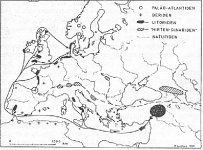
  • lundraces-map18.jpg
    lundraces-map18.jpg
    81.4 KB · Views: 285
To begin with these intrusive CHG-like brachy newcomers aren't the Etruscans. Etruscan civilization flourishes two millennia later. At the most these newcomers are responsible for intensifying the relationship with the Balkans and any Aegean-Balkan-Anatolian connection.

The other day i was thinking what if the language of the Etruscans came from the Rinaldone culture? If the Armenian hypothesis is true then these eastern immigrants/prospectors of the Copper Age could well be Indoeuropeans, maybe of the Anatolian branch, but i understand that it's a "remote" hypothesis

Perhaps their migrations to central Italy were stopped by the arrival of new populations during the Bronze Age. Are these new populations arrived in the Bronze Age the proto-Villanovians?

Before Proto-Villanova Tuscany was reached by other cultures from the North, Bell Beaker and Polada, in part..i think that Proto-Villanova, Chiusi-Cetona facies to be precise (their material culture was very similar to that of the Terramare), replaced or mixed with the much later Apennine folks..
 
Something that is also troubling with this data is that in the spreadsheet listing the samples, their Gheg samples are stated to come from "southern albania" and Tosk from "northern albania"

BGzqNeB.png


I'm not sure if this is just a typo or mistake in the spreadsheet, or if they literally tested only ghegs from the south and tosks from the north ( which is the opposite of gheg and tosk distribution)

I'm also not sure if this typo is just in the spreadsheet, or if it extends to the tables and data until the end. Very unclear

I tried to contact the authors but wasn't able to as I dont have a Nature subscription/account

My albanian work colleague comes from a town between the 2 lakes on your linguistic map and his wife from Tirana, they stated to me that they clearly speak the same language , but do not understand Kosovo albanian or greek albanian.....................maybe its because they are young ( not yet 40 )
 
My albanian work colleague comes from a town between the 2 lakes on your linguistic map and his wife from Tirana, they stated to me that they clearly speak the same language , but do not understand Kosovo albanian or greek albanian.....................maybe its because they are young ( not yet 40 )

The Standard Albanian that is currently taught in Albanian schools in Kosovo and Albania is the one that was created in 1972 under Enver Hoxhas stalinist government.
The Gheg dialect was unfairly neglected due to Ghegs either being in Kosovo under yugoslavia or in isolated mountains in the north(with exceptions that like shkodra).
Many gheg linguists like ernest koliqi etc were not even allowed to be present at the congress.

Before the 72' standard the Elbasan dialect was the official standard and in my opinion it was much fairer to both dialects. The dialects can differ quite a bit but
any properly educated person shouldn't have much issues although its not easy to say how many of those are produced.

I personally have trouble with Arvanitic tosk.

How different do they sound to you?

Here is a recording map of dialects in Albania: http://dialects.albanianlanguage.net/AL/
Here is a dialect map of Kosovo: http://dialects.albanianlanguage.net/KS/
Greece: http://dialects.albanianlanguage.net/GR/

Albanian_dialects.svg

DYkT23iTgUK4X8lq2T7u8ch7XWcgl5qe4PPR4aAjr_4.png


DYkT23iTgUK4X8lq2T7u8ch7XWcgl5qe4PPR4aAjr_4.png
 
^Nevermind I should have paid more attetion to the study. It refers to central Greece.
 
Arbereshe towns in Sicily, some of them were only partly Arbereshe.

 
I've lost it many years ago so i don't remember exactly what he wrote, i suppose that this physical type correspond to the old Armenoid or Dinaric type


Of course Mallegni didn't use such terms. It is just your guess. Mallegni only says that they are brachycephalic. And in any case, also the Baskid phenotype is in origin a strongly dinaricized brachycephalic. The fact that it later mixed with the atlanto-med is another story.


Some, like Coon, associated this same population with the later Bell Beaker but genetic don't seems to agree All your post was interesting..thanks for the reply

Coon associating this population with the later Bell Beaker shows how much these texts of physical anthropology are in many cases obsolete and outdated.
 
Of course Mallegni didn't use such terms. It is just your guess. Mallegni only says that they are brachycephalic.

Not my guess...Biasutti (Razze e popoli della terra Vol. Europa ed Asia) describe them as similar to the "Adriatic type" (Dinaric) but more "southern". He call this type "Campanian type" and connects it to the Eneolithic Gaudo Culture.
 
Not my guess...Biasutti (Razze e popoli della terra Vol. Europa ed Asia) describe them as similar to the "Adriatic type" (Dinaric) but more "southern". He call this type "Campanian type" and connects it to the Eneolithic Gaudo Culture.

Thanks, Cato. Can you scan the Biasutti's page? Or just go more in detail?
 
I will post a scan of the chapter...but in the next weeks, al momento no ce l'ho a portata di mano

Utilizzando Tapatalk
 
Back
Top