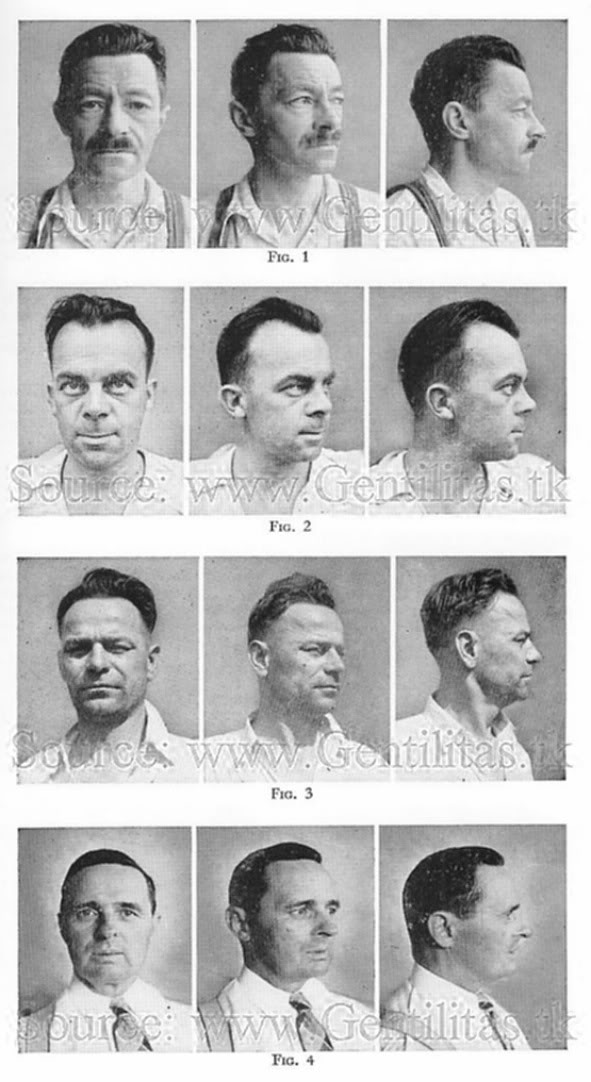
First Natufians had broader faces than today Levant, these last ones a modern mix in some way - they were even different on this aspect from "ancient levant" of some studies - surely Natudians had kept older traits inherited from a roughly said 'cromagnoid' layer (not exactly the European typical type), concerning cranial aspect: some old common basis ('croma's came from South-East I believe) with different drifts and maybe more ancestral african inheritage kept too. As Natudians were not very homogenous we could imagine neolithisation was accompanied by a selection of some less typical element in them, witthout it would be due by force to a natural pressure; hazard can exist in drifts, hard to know? this phenotypical modif does not seem come along with great modification of the total auDNA, if I rely on modern admixtures;
to be more precise:
Natufians :
supposed to be descendants of ‘Geometric Kebarians’ HG’s what seems partly right only -
WILSHAW : Natufian Hayonim (H), Nahal Oren (N-O) and Ain Mallah (A-M) -
- the original HG’s groups which gave birth to Natufians were diverse ; it seems that Kebarians were not the only « fathers » - as a mean Natufians showed a between position compared to Ancient Levant (their immediate predecessors) and Maghreb HG’s by example -
- the first Natufians taken as a mean (3 sites) were closer to Maghrebin HG’s (M-HG’s) and by time got closer to Ancient Levant (A-L) and then a bit closer to Recent Levant (R-L), on the way from A-L to R-L but closer to the A-L -
- except in final stage, 3 Natufians sites showed heterogeneity (biologically, not culturally!) ; individuals can be correctly attributed to their respective internal group around 70 % - homogeneity and loss of diversity came later unifying diverse Natufian sites – at first stages, A-M site was closer to M-HG’s -
- the general trend (author’s opinion) is a moderate shortening + broadening of the skulls, and narrowing of the faces, put on the account of neolithicization (in fact rather in the very late stages) -
I agree (with modesty) to the author conclusions stating the first Natufians sites showed a rather well shared culture but more than one ancestral pop biologically speaking (some of the features could be the result of introgressions from Anatolia horizons (higher skull, lower frontal angle, narrower face, aspect more marked in H and N-O, less in A-M site) -
& but :
Natufians separated first groups were between Maghreb HG’s and Ancient Levant : M-HG’s had low skulls, A-L high skulls – all of them had rather broad faces but as Natufians taken as a mean
A-L had high skulls and low frontal angles, M-HG’s had low skulls and high frontal angles -
spite the Natufians mean was rather closer to A-L compared to M-HG’s, they already showed they were not only on the straight way between both -
Recent Levant, whatever the part of lifestyle attached to Neolithicization (which could distord the straight way), show tendancies which cannot be explained by an osmosis between both : their only (relatively) homogenous trait is the narrower faces, but they show great heterogeneity concerning breadth/lenght of skulls, frontal angle and skull height, what is for me the evidence they received other pops inputs after Natufian’s times because I doubt it could be only the result of a drift based upon pure hazard in a rather short time and out of isolation – in some way they show kind of a regression (only at first sight) for some features compared to late Natufian means : I see here a ‘west-asian’ (Caucasus or Zagros input, with something recalling the ‘cappadocian med’ type mean, with a bit lower skull and higher frontal angle ; I regreat I cannot compare the shapes ; ATW these last tendencies can have the same remote origin than among the M-HG’s : old traits can be shared for some peculiar details even when pops have diverged since lo,g enough time and the allover auDNA has strongly drifted meanwhile.
I don’t refute (!) the authors global conclusions about neolithicization and morphology (progressive sedentism) but I find it’s a bit simplistic to input the whole transformation having given us the Recent Levant pop of Palestine to this unique change of culture ; I know we cannot always explain modif's by newcomers introgression and we have to explain the birth of new long faced or narrow faced types as for a part among Anatolian farmers introgression, but we had already some Paleo and Meso HG’s of Europe with longer faces than say our beloved ‘croma’. It’s a pity we don’t have in this study a craniologic survey of Jericho Neolithic pop, before recent Levant ; what we have is only a discret traits survey showing they lacked some of the most common peculiarities of Natufians (founder effect traits absent in other sites? Small sample of Natufians?)
a reproach to all these modern metric surveys : they compare often close enough pop’s, exaggerating their differences, without we could have a whole variation scale to put them in perspective ;


I was basing my whole point on PCA, Natufians cluster with Saudi Arabians so I thought their phenotypes would be similar.