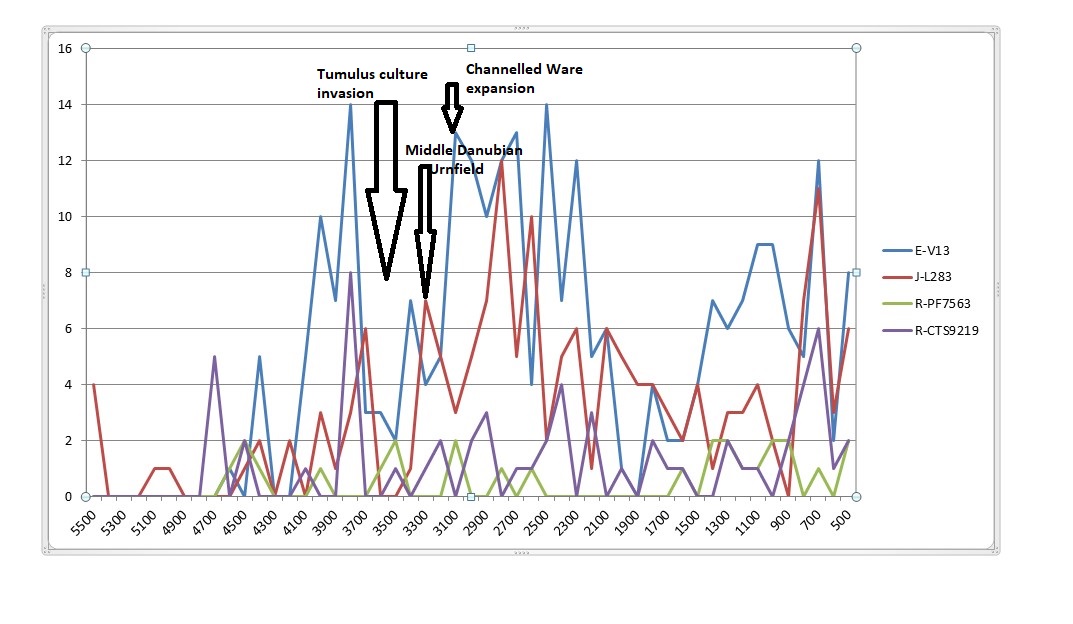
I think its very helpful to compare some of the main lineages in the Paleobalkan groups, the Albanians too, and how they behave over time, concerning documented branching and founder events:
https://www.eupedia.com/forum/threa...d-out-of-YFull?p=640763&viewfull=1#post640763
We can immediately see that E-V13 and R-CTS9219 share a synchronous development in the EBA. So either they were in the same population, or closely related ones, having the same fate, like e.g. in the Pannonian Tell cultures, which first expanded, then collapsed or retreated, under the pressure of the Middle Danubian Tumulus culture.
During the expansion of the Middle Danubian Tumulus culture, all three go down: E-V13, J-L283 and R-CTS9219.
At the end of the MBA, some E-V13 and J-L283 groups joined. The J-L283 joined the TC earlier and more successfully, you can see they go up, E-V13 down. In the next phase of the Urnfield period, E-V13 got its big moment and spread within Urnfield and especially with the Channelled Ware expansion. They did now colonise large parts of the Balkans in the transitional phase (1.300-1.000 BC). E-V13 goes straight up, but J-L283 goes straight down. That's a clear case of competition.
When E-V13 got weak because the Cimmerians from the East crashed into them, killed tens of thousands, ruined the economy and the central networks of the Channelled Ware people, they go straight down - the J-L283 did exploit the situation, they go straight up. But the Channelled Ware people recovered, became part of the Thraco-Cimmerian horizon and developed into Psenicevo-Basarabi, which led to their second big expansion in the early Hallstatt period. Again, E-V13 goes steeply up, J-L283 goes down.
So we have little synchronicity of these three main lineages, but in the very EBA to earlier MBA, when E-V13 and R-CTS9219 clearly experienced the same.
J-L283 did better with the Celts and Romans, they were largely stable, whereas both E-V13 and R-CTS9219 did suffer heavily from the La Tene Celtic invasion and the Roman wars with the Macedonians, Pannonian-Illyrians and the Dacians. This is very apparent, they just go straight down in that period. In the migration period, of all three, E-V13 profited the most, because they could not just keep their position, but expand it as part of Germanic and Slavic tribal groups.
The last phase of absolute synchronicity is the expansion of the Albanians and Southern Vlachs. Between 1.000-800 yBP all three go down (Christianisation, feudal states), to expand once more in a synchronous manner especially with Albanians-Southern Vlachs. This aligns well with the Albanian subclades we see, most expand with founder effects in the Medieval period.
What this very clearly shows is that E-V13 had throughout most of the time a more Northern position, or better said a more Northern focal point in comparison to J-L283 and R-CTS9219 after the EBA. It did usually profit from North -> South movements, as well as movements from the East or West. So a Central-Northern position relative to the Balkans. J-L283 on ther other hand is now partly crippled, because I think it had a more Western distribution early on, but what we see now is a limited survival of a whole bulk group from the West Balkan sphere. These are not well represented because of the later events (Celts, Romans and Slavs in particular). Whereas the bulk of those surviving into modernity did have a distinctively more Southern focal point.
R-CTS9219 on the other hand has more in common with E-V13, both in the EBA-early MBA origin of the presence in the region, as well as in the period of suffering under the Celtic-Roman pressure. So I guess they were first in the same spot as E-V13 and later kind of in the middle between E-V13 and J-L283.
Because E-V13 had such a strong more Northern presence, its possible that Southern branches were indeed synchronous with J-L283 too since the LBA. That's possible. What kind of surprised me for J-L283 is that they did not at all profit from the Tumulus culture expansion, at least the surviving lineages did not, early on. I thought they might have done better, but it seems they just suffered from this invasion almost as much as E-V13 and R-CTS9219. Actually it was quite dramatic, they go down to zero new branching events for two centuries.
At first I thought its mainly about the surviving vs. later eliminated lineages, but no, the ancient samples from Sardinia and Croatia being already included, so its really those which were widespread in the IA which suffered too.
So they did in fact join the ranks of the Middle Danubian sphere, it seems to me, no earlier than the Urnfield period. This is kind of a correction for me, because I really thought
J-L283 would have been stronger already with TC, but apparently, that's not the case, its all about the Middle Danubian Urnfield and the later Illyrian period. The data is very clear about that. J-L283 suffered strongly from the TC invasion, barely made it through that period, and only joined ranks with the R1b guys more successfully later.
https://ibb.co/mHYCWWz
That J-L283 suffered so heavily from TC (just one branch from 3.700-3.500 yBP!), but at the same time did join early and successfully the Middle Danubian Urnfielders can only mean they have a fairly North Western position at that time, close to the Alps. It would make no sense otherwise.