

Johane Derite
Regular Member
- Messages
- 1,968
- Reaction score
- 1,062
- Points
- 113
- Ethnic group
- Albanian
- Y-DNA haplogroup
- E-V13>Z5018>FGC33625
- mtDNA haplogroup
- U1a1a
Riverman has made a fascinating discovery, which he shared over in anthrogenica in his thread "Connecting Thracians and Etruscans through IBD Matching Networks"
LINK: https://genarchivist.net/showthread.php?tid=2469
Namely, he has found evidence that there was a predominantly North-Thracian migration to Northern Italy in the Iron Age at the latest.
Impotantly, the IBD matching doesn't show this relationship to have been through Illyrian or Greek mediation, rather it was a direct North-Thracian -> Etruscan migration/network.
This is pretty huge in itself as a discovery concerning the Daco-Thracians, here in this case the North-Thracians or Daco-Mysians as they're generally known linguistically.
However, apart from the new historical implications, and potentially archaeological ones (i.e. the flame-shaped spearheads that appear in North Italy and Gava), there are also huge potential linguistic implications:
Namely, if there was a minority Daco-Mysian component among Etruscans, potentially the signal of this linguistic stratum may also have been recorded somewhere among Etruscan inscriptions.
According to Grok, there are around 13,000 Etruscan inscriptions known. Most inscriptions are very short, often just names, ownership marks, dedications, or formulaic epitaphs on tombs, pottery, mirrors, or votive objects.
Only a tiny minority (fewer than 20–30) are of significant length (the longest being the Zagreb linen book with ~1,300 words, the Capua tile, the Perugia cippus, etc.
If there was a community of Daco-Mysians that had some sort of presence among Etruscans, then we should expect to a degree that this presence also extended linguistically also, i.e. if Etruscans got their flame-headed spears from the Gava Daco-Mysians, maybe also their word for spear or spearhead was loaned.
So this is a huge discovery from Riverman, as before linguists would have had no reason specifically to take into consideration Daco-Mysian as a potential linguistic branch for etymologizing or translating Etruscan texts.
There are also some mythological aspects stand out as potentially related:
Firstly, the myth of the Dardanoi living among Etruscans, per Aeneid and related myths. If the Dardanoi was just a common ethnonym in the iron age (it appears with channelled ware in troy, in central balkans also among the Dardani) for the North-Thracians, then this may be how this myth got tangled up in there.
Secondly, names like "Mezentius", a mythical Etruscan king, have an uncanny parallel with Thracian. Mezenai (horseman)

 en.wikipedia.org
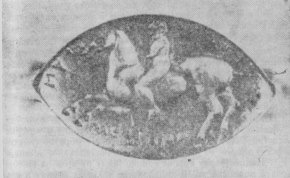

The interpretation of Vl. Georgiev is the following:
Text: eys, ie … dele, mezenai.
Translation: “(You) powerful, help … protect, (you) horseman!”
Related to:
Albanian. Mëz (foal, colt).
If Albanian being a language descended from Daco-Mysian is correct, as Vladimir Georgiev argued then it would also be indispensable in parsing out potential Daco-Mysian material out of the Etruscan corpus.
Even if 10 potential loans were found among these 13,000 inscriptions, then that would be very significant.
LINK: https://genarchivist.net/showthread.php?tid=2469
Namely, he has found evidence that there was a predominantly North-Thracian migration to Northern Italy in the Iron Age at the latest.
Impotantly, the IBD matching doesn't show this relationship to have been through Illyrian or Greek mediation, rather it was a direct North-Thracian -> Etruscan migration/network.
This is pretty huge in itself as a discovery concerning the Daco-Thracians, here in this case the North-Thracians or Daco-Mysians as they're generally known linguistically.
However, apart from the new historical implications, and potentially archaeological ones (i.e. the flame-shaped spearheads that appear in North Italy and Gava), there are also huge potential linguistic implications:
Namely, if there was a minority Daco-Mysian component among Etruscans, potentially the signal of this linguistic stratum may also have been recorded somewhere among Etruscan inscriptions.
According to Grok, there are around 13,000 Etruscan inscriptions known. Most inscriptions are very short, often just names, ownership marks, dedications, or formulaic epitaphs on tombs, pottery, mirrors, or votive objects.
Only a tiny minority (fewer than 20–30) are of significant length (the longest being the Zagreb linen book with ~1,300 words, the Capua tile, the Perugia cippus, etc.
If there was a community of Daco-Mysians that had some sort of presence among Etruscans, then we should expect to a degree that this presence also extended linguistically also, i.e. if Etruscans got their flame-headed spears from the Gava Daco-Mysians, maybe also their word for spear or spearhead was loaned.
So this is a huge discovery from Riverman, as before linguists would have had no reason specifically to take into consideration Daco-Mysian as a potential linguistic branch for etymologizing or translating Etruscan texts.
There are also some mythological aspects stand out as potentially related:
Firstly, the myth of the Dardanoi living among Etruscans, per Aeneid and related myths. If the Dardanoi was just a common ethnonym in the iron age (it appears with channelled ware in troy, in central balkans also among the Dardani) for the North-Thracians, then this may be how this myth got tangled up in there.
Secondly, names like "Mezentius", a mythical Etruscan king, have an uncanny parallel with Thracian. Mezenai (horseman)
Mezentius - Wikipedia
The interpretation of Vl. Georgiev is the following:
Text: eys, ie … dele, mezenai.
Translation: “(You) powerful, help … protect, (you) horseman!”
Related to:
Albanian. Mëz (foal, colt).
If Albanian being a language descended from Daco-Mysian is correct, as Vladimir Georgiev argued then it would also be indispensable in parsing out potential Daco-Mysian material out of the Etruscan corpus.
Even if 10 potential loans were found among these 13,000 inscriptions, then that would be very significant.


 ! I’m laughing my ass off! That’s classic.