• Don't want to see ads? Install an adblocker like uBlock Origin or use a Europe-based privacy-friendly browser like Vivaldi or Mullvad.

Etruscan and Daco-Thracian Relationship

Johane Derite

Regular Member
Messages
1,959
Reaction score
1,057
Points
113
Ethnic group
Albanian
Y-DNA haplogroup
E-V13>Z5018>FGC33625
mtDNA haplogroup
U1a1a
Riverman has made a fascinating discovery, which he shared over in anthrogenica in his thread "Connecting Thracians and Etruscans through IBD Matching Networks"

LINK: https://genarchivist.net/showthread.php?tid=2469

Namely, he has found evidence that there was a predominantly North-Thracian migration to Northern Italy in the Iron Age at the latest.

Impotantly, the IBD matching doesn't show this relationship to have been through Illyrian or Greek mediation, rather it was a direct North-Thracian -> Etruscan migration/network.

This is pretty huge in itself as a discovery concerning the Daco-Thracians, here in this case the North-Thracians or Daco-Mysians as they're generally known linguistically.

However, apart from the new historical implications, and potentially archaeological ones (i.e. the flame-shaped spearheads that appear in North Italy and Gava), there are also huge potential linguistic implications:

Namely, if there was a minority Daco-Mysian component among Etruscans, potentially the signal of this linguistic stratum may also have been recorded somewhere among Etruscan inscriptions.

According to Grok, there are around 13,000 Etruscan inscriptions known. Most inscriptions are very short, often just names, ownership marks, dedications, or formulaic epitaphs on tombs, pottery, mirrors, or votive objects.

Only a tiny minority (fewer than 20–30) are of significant length (the longest being the Zagreb linen book with ~1,300 words, the Capua tile, the Perugia cippus, etc.

If there was a community of Daco-Mysians that had some sort of presence among Etruscans, then we should expect to a degree that this presence also extended linguistically also, i.e. if Etruscans got their flame-headed spears from the Gava Daco-Mysians, maybe also their word for spear or spearhead was loaned.

So this is a huge discovery from Riverman, as before linguists would have had no reason specifically to take into consideration Daco-Mysian as a potential linguistic branch for etymologizing or translating Etruscan texts.

There are also some mythological aspects stand out as potentially related:

Firstly, the myth of the Dardanoi living among Etruscans, per Aeneid and related myths. If the Dardanoi was just a common ethnonym in the iron age (it appears with channelled ware in troy, in central balkans also among the Dardani) for the North-Thracians, then this may be how this myth got tangled up in there.

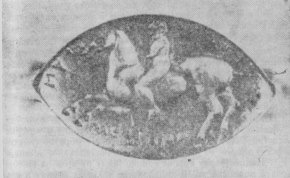
Secondly, names like "Mezentius", a mythical Etruscan king, have an uncanny parallel with Thracian. Mezenai (horseman)


1776566683046.png


1776566689506.png

The interpretation of Vl. Georgiev is the following:
Text: eys, ie … dele, mezenai.
Translation:
“(You) powerful, help … protect, (you) horseman!

Related to:
Albanian. Mëz (foal, colt).

If Albanian being a language descended from Daco-Mysian is correct, as Vladimir Georgiev argued then it would also be indispensable in parsing out potential Daco-Mysian material out of the Etruscan corpus.

Even if 10 potential loans were found among these 13,000 inscriptions, then that would be very significant.
 
So far, what we can say with certainty, is that there was a migration of Daco-Thracians into Northern Italy and into Etruscan communities. This resulted in widespread IBD sharing between Daco-Thracians and Etruscans/North Italians.
Just yesterday I found an individual case of a Thracian founder which had mixed Thracian-Etruscan offspring and he appears to be from 700-600 BC. His haplogroup is being placed in the tree already and incidently he splits from a Sardinian: https://discover.familytreedna.com/y-dna/E-BY6527/tree

This doesn't negate earlier and later migrations of Daco-Thracians to North Italy, but that's the earliest concrete evidence we got.

2650_SW_E-BY6527:I30936.TW,0.120652,0.156392,0.003017,-0.038114,0.022466,-0.011156,0.005875,-0.007154,0.011249,0.041185,-0.001786,0.009891,-0.019772,0.000688,-0.004072,-0.002254,0.009909,-0.001647,0.00176,-0.014757,0.001497,0.002968,0.007025,0.002289,-0.003712

He got a daughter and grandchidren, as well as great-grand- and so on. His descendants became part of the local core North Italian, presumably Etruscan community of the site they investigated.

However, he has barely any IBD sharing with any other Thracian-related sample, so he likely comes from a fairly isolated population. At the same time, many more Thracians from different areas have this IBD sharing with Etruscans. This implies there was a larger movement from Daco-Thracians to Northern Italy. Probably mostly individual migrants, but a solid number which left an impression.
Whether they were all North- or South Thracians is hard to tell right now. But it seemed to have involved both sides.

Especially horsemanship related words are most likely to have come from Thracians, because of the Thraco-Cimmerian connection. Thraco-Cimmerians did influence Hallstatt, Venetics and had influence even down to Northern Italy. And it was Thraco-Cimmerians and later Vekerzug (also with a strong, proven Thracian input!) which spread the new customs and tactics.

Here is a map with known Thraco-Cimmerian find spots:
Thraco-Cimmerian.png


Note that Eastern Hallstatt being completely covered and there is a path right through Northern Italy. And in most instances, even if being spread by peaceful means, even if being spread by traders and wanderers, people were involved.
 
Last edited:
Riverman has made a fascinating discovery, which he shared over in anthrogenica in his thread "Connecting Thracians and Etruscans through IBD Matching Networks"

LINK: https://genarchivist.net/showthread.php?tid=2469

Namely, he has found evidence that there was a predominantly North-Thracian migration to Northern Italy in the Iron Age at the latest.

Impotantly, the IBD matching doesn't show this relationship to have been through Illyrian or Greek mediation, rather it was a direct North-Thracian -> Etruscan migration/network.

This is pretty huge in itself as a discovery concerning the Daco-Thracians, here in this case the North-Thracians or Daco-Mysians as they're generally known linguistically.

However, apart from the new historical implications, and potentially archaeological ones (i.e. the flame-shaped spearheads that appear in North Italy and Gava), there are also huge potential linguistic implications:

Namely, if there was a minority Daco-Mysian component among Etruscans, potentially the signal of this linguistic stratum may also have been recorded somewhere among Etruscan inscriptions.

According to Grok, there are around 13,000 Etruscan inscriptions known. Most inscriptions are very short, often just names, ownership marks, dedications, or formulaic epitaphs on tombs, pottery, mirrors, or votive objects.

Only a tiny minority (fewer than 20–30) are of significant length (the longest being the Zagreb linen book with ~1,300 words, the Capua tile, the Perugia cippus, etc.

If there was a community of Daco-Mysians that had some sort of presence among Etruscans, then we should expect to a degree that this presence also extended linguistically also, i.e. if Etruscans got their flame-headed spears from the Gava Daco-Mysians, maybe also their word for spear or spearhead was loaned.

So this is a huge discovery from Riverman, as before linguists would have had no reason specifically to take into consideration Daco-Mysian as a potential linguistic branch for etymologizing or translating Etruscan texts.

There are also some mythological aspects stand out as potentially related:

Firstly, the myth of the Dardanoi living among Etruscans, per Aeneid and related myths. If the Dardanoi was just a common ethnonym in the iron age (it appears with channelled ware in troy, in central balkans also among the Dardani) for the North-Thracians, then this may be how this myth got tangled up in there.

Secondly, names like "Mezentius", a mythical Etruscan king, have an uncanny parallel with Thracian. Mezenai (horseman)


View attachment 19523

View attachment 19524
The interpretation of Vl. Georgiev is the following:
Text: eys, ie … dele, mezenai.
Translation:
“(You) powerful, help … protect, (you) horseman!

Related to:
Albanian. Mëz (foal, colt).

If Albanian being a language descended from Daco-Mysian is correct, as Vladimir Georgiev argued then it would also be indispensable in parsing out potential Daco-Mysian material out of the Etruscan corpus.

Even if 10 potential loans were found among these 13,000 inscriptions, then that would be very significant.


So, in 2026 are we really starting with this nonsense again? Dusting off the tired old narrative that "the Etruscans were basically Albanians/Thracians/Daco-Mysians" and pretending that a handful of IBD segments can suddenly rewrite 150 years of linguistics, archaeology, and common sense? Soon you'll be telling us that the Pyrgi Tablets are just badly written Albanian, or that the Zagreb mummy is a lost Albanian epic about horses and foals ("mëz", obviously — because nothing screams "ancient Etruscan" like cherry-picking modern Albanian words after 2,500 years of phonetic drift).

Maybe we'll pull out Nermin Vlora Falaschi's writings as "proof" again. You know, the usual self-taught genius who translated Etruscan into perfect Albanian and claimed that the Toschi of Tuscany were actually Tosks from Albania. Classic Balkan prestige-seeking material. So what’s the next move? Claiming that Greeks don’t exist and are actually Albanians? And when will it be Zecharia Mayani’s turn?

And while we're at it, let's not forget the ghost of the Bulgarian Vladimir Georgiev. His theory that Etruscan was closely related to Hittite (or even a dialect of it), completely flattened onto the Herodotean narrative of eastern origins, was proposed decades ago and has been completely rejected by mainstream scholarship. It is considered unreliable, forced, and methodologically weak. No serious scholar takes it seriously today.

Invoking Mezentius as evidence of a Thracian connection is particularly telling, impressive only to those who don't know the subject. Mezentius is a late Roman literary construct, first attested in Cato's Origines and then heavily reworked by Virgil. The only genuinely Etruscan trace that echoes the name is an inscription now in the Louvre mentioning a certain Laucies Mezenties, thought to possibly come from Caere and possibly date to the Archaic period, all suppositions. There is no evidence whatsoever that a king by that name ever ruled at Caere. As for the name itself, there is no academic consensus linking it to Thracian. The proposed etymologies are numerous and many are Indo-European, but the personal name Laucies closely recalls the Latin Lucius, one of the most common praenomina in the Roman world, and the prevailing view is that Laucies Mezenties was Latin or Osco-Umbrian Italic in origin. Not Thracian.

I understand that the Herodotean theory still appeals a lot to Albanians, Bulgarians, Turks… everyone would love to claim they founded Rome, but there is an even bigger problem. The Thracians were wandering around and were present in the Aegean, including Lemnos, where we find inscriptions in a language clearly related to Etruscan (part of the Tyrsenian family together with Raetic). This is interesting and well known. But it points to an Aegean / Tyrsenian connection for Etruscan, not a Daco-Thracian (Indo-European, satem-type) origin. Turning a non-Indo-European language family into Daco-Thracian just because "the Thracians were in the area" is a huge and desperate leap.

Even more importantly: yes, archaeologists have long recognized movements during the Urnfield period (Late Bronze Age and very early Iron Age) from the Carpathian-Danubian area toward Italy, passing through Slovenia and the Friuli border region. These population movements and cultural influences from the Danube basin toward the Po plain are real and documented and should also have traces among the ancient Veneti as well. Unfortunately, however, ancient Veneti practiced cremation and you know, no DNA analyis yet. In any case these are movements that belong to the Bronze Age and at most to the beginning of the Iron Age in the proto-Villanovan context (and subsequently Villanovan among the Etruscans). They concern the spread of the urnfield model and the cremation rite, and they predate the formation of the historical Etruscan culture (which emerges from the Villanovan Iron Age). They do not magically turn the Etruscans into Daco-Thracians nor explain their non-Indo-European language.

If IBD sharing is real, we are waiting for Riverman’s paper to be published in a peer-reviewed journal, you know ancient people moved, mixed, traded, and sometimes settled. An individual or a small North-Thracian or Daco-Mysian group ending up in northern Italy? Possible. Some cultural exchange, lexical borrowings related to horses, or stylistic influences? That is also possible. But jumping from "some shared ancestry segments" to "this proves a major Daco-Thracian migration that defines Etruscan identity, language, and culture" is pure wishful thinking and nationalist fanfiction with a fresh genetic coat of paint.

And where are the E-V13 among the Etruscans? They are not there. Zero evidence in the available ancient DNA from Etruscan sites. The Etruscans remain R1b P312, R1b U152, R1b L2, G2a L497... the only outliers, a handful, less than 6%, are J2b L283 but markers perfectly explainable and found almost everywhere.

Etruscan remains a non-Indo-European language of the Tyrsenian family. Albanian is Indo-European. You don't erase this fundamental difference with a few horse-related terms or selective IBD networks.

This is not serious science. It's the same old song we've been hearing for decades, just repackaged in updated form. It didn't hold up the first dozen times, and it won't hold up in 2026 either.
 
I didn't write about a major influence in Etruscans, but just gene flow. The question is just whether this gene flow came via intermediaries (say Thraco-Cimmerian, Vekerzug, Eastern Hallstatt groups) or more directly (from Dacian and Thracian core groups in the East).

The new sample has proven that at least in individual cases there was a direct migration from the Daco-Thracian core territories before 600 BC.

And this individual was no singleton, otherwise the pattern wouldn't be like that.

I never claimed that Etruscans were particularly strongly Thracian influenced compared to e.g. Eastern Hallstatt - the Frög group is clearly way more Thracian oriented than Etruscans on every possible level.

On a cultural level the connection is much broader by the way, going back to the Alpine-Danubian roads of the Urnfield period. Because there was a connection going from Protovillanovan <-> Middle Danubian UF <-> Kyjatice (South) and Lusatians (North) <-> Gáva-Holigrady (North) and Belegis II-Gáva (South).

This connection was so strong that we deal with very, very similar types of urns and swords in the whole sphere of this network spread within a couple of generations. But this was clearly not one ethnolinguistic sphere, since in Italy this was Etruscans-Venetic, secondarily Italic groups, Middle Danubian UF is Proto-Celtic, Kyjatice and Lusatians were separate dead end groups on the long term and Gáva/Belegis was North Thracian.

And where are the E-V13 among the Etruscans? They are not there. Zero evidence in the available ancient DNA from Etruscan sites.

Well, we have one E-V13 now and we also have two unrelated, from a rather Greek branch, under E-L618 which appear to be fully Etruscan, proving in any case the Carpatho-Balkan-Aegean connection.

But again, I don't expect Etruscans to be strongly Thracian influenced at all. But the IBD sharing is significant, since the Thracians don't have a lot of IBD matches in general, coming from a population which was largely isolated since the EBA.

Therefore it really matters if in many, many Thracians, and be it just small, Etruscan matches pop up. This means there must have been significant gene flow, otherwise it wouldn't be there so consistently.

This has nothing to do with explaining the Etruscan ethnos - at the most it helps to explain why some elements of the culture and IBD segments travelled, likely together, from the Tisza sphere to the Po valley so fast.

I mean the Reutlingen/Naue II swords spread from one end to the other in just a couple of generations. It was spread between North Italy and the Upper Tisza-Transylvania faster than to the neighbouring regions of the respective groups outside of this Alpine-Danubian network. That's something I guess.
 
Last edited:
So, in 2026 are we really starting with this nonsense again? Dusting off the tired old narrative that "the Etruscans were basically Albanians/Thracians/Daco-Mysians" and pretending that a handful of IBD segments can suddenly rewrite 150 years of linguistics, archaeology, and common sense? Soon you'll be telling us that the Pyrgi Tablets are just badly written Albanian, or that the Zagreb mummy is a lost Albanian epic about horses and foals ("mëz", obviously — because nothing screams "ancient Etruscan" like cherry-picking modern Albanian words after 2,500 years of phonetic drift).

Maybe we'll pull out Nermin Vlora Falaschi's writings as "proof" again. You know, the usual self-taught genius who translated Etruscan into perfect Albanian and claimed that the Toschi of Tuscany were actually Tosks from Albania. Classic Balkan prestige-seeking material. So what’s the next move? Claiming that Greeks don’t exist and are actually Albanians? And when will it be Zecharia Mayani’s turn?

And while we're at it, let's not forget the ghost of the Bulgarian Vladimir Georgiev. His theory that Etruscan was closely related to Hittite (or even a dialect of it), completely flattened onto the Herodotean narrative of eastern origins, was proposed decades ago and has been completely rejected by mainstream scholarship. It is considered unreliable, forced, and methodologically weak. No serious scholar takes it seriously today.

Invoking Mezentius as evidence of a Thracian connection is particularly telling, impressive only to those who don't know the subject. Mezentius is a late Roman literary construct, first attested in Cato's Origines and then heavily reworked by Virgil. The only genuinely Etruscan trace that echoes the name is an inscription now in the Louvre mentioning a certain Laucies Mezenties, thought to possibly come from Caere and possibly date to the Archaic period, all suppositions. There is no evidence whatsoever that a king by that name ever ruled at Caere. As for the name itself, there is no academic consensus linking it to Thracian. The proposed etymologies are numerous and many are Indo-European, but the personal name Laucies closely recalls the Latin Lucius, one of the most common praenomina in the Roman world, and the prevailing view is that Laucies Mezenties was Latin or Osco-Umbrian Italic in origin. Not Thracian.

I understand that the Herodotean theory still appeals a lot to Albanians, Bulgarians, Turks… everyone would love to claim they founded Rome, but there is an even bigger problem. The Thracians were wandering around and were present in the Aegean, including Lemnos, where we find inscriptions in a language clearly related to Etruscan (part of the Tyrsenian family together with Raetic). This is interesting and well known. But it points to an Aegean / Tyrsenian connection for Etruscan, not a Daco-Thracian (Indo-European, satem-type) origin. Turning a non-Indo-European language family into Daco-Thracian just because "the Thracians were in the area" is a huge and desperate leap.

Even more importantly: yes, archaeologists have long recognized movements during the Urnfield period (Late Bronze Age and very early Iron Age) from the Carpathian-Danubian area toward Italy, passing through Slovenia and the Friuli border region. These population movements and cultural influences from the Danube basin toward the Po plain are real and documented and should also have traces among the ancient Veneti as well. Unfortunately, however, ancient Veneti practiced cremation and you know, no DNA analyis yet. In any case these are movements that belong to the Bronze Age and at most to the beginning of the Iron Age in the proto-Villanovan context (and subsequently Villanovan among the Etruscans). They concern the spread of the urnfield model and the cremation rite, and they predate the formation of the historical Etruscan culture (which emerges from the Villanovan Iron Age). They do not magically turn the Etruscans into Daco-Thracians nor explain their non-Indo-European language.

If IBD sharing is real, we are waiting for Riverman’s paper to be published in a peer-reviewed journal, you know ancient people moved, mixed, traded, and sometimes settled. An individual or a small North-Thracian or Daco-Mysian group ending up in northern Italy? Possible. Some cultural exchange, lexical borrowings related to horses, or stylistic influences? That is also possible. But jumping from "some shared ancestry segments" to "this proves a major Daco-Thracian migration that defines Etruscan identity, language, and culture" is pure wishful thinking and nationalist fanfiction with a fresh genetic coat of paint.

And where are the E-V13 among the Etruscans? They are not there. Zero evidence in the available ancient DNA from Etruscan sites. The Etruscans remain R1b P312, R1b U152, R1b L2, G2a L497... the only outliers, a handful, less than 6%, are J2b L283 but markers perfectly explainable and found almost everywhere.

Etruscan remains a non-Indo-European language of the Tyrsenian family. Albanian is Indo-European. You don't erase this fundamental difference with a few horse-related terms or selective IBD networks.

This is not serious science. It's the same old song we've been hearing for decades, just repackaged in updated form. It didn't hold up the first dozen times, and it won't hold up in 2026 either.
You seem to have written a very long and emotional response based on your own motivated misunderstanding.

Nowhere did I claim etruscan was daco-mysian or indo-european.

The post was clear in that daco-mysians are presented as a minority intrusive element among the etruscans, not that they are the etruscans, and so the possibility is that a minority of the etruscan linguistic material may be loaned from this minority community, i.e. loans of things they gained from daco-mysian artisans such as spears, or swords as in the naue II example.

This was pretty clear.
 
I didn't write about a major influence in Etruscans, but just gene flow. The question is just whether this gene flow came via intermediaries (say Thraco-Cimmerian, Vekerzug, Eastern Hallstatt groups) or more directly (from Dacian and Thracian core groups in the East).

The new sample has proven that at least in individual cases there was a direct migration from the Daco-Thracian core territories before 600 BC. And this individual was no singleton, otherwise the pattern wouldn't be like that.

I never claimed that Etruscans were particularly strongly Thracian influenced compared to e.g. Eastern Hallstatt - the Frög group is clearly way more Thracian oriented than Etruscans on every possible level.

On a cultural level the connection is much broader by the way, going back to the Alpine-Danubian roads of the Urnfield period. Because there was a connection going from Protovillanovan <-> Middle Danubian UF <-> Kyjatice (South) and Lusatians (North) <-> Gáva-Holigrady (North) and Belegis II-Gáva (South).

This connection was so strong that we deal with very, very similar types of urns and swords in the whole sphere of this network spread within a couple of generations. But this was clearly not one ethnolinguistic sphere, since in Italy this was Etruscans-Venetic, secondarily Italic groups, Middle Danubian UF is Proto-Celtic, Kyjatice and Lusatians were separate dead end groups on the long term and Gáva/Belegis was North Thracian.

My previous message was addressed to Johane Derite, not to you. That user had already opened with the usual pseudoscientific playbook, including implausible comparisons with modern Albanian.

Despite all the evidence, the Etruscans continue to attract the most unfortunate kinds of interest. I recently came across a British pseudo-historian who believes King Arthur was of Trojan origin and naturally drags the Etruscans into it to make his case. I came across a Greek architect who teaches at a university and believes the Etruscans were Greek because of artistic similarities, apparently reading an archaeology book is too much to ask. And in Turkey, even university departments continue to maintain that the Etruscans were Turkish. Somewhat childish at this point, don't you think?

I would have gotten to your post separately. I am not sure what tool you used to estimate the IBD segments, I assume ancIBD or something similar, and I have not seen your full results with the Thracian samples and the actual cM values shared with the Etruscan ones. But if we are in the range of up to 12 cM, a few observations arise naturally.

If the claim is limited gene flow rather than a defining ethnic contribution, that is a much more defensible position and one broadly compatible with what the archaeological record already suggests about Urnfield connectivity, though I recall little to nothing from an archaeological standpoint that would support Thracian migrations into Etruria in the historical period. On broad Urnfield connectivity we may agree, but that still needs to be properly demonstrated. That said, the methodological issues with the IBD analysis remain. The ancIBD paper itself establishes that the method works robustly only for segments above 8 cM, and only when sample coverage meets a minimum threshold of 1x for 1240k capture data or 0.25x for WGS. Below these thresholds precision drops substantially.

Many samples in the Akbari set have highly variable coverage, frequently below 1x, which makes matches in the 7-8 cM range particularly unreliable. More broadly, inferring significant and consistent gene flow from matches in the 7-16 cM range is still a stretch even when the populations are contemporaneous. At these thresholds ancIBD cannot reliably separate genuine genealogical relatedness from background IBD reflecting shared Late Bronze Age haplotype structure. The consistency of the pattern across many Thracian individuals is interesting, but consistency alone does not resolve the ambiguity: if both populations, or at least some individuals within both, share ancestry from a similar Late Bronze Age source, you would expect exactly this kind of low-cM sharing to appear systematically across many individuals without any direct gene flow being required. Crucially, IBD analysis measures shared segments, not migration directionality. The assumption that this signal reflects movement from Thracians into Etruria is not supported by the method itself. A model based on shared Bronze Age ancestry fully accounts for the observed pattern without requiring any specific migratory event.

A further issue to consider is sampling bias. Etruscans are comparatively well represented in publicly available aDNA datasets, particularly relative to many contemporaneous populations, a factor that may introduce bias in IBD-based analyses. When performing IBD matching in such an imbalanced dataset, overrepresented populations will tend to appear more frequently among top matches at low cM thresholds. This reflects sample density rather than a specific signal of genetic affinity.

Well, we have one E-V13 now and we also have two unrelated, from a rather Greek branch, under E-L618 which appear to be fully Etruscan, proving in any case the Carpatho-Balkan-Aegean connection.

But again, I don't expect Etruscans to be strongly Thracian influenced at all. But the IBD sharing is significant, since the Thracians don't have a lot of IBD matches in general, coming from a population which was largely isolated since the EBA.

Therefore it really matters if in many, many Thracians, and be it just small, Etruscan matches pop up. This means there must have been significant gene flow, otherwise it wouldn't be there so consistently.

This has nothing to do with explaining the Etruscan ethnos - at the most it helps to explain why some elements of the culture and IBD segments travelled, likely together, from the Tisza sphere to the Po valley so fast.

I mean the Reutlingen/Naue II swords spread from one end to the other in just a couple of generations. It was spread between North Italy and the Upper Tisza-Transylvania faster than to the neighbouring regions of the respective groups outside of this Alpine-Danubian network. That's something I guess.

As for the claim that we now have one E-V13 and two unrelated individuals under E-L618 who appear to be fully Etruscan: are these unpublished samples from the 2026 Akbari dataset, with no radiocarbon date and no archaeological context? On what basis are they identified as Etruscan? Because they cluster near Etruscan samples in PCA or in G25 distances?

An individual can cluster near Etruscan samples for reasons that have nothing to do with Etruscan identity, including simply sharing a similar ancestral background or being of mixed ancestry. Without provenance, without dating, without a published context, calling any of them a fully Etruscan E-V13 is a hypothesis at best, not a finding.

The crested helmet tradition is itself a good illustration of how this Urnfield network between the Final Bronze Age and the Early Iron Age actually worked. Scholarship has long identified a "San Canziano-Tarquinia group" of bronze crested helmets, produced in Etruria but based on Central European prototypes, with Tarquinia itself identified as one of the main workshops. The long rivets that were structurally functional in the Central European originals became purely decorative in the Etruscan versions, a detail that neatly captures how objects moved and were reinterpreted across this network.

The geographical distribution of these helmets speaks for itself: crested helmets of the San Canziano type are documented at San Canziano/Škocjan itself, Slovenia (Grotta delle Mosche), at Hallstatt in Austria, and as far east as Zavadintsy in Podolia (Kamianets-Podilskyi, western Ukraine). A shared material culture spanning from Tarquinia to Ukraine. This network exemplifies proto-historic connectivity before full Iron Age divergences.

ZGyWVBz.png


You seem to have written a very long and emotional response based on your own motivated misunderstanding.

Nowhere did I claim etruscan was daco-mysian or indo-european.

The post was clear in that daco-mysians are presented as a minority intrusive element among the etruscans, not that they are the etruscans, and so the possibility is that a minority of the etruscan linguistic material may be loaned from this minority community, i.e. loans of things they gained from daco-mysian artisans such as spears, or swords as in the naue II example.

This was pretty clear.

The length reflects exhaustion more than anything else. The Etruscans hold some kind of record for being claimed by the widest variety of revisionisms... At some point the responses get longer by necessity. I spent many years defending the scholarly consensus on Etruscan origins in various forums before ancient DNA studies were published. Today, almost all those who argued for an eastern origin have disappeared. I am quite used to it, believe me.

Repetita iuvant.

To be clear on the core point: the IBD data is not sufficient to demonstrate the presence of any Thraco-Dacian or Daco-Mysian minority among the Etruscans in Etruria during the historical period. The methodological limitations are too significant, and the same signal, if accurate, might be fully accounted for by shared Bronze Age ancestry.
 
My previous message was addressed to Johane Derite, not to you. That user had already opened with the usual pseudoscientific playbook, including implausible comparisons with modern Albanian.

Despite all the evidence, the Etruscans continue to attract the most unfortunate kinds of interest. I recently came across a British pseudo-historian who believes King Arthur was of Trojan origin and naturally drags the Etruscans into it to make his case. I came across a Greek architect who teaches at a university and believes the Etruscans were Greek because of artistic similarities, apparently reading an archaeology book is too much to ask. And in Turkey, even university departments continue to maintain that the Etruscans were Turkish. Somewhat childish at this point, don't you think?

I would have gotten to your post separately. I am not sure what tool you used to estimate the IBD segments, I assume ancIBD or something similar, and I have not seen your full results with the Thracian samples and the actual cM values shared with the Etruscan ones. But if we are in the range of up to 12 cM, a few observations arise naturally.

If the claim is limited gene flow rather than a defining ethnic contribution, that is a much more defensible position and one broadly compatible with what the archaeological record already suggests about Urnfield connectivity, though I recall little to nothing from an archaeological standpoint that would support Thracian migrations into Etruria in the historical period. On broad Urnfield connectivity we may agree, but that still needs to be properly demonstrated. That said, the methodological issues with the IBD analysis remain. The ancIBD paper itself establishes that the method works robustly only for segments above 8 cM, and only when sample coverage meets a minimum threshold of 1x for 1240k capture data or 0.25x for WGS. Below these thresholds precision drops substantially.

Many samples in the Akbari set have highly variable coverage, frequently below 1x, which makes matches in the 7-8 cM range particularly unreliable. More broadly, inferring significant and consistent gene flow from matches in the 7-16 cM range is still a stretch even when the populations are contemporaneous. At these thresholds ancIBD cannot reliably separate genuine genealogical relatedness from background IBD reflecting shared Late Bronze Age haplotype structure. The consistency of the pattern across many Thracian individuals is interesting, but consistency alone does not resolve the ambiguity: if both populations, or at least some individuals within both, share ancestry from a similar Late Bronze Age source, you would expect exactly this kind of low-cM sharing to appear systematically across many individuals without any direct gene flow being required. Crucially, IBD analysis measures shared segments, not migration directionality. The assumption that this signal reflects movement from Thracians into Etruria is not supported by the method itself. A model based on shared Bronze Age ancestry fully accounts for the observed pattern without requiring any specific migratory event.

A further issue to consider is sampling bias. Etruscans are comparatively well represented in publicly available aDNA datasets, particularly relative to many contemporaneous populations, a factor that may introduce bias in IBD-based analyses. When performing IBD matching in such an imbalanced dataset, overrepresented populations will tend to appear more frequently among top matches at low cM thresholds. This reflects sample density rather than a specific signal of genetic affinity.


As for the claim that we now have one E-V13 and two unrelated individuals under E-L618 who appear to be fully Etruscan: are these unpublished samples from the 2026 Akbari dataset, with no radiocarbon date and no archaeological context? On what basis are they identified as Etruscan? Because they cluster near Etruscan samples in PCA or in G25 distances?

An individual can cluster near Etruscan samples for reasons that have nothing to do with Etruscan identity, including simply sharing a similar ancestral background or being of mixed ancestry. Without provenance, without dating, without a published context, calling any of them a fully Etruscan E-V13 is a hypothesis at best, not a finding.

The crested helmet tradition is itself a good illustration of how this Urnfield network between the Final Bronze Age and the Early Iron Age actually worked. Scholarship has long identified a "San Canziano-Tarquinia group" of bronze crested helmets, produced in Etruria but based on Central European prototypes, with Tarquinia itself identified as one of the main workshops. The long rivets that were structurally functional in the Central European originals became purely decorative in the Etruscan versions, a detail that neatly captures how objects moved and were reinterpreted across this network.

The geographical distribution of these helmets speaks for itself: crested helmets of the San Canziano type are documented at San Canziano/Škocjan itself, Slovenia (Grotta delle Mosche), at Hallstatt in Austria, and as far east as Zavadintsy in Podolia (Kamianets-Podilskyi, western Ukraine). A shared material culture spanning from Tarquinia to Ukraine. This network exemplifies proto-historic connectivity before full Iron Age divergences.

ZGyWVBz.png


The length reflects exhaustion more than anything else. The Etruscans hold some kind of record for being claimed by the widest variety of revisionisms... At some point the responses get longer by necessity. I spent many years defending the scholarly consensus on Etruscan origins in various forums before ancient DNA studies were published. Today, almost all those who argued for an eastern origin have disappeared. I am quite used to it, believe me.

Repetita iuvant.

To be clear on the core point: the IBD data is not sufficient to demonstrate the presence of any Thraco-Dacian or Daco-Mysian minority among the Etruscans in Etruria during the historical period. The methodological limitations are too significant, and the same signal, if accurate, might be fully accounted for by shared Bronze Age ancestry.
For the King Arthur was Trojan Guy id love to share my theory that Robin Hood was reptilian and Mesopotamian descent and he had several non fictional descendants that existed throughout history just like himself (and king Arthur) such as the Easter bunny, the tooth fairy, and bilbo baggins
 
As for the claim that we now have one E-V13 and two unrelated individuals under E-L618 who appear to be fully Etruscan: are these unpublished samples from the 2026 Akbari dataset, with no radiocarbon date and no archaeological context? On what basis are they identified as Etruscan? Because they cluster near Etruscan samples in PCA or in G25 distances?

Usually its about a combination of uniparentals (yDNA and mtDNA already found in Etruscans), dating and Region (SW and before the Roman era Iron Age) and IBD sharing among themselves and with known Etruscan samples.

The E-V13 is a full blown Thracian and in the data base we only see a daughter. That way I don't know wonder there is no E-V13, because either he had no sons or those sons are not in the data base. But he has many more distant (still high) matches which prove that his offspring survived in the regional population.

In some instances I can't be sure they are actually Etruscan, but based on the evidence they should be close-by and North Italian, which is what I often write (North Italian/Etruscan).

I also found a Greek in a proven Etruscan data set and I found a Sardinian-like individual in a LBA Greek one (possibly Sea People/UF migrations?). There is a half North Italian/Etruscan-like E-V13 from about 400 BC also (I41958).

Concerning the small segments: It is the same as it is if you are searching for modern DNA relatives: If you have a lot of high matches for that family branch, you might just discard them, but if you don't, you may start to use the small matches for hints also.
My conclusion is that even the small matches with 7 cM are for the most part real and valuable, because they are consistent in their pattern. The Thracians have very few matches in general, because of their long term genetic isolation and them being so undertested (West Romania is still a big black hole in DNA testing of actual locals). But the matches they get, repeat themselves over and over again. And if they have way more matching with Etruscans than with Greeks, that's truly remarakble. Also, while most have only (very) small matches of 7-8 cM, some go up to above 10 cM. And this includes core Thracian indvidiuals with no discernible Western admixture, so the gene flow seem to have gone the other way.

The descendents of the E-V13 from the earlier Iron Age plot all over the place between Etruscans and Thracians. Remarkably, many more samples do so, from different periods. Whether they have Greek or Thracian admixture is not always easy to differentiate, but both seem to have been present in Etruscans.
 
I should add that the Etruscans plot completely outside of the Thracian range. E-V13 plots all over the place, but the Etruscan core being not covered. So similar to the South Thracian outliers, this half-Etruscan immediately sticks out:

PCA-Thracian-Etruscan.jpg


It is truly remarkable that even an individual with just 50 % Etruscan ancestry sticks out - even for North Thracians which plot like Mezocsat locals, Vekerzug East or Himera duo North Balkan-type individuals. This proves that E-V13 was indeed extremely rare among Etruscans/Italics, because otherwise the overlap would be much bigger.
 
This is junk science and pure fiction. Albanian is a Western Paleo-Balkan language and a direct Yamnaya descendant which means it cannot in any way have a connection to non-IE Etruscan.

When it comes to Balkan archaeogenetic influences/presence in Italy that is clearly Western Balkan and not "Daco-Thracian" as can be seen in the archeological and ancient DNA evidence.
 
This is junk science and pure fiction. Albanian is a Western Paleo-Balkan language and a direct Yamnaya descendant which means it cannot in any way have a connection to non-IE Etruscan.

When it comes to Balkan archaeogenetic influences/presence in Italy that is clearly Western Balkan and not "Daco-Thracian" as can be seen in the archeological and ancient DNA evidence.

The new Akbari samples from Italy prove that at least SOME Thracians (and Greeks) came to the Etruscan/North Italian sphere. This is no longer about speculating around, this is about multiple actual finds from Italy dated between 800-300 BC which prove this unambiguously. If they were West Balkan, they wouldn't have had Thracian ancestral profiles, E-V13 and Thracian IBD matching.
 
The new Akbari samples from Italy prove that at least SOME Thracians (and Greeks) came to the Etruscan/North Italian sphere. This is no longer about speculating around, this is about multiple actual finds from Italy dated between 800-300 BC which prove this unambiguously. If they were West Balkan, they wouldn't have had Thracian ancestral profiles, E-V13 and Thracian IBD matching.
There's no denying the IBD matching. The relationship is there. And since it's there, there is no reason for there not to be loanwords into Etruscan from Daco-Thracian.

Compare the Greek loanwords into Etruscan:

"Etruscans had intense trade and cultural contact with Greeks (especially Euboean colonists and traders) from around the 8th–7th centuries BCE onward. This led to direct borrowing of words, especially for imported goods, pottery vessels, and mythological names/concepts. The Etruscans even adopted and adapted the Greek (Euboean) alphabet for writing their own non-Indo-European language.


Concrete examples of Greek → Etruscan loanwords​


  • Pottery and trade items(very common because of massive Greek ceramic imports):
    • Greek prochous (jug) → Etruscan pruchum
    • Greek lekythos (oil flask) → Etruscan lechtum
    • Greek kōthōn (drinking cup/pitcher) → Etruscan qutun
    • Greek spurida (basket) → Etruscan spurta
    • Greek elaion (olive oil) → Etruscan elaiva-
  • Mythological and divine names(heavily adapted/Etruscanised):
    • Greek Herakles → Etruscan Ercle (or Hercle)
    • Greek Aias (Ajax) → Etruscan Eivas
    • Greek Apollo → Etruscan Aplu
    • Greek Castor → Etruscan Castur

Linguists (notably Carlo de Simone in his major study Die griechischen Entlehnungen im Etruskischen) have catalogued these borrowings systematically. Wiktionary even maintains a dedicated category for “Etruscan terms borrowed from Ancient Greek” with multiple attested entries.

Many of these Greek words later entered Latin via Etruscan (e.g. persona ultimately from Greek prosōpon “mask” through Etruscan phersu), which is why some Greek-derived terms in English have an Etruscan “flavour” in their transmission.

It's pretty straightforward. Especially since there was trade.

It's unlikely to be as big of an impact as the Greek vocabulary, but because of the Gava material culture aswell as the proven IBD relationship, we should expect the possibility of Daco-Thracian loanwords into Etruscan just as there are Greek loanwords.
 
For the King Arthur was Trojan Guy id love to share my theory that Robin Hood was reptilian and Mesopotamian descent and he had several non fictional descendants that existed throughout history just like himself (and king Arthur) such as the Easter bunny, the tooth fairy, and bilbo baggins

The Trojan myth is the king of foundation myths: it has been raking in victims for about 2,700 years. References to Troy in a foundational sense, and to its origins, already appear in various texts from the Iron Age; then comes Virgil’s Aeneid (1st century BCE), which systematizes the myth and links Aeneas to the founders of Rome. From there it passes to the Franks, who claimed Trojan origins, to the Normans, to the Bretons... to the Habsburgs, and to dozens of other groups that adopted this Trojan “identity‑building kit” to legitimize themselves politically, as the French article on the Mythe des origines troyennes explains quite well.


As for King Arthur? Pure invention by Geoffrey of Monmouth in the 12th century (Historia Regum Britanniae), a forger who created him to glorify the Norman kings and the Bretons: no archaeological proof, just medieval propaganda (see works by Norris J. Lacy or Christopher Snyder).
The tragedy? That in 2026 there are still people who believe it’s all true.

Riverman, I'll get back to you later.
 
From 400 BC and earlier we have now multiple confirmed E-V13 individuals from SW Europe, most seem to be from Italy: us

2350_SW_E-CTS5856:I41958.TW,0.117238,0.151314,0.036958,-0.010982,0.040315,-0.005857,0.002115,0.001154,0.014521,0.032802,-0.001786,0.006894,-0.012933,-0.002615,0.002443,-0.012729,-0.006519,0.000507,0.007039,-0.011005,-0.001497,0.016817,-0.004807,-0.008555,-0.001796
2500_SW_E-BY5022:I29126.TW,0.106994,0.150298,-0.02225,-0.049742,0.008925,-0.018407,0.00188,-0.001154,-0.000409,0.023508,0.001299,0.004196,-0.007136,0.005092,-0.006922,-0.014187,-0.017471,0.004814,0.001885,-0.014007,-0.003119,0.006801,-0.002218,0.003494,-0.004311
2650_SW_E-BY6527:I30936.TW,0.120652,0.156392,0.003017,-0.038114,0.022466,-0.011156,0.005875,-0.007154,0.011249,0.041185,-0.001786,0.009891,-0.019772,0.000688,-0.004072,-0.002254,0.009909,-0.001647,0.00176,-0.014757,0.001497,0.002968,0.007025,0.002289,-0.003712
2650_SW_Thracian_like_Fem:I31263.TW,0.127482,0.159438,0.021119,-0.04845,0.033852,-0.022869,0.00047,-0.004846,0.014317,0.041732,-0.000325,0.013788,-0.019029,-0.008257,-0.022801,0.009679,0.030901,-0.003547,0.004902,-0.015007,-0.015473,-0.001978,-0.004067,0.00253,-0.006227
2650_SW_Thracian_like_Fem:I31998.TW,0.122929,0.152329,0.007165,-0.038437,0.034468,-0.018965,-0.003995,-0.000462,0.006136,0.045012,0.003735,0.001798,-0.021556,-0.008533,-0.018187,0.002519,0.00678,-0.003674,0.004777,-0.012256,-0.01123,0.011376,0.002465,0.003012,-0.005628
2696_SW_E-CTS5856:I29088.TW,0.126344,0.153345,0.015085,-0.037145,0.032006,-0.019522,0.000235,-0.006231,-0.007158,0.035536,0.007307,0.013488,-0.01888,-0.004817,-0.027687,-0.006364,0.01708,0.002407,-0.000126,-0.011631,-0.01435,0.002349,-0.007641,0.001205,0.002395
2700_SW_E-Y3183:I35691.TW,0.111547,0.145221,0.009428,-0.028101,0.024312,-0.00753,-0.00141,-0.003461,0.003477,0.019135,0.001137,0.001948,-0.008622,-0.003853,-0.000136,0.001724,0.00326,-0.00228,0.00176,0.001376,-0.002745,-0.001978,0.002095,-0.006868,0.001557
2700_SW_Fem_rel_I35691:I37218.TW,0.10927,0.144205,-0.001508,-0.022287,0.020004,-0.007809,0.00141,-0.004615,0.000205,0.021322,0.004547,0.009591,-0.011893,-0.003716,-0.002986,0.002652,0.002086,-0.006208,-0.000754,0.002376,-0.004866,0.004946,-0.005176,0.000602,0.001437


However, I'm not sure about the two related 2700 samples. They could be more modern mixtures. Most of the others look legitimate and while the females are more dubious, the males are clear with their haplogroup and IBD sharing with Thracians. Plus many of these E-V13 individuals have closer relatives in the North Italian-Etruscan sphere which seem to be their descendants.
 
From 400 BC and earlier we have now multiple confirmed E-V13 individuals from SW Europe, most seem to be from Italy: us

2350_SW_E-CTS5856:I41958.TW,0.117238,0.151314,0.036958,-0.010982,0.040315,-0.005857,0.002115,0.001154,0.014521,0.032802,-0.001786,0.006894,-0.012933,-0.002615,0.002443,-0.012729,-0.006519,0.000507,0.007039,-0.011005,-0.001497,0.016817,-0.004807,-0.008555,-0.001796
2500_SW_E-BY5022:I29126.TW,0.106994,0.150298,-0.02225,-0.049742,0.008925,-0.018407,0.00188,-0.001154,-0.000409,0.023508,0.001299,0.004196,-0.007136,0.005092,-0.006922,-0.014187,-0.017471,0.004814,0.001885,-0.014007,-0.003119,0.006801,-0.002218,0.003494,-0.004311
2650_SW_E-BY6527:I30936.TW,0.120652,0.156392,0.003017,-0.038114,0.022466,-0.011156,0.005875,-0.007154,0.011249,0.041185,-0.001786,0.009891,-0.019772,0.000688,-0.004072,-0.002254,0.009909,-0.001647,0.00176,-0.014757,0.001497,0.002968,0.007025,0.002289,-0.003712
2650_SW_Thracian_like_Fem:I31263.TW,0.127482,0.159438,0.021119,-0.04845,0.033852,-0.022869,0.00047,-0.004846,0.014317,0.041732,-0.000325,0.013788,-0.019029,-0.008257,-0.022801,0.009679,0.030901,-0.003547,0.004902,-0.015007,-0.015473,-0.001978,-0.004067,0.00253,-0.006227
2650_SW_Thracian_like_Fem:I31998.TW,0.122929,0.152329,0.007165,-0.038437,0.034468,-0.018965,-0.003995,-0.000462,0.006136,0.045012,0.003735,0.001798,-0.021556,-0.008533,-0.018187,0.002519,0.00678,-0.003674,0.004777,-0.012256,-0.01123,0.011376,0.002465,0.003012,-0.005628
2696_SW_E-CTS5856:I29088.TW,0.126344,0.153345,0.015085,-0.037145,0.032006,-0.019522,0.000235,-0.006231,-0.007158,0.035536,0.007307,0.013488,-0.01888,-0.004817,-0.027687,-0.006364,0.01708,0.002407,-0.000126,-0.011631,-0.01435,0.002349,-0.007641,0.001205,0.002395
2700_SW_E-Y3183:I35691.TW,0.111547,0.145221,0.009428,-0.028101,0.024312,-0.00753,-0.00141,-0.003461,0.003477,0.019135,0.001137,0.001948,-0.008622,-0.003853,-0.000136,0.001724,0.00326,-0.00228,0.00176,0.001376,-0.002745,-0.001978,0.002095,-0.006868,0.001557
2700_SW_Fem_rel_I35691:I37218.TW,0.10927,0.144205,-0.001508,-0.022287,0.020004,-0.007809,0.00141,-0.004615,0.000205,0.021322,0.004547,0.009591,-0.011893,-0.003716,-0.002986,0.002652,0.002086,-0.006208,-0.000754,0.002376,-0.004866,0.004946,-0.005176,0.000602,0.001437


However, I'm not sure about the two related 2700 samples. They could be more modern mixtures. Most of the others look legitimate and while the females are more dubious, the males are clear with their haplogroup and IBD sharing with Thracians. Plus many of these E-V13 individuals have closer relatives in the North Italian-Etruscan sphere which seem to be their descendants.

Confirmed by whom, exactly? By actual peer-reviewed papers or by the usual anthrofora echo chamber where a couple of IBD plots suddenly become "revolutionary evidence"? You're making a jumble of unproven assumptions and desperately trying to connect dots that don't actually connect.

If you want to be taken seriously, you’ll have to stop acting like the typical forum expert who isn’t used to any kind of real debate. Otherwise, you’ll end up talking only to yourself, alongside those who still believe ancient languages can be magically translated into modern Albanian with a dictionary and some wishful thinking. Besides, comparing the Daco-Thracians to the Greeks is downright comical. "If the Greeks left loanwords, then the Daco-Thracians must have done the same" as if the cultural and linguistic impact of some Balkan tribes was remotely comparable to that of classical Greek civilization. That's not scholarship, that's wishful thinking on steroids.

And let's not forget the elephant in the room: there is still no scholarly consensus that Dacian and Thracian were even the same language. Both are extremely poorly attested, phonologically problematic, and Georgiev himself considered them two separate Indo-European languages. So throwing around "Daco-Thracian influence" as if it were a well-established, unified source is just another example of turning sparse and disputed data into convenient nationalist fantasy.

Of the samples you posted, they all end up further south-east than what you’re calling the “Etruscan-Northern Italian profile, except one (I41958). That’s not the smoking gun for a direct Thracian migration into Etruria you’re pretending it is.

Speaking of which, it is also worth spending two words on I41958, which falls closer to the Piceni and the Daunians, two populations that are notoriously marked by strong Balkan influences from across the Adriatic.

Dk0WGrD.png


OHoxWe9.png


X1tt5hG.png
 
Confirmed by whom, exactly? By actual peer-reviewed papers or by the usual anthrofora echo chamber where a couple of IBD plots suddenly become "revolutionary evidence"? You're making a jumble of unproven assumptions and desperately trying to connect dots that don't actually connect.

Well, we have the following evidence:
.) Autosomal proportions which fit either Thracians of various kind or a Thracian-Etruscan mix
.) E-V13 patrilineages from Thracians
.) Dating which fits post-UF to Pre-Roman period
.) General region (SW Europe)
.) IBD sharing of the mixed individuals and offspring which CLEARLY points to Etruscans/North Italy with some having dozens of matches with clear cut Etruscans/very closely related North Italian groups to Etruscans

It is not rocket science and I don't need a published paper to approve it, because its just a logical consequence of the available data points.

I41958 plots closer to Illyrians, because that's where this kind of Etruscan-Thracian mixture puts an individual. But look at his IBD matches. Illyrians being very well tested, if a sample has significant Illyrian ancestry, it shows.

But of course, the final verdict will come with the published samples/context.
 
The Trojan myth is the king of foundation myths: it has been raking in victims for about 2,700 years. References to Troy in a foundational sense, and to its origins, already appear in various texts from the Iron Age; then comes Virgil’s Aeneid (1st century BCE), which systematizes the myth and links Aeneas to the founders of Rome. From there it passes to the Franks, who claimed Trojan origins, to the Normans, to the Bretons... to the Habsburgs, and to dozens of other groups that adopted this Trojan “identity‑building kit” to legitimize themselves politically, as the French article on the Mythe des origines troyennes explains quite well.


As for King Arthur? Pure invention by Geoffrey of Monmouth in the 12th century (Historia Regum Britanniae), a forger who created him to glorify the Norman kings and the Bretons: no archaeological proof, just medieval propaganda (see works by Norris J. Lacy or Christopher Snyder).
The tragedy? That in 2026 there are still people who believe it’s all true.

Riverman, I'll get back to you later.
IDENTITY BUILDING KIT 🤣! I’m laughing my ass off! That’s classic.
And I gotta check that link out, fascinating people waste their lives arguing about the origins of storybook characters
 
Well, we have the following evidence:
.) Autosomal proportions which fit either Thracians of various kind or a Thracian-Etruscan mix
.) E-V13 patrilineages from Thracians
.) Dating which fits post-UF to Pre-Roman period
.) General region (SW Europe)
.) IBD sharing of the mixed individuals and offspring which CLEARLY points to Etruscans/North Italy with some having dozens of matches with clear cut Etruscans/very closely related North Italian groups to Etruscans

It is not rocket science and I don't need a published paper to approve it, because its just a logical consequence of the available data points.

I41958 plots closer to Illyrians, because that's where this kind of Etruscan-Thracian mixture puts an individual. But look at his IBD matches. Illyrians being very well tested, if a sample has significant Illyrian ancestry, it shows.

But of course, the final verdict will come with the published samples/context.


These are not pieces of evidence; at most, they are just clues, especially since they are largely based on samples whose dating and archaeological context are unknown.

When it comes to the Etruscans, online forums are a real gallery of horrors, so let’s just say that personal research in this area has rarely produced any meaningful contributions. I’m ready to change my mind if presented with solid, well-conducted peer-reviewed studies that support this view, especially since E-V13 did eventually reach Italy. However, contacts with the Thracian world are primarily documented archaeologically in the Roman period and are much less clear for earlier phases, aside from the broader network associated with the Urnfield culture between the Late Bronze Age and the Early Iron Age, when distinct ethnic groups had not yet formed. By contrast, the presence of Greeks in Italy since the early Iron Age is well established.


IDENTITY BUILDING KIT 🤣! I’m laughing my ass off! That’s classic.
And I gotta check that link out, fascinating people waste their lives arguing about the origins of storybook characters

The problem is that for many, ancient history is just a quest for personal identity. Naturally, they filter the past to fit what they already want to be true. I guess it’s cheaper than therapy, but definitely weirder. If you can’t find a personality in the present, just dig one up from 3,000 years ago and hope nobody fact-checks you! :)

And let’s be clear: treating ancient sources as literal historical facts is a mistake that even 'serious' scholars made in the past. So, you can only imagine the absolute train wreck that happens in amateur circles when people start playing historian for fun.
 
The problem is that for many, ancient history is just a quest for personal identity. Naturally, they filter the past to fit what they already want to be true. I guess it’s cheaper than therapy, but definitely weirder. If you can’t find a personality in the present, just dig one up from 3,000 years ago and hope nobody fact-checks you! :)

And let’s be clear: treating ancient sources as literal historical facts is a mistake that even 'serious' scholars made in the past. So, you can only imagine the absolute train wreck that happens in amateur circles when people start playing historian for fun.

The quest for personal identity can, but doesn't have to, lead to a positive outcome, like the motivation to study history, archeology and archeogenetics. This may not be the best analogy but imagine how many former kids who loved watching Star Trek became astrophysicists or aspired to become astronauts because they were inspired by that television series. Your point is obvious though. This "personal quest" is abused to justify present-day political and ideological motives. A certain people with almost no history, a people that appears on the historical stage relatively recently (in the Middle Ages), tries to construct a continuity spanning millenia. I have seen all kinds of absurdities on the internet in this particular context. They range from the uncritical, shamelessly aggresive appropriation of the ancient Illyrians, about whom we know so little, to the appropriation of the Thracians and even outright denial of Greek history. What I didn't see coming (but maybe I should have) is that the Etruscans would come into their focus.

But let's not blame everything on people who're merely engaged in online discussions and "lobbying" for their historical narratives. Much of this is emboldened by an ever-falling quality in "professional" publications, with claims just as wild or at least scientifically unreliable and premature for conclusions. An example in this story is the attribution of haplogroups to ancient ethnic groups or peoples. It's not the attribution that is problematic because it certainly makes sense. But it is too far-fetched to claim that this or that haplogroup dominated, based on the limited samples we currently have. The Thracians are such a case. How many samples do we have? A dozen? Maybe twice that? Just because those samples are dominated by E-V13, that doesn't mean that haplogroup dominated among the entire Thracian population. What is the social and archeological context of those samples? How do we know those people identified as Thracians or spoke their language? Same goes for the Illyrians, with even lesser samples, and J2b-L283. Said attributions are solely based on geography (as named by the Romans) and time period (BA-IA). The latter criteria is certainly very important but it is not as certain to make such claims that Thracians were predominantly E-V13 etc. A lot of digging has to be done to get a reasonably good picture about the genetics of such ancient populations. The preponderance of a haplogroup may be tied to elite circles and close kinships. You might as well derive the entire Austrian genetics from the Habsburg family.

I agree with what you say about ancient sources. It is a mistake that has always been done and obviously still is. According to a Dorian narrative, they came to the Peloponnese, bringing back with them the sons of Heracles, who have once been expelled. But modern scholarship interprets this "right to return" myth as the Dorians' attempt to justify their conquest of the former Mycenaean heartland and the enslavement of its people.
 
The expansions and big founder events of haplogroups, all haplogroups I looked at, follow the same pattern in the pre-state era: They being associated with ethnic-tribal expansions which can be traced by the expansion of a material culture.
This is true for R-Z2103, R-U152, I-M253, E-V13, J-L283 etc, etc.
It is always about a clan which started to dominate a tribe, which split and expanded with multiple tribes in specific directions.

The whole narrative of elite males making all the difference completely collapsed under the weight of the actual data. The whole premise was wrong, because among humans, groups of males control the resources, including access to females.
In practise, these males were usually brothers and various degrees of paternal cousins in all patrilinear groups, like Indo-Europeans, Semites etc.
The consequence is, that a clan which kind of had "a winning streak" because of whatever advantage they acquired will spread its haplogroup to the point of being stopped. Stopped by other groups catching up or even by natural barriers, meeting equally strong competitors etc.

The whole concept of "big men" being the driving force behind the sudden, rapid and widespread expansions of specific haplogroups being not backed by the actual data.

Therefore the clear correlation of ethno-linguistic, material cultural and haplogroup expansions is nothing specific to just one haplogroup, it is the main factor for the rapid and spacially defined expansions of all haplogroups.

Therefore if you have specific phylogenetic pattern of expansion in a haplogroup, you just need to look twice for the associated material cultural and ethnic expansion.
 
Back
Top