• Don't want to see ads? Install an adblocker like uBlock Origin or use a Europe-based privacy-friendly browser like Vivaldi or Mullvad.

Ancient DNA from Hungary-Christine Gamba et al

I can only see 2 workarounds to consolidate Basque position on PCA chart. Either they didn't have ANE at all, therefore match Neolithic Farmers on the plot on WE axes, or something else is pulling them West counteracting ANE pull East.
Knowing that ANE was already found in Basques and that they were fairly secluded group in mountains, second scenario is more plausible. I think it is lurking inside some of WHG admixture.

To me all data until now are part-positive and part-negative for ANE-related admixture in Basques. Look for instance at Figure 10 from this Gamba et al paper: It's Basques and Sardinians who almost have no blue ("caucasic") color, while all other contemp. populations do have it. If you really have proof that there is similar high ANE in Basques as in other europeans, I'd be interested to learn about it.

By the way, I have to correct my initial statement where I said that Basques are slightly east-shifted when compared to Sardinians in the PCA plot. They actually look north/up-shifted due to their higher WHG compared to Sardinians, which also much better fits to the admixture analysis from Fig. 10.
 
Sorry, didn't get that at first. Do you mean proportional? I can see what you mean now. It make sense in most of the cases, but only when ANE component is present. In case of Sardinians, lowering EEF level, therefore increase of WHG, can cause a pull to the West instead.

I'm not sure but to me it looks like adding WHG to Sardinians would shift them to the upper-middle, in the directions where Basques are, because all WHG samples seem to accumulate at the top-middle. It would be a poor PCA analysis if major components like EEF and WHG would occupy the same direction (left). I think there is a triangle-like structure: bottom-left: EEF, top-middle: WHG, somewhere in the right: ANE-related.

What about UHG in NE Europeans? This 4th admixture might have NE pull on PCA chart too. Distorting the simple story of 3 main admixtures.

Well, the 'U' in UHG stands for "unknown", right? :) So I don't know either.

Of course I also think there are other admixtures in play besides those three. The fact that Mal'ta is so much older than EEF and WHG samples is also a bit unperfect I think.

Yet I personally don't expect any big surprises anymore with regards to western Hunter-Gatherers from the mesolithic/neolithic. They look surprisingly similar despite they come from very distant locations (Spain-Hungary-Scandinavia), or at least there is no clear east-west cline which would corresponds to their finding locations (Karelian HG probably will look more eastern though). The strong "northern" WHG composition of the Hungarian H-G KO1 also reduces somewhat the chances of a special, perhaps more EEF-like Hunter-Gatherer population in the Balkans (Hungary is almost Balkans), as I once speculated.
I'm not claiming they were all the same, but I think that we already have a crude impression of their diversity and that they were all mostly WHG and ancestral to many later admixture components. I also think that Hunter-Gatherers were more ready to admix with other tribes while farmers were more conservative I guess, that's why I don't expect another hidden isolated and very different Hunter-Gatherer population in mesolithic Europe. But this is just my current opinion, ready to be adapted by future knowledge.
 
To me all data until now are part-positive and part-negative for ANE-related admixture in Basques. Look for instance at Figure 10 from this Gamba et al paper: It's Basques and Sardinians who almost have no blue ("caucasic") color, while all other contemp. populations do have it. If you really have proof that there is similar high ANE in Basques as in other europeans, I'd be interested to learn about it.
From Lazaridis paper 2013, Basques have same level of ANE as Tuscans and slightly less than Spanish (1/10th less). Yet they plot with Neolithic and HGs (east-west).

Let's assume ANE in Basque is a mistake. We still need good explanation why Bra2 plots as far from Bra1 as Sardinians from rest of Europe.
Granted the older the sample the less dna can be recovered in good shape. Smaller the genome for statistical runs, the bigger are errors and discrepancies.
 
I'm not sure but to me it looks like adding WHG to Sardinians would shift them to the upper-middle, in the directions where Basques are, because all WHG samples seem to accumulate at the top-middle. It would be a poor PCA analysis if major components like EEF and WHG would occupy the same direction (left). I think there is a triangle-like structure: bottom-left: EEF, top-middle: WHG, somewhere in the right: ANE-related.
ANE - pulls straight East, WHG - North, EEF - South, additionally something is pulling North East, and something is pulling West, and something from Africa is pulling beduins SW. I think these additional pulls are making whole picture a bit muddy, except central Europe and Neolithic Farmers.

If EEF is pulling South-West (bottom-left) it would mean that Bedouins are closest to the pure ENF, first farmers?
 
From Lazaridis paper 2013, Basques have same level of ANE as Tuscans and slightly less than Spanish (1/10th less). Yet they plot with Neolithic and HGs (east-west).

Let's assume ANE in Basque is a mistake. We still need good explanation why Bra2 plots as far from Bra1 as Sardinians from rest of Europe.
Granted the older the sample the less dna can be recovered in good shape. Smaller the genome for statistical runs, the bigger are errors and discrepancies.

http://dienekes.blogspot.ca/2012/07/bronze-age-indo-european-invasion-of.html

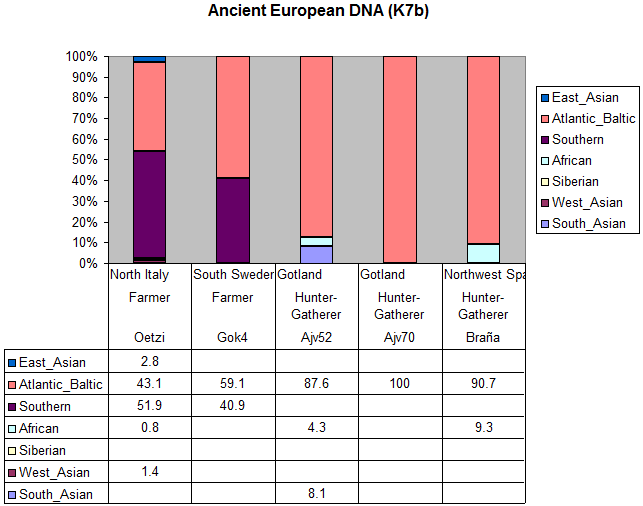
In K7 runs Bra have about 9% African admixture. I think they run 2 la brania together, Bra2 might have even more African, I'm not sure though. It might be the case that Bra2 is 91% WHG and 9% East African HG. This African admixture pulls it West on PCA.
ancientdna.png


In this Blog Bra1 is shown with 1.2 African admixture, therefore Bra2 might have it much more than 9%.
http://dienekes.blogspot.ca/2012/10/ancient-european-dna-assessment-with.html
 
From Lazaridis paper 2013, Basques have same level of ANE as Tuscans and slightly less than Spanish (1/10th less). Yet they plot with Neolithic and HGs (east-west).

Let's assume ANE in Basque is a mistake. We still need good explanation why Bra2 plots as far from Bra1 as Sardinians from rest of Europe.
Granted the older the sample the less dna can be recovered in good shape. Smaller the genome for statistical runs, the bigger are errors and discrepancies.

Given the high levels of R1b among Basques, I would expect more ANE and more certainty that it actually is there. So, regardless of how Basque R1b got there, it must be very diluted. The same would apply to Sardinian R1b, so I don't think it arrived there recently unless it was already very diluted when it arrived.
 
ANE - pulls straight East, WHG - North, EEF - South, additionally something is pulling North East, and something is pulling West, and something from Africa is pulling beduins SW. I think these additional pulls are making whole picture a bit muddy, except central Europe and Neolithic Farmers.


If EEF is pulling South-West (bottom-left) it would mean that Bedouins are closest to the pure ENF, first farmers?

Lazaridis tried to use them in his models as proxies for the first farmers. They are the most "southern" and have the least ANE, perhaps none. The problem is that they have additional SSA, some much more than others, depending on the tribe or clan,and there's been drift.

I don't know what's going on with the northeast. Does the ancient Karelian genome provide a clue? Or is it later Siberian etc, which makes the Finns impossible to fit into the three population model? (I know that in some runs none shows up in the Baltic countries, but I wonder if some could be hiding in "East European" etc. The other posters may have a better handle on it.

You're right about the ANE in the French Basque in the Lazaridis paper. (There is a slight difference between them and Pais Vasco on the Dodecad runs, by the way), and I think you may be onto something with the "African" in La Brana. I don't think it's actually "East African", however. East African is a mix of "African" and "West Asian".
 
You're right about the ANE in the French Basque in the Lazaridis paper. (There is a slight difference between them and Pais Vasco on the Dodecad runs, by the way), and I think you may be onto something with the "African" in La Brana. I don't think it's actually "East African", however. East African is a mix of "African" and "West Asian".
Of course, dyslexia kicked in, I meant West African. Close to Iberia and Bra2.
 
"Yet I personally don't expect any big surprises anymore with regards to western Hunter-Gatherers from the mesolithic/neolithic."

If WHG has two components, a main one and a much smaller one but the much smaller one is particularly divergent would that distort its influence - especially if the smaller component is strongly clustered?

 
From Lazaridis paper 2013, Basques have same level of ANE as Tuscans and slightly less than Spanish (1/10th less). Yet they plot with Neolithic and HGs (east-west).

Let's assume ANE in Basque is a mistake. We still need good explanation why Bra2 plots as far from Bra1 as Sardinians from rest of Europe.
Granted the older the sample the less dna can be recovered in good shape. Smaller the genome for statistical runs, the bigger are errors and discrepancies.

I now have another idea: before Lazaridis et al, we used to talk about "Amerindian" admixture, which later turned out to be ANE. I was predicing something like ANE for Hunter-Gatherers already before, although I guessed it to be related to Y-HQ Q (which still might turn out to be partially true). Now Basques show condradicting data for ANE possibly because their ANE is of north-eastern origin rather than the usual West-Asian. The smoking gun here could be "Amerindian", which Basques consistently possess, contrary to Sardinians, Bedouins and Palestinians, who have zero (check out for instance the table in the middle of this article from Genetiker; Globe4 also shows it, but I couldn't find data for Sardinians there). So maybe Basque ANE came from North-Eastern EHG, either during Bronze-Age (R1b northern-route), OR maybe yet during the late mesolithic (finnish-basque language similarity?), which would again open the door for a partial mesolithic R1b origin, although much more recent than in Spencer Well's terms of course. Basques also possess some Y-HG Q (0.5%).
Looking at various admixture runs together it could be that Basques were affected only by north-eastern ANE invasion, Bronze-Age and North-Europeans by some north-eastern ANE + West-Asian, and South-East Euros more by West-Asian.

Going back to the PCA plot, comparing Basques and Sardinians: whether Basques are shifted to the top-middle (WHG) or rather top-right (ANE) would barely be visible since they still have much more WHG than ANE, and since top-middle and top-right is not much of a difference.

So maybe "Amerindian"="EHG/North-Eastern ANE" and "West-Asian"="Caucasus/South-Eastern ANE"

What you say about african amixture in Europe is also possible.
 
I now have another idea: before Lazaridis et al, we used to talk about "Amerindian" admixture, which later turned out to be ANE. I was predicing something like ANE for Hunter-Gatherers already before, although I guessed it to be related to Y-HQ Q (which still might turn out to be partially true). Now Basques show condradicting data for ANE possibly because their ANE is of north-eastern origin rather than the usual West-Asian. The smoking gun here could be "Amerindian", which Basques consistently possess, contrary to Sardinians, Bedouins and Palestinians, who have zero (check out for instance the table in the middle of this article from Genetiker; Globe4 also shows it, but I couldn't find data for Sardinians there). So maybe Basque ANE came from North-Eastern EHG, either during Bronze-Age (R1b northern-route), OR maybe yet during the late mesolithic (finnish-basque language similarity?), which would again open the door for a partial mesolithic R1b origin, although much more recent than in Spencer Well's terms of course. Basques also possess some Y-HG Q (0.5%).
Looking at various admixture runs together it could be that Basques were affected only by north-eastern ANE invasion, Bronze-Age and North-Europeans by some north-eastern ANE + West-Asian, and South-East Euros more by West-Asian.

Going back to the PCA plot, comparing Basques and Sardinians: whether Basques are shifted to the top-middle (WHG) or rather top-right (ANE) would barely be visible since they still have much more WHG than ANE.

So maybe "Amerindian"="EHG/North-Eastern ANE" and "West-Asian"="Caucasus/South-Eastern ANE"

What you say about african amixture in Europe is also possible.

A northern coastal flow from the Baltic (and possibly beyond) and a southern coastal flow from northwest Africa (and possibly beyond) would produce some odd results I expect.
 
"Yet I personally don't expect any big surprises anymore with regards to western Hunter-Gatherers from the mesolithic/neolithic."

If WHG has two components, a main one and a much smaller one but the much smaller one is particularly divergent would that distort its influence - especially if the smaller component is strongly clustered?


I guess this population would require sufficient isolation within WHG.
 
but I couldn't find data for Sardinians there

Here are the world4 'Karitiana' admixtures for various populations:
(French)Basque: (5.1)4.6
Sardinian:1.7
from Dienekes

So according to this, Sardinians have not exactly zero, but still lowest Amerindian. Bedouins have still zero. Interestingly, Armenians also have zero 0.0 and Lezgin only 4.6, while Finns and Russians have max. (10%-12%), so this really is something north-eastern-european.


EDIT: Now it would be good to know the Amerindian admixture (not ANE directly) in WHG to estimate the possibility of mesolithic ANE influx.
 
Robert6;443154]C01 from Baden Copper Age Culture 2700-2900
is almost same autosomaly as the Neolithic Europeans,
The Baden culture has some of the earliest attestation of wheeled vehicles in central Europe, the so-called waggon-models in pottery.
Page 10
http://www.nature.com/ncomms/2014/141021/ncomms6257/extref/ncomms6257-s1.pdf

LeBrok;443156]Wagons are known to Neolithic cultures, unlike chariots which are the indication of Indo Europeans.

That's part of why so many people were convinced that the big changes in genetics would show up in a Copper Age Culture, but it's not there, or at least it's not there in this sample.

This brings us back to all those discussions we had on chariots. (There's even a separate thread on it I think.) There were wheeled vehicles and even wheeled war wagons south of the Caucasus. It's just that they seem to have been solid wheels. The theory by Anthony is that spoked wheels were attached to the carts around 2000 B.C. in Sintashta. Even that is only based on indentations in the ground. No part of those wheels have ever been found.

At any rate, BR1 is dated to [FONT=&quot]1980-2190 BC. Even that is cutting it pretty close. I couldn't quickly find anything that says the Early Bronze Mako culture had them (Unetice is later [/FONT][FONT=&quot](1800–1600) . BR2 [/FONT][FONT=&quot]Kyjatice culture is dated to 1110–1270 BC. and is certainly late enough, as of course is the pre-Scythian IR1. [/FONT]

If this article and map is correct, it didn't reach the area under discussion until about 1500 BC.
http://en.wikipedia.org/wiki/Chariot
 
Here are the world4 'Karitiana' admixtures for various populations:
(French)Basque: (5.1)4.6
Sardinian:1.7
from Dienekes

So according to this, Sardinians have not exactly zero, but still lowest Amerindian. Bedouins have still zero. Interestingly, Armenians also have zero 0.0 and Lezgin only 4.6, while Finns and Russians have max. (10%-12%), so this really is something north-eastern-european.


EDIT: Now it would be good to know the Amerindian admixture (not ANE directly) in WHG to estimate the possibility of mesolithic ANE influx.

And the modeling for a Yamnaya person is 50% Ancient Karelian (which is about as far north east you can go and remain in Europe) and an " Armenian like" farmer.
 
That's part of why so many people were convinced that the big changes in genetics would show up in a Copper Age Culture, but it's not there, or at least it's not there in this sample.

This brings us back to all those discussions we had on chariots. (There's even a separate thread on it I think.) There were wheeled vehicles and even wheeled war wagons south of the Caucasus. It's just that they seem to have been solid wheels. The theory by Anthony is that spoked wheels were attached to the carts around 2000 B.C. in Sintashta. Even that is only based on indentations in the ground. No part of those wheels have ever been found.

At any rate, BR1 is dated to 1980-2190 BC. Even that is cutting it pretty close. I couldn't quickly find anything that says the Early Bronze Mako culture had them (Unetice is later (1800–1600) . BR2 Kyjatice culture is dated to 1110–1270 BC. and is certainly late enough, as of course is the pre-Scythian IR1.

If this article and map is correct, it didn't reach the area under discussion until about 1500 BC.
http://en.wikipedia.org/wiki/Chariot

don't ask me the source, just read it somewhere ..
Mycenians had chariots 1600 BC
before it was assumed chariots spread from there to the Balkans
now archeologists doubt that and think it was the other way around
 
I guess this population would require sufficient isolation within WHG.

Yes, mountains and swamps.

(I also wonder if the signal from East African / Bedouin in EEF may get mixed up with this (imo) NW African signal scattered along the Atlantic coast (if it exists).
 
Wagons are known to Neolithic cultures, unlike chariots which are the indication of Indo Europeans.
Chariots is an Indo-Iranian innovation of two-wheeled carts
Those two-wheeled carts were from local people in southern part of Central Asia (local proto-Burushaski or proto-Dravidian)
http://en.wikipedia.org/wiki/Altyndepe
 
Back
Top