Well, I think that Gáva descends rather from Suciu de Sus than Belegis I. But even if we are talking about specifically Central European elements in the Balkan Urnfield spread, most to all of it came from Gáva-Holigrady and Belegis II-Gáva, not from the Celtic-like people of the Middle Danubian Urnfield group!
That's the big factor everybody needs to keep in mind: In the Balkans, the Urnfield package was spread by East Carpathian locals!
First in an archaic form by groups like Belegis I, Brnjica, Paracin (all Vatin derived rather) and Verbicoara-Tei, Zimnicea-Plovdiv-Cerkovna (closer to Wietenberg, Glina-Schneckenberg derived?).
Secondly the fully developed package by Gáva-Holigrady and Belegis II-Gáva, Channelled/Knobbed Ware.
The most important innovation of the more developed package were the Reutlingen and Riegsee type slashing swords (Naue II in the wider sense) and the long lances with casted spearheads. Both being spread from different innovative production centres, but for the Balkans the most important was from the Upper Tisza (Gáva) going down the Tisza to the Danube and the Olt, and from there the Danube down (lower danube) and Morava-Vardar valleys into the Balkans.
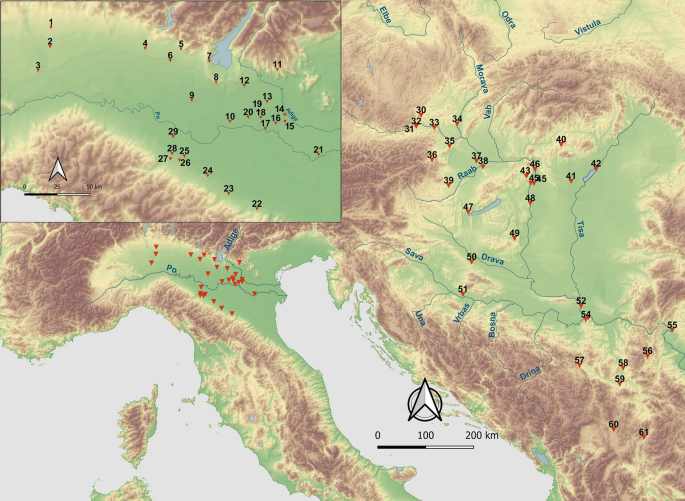
They spread a Proto-Hoplite type warrior, equipped with strong but not excessive (like late Mycenaean) armour, long lances, Naue II swords, round shields and specific arrowheads for the archers too. You can see on the map that Belegis II-Gáva kind of spilled these weapons into the Balkans, and that despite the Gáva-related groups producing less and less hoards (lack of material?) in the Balkans, compared to their homelands (Upper Tisza, Transylvania, Banat).
Here is an interesting paper on the Naue II/Reutlingen and Riegsee type swords which spread from Gáva in Belegis II-Gáva expansion zones down the Morava-Vardar river valleys:
During the Ha A1 period or the 12th /11 th century
BCE, the area of the West Morava Valley displayed
certain changes in material culture, both regarding the
pottery and the metal objects, both indicating the terri-
tory of Pannonia and Central Europe. Of particular
importance is the site of Konopljara, which yielded
pottery attributed to the Gava II–Belegiš group and a
mace-head pin. The published sword originates from
the vicinity of the site, which, when taken together,
raises the question of prolonged influences in this
area, or possibly the presence of populations from the
north of the Sava and Danube rivers, especially con-
sidering the find of such a sword so deep in the south.
It remains unknown how the sword from the West
Morava riverbed found its way to a region far from its
home territories. Unfortunately, this and numerous
other questions will remain open until new finds from
enclosed contexts, absolute dates and the provenance
analyses of raw materials from the so-called Central
European types of bronze jewellery and weapons are
available. On the other hand, new finds of swords with
fully cast hilts from the hinterland of the Balkans are
being recorded,76 as well as other metal finds such as
mace-head pins, bronze sickles, flame-shaped spear-
heads, Reutlingen swords, etc., whose origin should be
sought in the territories of Pannonia and Central Eu-
rope.77 The distribution of the aforementioned bronze
objects, when compared to the distribution of chan-
nelled pottery, displays a certain degree of regularity,
which was, it seems, short-lived with few specific ar-
chaeological features from several excavated sites.
Therefore Channelled Ware being directly associated with the spread of weapons, tools, jewelry and other material cultural objects and customs of Urnfield-type/Central European character. Belegis II-Gáva/late Belegis III was simply the agent of the same block which moved deeper into the South than others, which moved East (like Holigrady-Granicesti).
These items are not coming directly from a context associated with Vatin, or even early Belegis, but from Gáva influenced/overtaken late Belegis II-Gáva. And they spread from the Danube South, very far to the South, down to the Aegean even.
And this is, beyond doubt, the main movement associated with the big LBA-EIA (1300-1000 BC) expansoin of the Northern E-V13 branches. There is no other group or event having the same timing and right size, which could account for it. The correlation is perfect for an association with Gáva-related Channelled Ware (including Southern groups like Belegis II-Gáva and Vartop).
Look especially at Fig 12: You can see that the Upper Tisza Riegsee type of Naue II slashing swords being most common in the South in the core Belegis II-Gáva territory.
I mean the dating of the possible import sword which was travelling through Urnfield networks is just spot on:
With the other bronze swords of the so-called Central European type in the
territory of the Balkans (Riegsee and Reutlingen), the sword from the bed of the West Morava river certainly represents the herald
of changes that occurred during the Late Bronze Age in parts of the Mediterranean and its hinterland. It should be highlighted
that this sword represents the first example of this type recorded south of the Sava and Danube, with a quite narrow dating,
to a period of 1200–1100 BC.
That's exactly when the Northern E-V13 branches explode (CTS9320, FGC11451, L241, Y3183). This is 100 % associated with the new warrior type with Naue II swords and long lances marching South. The only remaining question is where they started: Was the initial starting point the Upper Tisza-Transylvania, or where they situated further South and just adopted the new customs to successfully use them when expanding from Belegis/Belegis II-Gáva further, deeper into the Balkans, from the Danubian zone.
Source:
https://doiserbia.nb.rs/img/doi/0350-0241/2024/0350-02412474009F.pdf
The pattern is even more striking with Reultingen type swords:
The Reutlingen sword type, also known as Naue II/Cetona, emerged as a distinct form of weaponry during the BzD period, introducing an innovative technique suited for cutting, tearing, and stabbing.1 The origin of Naue II-type swords,2 also referred to as the Reutlingen type3 and the Cetona type,4 is traced to the Central European-Carpathian region or northeastern Italy.5
Note they appeared basically at the same time in Gáva, Middle Danubian Urnfield and Protovillanovans. Like it travelled in light speed between the three main groups which started the spread of the UF package.
Note also the lack of finds in the area between the Danube and Tisza - the borderzone between Middle Danubian UF and Gáva.
Source:
Traces of Use, Damage, and Context of Deposition of Bronze Age Swords: A Case Study of Reutlingen-Type Swords from Vojvodina
www.academia.edu
We know that Knobbed Ware in Thrace had those swords too, but we can't be sure why less were found (no local big production centres, lack of resources, so less to waste? Less of an impact and dispersion in general?). Most of the finds in Gáva and Belegis II-Gáva come from hoards, which implies these people could abandon them. In other contexts, despite religious ideas, they might have been deemed to valuable to be laid to rest in my opinion.
But all the other Channelled Ware areas show many finds. Especially two areas: Core Gáva (formerly Suciu de Sus) territory at the Upper Tisza and in Transylvania, as well as core Belegis II-Gáva territory.
There is also evidence for their usage in battle:
The markings found on the blades were compared with results from experimental tests conducted on various types of European swords.22 Traces of use were observed on seven fragments, which accounts for 50% of the total number. The V-notch, recognized as the clearest indicator of direct contact with another sword, was identified on three specimens located at the upper, middle, and lower parts of the blade (fig.4,4a;fig.5,5a;fig.6,6a).
Traces of Use, Damage, and Context of Deposition of Bronze Age Swords: A Case Study of Reutlingen-Type Swords from Vojvodina
www.academia.edu










 OP39_noUDG.SG