Thucydides enjoyer
Regular Member
- Messages
- 47
- Reaction score
- 29
- Points
- 18

Amvrakia G25 - Pastebin.com
Pastebin.com is the number one paste tool since 2002. Pastebin is a website where you can store text online for a set period of time.



While one can detect the admixture of Greeks over time, it should be noted that some Ancient Greeks are closer to some modern Greeks, than to other Ancient Greeks. This is especially true for Greeks in the Hellenist Era and in the Classical era.

Thank you, even Lazaridis explicitly said there wasn't any major levantine demographic shift in Anatolia, and the population remained largely the same since ChL to Roman period. In fact, he demonstrated that Anatolia became more Greek.A study on Hellenistic/Roman era Greece is something that has been long awaited. It seems clear that up until the Hellenistic era both Tenea and Amvrakia cluster strongly with the LBA greeks with a few anatolian outliers. By the Roman era this changes in Tenea where the population begins to look rather identical to the BA/IA/Roman era western Anatolian genetic profile.
I see no indication whatsoever of any levantine pull of ancestry or levantine outliers for the Greek samples. This highlights more than anything the continuation of the bronze age pattern of Greece continueing to mix further with the anatolian peninsula, which was already hellenized at this point. I think at this point it also evidences further that both the Central Italian Roman imperial and modern southern Italian genetic structure derive their ancestry nearly totalistically from what was ultimately this cline of ancient greek ancestry rather than their original IA latin structure as well. The results of this study suggest there were no shifts of exotic input into the greek world as some have proposed but simply more movement eastwards on the preexisting Greco-anatolian cline.
Thank you, even Lazaridis explicitly said there wasn't any major levantine demographic shift in Anatolia, and the population remained largely the same since ChL to Roman period. In fact, he demonstrated that Anatolia became more Greek.

Yeah Iron Age sees a 30-50% Mycenaean-like influx iirc, at least on some parts. Not sure if it's older or happened during IA.Thank you, even Lazaridis explicitly said there wasn't any major levantine demographic shift in Anatolia, and the population remained largely the same since ChL to Roman period. In fact, he demonstrated that Anatolia became more Greek.
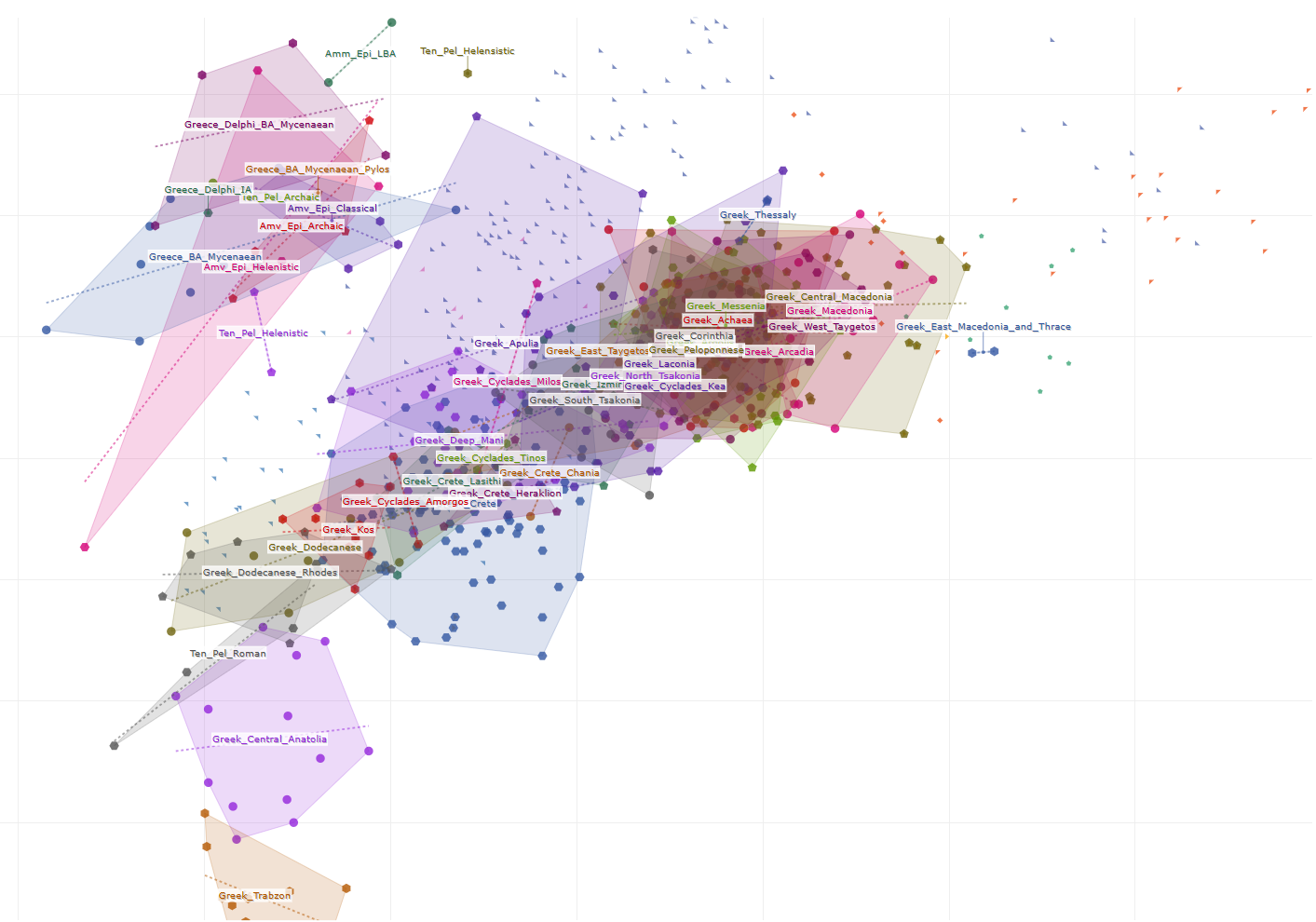
View attachment 19333
Big thanks to @Stefano for sharing the great work Teenpean is doing by converting BAMs to PLINK format. I was able to convert them to Eigenstrat, and upload them into this Smartpca projection using the smartsnp methodology.
Those who have been paying attention to the data will already know this. Anatolia clearly had a massive population with a high fertility rate from the Neolithic through at least the Iron age. Its only major admixture event prior to the Turks was with the Caucasus during the transition from Late Neolithic to the Chalcolithic Bronze age.
The roman tenea greeks have like 40%-50% mycaenean dna right?Also how much mycaenean dna modern greeks have actually
Lazaridis said that roman era western anatolians had 40-45% mycaenean like dna so i think its quite unlikely that the roman greeks of peloponnese had less mycaenean than the anatolian greeks,except if they were recent immigrants from somewhere elseNo, they likely had very little Mycenaean blood. It's hard to quantify it as it depends entirely on where said immigrants came from in Anatolia (it was a cline just like any other major deomgraphic hub), but if we use Isparta as an example, it's likely less than 15% Mycenaean influence. Perhaps more if we are talking migrations from central or eastern Anatolia but I see these regions as less influential due to geographic distance and later Hellenization.
Lazaridis said that roman era western anatolians had 40-45% mycaenean like dna so i think its quite unlikely that the roman greeks of peloponnese had less mycaenean than the anatolian greeks,except if they were recent immigrants from somewhere else