I found this excellent post on another forum I wanted to bring here. Pretty compelling, especially considering the Mesolithic I2a1b finds in Motala. This user seems to be against a Scandinavian origin but I think the Lochsbur/Motala finds support it.
DNA associated with the Germanic Goths
Hi everyone,
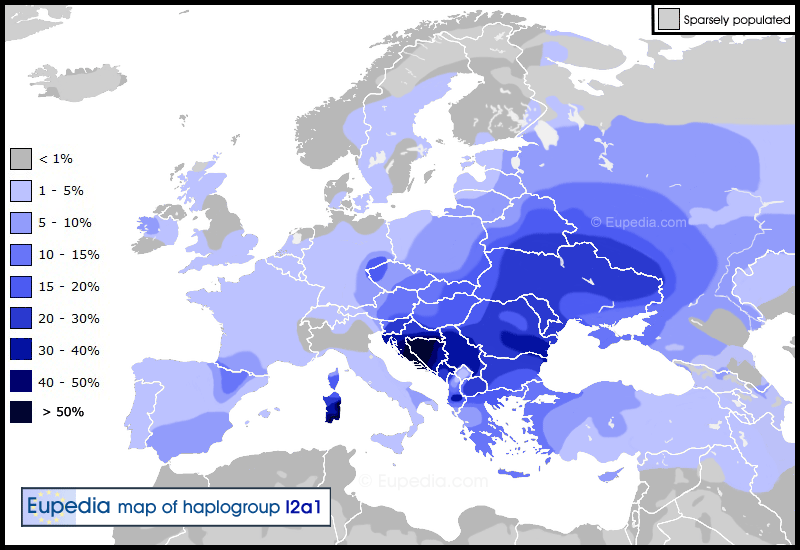
in his recent spread map Dr. Ken Nordtvedt “himself” locates the start of the I2a2a Dinarics, from now on, namley around the middle course of the Vistula. Which is modern day Pomerania.
Estimated age: about 2500 years ago. see google: Tree and Map for Hg I pdf
Dr. Ken Nordtvedt mentioned, a while ago:
I2a2a Dinaric is just too young to not have been the result of a sudden expansion not much more than 2000 years ago.
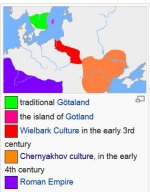
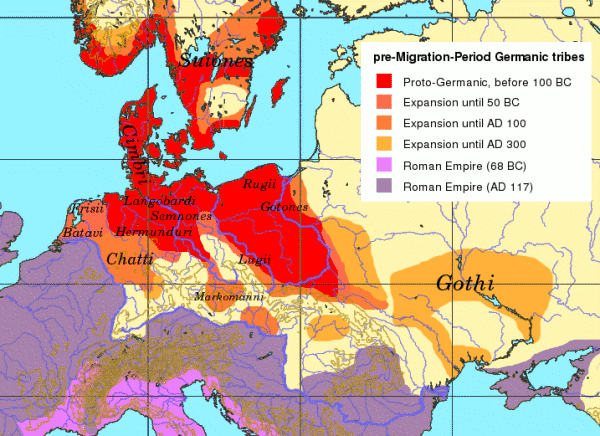
It is well testified, that 2000 years ago, the Vistula area were still part of Germania. And the Wielbark culture, (mainly associated with the Goths, as well as the Rugii, Heruli, Gepids and other Germanic tribes) appeared also in the Vistula area about the same time period like the haplogroup I2a2a Dinaric. The Wielbark culture also had a sudden expansion out of the Vistula, not much more than 2000 years ago. Spreading out into the same directions like the I2a2a Dinarics in Ken Nordtvedts new spread map. Although his spread map is schematic, it shows unequivocally and absolutely clear a huge expansion from the north into the southeast of Europe and the Balkan area.
The first movments of the slavic people, appear centuries later. Moving slowly from the southeast to the northwest of Europe. (Peter Heather, “Barbarians and Empires”). But the Gothic people moved the other way around, exactly the same way like the I2a2a Dinarics in reference to the spread map from Dr. Ken Nordtvedt. Concerning I2a2a Dinaric, no ethnics of people, in that number, at that time and particular place, could come into question, other than the Germanics and Gothic tribes. This is the only plausible explanation. The Goths as well as the I2a2a Dinarics, demonstrating a huge sudden expansion at the same time, moving in the same directions into the southeast of Europe. I can not see anything slavic in this group, because of the relationship between I2a2a Dinarics, I2a2a Disles and I2a2a Isles in Britain.
“Familytreedna administration 2012:
Dear I2a Project members:
We are happy to announce that all known I2a men can be placed in one of these five subgroups:
I2a1 (also called I-M26, nicknamed "Sardinian")
I2a2 (also called I-M423, includes "Dinaric", "Disles" and "Isles")
I2a3 (now called I-L1286, includes "Alpine" group, and the I-L233 groups "Western" and "Western Isles")
I2a4 (also called I-L880, nicknamed "Northern France")
I2a5 (also called I-L1294, nicknamed "France")
At this point, let us not forget the relationship between I2a and I2b in general. Basically you can claim, that pretty much all I2a2a Dinaric members in todays eastern Europe are culturally slavic people! But, they display ethnically Gothic/Germanic roots. Most of recent published maps about the migration of Germanic tribes, show the movment of the Goths and how they left their traces mainly in eastern Europe. Most of modern historians and scientific up-to-date maps show that the Goths did not come from Scandinavia. That was a long time legende from Jordanes. But if they are not originated from Scandinavia, would explain the lack of I2a2a Dinarics in Scandinavia. This means the Goths do not necessarily need to have a lot of I1a. The Goths left their DNA mainly in eastern Europe as we can clearly retrace. And very little in Germany except Thuringa and Hesse. (“Heike Grahn-Hoek”)
Most people, until now, are still strongly convinced that haplogroup I2a2a Dinaric must be of slavic origin, because of it´s high presence in eastern Europe and the Balkan areas. It was a logical conclusion, in the first point of view. But now we can see on the new map, that the origin of I2a2a Dinaric is not the Balkan area. It is roughly what is todays Poland. That makes a big difference. Peter Heather the modern day historian and expert of the Goths wrote something very interesting in this connection in his last published book (Empires and Barbarians) concerning the slavic expansion:
The Slavs came primary from the southeast and moved slowly sometimes even step by step to the west. But not all Germanic settlements were left when the Slavs moved into the northwest in the 6th century. There were still many farmers and familys in their Germanic homelands. The slavic people took over and the Germanics, have been assimilated by the arrivng slavic population. And the slavic language became the dominat one in these areas. (The Crimea might be an exception. It seems there was a gothic dialect spoken until the 17th century.)
This absorption or assimilation-process happend amazingly peaceful. At least, at the begin of the slavic expansion. Without these Germanic settlers, the slavic empire could have never reached the size as it is, in that short period of time, says Heather.
The Goths and Rugii did not just come with an conquering army to eastern Europe. They came with their entire people. Thousends and thousends of woman and children, farmers and warriors spread all across eastern Europe and the Balkan area.
They marched off to Belarus, conquer and settle in Moldavia and Romania (Dacia). They settled and established a powerful state in Dacia. Sacking Greece (Athens, Sparta) and even Rhodes, Cyprus and Crete were targets of their attacks. Battles in Turkey (Adrianople). Occupation of Albania 489-535.
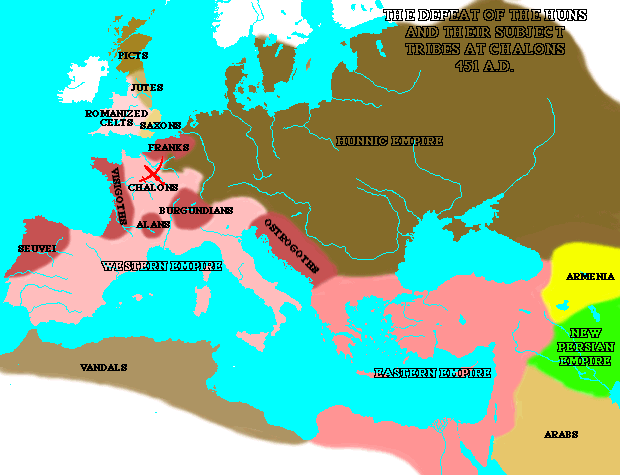
Also Settlements in western Hungary (Pannonia). 255 The Goths invade Macedonia. Taking over Moesia (Bulgaria) later known as the Moesian Goths. Ulfilias made the Gothic translation of the Bible for them. Raids in Belgrade, just to name a few well testyfied operations in the east. Bosnia was under the control of Theodoric the Great and his Ostrogothic Kingdom between 490-535. Dr. G. Rus, professor at the University of Liubljana, was taking detailed studys of Croatian and Bosnian origins. Professor Rus had proved that there were two large Gothic migrations into Bosnia and Croatia (Dalmatia). See the most recent map of germanic migrations below. The Goths and their Wielbark cousins were nearly all over eastern Europe. The Ostrogothic kingdom under Thoderic the Great was huge.
That´s why we still see most of I2a2a Dinarics in eastern Europe and the Balkan area today. Of course, we do have some I2a2a Dinaric members from italy as well. Check the Familytreedna I2a project.
(The sack of Rome, The Battle of Mons Lactarius near Naples, Ravenna the Ostogothic kingdom).
We also have members from Austria and Bavaria.They recently discovered the biggest Ostrogothic cemetery,more than 400 graves, ever found, at a place called Hemmaberg in Austria. The roman military brought a lot of gothic auxiliaries to the British isles, see Gloucester Goth. We do have I2a2 Dinaric members from the British Isles as well. Even the germanic Heruli (also Wielbark culture) came in two huge waves to the Aegean sea. The Rugii (Wielbark culture) have a strong conection to the Rus (Rugii-Rusyn-Rus-Ruthenen). After 900 AD all nordic people in eastern Europe were called Rus, not only swedish varangians. See and check: “Familytreedna Carpatho-Rusyn DNA project” there are many I2a2a Dinaric members north as well as south.
Most I2a2a Dinaric members, are from Pomerania and the Ukraine. It is not surprising. Pomerania was the homeland of the Goths and the Ukraine their biggest settlement after the great migration. But a great number of different tribes from all over eastern areas joint the Goths as well. And centuries later, when the Goths finally arrived in Spain, it was basically their
name that arrived the iberian peninsula. In Spain the Goths ruled over a huge area but provide only a small Gothic leadership, with their capital in Toledo. Wich was wiped out by the arabian conquest in the 8th century.
But after all, a few Goths from their Pomerian homelands survived in Spain. We can genetically trace back the Goths even into today's iberian peninsula. You can see the I2a2a Dinarics in the Familytreedna New Mexico project. All members have spanish ancestry and interestingly, they all belong to I2a2a Dinaric “north”. None of them is Diaric south.
Familytreedna New Mexico project:
Torres Spain I2a2 13 24 16 12 13-15 11 13 13 13 11 30
Chavez Spain I2a2 13 24 16 12 13-16 11 13 13 13 11 30
Torres Spain I2a2 13 24 16 12 13-16 11 13 13 13 11 30
Gallegos Spain I2a2 13 24 16 12 13-16 11 13 13 13 11 30
Torres Spain I2a2 13 24 16 12 13-16 11 13 13 13 11 30
Chavez Spain I2a2 13 24 16 12 13-16 11 13 13 13 11 30
Martinez Spain I2a2 13 24 16 12 13-16 11 13 13 13 11 30
Herrera Spain I2a2 13 24 16 12 13-16 11 13 13 13 11 30
Torrez Spain I2a2 13 24 16 12 13-16 11 13 13 13 11 30
Torres Spain I2a2 13 24 16 12 13-16 11 13 13 13 11 30
Chavez Spain I2a2 13 24 16 13 13-16 11 13 13 13 11 30
The Goths had certainly more Y-DNA haplogroups then just I2a2a Dinaric, (likely R1a??? We dont´t know yet). But I2a2a Dinaric is the most obvious of all,
matching the Gothic people. So far, this haplogroup is the only comprehensible one. The only one striking so clear, because of the young estimated age.
We see enough evidence for a very strong connection between the Wielbark and Chernyakhov cultures (Goths, Rugii etc.) and the haplogroup I2a2a Dinaric.
Here is some mtdna from the Wilbark culture. (Unfortunately Y-DNA is very fragile and does not last very long).
Juras 2012:
Wielbark Poland Kowalewko 0-300 AD H5 7028C, 16304C
Wielbark Poland Kowalewko 0-300 AD H 7028C, CRS
Wielbark Poland Kowalewko 0-300 AD W 2 samples 8251A, 16223T, 16292T
Wielbark Poland Kowalewko 0-300 AD W 8251A, 16192T, 16223T, 16292T
Wielbark Poland Kowalewko 0-300 AD U5b 7768G 16192T, 16270T
Wielbark Poland Kowalewko 0-300 AD U3 12308G, 14139G, 16343G
Wielbark Poland Rogowo 100-200 AD H 5 7028C, CRS
Wielbark Poland Rogowo 100-200 AD H 7028C, 16093C, 16129A, 16316G
Wielbark Poland Rogowo 100-200 AD H5 7028C, 16153A, 16304C,
Wielbark Poland Rogowo 100-200 AD H 2 samples of 7028C, 16183C, 16189C
Wielbark Poland Rogowo 100-200 AD H 7028C, 16129A
Wielbark Poland Rogowo 100-200 AD J2a 10398G 16069T, 16126C, 16145A, 16231C, 16261T, 16299G
Wielbark Poland Rogowo 100-200 AD T2b 16126C, 16294T, 16296T, 16304C
Best wishes Claus
Attachments