-
Don't want to see ads? Install an adblocker like uBlock Origin or use a Europe-based privacy-friendly browser like Vivaldi or Mullvad.
You are using an out of date browser. It may not display this or other websites correctly.
You should upgrade or use an alternative browser.
You should upgrade or use an alternative browser.
Neolithic Refuge and Continuity in Transylvania
- Thread starter PaleoRevenge
- Start date
-
- Tags
- e-v13

kingdavid
Regular Member
- Messages
- 2,505
- Reaction score
- 1,564
- Points
- 113
- Y-DNA haplogroup
- Rare E-m84>y60961
- mtDNA haplogroup
- H3+12192
I am sure there is a bunch of E-V13 guys in there. I just hope the resolution is better. In theory, there could be close relatives (for ancients) to me.
can be more since you are member in Genearchivist you can see every one
if more will appear teepean mention that there are total 403 males
so e-v13 have to appear there to some extent here is the first one
first one:
MGS006 Mödling E1b1b1a1b1a10~ https://www.yfull.com/tree/E-S2979/
can be more since you are member in Genearchivist you can see every one
if more will appear teepean mention that there are total 403 males
so e-v13 have to appear there to some extent here is the first one
first one:
MGS006 Mödling E1b1b1a1b1a10~ https://www.yfull.com/tree/E-S2979/
Another S2979 like expected for the Northern areas/in a Central European/Slavic-Avar context, I hope a more downstream subclade can be determined eventually and there are more V13ers.
PaleoRevenge
Well-known member
- Messages
- 1,529
- Reaction score
- 1,344
- Points
- 113
Nomad came up with an interesting G25 model. G25 is very useful for its ease in producing results. I made a slight change to his model by adding MENA and east Baltic to the calc for better precision.

What is intriguing is that the E-V13 from Zadar that was assumed to be a local Illyrian based on PCA plot, turns out to be entirely something else.
And I of course tested it out in QPDAM.

R3745 is without a doubt a exiled Dacian. Trying to model his profile with Illyrian fails miserably. It looks like the lilies never had E-V13 in any meaningful ratio. To date there is only one sample that showed llyrian profile from Viminacium.
I even reran the alleged Illyrian profiles from the Serbian study, using the idea from Riverman. Notice all models pass, but one of the samples does indeed seems to be 70-75% Illyrian and 20% Thracian based.

Keep in mind in the official Serbian paper, their models mostly failed. And the 'right' function they used was not ideal. Models failing in an 'right' function that gives easy passes equates to a hard failing grade.
Code:
1-Czech_MBA_Tumulus,0.129189,0.140651,0.0562855,0.032623,0.0438545,0.0110162,0.0014687,0.0038652,0.0072605,0.0133945,-0.004547,0.0046835,-0.0131192,-0.006606,0.0015948,0.0006962,-0.0082468,0.00019,-0.0007855,6.23E-05,0.0031195,0.0011128,-0.0078265,-0.0087962,-0.0024845
6-Kazakhstan_Central_Saka.SG,0.0821804,-0.1200354,0.059962,0.044251,-0.0382842,0.0027888,0.0020682,0.0021692,-0.0105944,-0.0243102,-0.01442,-0.0041362,0.0060952,-0.0217718,0.0149834,0.0080084,0.0004434,-0.0013176,-0.0014078,0.0091794,-0.0197902,0.0051684,-0.0057188,0.0034462,-0.0002158
5-Moldova_MCW,0.1250155,0.1040918,0.0560653,0.093993,-0.0032825,0.0356515,0.0019583,0.0031922,-0.0314625,-0.0468042,-0.001705,-0.001274,-0.002428,-0.015666,0.0277548,0.0099442,-0.00628,-0.0044762,-0.0005028,0.0049817,-0.0017885,0.0015662,0.004396,0.0087362,-0.0005988
4-Baltic_EST_BA,0.1321485,0.1213556,0.0992205,0.111662,0.051671,0.040746,0.0158398,0.0204684,-0.0029042,-0.050607,0.0009094,-0.0182389,0.0359462,0.0400344,-0.0180239,0.0018297,0.0103654,-0.000684,-0.0013952,0.0046272,-0.0024957,-0.0062692,0.0106487,-0.017388,0.002359
3-HUN_MBA_Fuzesabony,0.126344,0.1393812,0.061282,0.0491768,0.045239,0.0200802,0.003055,0.0114225,0.0114022,-0.003189,-0.0025982,-0.0029602,0.005575,0.0045072,0.000509,0.0008288,-0.0027055,-0.0040858,-0.0028598,0.0045645,0.0102632,0.0036165,-0.000955,-0.0117182,0.005748
2-Greece_Peloponnese_N,0.12088,0.1771082,-0.0070148,-0.0987736,0.0401918,-0.0426146,-0.000987,-0.0037384,0.025402,0.072457,0.0074052,0.0129482,-0.0257184,-0.0021194,-0.036563,-0.0082204,0.019349,-2.00E-07,0.0103576,-0.0128564,-0.0186424,0.0008408,-0.0042396,-0.0006266,-0.005628
X-IRN_Ganj_Dareh_N,0.0430252,0.0664158,-0.1550722,0.0047158,-0.122669,0.0235384,0.017109,-0.0011998,-0.082546,-0.0544158,-0.0028258,-0.0016186,0.0044896,-0.0062756,0.0316498,0.0561384,-0.0054242,0.0068664,0.0136508,-0.0334162,0.00856,-0.028836,-0.0110678,-0.039331,0.0222254
X-Levant_PPNB,0.072847,0.1639064,-0.0316026,-0.1361132,0.0332986,-0.0645352,-0.0134426,-0.0147684,0.0741604,0.03601,0.0188046,-0.0150764,0.035738,0.0025596,-0.0217696,0.006099,0.0098048,-0.0013176,-0.0047264,0.0188088,-0.001797,0.0071472,0.0008872,-0.0056874,-0.0037602
What is intriguing is that the E-V13 from Zadar that was assumed to be a local Illyrian based on PCA plot, turns out to be entirely something else.
And I of course tested it out in QPDAM.
R3745 is without a doubt a exiled Dacian. Trying to model his profile with Illyrian fails miserably. It looks like the lilies never had E-V13 in any meaningful ratio. To date there is only one sample that showed llyrian profile from Viminacium.
I even reran the alleged Illyrian profiles from the Serbian study, using the idea from Riverman. Notice all models pass, but one of the samples does indeed seems to be 70-75% Illyrian and 20% Thracian based.
Keep in mind in the official Serbian paper, their models mostly failed. And the 'right' function they used was not ideal. Models failing in an 'right' function that gives easy passes equates to a hard failing grade.
Whether they are of Carpathian or Balkan origin is hard to decide for the moment, but Carpatho-Balkan are both E-V13 carriers identified so far:
That's a trend already, together with the fact that, like expected, Northern and central branches (of Z5018 and Z5017) appeared first.
Distance to: ViennaCsokorgasse_AvarPeriod:CSK065.A0101 E-CTS9320
0.03456823 Serbian_South
0.03475347 Serbian_North
0.03581257 Romanian
0.03679881 Serbian_Šumadija
0.03714555 Croatian_Littoral
Distance to: MoedlingAdGS_AvarPeriod:MGS006.A0101 E-S2979
0.02584749 Montenegrin
0.02763446 Serbian_Croatian_Krajina
0.02767688 Serbian_South
0.02903778 Serbian_Šumadija
0.02979986 Moldovan
That's a trend already, together with the fact that, like expected, Northern and central branches (of Z5018 and Z5017) appeared first.
PaleoRevenge
Well-known member
- Messages
- 1,529
- Reaction score
- 1,344
- Points
- 113
Another fun aspect of these results: One of the few non-E-V13 individuals from Csokorgasse cemetery was https://www.yfull.com/tree/R-Z2110/
At this point I wouldn't wonder if he would be https://www.yfull.com/tree/R-Z2705/ a member of the big Albanian founder branch.
I already noticed it yesterday and yes he picks up significant Albanian post-mdv ancestry. So chances of him being R-Z2705 are big.

Without MENA proxies

Also note, all Wien samples have some Slavic & Germanic admixture, often both. Germanic admixture moves profiles in WHG direction, nothing to do with diliradians, the lilies.
Last edited:
Yes, they have various kinds of admixture, hard to keep it apart, but overall they follow a specific trend which is non-random in a way which suggests the core group came from one population, even if it was the result of a specific regional hybridisation. And they can be differentiated from say other sample groups from Avar era Austria to some degree. That they have both primarily central group and Vlach V13 branches plus a suspicious R-Z2103 is really interesting and proves their origins from around the Hungarian-Serbian Danube IMHO - of the core ancestral group of course.
PaleoRevenge
Well-known member
- Messages
- 1,529
- Reaction score
- 1,344
- Points
- 113
Yes, they have various kinds of admixture, hard to keep it apart, but overall they follow a specific trend which is non-random in a way which suggests the core group came from one population, even if it was the result of a specific regional hybridisation. And they can be differentiated from say other sample groups from Avar era Austria to some degree. That they have both primarily central group and Vlach V13 branches plus a suspicious R-Z2103 is really interesting and proves their origins from around the Hungarian-Serbian Danube IMHO - of the core ancestral group of course.
They are interesting, some have no MENA some have it at quite high levels. We don;t have IA samples from core regions which handicaps our understanding. But it is clear E-V13 have a consistent cline. And this has nothing to do with Illyrians, which are a alien people in profile.

ps I corrected/edited the models, I put Himera Greeks instead of Himera E-V13s in the source.
I asked Pribislav about the R-Z2103 sample from Csokorgasse and this is his assignment:
Not that numerous but fairly widespread, including two Armenian samples and one from India.
As for CSK068, he belongs to https://www.yfull.com/tree/R-FGC24396/
Not that numerous but fairly widespread, including two Armenian samples and one from India.
PaleoRevenge
Well-known member
- Messages
- 1,529
- Reaction score
- 1,344
- Points
- 113
The lead author of the Roua project did a interview recently.

Did not disclose much, other than there is something very interesting about the highlanders, the Wallachians are extremely admixed and the data is already out. I don't know what the last part means, maybe the genomes are available but not the paper?
And they did have this interesting slide:

They did say there would be gypsies in the samples and those have to be the outliers(11 samples). What is interesting is that samples from Ukraine intrude deep into the Romanian samples and one sample even bypasses them(notice the protrusion towards Greece). Most logical guess, is that these southern shifted samples are the Hutsuls, the last Dacian outpost in a Slavic sea.
Also interesting, Transcarpathia Ukranians as a whole(black dots in PCA) are noticeably EEF shifted compared to regular Ukranians (gray dots, samples from the 2021 study).
Did not disclose much, other than there is something very interesting about the highlanders, the Wallachians are extremely admixed and the data is already out. I don't know what the last part means, maybe the genomes are available but not the paper?
And they did have this interesting slide:
They did say there would be gypsies in the samples and those have to be the outliers(11 samples). What is interesting is that samples from Ukraine intrude deep into the Romanian samples and one sample even bypasses them(notice the protrusion towards Greece). Most logical guess, is that these southern shifted samples are the Hutsuls, the last Dacian outpost in a Slavic sea.
Also interesting, Transcarpathia Ukranians as a whole(black dots in PCA) are noticeably EEF shifted compared to regular Ukranians (gray dots, samples from the 2021 study).

Southpaw
Regular Member
- Messages
- 2,618
- Reaction score
- 1,424
- Points
- 113
- Ethnic group
- Albanian
- Y-DNA haplogroup
- E-V13
I believe that Eastern Serbia and Western Bulgaria are a good source for finding E-L618/E-V13, sites where Vinca Culture met with Karanovo.

Like Belovodo, a trajectory where we find world's first metal workers. It looks like during Chalcolithic there was a revolution going on. After the Chalcolithic downfall the E-V13 might have taken mountainous lifestyle living in between Southern Carpathians and Balkan Mountains which was their original lifestyle anyway if they descended from Cris farmers from Early Neolithic times descending from North Carpathians down to Central-Eastern Balkans during Mid to Late Chalcolithic.
Archaeometallurgy of the Vinča culture: a case study of the site of Belovode in eastern Serbia
The site of Belovode came to fame within the archaeological community with the discovery of the world’s earliest metallurgy, demonstrated by several pieces of copper slag dated at c5000 BC (Radivojević et al 2010). Extensive compositional,
www.academia.edu
Like Belovodo, a trajectory where we find world's first metal workers. It looks like during Chalcolithic there was a revolution going on. After the Chalcolithic downfall the E-V13 might have taken mountainous lifestyle living in between Southern Carpathians and Balkan Mountains which was their original lifestyle anyway if they descended from Cris farmers from Early Neolithic times descending from North Carpathians down to Central-Eastern Balkans during Mid to Late Chalcolithic.
Last edited:
PaleoRevenge
Well-known member
- Messages
- 1,529
- Reaction score
- 1,344
- Points
- 113
Found this helpful map, I made a small edit to mark out the regions that were sampled in red. I really want to see the results, the PCA alone looks promising.

Last edited:
On the Bilsk individuals:
I couldn't find anything about this branch. On YFull it exists without any samples: https://www.yfull.com/tree/E-Y271618/
Coudln't even find it on FTDNA?Genetic Homeland DNA Marker Index for Y271618 on Y chromosome
Information on DNA marker Y271618 on the Y chromosome and its research in genetic genealogy.www.genetichomeland.com
It is now added to the FTDNA tree with 1 Italian sample. I am assuming FTDNA are possibly adding the Bilsk samples this week and they formed a branch with this Italian who was previously E-L618*.
PaleoRevenge
Well-known member
- Messages
- 1,529
- Reaction score
- 1,344
- Points
- 113
I looked the PCA carefully. I went to Davidski's database, all the Ukrainan samples there are from the 2021 study that were produced by the same author above. This means we have the gray samples in G25.

Why is this interesting? Because the black samples(the new 150 samples from Zacarpathia) have a longer range than the gray samples (plotted in G25 above). If none of these new samples are jews, that means some Hutsuls eclipse the most Slavic shifted Albanians and Greeks. This is way beyond my expectations and incredible.
This is the PCA from the video flipped horizontally.

How to read the PCA above
-The gray dots are the G25 Ukrainian samples, which I generously plotted for comparison.
-Brown hexagon is the Zhitomir outlier, which is also in the G25(right next to the Albanian cluster in the G25 map).
-Dark blue, two Greek samples
-Green triangle, a single Moldovian
- Light green hexagon, two Croatian samples
- Blue- probably the Hutsuls.
Again assuming none of the samples are jews, than some(a handful) of these Zacarpathians will overlap with the most Slavic shifted Albanian and Greeks.
Why is this interesting? Because the black samples(the new 150 samples from Zacarpathia) have a longer range than the gray samples (plotted in G25 above). If none of these new samples are jews, that means some Hutsuls eclipse the most Slavic shifted Albanians and Greeks. This is way beyond my expectations and incredible.
This is the PCA from the video flipped horizontally.
How to read the PCA above
-The gray dots are the G25 Ukrainian samples, which I generously plotted for comparison.
-Brown hexagon is the Zhitomir outlier, which is also in the G25(right next to the Albanian cluster in the G25 map).
-Dark blue, two Greek samples
-Green triangle, a single Moldovian
- Light green hexagon, two Croatian samples
- Blue- probably the Hutsuls.
Again assuming none of the samples are jews, than some(a handful) of these Zacarpathians will overlap with the most Slavic shifted Albanian and Greeks.
View attachment 16944
It is now added to the FTDNA tree with 1 Italian sample. I am assuming FTDNA are possibly adding the Bilsk samples this week and they formed a branch with this Italian who was previously E-L618*.
How do you know its the Bilsk sample? Its not in Time Tree as of yet.
I am presuming it is one of the Bilsk samples because they are the only samples I'm aware of that are on this subclade, and whenever the FTDNA tree forms a new subclade with only 1 person it is either with a scientific sample or with an ancient sample.How do you know its the Bilsk sample? Its not in Time Tree as of yet.
I am presuming it is one of the Bilsk samples because they are the only samples I'm aware of that are on this subclade, and whenever the FTDNA tree forms a new subclade with only 1 person it is either with a scientific sample or with an ancient sample.
We'll see when the Time Tree updates. Just wanted to know whether you had additional info, but this could be right.
Looks like the Time Tree update will happen only this week, it wasn't included in the last weeks update. I also hope to get more samples from the Eastern European and Austrian Avar paper in the near future. It seems to take a while though.
I guess the Ukrainian paper will have the E-L618 as its biggest takeaway, if looking at Theytree: https://www.theytree.com/portal/index/samples?keyword=North Pontic crossroads: Mobility in Ukraine from the Bronze Age to the early modern period
But the Avar era samples from Austria mgiht yield some highly interesting patterns, even if they are that late. Lots of Northern and central branches, especially big founders of CTS9320, but also a couple of others from Z5018.
Edit: Looks like some R1a updates from the Ukrainian results being added to Time Tree in this weeks update according to Göran, which likely means that the E-L618 update indeed comes from the paper and will appear with the next update as well.
I guess the Ukrainian paper will have the E-L618 as its biggest takeaway, if looking at Theytree: https://www.theytree.com/portal/index/samples?keyword=North Pontic crossroads: Mobility in Ukraine from the Bronze Age to the early modern period
But the Avar era samples from Austria mgiht yield some highly interesting patterns, even if they are that late. Lots of Northern and central branches, especially big founders of CTS9320, but also a couple of others from Z5018.
Edit: Looks like some R1a updates from the Ukrainian results being added to Time Tree in this weeks update according to Göran, which likely means that the E-L618 update indeed comes from the paper and will appear with the next update as well.
Last edited:
PaleoRevenge
Well-known member
- Messages
- 1,529
- Reaction score
- 1,344
- Points
- 113
Looks like the results are shelved again, who knows when they'll see the light of day. One thing is obvious after the presentations in Rome, rrenjet issued a map, which was largely nonsense, but also gave away clues.
3,000 BC, the pink area is pretty much Yamnaya and not the hub of E-V13.

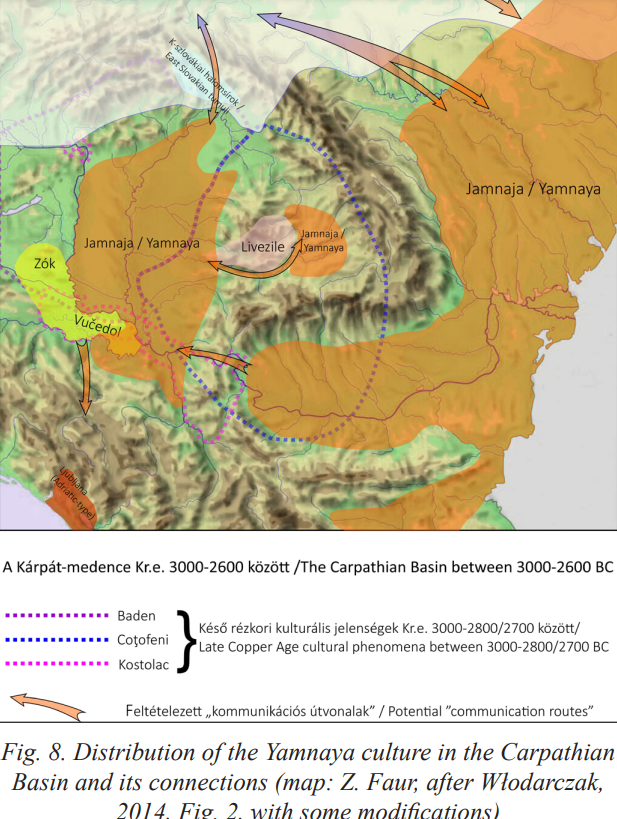
And we have plenty of samples from the region, EBA and MBA, no E-V13. Could there be E-V13 in western Cotofeni? If the map is based on some truth and to be taken verbatim, than the answer would be yes. It also quite clear from the presentation by Florin in the Hungarian conference that he put quite a emphasis on Livezile remains, without a doubt they found a rich vein of E-V13s in those samples and it is on that basis rrenjet included the region in their map than made some non-sense edit to stretch out to the Bosnian border.
The rest is all guesses, but I will assume E-V13 is largely sporadic in MBA due to strong adherence to cremation.
3,000 BC, the pink area is pretty much Yamnaya and not the hub of E-V13.
And we have plenty of samples from the region, EBA and MBA, no E-V13. Could there be E-V13 in western Cotofeni? If the map is based on some truth and to be taken verbatim, than the answer would be yes. It also quite clear from the presentation by Florin in the Hungarian conference that he put quite a emphasis on Livezile remains, without a doubt they found a rich vein of E-V13s in those samples and it is on that basis rrenjet included the region in their map than made some non-sense edit to stretch out to the Bosnian border.
The rest is all guesses, but I will assume E-V13 is largely sporadic in MBA due to strong adherence to cremation.
We can be absolutely sure that the cremation gap and sampling bias is real, because not just the Upper Tisza region, but most Daco-Thracian regions and cultures from Transcarpathia right down to Greece had a bias towards cremation, especially before the Iron Age.
Now its about getting some results from groups which transitioned to inhumation at some period in time, like Livezile-Rosia, Thraco-Cimmerian Mezocsat, Gornea-Kalakacza, Basarabi, Vekerzug-related mixed Scythians from Transylvania etc.
For a couple of those we have some insights, but no final results, and as annoying and repetitive as it is, we need those results to move on.
Now its about getting some results from groups which transitioned to inhumation at some period in time, like Livezile-Rosia, Thraco-Cimmerian Mezocsat, Gornea-Kalakacza, Basarabi, Vekerzug-related mixed Scythians from Transylvania etc.
For a couple of those we have some insights, but no final results, and as annoying and repetitive as it is, we need those results to move on.