• Don't want to see ads? Install an adblocker like uBlock Origin or use a Europe-based privacy-friendly browser like Vivaldi or Mullvad.

Neolithic Refuge and Continuity in Transylvania

Absolutely. We have all the populations which are truly relevant, we have Bodrogkeresztur, Tripolye-Cucuteni and Gumelnita-Pre-Salcuta. When ignoring these strange buk samples, what remains are high EEF Copper Age samples with varying degrees (1-18 %) of WHG admixture in the pre-steppe Late Neolithic to Copper Age. And ALL those groups had E-L618. The only group missing is Petresti, which in my opinion will have more EEF than Bodrogkeresztur and being closer to the Oltenia-Gumelnita samples which were nearly 100 % EEF. Because Petresti looks to me like an offshoot anyway.
These are all old European Neolithic groups and we also have E-L618 from earlier Neolithic groups like Impresso-Cardial, Lengyel, LBK, Michelsberg etc.

Therefore if there was any more Anatolian-Levantine admixture, I guess it was coming from later Late Neolithic/Copper Age movements unrelated to E-V13, like e.g. exchange networks of Usatovo-Gorodsk and Cernavoda.

It is pretty clear that we have to look for Cotofeni-related groups and Glina-Schneckenberg first and foremost, because those are the deep rooted regional groups of the Copper-EBA which gave rise to the later Thracian cultures.

I recently read about the spread of Thracians in the Hellenistic armies, which could have contributed to the distribution of South Thracian branches like E-BY5022 in the Near East in particular.

Keeping up ~20 PPNB autosomal for such a prolonged time would be absolutely unexpected. Either that or E-V13 migrated from Northern Levant to Balkans in Chalcolithic.

I think both options are highly unlikely.
 
Keeping up ~20 PPNB autosomal for such a prolonged time would be absolutely unexpected. Either that or E-V13 migrated from Northern Levant to Balkans in Chalcolithic.

I think both options are highly unlikely.

I don't see such a high level of Levantine-related admixture, but what's even more, I don't think more Northern groups had as much. And I think that's not just because the mixed with other groups in the North, but because the South Thracians, especially those coming from South of the Balkan mountains, the Psenichevo-South Thracian core from the East Rhodopes and downwards, received admixture from locals and beyond, which not all other Daco-Thracians had or at least had not on the same level. But again, this all has to be seen with more samples, which we still don't have.
What I wouldn't underestimate though is the backflow from their adventures in the East. Never underestimate that, because we see it in multiple people, including e.g. Germanic and Slavic groups later, that there was significant backflow from movements to the South practically every single time. And if we think about some of the early Thracians being dominated by male warbands and a social structure in which polygyny was the norm, at least for the elite, you can easily imagine how quickly significant, mainly female mediated, admixture could have taken place.

We also know from later Psenichevo and Basarabi, that they practised marriage exchange networks. Like we have evidence for e.g. brides from Southern Romania moving to Southern Austria, into the Frög group in particular. And this exchange seems to have been reciprocal, over such large distances, for multiple generations.
You can easily imagine, that the exchange of South Thracians from the area of Kapitan Andreevo with those from say North Western Anatolia is extremely likely to have been way more important, than between Frög and Basarabi, which was big already.

If they practised those marriage exchange even with non-Thracians (like Northern Illyrians and Eastern Celts), I'm pretty sure they both grabbed, bought and exchanged females with territories in shorter distance, like Western Anatolia, on a very regular basis.
 
I don't see such a high level of Levantine-related admixture, but what's even more, I don't think more Northern groups had as much. And I think that's not just because the mixed with other groups in the North, but because the South Thracians, especially those coming from South of the Balkan mountains, the Psenichevo-South Thracian core from the East Rhodopes and downwards, received admixture from locals and beyond, which not all other Daco-Thracians had or at least had not on the same level. But again, this all has to be seen with more samples, which we still don't have.
What I wouldn't underestimate though is the backflow from their adventures in the East. Never underestimate that, because we see it in multiple people, including e.g. Germanic and Slavic groups later, that there was significant backflow from movements to the South practically every single time. And if we think about some of the early Thracians being dominated by male warbands and a social structure in which polygyny was the norm, at least for the elite, you can easily imagine how quickly significant, mainly female mediated, admixture could have taken place.

We also know from later Psenichevo and Basarabi, that they practised marriage exchange networks. Like we have evidence for e.g. brides from Southern Romania moving to Southern Austria, into the Frög group in particular. And this exchange seems to have been reciprocal, over such large distances, for multiple generations.
You can easily imagine, that the exchange of South Thracians from the area of Kapitan Andreevo with those from say North Western Anatolia is extremely likely to have been way more important, than between Frög and Basarabi, which was big already.

If they practised those marriage exchange even with non-Thracians (like Northern Illyrians and Eastern Celts), I'm pretty sure they both grabbed, bought and exchanged females with territories in shorter distance, like Western Anatolia, on a very regular basis.
It makes perfect sense to me, and even explains the real reason for the ANF-rich profile seen in these Thracian E-V13 samples from Bulgaria, for example!
 
To bring back the IBD topic, the first sample Stefano showed as his promo is a E-V13 sample from La Tene Hungary:
wW7x468.png


IBD sharing is with Celts and Thracians. This was a sample some failed linguist was trying to argue as Illyrian or partially Illyrian. It was not possible with general autosomal tools and its now definitely impossible, as there is no IBD sharing with Illyrians.

One sample that was hailed as the holly grail of the mythical Illyrian E-V13 was the sample from Naissus. This sample shares very little with any of the Iron Age samples.
hkGUVBV.png


It shares micro segments with one of the Ohrid Brygian sample, one micro segment with Bronze Age Macedonia and one micro segment with a EIA Thracian. If this sample was a Illyrian Dardani, it would have showed it through a connection to Cinamak samples. All arguments made to date are void of any data, entirely based wishful thinking, a lotto ticket hopium to liliria conneciton. Also to beat a dead horse, if the Himera's were from a Thracian-Illyrian contact zone, they would show connection to the Naissus sample or the very numerous Vimincium samples, but there is zero connection, no IBD trail. My advise to the Greeks that took some cash to push propaganda reminiscent of communist era, stick to catching butterflies.
 
I agree with your conclusions, but one thing: My impression is that the Celtic-like influence which Thracians received comes rather from an old, Bell Beaker and/or Tumulus culture source, not actual Celts. If it would be actual Celtic, the IBD sharing would be all over the place. It is rather a very old steppe-related component, probably as old as Cotofeni to Nyirseg, and on the contrary, Celts received a bit of Carpathian influence too. So small segments could migrate with this influence as far as England. If it would have been actual, core Celtic ancestry, on a significant level, it would show, it would glow up. But it does not.

However, we will see with actual Western-Northern Thracians-Dacians, these could have more recent actual Celtic admixture too, from the La Tene period. But this will postdate the Proto-Thracian period and not being present in all Daco-Thracians.
 
Does anyone (?RIverman) have a list on hand of E-V13 samples from aDNA, doesn;t have to be every individual Bulgaria-IA ID but main points e.g. Bulgaria IA, western Scythians, Himera, Near East etc ? it will come in handy for an upcoming study

Thanks. I agree that E-V13 distribution cannot only be due to Roman Era expansion, due to its presence in Przeworsk,, Iron Age Ukraine, etc.
I guess the main contention revolves around how it became prevalent in 'Daco-Mysia' ?

E-V13 was for sure present in both Northern Thracians (Geto-Dacians) and Southern Thracians. We already see they were dominated by different branches of E-V13, like typical South Thracian is E-BY5022 and typical North Thracian are the main branches of E-S2979 and E-CTS9320.

The borderline between the two was the Balkan mountain range, as you can see on this toponymic map:

THR_LANG.gif


The Danube was not the border between North and South Thracians, but the Balkan mountains:

800px-Balkangebirge_Balkan_topo_de.jpg


Also note that the Geto-Dacian place names are only limited to the area the ancient authors covered, they obviously lived beyond that sphere up to say Transcarpathia-Subcarpathia in particular.

And what is most important: These North Thracians/Geto-Dacians were still a tribal people of their own at least up to the 4th century AD, around the time Sântana de Mureș cultural phase (dominated by Goths) and the formation of the Gepids. Probably even later, up to he Avar period.

The open question is: Did Geto-Dacians emerge solely because of a migration from the South to the North, or were areas like Transylvania already Thracian in the Bronze Age or even origined from there.

For the Iron Age its pretty clear that both Psenichevo (South) and Basarabi (North) were Thracian. Less certain are again Northern groups like Sanislau and Kustanovice.
 
This time I used scaledinnovation to plot the predicted positioning of the main E-V13 sorted by Northern Thracian founder branches from the LBA-EIA like E-FGC11451, E-L241, E-S2972, E-CTS9320 vs. old South Thracian branches like E-BY5022, E-Y16729 and E-PH1246.

What I think was the most volatile is the West to East positioning. Because that can largely depend on how many Slavic vs. English testers were present. But the latidunal positioning on the North to South axis was very consistent. Here is the map:
Scaledinnovation-17-10-2025.jpg


It is interesting to see that there are basically three "couples" which clearly emerge:
"Northern couple": E-FGC11451 and E-L241
"Northern-central couple": E-CTS930 and E-S2972
"Southern couple": E-BY5022 and E-PH1246 (E-Y16729 is also in this group, but still more Southern shifted)

What's definitely wrong is the positioning on the longitudinal positioning on the West to East axis. And this is clearly due to the strong presence of British testers (testing bias) and the fact, that in some regions of the East E-V13 was significantly reduced, while it could expand in Late Antiquity-migration period into the West Balkana and Western Central Europe.

This causes a West shift, which isn't ancient and for sure not correct - because there is practically no way that E-FGC11451 expanded primarily in an area like Austria in the LBA-EIA transitional period.

But the relative positioning from North to South of the main branches looks very solid.

If one puts the brown line for the maximal North to South distance in different spots, one could get e.g. the Upper Tisza-Northern Transylvania to Oltenia or from Oltenia to the South Rhodopes/South Thrace.

The most realistic positioning appears to be Transylvania (North), Oltenia (centre) and South (North Western Bulgaria). This would equate in the LBA - Otomani-Wietenberg (North) to Verbicoara-Tei-Belegis (centre) to (Brnjica and Zimnicea-Plovdiv-Cerkovna (South).

In any case, there is no scenario in which Basarabi was not dominated by the Northern-central branches and Psenichevo by the Southern ones. That's looking very solid from any possible perspective. Northern groups like Late Gáva, Sanislau and Kustanovice are less certain, but highly likely as well.

I think scaledinnovation did a pretty good job on the latidunal axis, this looks fairly solid. The West : East axis on the other hand being skrewed by the modern data.
 
I think these kinds of auto-apps can be misleading. Esp if you're saying that BY5022 is a major south Trhacian lineage but that programme is showing it off in Croatia. We should ge getting some more Hungary/ Romania LBA - IA data soon

The Southern branches have the "paradox pattern" of distribution, which means they get more samples from areas like the Near East and more samples from areas like Britain and Spain at the same time, but less from areas like say Central Europe, Eastern Europe and even, relatively, from the Carpatho-Balkan sphere.
This is because there starting position was very Southern and many descendents survived on the fringes and in Greco-Roman expansion zones. How they being positioned at scaledinnovation is purely because of the Roman migrations of South Thracians to areas like Britain. That's really pulling them West. All of them. In reality they will be all closer to the brown line I have drwan than to where they being put by the tool. This is not really the fault of the tool, because of the mentioned testing and survival bias.

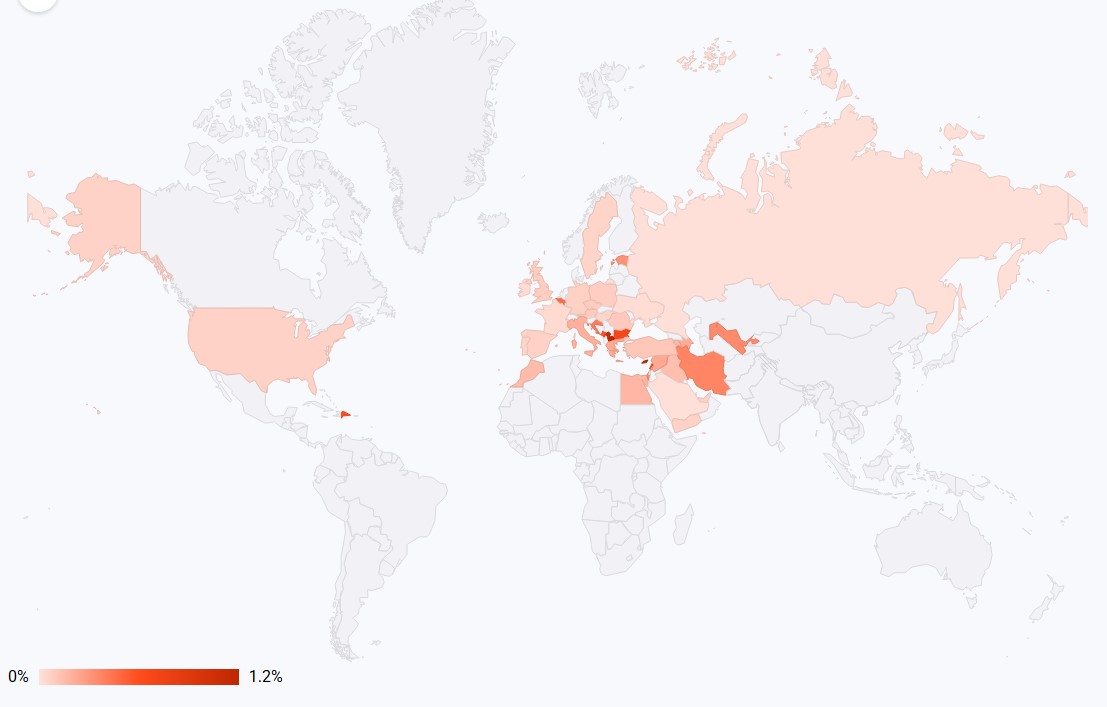
Just for context, for E-BY5022, 38 people have put England as their country of origin into the FTDNA data base:

E-BY5029 is downstream of a completely Near Eastern-Caucasian dominated branch (Iranian, Armenian etc.) and has an Iranian tester of its own, yet the vast majority of modern testers are from the British Isles.
Some of its branches might have joined La Tene Celts in the early phase even, along the Danube, looking at its pattern, but the upstream branch of E-BY5084 is clearly South Thracian-Near Eastern Oriented. None of these testers if from Croatia, they are either from England, Ireland, Germany or countries like Armenia, Iran, Iraq and Turkey. That's the "paradox pattern" of South Thracian branches: They are overrepresented on the fringes (NW and SW-S Europe vs. Near Eastern-Caucasus countries), but lower in Central and South Eastern Europe.

This pattern is even more striking if comparing with main Northern branches.

On FTDNA you can also clearly see that the main route for the distribution of E-BY5022 was Mediterreanean, rather than the land route:

E-BY5022.jpg


You can see that Albania, Serbia and Bosnia have no testers, but Italy, Croatia and Spain have. That's because the spread was mainly by sea and in the Roman period. For Northern branches which spread with Dacians, Daco-Romans and Vlachs, its the exact opposite. They are high in Albanians, Vlachs and also still higher in areas like Serbia and Bosnia, compared to Croatia.
This being already recognisable in the ancient DNA samples (coastal for BY5022 whereas its Northern Croatia, closer to the Danube for Northern branches).
 
Last edited:
useful article
ALBANIANS, ROMANIANS AND SLAVS IN THE EARLY MIDDLE AGES - A LINGUISTIC AND ARCHAEOLOGICAL PERSPECTIVE


A very Romanian-oriented interpretation, but refreshing to read with its alternative scenarios. E.g.:

If there ere is divergence within this group of scholars, then that exclusively refers to details.For example, Bulgarian linguists and archaeologists claim that the Albanian ethnogenesisis based on Thracians escaping Romanization, who clung onto the Stara Planina Mountainsuntil the arrival of the Slavs, who then forced them to move out and into western regionsof thehe peninsula (Georgiev 1960; Георгиев 1977, 212-215; Ködderitzsch 1988; for thesurviva ival of Thracians in the Stara Planina Mountains, see Duridanov 1986; Duridanov1989; Yanakieva 2018; see also Tāpkova-Zaimova 1972). However, according to theHasdedeu-Bonfante-Russu hypothesis, the only people of Thracian origin responsible for theethnonogenesis of the Albanians could be the so-called free Dacians, particularly theCarpifi pifrom the land north ofthe Danube. As they lived just outside the Roman province ofDacia ia (within the present-day province of Moldavia), they were never Romanized. TheSlavs, s, in their migration to and across the Danube, took the Carpi with them or pushedthemem ahead into the Balkans. After crossing the Danube, the Dacian-speaking Carpi supposedly met the Thracians from the Stara Planina Mountains, who, being themselves pushed out by the Slavs, joined the Carpi in their to present-day Albania.

It is interesting to note, in this context, that the Romanians seem to have more South Thracian and Greek influences alike as the Albanians. Like the Albanians E-V13 looks more like having been "marching through", whereas in Vlachs it is more of a fusion with Greco-Romance elements. The latter absolutely doesn't mean they were more South, it just means they assimilated other people and being not as clearly Dacian-only, though their E-V13 core absolutely still is (but not as much as in Albanians which have barely any South/East Thracian branches, but being even more completely dominated by Western/Northern-central branches).

However, cemeteries and isolated graves appear in large numbers especially along the western coast of the Balkans, from the Peloponnese to Istria, with a prominent cluster in the mountain region of northern Albania. On sites in Albania, as well as western Macedonia, graves are commonly found inside and around the ruins of older churches. Typical for some cemeteries in northern Albania, which have been attributed to so-called Komani culture, is the deposition of weapons - swords, arrow - or spearheads, as well as battle axes. Burial rites are remarkably homogeneous: stone or brick cists; an abundance of grave goods; occasional deposition of weapons; use of cenotaphs and multiple burials; west-east orientation of graves; clear-cut gender differentiation. Incontrovertible evidence of continuity of late antique practices, such as the grave deposition of water jugs and fibulae with bent stem, may be interpreted as indicating a Roman(ce) population, which nicely dovetails the presence ofwords of predominantly (Old) Latin origin in Albanian (Vătăşescu 1997).

Concerning the timing I think that he is too late since the phylogenetic patterns of both Albanians and Vlachs/Romanians suggest an earlier formation. However, relatively the Vlachs-Romanains appear to have, as a tendency, later founder events than Albanians indeed:

There is of course no way of knowing whether the refugees responsible for thepopula ulation increase within the area of the Komani culture spoke a Thracian dialect, much lessthat ththat immigration was responsible for current linksbetweenRomanian and Albanian, or forthe lat latter's appearance. At best, one can just assume that the immigrants consolidated a localidiom m,which was already in existence by the time they arrived. Some, at least, believe that theAlbabnian language was already formed in the 5t6thcenturies, although there is no reliable wayof fdating p the linguistic facts upon which that belief is based, for the data are chronologicallyimpredrecise (Demiraj 2006, 210; Ceka 2014, 258; see also Fiedler 2001). If there was already anAlbannian language atthe end ofLate Antiquity, then the Romanian language, which is believedto have appeared later, namely during the 8t and 9h centuries, could not possibly come intobeingofallin a region inhabited by speakers ofAlbanian. Itis worth mentioning in this respect that,Ithe dialects of Romanian, Aromanian, the speakers ofwhich live(d) closest to Albanians,has ththe smallest number ofAlbanian-Romanian parallels. On the contrary, the closest parallelsto AlAlbanian are in modern Romanian spoken in the northwestern part of present-day Romania,i.e the farthest from Albania. Such parallels concern not only matters of phonetics (e.g,rhota otacization), but vocabulary as well (e.g., Rom. nea 'snow'). Those observations seem touggest that the Latinity undertying Albanian is, in its oldest components, different from theLatin tinity ofthe Romanian language (Vătăşescu 1997).

He also has to date Slavs to late, in my opinion.
 
I found this interesting paper:


To investigate how the Romanian genetic makeup evolved, 33 ancient genome-wide sequences were generated from individuals archaeologically assigned to cultures spanning from the Late Neolithic/Chalcolithic to the Late Bronze Age: Globular Amphora (n=3) and Horodiştea (n=3), Monteoru (n=7), Otomani (n=2), and Noua (n=18) cultures. Very importantly this is the first genetic data generated for these cultures in Romania. The newly generated data was analysed in the context of published data from modern (n=958) and ancient samples (n=6758), and 15 out of 33 newly generated samples were also carbon dated. The results showed that Chalcolithic and Early Bronze Age cultures are similar to Late Neolithic populations, e.g., TRB and Baden, showing little or no Steppe ancestry in their genetics, despite the fact that Steppe influences appear in the material record. However, by the Middle Bronze Age, the genetic landscape appears to have shifted dramatically and two almost antithetical genetic makeups seem to co-exist even at the same site level. One represents a continuation of the earlier Bronze Age, albeit showing a slight increase in Steppe ancestry. The second one displays predominant Steppe ancestry similarly to Steppe populations. In the Late Bronze Age, the two seem to finally fully merge. Overall, the Romanian Bronze Age seems to be characterised by a slow integration of the Steppe ancestry, only showing more significant signs during the Middle Bronze Age while maintaining older Neolithic Ancestry.

The second quotation means with near certainty that in Noua the locals with high EEF and low steppe co-existed side by side with fully steppe derived people from Sabatinovka in the Noua context. Since Noua-Coslogeni-Sabatinovka was then pushed back again, by the locals, we can assume, also based on this paper, that the Transylvanian/Romanian locals were high in EEF-/Copper Age ancestry. This is most important:

while maintaining older Neolithic Ancestry.

Presumably from Bodrogkeresztur-Tiszapolgar, Petresti, Salcuta, Tripolye-Cucuteni, GAC etc.

The most downstream assignment from Noua is R1b1a1b1a1a1c2b2a1b1b1a = downstream of R-Z2106. This is very interesting, because so far Sabatinovka yielded primarily R-Z93 - which was found in this larger sample too. Monteoru too, so far having assignments for I2 primarily, brought up some R1b1b, probably already from the transition or a different clan?

Unfortunately, there are no samples from core Wietenberg-Noua territory locals, obviously.

One Otomani sampled individual was R-L2, obviously from the Tumulus culture context which broke into Otomani. The individual was likely from the area of Carei:

Which points to the deep penetration of Tumulus culture influences. The Otomani samples are clealry from a Füzesabony into TC context, no earlier layer locals (like from Nyirseg or Livezile and the like):
SR011’s model is a three-wat one of WHG, ANF and Yamnaya ancestry (13%/56%/31%). SR012’s first model is also a three-way one of WHG, ANF and Yamnaya ancestry (13%/37%/50%).

However, one thing is already interesting:

The Otomani samples have more allele sharing with Neolithic and Chalcolithic samples like Trypillia and Globular Amphora than older Bronze Age samples like Corded Ware and Bell Beakers

Lastly, the fact that the Neolithic ancestry is so prevalent in the Otomani samples lead to the conclusion that the Steppe assimilation was slow and constant instead of a drastic shift where Neolithic elements would be smaller or non-existent.

This time the Monteoru samples are not all the same, some have high steppe, but others have interesting patterns, especially:

SR023’s model was of 14% WHG, 41% ANF, 45% YAM and SR025’s was of 10% WHG, 62% ANF, 28% YAM.

Note the relatively low WHG AND Yamnaya ancestry especially in SR025.

The limited radiocarbon dating of the Monteoru samples show that there is a small overlap of timeframes, suggesting that the Monteoru was an heterogenous population even across sites.

I think SR025 might have core Transylvanian-Oltenian local ancestry. Because lower levels of WHG-Yamnaya were not present even around Nothern Bulgaria in that time frame.

It is very unfortunate that practically all Noua samples are from former Monteoru and Costisa territories, nothing from Wietenberg or Verbicoara-Tei areas. If they mixed with locals in Monteoru territory, they probably did so as well in Wietenberg-Tei territories, though nobody can say for sure.

Of the 6 samples only 4 different haplogroups are found: I2a1a2, J, R1b1a1b and R1a1a. I2a1a2, found in SR029 and SR030, it is an haplogroup found typically in Neolithic samples and rarely observed during the Bronze Age. J haplogroup, found in SR058, it is an haplogroup that is believed to have originated in West Asia and entered Europe during the Neolithic, thus being found in Europe during this period.

The Neolithic ancestry is not always the same:

Looking at the PCA (Figure 37) it is possible to see that the Noua culture is the most diverse culture reported in this study. This diversity is observed in general during the Bronze Age as seen with the Steppe BA, Bell Beakers and Corded Ware samples. Despite the high heterogeneity across sites, homogeneity characterizes within site diversity Truşeşti, Doina and Roman-Neamt samples plotting relatively close to each other in distinct zones. Truşeşti and Doina samples plot in the European Bronze Age region, with Truşeşti samples more on the left side and Doina on the right. Roman-Neamt samples plot with the Baltic Bronze Age with samples from Estonian, Lithuanian and Latvian Bronze Age. This was not expected as this region is so geographically specific and raises a question to a possible connection between the Baltic and the Roman-Neamt site. ADMIXTURE results reiterate the diversity of Noua and the intra-site homogeneity. The amount of Steppe ancestry component is similar between cultures being the ratio of WHG and ANF ancestry component were the differences lie. Doina is the site were the Neolithic component remains in higher quantity with the exception of SR061 that closely resembles Truşeşti and Roman-Neamt samples, a result that parallels the PCA one.

Doina samples show much more Neolithic ancestry than other Noua culture sites. SR054, SR055 and SR058 only produced a single model of WHG, ANF and Yamnaya ancestry, with an average of 10%-15% WHG ancestry, 25%-40% ANF ancestry and the 45%-65% Yamnaya ancestry.

Keep in mind they likely have Sabatinovka-steppe admixture.

Doina samples are not as homogeneous as the Truşeşti and Roman-Neamt samples. Nonetheless, these samples share more alleles on average with earlier Bronze Age samples and a bit less with the other later Bronze Age samples when compared with the other Noua sites. This shows the Neolithic ancestry that is still prevalent in the Doina samples. SR061 is the exception, being more similar to Truşeşti and Roman-Neamt samples Overall, the Noua culture genetics show a well-established Bronze Age culture that is diverse. This heterogeneity between sites could be due to the Noua culture being an amalgamation of earlier cultures.

Again, this leaves us with the possibility that Noua-Coslogeni groups in Wietenberg-Tei territories were more shifted towards those. Unfortunately there are no such samples included. These should come with the Transylvanian BA research results, especially for Wietenberg-Noua.

There are a couple of later samples too, which however don't have a lot of local flair, to put it that way. One being from Cluj, 5-6th century AD, presumably under https://www.yfull.com/tree/R-CTS7556/

SR052 433-600 cal. AD Cluj Romania R1b1a1b1a1a1c2b2a1b1b1a HV0e This Study

It might be interesting though, because it shows an association with Albanians and it might be deeper rooted, with HV0e having an Romanian deep branch.

Source: https://pure.hud.ac.uk/ws/portalfiles/portal/67174267/FINAL_THESIS.pdf

What we can see is the great diversity within Romania, by different sites, and that there must have been a relatively more EEF-shifted (compared to the Monteoru core or Füzesabony) population nearby.

Due to the lack of proper sampling from any relevant groups of locals East of Tisza and between Transcarpathia to Oltenia, we must still wait for the Transylvanian BA and South Pannonian paper to know more with certainty.
 
Great find Riverman, also important is the site of the samples, almost none from core region of interest and despite that, the authors still concluded there is a strong neolithic component around surviving and mixing with the various invaders.

NTxj56g.png
 
The Cluj site would be important geographically, but its the wrong time:
SR052 Noua Cluj UBA-43738 1536 ± 32 433-600 cal. AD

However, its haplogroup R-BY611 / R-CTS7556 is interesting for a wider context I'd say. The most Neolithic shifted site is Doina, which is, incidently, also one of the closest to Transylvania.

The Eastern groups got the increased WHG from GAC ancestors. It is very important that the author points to the main mode of differentiation among the locals being higher or lower levels of WHG : ANF/EEF ancestry. This opens up the option of a more EEF/less WHG population nearby (like Wietenberg?).
 
The R1b according to one online source is a germanic 106 sub-branch. This is not my expertise at all. So it makes sense under Gepid context.
[td width="139pt"]
R1b1a1b1a1a1c2b2a1b1b1a​
[/td][td width="293pt"]
FGC924/Y3159, FGC930/Y11027, FGC935/Y3157​
[/td]​
 
The R1b according to one online source is a germanic 106 sub-branch. This is not my expertise at all. So it makes sense under Gepid context.

[td width="139pt"]
R1b1a1b1a1a1c2b2a1b1b1a

[/td][td width="293pt"]
FGC924/Y3159, FGC930/Y11027, FGC935/Y3157

[/td]​

Well, ChatGPT said its old nomenclature and the haplogroup is under R-Z2103 for Cluj and R-L2 for Otomani.
 
Last edited:
We will definitely have some clues pretty soon, Bulgarian scholar Chobanov said in a podcast that he knows with full confidence from where did Thracians came from, he said he used IBD method to determine the originating culture from "bronze age". That means that they will publish it soon.

I also think Carpathian Basin during Bronze Age was very diverse, whatever happened during Late Bronze Age - Early Iron Age the Daco-Moesian groups became way more prominent with the Iranic steppe groups during Iron Age halting their expansion. Whether they came from more South or were one of the groups in Transylvania is yet to be seen.
 
We will definitely have some clues pretty soon, Bulgarian scholar Chobanov said in a podcast that he knows with full confidence from where did Thracians came from, he said he used IBD method to determine the originating culture from "bronze age". That means that they will publish it soon.

I also think Carpathian Basin during Bronze Age was very diverse, whatever happened during Late Bronze Age - Early Iron Age the Daco-Moesian groups became way more prominent with the Iranic steppe groups during Iron Age halting their expansion. Whether they came from more South or were one of the groups in Transylvania is yet to be seen.

I heard what he said, but it sounded a bit vague still. And you know, some papers come up with models based on limited data which simply doesn't work. We need samples from Transylvania, Oltenia and the Banat - Transylvania BA you know about, South Pannonian mega-forts paper and Gomolava should do Banat, Oltenia is completely off the radar still.

On genarchivist I explored the variability within the South Thracians a bit more, since there are two extreme ends of their variation:
I20184 (Female) + I20186 (R-Z93) Southern end
I20183 (E-V13) + I20181 (E-V13 Northern end

The Southern end has increased Iranian-Levantine, decreased steppe, the Northern end increased steppe-WHG, decreased Iranian-Levantine by comparison.

If using the Southern end duo as reference, and otherwise proximate source, you get this:

Target: South_Thracian:Bulgaria_EIA:I20183
Distance: 2.5327% / 0.02532693
46.4 South_Thracian (I20184+ I20186)
46.2 East_Thracian
5.2 Monteoru
2.2 Slovakia_IA_Vekerzug_South_East

Target: South_Thracian:Bulgaria_EIA:I20181
Distance: 2.9691% / 0.02969139
47.8 East_Thracian
44.6 South_Thracian (I20184+ I20186)
6.0 Monteoru
1.6 Moldova_Glinoe_Scythian.SG

If using only I20184 + I20186 as reference, the clearly more Northern shifted E-V13 South Thracians need to be one half Thracian Kartal and still, on top of that, Monteoru admixture of non-trival 5 percent. This is big and shows how different the South Thracian samples actually are, fairly heterogeneous in a crucial respect.

But what if removing all other Thracian sources? Vekerzug, Glinoe, Himera, Thracian Hallstatt. What remains? What do they need then from less proximate sources?

This:

Target: South_Thracian:Bulgaria_EIA:I20183
Distance: 3.0755% / 0.03075523
71.2 South_Thracian (I20184+ I20186)
27.0 Monteoru
1.8 Hungary_LBA


Target: South_Thracian:Bulgaria_EIA:I20181
Distance: 3.4749% / 0.03474877
70.0 South_Thracian (I20184+ I20186)
29.8 Monteoru
0.2 Bulgaria_MLBA

The North Thracian samples are also above the MBA/South Thracian baseline for steppe ancestry, which is between 19-26 percent in regulars. Whether that is because the South Thracians have this obvious Southern admixture, best visible in the Southern end samples, or whether the Northern groups have steppe admixture (Noua-Sabatinovka? Füzesabony? Tumulus culture?) the South Thracians didn't receive is up to debate.

But to me its absolutely clear that in South Thracians the E-V13 carriers correlate with increased steppe+WHG ancestry compared to females and the R-Z93 individual. Why is again up to debate, but I think they are simply less admixed/have received more of the Carpathian ancestry.

The difference within the South Thracians is not huge, but its absolutely significant in all models and on the PCA. Like the Northern end samples get closer to the South Eastern outliers from Vekerzug-Chotin, while the Southern end individuals are practically completely in the variation of the Mycenaean Greeks.
 
I heard what he said, but it sounded a bit vague still. And you know, some papers come up with models based on limited data which simply doesn't work. We need samples from Transylvania, Oltenia and the Banat - Transylvania BA you know about, South Pannonian mega-forts paper and Gomolava should do Banat, Oltenia is completely off the radar still.

On genarchivist I explored the variability within the South Thracians a bit more, since there are two extreme ends of their variation:
I20184 (Female) + I20186 (R-Z93) Southern end
I20183 (E-V13) + I20181 (E-V13 Northern end

The Southern end has increased Iranian-Levantine, decreased steppe, the Northern end increased steppe-WHG, decreased Iranian-Levantine by comparison.

If using the Southern end duo as reference, and otherwise proximate source, you get this:

Target: South_Thracian:Bulgaria_EIA:I20183
Distance: 2.5327% / 0.02532693
46.4 South_Thracian (I20184+ I20186)
46.2 East_Thracian
5.2 Monteoru
2.2 Slovakia_IA_Vekerzug_South_East

Target: South_Thracian:Bulgaria_EIA:I20181
Distance: 2.9691% / 0.02969139
47.8 East_Thracian
44.6 South_Thracian (I20184+ I20186)
6.0 Monteoru
1.6 Moldova_Glinoe_Scythian.SG

If using only I20184 + I20186 as reference, the clearly more Northern shifted E-V13 South Thracians need to be one half Thracian Kartal and still, on top of that, Monteoru admixture of non-trival 5 percent. This is big and shows how different the South Thracian samples actually are, fairly heterogeneous in a crucial respect.

But what if removing all other Thracian sources? Vekerzug, Glinoe, Himera, Thracian Hallstatt. What remains? What do they need then from less proximate sources?

This:

Target: South_Thracian:Bulgaria_EIA:I20183
Distance: 3.0755% / 0.03075523
71.2 South_Thracian (I20184+ I20186)
27.0 Monteoru
1.8 Hungary_LBA


Target: South_Thracian:Bulgaria_EIA:I20181
Distance: 3.4749% / 0.03474877
70.0 South_Thracian (I20184+ I20186)
29.8 Monteoru
0.2 Bulgaria_MLBA

The North Thracian samples are also above the MBA/South Thracian baseline for steppe ancestry, which is between 19-26 percent in regulars. Whether that is because the South Thracians have this obvious Southern admixture, best visible in the Southern end samples, or whether the Northern groups have steppe admixture (Noua-Sabatinovka? Füzesabony? Tumulus culture?) the South Thracians didn't receive is up to debate.

But to me its absolutely clear that in South Thracians the E-V13 carriers correlate with increased steppe+WHG ancestry compared to females and the R-Z93 individual. Why is again up to debate, but I think they are simply less admixed/have received more of the Carpathian ancestry.

The difference within the South Thracians is not huge, but its absolutely significant in all models and on the PCA. Like the Northern end samples get closer to the South Eastern outliers from Vekerzug-Chotin, while the Southern end individuals are practically completely in the variation of the Mycenaean Greeks.

To me the modern border triangle between Romania, Serbia and Bulgaria looks the most promising location-wise. Fertile Banat was close, Carpathians were close, Danube river and Haemus Mountains were there.
 
To me the modern border triangle between Romania, Serbia and Bulgaria looks the most promising location-wise. Fertile Banat was close, Carpathians were close, Danube river and Haemus Mountains were there.

For the starting point of the South Thracians: Yes, most definitely. But leaving out Transylvania and Banat altogether? I doubt it.

Keep in mind that the E-V13 phylogeny strongly suggests, this is my current best verdict on the matter, that there was a major split of branches between 2200-1600 BC. I know I said something different before, but that was because I concentrated too much on Z5017 and Z5018 honestly.
I concentrating on the South Thracian branches, there is no way these could have been in the same population especially after 1600 BC, but most likely the split happened much earlier.

Therefore I think that there was a zone of strong interaction between Western Transylvania and Oltenia. That is the core. From there various groups emerged, which occupied at different stages different regions.

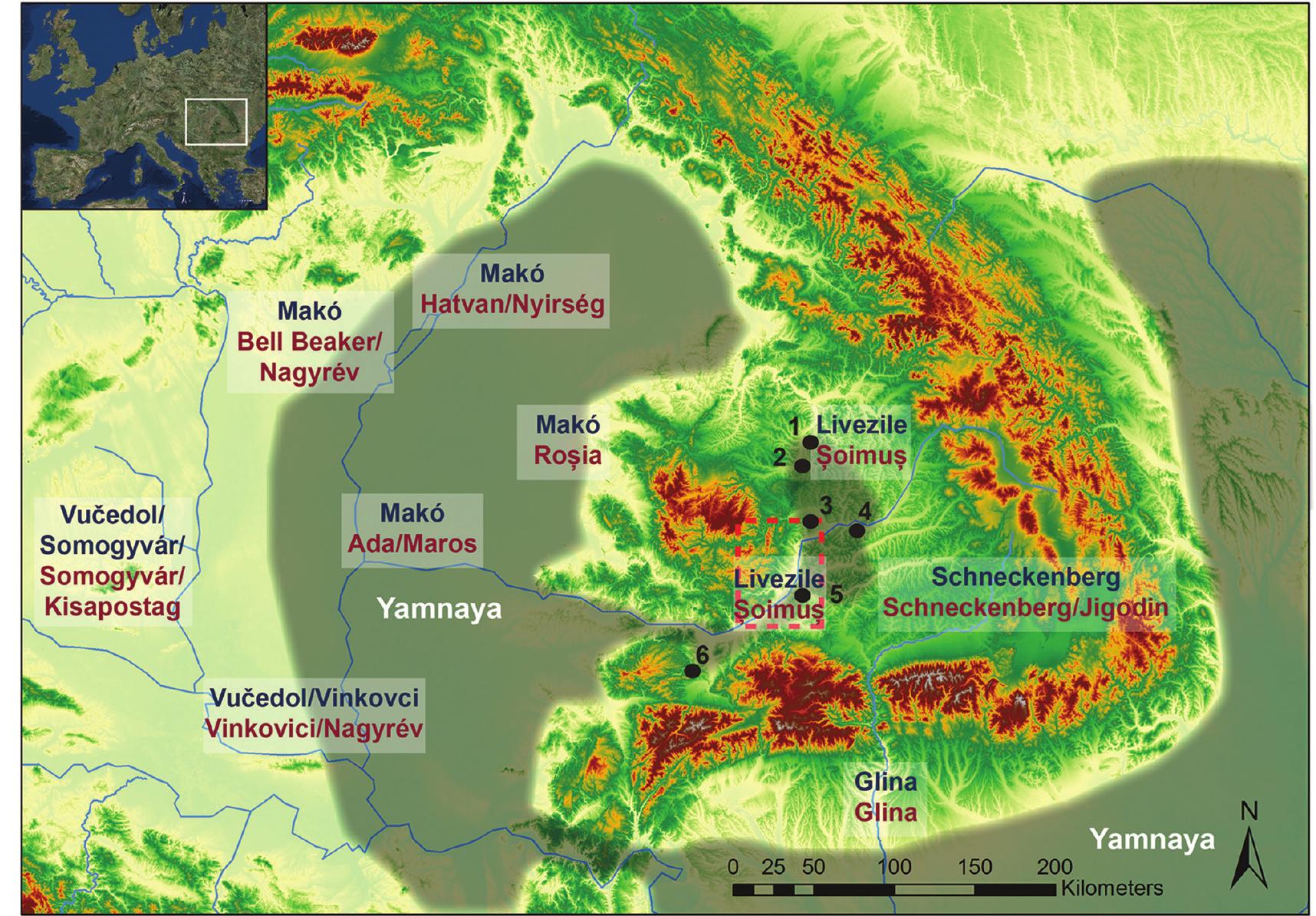
And they all had elements of their metallurgy and especially burial rites and religious-ideological fundaments in common. If you look at this map, it is the zone from Nyirseg to Glina which is the core:

figure_001.jpg


Yamnaya pastoralists kind of formed a cordon around them. Later they were surrounded by Danubian groups related to Kisapostag with a lot of GAC-WHG-rich ancestry, like Encrusted Pottery and admixed groups to the West, Monteoru, Costisa and related groups to the East.

The area of Maros was later occupied by Vatin and then Belegis for the most part, which being also rather Vucedol-Cotofeni derived groups and could have been related.

But you see that the Carpathian mountains and the steppe-like landscapes form a curtain, and its the area in between, the valleys and highlands, which were always the core zone of the Northern Thracians. And I think they were also the core zone for the Proto-Thracians.
 
Taking another look at the phylogenetic patterns of E-V13, I tried to categorise all old-main branches of first E-BY3880 and then the remaining E-V13 of old age into three categories.
1) Northern
2) Central or unclear because of lack of data
3) Southern

Typical for Northern branches is:
a) Lack of older, diversified Near Eastern branches, especially practically no testers from Arabian countries East of Syria and Iran. Very low relative presence in the Near East.
b) Many older branches with an exclusive presence in modern testers from Northern and Eastern Europe
c) Strong founder events in the Late Bronze Age to Early Iron Age transition, most likely associated with Gáva-Holigrady and/or Belegis II-Gáva- and Vartop-Gáva.
d) Ancient DNA samples primarily from the Carpathian basin, barely any samples from Thrace and Moldova-Ukraine in the Early Iron Age period. Low frequency South of the Danube up to the Late Roman period.

Typical for Southern branches is:
a) Disproportional presence of Near Eastern branches, especially from Arabian countries and Iran. Very high relative presence in those regions.
b) Strong presence in Southern Italians and Greco-Turkish samples with old TMRCA and little overlap to Carpatho-Balkan and Eastern European samples.
c) Ancient DNA finds from Thrace, Moldova-Ukraine in the Early Iron Age and South of the Danube in general, including Mediterranean coast.
d) Many branches show "paradox pattern" in their distribution, having members from say Saudi Arabia and England in one younger subbranch.
e) Lack of the Late Bronze to Early Iron Age transition founder events. Barely any significant, disproportional growth associated with Gáva and Channelled Ware period expansions.

For E-BY3880 branches:

Rather Northern:
E-FT171969 (too young)
E-BY152493 (intermediate)
E-S10174 (intermediate)
E-FTT49/Z5018
E-Z5017


Rather central or unclear, not enough data:
E-BY6527 (intermediate)
E-Y19509
E-BY6484
E-BY6527
E-BY6250 (too young)
E-FT350463

Rather Southern:
E-FT334643 (too young)
E-BY6283 (intermediate)
E-Y16729
E-FGC44169/BY5022


For Non-E-BY3880 branches:


Rather Northern:
E-S3003/E-L540 (too young)
E-BY6550 (too young)

Rather central or unclear, not enough data:
E-Z16663 (characteristics of Northern and Southern branches)

Rather Southern:
E-FT7781
E-PH1246


What is astonishing if looking at the E-V13 phylogeny that way, is that the most clearly Northern branches are completely dominated by E-Z5018 primarily, and E-Z5017 secondarily, which is already a bit more Southern relatively speaking.

Contrary to that, many of the bigger, clearly assignable branches of E-V13 are in the Southern category like
E-FT7781
E-PH1246
E-Y16729
E-FGC44169/BY5022


But all in all, if concentrating on E-BY3880 primarily, we can conclude that it kind of "split in half" possibly. And this split happened soon after the emergence of these haplogroups, because of the vastly different pattern in the next generations of the new branches.

The central topic I'm thinking about in this context is the emergence of three groups:
1) Eastern Otomani-Wietenberg
2) Verbicoara-Tei
3) Vatin

The big question here is, could there be a common source group contributing to the emergence of all three, spreading E-BY3880 branches into them.

Obviously the most likely scenario is a transition from Nyirseg-local Transylvanian post-Cotofeni groups contributing to both Eastern Otomani, Wietenberg and Verbicoara.

What any scenario must achieve is how the main South Thracian branch of E-FGC44169/BY5022 could end up in Verbicoara-Tei into Zimnicea-Plovdiv-Cerkovna or in a much less likely alternative scenario in Vatin and from there in Brnjica-Belegis.

Why? Because it must end up in the South Thracian groups which established themselves in the area later occupied by Psenichevo culture, BEFORE the LBA-EIA transition expanson of Gáva-related Channelled Ware into the Balkans.

Why that?

Look at https://discover.familytreedna.com/y-dna/E-BY5022/tree

TMRCA of E-FGC44169 is around 2200-2100 BC. It is has a lot of early branches, major founder events already 2000 BC, most notably E-BY5022, which had a big growth spurt around 1700-1500 BC (when ZPC moved into Thrace!).

But despite all of this, despite its huge effective population size already in the EBA, it has very little going on for the LBA-EIA transition.
Only two to four rather Northern oriented subbranches have any sort of expansion, and these are untypical (Northern oriented) for E-BY5022!

Therefore it looks like some E-BY5022 branches could have participated in the LBA-EIA expansion, even if only on a very limited base, but the bulk did most definitely not. Like if they were not attendants to the same party, not in the same population as the Northern oriented branches any longer.

And the reason for this is in my opinion that:

Sites-with-globular-beakers-of-the-Zimnicea-Cherkovna-Plovdiv-and-Paracin-types-split.jpg

This could mean that some branches of e.g. E-BY5022 stayed behind in areas like Oltenia-Muntenia, the original source region for the Verbicoara-Tei/Fundeni-Govora groups. But all the typical branches with a significant growth in the ZPC expansion period, paradox pattern, Near Eastern branch members, ancient DNA finds (like in Kapitan Andreevo) where moving South of the blue line already by around 1700-1500 BC.

And I think the other "Southern pattern branches" did the same. This was a fairly big Southward push in the MBA-LBA.

On the other hand, the Northern branches, presumably from the Tisza-Transylvanian-Banat regions, moved into the Southern branches former homelands of Banat-Oltenia-Muntenia en masse, expanded there big time with Gáva, Belegis II-Gáva and Vartop, established themselves as dominant groups in Southern Romania - where those Southern branches ancestors lived before as well.

That's why the Southern branches were so strongly concentrated South of the Balkans and had way more gene flow into the Near East, than the Northern branches, with which they still lived together/in close proximity at the very least up to around 2300-2200 BC.

And I think a crucial split could have been between Wietenberg and Verbicoara.

Verbicoara has strong Glina-Schneckenberg traditions, but there was a break and massive transformation between G-S and Verbicoara. Then both Wietenberg and Verbicoara emerged and roughly about the same time, with many characteristics in common. This could have been a second pulse from post-Cotofeni Transylvania, in my opinion.
There was a zone of interaction between Balta Sarata, Verbicoara and Wietenberg. And I think that's absolutely crucial and where E-BY3880 expanded from, spreading into both Wietenberg-Eastern Otomani and Verbicoara.

On the close interaction of Otomani, Wietenberg, Balta Sarata and how Suciu de Sus and Cehalut can be derived from these interaction together with new Tumulus and Noua culture impulses in the LBA:

Looking to the location of late Wietenberg sites, it is obvious that most of them have a different position than the ones belonging to previous phase (III Chidioan or C Boroffka). These small-scale movements in the habitation area could be connected to the Noua penetration in Eastern Transylvania. However, the high frequency of Suciu de Sus and/or Cehlu pottery imports also points towards North-Western disturbances, maybe associated with the expansion of the Carpathian Tumulus Culture 89. It is important to stress the fact that only Suciu de Sus incised pottery is present in most of the Wietenberg IV sites, as C. Kacsó already noticed90. It is not easy to make a clear distinction between the Suciu de Sus and Cehlu pottery often mixed in late Wietenberg complexes from central and South-Western Transylvania. However, a Suciu de Sus biconical pot with incised decoration and protuberances could be identified in the Geoagiu de Sus pit (pl. I/1), with parallels both in Suciu de Sus I91 and Otomani IIIb92 sites. Several Cehlu-type bowls are to be found in the Mhceni ritual pit (pl. II/3-4, 6), one of them (pl. II/6) with perfect parallels in the Acâ- Crasna Veche site93. A perforated lid (?) from the same Mhceni pit94 has an almost identical parallel in the Lucceni site95. Cehlu-type bowls with large conical knobs are widespread in the late Wietenberg sites96, but we would like to stress the replacement of grooves with „Zahnstempelung“ bands in the Alba Iulia–Ijac site.97 Together with the arcades decorated in the “Zahnstempelung” technique from Aiton “Locul lui Pou” site98, these finds are clear proofs for the reproduction of Cehlu-type motifs and shapes in a traditional Wietenberg technique. This is just one side of the complex cultural interferences that took place during the Late Bronze I period in Central and Southern Transylvania. In the Haeg region, the Wietenberg culture came into contact with Balta Srat group99, a relation which evolved up to phase IV (D), as the finds from the Cauce Cave seems to illustrate100. The fragment of a typical Noua kantharos with disc-shaped button on its handle was also found in the same site101 .

What happened after the Noua invasion:

The Late Bronze I is represented by the last phase of the Wietenberg culture in Western Transylvania and the penetration of the Noua I groups in the Southern part, while Suciu de Sus II and early Cehalut phase covers the North and North–West.

This would have caused a wedge between the Southern groups (Verbicoara-Tei) and the Northern ones (Otomani-Wietenberg), with the locals (Eastern Otomani-Wietenberg) retreating to North and North West-West - forming Suciu de Sus and Cehalut (this is exaclty the time frame for E-Z5018 starting to expand!).

The Late Bronze II is the time of major expansion of the Noua culture (phase II) over Central and South-Western Transylvania, while late Cehalut and Igrita groups evolve in the West and Lapus group start its development in the Northern area. Probably late Balta Srat and Igria mixed groups are present in a quite limited area from the South–West (mainly the Haeg region, with intrusions towards Hunedoara and Deva). By the end of this phase, the early elements of the Band-Cugir group probably penetrated from the North-West and reach the middle Mures valley.

In the next phase the offensive of the Gáva- and Belegis II-Gáva, related groups start:

The Late Bronze III is divided in two sub-phases, according to the evolution of the early Gáva phase. Late Bronze IIIa is represented by the Band-Cugir group in the West and the late Noua (phase III) in the South-East, while Lapus II group develops common features with the earliest Gáva (Ia) groups from the North-West. A limited penetration of the Susani group could be detected in South-Western Transylvania. Late Bronze IIIb represents the time of the early Gáva (phase Ib) expansion over the Central and Southern Transylvania, up to Southern Carpathians.

Source:

The Southern branches of E-V13 must be separated from the Northern ones in the MBA-LBA, and there are just two viable scenarios for that talking about the BY3880 split:
1) Verbicoara-Tei split from Balta Sarata-Wietenberg-Eastern Otomani
2) Vatin-Verbicoara split, with later Belegis and Brnjia starting to move South too

Currently I'm strongly preferring the 1st scenario, because it fits the whole chain of events much better, especially the Z5018 vs. BY5022 split.

 
Back
Top