• Don't want to see ads? Install an adblocker like uBlock Origin or use a Europe-based privacy-friendly browser like Vivaldi or Mullvad.

Neolithic Refuge and Continuity in Transylvania

I found a great map for the MBA Carpathian basin before the Tumulus culture invasion (Koszider horizon):
Abb-4-33-Karpatenbecken-Bz-A2-B1-Eszter-Fej-r-2020.jpg


Source: https://refubium.fu-berlin.de/bitst...szter_Fejer_Band_1.pdf?sequence=3&isAllowed=y


Note that all the relevant (even the rather mixed Gyulavarsand-Otomani) groups with Suciu de Sus and late Wietenberg were far to the East from the Tisza river.


The strongest influence of Wietenberg outside of the Inner Carpathians was found in Monteoru:


Der Einfluss der Tei-, Monteoru-, und Verbicoara-Kulturen ist in Siebenbürgen bekannt, und in geringer Menge (besonders im
Gebiet der Monteoru-Kultur) wurden auch Funde der Wietenberg-Kultur außerhalb der Karpaten gefunden.


This is again a good supporting argument for the high EEF/ANF individuals (like SR025) from the county of Neamt, in Monteoru and subsequent Noua periods, being the result of admixture from Wietenberg, because the contacts were there!


Map for the period before the formation of Gáva:


Abb-4-52-Karpatenbecken-Bz-A2-B1-Eszter-Fej-r-2020.jpg


Note the important groups for Gáva: Proto-Gáva territory (Northern Cehalut-Suciu de Sus/Lapus overlap, like Berkezs-Demecser group etc. which had additional Tumulus culture/Piliny influences). Igrita is largely Suciu de Sus derived too and has also some Wietenberg heritage. Basically all the Pre-/Proto-Gáva groups develop from the Cehalut-Suciu de Sus sphere of influence, they just got new impulses from the West (TC and Piliny), which are clearly-primarily cultural only.


The Pre-Gáva territory shows influences from the South, from Belegis too - which is why Vatin-Belegis could play a role as well:


Das Areal östlich von der Donau, die Ungarische Tiefebene besitzt kein einheitliches
archäologisches Material. Die Perioden BzD und HaA1 sind durch gemischtes Material der
lokalen Hügelgräberkultur, der transdanubischen Urnenfelderkultur und der Belegiš-Kultur
charakterisiert. Obwohl diese gemischte materielle Kultur früher nur in der südlichen Region
der Tiefebene bekannt war (Csorva-Gruppe), sind heutzutage auch mehrere Fundstellen in der
nördlichen Region lokalisiert, die unter dem Begriff pre-Gáva-Kultur zusammengefasst
werden.
537


Therefore the "Pre-Gáva" area being simply a mixed zone of interaction with influences from the Suciu de Sus sphere meeting Belegis influences, but also others from the West. I would describe it as an "experimental zone", in which new combinations based on diverse influences were kind of tested.


For the evolution of Gáva, the territory labelled as "Proto-Gáva" is most important, in which the primary influences are Suciu de Sus-Cehalut locals, which received new impulses from the Piliny and Southern mixed zone. But its there, at the Upper Tisza, the Gáva core evolved:


Das Obere Theissgebiet trennt sich vom Material der Ungarischen Tiefebene. Die
archäologischen Funde der Periode BzD–HaA1 ähneln dem Material der jüngeren Gáva-
Kultur, es gibt sogar Fundensembles, die darauf hindeuten, dass die Gáva-Kultur in diesem
Raum bereits in der Epoche HaA1 entstand. Dementsprechend ist die Phase BzD als die
Epoche der proto-Gáva-Kultur bezeichnet.539 Ihre genaue chronologische und geographische
Begrenzung ist wegen der Einflüsse von den Kulturen der benachbarten Gebiete
problematisch, einerseits die Piliny-Kultur, andererseits die Hajdúbagos-Cehăluţ-Kultur und
die Suciu de Sus-Kultur haben bei der Genese der materiellen Hinterlassenschaft der proto-
Gáva bzw. der Gáva-Kultur
mitgewirkt (Abb. 4.52).


Die beschriebene Gruppe befindet sich im Entstehungsgebiet der späteren Gáva-
Kultur, im Areal der sogenannten proto-Gáva-Kultur, die aus den Elementen der lokalen
Kulturen Hajdúbagos-Cehăluţ, Suciu de Sus, und Lăpuş I-II zusammensteht und für die
Zeitstufen BzD–HaA1 gekennzeichnet ist (Abb. 4.52).


I think that area and possibly much of Lapus and Cehalut was dominated by E-Z5018 already in that time frame.


Based on sickle forms, the emerging Gáva-related groups had contacts to Noua, more intensive than their Western neighbours. So they had both Western (Tumulus culture, Piliny) and Southern (Belegis) as well as Eastern (Noua) cultural influences which they combined on their own.


Late phase of Gáva, when the Kalakacza horizon already began emerging in the South:


Abb-4-108-Karpatenbecken-Bz-A2-B1-Eszter-Fej-r-2020.jpg


From this group (Kalakacza) we will get sacrificial pit samples, which however seem to be various individuals from different groups they could grab for the sacrifices:


Am südlichen Rand der Gáva- und der Urnenfelderkulturen, in Syrmien und im Gebiet
südlich vom Fluss Mureş verändert sich die materielle Kultur: die Elemente der Belegiš II und
der Gáva-Kulturen erscheinen in diesem Areal, aber am Anfang der Periode HaB das Material
der Kalakača-Gornea (Kalakača-Bosut) Kultur charakterisiert die Funde des Raumes, und
wegen der Ähnlichkeiten der zwei Kulturen wird diese Zeitperiode als die erste Phase der
eisenzeitlichen Bosut-Kultur angesprochen.


While Mezocsat shows the Eastern steppe-Cimmerian influences, in much of the territory Gáva people were surviving:


Ab der Periode HaB2/3 wird östlich geprägtes Material innerhalb des
Karpatenbeckens stärker verbreitet. Die meisten Funde kumulieren in Ostungarn und im
Nördlichen Mittelgebirge, aber auch im östlichen und südlichen Teil von Transdanubien sind
sie bekannt. Gegenstände östlicher Herkunft sind in Depotfunden und in Gräbern mit lokalen
Objekttypen gemischt überliefert. Gräberfelder, deren Material zu einer osteuropäischen
Kulturgruppe gehört (Mezőcsát-Kultur), befinden sich ausschließlich in zwei ostungarischen
Regionen. Anscheinend war das Material der Gáva-Kultur in dieser Epoche (HaB2/3) in den
anderen Gebieten von Ostungarn immer noch präsent.739


Source: https://refubium.fu-berlin.de/bitst...szter_Fejer_Band_1.pdf?sequence=3&isAllowed=y
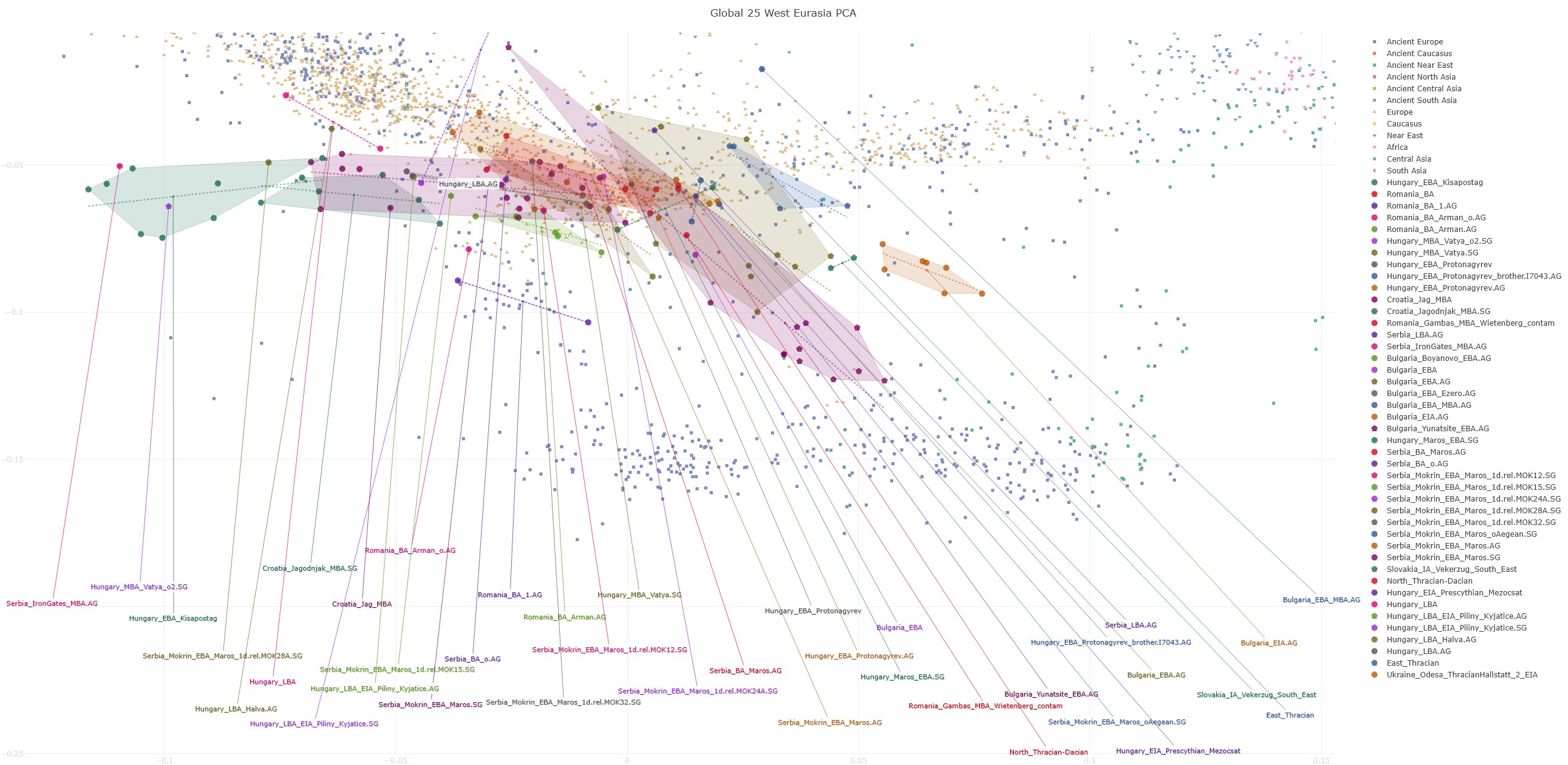
 
To clear the PCA a bit up for the purpose and point to the pattern I have observed, I used primarily relevant EBA-MBA samples to populate the PCA and this shows a clear pattern:

EBA-MBA-Comparison-PCA.jpg


There are two poles, one being Kisapostag, the WHG-rich invaders of the Danubian sphere, and the other end being groups like Nagyrev, Maros without strong Encrusted Pottery-Vatya admixture, Bulgarian EBA groups and at the very end the Southern Thracian samples.

There is no Carpatho-Balkan sample group which really overlaps with with the South Thracians from Post-Psenichevo in particular, but there are a variety of samples and groups from the Eastern Carpathian and Balkan sphere which get close and overlap with Thracian related samples from Mezocsat, Glinoe, Thracian Hallstatt Kartal and get pretty close to the South Eastern outliers from Vekerzug-Chotin.

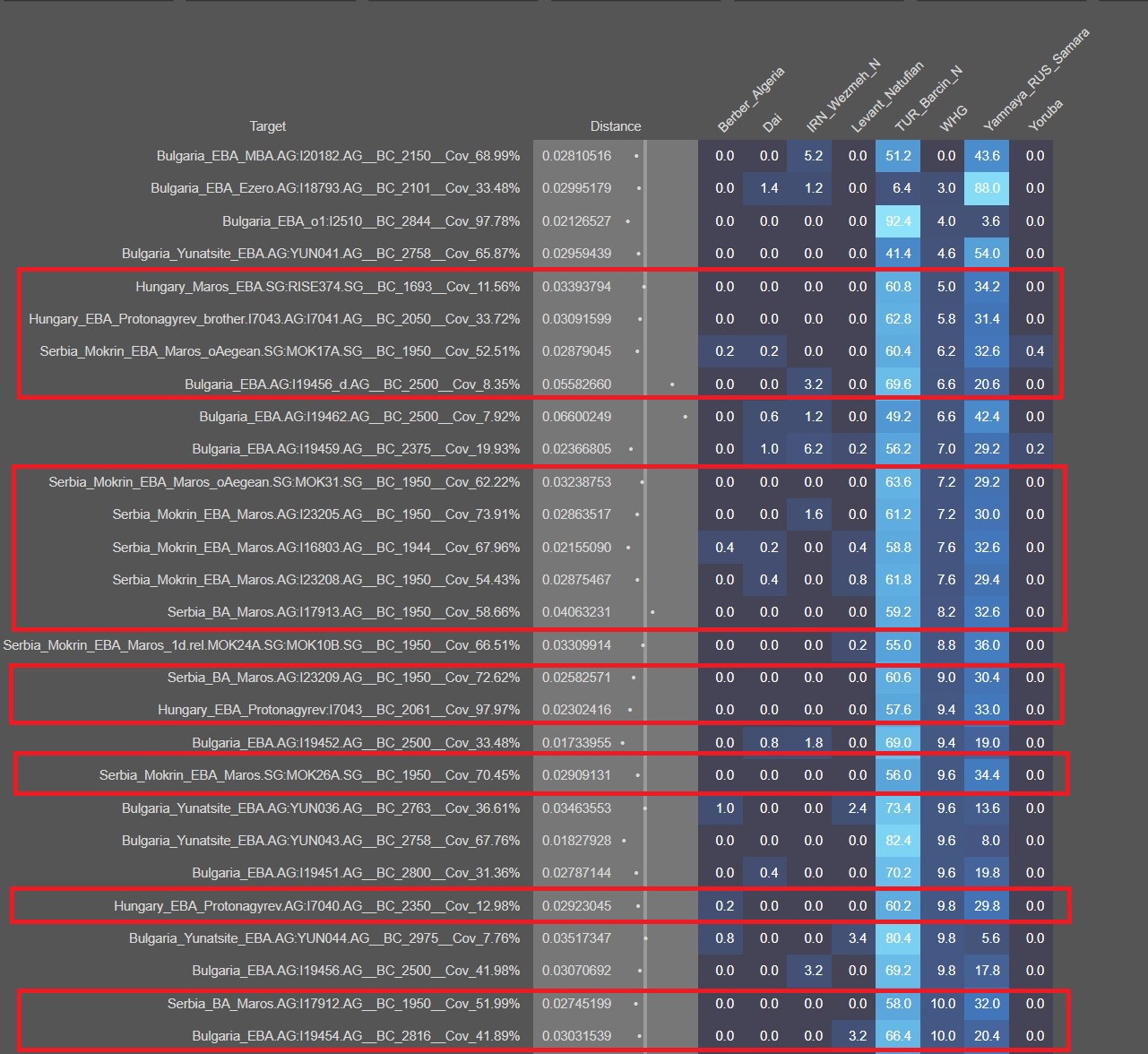
Since the ratio of ANF : WHG : Steppe is so crucial, I made a basic admixture run for those proportions with those sample groups which get closest to the South Thracians on the PCA and then I sorted them by WHG ancestry:

EBA-MBA-WHG-sorted-marked.jpg


After that ranking, I marked those which fulfilled the following requirements:
1) ANF > 55 %
2) WHG < 10 %
3) Steppe between 20-35 %

You get a top ranking group of samples from the following archaeological groups:
1) Proto-Nagyrev
2) Maros from different sites in Hungary and Serbia
3) Bulgarian EBA only one fit with increased Iranian

What I find particular noteworthy is that the Hungarian Maros samples are closer to the standard than the Serbian ones. And I think the reason for that is, that the Hungarians are more derived from Somogyvar-Vinkovci/Vucedol and/or having Cotofeni ancestry, than those from Serbia which are more mixed, have more contacts with Vatya and other high WHG-groups.
The so called "Aegean outliers" are in this respect closer to the Hungarian samples we got, than the average from Serbia, as one can see.

It is also noteworthy, that we have from the other side of the Carpathian mountains, from Monteoru, a similar trend: One sample from Neamt county deviates strongly from the Monteoru standard and basically mimics the proportions we find in the Nagyrev and Maros samples with low WHG.

We therefore have only one question to answer: Is that the Transylvanian-Oltenian core profile, or are these still mixed individuals and the core has still lower steppe/WHG ancestry?

But the trend is absolutely clear: Nagyrev, North Eastern Maros and Western Monteoru all go down and closer to a ratio of about 65 % ANF, 30 % Steppe and 5 % HG ancestry. This is where the trend goes if coming closer to Transylvania.

The only question here is, does the core itself go further down with steppe/WHG, or is the reason for the South Thracian profile primarily admixture in the South East, with Aegean-Anatolian locals.
 
What i have been told by an archaeologist specialized in all of these cultures is that the situation is very complicated and uncertain what really happened.

What we know is that the earliest radiocarbon dated sites of Stamped-Ware are in Eastern Rhodopes and in Eastern Carpathians in Middle Dnieper which makes the situation for now bizarre.
 
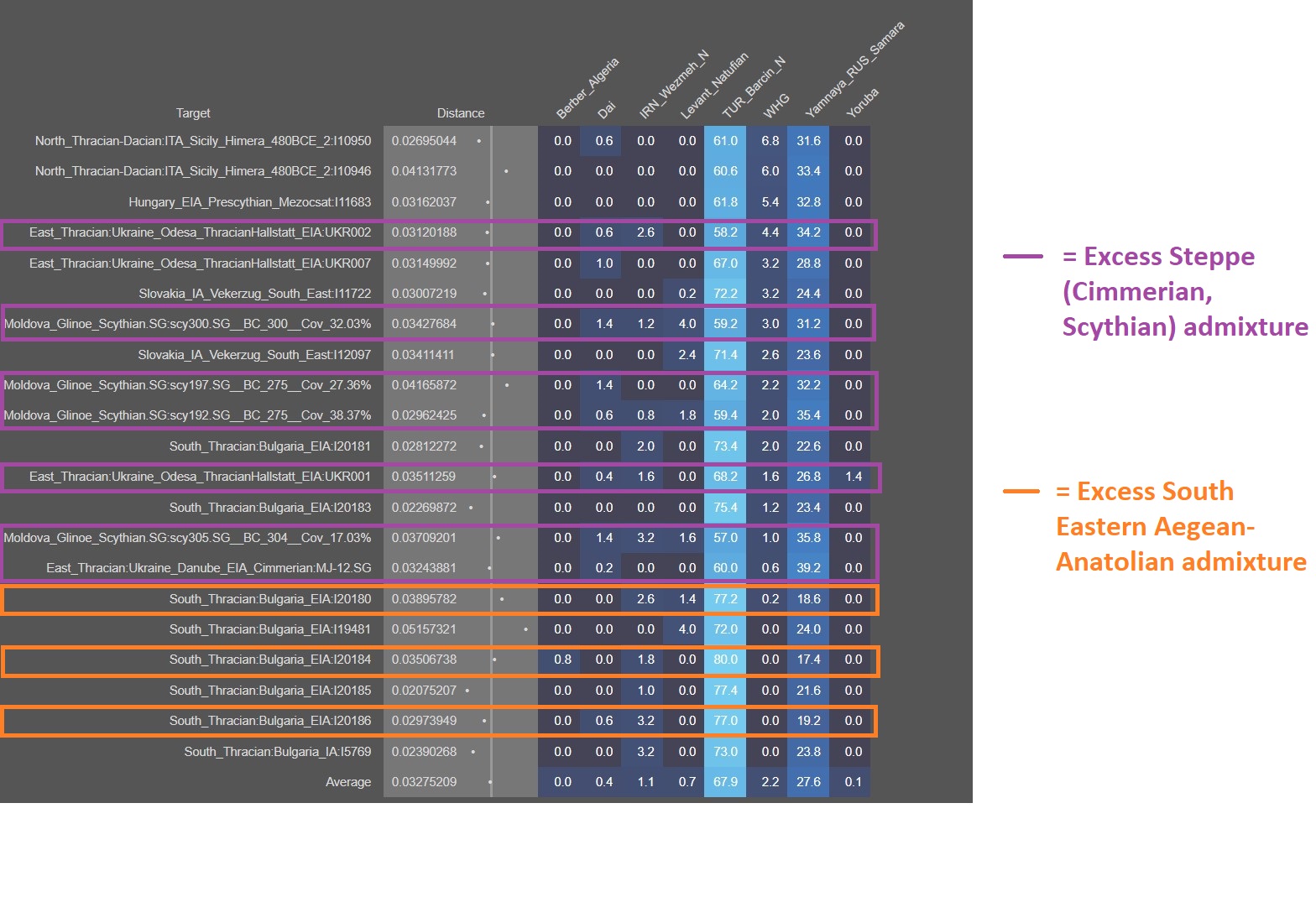
Another point of view emerges if only concentrating on those samples which are confirmed Daco-Thracians by having haplogroup E-V13, sharing IBD segments and/or coming from a Thracian-related archaeological context. I sorted them by the HG proportion, just like the Carpatho-Balkan EBA-MBA samples before and what struck me is how smooth the cline is from the Northern to the Southern samples: Himera -> Mezocsat female -> Thracian Hallstatt -> South Eastern outlier Chothin-Vekerzug -> South Thracians Post-Psenichevo.

Thracian-Samples-Marked.jpg


However, I also noticed that this smooth cline being kind of broken, with deviating ratios for ANF : Steppe : WHG multiple times and those breaks also follow a specific pattern. Basically we get two devaitions from the smooth transition from North to South: One of increased steppe (mostly Cimmerian-Scythian by the looks of it, often combined with non-trivial trace levels of East Asian!) in the East and the other with increased South Eastern Aegean-Anatolian admixture (often associated with increased Iranian-Levantine) which pushes the steppe ancestry down.

What's really amazing about this is, that in the East Thracian Hallstatt sample only one individual follows the expected North to South gradient pattern, and that is UKR007!

He is the ONLY Thracian Hallstatt sample which follows the pattern correctly, without a deviation, and its the only sample with E-V13 from that group!

If we move South, the pattern is almost the same insofar, as among the Southern deviating samples, one is R-Z93, another female, only one E-V13 is in the deviating group, whereas the most typical and higher steppe oriented individuals are E-V13 males (most notably I20181 and I20183).

So what emerges from this trend is a smooth transition of higher to lower steppe/WHG within the Thracian sphere, nothing abrupt or drastic, with individual deviations based primarily on excess admixture from the steppe groups (mainly Cimmerian-Scythian) or the South East (mainly Aegean-Anatolian-Levantine).

The Thracian core in these samples ranges from 60-76 % ANF, 1-7 % HG and 22-33 % Steppe in this most basic model. The trend is pretty clear with higher in the North, lower in the South, but the decline or increase is pretty smooth and not caused by foreign admixture of significance.

Where the ancestral proportions move further up or down, than this range, its in all available instances very clearly associated with additional admixture not associated with the core groups.

That there is additonal steppe admixture in Glinoe and Thracian Hallstatt - not all, but most individuals, is absolutely obvious, as it is pretty obvious that there are non-harmonised, heterogeneous patterns for Aegean-Anatolian-Levantine admixture in the South Thracians.

What this also shows is that we don't have sampled the unmixed core yet. Because even the South Thracians are too heterogeneous and mixed for being the unmxied core population. They have varying levels of Anatolian-Levantine ancestry and foreign haplogroups (R-Z93), with a stronger trend of excess admixture in the females and the foreign haplogroup carrier.

The Thracian Hallstatt sample UKR007 appears so far to be probably one of the most consistent samples of a core Thracian we got, because he has a very specific profile and falls fully into the expected pattern from North to South without deviation - also being an older sample from a clearly Thracian-derived group.

However, the same can't be said about the other Thracian Hallstatt Kartal samples: Again, they show obvious excess foreign admixture and foreign haplogroups (haplogroup C-F22551, which shows zero overlap with E-V13 in general).

It is very, very impressing that both in the East with Kartal and Glinoe and in the South with Post-Psenichevo there is a trend of the less (like Glinoe 197) or not (like UKR007, I20181 etc.) deviating samples to be E-V13 carriers.


If marking (red outline) only those Thracian-related samples with the least deviation from the Thracian pattern, we get this on the PCA:

Thracian-Samples-PCA-Marked.jpg


Note that its pretty even/flat, similar to the general trend in the Carpathian basin from Encrusted Pottery to Maros-Nagyrev locals in the Eastern Carpathian basin and Bulgarian EBA.


It is also pretty obvious that only the E-V13 carrier UKR007 falls really and truly into this wider range Thracian cluster. Most of the Glinoe and Thracian Hallstatt samples we got do not, because they have excess steppe admixture.


Also remarkable that if looking at the North vs. South range of confirmed Thracian-related Early Iron Age samples, the central position being very clearly occupied by UKR007.

These are this top matches by distance in the current data base - in bold those which are earlier or roughly contemporary to him:

Distance to: East_Thracian:Ukraine_Odesa_ThracianHallstatt_EIA:UKR007
0.03039037 Hungary_IA_LaTene_oEast.AG:I18832.AG__BC_260__Cov_57.70%
0.03106481 Hungary_Hács_EMA:Hacs_21__AD_475__Cov_98.16%
0.03187342 Hungary_Transtisza_LSarmation_EHun_oEast.AG:A181027.AG__AD_400__Cov_90.57%
0.03357243 Croatia_Karlovac_BubisCave_Roman:BBC003__AD_275__Cov_70.32%
0.03449422 NorthMacedonia_IA.AG:I10383.AG__BC_657__Cov_68.49%
0.03521312 Slovakia_Roman_IA:CGG021935__AD_236__Cov_67.93%
0.03527865 Croatia_Karlovac_BubisCave_Roman:BBC016__AD_275__Cov_62.77%
0.03567979 NorthMacedonia_IA.AG:I10379.AG__BC_641__Cov_67.04%
0.03583099 Croatia_MBA.AG:I5073.AG__BC_1623__Cov_71.85%
0.03628636 Hungary_Sarmatian:OFU-27__AD_309__Cov_51.38%
0.03706839 Albania_Bardhoc_PostMedieval.AG:I15707.AG__AD_1551__Cov_69.68%
0.03716498 Italy_Tarquinia_Etruscan.SG:ITTQ19.SG__BC_856__Cov_86.09%
0.03723292 Serbia_Naissus_LateAntiquity.SG:R6764.SG__AD_334__Cov_63.45%
0.03724375 Italy_Ordona_Daunian.SG:ORD009.SG__BC_547__Cov_63.09%
0.03758263 Serbia_Mokrin_EBA_Maros.AG:I16803.AG__BC_1944__Cov_67.96%
0.03766529 Greece_Mygdalia_LBA.rel.AG:MYG005.AG__BC_1466__Cov_61.93%

0.03768738 Hungary_MiddleAvar.AG:HNJ003.AG__AD_700__Cov_80.01%
0.03791371 Croatia_LateAntiquity_oEurope.TW:I33889.TW__AD_400__Cov_94.42%
0.03813070 Serbia_Mokrin_EBA_Maros.AG:I23208.AG__BC_1950__Cov_54.43%
0.03827109 Croatia_LateAntiquity.AG:I26767.AG__AD_626__Cov_71.17%
0.03868615 Italy_SouthTyrol_EMA:2069__AD_512__Cov_43.90%
0.03892708 Hungary_IA_LaTene_o.AG:I4998.AG__BC_300__Cov_26.87%
0.03911364 Croatia_Popova_CA.SG:POP39.SG__BC_2676__Cov_83.43%
0.03978154 Slovakia_IA_Vekerzug.AG:I11721.AG__BC_575__Cov_67.68%

0.03981278 Slovenia_Emona_Roman.SG:R10467.SG__AD_322__Cov_67.63%
0.03995472 Italy_Sicily_Marsala_Roman:I24671__BC_127__Cov_61.64%
0.04002697 Serbia_Roman.AG:I15510.AG__AD_200__Cov_47.37%
0.04007685 Hungary_IA_Syrmian_SremGroup.AG:I18259.AG__BC_360__Cov_65.37%
0.04013104 Austria_ViennaBasin_Mödling_Avar:MGS185__AD_775__Cov_66.55%
0.04019493 Croatia_MBA.AG:I4332.AG__BC_1558__Cov_64.59%
0.04022807 Italy_Bivio_Roman.SG:R1555.SG__AD_152__Cov_51.41%
0.04047428 Croatia_Mursa_Roman:OSIJ004__AD_292__Cov_62.03%
0.04048473 Italy_Tarquinia_Etruscan.SG:ITTQ14.SG__BC_980__Cov_87.23%
0.04083607 Croatia_Roman_EarlyImperial_o3.AG:I26703.AG__AD_100__Cov_77.43%
0.04086180 Croatia_EarlyMedieval_Avar.AG:I28392.AG__AD_800__Cov_74.02%
0.04098348 Hungary_SoutheasternTransdanubia_LateAvar:AHPS256W__AD_850__Cov_53.56%
0.04115801 Bulgaria_EBA.AG:I19452.AG__BC_2500__Cov_33.48%
0.04117834 Croatia_Zadar_Roman.SG:R3746.SG__AD_177__Cov_64.39%
0.04140837 Albania_Bardhoc_PostMedieval.AG:I14687.AG__AD_1550__Cov_63.78%
0.04145147 Tunisia_Kerkouane_Punic:I24193__BC_542__Cov_67.93%
0.04148489 Hungary_SoutheasternTransdanubia_LateAvar:AHPS207W__AD_800__Cov_70.69%
0.04152726 Hungary_EBA_Yamnaya_o:I18100__BC_2759__Cov_47.28%
0.04169225 Italy_TarquiniaMonterozzi_IA.SG:R10343.SG__BC_378__Cov_69.61%
0.04181430 Italy_SouthTyrol_EMA:2068__AD_512__Cov_47.57%
0.04185689 Bulgaria_EIA.AG:I20181.AG__BC_800__Cov_74.19%
0.04187752 Austria_ViennaBasin_Mödling_Avar:MGS294__AD_775__Cov_64.68%
0.04195725 Greece_Crete_Krousonas_LBA.SG:kro009.SG__BC_1185__Cov_48.23%
0.04214634 Austria_ViennaBasin_Csokorgasse_Avar:CSK032__AD_750__Cov_75.87%
0.04220966 Croatia_Roman_EarlyImperial_brother.I26708.AG:I26702.AG__AD_100__Cov_76.46%

Basically this confirms his ancestry is most similar to that of expected Cotofeni and/or known Vucedol/Somogyvar-Vinkovci derived and related groups. The only South Thracian sample in the top 50 being, what a surprise I20181! The typical pattern representative from the South Thracian sphere.

What I also find remarkable, even if it might be due to pure chance, is that most of his close matches from Lower Austrian-Viennese Avars (Csokorgasse, Moedling etc.) are also E-V13 carriers.
 
What i have been told by an archaeologist specialized in all of these cultures is that the situation is very complicated and uncertain what really happened.

What we know is that the earliest radiocarbon dated sites of Stamped-Ware are in Eastern Rhodopes and in Eastern Carpathians in Middle Dnieper which makes the situation for now bizarre.

Keep in mind that Stamped Pottery has strong Gáva-related traditions and the time frame doesn't fit with Stamped Pottery anyway.

Also, as you can see, the Thracian Hallstatt, Glinoe and the Post-Psenichevo samples show clear traces of foreign admixture, both autosomally and uniparentally.

The core is more to the West for Glinoa-Kartal and more to the North for Post-Psenichevo South Thracians. This brings us closer to the real core for the Thracian cultures, which is in and around Transylvania, Oltenia primarily and Banat, possibly Western Muntenia secondarily.

Stamped Pottery was, in part, clearly the result of new (partly foreign) influences and ideas meeting earliy ZPC and Channelled Ware-related groups. Part of the equation was also the Encrusted Pottery-Garla Mare influence, without a doubt.

And Basarabi shows a stronger and more lasting Gáva-related Channelled Ware tradition than the Southern derived groups - which had it too, just to make that clear. Early Danubian Fluted-Knobbed Ware and early Psenichevo is not explainable without being at least affected by a Gáva-related source.
 
Concerning the WHG-ancestral proportion, this is the current status based on the available data for the later EBA-MBA:

WHG-Kisapostag.jpg


The main open gaps are Transylvania, Oltenia and the Vatin zone in Northern Serbia.

Vatin is likely to be similar to the Maros locals, but it could go either way and be closer to Vatya too. We really don't know. But based on Maros locals and the mixed Monteoru site in Neamt, Transylvania should be either in the 5-10 % range or below it and for Oltenia the same is likely.

It is absolutely striking that the Eastern Carpathian (Nagyrev and Maros locals) and the mixed Monteoru site from Neamt both have by far the lowest WHG with low steppe. In all other instances, e.g. in Füzesabony, Mierzanowice, most Bulgarian BA samples etc. the decrease of WHG being accompanied by an increase of either steppe or Iranian-Levantine ancestry. Higher levels of ANF (55-75 %) and lower steppe (20-35 %) are usually not what we see in these individuals.

But it is a typical profile in both the Vucedol/Somogyvar-Vinkovci area and the East Carpathian zone, which has Vucedol/Vinkovci and Cotofeni ancestry.

I'm pretty sure about Transylvania-Oltenia, but Vatin is a surprise box so to say. I can't really pin it down right now, because it could be mostly Vinkovci-Cotofeni derived too, or not.

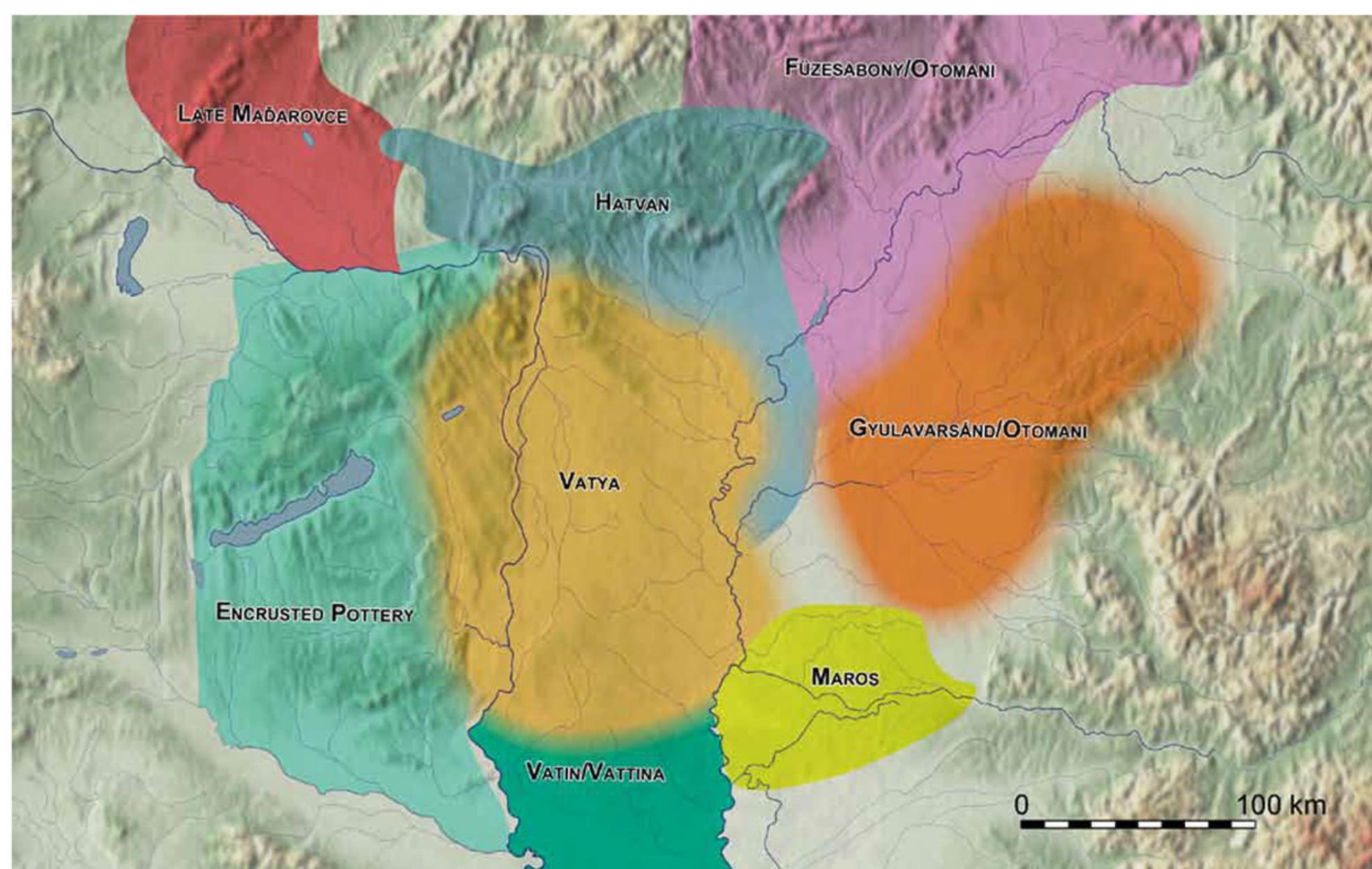
Here is the map for the MBA of the Carpathian basin:
figure_030.jpg


The Füzesabony invaders seem to have mixed with a very Encrusted Pottery-like people, like Encrusted Pottery directly or EP shifted Vatya-Hatvan groups.

Unlike from Maros, we don't have samples from Gyulavarsand yet, but again we have the Maros locals and the previous era Proto-Nagyrev samples, which both make it likely that they were in the same range (5-10 %, low steppe), while its not sure of course.

The general trend in Maros and Nagyrev is however most likely still Vucedol/Vinkovci oriented, therefore we can say that up to around the Tisza local Vucedol/Vinkovci people did survive into the MBA. And we can also say that Cotofeni is also highly likely to have lower steppe/WHG, but it might still differ signficantly from the primarily Vucedol/Vinkovci derived groups (locals in Nagyrev, Maros and most likely also Vatin).
 
Last edited:
rafc pointed me to a mistake I made at genarchivist:

rafcHowever, if you look at the actual data, you will see that SR023 and SR025 have 10 and 14% of WHG, not 5-10% as Riverman shows on his map. But you will also see they don't come from Neamt at all, they actually come from Buzau county, the most Southern site tested for the thesis.
They have about 50-70% of WHG of the Monteoru samples we already had, but they were in fact found only about 1km from those known samles. If I look at the PCA, I also get the impression they plot about the same. So I think the difference might be more due to G25/qpADM differences than anything else, although I don't exclude it's because the ones from the thesis might be younger (in fact SR025, the 10% WHG sample, is not C14 dated and might be much younger).
I'm sure that once the mistake is realized, Buzau will become the most Wietenberg influenced location, and Neamt (where we find the by far most HG-shifted samples, SR064 and SR065) will turn out to have no Wietenberg impact at all.

You are right, I was to careless and made a mistake. Keep in mind though that what I have written before: We have actual two sample groups with relatively increased ANF, one from a Noua context in Neamt (Doina), but obviously heavily mixed, and the other from Buzau (Cindesti). Both are close to the Carpathians, in the highlands:
NTxj56g.png


Cioinagi-Bălinteşti is further away from the Carpathian mountains and has the following results:

The PCA analysis divides the Monteoru culture samples into 3 groups (Figure 34). The first
group, comprised of SR017 and SR022 from the Cîndeşti site plus SR028 from the Cioinagi-
Bălinteşti site, clusters with Yamnaya samples and some Bronze Age samples from the
Steppe and Europe. The second group, comprised by SR023, SR024 and SR025 from
Cîndeşti, cluster between the Neolithic and the Bronze Age in Europe and close to the
Otomani culture samples and SR009. Lastly, SR015 clusters within the major Bronze Age
European cluster. ADMIXTURE (Figure 35) also divides the Monteoru samples into the same
three groups. The group containing SR028, SR017 and SR022 closely resemble Yamnaya
populations with the only difference being the prevalence of the Neolithic component that
is lacking in the Yamnaya. The group containing SR023, SR024 and SR025 resembles
Chalcolithic and Early Bronze Age samples, where the Neolithic component is the major
component, and not Bronze Age samples where the Neolithic is significantly reduces as seen
with SR015. Overall, the Monteoru culture looks to be composed by to groups, one
resembling Yamnaya populations, and another resembling Chalcolithic/Early Bronze Age
population still transitioning fully to Bronze Age. SR0015 resembles an outlier, and this could
be due to its low quality, as mentioned above, or the lack of more samples does not reveal
the true diversity of the Monteoru culture or Cioinagi-Bălinteşti site.


So the highland site population (Cîndeşti) being directly contrasted to the lowland site (Cioinagi-Bălinteşti).

For Neamt county we read the following for the local mixed group in the Noua period from the site of Doina:

The amount of Steppe ancestry component is similar between cultures being the ratio of WHG and ANF ancestry component were the
differences lie. Doina is the site were the Neolithic component remains in higher quantity
with the exception of SR061 that closely resembles Truşeşti and Roman-Neamt samples, a result that parallels the PCA one

Doina is No 12 on the map.

Source: https://pure.hud.ac.uk/ws/portalfiles/portal/67174267/FINAL_THESIS.pdf

Another thing I noticed while going through the ancient samples we got is this sample:
NorthMacedonia_BA.AG:I7231.AG__BC_1219__Cov_74.04%,0.132035,0.149283,0.010182,-0.02261,0.027697,-0.006414,0.00423,-0.002769,0.002863,0.033349,0.003573,0.006594,-0.010258,0.002064,-0.018458,0.001724,0.004433,0.002027,0.007416,-0.006253,-0.016596,0.008161,-0.003821,-0.001928,-0.003113

I noticed it being very close to the central portion of the "smooth cline" between Northern and Southern Thracian-related groups, fairly close to the Thacian Hallstatt E-V13 with the least amount of extra steppe admixture of all Thracian Hallstatt Kartal samples. He is from the Ulanci group and while we discussed this group before, I thought its worth to investigate a bit more.

First, the Ulanci group was strongly Aegean influenced culturally, but it also shows a lot of Central European traits. Concentrating on the material culture, we can read:

Here we will focus on the large number of newly discovered pins, which represent an important corpus of finds, and which were mostly discovered at the Dimov Grob cemetery in closed archaeological complexes-graves. So far, over forty pins have been discovered, the main feature of most of them is that they are part of a large group of pins with a perforated neck. All discovered pins are dated to the Late Bronze Age, and as forms are widely distributed in Central Europe. But there are variants of pins which, despite being typically Central European, no longer have their classical characteristics and form their own local features. It is also important to emphasize that the pins of the Ulanci group represent a border zone, since they correspond to the southernmost borderline of the distribution of the corresponding pin types of northern origin, and temporally correspond to the last phase of their use further north.

A group of pins with a pressed double-conical head (Nadeln mit doppelkonischen kopf und profililiertem kopfende) is represented by a single specimen that comes as a chance find from the Mali Dol necropolis (Pl.2,1).9 This group of pins has numerous variants, and the pin from Mali Dol is a variant with a small double-conical head with horizontal ribs performed as a decoration on the head. This type of pins is widespread in Germany, Austria, Moravia, Slovakia and less frequently in Hungary and Romania. In the Balkans, they have been discovered in Slavonia, Srem, southern Banat and northern Serbia along the Danube. Our pin can be connected to the Morava Valley, especially the areas of Jagodina and Paračin, which represents the center of these pins, but they are smaller heads, so it can be assumed that our pin is also part of this regional group.

The dating of the group of club-headed pins is the beginning of the Late Bronze Age (Bz D to Ha A I), and the distribution is wide from Bohemia, Moravia, Slovakia, Austria, Bavaria, western Hungary, Slavonia, northern and eastern Bosnia and Romania. In Serbia, it occurs in Srem, Banat and northern Serbia and sporadically occurs in the Drina and Morava valleys,22 and with new discoveries, the Vardar valley as well.

The pins of this group are locally produced products, imitating the Paarstadl type, which is widespread in central Europe, where the type is dated to the Lohharn phase (Bz B) of the Tumuli culture, and originates from the northwestern Carpathian Basin.6 Vasić dates the pin from grave 26 at Dimov Grob to the LH III B period.7 These pins can be associated with southern influences of the Tumuli culture, so our samples would represent the southernmost borderline of the distribution of the Paarstadl type.


All of this made me wonder whether there is a connection of Vatin and Maros to the Ulanci group too. Fortunately, the sample was assigned by FTDNA to the haplogroup:

And this branch is packed with Maros samples. It has a TMRCA of around 3000 BC, so we can't be sure about its older distribution, but I couldn't find an older sample than those from the Maros group.

Everything considered, it is worth to further investigate whether we have a movement from the Banat-North Serbian region, from around Maros and Vatin, to Macedonia, an at least contributing element to the Ulanci group - which area was later disrupted by incoming Belegis-related groups like Brnjica and Belegis II-Gáva.
 
Keep in mind that Stamped Pottery has strong Gáva-related traditions and the time frame doesn't fit with Stamped Pottery anyway.

Also, as you can see, the Thracian Hallstatt, Glinoe and the Post-Psenichevo samples show clear traces of foreign admixture, both autosomally and uniparentally.

The core is more to the West for Glinoa-Kartal and more to the North for Post-Psenichevo South Thracians. This brings us closer to the real core for the Thracian cultures, which is in and around Transylvania, Oltenia primarily and Banat, possibly Western Muntenia secondarily.

Stamped Pottery was, in part, clearly the result of new (partly foreign) influences and ideas meeting earliy ZPC and Channelled Ware-related groups. Part of the equation was also the Encrusted Pottery-Garla Mare influence, without a doubt.

And Basarabi shows a stronger and more lasting Gáva-related Channelled Ware tradition than the Southern derived groups - which had it too, just to make that clear. Early Danubian Fluted-Knobbed Ware and early Psenichevo is not explainable without being at least affected by a Gáva-related source.

You cannot never be sure about the direction of influence, even if channeling/fluting appeared among Gava first and Proto-Psenicevo, the first appearance of knobs and channeling/fluting as technique was at EBA Balkan culture Bubanj-Hum III, if u want to connect the dots solely on that you can do it but it is too vague.

IMO both you and rafc are off the charts, i read rafc equating Monterou and Wietenberg which fundamentally are two different cultures in material culture. He undermines too much.

I think E-V13 spread with Balkan-Carpathian traditions, people spread around Danube between Balkans and Carpathians and everything fits IMO, there might have been E-L618 spread more south in Aegean who participated in small numbers, but the core E-V13 wasn't that north or that south, it was right there on both sides of Danube not too far from either side.
 
You cannot never be sure about the direction of influence, even if channeling/fluting appeared among Gava first and Proto-Psenicevo, the first appearance of knobs and channeling/fluting as technique was at EBA Balkan culture Bubanj-Hum III, if u want to connect the dots solely on that you can do it but it is too vague.

IMO both you and rafc are off the charts, i read rafc equating Monterou and Wietenberg which fundamentally are two different cultures in material culture. He undermines too much.

I think E-V13 spread with Balkan-Carpathian traditions, people spread around Danube between Balkans and Carpathians and everything fits IMO, there might have been E-L618 spread more south in Aegean who participated in small numbers, but the core E-V13 wasn't that north or that south, it was right there on both sides of Danube not too far from either side.

The issue here is that we have a split of the Northern vs. Southern groups fairly early, definitely before 1800 BC. If the groups which moved to the Rhodopes from the Danube lived in the same populaton still by around 1800-1600 BC, this pattern is not explainable. Rather, we have an earlier split probably from the late Cotofeni horizon.

What we need for E-V13 is a population which was largely separated from other groups, barely mixed, and developed on its own, before expanding. Currently I see no better candidate for that than the core Cotofeni groups:

Co%C8%9Bofeni_culture.jpg


As you can see, they extended from the Danube to Transcarpathia with a centre around the Apuseni mountains.

The only issue I still have is with E-BY3880, because it split fairly late. Main candidates are Nyirseg, late Post-Cotofeni groups (like Livezile) or Glina-Schneckenberg.

Currently, I think the Post-Cotofeni horizon is probably the most likely - since it contributed to the emergence of both Eastern Otomani, but especially Wietenberg and Verbicoara. Glina-Schneckenberg and Nyirseg are good candidates too though, but Glina-Schneckenberg was hit too hard by the incoming WHG-I-P222 groups probably.
 
Why the Danubian area is out - we got samples from there, and they are Cernavoda or from the WHG-rich I2 people. This individual from Pietrele is representative, it is not a typical Cernavoda individual:

Target: Romania_PietreleMaguraGorgana_Gumelnita_EBA.AG:PIE078.AG__BC_3193__Cov_25.96%
Distance: 3.2095% / 0.03209489
73.0 TUR_Barcin_N
15.8 WHG
10.0 Yamnaya_RUS_Samara
0.8 Dai
0.4 Yoruba

It rather looks like a mixed up group of Tripolye-Cucuteni and GAC with steppe admixture from my point of view, so a general North to South migrant from the described GAC-TCC sphere of interaction. For a typical Cernavoda the steppe is too low, Iranian is absent and WHG too high. But yet we don't have Southern Cernavoda samples also.

Cernavoda groups are also likely to have moved through Thrace and into Anatolia, in my opinion, but again we have a sampling gap.

Ezero is very problematic indeed, because culturally its part of this Carpatho-Balkan sphere, yet the sample we got are just those WHG-rich people or Yamnaya (similar to Monteoru, just different ratios). But you are absolutely right that we can assume the bulk of Bulgaria being inhabited by people like the one from EBA Pietrele, I mean the Yunatsite samples are all like it, with an average of: 74.3 ANF 11.4 WHG 12.4 Steppe

That kind of increased WHG and low steppe is typical for this sample in Pietrele and Yunatsite, but also other Bulgarian EBA samples. What makes Tell Yunatsite so special is that we have a good number of samples from both the late CA (Gumelnita) and the EBA.

The average for the CA is: 1 Iranian 0,5 Levantine 93.8 ANF 1.6 WHG 3.0 Steppe
The average for EBA is: 74.3 ANF 11.4 WHG 12.4 Steppe

These are clearly two completely different populations! I mean that's 7 times HG ancestry and 4 times steppe. What's also noteworthy is that they had Iranian admixture, low but higher than in the older Salcuta and Gumelnita samples. This means they could have had Cernavoda admixture, bringing in low level steppe and Iranian.

So we see in Yunatsite Cernovada coming in, mixing with local Gumelnita-Karanovo people first, and then we see this WHG-richer group replacing these locals or heavily admixing with them.

We can assume that this represents Ezero, the Pietrele sample in Southern Romania is first, then we see it in Yunatsite. That's why I have put it that way on the map:

0-P3-BCH8htxg-BEyws-Kisapostag.jpg

74.3
11.4Bulgari
12.4f

Bulgaria was covered, at least to the Rhodopes, by this WHG-rich impact. Not the same groups as in Monteoru or Hungarian-Serbian Kisapostag, but a related group which had, without doubt, significant GAC-HG admixture.

If we check the other EBA to early MBA samples from Bulgaria, and removing the increased steppe outlier, we get this average:

2.8 Iranian 0.7 Levantine 64.8 10.8 20.5

What this means to me is that the Cernavoda-derived element survived. It wasn't gone but mixed with these WHG-rich newcomers, resulting in the EBA-MBA local Bulgarian profiles in some sites. Like I19454 is "the most average looking" EBA sample from Bulgaria, and he is from Stara Zagora:

Territory: Bulgaria - Tell-Kran (province Stara Zagora, municipality Kazanlak)
Molecular Sex: M
Datation: 2901-2700 calBCE (4220±25 BP, PSUAMS-13517)
Skin: N/A
Hair: N/A
Eye: N/A
Predicted Y-DNA: I2a1a2b
Predicted mtDNA: U8b1b

TUR_Barcin_N: 45.48 %
TUR_Tepecik_Ciftlik_N: 25.58 %
Yamnaya_RUS_Samara: 16.97 %
WHG: 11.24 %
Nganassan: 0.72 %


His haplogroup is https://discover.familytreedna.com/y-dna/I-L621/tree

So while he has Cernavoda-Karanovo admixture, by the looks of it, his paternal side is the same as that from Tell Yunatsite. This proves these WHG-rich I2 dominated people had completely taken over. They mixed with locals, but they were the dominat force. And we have the same haplogroup from Monteoru!
But it doesn't stop there, we also have an overlap of Monteoru and Yunatsite/Kran (= Ezero) sites:

The increased WHG and the same haplogroups prove that the ancestors of Monteoru and Ezero are, in their core, the same people.


Also again, the two sites Pietrele and Tell Kran, Tell Yunatsite are pretty far apart, but we see a fairly homogeneous base population which received varying degrees of local admixture. Like Tell Yunatsite is a carbon copy from the North, while Tell Kran shows some variation and local admixture.

And again, we know that this incursions from the GAC-HG rich groups were stopped primarily in Transylvania and around Oltenia. The rest of the area in the Eastern Carpatho-Balkan sphere was completely covered.

This makes Ezero such a bad candidate, because it was not just affected, but completely taken over by these GAC-HG admixed people from the North in the EBA.
 
Last edited:
This I2a and WHG is a circular logic, and very bad IMO, if u go by that faulty logic one should expect the more north or west you go even more WHG should increase by populations, but that is not the case, Pannonia-Carpathia was a place where a particular group increased and bloomed. Why shouldn't isolated populations reside somewhere close to it? Do you see the faultiness of this logic?

Danubian Delta/Lower Danube is by no means excluded, you have Coslogeni Culture over there, who mixed with Noua-Sabatinovska to create Noua-Sabatinovska-Coslogeni complex, kinda related to Zimnicea-Plovdiv-Cherkovna Complex, i wouldn't exclude this, nor nearby Iron Gates, even Rhodopes, you never know. But my intuition tells me it has to be between Haemus Mons and Carpathian Mountains with the Danube river inbetween, that is a very strategic location.

For example, Dubene necropolis in Central Bulgaria in Haemus Mons is a very promising EBA candidate for E-V13: http://www.aegeobalkanprehistory.net/index.php?p=article&id_art=3

EBA III = roughly 2500–2200 BC matching E-V13 TMRCA rise.

As u can see Dabene is literally untouched and untested, nor related cultures yet they were super-important: https://naim.bg/contentFiles/Arh_2005_14_summary_14.pdf

The Dubene necropolis is very peculiar stylistically material culture, it has analogies even with Cotofeni Culture in Romania.

Marginally, and to over-simplify (not really precise archaeological) it fits some patters: low tumuli, pits, cremations, gold smithing traditions rivalling EBA Troy, right location to expand both north (toward Carpathians) and south during MBA-LBA (toward Aegean Thrace).
 
Last edited:
What you need is a successful legacy and potential and ancestral relationship to the known Thracian cultures.

The I2/WHG-rich debate is important in itself and for E-V13 to explain why the descendants of Horodistea and Kisapostag were different.
Like it is not a general pan-Carpathian or pan-Balkan phenomenon, but it affected those groups with significant ancestry from these main sources.

It is absolutely clear to me that the Pre- to Proto-Thracians with E-V13 came from Cotofeni or Cotofeni-Vucedol.

Probably just chance, but did you notice that all the Albanian-Illyrian oriented writers don't comment on E-V13 any more?
I really wonder whether they had contacts to the Transylvanian papers authors. I also remember corrigendum playing Wietenberg down, like if its not really relevant in the wider sense. This also made me wonder about inside knowledge, since I would assume the authors provide information to colleages...
 
Personally, I might be wrong here, but i have found a good candidate of E-V13 in late EBA beginning of MBA.


Karlovo region and the necropolises there are very important and connect well Anatolia with Central Europe, it was a crucial part.

Based on leaks that have been exposed (if we trust), they could have been Late Chalcolithic arrivals from further north (Chalcolithic Ukraine), I2a + E-L618 who formed Yunatsite Culture and related Late Chalcolithic cultures, but the people from Dabene and Karlovo region both north and south of it could have been exclusively E-L618/E-V13 who positioned themselves quite well and survived EBA and then in MBA-LBA-EIA even managed to overpower Yamnaya groups.
 
Personally, I might be wrong here, but i have found a good candidate of E-V13 in late EBA beginning of MBA.


Karlovo region and the necropolises there are very important and connect well Anatolia with Central Europe, it was a crucial part.

Based on leaks that have been exposed (if we trust), they could have been Late Chalcolithic arrivals from further north (Chalcolithic Ukraine), I2a + E-L618 who formed Yunatsite Culture and related Late Chalcolithic cultures, but the people from Dabene and Karlovo region both north and south of it could have been exclusively E-L618/E-V13 who positioned themselves quite well and survived EBA and then in MBA-LBA-EIA even managed to overpower Yamnaya groups.
That area was surrounded by samples we got from the Cernavoda-Foltesti/Ezero horizon, like Tell Kran, Tell Yuntsite and Pietrele.

Anatolian influences go as far as Salcuta and Cotofeni by the way, partly transmitted by these Cernavoda-Horodistea-Foltesti groups.
 
I should also add that even Livezile had some Horodistea-Foltesti influences, which is part of the differentiation from earlier Cotofeni, which had very little to none. So it will be interesting to see how much of Horodistea-Foltesti influence reached the area in the developed EBA (after Cotofeni). Crucial here is of course Western Transylvania and South Western Transylvania Banat and Oltenia.
Its just a pity that we don't have the samples from Transylvania yet, because even if they wouldn't be E-V13, it would tell us so much about the wider Carpatho-North Balkan sphere, since these groups had the various contacts.
But again, if following the abstract literally and under the assumption that it has to be taken literally, if they really mean continuity from the Copper Age, it means from late Bodrogkeresztur-Salcuta and that means very high EEF, very low WHG. Not as low as in South Thracians, but so low that limited Aegean-Anatolian admixture could bring them there.
Especially to the position of the core samples of the male E-V13 carriers, which had noticeably more WHG and steppe than the other South Thracian Post-Psenichevo samples, among which is just one E-V13, the others are females and R-Z93.

The only factor for doubt is that some authors had claimed "genetic continuity" for regions and populations when this was absolutely not the case. Like just because steppe didn't increase to more than 30 %, it was continuity, even if the ANF : WHG ratio changed dramatically from say Cotofeni to Livezile and Soimus.
I mean I don't think the experienced author specialised on the topic would make that mistake, but who knows...
 
I used this map:

To illustrate the local Copper Age survival zone vs. those zones of high impact of Horodistea-Foltesti and Kisapostag-related groups, plus the migration routes which seem to be well-documented at this point by ancient DNA evidence.
Note that it remains open whether Kisapostag which expanded into Transdanubia migrated along the Danube South primarily or used primarily a Northern route - different studies and scholars suggest different solutions to the problem. Fact is, they came from the Eastern Globular Amphora groups with high local hunter gatherer admixture.
Horodistea-Foltesti being late Tripolye-Cucuteni with Cernavoda and also limited GAC-HG admixture.

Early Cernavoda (and Usatovo on the other hand had, like shown before, a different profile with low HG ancestry and a bit of Caucasian-Anatolian admixture instead.

Here is the commented map:
SEE-Eneolithic-cultures-2-Horodistea-Kisapostag.png


Note that the influence of late Salcuta on late, Southern Bodrogkeresztur-Tiszapolgar being archaeologically well-documented and we also see it in the Bodrogkeresztur-Tiszapolgar samples, with outliers with decreased WHG ancestry. And this despite the fact, that these samples are all from the North, not from the South, from the Banat and Southern Transylvania, where this impact was far greater.

One story is how much Horodistea-Foltesti did influence Livezile, since there were cultural contacts in the post-Cotofeni horizon, after the arrival of Yamnaya.

Another is whether Glina was primarily Cotofeni derived, or had strong Foltesti and GAC-HG influences like later Monteoru did. I tend to say Glina was mostly Cotofeni derived, but we don't know for sure.

A similar situation is with Vatin in the West, which bloomed exactly at the highway between the two big WHG-rich movements in the West (Kisapostag, Encrusted Pottery, Vatya) and East (Horodistea-Foltesti, Monteoru, Ezero). Even samples nearby from Maros and Middle Bronze Age Serbia having increased WHG ancestry from the Kisapostag sphere primarily. Could it still have been rather Vucedol-oriented and having received a pulse from the Cotofeni sphere, from Balta Sarata and Glina, Verbicoara?

Hard to tell without testing.

But again, in Bulgaria the local Gumelnita-Karanovo formation seems to have been completely broken up by Hoodistea-Foltesti already and this results in a very bad fit for the later Thracians, both North and South.

The primary focus is therefore most definitely on the Transylvanian-Oltenian Cotofeni-derived block and secondarily on the Central Balkan groups which being also the result of Vucedol-Cotofeni and earlier Gumelnita-Karanovo, Bubanj-Salcuta survival nests. They are however rather too small demographically, have no good fit for the material culture and being under foreign influence or having been in territories which were not Thracian later.

All of this doesn't mean that the Lower Danube is out for the Late Bronze Age by the way, of course not, but for the EBA to early MBA. The difference lies in the formaton of Glina-Schneckenberg (unsure) and Verbicoara (likely) and Tei (unsure) in the area, which are quite likely to have been more Cotofeni and Cotofeni-Vucedol derived than the EBA-early MBA groups.
If they are, this would mean a push-back of Horodistea-Foltesti/GAC-HG influence.

Worth to mention that a lot of the territory initially occupied by Horodistea-Foltesti being conquered by Yamnaya - as you can see e.g. on these figures I showed before:

There are also more detailed maps which show a high impact of Yamnaya on nearly all the Northern Horodistea-Foltesti areas, but a low one on the Southern ones (in yellow on the 3300-2000 BC map, especially Ezero). The Yamnaya impact was also low on the main Cotofeni and Northern Vucedol groups (like Livezile, Soimus, Rosia, Copaceni, Nyirseg etc.).

But the middle zone, the zone later occupied by Vatin-Verbicoara-Tei was nearly completely covered by Yamnaya finds. This creates the opportunity for the Cotofeni and Cotofeni-Vucedol derived groups to have pushed what remained in those areas back from the highlands. Which would be also in accordance with the spread of Cotofeni- and Northern Vucedol derived cremation rites in these groups.

Another rough sketch for the Yamnaya site distribution in the Carpatho-Balkan sphere:

images


Larger map in this paper:

Compare also:

map-of-the-Yamnaya-area-base-map-Cezar-Buterez-map-of-mounds-investigated-in-Romania.jpg


Note especially that Oltenia, Northern and Southern Transylvania being almost "Yamnaya free". There are only sites in the centre of Transylvania.

More detailed maps, showing that Nyirseg, Northern Transylvania, Southern Transylvania and Northern Oltenia being practically free of Yamnaya proper sites:

Areas like Nyirseg (Nyirseg-Sanislau culture), Northern and Southern Transylvania (Cotofeni and its descendants like Livezile, Copaceni, Soimus, Rosia etc.), much of Oltenia (Cotofeni, later Glina) and Southern Thrace closer to the Rhodopes (Ezero) being largely left out, and its from these zones which were "left out" from which the locals returned and pushed Yamanya back.

Worth to mention that Monteoru territory was covered by Yamnaya, and they also had, going by the paper on Monteoru and Noua, R-Z2103 haplogroup more frequently, just like Maros territory, which was covered as well.

This is also what the archaeology shows, that Hordistea-Foltesti/Late Cernavoda was disrupted by Yamnaya and some groups fled towards South Eastern Transylvania, where they mixed with local Cotofeni groups to some degree and influenced them. But overall they were disrupted and degraded.
This means they had probably more limited continuity in the regions close to the Danube, in which the Yamnaya sites bloomed.

Glina was probably not homogeneous, but it could have been more Western/Northern (Cotofeni and Cotofeni-Vucedol) influenced rather, despite earlier intrusions from the North East.

The Salcuta influence on Bodrogkeresztur being mostly associated with the so called "Scheibenhenkel"-pottery and the Hunyadihalom-culture within the wider Bodrogkeresztur phase:

Map-of-the-Hunyadihalom-Laznany-culture-and-occurrence-of-the-Scheibenhenkel-handles-in.png

Abstract associated with the map:

In the light of new radiocarbon chronology of the Hunyadihalom-Lažňany horizon (ca. 4200 –3800 BC, according Raczky, Siklósi 2013; ca. 4000 –3800 BC according Brummack, Diaconescu 2014), the date of grave 7 from Książnice corresponds well to the ceramic inventory with the characteristics of the Hunyadihalom-Lažňany horizon. The presence of the Hunyadihalom-Lažňany influences in Lesser Poland in the late 5th and 4th millennia BC forces us to pose the questions about their role in the spread of “Chalcolithic” attributes north of the Carpathian Mountains. There is clearer support for the thesis that the new cultural trends, which were expressed by the sepulchral ideology borrowed from the area of the Carpathian Basin emphasizing the elitism of burials, drawing clearer distinctions between the sacred and the profane in the spatial sense, and strongly emphasizing sexual dimorphism, could be to a greater extent the result of the influences of the Hunyadihalom-Lažňany horizon, and not just – as has traditionally been accepted – of the Tiszapolgár and Bodrogkeresztúr cultures.

Source: https://www.researchgate.net/public...an_cultures_north_of_the_Carpathian_Mountains

There is an ongoing debate on how strong the Salcuta influence was in this Hunyadihalom cultural group. But undeniable is the strong influence as such. Hunyadihalom-Lažňany is also one of the first formations which
a) had cremation burials
b) a tradition which can be continued into the Cotofeni period in Transylvania

The Scheibenhenkel phenomenon goes beyond Salcuta and Hunyadihalom-Lažňany, it is not restricted to those groups, but Salcuta was among the first producing such ceramics and its being associated with "Southern influences".

More crucial is that we have a clear chronology of events and a clear pattern of Salcuta expanding into Bodrogkeresztur territory, into Banat and Transylvania.

One author says is clearly:

Das Vorkommen der die Hunyadihalom-Keramik kennzeichnenden Elemente in den Gräberfeldern der Bodrogkeresztúr-Kultur kann allein nicht dem Erscheinen von neuen und größeren Volksgruppen im östlichen Karpatenbecken, sondern vielmehr südlichen und südöstlichen Wirkungen zugeschrieben werden. Die Ergebnisse der Siedlungsforschungen (z. B. TiszafüredMajoros83, Tiszalúc) dürften zugleich die Ankunft von kleineren, eingewanderten Gruppen aus vom Balkan nicht ausschließen.

Die ähnlichen typologischen Merkmale (Gefäßformen und Verzierungen, Scheibenhenkel usw.) im östlichen Teil des Karpatenbeckens (von Lažňany über die Bodorgkeresztúr-Kultur bis Vajska und noch weiter nach Süden), können in erster Linie den Wirkungen und Gegenwirkungen zwischen den verschiedenen Gemeinschaften des untersuchten Bereiches zugewiesen werden und auch das „Scheibenhenkel-Phänomen” ist als ein Beweis der überregionalen Beziehungen zwischen dem Balkan und dem Karpatenbecken zu behandeln.

Source: https://www.academia.edu/31419565/TISZAPOLGÁR_BODROGKERESZTÚR_HUNYADIHALOM_WIRKUNGEN_UND_GEGENWIRKUNGEN_AM_ENDE_DER_HOCHKUPFERZEIT_IM_OSTKARPATENBECKE

Therefore elements from the Balkan migrated into Tiszapolgar-Bodrogkeresztur territory, primarily from Salcuta, which resulted in the formation of the Hunyadihalom group and the spread of the Scheibenhenkel-phenomenon Northward.

Again, this Salcuta-related influence is clearly visible in the samples from Bodrogkeresztur-Tiszapolgar, with a trend towards individuals with much reduced WHG ancestry compared to the average. And again, we can just assume that later samples and samples from the South would have still increased such influence.

Individuals with decreased HG ancestry from the large Bodrogkeresztur sample are e.g.:
I20809 (has Yamnaya and ancestry and resembles Gumelnita from Pietrele) and I7132.
https://www.exploreyourdna.com/sample/romania/i20809.htm Female with low level steppe admixture, similar to some of the Gumelnita phase Pietrele samples.
https://www.exploreyourdna.com/sample/romania/I7132.htm Unknown sex (fully typical Salcuta, pre-steppe admixture Balkan Copper Age group representative).
https://www.exploreyourdna.com/sample/romania/I7128.htm Unknown sex (probably mixed?)

All are from North Western Romania.

We have therefore the clear indication for Northern groups from Tripolye-Cucuteni and GAC-HG groups marching South with Horodistea-Foltesti, forming Ezero in South (!) Thrace and at the same time we see Gumelnita-Salcuta related groups marching into the Banat, Oltenia, Transylvania, even with infiltrations as far as Eastern Slovakia and Southern Poland.

If you want so, this was kind of an exchange in both directions, since the Danubian groups were pushed and pushing themselves North, whereas the Moldovan-Forest steppe groups pressed South on a grande scale.


And again this is not mere speculation, it is well-documented both by the analyses of the archaeological, material culture, as well as the genetic data. The samples from Bodrogkeresztur leave no doubt of individuals having "Southern" admixture from the sphere of Salcuta-Gumelnita and the samples from EBA Pietrele, Tell Kran and Tell Yunatsite leave no doubt whatsoever that Horodistea-Foltesti groups did replace to a large extent the local Gumelnita-Karanovo people of South Eastern Romania and Bulgaria, forming Ezero as a consequence of this replacement and admixture event.

These two groups, Bodrogkeresztur proper and Hunyadihalom-Lažňany, were not really separated, but were in constant contact and interaction with each other - this suggests gene flow and exchange of cultural packages. It also represents only the first pulse from the wider Salcuta sphere, the later one was associated with Salcuta's end phase and Cernavoda, with movements from Oltenia into Transylvania.
 
Last edited:
The core Cotofeni zone received multiple pulse migrations from the Salcuta sphere:

1) Hunyadihalom-Lažňany expansion from Salcuta, "Scheibenhenkel" horizon which blended-mixed into local Bodrogkeresztur on the long run. These would be very high ANF-dominated people bringing WHG in all affected Tiszapolgar-Bodrogkeresztur areas down.
2) Late Salcuta and Gumelnita groups, presumably similar to Pietrele Magura Gumelnita phase, with some steppe-Cernavoda admixture already
3) Regional Cernavoda groups, from the North Danubian zones of Oltenia-Muntenia in particular, which were again mixed Salcuta with actual Cernavoda

To test this hypothesis with another method, I created a custom PCA - source:

Yamnaya_RUS_Samara,0.1255849,0.089028,0.0426986,0.1153479,-0.0287232,0.0450564,0.0036033,-0.0025642,-0.0559032,-0.0728943,0.0018222,3.32e-05,-0.0026924,-0.0233041,0.0366141,0.0157633,-0.0012316,-0.0017879,-0.0038408,0.0137704,-0.0031749,0.0007557,0.0110649,0.0186102,-0.004537<br>WHG,0.1246365,0.116278,0.184789,0.189279,0.1546445,0.0464355,0.0131605,0.0372675,0.0890705,0.017768,-0.0153455,-0.015811,0.0159065,-0.0030275,0.053338,0.0582065,0.00502,0.016343,-0.0093015,0.055589,0.0944585,0.0111905,-0.049607,-0.160866,0.0170045<br>TUR_Barcin_N,0.1175998,0.180118,0.0035312,-0.101158,0.0510443,-0.0483875,-0.0043582,-0.0069334,0.0362287,0.0807473,0.0079718,0.0118803,-0.0234545,0.0004691,-0.0419807,-0.0101913,0.0233091,0.0019866,0.0136954,-0.0097489,-0.0142249,0.0057723,-0.0041232,-0.0031658,-0.0043437<br>IRN_Wezmeh_N,0.037562,0.072103,-0.165556,-0.016473,-0.11756,0.01506,0.017861,-0.003231,-0.071583,-0.046835,0.003085,-0.003147,0.00669,0.000688,0.022122,0.053036,-0.011735,0.001014,0.014581,-0.035267,0.009358,-0.023741,-0.006655,-0.032896,0.019998<br>Dai,0.0156507,-0.438709,-0.046763,-0.0609662,0.1201762,0.0622622,0.00047,-0.0073845,-0.0189698,-0.013121,0.0109208,0.0020232,-0.000446,-0.006193,0.0012895,0.0045742,0.0061282,-0.0009502,-0.0043368,-0.011662,0.0121972,0.0090268,0.0149438,0.002892,0.007095<br>Levant_Natufian,0.020488,0.1431895,-0.0377125,-0.1387295,0.030775,-0.079484,-0.025616,-0.0175375,0.114329,0.002005,0.0332085,-0.0222555,0.076486,0.002133,0.0153365,0.009016,-0.0154505,-0.001014,-0.02206,0.040832,0.001497,0.0001235,-0.003636,-0.0044585,0.006287


Then I threw most relevant samples on this PCA and the result is absolutely remarkable:

Cernavoda-Salcuta-PCA3-marked.jpg


We get three basic clines for Greeks, Thracians and Illyrians, which are vastly different, even if they overlap on the fringes.

The Thracian basic cline goes from Salcuta-Gumelnita Pietrele down to Cernavoda-Usatovo. This is essentially true even for those samples which are presumably Vucedol (more Ilyrian-like) admixed, like the E-V13 Himera duo and the Balkan-shifted female from Mezocsat with Thracian IBD sharing.

Even those being shifted, relatively from the Illyrians, towards the Salcuta-Gumelnita -> Cernavoda-Usatovo line.

I think it is safe to assume that the Thracians needed substantial ancestry from the sphere of Bubanj-Salcuta to Gumelnita-Karanovo. And the issue here is, that there is only one macro-region with significant local survival of this kind of Copper Age Carpatho-Balkan ancestry, and that's the Cotofeni sphere with Transylvania, Oltenia, Banat.

Of course I know that ChatGPT is self-affirmatory, but this is from the discussion on the matter, with the main question being: For which regions can we assume substantional survival and continuity from the Copper Age groups associated with Bubanj-Salcuta and Gumelnita-Karanovo:

The only region where the old CA Balkanic ancestry truly persists into the MBA at scale is:
Transylvania – Oltenia – Banat (the Cotofeni → Schneckenberg → Wietenberg corridor)
This is the sole continuous macro-region where:
  • Gumelniţa–Salcuţa-type ancestry survives into the EBA
  • then flows into the MBA through local continuity
  • without being replaced by steppe-dominated newcomers
This makes the Cotofeni–Schneckenberg–Wietenberg line the only major MBA tradition directly descended from the Copper Age Balkan super-system.


And that's correct, there is no region with a stronger substantional survival of this Copper Age tradition, especially none which plays a decisive role for the later Thracian Early Iron Age culture. Ezero is now completely out, you can also see it on the PCA, its just no good fit - it is right of the Croatian BA groups, right where Bodrogkeresztur outlier 2 sits, who appears to be also from Horodistea-Foltesti!

Both the "Aegean outlier" from Mokrin and the Mezocsat female with Thracian IBD sharing (I11683) plus the Himera E-V13 duo are closer to the Thracian cline and shifted towards early Cernavoda-Usatovo by comparison.

If you wonder about the single Croatian MBA on the PCA closer to the Thracians, thats an individual sample I26726

Target: Croatia_MBA:I26726__BC_1461__Cov_77.93%
Distance: 4.5406% / 0.04540558
60.0 TUR_Barcin_N
36.4 Yamnaya_RUS_Samara
3.4 WHG
0.2 Dai

Interestingly its fairly late and the HG ancestry is among the lowest for all of MBA Croatia. So I wouldn't wonder if she does have actual Cotofeni-related ancestry - or its just chance. In any case, just in case anybody wonders...

I think its pretty fixed now, with the main ancestral component of the Proto-Thracians coming from Salcuta-Gumelnita, with additional admixture coming mainly from Cernavoda and Bodrogkeresztur. That's what we have to assume being the base for Cotofeni and that's what the Thracians show in the runs.

Probably one of the current best model withiout assuming additional Anatolain admixture - Bodrogkeresztur, Encrusted Pottery, Monteoru, Füzesabony etc. get all rejected and the distances are acceptable. Interestingly, it is always one of the South Thracians (an E-V13 carrier) which gets the most of a Kisapostag-related source - but he doesn't take Monteoru or Encrusted Pottery in the same model, only Kisapostag:
Cernavoda-Salcuta4.jpg


That's probably one of the best models without assuming additional Anatolian-related input other than via Cernavoda. And the Pietrele Gumelnita samples being strongly correlated, also on the PCA. If adding a high steppe source and Anatolian BA-IA sources, things get more messy. But I think the core is extremely likely to be very similar and largely from closely related sources to Gumelnita-Salcuta and early Cernavoda Kartal.
 
Last edited:
My answer to rafc at genarchivist is relevant to the topic, because I broke down the trend for Bodrogkeresztur, which is a key piece of evidence:

But let's break it down in detail, because we don't need those samples, we have the most proximate sources for Salcuta, North Western Gumelnita and Tiszapolgar-Bodrogkeresztur at hand. And these three are crucial to understand the pre-Cotofeni local base.

We have a huge sample from Gumelnita (Pietrele) and Karanovo (Tell Yuntsite) which is basically one group of people with a slight decrease of steppe and WHG from North to South. Basically the same we have to expect for Thracians later, just an earlier block with a similar pattern.

There are just two outlier samples with very high WHG (above 20 %), if removing from this huge sample all outliers, this is what we get while ignoring other still significant outliers:
89.8 ANF
4.1 WHG
4.7 Steppe

And we have every indication that late Salcuta was pretty much the same, because they have close parallels to Gumelnita, being closely connected - the whole larger block of Bubanj-Salcuta and Gumelnita-Karanovo was interconnected.

We only have earlier Late Neolithic samples from Salcuta area, no good samples from Salcuta proper. But what we do have is the large sample from Bodrogkeresztur-Tiszapolgar and we know what their average was. They have basically three types of outliers:
1) increased WHG looking like late Tripolye-Cucuteni to already Horodistea-Foltesti rather, some even in the directon of Kisapostag and GAC-HG.
2) increased steppe and a bit Caucasian-Anatolian, presumably from early Cernavoda, type Kartal
3) increased ANF and reduced WHG without additional admixture

It is interesting that 2) and 3) being more often combined than 1) and 2). And this, in my opinion, points strongly towards the main direction of the steppe influence coming to the Tisza-Transylvanian zone: From the South, from late Salcuta and early Cernavoda.

Again we can clearly point our fingers on where the Horodistea-Foltesti type outliers come from, and we can also see a clear pattern with the Hunyadihalom-Lažňany horizon which was the main influence in Tiszapolgar-Bodrogkeresztur at their height.

Same custom PCA as used before:

Cernavoda-Salcut-PCA4.jpg


First, note how many individual samples are in the farily homogeneous Gumelnita cluster, again, coming from the East Balkan block which was extending from Eastern Romania down to Southern Thrace.

Second, note that the average of the samples labelled as "Early Copper Age" are further removed, on average, in some instances despite WHG outliers from Tripolye-Cucuteni in the later sample groups (!) than the later period samples and the Bodrogkeresztur samples from Romania in general:

So we have a clear pattern of
a) many individuals being pulled into the Gumelnita cluster
b) the average shifting from earlier periods and Hungary-Serbia to later periods and Romania in the direction of the Gumelnita cluster.

And the conclusion can only be, that this is due to the Hunyadihalom-Lažňany/Scheibenhenkel horizon, which came mostly from Salcuta to Bodrogkeresztur.

I already pointed to individuals which are basically a carbon copy of the earlier samples from Southern Romania I provided before. Especially these individuals with decreased HG ancestry from the large Bodrogkeresztur sample are e.g.:


I20809 (has Yamnaya and ancestry and resembles Gumelnita from Pietrele) and I7132.
https://www.exploreyourdna.com/sample/ro...i20809.htm Female with low level steppe admixture, similar to some of the Gumelnita phase Pietrele samples.
https://www.exploreyourdna.com/sample/romania/I7132.htm Unknown sex (fully typical Salcuta, pre-steppe admixture Balkan Copper Age group representative).
https://www.exploreyourdna.com/sample/romania/I7128.htm Unknown sex (probably mixed?)

The most likely interpretation of this comparison is indeed, that Salcuta was in the early period for the most part ANF, and later more like the Pietrele Gumelnita samples, since they received early steppe-Cernavoda-related influences already.

Now since these samples are from SE-Romania, we can’t be sure how the later Salcuta area looked like at this moment, but it seems logical to me it would be following the same evolution to more HG as their neighbours (who were also lacking this in the earlier Neolithic).

How do you explain the shift of Bodrogkeresztur from higher to lower WHG over time (ealry to late) and space (Hungary/Serbia to Romania) and the outliers with higher ANF/lower WHG during the Hunyadihalom-Lažňany/Scheibenhenkel horizon? The most parsimonious explanation is that Salcuta was still like the earlier Neolithic samples from the area, very high ANF, and did disperse in Tiszapolgar-Bodrogkeresztur context.

This is now even more speculative, but I wondered about the E-L618 samples from Tiszapolgar-Bodrogkeresztur and that they are not in the IBD network of the local clans. Probably they came from more Hunyadihalom-Lažňany influenced communities?

So there is no proof at all that the Salcuta-culture was high ANF, there are just some 6th millenium BC samples from the same region that are high ANF, like most Neolithic samples from that era.

The proof is the large Bodrogkeresztur sample, and again, we know the MAIN influence was coming from Salcuta. And to assume the singular Horodistea-Foltesti type outliers are the Salcuta source is nonsense. The Salcuta and Gumelnita influence can be clearly defined.

Then there is the second claim, that this unproven high ANF-population moved to Transylvania where they formed the EBA Cotofeni-culture.

I'm pretty convinced of the Cotofeni source population for quite some time, but now dug deeper into the origins of the Cotofeni culture. This was a long process and there is no 100 % consensus on the issue, but there seem to be mainly three sources:
- Bodrogkeresztur (after it had already received Hunyadihalom-Lažňany admixture!)
- later Salcuta-Gumelnita influences, presumably already with steppe/Cernavoda admixture, probably similar to Gumelnita
- Cernavoda influence, especially form the so called Celei group. These Cernavoda groups are likely to have mixed with Gumelnita and especially late Salcuta (IV) again.

Basically you therefore have three waves of Salcuta/Gumelnita-Salcuta pulse migrations into the mostly Bodrogkeresztur-Petresti local base from the earlier Copper Age. As I have shown before, this is not just my view or a fringe view, this is the more common interpreation of the later Copper Age in the region.

Now apart from the Transylvanian samples I already mentioned above we also have ROM047 (~4300BC) who is 11% BHG, 89% ANF, and GB (~3400BC), which is actually a very high BHG outlier, so it’s understandable why a complicated chain is needed to try and get high-ANF, low-HG ancestry into Transylvania. But I don't see how one can claim high continuity based on the Transylvanian abstract, and at the same time propose a complete turnover from Chalcolithic to EBA.

Well, the abstract didn't write about continuity from the Late Neolithic period, but from the Copper Age onward! And this means, if to be taken literally, primarily continuity from Cotofeni onwards, not necessarily from Bodrogkeresztur onwards.
And keep in mind, that we still have scratched only on the surface of Bodrogkeresztur-Tiszapolgar and Hunyadihalom-Lažňany, because the samples are still fairly Western for the group and we don't have the E-L618 clans yet, since they are IBD outliers on the sampled sites.

Again, we have every indication based on the available samples, and thankfully we have fairly large sample sizes from Tiszapolgar-Bodrogkeresztur and Gumelnita-Karanovo, that Bodrogkeresztur received in its later phase a significant pulse from an ANF-rich source, which can only be associated with the Hunyadihalom-Lažňany/Scheibenhenkel horizon and Salcuta.

The crucial part of the G25 model is, whether a population like Pietrele Gumelnita phase and early Cernavoda from Kartal could create the main ancestral component for the Thracians and the answer is a simple yes. That is all needed, because archaeologically these could/should be the main components for Cotofeni.

As you can see, there is a strong overlap of low WHG and varying degrees of steppe admixture in Bodrogkeresztur and Gumelnita Pietrele:

Cernavoda-Salcuta5.jpg


tt is worth to mention that while there is this strong overlap of Bodrogkeresztur and Gumelnita, presumably due to the Hunyadihalom-Lažňany intrusion, the first Tiszapolgar sample in this row I used comes at 6 percent WHG in this model! So the list would go on and on with Gumelnita and Bodrogkeresztur samples, until it reaches the Tiszapolgar samples we got - given, they are a smaller sample size, but still it is remarkable.

The majority (4 of 5) of the early Tiszapolgar samples are at 10+ % WHG, only one outlier is at 6 - presumably due to admixture from Salcuta/Hunyadihalom-Lažňany.

This is also no North vs. South trend, because the Serbian Tiszapolgar samples are at 10+ % WHG as well!

Nearly all Tiszapolgar samples, early and later, are at 10+ % WHG, with very little to no steppe.

By comparison, in Bodrogkerestur from Romania increases both ANF and steppe, while WHG goes down. This must be the result of the Southern contacts with Salcuta-Gumelnita and early Cernavoda-Salcuta IV in my opinion.

In concrete numbers:
Tiszapolgar (mostly Hungary, but also 2 from Serbia):
86.7 ANF
12.4 WHG
0.5 Steppe

Bodrogkeresztur from Hungary, early period:
85.8 ANF
13.5 WHG
0.4 Steppe

Bodrogkeresztur from Romania, including later samples, obvious outliers, like I14158 (Horodistea-Foltesti?) removed:
88.9 ANF
8.9 WHG
1.8 Steppe


So you can clearly see that going into Romania, into territory of Hunyadihalom-Lažňany/Salcuta-Gumelnita influence and later periods, you have an increase of both ANF and steppe.
And as we have seen above, there is a strong portion of Bodrogkeresztur from Romania, with a solid overlap with the Salcuta-Gumelnita sphere.

This can never be explained by anything remotely close to Horodistea-Foltesti or Kisapostag, this must be from the Salcuta sphere and from a very ANF-rich population which received Cernavoda admixture. The trend is absolutely clear and unambiguous, and the most parsimonious explanation is the Hunyadihalom-Lažňany/Salcuta influence on Bodrogkeresztur in Romania.

Again, that's the map showing the influence in terms of archaeological material:

Map-of-the-Hunyadihalom-Laznany-culture-and-occurrence-of-the-Scheibenhenkel-handles-in.png


This explains why even Serbian Tiszapolgar samples and Hungarian Bodrogkeresztur have significantly higher WHG and fewer outliers in the direction of Gumelnita Pietrele/high ANF.

We have whole clusters from Romanian Bodrogkeresztur in which WHG falls below 5 %. So the admixture is not even, the average includes still individuals with Tripolye-Cucuteni/Horodistea-Foltesti/Kisapostag-like admixture. I have not removed those with WHG in my basic model below 20 % (only 3 were removed, which are clearly coming from the Eastern sphere of Horodistea/GAC).

So we see in this Bodrogkeresztur sphere two competing trends: One going in the direction of Tripolye-Cucuteni (weaker), the other in the direction of Salcuta-Gumelnita (stronger). But we know from the following periods that the Salcuta influence became even more dominant, especially in Cotofeni.

These are still fairly early Bodrogkeresztur samples, the latest period is not covered and I think we would see a further shift towards Salcuta-Gumelnita, already in the Bodrogkeresztur period.
 
On top of this genetic and stylistic influence from the Salcuta-Gumelnita sphere on Bodrogkeresztur, this Hunyadihalom-Lažňany horizon also introduced cremation to Romania on a broader scale, for the first time - and this tradition being kept or revived, in the later Cotofeni sphere:

At the moment, on the basis of the analysis of imported copper artefacts and the pre-
sence of pottery belonging to the Hunyadihalom-Lažňany horizon, and the basis of the
results of calibration of radiocarbon datings for graves 7 and 8, it seems that the necropolis
functioned at the turn of the 5th and 4th and early in the 4th millennium BC, most probably
between 4030-3830 BC
(Wilk 2016, 24). However, while looking at the number of un-
earthed burials, the real period of using the cemetery should not have exceeded 80 to 100
years (Wilk 2016, 23; Furmanek and Mozgała-Swacha 2017, 181). Such a chronology of
the site in Książnice corresponds well to the new data about the absolute chronology of the
Copper Age in the Carpathian Basin, and the proposal of a much earlier dating of the Hu-
nyadihalom-Lažňany horizon than previously assumed, going back to 4200/4000/3950-
3800/3750 BC, (Raczky and Siklósi 2013, 569-570, fig. 6, 7; Brummack and Diaconescu
2014, fig. 12, fig. 13, 252). If we add to this that the vast majority of instances of cremation
burial practices in this part of Europe are associated with the horizon Hunyadihalom-
Lažňany
, the aforementioned argument becomes even more valid.

Note also that exactly in this time frame, individuals with increased ANF, often also increased steppe appeared in Bodrogkeresztur - this is proven by the samples we got.

The beginnings of cremation burial in Central Europe date to the Mesolithic (Gil-
Drozd 2010; Kośko and Videiko 1995). On the territory of the Carpathian Basin, which is
of particular interest to us, this type of burial was used with varying intensity from the
beginnings of the Neolithic, and lasted until the late Copper Age (Lichter 2001, tabelle 24,
abb. 168; Nevizansky 1985, 258; Šutekova 2007, 6-9).
Related to the early Copper Age, evidence of the use of cremation come from a ne-
cropolis of the Tiszapolgár culture in the villages of Lúčky (8 graves, Nevizánsky, 1984,
264), Tibava (graves 3/55, 3, 6, 15/56; Šiška 1964, 339-340) and Vel’ke Raškovce (grave
22; Vizdal 1977, 46-47). In the Bodrogkeresztúr culture, instances of cremation have oc-
curred twice, in grave 29 on the Jászladány cemetery, and in grave 4 on the Fényeslitke
cemetery (Nevizansky 1984, 279). Both in the case of Tiszapolgár and the Bodrogkeresztúr
cultures, cremation was an incidental ritual, which did not lead to a wider propagation of
the idea of cremation among societies of the early Copper Age, or those from the begin-
nings of the middle Copper Age.
It was only at the beginning of the 4th millennium BC, in the Lažňany group, which
was occupying the northern part of the Carpathian Basin, that cremation became an im-
portant element in the burial ritual
(Lichter 2001, fig. 160). From this period come several
dozen burials located on four cemeteries:

Owing to recently published radiocarbon dates of four graves from Barca cemetery, we
know that the necropolis functioned in the years 3960-3800 BC (Brummack 2015, fig. 16).
Even though these dates were obtained from skeletal graves, until now they are the best
reference to the chronology of the cremation graves in the Lažňany group. At the same
time, it must be emphasized that very similar dates, going back to the 4 th millennium BC,
have been obtained for skeletal graves of the Hunyadihalom group, which were discovered
in the settlement of Tiszalúc-Sarkad (Brummack 2015, fig. 16; Raczky and Siklósi 2013,
table 2).

Next group with a higher rate of cremations and invisible burials is Tripolye-Cucuteni, from a mixed site:

Of great interest is also the cemetery of the Tripolye culture (phase BII), situated about
200 km to the east, in Ostróg in the district of Rovno. Its unique character is due to the fact
that in its pottery inventory we can observe characteristics of phase BII of the Tripolye
culture and of the Rzeszów phase of the Malice culture (Pozikhovkiy and Samolyuk 2008).
This necropolis, preliminarily dated to ca 4100-3600 BC, consisted of 18 cremation
burials, forming an oval elongated along the N-S axis (Pozikhovkiy and Samolyuk 2008,
fig. 1b). Apart from the painted Tripolye culture in the graves, there were many forms
characteristic of the Malice culture such as goblets and cups with high, outward- bent
necks, as well as bowls and pots with bi-conical profiles, decorated with notched orna-
ments on shoulders or the spouts (Pozikhovkiy and Samolyuk 2008, 41, fig. 2, 4-9, 11).

Source: https://www.researchgate.net/public...thic_period_north_of_the_Carpathian_Mountains

And again, the most common interpretaton of the Hunyadihalom-Lažňany/Scheibenhenkel horizon is a direct migration and cultural influence from the area of Salcuta into the Carpathian basin and partially even beyond.

We have the samples from Gumelnita and they show strong overlap with many ANF-shifted samples from Bodrogkeresztur, but we also know that the non-Gumelnita base of Salcuta was going more in the direction of Vinca, which would imply even higher levels of ANF for the older regional base - which is what the older samples from Salcuta area are suggesting as well.

But fact is, the Gumelnita Pietrele samples are an excellent fit and being preferred by the Thracian samples in nearly all models. They seem to represent, by and large, the Salcuta input into Bodrogkeresztur, overall, fairly well.

It is just amazing that thanks to the large samples we got from these groups, we can follow the trace of the Salcuta/Hunyadihalom-Lažňany expansion into the Carpathian basin.

These are the newest datings for the chronology of the region and they point to HL being present in the end phase of Bodrogkeresztur, they gathered one of the largest sample of absolute dating for the whole Carpatho-Balkan sphere:

Based on our results, we suggest changing the terminology of the period, since the Tiszapolgár
and Bodrogkeresztúr pottery styles cannot be sharply separated in time, and there is a
significant overlap between them. At the same time, the use of the Hunyadihalom style is
clearly different in time. Thus, we think that in the future it would be better to classify
both Tiszapolgár and Bodrogkeresztúr finds to the ECA, and the Hunyadihalom finds to
the MCA on the GHP.

Source: https://www.cambridge.org/core/serv...e_chronology_of_the_great_hungarian_plain.pdf

That's why we see this shift towards increased ANF and later also increased steppe from the Salcuta and early Cernavoda sphere to the South of Transylvania, especially via Oltenia. This happened already in the Bodrogkeresztur phase, but is likely to have further intensified with Cotofeni.

Another point to make: Baden culture appears to be largley in the Tiszapolgar and Hungarian Bodrogkeresztur tradition, also genetically. They have higher WHG, 10+ % usually, and most have practically no steppe admixture. This being fundamentally different already for the Romanian Bodrogkeresztur samples we got, despite those being not from the core HL sphere, despite those being still rather early dated!

This could put the Baden-Boleraz vs. Cotofeni into context, because if we assume a large scale continuity of both, the latter will be way more leaning towards HL, Salcuta and early Cernavoda, because this is what to expect from the Western Romanian regions, in and around Transylvania, already based on the available data.

The Proto-Boleraz samples might vary more than the Baden ones, by the way, suggesting again some admixture with a more ANF-rich source. But again, we have every indication for the trend from Romanian Bodrogkeresztur to have continued with an increase of both ANF and steppe ancestry, into the Cotofeni period.

The subtle but noticeable differences between Tiszapolgar and Bodrogkeresztur were already noted in the publishing paper:

The Tiszapolgár-style graves at the Basatanya site show a non-significantly lower EHG component compared to those that have Bodrogkeresztúr-style pottery (ca. 2.6% on average compared to 4.6%, two-sample t-test p = 0.0765, see Supplementary Data 5B). There are also relatively few genetic outliers at Basatanya, with only three individuals failing the ANF-WHG-EHG 3-way qpAdm model test (Supplementary Data 5A).

And we have Middle Neolithic samples from the same site, which scored like this:
Target: Romania_Urziceni-Vamă_MN:I23350__BC_5150__Cov_34.25%
Distance: 3.9698% / 0.03969832
82.6 TUR_Barcin_N
17.4 WHG

Totally unlike the Vinca-Salcuta samples from the South of it, and above the level of Tiszapolgar-Bodrogkeresztur core even. This suggests that the admixture came indeed with HL/Salcuta-Gumelnita to the area. Not Tiszapolgar-Bodrogkeresztur, not from the East, obviously, and not being local.

Again I also had, from the start, the suspicion that some of the E-L618 carriers might be from separate communities since they lack IBD sharing. The most interesting sample we got is from Bodrogkerezstur in Romania, and he's being confirmed E-L618 by FTDNA also. This is the individual:

TUR_Barcin_N: 92.15 %
WHG: 7.85 %


And that is what the paper said about this site:

The Urziceni–Vamă Early Copper Age cemetery, with three Neolithic and 129 Copper Age graves, is located in the border zone between Romania and Hungary. Based on Bayesian-modeled AMS radiocarbon measurements, the Copper Age occupation of the site can be dated from 4285−4130 cal BCE to 4035−3940 cal BCE (68.3%) with a 140−300 year (68.3%) span of use (Supplementary Figs. 19-20, Supplementary Data 2). The graves contained Bodrogkeresztúr and Bodrogkeresztúr-Salcuţa-style pottery
This means they were in the HL/Salcuta sphere of influence! The Urzizeni site is the only deep in HL/Salcuta influenced territory, they go on to write:

At Urziceni-Vamă, 28 out of 50 Early Copper Age individuals can be modeled using a local Middle Neolithic source alone; this lower proportion of fitting models suggests additional admixture into this community from exogenous sources (Supplementary Data 5E). Similarly, only half of the Early Copper Age individuals fit as derived without admixture from a population genetically identical or closely related to Late Neolithic Polgár-Csőszhalom (p > 0.05). Consistent with the ancestry variability observed in f4-statistics (Supplementary Fig. 4), Early Copper Age Urziceni-Vamă individuals have evidence of several streams of post-Neolithic influx and show diverse ancestry proportions, which, however, do not correlate with pottery styles (such as Bodrogkeresztúr- and Salcuța-styles, see Supplementary Fig. 1, Supplementary Data 45). Sporadic evidence of CHG (Caucasus hunter-gatherer) ancestry is evident in graves 17, 18 and 31, which can be early signs of steppe influence into the area, since CHG + EHG appears jointly, like in later Yamnaya-related groups7. However, in nine cases, CHG can be fit without an EHG component (p > 0.05, with component Z-score>2 Supplementary Data 5D). In a group-based qpAdm analysis, the genetic composition of the Urziceni-Vamă is most similar to Basatanya, whereas the comparative Copper Age Romanian Pietrele and Bulgarian Varna site groups show significant differences in their WHG composition58 (Supplementary Data 5F). This reflects the observation that the Varna group has genetic components from all WHG, EHG and CHG in similar proportion (4−6%), alongside the predominant ANF ancestry. Although the Varna population is not a suitable group source for Urziceni-Vamă overall, five Urziceni individuals who do not fit the Late Neolithic GHP source can be modeled using either Varna or Pietrele as a single source (p > 0.05, Supplementary Data 5E).
They have admixture from new sources, but why does it not correlate with pottery style? Because this was a fusion in the Scheibenhenkel-horizon, they were so heavily intermixed, over generations presumably, that it wasn't possible to sort it out based on pottery any longer. But what's crucial: Salcuta/HL influences were there, and so was ANF going up, HG down. Everything points to Salcuta being Gumelnita Pietrele-like, for the most part.

The Salcuta style being not correlated with clan-based structure in the burial ground, presumably because they were from different communities in my opinion or this was just an influence on the community they investigated:
After subdividing the Early Copper Age Urziceni-Vamă dataset based on pottery styles (Bodrogkeresztúr and the mixed Bodrogkeresztúr-Salcuța (Supplementary Note 2, Supplementary Fig. 1), we observe significant differences in network connectivity. Individuals buried with Bodrogkeresztúr-style grave goods (n = 48) form within-style cliques (seven cliques with 22 nodes), while individuals (n = 14) with Bodrogkeresztúr-Salcuța-style grave goods do not form within-style cliques. The (kB/k style) ratio is significantly larger for the individuals in Bodrogkeresztúr-Salcuța-style graves compared to the values of the individuals in Bodrogkeresztúr-style graves in line with the style specific pattern of the cliques (p < 0.001 in Fisher’s exact test, Supplementary Data 7A). Notably, pottery styles do not strictly align with family structures, as demonstrated by mixed-style cliques (five cases) and the appearance of Bodrogkeresztúr-Salcuța-style pottery in only one grave per families C, E, F, J and K. Although the available radiocarbon data do not allow for a chronological separation of the two styles, the archaeological chronology, pedigrees and age at death of certain individuals support the version A of the family trees F and K. This phenomenon might indicate that the Bodrogkeresztúr-Salcuța-style pottery appeared in the cemetery rapidly, within a time span of one or two generations.
I think they married from a Salcuta dominated clan site into this community, leading to outsiders and mixed-style descendants, brides etc. It wold have been great to get a Salcuta-centered site sampled, but this didn't happen. However, that already the Bodrogkeresztur dominated site is so mixed and shifted towadrs Salcuta-Gumelnita is absolutely telling!

The paternal genetic diversity is also larger at Urziceni-Vamă than at Basatanya (Supplementary Fig. 11). Y-lineages include C2a, which is associated with Mesolithic people and H2 and G2a elements of Neolithic origin1, as well as potentially new external influences such as R1b from steppe-outliers (graves 12 and 79).
Source: https://www.nature.com/articles/s41467-025-60368-2

He has no steppe and his HG ancestry is still not that low, but it is signifciantly (!) lower than in Tiszapolgar (Hungary, Serbia) and Hungarian Bodrogkeresztur, as well as for the Bodrogkeresztur core-average.
This suggests he has received admixture from an ANF-rich source already, and my suspicion is it could be from Hunyadihalom-Lažňany. As far as I now, we don't have E-L618 from Gumelnita, only from Varna from around that block - where the E-L618 individuals were again IBD outliers by the way (!), but we still have no proper sampling for Salcuta.

I wouldn't wonder at all if Salcuta turns out to be a primary hotspot for E-L618. The haplogroup was also present in Usatovo, so it likely was in Cernavoda too, but here we have samples with zero steppe and increased ANF, so these are likely to come from the sphere of Tiszapolgar-Bodrogkerezstur or Salcuta-Gumelnita.

We also have sample from the zone of Tiszpolgar, which is less of an outlier and earlier:
TUR_Barcin_N: 89.63 %
WHG: 9.95 %
Yamnaya_RUS_Samara: 0.42 %

So the idea of E-L618 being increased by the Southern influence which spread with HL/Scheibenhenkel horizon remains somewhat speculative. He is still at the lower end compared to later Tiszapolgar though, not the lowest level, but still rather below average. Considering how widespread E-L618 seems to have been, in the Late Neolithic of Central to South Eastern Europe, we need more to make qualified verdicts on the issue. Best would be to get Salcuta sampled as good as Gumelnita and Bodrogkeresztur, obviously.

The big takeaway is: We can name the Southern influence which shifted Transylvania to the South, increased ANF and steppe ancestry at the same time: It is coming from Salcuta and Salcuta-Gumelnita communities from Southern Romania.

Crucial is also: In their home zones to the South and East, they didn't survive on a larger scale, because part of the reason for their movements into Transylvania was the pressure from the steppe groups, from Cernavoda groups and Horodistea-Foltesti. Later, their territory was basically "raided to the ground" by Yamnaya. So the main zone of survival was the Cotofeni sphere, which was basically a "Balkanised" refuge.

We see it in the making, in Urzizeni, because the outsiders coming into Bodrogkeresztur commuity, from the Salcuta-dominated/HL sphere, are not related to the locals. They bring the new style, customs and technologies to the area, presumably from a Salcuta-domianted community nearby. Which also fits the E-L618 individuals being IBD outliers in the tested communities by the way!

Since HL/Salcuta influence was late, spreading in the late/end phase of Bodrogkeresztur the most, we can assume that this ANF-rich and steppe admixed Salcuta-colonists became more numerous and influential over time.
 
Last edited:
Another aspect of why the Gumelnita-Salcuta connection is probably the best scenario is that we have some of the closest E-L618 ancient DNA samples from Varna - a well known site you can find on the map in the midst of Gumelnita-Karanovo territory:

1920px-SEE-Eneolithic-cultures_2.png


The TMRCA with E-V13 goes back to around 7000 BC with upstream E-CTS1975, so that's really a lot, but the third branch of E-CTS1975 has an ancient DNA sample from Kydonia, Greece, and seems to be associated with Mycenaean Greeks. Now another fun part for this E-BY6630 branch found in Greeks is that it has a TMRCA of around 3800-3700 BC.
E-BY6630 has actually two founder events, one 3800-3700 BC, the other 3600-3500 BC. That's earlier than E-V13 and that's fairly significant for such a rare branch to have that many branches from that time frame. It suggests it was fairly big, at its time, since we can assume many more died out or being not tested yet.

Considering both we can indeed see a tendency for E-CTS1957 to have lived in Gumelnita culture. This would fit with a presence in Varna and a later dispersion in multiple directions, including Mycenaean Greece, later, with the Kydonia sample from Mycenaean Crete coming from around 1700-1200 BC.

Obviously this is something others might have thought about as well, but the problem always was, what did happen to E-V13 after its presence in Gumelnita?

The survival rate, the absence in the ancient DNA record, the autosomal profile and bad fits for the cultural-archaeological background of the Thracians were always against a regional continuity.

But now we have a path for this into the main source of the Pre-/Proto-Thracian traditions, which is Cotofeni: Salcuta was strongly influenced by Gumelnita, and early Cernavoda did mix extensively with Salcuta and Gumelnita, leading to the groups in Southern Romania which followed the route of Salcuta/Hunyadihalom-Lažňany.

Therefore despite the presence of E-L618 in Tiszapolgar, Lengyel and Tripolye-Cucuteni, all groups from which E-V13 could have come in the Eastern Carpathian basin, as well as samples from Usatovo to the East, I now tend to favour slightly this path:
Gumelnita -> Salcuta (alternatively Cernavoda-Usatovo directly?) -> Cotofeni -> local Transylvanian successors and/or Glina-Schneckenberg -> Balta-Sarata, Eastern Otomani, Wietenberg, Verbicoara-Tei

I also made a comparison with all available samples from Western Romania prior to later Bodrogkeresztur and the Hunyadihalom-Lažňany horizon. The result is that all samples from prior to the HL/Salcuta influence seem to have had around 10 % and more HG ancestry.
So that's not just true for Tiszapolgar from Hungary and Serbia, for Bodrogkeresztur from Hungary and for the unmixed core of Bodrogkeresztur in Romania, but it seems to get confirmed by additional samples from Western Romania which all predate the HL horizon.

To be specific, this includes Middle Neolithic to Copper Age samples like:
Romania_Urziceni-Vamă_MN:I23350__BC_5150__Cov_34.25%,0.12862,0.182795,0.046763,-0.052326,0.069551,-0.036814,-0.01081,-0.001385,0.046631,0.076357,0.000487,-0.005845,-0.006838,-0.005505,-0.026058,0.009679,0.010691,0.003927,0.012444,-0.003502,0.015722,0.012118,-0.006779,-0.016508,0.010298<br>Romania_Iclod_LN_Eneolithic:rom046dr__BC_4628__Cov_22.39%,0.124067,0.171624,0.026398,-0.062016,0.059088,-0.034025,-0.003995,-0.01223,0.042745,0.075992,-0.004547,0.013488,-0.029583,-0.00867,-0.028773,0.012463,0.0236,0.008488,0.012821,-0.006878,-0.004367,0.015457,0.00419,-0.015303,-0.005628<br>Romania_Iclod_LN_Eneolithic_contam.SG:rom011.SG__BC_4761__Cov_32.18%,0.124067,0.173656,0.037712,-0.067507,0.061858,-0.029284,-0.006345,-0.006231,0.043155,0.081277,0.006658,0.005395,-0.019326,0.002477,-0.023208,-0.006099,0.017211,0.002407,0.006788,0.001,-0.001373,0.007296,-0.014297,-0.028799,0.000479<br>Romania_DeceaMuresului_LN_Eneolithic_contam.SG:rom047.SG__BC_4259__Cov_19.31%,0.126344,0.180764,0.032432,-0.078489,0.061242,-0.028168,-0.003055,0.003231,0.049086,0.082188,0.012504,-0.004196,-0.026908,0.014863,-0.029451,-0.020684,0.001695,-0.001394,0.011061,-0.008254,0.003119,0.005935,0.001602,-0.023377,-0.001317<br>

The Iclod and Decea Muresului sample are particularly noteworthy, because they are so similar to the Tiszapolgar-Bodrogkeresztur standard.

This sample from Iclod in Transylvania is particularly interesting, because its to the South of Urzizeni, yet she mirrors the Tiszapolgar standard:

This means if taking everything into consideration, it is beyond doubt that the shift towards ANF and higher steppe ancestries in Bodrogkeresztur came from the Salcuta influence on the region. From the direction of Southern Romania beyond the Carpathians, the Salcuta-Gumelnita sphere.

This blog on the Salcuta cultures points some details out I often read and seem to be solid:

Sălcuţa culture is subsequent to Gumelniţa culture and only within its first phase it might have been contemporaneous with the Gumelniţa communities secluded in the hilly part of Muntenia.

Sălcuţa populations used the axes made of coppes, the Jaszladany type even in the evolutional phase III level (Reşca piece), and the metallurgy of copper was highly developed, all the copper tools categories from that period being well represented.

Per ensemble, the known Sălcuţa culture silex tools and weapons are resembling as far as to identical with the similar types found in the area of the Gumelniţa culture.

Some residences of Sălcuţa culture had a porch on the entrance; this tradition it is similar to Vădastra culture. About the type of the residences, the model and the
way of construction, the biggest resemblace are with Gumelniţa culture.

It appears to be reasonable, everything considered, that there was a very close relationship of Gumelnita and Salcuta:

More statigraphic sequences from Oltenia attest the presence of the gumelnitean populations in the area.
In some of his studies(NICA, 35 – 47, IDEM, 1994, 41 - 59) M. Nica is speaking about a Boian V - Gumelniţa I statigraphic sequence, accentuated in several settlements from the left and the right side of the Olt.
[...]
Another statigraphic settlement from around Olt river, present at Romula, Dealul Morii(NICA, 1985, 39), is pointing at the Vinča, Dudeşti, Gumelniţa and Sălcuţa cultural succession, sequence confirmed by the researches made at Drăgăneşti - Olt " Corboaica ", where we can observe the Gumelniţa B 1 and Sălcuţa cultures.( The lower and middle layers of the vessels are small and medium with black, gray or brown luster. Concerning the processing technique, we find analogies in Sultana, Tangâru Gumelniţa, Căscioarele. Ceramics presenting plant debris is of tradition Boian V - Gumelniţa 1 (A 1) tradition. In the upper levels the vessel surfaces are neat, and as forms we meet bowls, vessels, vases with piriform short lip, pots with curved body, Askoi, cups common to both populations Sălcuţa and Gumelniţa).
In a less detailed presentation of the ceramics, the Gumelniţa character can be noticed, and the resembling goes as far as identical to a part of the ceramic belonging to Sălcuţa culture.

As a corollary of all these common elements, at present we cannot dissociate the two south Carpathians Neolithic cultures: Sălcuţa and Gumelniţa, even though there are chronological differences between the two cultural phenomena. More over, culture Sălcuţa is of Gumelniţa origin, background material, constructive elements of nature and spiritual approaches and illustrating this character.
New insights, connections with neighboring areas will reveal in the future, this view that we consider nearest to the truth.​
Dr. Catalin Nicolae Patroi

Source: https://culturasalcuta.blogspot.com/p/english.html

On the type of axes common in the Salcuta layer:
Time-span-1-4300-3900-BCE-distribution-map-of-the-Jaszladany-type-axe-adzes-according.png


Time span 1 (4300–3900 BCE); distribution map of the Jászladány-type axe-adzes (according to Klassen et al. 2017; Bleuer et al. 2018)


You can see the high concentration of this axe type in Oltenia and Transylvania. This shows the interconnections of these spheres. South of the Balkan mountains and East of the Carpathian mountains, there are only very few finds, probably imports?

The Jászladány-type axes distribution largely mirrors the later Cotofeni type ceramic distribution, with a strong focus on Transtiza, Transylvania, Banat and Oltenia.
 
Back
Top