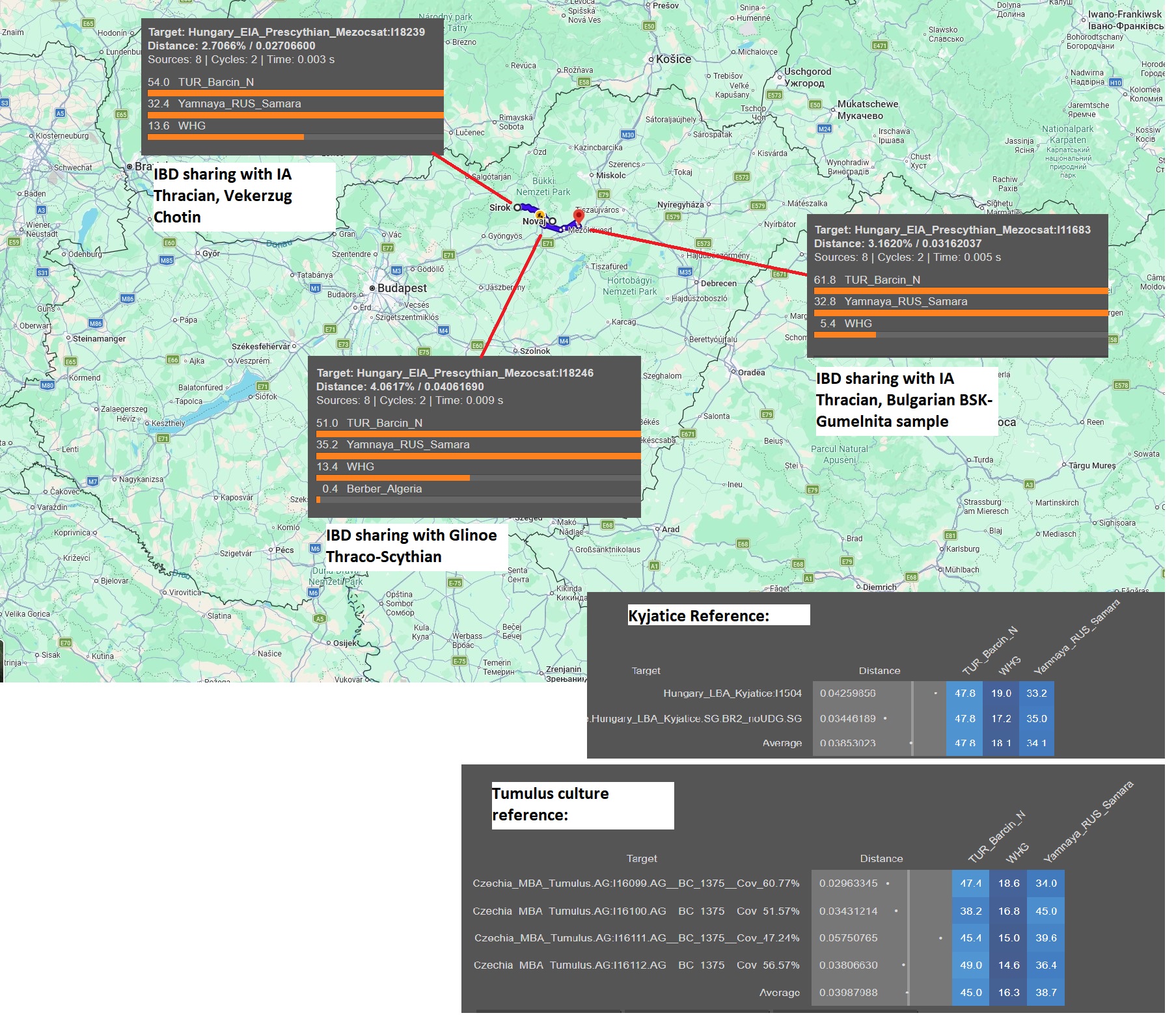
FTDNA confirmed the position of I40543 upstream of E-V13, at E-CTS1975. We'll see whether he ends up in the known Varna branch E-BY28614 or not. If he would form yet another branch of E-CTS1975, that would be big news, because we now have multiple lines of evidence for the closest connection of the Iron Age Thracians being from the network of Bodrogkeresztur-Salcuta-Gumelnita.
Basic model:
Target: Akbari2026:I40543.TW
Distance: 2.2738% / 0.02273829
86.0 TUR_Barcin_N
8.8 Yamnaya_RUS_Samara
4.4 WHG
0.8 Dai
Closest G25 matches by distance:
Distance to: Akbari2026:I40543.TW
0.02064906 Bulgaria_Varna_Chalcolithic.AG:VAR010.AG__BC_4599__Cov_65.29%
0.02216373 Bulgaria_Varna_Chalcolithic.AG:VAR016.AG__BC_4452__Cov_36.44%
0.02275250 Bulgaria_Chalcolithic.AG:I2430.AG__BC_4498__Cov_54.04%
0.02613323 Bulgaria_Varna_Chalcolithic.AG:VAR022.AG__BC_4503__Cov_72.39%
0.02915065 Romania_PietreleMaguraGorgana_Gumelnita_C.AG IE012.AG__BC_4537__Cov_37.14%
0.02946259 Turkey_Central_AsikliHoyuk_PPN:Ash129__BC_7887__Cov_51.29%
0.02975656 Turkey_Central_Boncuklu_PPN.AG:ZMOJ_BON014.A0101_Luk21.AG__BC_7950__Cov_50.75%
0.02976351 Hungary_MN_AVK.AG:I17939.AG__BC_4900__Cov_61.24%
0.03114160 Hungary_LN_Tisza.AG:I0449.AG__BC_4750__Cov_82.15%
0.03124634 Italy_Sicily_MBA_o2.AG:I3125.AG__BC_1540__Cov_77.93%
0.03147323 Romania_PietreleMaguraGorgana_Gumelnita_C.AGIE038.AG__BC_4563__Cov_65.33%
0.03168980 Bulgaria_Varna_Chalcolithic.AG:VAR034.AG__BC_4588__Cov_28.32%
0.03210950 Romania_PietreleMaguraGorgana_Gumelnita_C.AGIE017.AG__BC_4612__Cov_54.71%
0.03212692 Bulgaria_Varna_Chalcolithic.AG:VAR018.AG__BC_4425__Cov_50.30%
0.03225593 Romania_PietreleMaguraGorgana_Gumelnita_C.AGIE037.AG__BC_4292__Cov_51.03%
0.03277969 Turkey_AsikliHoyuk_EN_Preceramic_o:Ash133__BC_7895__Cov_63.78%
0.03295578 Romania_C_Bodrogkeresztur.AG:I4088.AG__BC_4241__Cov_62.13%
0.03296468 Italy_Sicily_IA.AG:I13377.AG__BC_700__Cov_75.05%
0.03316573 Italy_Sicily_IA.AG:I13385.AG__BC_642__Cov_77.59%
0.03358760 Turkey_Central_Boncuklu_PPN.WGC.SG:Bon002.WGC.SG__BC_8128__Cov_91.47%
0.03369395 Romania_N_IronGates.SG:NEO674.SG__BC_3829__Cov_22.73%
0.03373115 Turkey_Central_Boncuklu_PPN.AG:ZHJ_BON024.A0101_Luk84.AG__BC_8240__Cov_51.11%
0.03374750 Romania_PietreleMaguraGorgana_Gumelnita_C.AGIE065.AG__BC_4562__Cov_48.03%
0.03376506 Bulgaria_Chalcolithic.AG:I2424.AG__BC_4338__Cov_58.10%
0.03382472 Hungary_LN_Tisza.SG:VM-33.SG__BC_4750__Cov_71.84%
0.03411380 Bulgaria_Yunatsite_EBA.AG:YUN043.AG__BC_2758__Cov_67.76%
0.03421547 Romania_PietreleMaguraGorgana_Gumelnita_C.AGIE004.AG__BC_4621__Cov_61.08%
0.03445196 Italy_Sicily_IA.AG:I13394.AG__BC_734__Cov_76.34%
0.03447480 Turkey_Central_Boncuklu_PPN.AG:ZKO_BON001.A0101_Luk7.AG__BC_7950__Cov_55.65%
0.03515419 Romania_C_Bodrogkeresztur_o1.AG:I15623.AG__BC_4138__Cov_57.84%
0.03523431 Bulgaria_Varna_Chalcolithic.AG:VAR019.AG__BC_4624__Cov_51.59%
0.03544363 Germany_EN_LBK.AG:XN174.AG__BC_4850__Cov_21.37%
0.03552790 Bulgaria_Varna_Chalcolithic.AG:VAR030.AG__BC_4478__Cov_40.68%
0.03556233 Turkey_AsikliHoyuk_EN_Preceramic:Ash128__BC_8068__Cov_98.19%
0.03573727 Italy_Sicily_IA.AG:I13395.AG__BC_700__Cov_64.89%
0.03577828 Hungary_Polgár-Csőszhalom_LN:I10149__BC_4660__Cov_61.31%
0.03583092 Hungary_MN_AVK.AG:I21846.AG__BC_5125__Cov_57.50%
0.03586282 Italy_Sicily_IA.AG:I13386.AG__BC_700__Cov_73.51%
0.03602332 Bulgaria_Yunatsite_Chalcolithic_GumelnitaKaranovo.AG:YUN028.AG__BC_4443__Cov_33.68%
0.03615744 Hungary_Polgár-Basatanya_LN:I10011__BC_4235__Cov_74.13%
0.03621144 Bulgaria_Chalcolithic.AG:I2423.AG__BC_4431__Cov_44.58%
0.03625457 Romania_C_Bodrogkeresztur.AG:I14160.AG__BC_3950__Cov_69.51%
0.03630621 Germany_EN_LBK.AG:XN168.AG__BC_5143__Cov_23.98%
0.03651008 Romania_PietreleMaguraGorgana_Gumelnita_C.AGIE019.AG__BC_4500__Cov_35.30%
0.03651291 Romania_PietreleMaguraGorgana_Gumelnita_C.AGIE014.AG__BC_4466__Cov_35.53%
0.03654494 Hungary_MN_Vinca.AG:I1895.AG__BC_5245__Cov_59.97%
0.03665162 Turkey_Marmara_Aktopraklik_LN.SG:AKT16.SG__BC_6613__Cov_98.43%
0.03670612 Bulgaria_PetkoKaravelovo_Chalcolithic.AGTK005.AG__BC_4550__Cov_30.49%
0.03670990 Hungary_LN_Tisza.SG:HGO-26.SG__BC_4750__Cov_55.32%
0.03671744 Bulgaria_Varna_Chalcolithic.AG:ANI159-ANI181.AG__BC_4616__Cov_36.90%
The top matches are clearly from Bodrogkeresztur, Salcuta, Varna, Gumelnita-Karanovo. So he's deeply embedded in this Carpatho-Danubian Eneolithic network. And its the same kind of network, the Iron Age Thracians have closest IBD matches as well. Especially Pietrele site is instrumental here, because it represents a Northern Gumelnita variant which in contact with BSK/Salcuta might have contributed to Salcuta/Cotofeni pretty directly. And this could be a path, with Salcuta and North Western Gumelnita, which leads to E-V13 dominated Cotofeni. Actually, its a straightforwards path, as I have now explained many times with various data points (archaeological, archaeogenetic, phylogenetic etc.).
Importantly, we have a sample from Northern Bulgaria, which I wrote about, which has an even better fit for the Iron Age Thracians, being more Salcuta shifted:
Target: Bulgaria_Dzhulyunitsa_Chalcolithic.AG:I2509.AG__BC_4400__Cov_75.67%
Distance: 3.5605% / 0.03560529
91.2 TUR_Barcin_N
5.4 Yamnaya_RUS_Samara
2.4 WHG
1.0 Levant_Natufian
And she is the most central positioned Copper Age Balkan sample in the old Ringbauer IBD data base! She not just connects to other Bulgarian and South Romanian samples, but also to Bodrogkeresztur and 3 different Iron Age Thracian samples.
Because of the new E-CTS1975 sample, its worth to take a second look at her IBD matching:
Bulgaria_C:I2509 Switzerland_LN.AG:Aes20 7.02 19.59 3<br>Bulgaria_C:I2509 Germany_Saxony_LBK_N.AG ER034 8.77 16.47 2<br>Bulgaria_C:I2509 Romania_C_Bodrogkeresztur_o1:I15623 8.61 15.14 2<br>Bulgaria_C:I2509 Czechia_N_Rivnac_oAnatolia.AG:TUC002 8.08 14.67 2<br>Bulgaria_C:I2509 Bulgaria_EIA:I20183 7.11 13.49 2<br>Bulgaria_C:I2509 England_Viking.SG:VK175_noUDG.SG 7.14 13.29 2<br>Bulgaria_C:I2509 Croatia_MN:I26738 7.23 13.23 2<br>Bulgaria_C:I2509 France_GrandEst_EN.SG:Schw72-15.SG 6.61 13.16 2<br>Bulgaria_C:I2509 Italy_Medieval.SG:VK534_noUDG.SG 6.72 12.84 2<br>Bulgaria_C:I2509 Hungary_EIA_Prescythian_Mezocsat:I11683 8.41 8.41 1<br>Bulgaria_C:I2509 Ukraine_EIA_Cimmerian_o1.SG:MJ-31_noUDG.SG 8.31 8.31 1<br>Bulgaria_C:I2509 Croatia_C_Lasinja:I10053 8.30 8.30 1<br>Bulgaria_C:I2509 Turkey_N_sister.I0736:I0854_enhanced 8.08 8.08 1<br>Bulgaria_C:I2509 Turkey_Central_TepecikCiftlik_N.WGC.SG:Tep003_noUDG.WGC 8.05 8.05 1<br>Bulgaria_C:I2509 Croatia_Popova_MN.SGOP12_noUDG.SG 7.99 7.99 1<br>Bulgaria_C:I2509 Turkey_N:I0746 7.98 7.98 1<br>Bulgaria_C:I2509 Czechia_EBA_Unetice.AG:KNE002 7.89 7.89 1<br>Bulgaria_C:I2509 France_MN_father.or.son.GLN302.AG:GRG052 7.77 7.77 1<br>Bulgaria_C:I2509 England_Viking_o.SG:VK150_noUDG.SG 7.71 7.71 1<br>Bulgaria_C:I2509 Croatia_Dragulin_Roman.SG:R3665.SG 7.71 7.71 1<br>Bulgaria_C:I2509 Ukraine_Eneolithic_Trypillia.SG:VERT111 7.64 7.64 1<br>Bulgaria_C:I2509 Latvia_LN_CordedWare.SG:Latvia_LN1_noUDG.SG 7.59 7.59 1<br>Bulgaria_C:I2509 Ireland_MN.SGB1327.SG 7.58 7.58 1<br>Bulgaria_C:I2509 Sweden_Late_N.SG
 ll010_noUDG.SG 7.55 7.55 1<br>Bulgaria_C:I2509 Spain_MLN:I7606 7.51 7.51 1<br>Bulgaria_C:I2509 Czech_EBA_Unetice:KO1006 7.47 7.47 1<br>Bulgaria_C:I2509 Ukraine_Eneolithic_Trypillia.SG:VERT106C 7.40 7.40 1<br>Bulgaria_C:I2509 England_EIA:I13682 7.29 7.29 1<br>Bulgaria_C:I2509 Estonia_EarlyViking.SG:VK480_noUDG.SG 7.27 7.27 1<br>Bulgaria_C:I2509 Kyrgyzstan_TianShan_Hun.SGA65_noUDG.SG 7.26 7.26 1<br>Bulgaria_C:I2509 Romania_EN:I2533 7.24 7.24 1<br>Bulgaria_C:I2509 Turkey_Boncuklu_N.SG:Bon002_noUDG.WGC 7.21 7.21 1<br>Bulgaria_C:I2509 Estonia_EarlyViking.SG:VK491_noUDG.SG 7.18 7.18 1<br>Bulgaria_C:I2509 France_MN:GRG028 7.17 7.17 1<br>Bulgaria_C:I2509 France_EN_MN:LBR003 7.12 7.12 1<br>Bulgaria_C:I2509 Ireland_MN.SGN07.SG 7.09 7.09 1<br>Bulgaria_C:I2509 Russia_MLBA_Sintashta.SG:RISE394_noUDG.SG 7.08 7.08 1<br>Bulgaria_C:I2509 Romania_C_Bodrogkeresztur:I14165 7.06 7.06 1<br>Bulgaria_C:I2509 Germany_EN_LBK:I0026 7.05 7.05 1<br>Bulgaria_C:I2509 Czech_BellBeaker:KO1003 7.02 7.02 1<br>Bulgaria_C:I2509 Norway_Viking.SG:VK393_noUDG.SG 7.02 7.02 1<br>
One of her closest matches is the more North oriented E-V13 South Thracian sample I20183 and the Mezocsat female with the highest ANF/strongest Thracian orientation (likely most Gáva-shifted individual of the Mezocsat females). She matches with an additional Thraco-Cimmerian mixed individual, plus Vekerzug matches! And of course she has multiple Bodrogkeresztur matches. More than from Bulgarian Copper Age proximate sources!
It this therefore very clear, that she sits at the border between Salcuta and Gumelnita, with strong connections to the first wave of steppe gene flow - as can be seen with one of the Urziceni / Bodrogkeresztur-Salcuta samples she matches higly with, which sits directly between Gumelnita-Salcuta and the Thracians.
The new E-CTS1975 sample and the old Gumelnita-Salcuta Dzhulyunitsa sample with the high IBD matching with Thracians both plotted on the PCA with relevant references:

Both samples sit on the cline from pure ANF/Barcin-like, like e.g. Salcuta from Urziceni represents it, or Vinca, over ANF-shifted North Western Gumelnita, with steppe admixture, to Urziceni with steppe admixture to the South Thracians.
The only thing they need, to end up in the Thracian core, is additional, relatively pure steppe ancestry from say Cernavoda I/III, Usatovo or even Yamnaya.
I think we can now say with some confidence that E-CTS1975 being clearly associated with the Lower Danube sphere, with Bodrogkeresztur, Salcuta, Gumelnita, Varna. And we can also say that individuals like I2509 from Northern Bulgaria represent this network perfectly, because she shares IBD with Bodrogkeresztur - but zero with Bulgarian samples. I went down to 6 cM, she still doesn't get it!
So she is from Bulgaria, but she's actually closer related to Salcuta and Bodrogkeresztur, with which she shares 5 IBD matches. Zero from Bulgaria, only (!) the Thacian Iron Age sample, but 5 with Bodrogkeresztur. And this despite the fact that the vast majority of Salcuta shifted Urziceni samples being NOT in the Ringbauer data base. Only a small number is. If they would, she likely would have matched with them as well!
So we have the most central Copper Age Balkan sample by IBD matching, for the Thracians, being actually from Salcuta-Bodrogkeresztur despite sitting in Northern Bulgaria. That explains perfectly why she doesn't have local matches, but tons of Carpathian basin ones. She has ZERO Bulgarian matches other than the Iron Age Thracian - literally zero!
At the same time she matches with a presumable direct ancestor for Salcuta, from Dolj country, Oltenia: https://www.exploreyourdna.com/sample/romania/i2533
Which is a pure ANF individual! So I2509 represents a (mostly) Salcuta derived individual with near absolute certainty.
We therefore have a combined evidence for the Lower Danube as the E-V13 source region:
1) E-CTS1975 found in the Bodrogkeresztur-Salcuta-Gumelnita-Varna network multiple times
2) IBD sharing of Bodrogkeresztur and Salcuta with Iron Age Thracians - and this connection is as strong or visibly stronger than with any more Southern source
3) Autosomal profile of the Bodrogkeresztur-mixed, Salcuta and North Western Gumelnita groups is the by far best fit for the Thracian ANF-rich base.
4) The Thracian cultures can be derived, ultimately, with burial rites, subsistence pattern, weaponry, metallurgy and tools, ceramic etc. from the Carpatho-Danubian groups and most specifically the Cotofeni/Gornea-Orlesti descendants.
The plot thickens and these new samples might help a great deal.
We practically found the Thracian genetic base: They have the ANF-rich profile, they have E-CTS1975 - the only thing they need to end up in the Iron Age Thracian core, now well established to be the centre of E-V13 expansion, for all main branches, is additional fairly undiluted steppe. To get from the already sampled steppe-mixed Salcuta, Gumelnita, Varna, Bodrogkeresztur samples to the Thracian Iron Age profile they just need about 10 % extra steppe. That's all. Especially the Urziceni samples with Salculta-steppe admixed profiles need only that much: 10 % extra steppe and they are in the Thracian core!
That the new sample is from Northern Gumelnita-Varna can also be seen by looking at his serial neighbour, which is downstream of R-V88: https://discover.familytreedna.com/y-dna/R-F3867/tree
Samples from this branch of R-V88 were all from the same zone: Varna, Pietrele (Southern Romania), Smyadovo (Northern Bulgaria): That's Gumelnita! I40542 plots that way. But interestingly, probably just by chance, but who knows, probably not, he has less steppe shift and more WHG shift. The E-CTS1975 is a much better fit for the Thracian cline from Salcuta to the IA Thracians, because he has more ANF, more steppe and less other admixture.
Let's compare the three samples, the Salcuta-mixed female from CA North Bulgaria, the E-CTS1975 and the R-V88 individual:
Target: Bulgaria_Dzhulyunitsa_Chalcolithic.AG:I2509.AG__BC_4400__Cov_75.67%
Distance: 3.5605% / 0.03560529
91.2 TUR_Barcin_N
5.4 Yamnaya_RUS_Samara
2.4 WHG
1.0 Levant_Natufian
Target: R-F3867:Akbari2026:I40542.TW
Distance: 2.5091% / 0.02509067
88.0 TUR_Barcin_N
6.6 WHG
5.4 Yamnaya_RUS_Samara
Target: E-CTS1975:Akbari2026:I40543.TW
Distance: 2.2738% / 0.02273829
86.0 TUR_Barcin_N
8.8 Yamnaya_RUS_Samara
4.4 WHG
0.8 Dai
They are pretty similar and prove that Salcuta and Northern Gumelnita just provides us with good forts for the Thracian base. However, the BSK/Salcuta female is a perfect fit, the E-CTS1975 is probably still ok and the R-F3867 is the worst of the three.
We now have two E-CTS1975 from Gumelnita-Varna, that's fine, but I still think there was an even bigger nest from where these came from, and that might be BSK/Salcuta itself. That we only got Salcuta samples from mixed Bodrogkeresztur and mixed Gumelnita-zone is quite telling.
Just with the Bronze and Iron Age, the lack of samples from core regions (like Southern Transylvania, Eastern Banat and Oltenia through the ages is a big miss, the biggest for the whole debate.
Yet we only have very few samples from areas like Oltenia, and voila, the Neolithic sample from Dolj matches with the later Salcuta-derived female from Bulgaria. Even single, outdated samples help. Just imagine what it would mean if having that core area of Salcuta and Cotofeni being sampled like e.g. Hungary or even Bulgaria!
Basic model:
Target: Akbari2026:I40543.TW
Distance: 2.2738% / 0.02273829
86.0 TUR_Barcin_N
8.8 Yamnaya_RUS_Samara
4.4 WHG
0.8 Dai
Closest G25 matches by distance:
Distance to: Akbari2026:I40543.TW
0.02064906 Bulgaria_Varna_Chalcolithic.AG:VAR010.AG__BC_4599__Cov_65.29%
0.02216373 Bulgaria_Varna_Chalcolithic.AG:VAR016.AG__BC_4452__Cov_36.44%
0.02275250 Bulgaria_Chalcolithic.AG:I2430.AG__BC_4498__Cov_54.04%
0.02613323 Bulgaria_Varna_Chalcolithic.AG:VAR022.AG__BC_4503__Cov_72.39%
0.02915065 Romania_PietreleMaguraGorgana_Gumelnita_C.AG
IE012.AG__BC_4537__Cov_37.14%0.02946259 Turkey_Central_AsikliHoyuk_PPN:Ash129__BC_7887__Cov_51.29%
0.02975656 Turkey_Central_Boncuklu_PPN.AG:ZMOJ_BON014.A0101_Luk21.AG__BC_7950__Cov_50.75%
0.02976351 Hungary_MN_AVK.AG:I17939.AG__BC_4900__Cov_61.24%
0.03114160 Hungary_LN_Tisza.AG:I0449.AG__BC_4750__Cov_82.15%
0.03124634 Italy_Sicily_MBA_o2.AG:I3125.AG__BC_1540__Cov_77.93%
0.03147323 Romania_PietreleMaguraGorgana_Gumelnita_C.AG
IE038.AG__BC_4563__Cov_65.33%0.03168980 Bulgaria_Varna_Chalcolithic.AG:VAR034.AG__BC_4588__Cov_28.32%
0.03210950 Romania_PietreleMaguraGorgana_Gumelnita_C.AG
IE017.AG__BC_4612__Cov_54.71%0.03212692 Bulgaria_Varna_Chalcolithic.AG:VAR018.AG__BC_4425__Cov_50.30%
0.03225593 Romania_PietreleMaguraGorgana_Gumelnita_C.AG
IE037.AG__BC_4292__Cov_51.03%0.03277969 Turkey_AsikliHoyuk_EN_Preceramic_o:Ash133__BC_7895__Cov_63.78%
0.03295578 Romania_C_Bodrogkeresztur.AG:I4088.AG__BC_4241__Cov_62.13%
0.03296468 Italy_Sicily_IA.AG:I13377.AG__BC_700__Cov_75.05%
0.03316573 Italy_Sicily_IA.AG:I13385.AG__BC_642__Cov_77.59%
0.03358760 Turkey_Central_Boncuklu_PPN.WGC.SG:Bon002.WGC.SG__BC_8128__Cov_91.47%
0.03369395 Romania_N_IronGates.SG:NEO674.SG__BC_3829__Cov_22.73%
0.03373115 Turkey_Central_Boncuklu_PPN.AG:ZHJ_BON024.A0101_Luk84.AG__BC_8240__Cov_51.11%
0.03374750 Romania_PietreleMaguraGorgana_Gumelnita_C.AG
IE065.AG__BC_4562__Cov_48.03%0.03376506 Bulgaria_Chalcolithic.AG:I2424.AG__BC_4338__Cov_58.10%
0.03382472 Hungary_LN_Tisza.SG:VM-33.SG__BC_4750__Cov_71.84%
0.03411380 Bulgaria_Yunatsite_EBA.AG:YUN043.AG__BC_2758__Cov_67.76%
0.03421547 Romania_PietreleMaguraGorgana_Gumelnita_C.AG
IE004.AG__BC_4621__Cov_61.08%0.03445196 Italy_Sicily_IA.AG:I13394.AG__BC_734__Cov_76.34%
0.03447480 Turkey_Central_Boncuklu_PPN.AG:ZKO_BON001.A0101_Luk7.AG__BC_7950__Cov_55.65%
0.03515419 Romania_C_Bodrogkeresztur_o1.AG:I15623.AG__BC_4138__Cov_57.84%
0.03523431 Bulgaria_Varna_Chalcolithic.AG:VAR019.AG__BC_4624__Cov_51.59%
0.03544363 Germany_EN_LBK.AG:XN174.AG__BC_4850__Cov_21.37%
0.03552790 Bulgaria_Varna_Chalcolithic.AG:VAR030.AG__BC_4478__Cov_40.68%
0.03556233 Turkey_AsikliHoyuk_EN_Preceramic:Ash128__BC_8068__Cov_98.19%
0.03573727 Italy_Sicily_IA.AG:I13395.AG__BC_700__Cov_64.89%
0.03577828 Hungary_Polgár-Csőszhalom_LN:I10149__BC_4660__Cov_61.31%
0.03583092 Hungary_MN_AVK.AG:I21846.AG__BC_5125__Cov_57.50%
0.03586282 Italy_Sicily_IA.AG:I13386.AG__BC_700__Cov_73.51%
0.03602332 Bulgaria_Yunatsite_Chalcolithic_GumelnitaKaranovo.AG:YUN028.AG__BC_4443__Cov_33.68%
0.03615744 Hungary_Polgár-Basatanya_LN:I10011__BC_4235__Cov_74.13%
0.03621144 Bulgaria_Chalcolithic.AG:I2423.AG__BC_4431__Cov_44.58%
0.03625457 Romania_C_Bodrogkeresztur.AG:I14160.AG__BC_3950__Cov_69.51%
0.03630621 Germany_EN_LBK.AG:XN168.AG__BC_5143__Cov_23.98%
0.03651008 Romania_PietreleMaguraGorgana_Gumelnita_C.AG
IE019.AG__BC_4500__Cov_35.30%0.03651291 Romania_PietreleMaguraGorgana_Gumelnita_C.AG
IE014.AG__BC_4466__Cov_35.53%0.03654494 Hungary_MN_Vinca.AG:I1895.AG__BC_5245__Cov_59.97%
0.03665162 Turkey_Marmara_Aktopraklik_LN.SG:AKT16.SG__BC_6613__Cov_98.43%
0.03670612 Bulgaria_PetkoKaravelovo_Chalcolithic.AG
TK005.AG__BC_4550__Cov_30.49%0.03670990 Hungary_LN_Tisza.SG:HGO-26.SG__BC_4750__Cov_55.32%
0.03671744 Bulgaria_Varna_Chalcolithic.AG:ANI159-ANI181.AG__BC_4616__Cov_36.90%
The top matches are clearly from Bodrogkeresztur, Salcuta, Varna, Gumelnita-Karanovo. So he's deeply embedded in this Carpatho-Danubian Eneolithic network. And its the same kind of network, the Iron Age Thracians have closest IBD matches as well. Especially Pietrele site is instrumental here, because it represents a Northern Gumelnita variant which in contact with BSK/Salcuta might have contributed to Salcuta/Cotofeni pretty directly. And this could be a path, with Salcuta and North Western Gumelnita, which leads to E-V13 dominated Cotofeni. Actually, its a straightforwards path, as I have now explained many times with various data points (archaeological, archaeogenetic, phylogenetic etc.).
Importantly, we have a sample from Northern Bulgaria, which I wrote about, which has an even better fit for the Iron Age Thracians, being more Salcuta shifted:
Target: Bulgaria_Dzhulyunitsa_Chalcolithic.AG:I2509.AG__BC_4400__Cov_75.67%
Distance: 3.5605% / 0.03560529
91.2 TUR_Barcin_N
5.4 Yamnaya_RUS_Samara
2.4 WHG
1.0 Levant_Natufian
And she is the most central positioned Copper Age Balkan sample in the old Ringbauer IBD data base! She not just connects to other Bulgarian and South Romanian samples, but also to Bodrogkeresztur and 3 different Iron Age Thracian samples.
Because of the new E-CTS1975 sample, its worth to take a second look at her IBD matching:
Bulgaria_C:I2509 Switzerland_LN.AG:Aes20 7.02 19.59 3<br>Bulgaria_C:I2509 Germany_Saxony_LBK_N.AG
ER034 8.77 16.47 2<br>Bulgaria_C:I2509 Romania_C_Bodrogkeresztur_o1:I15623 8.61 15.14 2<br>Bulgaria_C:I2509 Czechia_N_Rivnac_oAnatolia.AG:TUC002 8.08 14.67 2<br>Bulgaria_C:I2509 Bulgaria_EIA:I20183 7.11 13.49 2<br>Bulgaria_C:I2509 England_Viking.SG:VK175_noUDG.SG 7.14 13.29 2<br>Bulgaria_C:I2509 Croatia_MN:I26738 7.23 13.23 2<br>Bulgaria_C:I2509 France_GrandEst_EN.SG:Schw72-15.SG 6.61 13.16 2<br>Bulgaria_C:I2509 Italy_Medieval.SG:VK534_noUDG.SG 6.72 12.84 2<br>Bulgaria_C:I2509 Hungary_EIA_Prescythian_Mezocsat:I11683 8.41 8.41 1<br>Bulgaria_C:I2509 Ukraine_EIA_Cimmerian_o1.SG:MJ-31_noUDG.SG 8.31 8.31 1<br>Bulgaria_C:I2509 Croatia_C_Lasinja:I10053 8.30 8.30 1<br>Bulgaria_C:I2509 Turkey_N_sister.I0736:I0854_enhanced 8.08 8.08 1<br>Bulgaria_C:I2509 Turkey_Central_TepecikCiftlik_N.WGC.SG:Tep003_noUDG.WGC 8.05 8.05 1<br>Bulgaria_C:I2509 Croatia_Popova_MN.SGOP12_noUDG.SG 7.99 7.99 1<br>Bulgaria_C:I2509 Turkey_N:I0746 7.98 7.98 1<br>Bulgaria_C:I2509 Czechia_EBA_Unetice.AG:KNE002 7.89 7.89 1<br>Bulgaria_C:I2509 France_MN_father.or.son.GLN302.AG:GRG052 7.77 7.77 1<br>Bulgaria_C:I2509 England_Viking_o.SG:VK150_noUDG.SG 7.71 7.71 1<br>Bulgaria_C:I2509 Croatia_Dragulin_Roman.SG:R3665.SG 7.71 7.71 1<br>Bulgaria_C:I2509 Ukraine_Eneolithic_Trypillia.SG:VERT111 7.64 7.64 1<br>Bulgaria_C:I2509 Latvia_LN_CordedWare.SG:Latvia_LN1_noUDG.SG 7.59 7.59 1<br>Bulgaria_C:I2509 Ireland_MN.SGB1327.SG 7.58 7.58 1<br>Bulgaria_C:I2509 Sweden_Late_N.SGll010_noUDG.SG 7.55 7.55 1<br>Bulgaria_C:I2509 Spain_MLN:I7606 7.51 7.51 1<br>Bulgaria_C:I2509 Czech_EBA_Unetice:KO1006 7.47 7.47 1<br>Bulgaria_C:I2509 Ukraine_Eneolithic_Trypillia.SG:VERT106C 7.40 7.40 1<br>Bulgaria_C:I2509 England_EIA:I13682 7.29 7.29 1<br>Bulgaria_C:I2509 Estonia_EarlyViking.SG:VK480_noUDG.SG 7.27 7.27 1<br>Bulgaria_C:I2509 Kyrgyzstan_TianShan_Hun.SGA65_noUDG.SG 7.26 7.26 1<br>Bulgaria_C:I2509 Romania_EN:I2533 7.24 7.24 1<br>Bulgaria_C:I2509 Turkey_Boncuklu_N.SG:Bon002_noUDG.WGC 7.21 7.21 1<br>Bulgaria_C:I2509 Estonia_EarlyViking.SG:VK491_noUDG.SG 7.18 7.18 1<br>Bulgaria_C:I2509 France_MN:GRG028 7.17 7.17 1<br>Bulgaria_C:I2509 France_EN_MN:LBR003 7.12 7.12 1<br>Bulgaria_C:I2509 Ireland_MN.SGN07.SG 7.09 7.09 1<br>Bulgaria_C:I2509 Russia_MLBA_Sintashta.SG:RISE394_noUDG.SG 7.08 7.08 1<br>Bulgaria_C:I2509 Romania_C_Bodrogkeresztur:I14165 7.06 7.06 1<br>Bulgaria_C:I2509 Germany_EN_LBK:I0026 7.05 7.05 1<br>Bulgaria_C:I2509 Czech_BellBeaker:KO1003 7.02 7.02 1<br>Bulgaria_C:I2509 Norway_Viking.SG:VK393_noUDG.SG 7.02 7.02 1<br>One of her closest matches is the more North oriented E-V13 South Thracian sample I20183 and the Mezocsat female with the highest ANF/strongest Thracian orientation (likely most Gáva-shifted individual of the Mezocsat females). She matches with an additional Thraco-Cimmerian mixed individual, plus Vekerzug matches! And of course she has multiple Bodrogkeresztur matches. More than from Bulgarian Copper Age proximate sources!
It this therefore very clear, that she sits at the border between Salcuta and Gumelnita, with strong connections to the first wave of steppe gene flow - as can be seen with one of the Urziceni / Bodrogkeresztur-Salcuta samples she matches higly with, which sits directly between Gumelnita-Salcuta and the Thracians.
The new E-CTS1975 sample and the old Gumelnita-Salcuta Dzhulyunitsa sample with the high IBD matching with Thracians both plotted on the PCA with relevant references:
Both samples sit on the cline from pure ANF/Barcin-like, like e.g. Salcuta from Urziceni represents it, or Vinca, over ANF-shifted North Western Gumelnita, with steppe admixture, to Urziceni with steppe admixture to the South Thracians.
The only thing they need, to end up in the Thracian core, is additional, relatively pure steppe ancestry from say Cernavoda I/III, Usatovo or even Yamnaya.
I think we can now say with some confidence that E-CTS1975 being clearly associated with the Lower Danube sphere, with Bodrogkeresztur, Salcuta, Gumelnita, Varna. And we can also say that individuals like I2509 from Northern Bulgaria represent this network perfectly, because she shares IBD with Bodrogkeresztur - but zero with Bulgarian samples. I went down to 6 cM, she still doesn't get it!
So she is from Bulgaria, but she's actually closer related to Salcuta and Bodrogkeresztur, with which she shares 5 IBD matches. Zero from Bulgaria, only (!) the Thacian Iron Age sample, but 5 with Bodrogkeresztur. And this despite the fact that the vast majority of Salcuta shifted Urziceni samples being NOT in the Ringbauer data base. Only a small number is. If they would, she likely would have matched with them as well!
So we have the most central Copper Age Balkan sample by IBD matching, for the Thracians, being actually from Salcuta-Bodrogkeresztur despite sitting in Northern Bulgaria. That explains perfectly why she doesn't have local matches, but tons of Carpathian basin ones. She has ZERO Bulgarian matches other than the Iron Age Thracian - literally zero!
At the same time she matches with a presumable direct ancestor for Salcuta, from Dolj country, Oltenia: https://www.exploreyourdna.com/sample/romania/i2533
Which is a pure ANF individual! So I2509 represents a (mostly) Salcuta derived individual with near absolute certainty.
We therefore have a combined evidence for the Lower Danube as the E-V13 source region:
1) E-CTS1975 found in the Bodrogkeresztur-Salcuta-Gumelnita-Varna network multiple times
2) IBD sharing of Bodrogkeresztur and Salcuta with Iron Age Thracians - and this connection is as strong or visibly stronger than with any more Southern source
3) Autosomal profile of the Bodrogkeresztur-mixed, Salcuta and North Western Gumelnita groups is the by far best fit for the Thracian ANF-rich base.
4) The Thracian cultures can be derived, ultimately, with burial rites, subsistence pattern, weaponry, metallurgy and tools, ceramic etc. from the Carpatho-Danubian groups and most specifically the Cotofeni/Gornea-Orlesti descendants.
The plot thickens and these new samples might help a great deal.
We practically found the Thracian genetic base: They have the ANF-rich profile, they have E-CTS1975 - the only thing they need to end up in the Iron Age Thracian core, now well established to be the centre of E-V13 expansion, for all main branches, is additional fairly undiluted steppe. To get from the already sampled steppe-mixed Salcuta, Gumelnita, Varna, Bodrogkeresztur samples to the Thracian Iron Age profile they just need about 10 % extra steppe. That's all. Especially the Urziceni samples with Salculta-steppe admixed profiles need only that much: 10 % extra steppe and they are in the Thracian core!
That the new sample is from Northern Gumelnita-Varna can also be seen by looking at his serial neighbour, which is downstream of R-V88: https://discover.familytreedna.com/y-dna/R-F3867/tree
Samples from this branch of R-V88 were all from the same zone: Varna, Pietrele (Southern Romania), Smyadovo (Northern Bulgaria): That's Gumelnita! I40542 plots that way. But interestingly, probably just by chance, but who knows, probably not, he has less steppe shift and more WHG shift. The E-CTS1975 is a much better fit for the Thracian cline from Salcuta to the IA Thracians, because he has more ANF, more steppe and less other admixture.
Let's compare the three samples, the Salcuta-mixed female from CA North Bulgaria, the E-CTS1975 and the R-V88 individual:
Target: Bulgaria_Dzhulyunitsa_Chalcolithic.AG:I2509.AG__BC_4400__Cov_75.67%
Distance: 3.5605% / 0.03560529
91.2 TUR_Barcin_N
5.4 Yamnaya_RUS_Samara
2.4 WHG
1.0 Levant_Natufian
Target: R-F3867:Akbari2026:I40542.TW
Distance: 2.5091% / 0.02509067
88.0 TUR_Barcin_N
6.6 WHG
5.4 Yamnaya_RUS_Samara
Target: E-CTS1975:Akbari2026:I40543.TW
Distance: 2.2738% / 0.02273829
86.0 TUR_Barcin_N
8.8 Yamnaya_RUS_Samara
4.4 WHG
0.8 Dai
They are pretty similar and prove that Salcuta and Northern Gumelnita just provides us with good forts for the Thracian base. However, the BSK/Salcuta female is a perfect fit, the E-CTS1975 is probably still ok and the R-F3867 is the worst of the three.
We now have two E-CTS1975 from Gumelnita-Varna, that's fine, but I still think there was an even bigger nest from where these came from, and that might be BSK/Salcuta itself. That we only got Salcuta samples from mixed Bodrogkeresztur and mixed Gumelnita-zone is quite telling.
Just with the Bronze and Iron Age, the lack of samples from core regions (like Southern Transylvania, Eastern Banat and Oltenia through the ages is a big miss, the biggest for the whole debate.
Yet we only have very few samples from areas like Oltenia, and voila, the Neolithic sample from Dolj matches with the later Salcuta-derived female from Bulgaria. Even single, outdated samples help. Just imagine what it would mean if having that core area of Salcuta and Cotofeni being sampled like e.g. Hungary or even Bulgaria!