• Don't want to see ads? Install an adblocker like uBlock Origin or use a Europe-based privacy-friendly browser like Vivaldi or Mullvad.

Neolithic Refuge and Continuity in Transylvania

When realising that I20184 is for sure Aegean-Anatolian admixed and having close matches from the Greek sphere, I still saw a problem: Her Greek-like matches don't look like the ideal source of the admixture. The admixture looks more Minoan-like, but definitely not Minoan-proper, but still early-mixed Greek.

So I plotted all the E-V13 branches and a solid number of Aegean/Greek-Minoan samples looking out for samples which could fit the bill under the assumption of about 50 % recent admixture in I20184.

The samples which fit the bill are the early Greek to Greek-Minoan mixed individuals from Crete:

Samples are:

Using the Ghost population toolkit https://admixr.com/ghost
turned out that the ideal fit is xan036. This is the reconstructed Ghost population under the assumption that I20184 has about 50 % of that sort of admixture:
Thracian_reconstructed2,0.112685,0.167562,0.012445,-0.035530000000000006,0.024005000000000002,-0.032908,0.00517,0.015231000000000001,0.02168,0.056128,-0.005033,0.004196,-0.033597,-0.0027530000000000002,-0.016693999999999997,-0.019623,0.00013099999999999999,0.002281,0.0007539999999999977,-0.012754999999999999,-0.021087,0.004822,-0.0028339999999999997,-0.004339000000000001,-0.0017969999999999996

The reconstructed Thracian side of her would be:
Target: Thracian_reconstructed2
Distance: 4.8276% / 0.04827643
75.0 TUR_Barcin_N
21.8 Yamnaya_RUS_Samara
1.6 Berber_Algeria
1.6 WHG

This would still make her very Southern even for the Thracian groups, but if ignoring the obvious noise created by the tool, with about 75 ANF, 22 Steppe and 1 WHG, her Thracian ancestor ends up in the core Thracian cluster! This can be seen on the PCA as well.

We therefore can grasp a population with which incoming Thracians mixed, which looked like early Greeks/Greek-Minoan people.

You can see it clearly on the plot:

South-Thracian-admixed-reconstructed-model.jpg


There are only two samples in this South Eastern pulled corner, this female (I20184) and one E-V13 male (20180), plus there is this R-Z93 outlier (I20186), which is not as extremely shifted, but still in the same direction.

So I think there is actual evidence for admixture with a local more Greco-Minoan-like population. However, this element in the South Thracians creates outliers which being pulled outside of the Thracian core population. This Thracian core population was already fully homogenised much earlier, as can be seen in this massive E-V13 cluster around the less/unadmixed South Thracians like I20181, I20183 and the Thracian IA female from North of the Balkan mountians I5769, plus the whole core cluster.

An interesting point about this is, however: What are these South Eastern pulled outliers from the South Thracians? Is this the result of Thracians just mixing with a local pre-Thracian element recently? Or are these "other Thracians", like e.g. earlier waves of Thracians from say Brnjica and Zimnicea-Plovdiv-Cerkovna, which lived there for longer, mixed with some locals?

The question is therefore "who's deeper rooted in the region?" There can be only two answers:
1) The South Eastern admixed cluster - which is a complete outlier among other Daco-Thracians and E-V13.
2) The Northern oriented, typical E-V13/Thacian-like individuals which connect to the areas North of the Balkan mountains - which would make the South Eastern pulled individuals the result of very recent admixture.

This proves real structure, even among the South Thracians tested. We'll see whethere there is even more, like especially for the East and West to North Thracians. Because we already see this strong Himera-like cluster for the E-V13 samples - and many of these samples don't appear to be recently mixed with Illyrians etc., but rather sharing a cluster with the Himera individuals (increased steppe/HG) and Eastern Vekerzug.

While there remains some speculation, these things can be stated for fact:
1) The South Thracians show structure, about half the samples have an Aegean admixture the other half does not have or doesn't have at the same level - not even remotely so.
2) This admixture proves that there were either two different populations which met in Thrace, or that one half of the South Thracians received RECENT Aegean admixture - the other half did not.
3) This same type of admixture, this Aegean-like mystery population did also mix into Mycenaean Greeks, because the closest matches for I20184, and they are genealogically relevant already, are proving that connection. They don't represent the source, but they received admixture from the same source.
4) The mystery Aegean population is a bad fit for Thracians overall, because of the fairly high level of Iranian admixture. Too high for the regular/core Thracians - they need a source which was more purely ANF. Actually, some Bodrogkeresztur, Gumelnita and Varna samples are more on the Thracian cline - as can be seen also, on the plot.
 
The new E-L618, E-CTS1975 -> PF2252 sample which looks basically like Danubian CA (could be either Bodrogkeresztur or Varna, rather, mixed with Salcuta?) with increased steppe:

Target: Akbari2026:I40543.TW
Distance: 2.2738% / 0.02273829
86.0 TUR_Barcin_N
8.8 Yamnaya_RUS_Samara
4.4 WHG
0.8 Dai

If plotting him beside the other early E-L618 in the data base, you can clearly see that he plots the closest to the later Thracian core. That is, becaue the other two Varna samples with steppe admixture do have more WHG (being pulled to the left), while he has not.

E-L618-Plot.jpg


These are this IBD matches - some things stick out immediately:

sample I40543.TW unknown<br> I41067.TW 25.08 unknown&nbsp; G-FTB14640 = https://discover.familytreedna.com/y-dna/G-FTB14640/tree - upstream found in Lengyel, exact branch in Bodrogkerestzur-Urziceni - by distance closest to Varna and Bodrogkeresztur, similar proportions to him, most definitely the same population<br> I16775.SG 20.59 Italy_N<br> I40198.TW 17.76 unknown&nbsp; R-BY17643 = EHG/Tripolye/Dereivka branch: https://discover.familytreedna.com/y-dna/R-BY17643/tree same population, same basic profile, closest by distance Bodrogkeresztur <br> I24018.AG 15.00 Austria_N_LBK Asparn-Schletz LBK: https://www.exploreyourdna.com/sample/united-kingdom/atp-psn-933<br> I41579.TW 11.78 unknown&nbsp; G-FT99363 = https://discover.familytreedna.com/y-dna/G-FT99363/tree branch which connects Transylvania upstream (Urziceni) and South Romania downstream (closest). Multiple new samples on this branch upstream and terminal. Autosomally closest to Varna, secondarily Bodrogkeresztur. <br> I40513.TW 11.60 unknown Closest to Varna, increased steppe<br> I40503.TW 11.51 unknown Closest to Varna and Bodrogkeresztur, increased steppe<br> I39268.TW 11.49 unknown&nbsp; J-ZS58 Aegean? https://discover.familytreedna.com/y-dna/J-ZS58/tree Closest to Bodrogkerestzur, Boian, Gumelnita. More Southern admix<br> I37511.TW 10.81 unknown&nbsp; R-F3867 https://discover.familytreedna.com/y-dna/R-F3867/tree Varna-Gumelnita lineage - mix, increased HG, already more Horodistea-Foltesti like. <br> I41603.TW 10.39 unknown Equal distance to Tiszapolgar-Bodrogkeresztur and Gumelnita-Varna. <br> STR233.AG 10.38 Belgium_StRombout_Cemetery_PostMedieval<br> I37399.TW 10.29 unknown&nbsp; R-BY76903 R-L2 branch: https://discover.familytreedna.com/y-dna/R-BY76903/path Tumulus culture? <br> I40159.TW 10.01 unknown&nbsp; G-FT99363 = https://discover.familytreedna.com/y-dna/G-FT99363/tree same branch as above, just more upstream, points to both Bodrogkeresztur and Gumelnita. Autosomally closest to Gumelnita, Neolithic Hungary and Boian-Salcuta. <br> buk022.SG 9.97 Romania_Curatesti_Boian_LN_Eneolithic Boian from Southern Romania: https://www.dnagenics.com/ancestry/...09e5i9eg_MR_iiMBQxp7rb5sQ5-KqpdjS04S#identity<br> I40777.TW 9.78 unknown<br> I11933.AG 9.78 Hungary_MN_AVK<br> VAR009.AG 9.75 Bulgaria_Varna_Chalcolithic<br> I10010.AG 9.72 Hungary_Tiszapolgár<br> I41578.TW 9.71 unknown<br> I39283.TW 9.57 unknown<br> I0698_enhanced.AG 9.43 Bulgaria_N<br> I46059.TW 9.42 unknown<br> Klein7.SG 9.41 Austria_Kleinhadersdorf_LBK_EN<br> I39476.TW 9.21 unknown<br> I19345.AG 8.94 Armenia_Karashamb_LBA<br> I44820.TW 8.87 unknown<br> I23137.AG 8.83 unknown<br> I23317.AG 8.79 unknown<br> I7952.AG 8.78 Czechia_N<br> I10356.AG 8.72 Hungary_Tiszapolgár<br> I10455.SG 8.71 unknown<br> VERT118.SG 8.67 Ukraine_Eneolithic_Trypillia<br> I41060.TW 8.61 unknown<br> I10007.AG 8.49 Hungary_Tiszapolgár<br> I23324.AG 8.47 unknown<br> I45013.TW 8.32 unknown<br> I41071.TW 8.28 unknown<br> I23376.AG 8.27 unknown<br> I38497.TW 8.23 unknown<br> I24892.AG 8.21 Austria_N_LBK<br> I7896.AG 8.17 Slovakia_N_LBK<br> POP36.SG 8.13 Croatia_Popova_MN<br> I8799.AG 8.09 Hungary_Tiszapolgár<br> I40500.TW 8.02 unknown<br> I29771.TW 8.02 unknown<br> I7554.SG 7.99 United_Kingdom_Scotland_N<br> I15638.AG 7.98 unknown<br> I44335_preQC.TW 7.97 unknown<br> I17647.AG.TW 7.94 unknown<br> I40214.TW 7.93 unknown<br> I18656.AG 7.92 Hungary_MN_AVK<br> buk019.SG 7.83 Romania_Curatesti_Boian_LN_Eneolithic<br> I43863.TW 7.81 unknown<br> I40517.TW 7.80 unknown<br> I23349.AG 7.76 Romania_Bodrogkeresztur_ECA<br> I0432.SG 7.72 Russia_MBA_Poltavka_oEEF<br> I17981.AG 7.71 Bulgaria_N_o<br> I37408.TW 7.67 unknown<br> I2424.AG 7.65 Bulgaria_Chalcolithic<br> I8140_enhanced.AG 7.64 Spain_C<br> I47231.TW 7.63 unknown<br> I24283.AG 7.62 Austria_N_LBK<br> I3948.AG 7.60 Croatia_N_Cardial<br> I33825.TW 7.59 unknown<br> I18653.AG 7.58 unknown<br> I21851.AG 7.57 Italy_Sicily_Palermo_Punic_Late<br> I3917.AG 7.57 Turkey_Central_Gordion_Ancient<br> I21390.AG 7.57 United_Kingdom_England_N_Megalithic<br> POP24.SG 7.55 Croatia_Popova_MN<br> I31571.TW 7.54 unknown<br> I13386.AG 7.46 Italy_Sicily_IA<br> poz252.SG 7.46 Poland_Siniarzewo_LLBK_LLengyel_N<br> I10249.AG 7.45 unknown<br> I44835_preQC.TW 7.45 unknown<br> I11902.AG 7.43 Romania_C_Bodrogkeresztur<br> I43847.TW 7.43 unknown<br> I45380.TW 7.43 unknown<br> I8172.AG 7.41 unknown<br> I29890.TW 7.41 unknown<br> I35411.TW 7.41 unknown<br> I37640.TW 7.41 unknown<br> I8184.AG 7.37 unknown<br> I42257.TW 7.37 unknown<br> R6.SG 7.35 Italy_South_N_oWHG<br> NA12005 7.33 Utah_WhiteAmerican_modern<br> I39558.TW 7.33 unknown<br> I6739.AG 7.33 Russia_Saratov_Khvalynsk_Eneolithic<br> I24682.AG 7.29 unknown<br> I26214.AG 7.29 unknown<br> I26335.AG 7.29 unknown<br> BOK017.AG 7.27 Russia_Krasnodar_Yamnaya_EarlyCatacomb_EMBA<br> I10413.AG 7.27 unknown<br> RISE1246.SG 7.27 Poland_Ksiaznice_GlobularAmphora<br> prs009.SG 7.24 Ireland_Megalithic<br> I34413.TW 7.23 unknown<br> I35392.TW 7.23 unknown<br> MA2206.SG 7.23 Turkey_Central_Kalehoyuk_AssyrianColonyPeriod<br> I24678.AG 7.23 Italy_Sicily_Birgi_Punic_Early<br> I18973.AG 7.22 unknown<br> GRG008.AG 7.21 France_MN<br> ELY005.SG 7.21 United_Kingdom_England_Saxon<br> I38697.TW 7.19 unknown<br> I2427.AG 7.19 Bulgaria_Chalcolithic<br> I40182.TW 7.17 unknown<br> I13744.AG 7.16 unknown<br> I4069.AG 7.15 Netherlands_LNB_BellBeaker<br> I41068.TW 7.14 unknown<br> I3037.AG 7.14 United_Kingdom_England_EarlyMedieval_Saxon<br> I4267.AG 7.14 Kazakhstan_Zevakinskiy_LBA<br> I37549.TW 7.13 unknown<br> I44845_preQC.TW 7.13 unknown<br> I39000.TW 7.10 unknown<br> I37389.TW 7.10 unknown<br> I20147.AG 7.08 Turkey_Aegean_Mugla_Stratonikeia_Byzantine<br> NA20502 7.08 Toscani_Italia_modern<br> I35967.TW 7.08 unknown<br> I21402.AG 7.08 France_GrandEst_IA2<br> R133.SG 7.07 Italy_LateAntiquity<br> GLN308.AG 7.07 France_N<br> HJE012.SG 7.06 Sweden_HjelmarsRor_N<br> I40168_preQC.TW 7.04 unknown<br> I19585.AG 7.04 unknown<br> I28462.AG 7.04 unknown<br> GLN208.AG 7.04 France_N<br> ST0186.SG 7.03 Belgium_Flanders_Sint_Truiden_PostMedieval<br> HAL001.SG 7.02 Russia_Yaroslavl_Fatyanovo_BA<br> I1895_enhanced.AG 7.01 Hungary_MN_Vinca<br> I33872.TW 7.00 Croatia_SarengradKlopare_Avar_Kesthely<br>

His closest matches share the same pattern: A bit higher steppe than WHG, haplogroups which appear in Bodrogkeresztur and Varna.

Apparently he is in the centre of a network between Tiszapolgar-Bodrogkeresztur and Varna, which kind of bypassed Gumelnita to some degree. That there are more earlier Boian than Gumelnita matches is truly astonishing, as is the general lack of Gumelnita matches.

Therefore its possible that the fact, that we have found E-L618 in both Tiszapolgar-Bodrogkeresztur and Varna, but so far not in Gumelnita, is no fluke. I mean the actual samples could refute this, but going by matching and similarity, this sample is just very close to both Tiszapolgar-Bodrogkerestzur and Varna, but not Gumelnita - let alone something more Southern.

Particularly noteworthy is the close matching with Asparn-Schletz Eastern LBK and Lengyel samples - AGAIN.

So regardless of this individual's exact provcenance, he proves the reality of this Carpatho-Danubian network which connected Tiszapolgar-Bodrogkerestzur - BSK/Salcuta - Gumelnita-Varna.

That he kind of bypasses Gumelnita is highly interesting and a bit unexpected.

If we follow:
1) E-L618 samples
2) other uniparental connections, both yDNA and mtDNA haplogroup branches
3) Autosomal similarities
4) IBD matching
5) Material culture and connections

We get to the Carpatho-Danubian network already in the Copper Age in which all these elements fuse together to one coherent mega-structure:

SEE-Eneolithic-cultures-Cucuteni-marked.jpg


The big open question is the very centre or intermediary of this network - which must have been involved one way or another: Petresti in the North and Salcuta in the South.

Now Petresti might have been not necessary or a dead end, because it was largely replaced by Bodrogkersztur and Hunyadi-halom (Salcuta influenced) expansions, but don't know that for sure at this point. Salcuta on the other hand must have been involved, because the BSK/Salculta influence on the later, surviving Eneolithic groups was prominent. But again, this doesn't mean that the patrilineages couldn't have arrived from Bodrogkeresztur, Varna or Tripolye-Cucuteni/Usatovo/Cernavoda.
 
Based on the data, it is very likely that the E-L618 lineages in Varna came from Tiszpolgar-Bodrogkeresztur. Unfortunately we don't have the sample from Tripolye-Cucuteni and Usatovo in the IBD data base.

What I could do was checking if the Verteba cave TCC individuals have indeed Tiszapolgar-Bodrogkeresztur admixture, like expected from the archaeological model. We know, that Tisazpolgar-Bodrogkeresztur had only little such admixture, rather outlier individuals appear here and there.

Nearly all of them have fairly significant IBD sharing with Tisazpolgar-Bodrogkeresztur. Not just with the TCC outliers, which are likely migrants from the East, which appear here and there, but also with early, fully typical individuals like here:
sample VERT015.SG Ukraine_Eneolithic_Trypillia
I5114.SG 9.72 Hungary_Polgar_Csoszhalom_LN

sample VERT028.SG Ukraine_Eneolithic_Trypillia
I15619.AG 8.82 Romania_C_Bodrogkeresztur
I5114.SG 8.47 Hungary_Polgar_Csoszhalom_LN

sample VERT029.SG Ukraine_Eneolithic_Trypillia
USV005.AG 10.90 Ukraine_Eneolithic_Usatove_BolsojKujalnik_C (is interesting because it kind of proves how E-L618 could have come from Tiszapolgar-Bodrogkeresztur first to Tripolye-Cucuteni (also Varna!) and from there to Usatovo and Cernavoda.
I7137.SG 9.99 Romania_C_Bodrogkeresztur

sample VERT030.SG Ukraine_Eneolithic_Trypillia
MAJ020.AG 9.61 Ukraine_Eneolithic_Usatove_Majaky_C
I30423.TW 8.87 Austria_N_LBK

sample VERT031.SG Ukraine_Eneolithic_Trypillia
I20869.AG 8.45 Romania_Bodrogkeresztur_ECA
I5108.SG 8.31 Hungary_Tiszapolgar_ECA

sample VERT033.SG Ukraine_Eneolithic_Trypillia
I5109.SG 8.75 Hungary_Polgar_Csoszhalom_LN
I1877.AG 8.12 Hungary_EN_Starcevo_2

sample VERT035.SG Ukraine_Eneolithic_Trypillia
I30430_v2.TW 10.71 Austria_N_LBK
I16009.AG 9.45 Slovakia_N_LBK
I10294.AG 8.51 Croatia_C_Lasinja
I20806.AG 8.51 Romania_C_Bodrogkeresztur
I24894.AG 8.20 Austria_N_LBK
I5101.SG 8.04 Hungary_Tiszapolgar_ECA

sample VERT100B.SG Ukraine_Eneolithic_Trypillia
I24896.AG 9.81 Austria_N_LBK
VM-33.SG 8.35 Hungary_LN_Tisza
NE1.SG 8.27 Hungary_MN_LBK

sample VERT103B.SG Ukraine_Eneolithic_Trypillia
I27774.AG 10.73 Austria_N_LBK
I29877.TW 8.46 Hungary_EN
I23123.AG 8.32 Romania_Bodrogkeresztur_ECA
I21895.AG 8.21 Hungary_Tiszapolgar_ECA
I7046.AG 8.20 Hungary_Ludanice_ECA

Exact same matching pattern as we see in Thracians! Plus the uniparentals (E-L618 and mtDNA found in Eastern LBK-Lengyel into Tisazpolgar-Bodrogkeresztur.

We can therefore say with near certainty: The primary path for the spread of E-L618 AND the majority of Thracian-related mtDNA haplogroups was Impresso-Cardial -> Eastern LBK/Lengyel -> Tiszapolgar-Bodrogkeresztur.

Both Tripolye-Cucuteni and Varna show the same influx from Tiszapolgar-Bodrogkeresztur, but the same can't be observed on any significant level in the opposite direction. It was therefore a spread from Tisazpolgar-Bodrogkeresztur to Tripolye-Cucuteni and Varna, and not vice versa.


And the TMRCA for many of the mtDNA branches, as well as the IBD matching, are too close to be wildly distant. We are talking about an impact from Tiszapolgar-Bodrogkeresztur just a couple of generations before these individuals lived. That's exactly the time frame proposed by the authors above, which have predicted the impact from Tisazpolgar-Bodrogkeresztur based on the archaeological material in late Tripolye-Cucuteni and observed similarities between Tiszapolgar-Bodrogkeresztur and Varna.

What this also proves:
1) How much older the common Thracian ancestry must be! It can never be from a time post-1200 BC, it is much older. This means multiple Carpatho-Danubian cremation block groups must have been Thracian.
2) Thracians share the exact same sites, type of matches as the Tripolye-Cucuteni and Varna samples with Bodrogkeresztur ancestry do. This proves that Thracians have significant Tiszapolgar-Bodrogkeresztur ancestry, because its the only Late Neolithic into Copper Age signal of signficance they have and share. This being further supported by mtDNA branches with a VERY close TMRCA to Tiszapolgar-Bodrogkeresztur ancestors.


That Bodrogkeresztur did expand South/South East can be also proven in Greeks: Apparently a different wave did reach the Greeks than the Thracians, but it did contribute to the early Greek genetics significantly also.

Now the only remaining question is what I stayed above: Was Tiszapolgar-Bodrogkeresztur the primary source for E-V13 and Thracian mtDNA plus DNA segments we can deduce from this data, and we just haven't sampled the right region or subgroup of Bodrogkeresztur yet, or was it a closely aligned, neighbouring group, from which Bodrogkeresztur received that kind of admixture over many generations?
At this point that's the only question which remains. Because Tripolye-Cucuteni, Varna and Usatovo all look like colonies/admixture events coming from Tiszapolgar-Bodrogkeresztur.

Map-of-Central-Europe-showing-D-abki-at-the-top-and-the-heartland-of-the.png


Map of Central Europe showing D abki ̨ at the top and the heartland of the Bodrogkeresztúr culture at the bottom, centred on the Tisza river flowing from Hungary through to Serbia. The northern end of the Adriatic can be seen at the bottom left. This map shows the principal imports to northern Europe: Bodrogkeresztúr pottery to Poland and copper axes of Jaszládany type (after Klassen 2000: 118; Gedl 2004).

Source: https://www.researchgate.net/figure...e-top-and-the-heartland-of-the_fig1_250308247

The Jaszládany type axes stayed important in the more mixed (in the East especially Salcuta) Hunyadi-halom horizon. This Salcuta influence would undoubtedly increased the ANF ancestry. But by now I'm no longer sure about E-L618/E-V13 coming from outside, because apparently Tiszapolgar-Bodrogkeresztur was an E-L618 epicentre in its own right. In fact, its the only proven source population. All others tested so far are just secondary expansions.

The Bodrogkereszt´ur pottery from D˛ abki can be dated to Bodrogkereszt´ur B (c. 3850–
3700 cal BC) and to the beginning of the Hunyadi-halom culture (c. 3800–3600/3500
cal BC; Raczky 1995; Patay 2005: 131–2; see Figure 2).


Source: https://www.researchgate.net/public...tral_European_Neolithic_Hungary_to_the_Baltic

Therefore there is a chronologically fluent transition from Bodrogkeresztur -> Salcuta-influx -> Hunyadihalom-Lažňany -> Cernavoda influence -> Cotofeni -> Yamnaya/Vucedol influence -> Gornea-Orlesti-Foeni -> Thracian split into the groups of the Carpatho-Danubian cremation block: Otomani, Wietenberg, Balta Sarata, Vatin North, Vatin South, Verbicoara, Tei.

Obviously: Salcuta increases ANF, Cernavoda introduces higher steppe levels and presumably the Thracian language - steppe ancestry further increased with Yamnaya-Vucedol influences and possilby differentiated by region later (e.g. Füzesabony in Otomani, Vatya-Encrusted Pottery in North Vatin etc.).

As for the spread of the Jászladány axe type, which was developed by Tiszapolgar-Bodrogkeresztur:

Time-span-1-4300-3900-BCE-distribution-map-of-the-Jaszladany-type-axe-adzes-according.png


This map kind of mirrors, by and large, the IBD matching pattern with Tiszapolgar-Bodrogkeresztur IBD segments being found in all those areas. But very little evidence for signficant flow in the opposite direction!

Also note the strong presence in Oltenia and other Salcuta territories! This proves the strong, intimate connection between Bodrogkeresztur and Salcuta - also Petresti to some degree, though Petresti was just overtaken by Bodrogkeresztur, while Salcuta was not (at least not if going by current archaeological consensus - DNA wise we have still nothing!). Therefore as it stands: Bodrogkeresztur and Salcuta are the only reasonable main source groups.

No 1 is the axe type:
Objects-from-time-span-1-4300-3900-BCE-N-1-Museum-Zofingen-AG-cross-edged-axe.png


Its also interesting that the Corded Ware Culture battle axe kind of mimics this copper age axe type to some degree, in a rather crude way, in my opinion.
 
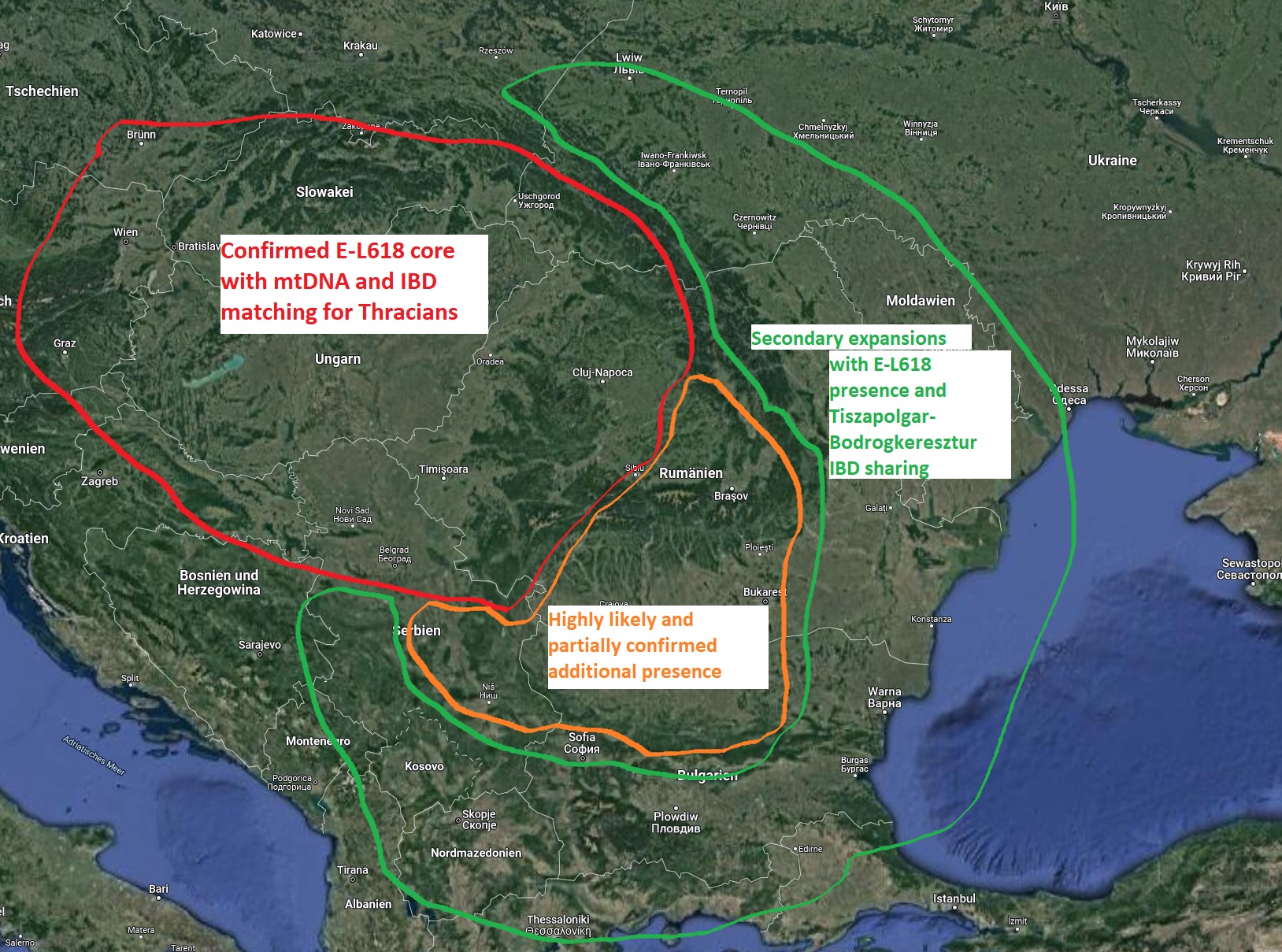
If you combined E-V13 finds, autosomal Thracian shift in groups and multiple individuals, as well as IBD sharing, you get this map for the Early Iron Age distribution:

Thracian-confirmed.jpg


The only significant element left out are the Phrygians, with the Balkan-shifted, increased steppe E-V13 from the Phrygian valley and the outlier in Mesopotamia. I'd say the Thraco-Phrygian connection is relevant, the presence in Mesopotamia are just splinters.

But the zone marked in red is not about singletons and splinters, it is about detectable Thracian-related genetic presence, associated with known Thracian material, cultural influence. That we haven't had E-V13 from Mezocsat yet is pure chance, because the autosomal shift and IBD matching is absolutely striking. All Thracian-shifted individuals from Mezocsat are more or less mixed females.

The obvious big gap is still Romania and there is no way Romania wasn't packed with E-V13 in the Early Iron Age. Not all groups, it always depends, like Scythian newcomers not necessarily. But the local BA/EIA population for sure.

For the Eneolithic, we get this pattern for E-L618, mtDNA And IBD sharing of highest relevance for the Thracians:

Eneolithic-shared.jpg


The red zone is the Eastern LBK-Lengyel into Tiszapolgar-Bodrogkeresztur sphere - the orange is Petresti and Salcuta with North Western Gumelnita samples. Even Northern Bulgaria is in mostly because of I2509, which has just a lot of Bodrogkeresztur-related matching! Without her, and she is a central individual, we could leave much of Gumelnita out.

Therefore most of the pattern looks like an expansion of Tiszapolgar-Bodrogkeresztur and possibly Salcuta-BSK into other areas of the Carpatho-Balkan and Western steppe sphere.

Tiszapolgar-Bodrogkeresztur is the main Eneolithic group Thracians have mtDNA and IBD segments from - plus E-L618/E-V13. This might be mostly due to undersampled groups from BSK, but that's really the only alternative. Core Tripolye-Cucuteni, Gumelnita-Karanovo and the Aegean sphere are being completely dwarfed by comparison.
 
I wouldn't jump the gun without any context even if they come from the neighboring slavic speaking countries. They are probably medieval or even more recent, especially I41663 fella.

So far I41663 seems to be Y32147* (no coverage for Y133365 but negative for below branches. Same thing for Y126039 and FT166340, no coverage for those nodes but negative for some of the below branches)

I43465 seems to be Z2705* (xY476553) (BY38894? BY147912? BY105603?)
Negative for all subbranches below BY38894 and under BY105603 though, so hard to say without coverage there if he is under those nodes as BY38894*, BY147912* or the fourth parallel branch under Z2705.
Interesting, noticed I41663 at FTDNA they had him under Y229537 yfull node. Really good reads for FGC14730 and currently splits that yfull node:
FGC14730 (G+) Y229640 (A-) Y229542 (A-) MF78736 (C-)

I am seeing only some Tosks there, Gjirokaster/Vlore. Just above a sample from Kukes.
 
There are no Thraco-Illyrian branches, lol. You keep extending olive branches to those talibans that literally wish you dead.

The following samples appear to be from Avar sites, because these IDs are amidst other samples from are all sorts of non-Balkan haplos, but also plenty of E-V13s, rarely any J-L283 and usually of isolate branch that are not Albanian.

Albanian
I39569.TW R-BY611 R-BY611 R-M207>M173>M343>L754>L576621>..L.389>P297>M269>L23>Z2103>M12149>
I40319.TW R-BY611 R-BY611 R-M207>M173>M343>L754>L771681>..L.389>P297>M269>L23>Z2103>M12149>
I43465.TW R-PH970 R-PH970 R-M207>M173>M343>L754>L579641>..L.389>P297>M269>L23>Z2103>M12149>
I41663.TW R-Y32147 R-Y32147 R-M207>M173>M343>L754>L679671>..L.389>P297>M269>L23>Z2103>M12149>

Close relative to Albanian
I46264.TW R-FTD60421 R-FTD60421 R-M207>M173>M343>L754>L776611>uLn3s8ta9b>lPe_2d9o7w>Mns2t6re9a>mL23>Z2103>M12149>
I34877.TW R-BY99751 R-BY99751 R-M207>M173>M343>L754>L679661>..L.389>P297>M269>L23>Z2103>M12149>

Distant relative
I41636.TW R-BY99751 R-BY99751 R-M207>M173>M343>L754>L679681>..L.389>P297>M269>L23>Z2103>M12149>I47256.TW R-BY99751 R-BY99751 R-M207>M173>M343>L754>L774671>..


None of these samples based on the IDs next to them appear Illyrian. I think these are Avar sites due to diversity of Slavic, MENA, German, Asian haplos. These are the real IDs, so they are not scrambled. If these were from some homogenic ethnic unit they would all be within the same ID numbering sequence. Very few Albanian specific E-V13s, I think there was one under FGC11451. Either way R-Z2705 appears to be related to E-V13. Tough luck.
I39569 - is labeled as central Europe(Hungary?) about 950-1,000 AD
I40319 - is labeled as central Europe(Hungary?) about 1,000-1,050 AD
I43465 - is labeled as SE Europe, Ottoman period
I41663 - is labeled as SE Europe, 1,450-1,500 AD
I46264 - is labeled as SE Europe, late Roman period 300 AD
 
Last edited:
All the E-V13s
Date mean in BP in years before 1950 CE Broad geographic region (N=North, C=Central, SW=Southwest, SE=Southeast, E=East)


I41062 4450 SE E-BY190131
I41598 3300 SE E-Y99468
I43953 3300 SE E-CTS5856
UKR007 2856 E E-BY6250
I20180 2750 SE E-BY6283
I20181 2750 SE E-S10174
I20183 2750 SE E-CTS5856
I20185 2750 SE E-Y61212
I35691 2700 SW E-CTS5856
I29088 2696 SW E-CTS5856
I30936 2650 SW E-CTS5856
I13596 2562 SE E-CTS2001
I29126 2500 SW E-CTS5856
I10946 2430 SW E-CTS5856
I10950 2430 SW E-CTS5856
I41958 2350 SW E-CTS5856
I37654 2290 E E-CTS5856
I12848 2290 SW E-BY4863
UKR152 2245 E E-CTS5856
I16272 2239 C E-Y258117
I5724 2232 SE E-Y99468
I41338 2231 SE E-Y99468
scy197 2225 E E-Y258117
I18832 2210 C E-Y258117
I40508 2150 SE E-Y99468
I35196 2089 SE E-Y258117
I19956 1871 SW E-CTS5856
I28339 1850 SW E-BY5022
I28343 1850 SW E-BY6092
I32008 1800 SW E-FTD65684
I32072 1800 SW E-BY6518
I41738 1800 SE E-BY5022
I41740 1800 SE E-CTS5856
I41938 1800 SE E-FGC76600
I41942 1800 SE E-FTD34333
I42255 1800 SE E-CTS5856
I42256 1800 SE E-S10174
I42267 1800 SE E-Z37871
I42369 1800 SE E-BY5786
I42468 1800 SE E-BY5786
I42863 1800 SE E-BY5786
I43006 1800 SE E-CTS5856
I43232 1800 SE E-CTS5856
I43561 1800 SE E-BY5029
I43564 1800 SE E-S10401
I43567 1800 SE E-BY5022
I43568 1800 SE E-FGC11451
I43569 1800 SE E-Z38770
I43570 1800 SE E-PH283
I43571 1800 SE E-BY4863
I43572 1800 SE E-CTS5856
I43629 1800 SE E-CTS5856
I43631 1800 SE E-BY4564
I43636 1800 SE E-CTS9320
R3931 1769 SE E-BY72004
R6756 1769 SE E-CTS5856
I35346 1759 SW E-BY15412
I40077 1750 SE E-BY4770
I39116 1700 C E-BY4684
I42076 1700 SE E-Y81468
I43700 1700 SE E-BY4280
I43705 1700 SE E-CTS5856
I43707 1700 SE E-PH3589
I43712 1700 SE E-BY160588
I43716 1700 SE E-FT131163
I43732 1700 SE E-BY4684
I43743 1700 SE E-BY4280
I43746 1700 SE E-Y145455
I43806 1700 SE E-FTB7315
I43811 1700 SE E-PH3589
I43814 1700 SE E-CTS5856
I43815 1700 SE E-CTS5856
I44138 1700 SE E-Z16988
I44144 1700 SE E-PH3589
I45215 1700 SE E-Y18675
I46263 1700 SE E-Y258117
I46267 1700 SE E-CTS5856
I46268 1700 SE E-CTS5856
I15504 1700 SE E-Z27131
I20802 1700 C E-Z27131
I39192 1650 SE E-BY4280
I42272 1650 SE E-FT187808
I42273 1650 SE E-BY5029
I35009 1650 SE E-BY193150
R6764 1616 SE E-CTS5856
I14092 1615 N E-FTB75291
I34737 1600 C E-Y95697
I34744 1600 C E-Y84162
I34754 1600 C E-CTS5856
I34775 1600 C E-BY152493
I39108 1600 SE E-BY4280
I39629 1600 SE E-CTS5856
I40978 1600 SE E-FT64983
I41121 1600 SE E-Y16729
I41122 1600 SE E-CTS2001
I41123 1600 SE E-BY193150
I41233 1600 SE E-A7136
I19585 1575 N E-BY4280
I14094 1574 N E-BY188966
I39448 1550 SE E-CTS5856
I40934 1550 SE E-CTS5856
I41340 1550 SE E-BY4280
I41542 1550 SE E-BY188918
I41545 1550 SE E-A9479
I42631 1550 SE E-BY4642
I44248 1550 SW E-BY6466
I44535 1550 SW E-BY159225
I34296 1550 SE E-PH345
I27297 1540 SE E-CTS5856
I35444 1508 C E-Y95697
I13733 1500 SW E-BY6039
I15470 1500 SW E-FGC71980
I37516 1500 SW E-Z21362
I37517 1500 SW E-CTS5856
I42347 1500 SE E-BY6283
I28867 1450 SW E-CTS5856
I28871 1450 SW E-BY4600
I28872 1450 SW E-Z21291
I28874 1450 SW E-FT355382
I28892 1450 SW E-A7136
I28893 1450 SW E-FGC11451
I28953 1450 SW E-CTS5856
I31824 1450 SW E-BY6203
I38879 1450 SW E-CTS5856
I46362 1450 SW E-BY5465
I46368 1450 SW E-BY5022
I46561 1450 SW E-FTC71867
I34447 1425 SE E-Y145455
I30543 1400 C E-CTS5856
I34443 1400 SE E-CTS5856
I41101 1400 SE E-BY4642
I8366 1350 SE E-BY116895
I35662 1350 E E-BY4280
I35671 1350 E E-Z38770
I35674 1350 E E-BY5022
I44723 1350 SW E-BY6170
I34990 1341 SE E-BY199965
I35005 1341 SE E-FTA38025
I38989 1341 SE E-BY5022
I38990 1341 SE E-FT7837
I38993 1341 SE E-CTS5856
I39088 1341 SE E-CTS5856
I39104 1341 SE E-BY4280
I39599 1341 SE E-BY6283
I39600 1341 SE E-CTS5856
I39601 1341 SE E-PH1954
I39617 1341 SE E-PH1954
I39618 1341 SE E-CTS5856
I16750 1325 C E-CTS1357
I33873 1308 SE E-FTC12456
I47487 1300 C E-FGC11451
I47578 1300 C E-BY6226
I47739 1300 C E-CTS5856
I32730 1275 SE E-FT61046
I34368 1275 SE E-BY6518
I34370 1275 SE E-Z21371
I35084 1275 SE E-Y16729
I28388 1250 SE E-Y95697
I33880 1250 SE E-Y95697
I33881 1250 SE E-A11837
I35173 1250 SE E-FGC11450
I44539 1250 SE E-Y145455
I44546 1250 SE E-FGC11451
I44633 1250 SE E-BY202815
I44637 1250 SE E-BY6276
I44683 1250 SE E-CTS5856
I44684 1250 SE E-BY5465
I44743 1250 SE E-MF179182
CSK003 1238 C E-FTC71867
CSK019 1238 C E-BY6276
CSK032 1238 C E-FTE95762
CSK036 1238 C E-Z21291
CSK041 1238 C E-BY65664
CSK044 1238 C E-Z21371
CSK048 1238 C E-A2192
CSK057 1238 C E-FGC11451
CSK058 1238 C E-FGC11450
CSK062 1238 C E-BY5022
CSK067 1238 C E-Y142744
CSK082 1238 C E-Y196687
MGS146 1225 C E-FGC11451
MGS149 1225 C E-Z21362
MGS319 1225 C E-Y84162
I28396 1200 SE E-BY4835
I32742 1200 SE E-CTS5856
I34793 1200 SE E-BY190580
I34798 1200 SE E-CTS2001
I34810 1200 SE E-CTS9320
I38958 1200 SE E-FTC6774
I38960 1200 SE E-BY5140
I39177 1200 SE E-Z21362
I40991 1200 SE E-S19928
I45390 1200 SW E-A783
I45961 1200 SW E-Y145455
I41779 1175 SE E-A2192
I33759 1150 SE E-SK888
I38841 1150 SE E-SK888
I39188 1150 SE E-SK888
I40938 1150 SE E-A783
I38583 1100 C E-FGC11450
I38662 1100 C E-BY203425
I39550 1100 C E-Z21365
I41078 1100 SE E-FTA18989
I41079 1100 SE E-S25766
I19786 1050 SW E-BY152493
I32026 1050 SE E-Z21362
I37899 1050 C E-CTS5856
I37906 1050 C E-Y19509
I37937 1050 C E-BY143121
I37963 1050 C E-Z21291
I37965 1050 C E-Y258117
I39787 1050 C E-Y258117
I39858 1050 C E-S2978
I39864 1050 C E-BY14151
I39886 1050 C E-Z16988
I40442 1050 C E-FT7837
I40444 1050 C E-BY6559
I40653 1050 C E-Z38664
I43357 1050 C E-BY5022
I46595 1050 C E-FGC11450
I46598 1050 C E-BY6106
I27539 1015 SW E-FGC11450
I10608 1002 C E-FGC11451
I38363 950 C E-CTS5856
I44583 950 SE E-CTS5856
I44591 950 SE E-BY34244
I44688 950 SE E-BY5022
I29205 940 SW E-BY188966
I47903 900 SE E-CTS2001
I43907 900 SE E-FT262507
I41531 850 SE E-Y41980
I44284 850 SW E-PH631
I47033 850 SE E-PH631
I41403 800 SE E-FT7837
I41430 800 SE E-FGC11450
I41438 800 SE E-FGC44169
I41443 800 SE E-CTS9320
I41444 800 SE E-CTS9320
I39633 775 SE E-CTS9320
I47062 775 SE E-CTS9320
I47065 775 SE E-CTS9320
I42284 750 SE E-L241
I47068 725 SE E-V13
I41665 700 SE E-CTS9320
I43133 700 SE E-CTS9320
I43416 700 SE E-CTS9320
I43417 700 SE E-CTS9320
I47031 700 SE E-BY4642
I47063 700 SE E-V13
I47174 700 SE E-V13
I17822 666 E E-V13
I41949 650 SE E-V13
I47074 600 SE EV-13
I47093 600 SE E-V13
I25964 550 SW E-V13
I41727 550 SE E-V13
I47260 550 SE E-V13
I47272 550 SE E-V13
I43508 525 C E-V13
I44928 525 C E-V13
I23985 475 SW E-V13
I45013 434 C E-V13
I45035 396 C E-V13
I41596 350 SE E-V13
I47861 300 SE E-v13
I47863 300 SE E-CTS9320
I47864 300 SE E-V13
I47872 300 SE E-V13
I25444 300 SW E-V13
I46995 300 SE E-V13
I47042 300 SE E-V13
I41336 200 SE E-V13
I41604 200 SE E-V13

wvvcSr2.png
 
Last edited:
I41062 4450 SE E-BY190131
His haplogroup is too young and he plots in a manner which doesn't fit. His IBD matches too look too modern and his closest match is from 1700 BP.

There appear to be a couple of misdated samples. The oldest genuinely Thracian individual is, like I had predicted on GA,
I41598 3300 SE E-Y99468

The Greek-Thracian mixed sample is interesting:
I43953 3300 SE E-CTS5856

Because he comes from a whole series of Balkan-Greek mixed individuals, of which a couple look Thracian (females). It looks like this was a Greek community which had, probably from neighbouring tribes, brides. And these brides looked more Northern Greek, Paeonian-Illyrian and/or Thracian respectively. That's my interpretation at first glance.

This series has some interesting haplogroups also. The samples are all from 1300-1000 BC and show how Thracian mixed into this Greek population - and other Northern tribal indivduals also.
 
- From the data it is clear zero samples from Romania, Romania is grouped in the East group(refer to authors map)
- Akhbari databse does not seem to have many new IA samples from Bulgaria or did not include them
- Two iron age samples that plot like Illyrians are I35196 and I5724, both have no connection to Illyrians in IBD.
- Those samples from the Roman period might be the new batch from Viminacium
- The Bulgarian leaker claimed they found a Thracian holdout in the area of Timochani, to me it seems these samples are not in this database or only small fraction is, because one cannot make such a conclusion when seeing the 700-900 AD samples, very little of the old population is in the graph
- Even up to 900 AD there are still samples that plot like south Thracians in the SE region.
 
Last edited:
I41062 4450 SE E-BY190131
His haplogroup is too young and he plots in a manner which doesn't fit. His IBD matches too look too modern and his closest match is from 1700 BP.

There appear to be a couple of misdated samples. The oldest genuinely Thracian individual is, like I had predicted on GA,
I41598 3300 SE E-Y99468

The Greek-Thracian mixed sample is interesting:
I43953 3300 SE E-CTS5856

Because he comes from a whole series of Balkan-Greek mixed individuals, of which a couple look Thracian (females). It looks like this was a Greek community which had, probably from neighbouring tribes, brides. And these brides looked more Northern Greek, Paeonian-Illyrian and/or Thracian respectively. That's my interpretation at first glance.

This series has some interesting haplogroups also. The samples are all from 1300-1000 BC and show how Thracian mixed into this Greek population - and other Northern tribal indivduals also.

Yep his top matches are all moderns:
I43814 1700 SE
I42342 750 SE
I38662 1100 C
I47273 850 SE
I34363 1275 SE
I43699 1700 SE
i47706 1300 C
I47120 550 SE
I40277 1200 SE
I44656 1050 SE
i48401 5600 N
I42846 2300 E
I38622 1100 C

I43953.TW Has matches with samples that plot like Greeks, from same exact timeframe, big IBD segments too
A-V221 I43916 3325 SE 87.62
G-Z42570 I43952 3300 SE 39.85
R-CTS699 I43942 3300 SE 32.13
0 I43931 3275 SE 23.98
R-BY133177 I43936 3300 SE 19.54
H-FTC500 I44046 3300 SE 18.20
0 I43917 3325 SE 17.88


FnjcYOO.png
 
So the other oldest E-V13 has neolithic components from eastern Hungary and even Poland, so much for the Aegean theories. Hungary Yamnaya, Hungary neolithic. The black hole remains Romania, zero publications, the only such country.
I41598.TW unknown
NEO147.SG 15.09 Hungary_MN_Tisza
I5126.SG 14.87 Hungary_EBA_Yamnaya
I34066.TW 12.18 unknown
I6919.SG 11.23 Russia_Volgograd_EBA_Yamnaya
I7142.SG 10.86 unknown
I29039.AG 9.86 unknown
I41740.TW 9.63 unknown
HG00102 9.58 unknown
I45911.TW 9.58 unknown
RISE1166.SG 9.55 Poland_Koszyce_GlobularAmphora
I42262.TW 9.52 unknown
N44.SG 9.51 Poland_CordedWare_3
I26021.AG 9.42 unknown
I18213.AG 9.42 Hungary_EIA_Prescythian_Mezocsat
I3132.SG 9.14 United_Kingdom_Scotland_C_EBA
I34045.TW 9.04 unknown
I26735.AG 9.02 Croatia_LIA_La_Tene
RISE1167.SG 8.98 Poland_Koszyce_GlobularAmphora
RISE1171.SG 8.98 Poland_Koszyce_GlobularAmphora
 
All the older Thracians appear to have their closest steppe matches with Carpatho-Danubian/Danube-Tisza Yamnaya so far. Like Northern Bulgaria, Eastern Hungary and Slovakia.
 
There are more very old samples from SW Europe - one belongs to E-PH3589, downstream of the Northern-Central branch of E-Y3183. From about 800-700 BC.

2700_SW_E-Y3183:I35691.TW,0.111547,0.145221,0.009428,-0.028101,0.024312,-0.00753,-0.00141,-0.003461,0.003477,0.019135,0.001137,0.001948,-0.008622,-0.003853,-0.000136,0.001724,0.00326,-0.00228,0.00176,0.001376,-0.002745,-0.001978,0.002095,-0.006868,0.001557

I37218 is his daughter I guess. However, I'm not sure the dating is correct in this case, because they look like more modern mixtures.

Fairly old Eastern European new sample:
2290_E_E-BY4684:I37654.TW,0.106994,0.060932,0.038466,0.03876,-0.010156,0.013108,0.003995,0.001615,-0.021475,-0.017312,0.002761,0.001499,-0.002379,-0.013212,0.007736,0.001458,-0.002868,0.002407,0.003017,0.006878,-0.012353,0.00643,-0.000863,0.009399,0.003233

He seems to be Scytho-Sarmatian. Haplogroup is https://discover.familytreedna.com/y-dna/E-BY4684/tree and matches Thracian Hallstatt UKR002

We also get a pretty old Near Eastern outlier:
2562_SE_Near_East_E-CTS5856:I13596.AG,0.079676,0.148267,-0.058454,-0.083011,-0.02185,-0.024263,-0.00094,-0.001615,0.002454,-0.002187,0.002436,-0.000749,0.014123,-0.00289,-0.0019,0.006232,-0.019297,0.004054,0.00264,-0.001876,-0.003993,0.007666,-0.008874,0.002289,0.002155

His IBD match list is super short but includes once more an Eastern LBK sample:
I13596.AG unknown<br> GLN291.AG 9.47 France_N<br> I3965.AG 8.94 Israel_MLBA<br> I16011.AG 8.50 Slovakia_N_LBK<br> I5219.AG 8.43 unknown<br> als010.SG 8.23 Sweden_central_Late_Viking<br> I45883.TW 8.03 unknown<br> I39847.TW 7.94 unknown<br> Bar25.SG 7.58 Turkey_Marmara_Barcin_N<br> I34253.TW 7.50 unknown<br> I40900.TW 7.40 unknown<br> NA20778 7.22 unknown<br> I28429.AG 7.19 unknown<br> S47489_Fluffle.18_SQ.TW 7.14 unknown<br> I43743.TW 7.10 unknown<br> I43283.TW 7.07 unknown<br> I28776.AG 7.06 unknown<br> I21212.AG 7.06 unknown<br> I37596.TW 7.06 unknown<br> NEO630.SG 7.06 United_Kingdom_Scotland_Orkney_N<br> I44320_preQC.TW 7.04 unknown<br> I23256.AG 7.03 unknown<br> I12789.AG 7.00 unknown<br> I40512.TW 7.00 unknown<br> I43223_preQC.TW 7.00 unknown<br>

These Anatolian or Phrygian? group with Thracian lineages might have formed the bridge over which some Levantine segments came to South and Easter Thacians? Because Israel_MLBA appeared in those.

His assignment might be interesting.

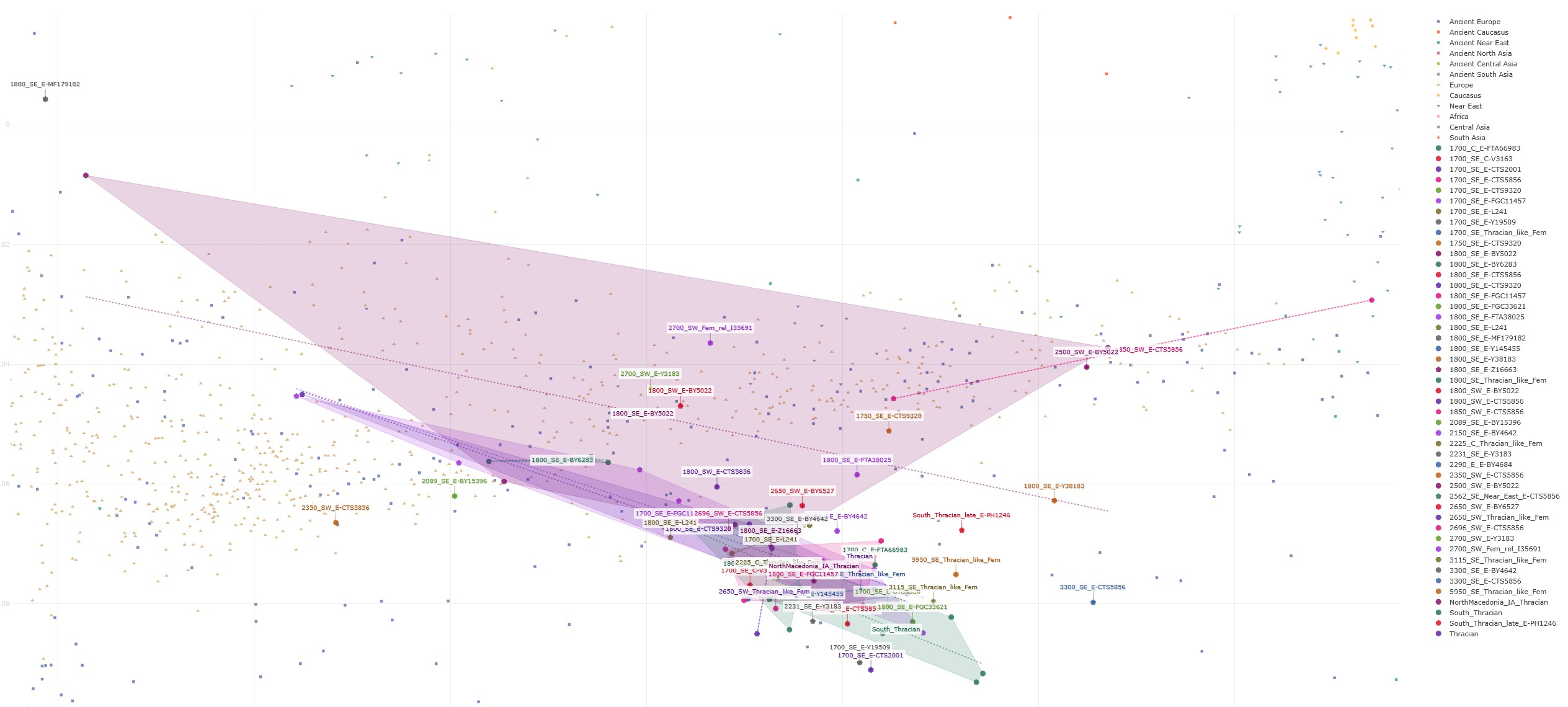
I made a PCA with a focus on typical Thracian profiles and samples older than 1800 BP (only specific 1700 BP samples added):

PCA-earlier-Samples.jpg


The core becomes much more compact. Outliers are primarily in the direction of the steppe (Scytho-Sarmatian shifted), the Near East (Phrygian-Anatolian?) and Mycenaean Greeks, plus North Italy, Etruscans and West Balkan sphere. These are however all clearly outliers by position.

Even the core of the SW/Italian early samples plot within or close to the Thracian core - some are clearly mixed, like one on the lower left appears to be half Etruscan (Thracian father, Etruscan mother).

Here a more detailled view of the same plot:

PCA-earlier-Samples-Zoom.jpg


The Thracian core becomes very apparent and the 3, especially 2, in particular I20184 outlier position of the South Thracians is very clearly visible.

I marked all the oldest samples from the new data which have no clear and strong signal of foreign admixture. Apparently, regardless of where they are from (Italy, Central Europe, South Eastern Europe), they all plot exactly in what I have outlined before as the Thracian autosomal core:

PCA-earlier-Samples-Zoom-Detail.jpg


All the older samples outside are clearly and strongly admixed (Greek, Near Eastern, North Italian-Etruscan, Scytho-Sarmatian etc.).

However, my impression is that this is, in part, also due to the lack of samples from specific regions. The majority of the 1800-1600 BP samples seems to come from Serbia and Bulgaria, Danubian Roman provinces. And it likely shows the influx of resettled Dacians. Because a very large fraction of these samples is related among each other, but has near zero admixture in the first generations.

I don't think that e.g. the Himera-type population or the Thracian Hallstatt population just vanished shortly after its existence, so I think we are simply still missing much of the potential sampling. And the primary reason for this is obviously that there are basically no relevant West Romanian samples included. No later Copper Age, no Bronze Age, no Iron Age, not even Roman era. Because there is no way that there would be no E-V13 in Roman era Western Romania. That's impossible. All this data being completely holden back.
 
When looking at the 1800 SE samples with E-V13, there is one group of samples which follow a serial number, together with females and non-E-V13 individuals. These are the samples:

G-Z39053:I43558.TW,0.121791,0.149283,-0.00792,-0.043605,0.011079,-0.006693,0.001645,-0.006,-0.010431,0.014943,0.004709,0.003897,-0.006987,0.003441,-0.009093,-0.007292,-0.007953,0.008615,0.012821,-0.007003,-0.003494,0,0.001849,-0.004458,-0.002155<br>Female:I43559.TW,0.1161,0.159438,-0.023381,-0.059109,-0.000923,-0.023148,-0.002115,-0.003,-0.016975,0.018588,0.002598,0.004496,-0.003271,0.003991,-0.013029,-0.017767,-0.001304,-0.000887,0.004902,-0.002251,-0.000998,0.007296,-0.001972,-0.001446,-0.0097<br>R-Z2109:I43560.TW,0.133173,0.153345,0.023759,-0.007752,0.034468,-0.005578,-0.00235,-0.004154,0.001227,0.024055,0.007957,0.007643,-0.016353,-0.00289,-0.014522,-0.005569,0.018123,-0.005068,0.002388,-0.002751,-0.005366,0.003586,-0.001356,0.010363,0.001078<br>E-FGC11451:I43561.TW,0.132035,0.157407,0.017348,-0.040375,0.030775,-0.025658,0.00329,0.004615,0.01309,0.040639,0.006171,0.004796,-0.016204,0.003441,-0.025923,-0.00716,0.014733,-0.00038,0.005782,-0.011255,-0.016471,0.002349,0.003451,-0.002771,-0.004191<br>R-Z2109:I43562.TW,0.12862,0.151314,0.02225,-0.005814,0.023697,-0.004741,-0.00047,-0.006461,-0.003068,0.01713,-0.002761,0.003897,-0.014271,-0.004266,-0.007329,-0.002519,0.00339,0.003041,0.005028,-0.006378,-0.011605,0.00272,0.000493,-0.001084,-0.004431<br>Female:I43563.TW,0.1161,0.155376,-0.032055,-0.069122,0.009232,-0.027052,0.005875,-0.001615,-0.008795,0.024602,0.00682,0.007793,-0.010258,0.003991,-0.007872,-0.009016,0.011604,0.001267,0.004274,-5e-04,-0.010731,0.005317,-0.003574,0.000361,-0.002036<br>E-Y145455:I43564.TW,0.119514,0.159438,0.003017,-0.047804,0.032929,-0.023427,0.000705,0.003692,0.012476,0.038816,0.004547,0.012889,-0.014866,-0.006468,-0.028501,0.004243,0.025946,0.003421,0.004902,-0.009755,-0.007237,0.00272,0.000616,0.005543,-0.00479<br>Female:I43565.TW,0.126344,0.150298,0.006411,-0.031331,0.021542,-0.013666,-0.000235,0.000231,0.008999,0.034807,0.009581,0.010491,-0.011001,-0.002064,-0.013165,-0.008751,0,-0.004561,0.010936,-0.004752,-0.00574,0.001731,-0.001849,0.001084,-0.000479<br>E-FGC11451:I43567.TW,0.126344,0.159438,0.009805,-0.047158,0.028928,-0.02259,0.000705,-0.000462,-0.001841,0.039181,0.00682,0.006894,-0.011298,0.007432,-0.026465,-0.011005,-0.001565,-0.003801,0.007668,-0.01063,-0.009858,-0.005441,0.000986,-0.00241,-0.0097<br>E-CTS9320:I43568.TW,0.120652,0.166547,0.010182,-0.040375,0.027697,-0.021753,-0.003995,-0.002769,0.00409,0.039727,0.008444,0.01079,-0.017542,-0.003165,-0.020494,-0.010872,0.010952,0.000633,0.005405,-0.012131,-0.012852,-0.002349,-0.006162,-0.001084,-0.002275<br>E-BY6283:I43569.TW,0.125205,0.149283,0.02753,-0.014535,0.033237,-0.004741,0.004935,0.002538,0.011249,0.019864,0.005196,0.005095,-0.01219,-0.000275,-0.002714,-0.017237,-0.005476,0.005321,0.004148,-0.010255,-0.010482,0.001978,0.001479,0.000723,-0.00491<br>E-L241:I43570.TW,0.130897,0.159438,0.018856,-0.035207,0.030775,-0.020638,0.010105,-0.002077,0.000409,0.032074,0.005359,0.005695,-0.017245,0,-0.020087,-0.01127,0.001434,0.006461,0.006788,-0.010755,-0.009109,0.007048,-0.00037,0.001084,-0.003832<br>E-BY5022:I43571.TW,0.120652,0.156392,0.007165,-0.039406,0.034776,-0.026495,-0.00564,-0.000462,0.010431,0.034625,0.003897,0.008243,-0.013379,-0.001927,-0.022258,-0.005701,0.010561,-0.003167,-0.000251,0.00025,-0.002121,0.008532,0.003451,0.001084,0.000599<br>E-SK888:I43572.TW,0.120652,0.116786,0.035826,0.030362,0.01508,0.007251,0.009165,0.013615,-0.003886,-0.005649,0.001137,0.001349,-0.003419,-0.004542,-0.001629,-0.004906,0.007562,0.002027,-0.003017,-0.000625,-0.010606,0.003957,-0.000739,-0.003012,-0.003353<br>Female:I43573.TW,0.122929,0.164516,-0.029793,-0.066215,0.005232,-0.019522,0.0047,0.003231,-0.003886,0.033349,0.003085,0.009891,-0.017096,0.002064,-0.016422,-0.017369,-0.002868,0.006081,0.010936,-0.014132,0.000998,0.012118,-0.00493,0.002169,0.000718<br>Female:I43496_preQC.TW,0.112685,0.153345,-0.011691,-0.057817,0.013233,-0.023706,-0.001175,-0.008307,-0.001636,0.036812,-0.002923,0.009292,-0.015907,0.001376,-0.011672,0.002254,0.021644,-0.003421,0.00264,0.006128,-0.003244,-0.003833,0.001972,0.014942,0.002515<br>J-MF10501:I43497_preQC.TW,0.111547,0.151314,-0.040352,-0.064923,-0.004616,-0.019522,0.0047,-0.000923,-0.015544,0.023691,-0.001299,0.005995,-0.017245,0.003303,-0.010315,-0.008221,0.00691,0.001647,0.007668,-0.004002,-0.013351,-0.003091,-0.005546,0.000241,0.00012<br>E-FGC11451:I43501_preQC.TW,0.126344,0.159438,0.003017,-0.041344,0.024312,-0.025937,0.001645,-0.006461,0.007567,0.037541,0.006008,0.009741,-0.015758,-0.002477,-0.017644,-0.000398,0.006258,0.003421,0.008673,-0.006753,-0.015348,-0.000495,0.002835,0.009519,-0.001078<br>Female:I43502_preQC.TW,0.120652,0.11577,0.035826,0.027455,0.017234,0.01004,0.002115,-0.000462,-0.003477,0.006196,-0.003085,0.004046,0.001635,-0.006468,-0.0095,0.009812,0.016168,-0.003547,0.006411,0.003001,-0.012603,0.003091,-0.000616,0.007712,0.006107<br>

This series is particularly interesting because the majority of E-V13 carriers is "fairly pure" and part of the very inner "Thracian core" in every respect (PCA, autosomal proportions, IBD matching etc.).

What I did is to look at the non-E-V13 individuals and those E-V13 which are not part of the core, to get a better picture of what's going on, under the assumption that they are from either the same site or a site from the same general region.

The results are absolutely striking and highly interesting. First off, the females from this series are clear autosomal outliers, with 4 out of 6 looking "Imperial Roman" Levantine-Anatolian admixed. However, they do have Thraican ancestry! So they really look like longer term mixes of some sort from within the Roman sphere.

The crucial part is, however, not a single of the E-V13 males looks like that! Not even the E-BY5022. The E-V13 males are all either typical Thracians, or have Carpathian Basin to steppe admixture. The only male which plots in the direction of these females has this rare Caucasian haplogroup: https://discover.familytreedna.com/y-dna/G-Z39053/tree and shows additional, extra Caucasian pull.
The best representative of this Imperial Roman type ancestry has haplogroup https://discover.familytreedna.com/y-dna/J-MF10501/tree which appeared among Greeks and Sarmatians from Southern Romania.

The two R-Z2109 from this set, having two different branches downstream (!) plot with the E-BY6238 male right in the Vekerzug East cluster. Like they are spot on. E-BY6238 shows Thracian IBD sharing, the R-Z2109 not as clearly so (didn't dig deep though). Even more steppe shifted is the E-SK888 sample, he's outside the range of the clearly defined Thracian sphere even, very much steppe shifted - similar to some Glinoe Thraco-Scythians still, though.

So it looks as if this sample covers:
1) a group of females with partial Thracian ancestry, being from a Greco-Thracian/Romanised background and having possilbe extra Anatolian admixture. They team up with a J-MF10501 Aegean-Anatolian individual which represents the South Eastern pull they show.
2) a Caucasian shifted G-individual, which is fairly close to these females
3) 2 E-V13 (E-SK888 and E-BY6283 and 2 R-Z2109 which look like coming from a steppe shifted community very similar to identical to what we see in Vekerzug, presumably will find in Ciumbrud and we have also seen, to some degree, in Glinoe.
In this context it is important to stress that E-BY6283 was found by now in more than half a dozen samples of which the majority was from a Sarmtian context from Eastern Hungary. Therefore if a branch deserves the term "Daco-Sarmatian", its E-BY6283: https://discover.familytreedna.com/y-dna/E-BY6283/tree
It is therefore very likely, that this Vekerzug-like individuals came from a Sarmatian-related context in the Eastern Carpathian basin.
4) A nearly pure E-V13 group with different branches which look like "fresh arrivals".

So we really have a strong dominance of Dacian and Daco-Sarmatian male individuals meeting a local mixed-Romanised female population.

And we see that they mixed, because of the shift which can be best defined by the outcome of the 1700 BP SE samples with E-FGC11457/FGC11451! And it now makes perfect sense why the purely Daco-Thracian E-FGC11451 tribe did mix in two directions while being probably in the same spot: They mixed in two directions!
One time they mixed with Daco-Sarmatians and Daco-Celts from the Carpathian basin, the second time they mixed with these local Romanised Greco-Thracian-Anatolian females!


My conclusion is therefore that we really look at resettled Daco-Sarmatians and Dacians from the Eastern Carpathian basin and Dacia in generla which were brought to the Danubian provinces, to a site in which a local mostly Romanised-mixed population (which had Thraican ancestry as well!) lived.

To illustrate what I described here, here is the IBD + PCA plot, it shows the connections between the groups and relation to confirmed Thracian-related groups and samples:

IBD-1800-BP-set.jpg


As one can see, two of the highly mixed Romanised females have IBD sharing with confirmed Thracian/Thracian core samples. The Caucasian G-carrier, the steppe outlier E-SK888 and the two R-Z2109 are IBD isolates. But so is the North Thracian IA female from North-central Bulgaria - just saying.

However, the others do connect nicely, but none of them is closely related. So they come from a Daco-Thracian sphere and populations, but not close family-clan-villages etc.

The general plot is lovely, showing that E-V13 came in either nearly pure or with mostly Scytho-Sarmatian/Carpathian basin admixture:
1800-BP-Plot.jpg


Whereas all the E-V13 males plot in the Thracian core or have Scytho-Sarmatian/Carpathian basin admixture, 3 out of 5 of the females are "Imperial Roman" shifted-mixed. Only one female may be considered predominantely Daco-Thracian and one Daco-Sarmatian.

Here I marked the clusters to make the process and which populations met clear:

1800-BP-Plot-marked.jpg


I know from the wider set that there were Daco-Thracian females involved too. But I think even with this limited number of samples, the pattern becomes pretty obvious.

The smoking gun is indeed that the 2nd, 3rd, 4th generation of the E-FGC11451 centered pure Daco-Thracians starts to shift in the direction of either the Sarmatian/Carpathian basin cluster or the Imperial Roman/Greek one.

The conclusion for me is that we do indeed deal with the historically attested resettlement of the Dacians. Dacians and Daco-Sarmatians coming in, meeting a local, already Romanised and oftentimes mixed Thraco-Greek population.

If adding more samples form the 1800 BP series, the pattern becomes even more pronounced, but not different. And there is a clear correlation of yDNA-haplogroup with autosomal ancestry. E.g. there is at least one clearly Celtic outlier in the data set, and he has haplogroup R-BY16431 (I43639).

This means he likely is, too, a first generation migrant from a Celtic region, likely from the Carpathian basin. One half-Celtic looking or Carpathian basin individual is I-Y66188 (I43630), this branch was only found in LBA Hungary so far!

There are even more Near Eastern-Caucasian pulled individuals, like I43635, which show us where the "Imperial Roman" shift came from, Incidently, this individual is R-Z93, whereas the next extreme Near Eastern I43637 is J-Z39600!

On the other hand, I43636 is a fully typical Thracian with E-SK888!

Such a strong differentiation along the male lineages only can only be explained by fairly recently shared space or reproductive-social isolation.

I tend towards the first, with a large scale recent immigration, because of two factors:
- The locals already have this Imperial Roman admixture
- The E-V13 being not just associated with typical Thracian, but also with Daco-Sarmatian and Carpathian basin ancestry - and this influx from the Carpathian basin can be proven otherwise, with other lineages (Sarmatian, Celtic, Kyjatice etc.) too.

But it might be a local North Carpathian community too, we can't exclude that yet, which didn't freshly arrive from more Northern regions but already lived in Northern Serbia/Northern Bulgaria. I think the more recent arrival is more plausible, but its not 100 % proven and it might have been both (local Thracians, some of which were already mixed, others not, newly arriving Dacians on top).

The very strong association of patrilineages with E-V13 with Daco-Thracian and Daco-Sarmatian type ancestry is however absolutely striking in this whole set from 1800 BP. And it is a very large set, with dozens of samples. This is solid.

The other haplogroups are rarely associated with Daco-Sarmatian/Daco-Carpathian type ancestry and practically never (with the exception of C-V86) with the ancestral core type.
 
To demonstrete in detail what I have written above, that we deal with a totally E-V13 dominated fairly pure Daco-Thracian population which appeared unmixed on the scene and the admixture had a male sex bias, here the core group sampled which being dominated by E-FGC11457 over the generations, once more, after I described the genetic environment and the various other migrants and ethnic groups (Sarmatians, Daco-Sarmatians, Carpathian basin residues, Celts, Dacians, Thraco-Greek mixed, Anatolians, "Imperial Roman", Caucasian outliers etc.).

The first generation is among the purest Daco-Thracian samples we got, they kind of define the Daco-Thracian autosomal core by themselves, all 5 of them. Additionally, most of them don't have IBD sharing and those which do, only very distant one, at the same level as say South Thracians and Mezocsat or Vekerzug. So it proves a connection, but it could be very distant, going back up to 1000 years and more. Therefore we deal with the influx or simply regional appearance in the record of a big population. This E-FGC11451 alone must have come from a population in which there must have been many hundreds of E-FGC11457 carriers at the lower minimum.

PCA-E-FGC11457.jpg


Note the 1800 BP samples are pure Daco-Thracian type individuals, all of them, despite not being closely related to each other and sharing only very little IBD or none at all.
The 1700 BP generation, just about 100 years later, being shifted towards two poles, the Daco-Sarmatian and Carpathian basin one, we saw on the PCA before, and one in the direction of admixed South Thracians like we see them in Kapitan Andreevo, a bit more Thraco-Greek if you like. The 1600 BP individual is mixed with Celto-Germanic.

If we compare this with the larger data set from 1800 BP, the pattern is clear:
1800-BP-Plot-2.jpg


There are a couple of Carpathain basin/Celto-Germanic and Sarmatian admixed E-V13 in here, but the majority is in the Daco-Thraican autosomal core or very close to it. The only mixed E-V13 in the larger data set, moving in the direction of Thraco-Greek/Imperial Roman is, and I don't think that's by chance, a E-BY5022. The main male population with this Imperial Roman trend is fully dominated by haplogroup J-M410.
Absolutely striking is also that many more females are shifted towards the Near East, in the "Imperial Roman direction". A similar number being positioned between the Daco-Thracian core and the Central European (Carpathian basin, Celto-Germanic) group dominated by branches of R-L51.


Incidently, the more Sarmatian shifted profiles being also dominated by females.

The question is from which site or sites these 1800 BP SE samples are coming from. The early trend suggests the E-V13 population mixed way more with Central European/Celtic and Sarmatian individuals first. This would suggest closer proximity to the Carpathian basin and a more Dacian orientation. The Romanised Thraco-Greek/Imperial Roman type population was dominated by Near Eastern patrilineages, most notably J-M410, but also had E-M34, E-V22 etc. and like already argued only one E-V13 with out of all branches the rather South Thracian E-BY5022.

It is also noticeable that even in the following generations, if taking the full set, all E-V13 branches through all periods, E-BY5022 splits more radically between North Western Euroepean and Near Eastern, whereas the Northern E-V13 branches (E-FGC11457, E-Y3183, E-L241, E-CTS9320) being characterised by a variation from the Balkans to other parts of more Northern Europe and little to now presense in the Near Eastern block. So this is not by chance and no coincidence, because otherwise we would see a stronger shift for the Northern branches in that direction.

To see what's really going on, over time, I did a general PCA with a large fraction of the 1700 BP samples:

1700-BP-Plot-2.jpg


The 1700 BP population stabilised along the Central European - Thracian axis. The number of Near Eastern/Imperial Roman outliers decreases. This population element did get reduced in the 100-200 years.

On the other hand, the mixture which we could see already in the 1800 BP for the E-V13 Daco-Thracians did increase: They being distributed along the full axis between Celto-Germanic and Thracian core. The Sarmatian element is practically absent in its pure form, but the Scytho-Sarmatian pull being still very noticeable. So we can conclude that these three elements kind of merged (Daco-Thracians, Celto-Germanic and Sarmatian), while the "Imperial Roman" type ancestry did rather shrink and not participate as strongly at all.

The question here is whether the strong Daco-Thracian contribution was a regional resurgence, or the result of a resettlement and migration. In favour of the latter is that there are practically no Romanised-ancestry type E-V13 Daco-Thracians, only singletons from Southern branches. Also that they soon start to mix, after arrival, whereas the first generation of some of the tribes-clans looks essentially "pure". The other issue is this sex bias, which is pretty extreme. I already wondered about the low number of females in the Thracian core compared to the males. Probably that's not just chance too.

There are only 5 (!) typical Thracian-like females in the 1800 BP SE set! Only 5!!!

After analysing the whole 1800 BP set, the number of E-V13 males which have a typical Thracian core profile by far exceeds that number. In fact, there are as many E-FGC11451 males ALONE (5)!

This implies a strong male biased contribution of E-V13 Daco-Thracians to this set.

The most likely explanation for such a strong pattern is that these were Dacian soldiers or prisoners of war which brought only a limited number of their own females with them. And apparently, this is absolutely evident from the data set, they came from a very large Daco-Thracian population. Not a small tribe or community, but a big population. Otherwise the IBD and branch pattern would look radically different. We are talking in my opinion with a rough estimate about at least hundreds, if not thousands of E-V13 patrilineages.


The following generations of this Daco-Thracian population mixed primarily with Sarmatian and Celtic-more Western Carpathian basin wives. This is again absolutely evident even if just looking at the E-FGC11457 bunch, but its true for a the whole population which starts to get stretched along those lines, due to these E-V13 males taking the Celtic, Illyrian, Pannonian, Sarmatian wives.

Such a sudden appearance of a strong male group suggests also something else: A pulse migration. Like a very large number of distantly related, same ethnic group males coming in, in a very short period of time. This too is very significant.

When going through the data once more, for the 1800 BP South Eastern European set, I was quite shocked by the extreme sex bias of the data. This also explains why the 1700 BP samples were so much more mixed: They had not enough females from their own community with them to begin with!

Under the assumption that the male E-V13 population was only invisible before, because they did cremate, this would make only sense if we assume that the female were more often cremated than the males. Now while I can't completely exclude that possibility, I don't think its the most parsimonious explanation for this pattern. I mean why should the Dacian males abandon cremation, but the females don't?
Therefore I tend to explain these numbers by an actual sex bias and this is the strongest argument in favour of a sudden pulse migration which was male dominated from a Daco-Thracian population - likely North of the Danube, but could have been South of the Danube in Northern Serbia or Northern Bulgaria also, its source region I mean.
 
Last edited:
After the last run I sorted the oldest samples (1300-1100 BC, 800-600 BC) and some of the E-FGC11451 and couple of other 1800 BP/SE samples with vs. without significant IBD sharing with Greek samples. The result is glass clear. I used these samples:

Greek_IBD:1800_SE_E-CTS9320:I42255.TW,0.126344,0.157407,0.014331,-0.034884,0.018157,-0.015897,-0.003525,-0.006461,0.005931,0.043919,0.002923,0.001349,-0.015609,-0.000688,-0.021172,-0.007027,0.008345,0.003927,0.012318,-0.014257,-0.011105,-0.002226,0.001972,-0.001687,-0.000718 <br>Greek_IBD:1800_SE_E-FGC11457:I43501_preQC.TW,0.124067,0.161469,0,-0.04522,0.026466,-0.022311,0,-0.004615,0.00634,0.034625,0.003573,0.014537,-0.015758,0.000413,-0.015472,0.002519,0.008736,0.001647,0.00905,-0.003126,-0.013975,0.001978,-0.000986,0.006266,0.000239&nbsp; &nbsp; &nbsp; &nbsp; &nbsp; &nbsp; &nbsp; &nbsp; &nbsp; &nbsp; &nbsp; &nbsp; <br>Greek_IBD:1800_SE_E-Y145455:I43564.TW,0.120652,0.157407,0.003771,-0.050065,0.034468,-0.023148,0.00047,0.003461,0.011862,0.038999,0.002761,0.007793,-0.015163,-0.011285,-0.024837,0.002121,0.026598,-0.00114,0.005656,-0.008254,-0.009608,0.006554,0.000493,0.006507,-0.007305&nbsp;&nbsp; <br>Greek_IBD:3115_SE_Thracian_like_Fem:I43959.TW,0.113823,0.158423,0.009805,-0.052972,0.025235,-0.027889,-0.005875,-0.000923,0.013908,0.047928,-0.005846,0.01124,-0.021258,0.003165,-0.018729,-0.018695,-0.000913,0.000253,0.005656,-0.014507,-0.021587,-0.003215,0.002465,0.011447,-0.003952&nbsp; &nbsp; &nbsp; &nbsp; <br>Greek_IBD:3300_SE_E-CTS5856:I43953.TW,0.121791,0.1635,-0.006788,-0.0646,0.022773,-0.028726,-0.00658,-0.005307,0.007567,0.045195,-0.003897,0.007044,-0.016353,0.004542,-0.019679,-0.014054,0.009127,0.003801,0.01169,-0.008879,-0.007237,0.002226,-0.003697,0.007591,0.008622&nbsp;&nbsp; <br>Greek_IBD:South_Thracian:I20180.AG,0.110408,0.171624,0.007542,-0.0646,0.036314,-0.02259,0.00188,-0.005538,0.012067,0.046106,-0.000162,0.003147,-0.009663,0.002615,-0.019679,-0.019093,-0.004042,0.00266,0.003645,-0.01088,-0.012353,0.001978,0,-0.003012,-0.011137&nbsp; &nbsp; &nbsp; &nbsp; <br>Greek_IBD:South_Thracian:I20184.AG,0.117238,0.169593,0.005657,-0.059109,0.02739,-0.027052,0,0.006231,0.01718,0.052848,-0.000974,0.008692,-0.024083,0.002064,-0.018458,-0.019358,0.000261,0.004181,0.008799,-0.015507,-0.015098,0.003091,-0.002711,0.003253,-0.002515&nbsp; &nbsp; &nbsp; &nbsp; <br>Greek_IBD:South_Thracian:I20186.AG,0.121791,0.156392,0.004903,-0.058786,0.031698,-0.025379,0.00611,-0.000462,0.007772,0.045741,0.003085,0.006294,-0.020218,0.009496,-0.02823,-0.014983,0.001956,0.003421,0.009176,-0.012131,-0.011605,0.003833,-0.007148,-0.000602,-0.00467&nbsp; &nbsp; &nbsp; &nbsp; <br>No-Greek_IBD:1800_SE_E-FGC11457:I42468.TW,0.124067,0.159438,0.012068,-0.034561,0.033545,-0.02008,0,-0.001154,0.005931,0.033896,0.005359,-0.001349,-0.010704,0.00523,-0.023344,-0.012198,-0.007823,-0.004307,0.01257,-0.017633,-0.010981,0.004946,0.005053,0.003133,-0.00491&nbsp; &nbsp; &nbsp; &nbsp; &nbsp; &nbsp; &nbsp; &nbsp; &nbsp; &nbsp; &nbsp; &nbsp; <br>No-Greek_IBD:1800_SE_E-FGC11457:I42863.TW,0.121791,0.162485,0.008674,-0.047481,0.030775,-0.022032,0.002115,0,0.008999,0.050479,0.004222,0.009292,-0.02111,0.00289,-0.023344,-0.001193,0.025946,0.00228,0.008673,-0.003252,-0.010107,0.005317,0.00493,-0.006868,0.005868&nbsp; &nbsp; &nbsp; &nbsp; &nbsp; &nbsp; &nbsp; &nbsp; &nbsp; &nbsp; &nbsp; &nbsp; <br>No-Greek_IBD:1800_SE_E-FGC11457:I43561.TW,0.132035,0.155376,0.014708,-0.040375,0.032929,-0.028726,0.00188,0.004154,0.013703,0.04155,0.006658,0.004196,-0.017096,0.004404,-0.022665,-0.00769,0.01017,-0.005828,0.005908,-0.014507,-0.0141,0.006801,0.005669,-0.003253,-0.003592&nbsp; &nbsp; &nbsp; &nbsp; &nbsp; &nbsp; &nbsp; &nbsp; &nbsp; &nbsp; &nbsp; &nbsp; <br>No-Greek_IBD:1800_SE_E-FGC11457:I43567.TW,0.124067,0.160454,0.010182,-0.051357,0.030467,-0.024263,-0.003055,0.001846,0.008385,0.042097,0.007632,0.007643,-0.008474,0.006881,-0.02633,-0.009281,-0.000522,-0.00228,0.00817,-0.010755,-0.013726,-0.004204,0.003081,-0.004579,-0.00467&nbsp; &nbsp; &nbsp; &nbsp; &nbsp; &nbsp; &nbsp; &nbsp; &nbsp;&nbsp; <br>No-Greek_IBD:1800_SE_Thracian_like_Fem:I42264.TW,0.122929,0.160454,0.011314,-0.04522,0.037238,-0.018407,-0.00376,-0.000692,0.018407,0.04483,0.008282,0.006894,-0.016947,0.000275,-0.020494,-0.008884,0.007041,0.002914,0.01081,-0.008379,-0.008984,0.01014,0.001479,0.007953,-0.00012 <br>No-Greek_IBD:3300_SE_E-BY4642:I41598.TW,0.118376,0.15436,0.00792,-0.040052,0.026159,-0.015618,-0.002115,-0.003231,0.009613,0.039363,0.003248,0.008542,-0.01888,0.000963,-0.021444,-0.007558,0.013299,0.00076,0.012067,-5e-04,-0.012228,0.00643,0.000246,-0.000843,-0.00467&nbsp; &nbsp; &nbsp; &nbsp; <br>No-Greek_IBD:South_Thracian:I20181.AG,0.119514,0.157407,0.007165,-0.040052,0.028621,-0.023706,-0.004935,-0.005769,0.014726,0.041185,-0.001624,0.009292,-0.025272,-0.001101,-0.014386,0.003182,0.028945,0.003801,0.017095,-0.010505,-0.007237,0.000124,-0.006039,0.007109,-0.015088&nbsp; &nbsp; &nbsp; &nbsp; <br>No-Greek_IBD:South_Thracian:I20183.AG,0.121791,0.158423,0.012445,-0.042313,0.032621,-0.020359,0.00658,-0.003,0.015748,0.04319,0.000162,0.009741,-0.009217,-0.005092,-0.028773,0.003315,0.019818,0.006841,0.008422,0.003001,-0.00549,-0.001855,-0.000246,0.005061,-0.011616&nbsp; &nbsp; &nbsp; &nbsp; <br>No-Greek_IBD:South_Thracian:I20185.AG,0.122929,0.155376,0.007165,-0.050065,0.038469,-0.034025,0.00376,-0.003923,0.00634,0.050479,0.002436,0.01139,-0.013528,-0.002615,-0.029858,-0.00769,0.01369,0.005321,0.014581,-0.008379,-0.008984,0.005441,-0.000616,0.000482,-0.005508&nbsp; &nbsp; &nbsp; &nbsp; <br>No-Greek_IBD:Thracian:I5769.SG,0.121791,0.156392,0.009051,-0.052326,0.032929,-0.025937,0.003995,-0.001615,0.002659,0.035172,0.003897,0.006294,-0.017988,-0.000826,-0.013301,-0.002652,0.012517,0.005321,0.007165,-0.012131,-0.008984,0.000124,-0.005423,0.005784,-0.007305 <br>

And this is these samples plotted on the PCA - with highly interesting, absolutely striking results:

Thracians-w-admixture1.jpg


The no Greek IBD samples form a tight core Daco-Thracian cluster throughout the ages.

The Greek IBD clusters can be grouped into 3:
1) Thracians with Mycenaean Greek admixture. These are the oldest samples from 1300-1100 BC from a Greek context in the Akbari set, with one E-V13 being basically fully Greek, one female having significant Greek admixture. Like I43959.
2) Thracians with pre-Greek Aegean admixture. This type of admiture dominates the later South Thracian Aegean admixed samples, like I20184 and I20180 etc. They aren't just pulled towards the Greek North Neolithics and EBA Perachora, some of them have actual IBD sharing with those too!
This suggests there was an Aegean still fairly Neolithic substrate population between the Thracians and Greeks, which was essentially non-Thracian and non-Greek, but mixed into both.

3) Thracians with both Greek and some more Northern (e.g. Carpathian basin) admixture balancing their position out or making them even more Northern on the PCA. Example being I42255.

We can therefore see:
The Proto-Thracians were unrelated to the Aegean populations, but after arrival, they mixed both with actual Greeks and with an unknown Aegean rest-population. This Aegean admixture was however not ubiquitous but restricted to specific groups and individuals. And it could be transmitted more directly (rest-populations around the Rhodopeans or South of it?) or indirectly (via classical Mycenaean Greeks?).

The Thracians without these type of admixture are very homogeneous and come clearly from an endogamous/isolated Thracian core population.

The fluent border between Thracian and Greek genetics being therefore the secondary result of Thracians mixing with Aegeans and Greeks, Greeks receiving both Thracian and other Balkan admixture. Earlier, unmixed Thracians and Mycenaean Greeks have much less overlap. The Thracian core population being very well-defined.
 
Last edited:
After the last run I sorted the oldest samples (1300-1100 BC, 800-600 BC) and some of the E-FGC11451 and couple of other 1800 BP/SE samples with vs. without significant IBD sharing with Greek samples. The result is glass clear. I used these samples:

Greek_IBD:1800_SE_E-CTS9320:I42255.TW,0.126344,0.157407,0.014331,-0.034884,0.018157,-0.015897,-0.003525,-0.006461,0.005931,0.043919,0.002923,0.001349,-0.015609,-0.000688,-0.021172,-0.007027,0.008345,0.003927,0.012318,-0.014257,-0.011105,-0.002226,0.001972,-0.001687,-0.000718 <br>Greek_IBD:1800_SE_E-FGC11457:I43501_preQC.TW,0.124067,0.161469,0,-0.04522,0.026466,-0.022311,0,-0.004615,0.00634,0.034625,0.003573,0.014537,-0.015758,0.000413,-0.015472,0.002519,0.008736,0.001647,0.00905,-0.003126,-0.013975,0.001978,-0.000986,0.006266,0.000239&nbsp; &nbsp; &nbsp; &nbsp; &nbsp; &nbsp; &nbsp; &nbsp; &nbsp; &nbsp; &nbsp; &nbsp; <br>Greek_IBD:1800_SE_E-Y145455:I43564.TW,0.120652,0.157407,0.003771,-0.050065,0.034468,-0.023148,0.00047,0.003461,0.011862,0.038999,0.002761,0.007793,-0.015163,-0.011285,-0.024837,0.002121,0.026598,-0.00114,0.005656,-0.008254,-0.009608,0.006554,0.000493,0.006507,-0.007305&nbsp;&nbsp; <br>Greek_IBD:3115_SE_Thracian_like_Fem:I43959.TW,0.113823,0.158423,0.009805,-0.052972,0.025235,-0.027889,-0.005875,-0.000923,0.013908,0.047928,-0.005846,0.01124,-0.021258,0.003165,-0.018729,-0.018695,-0.000913,0.000253,0.005656,-0.014507,-0.021587,-0.003215,0.002465,0.011447,-0.003952&nbsp; &nbsp; &nbsp; &nbsp; <br>Greek_IBD:3300_SE_E-CTS5856:I43953.TW,0.121791,0.1635,-0.006788,-0.0646,0.022773,-0.028726,-0.00658,-0.005307,0.007567,0.045195,-0.003897,0.007044,-0.016353,0.004542,-0.019679,-0.014054,0.009127,0.003801,0.01169,-0.008879,-0.007237,0.002226,-0.003697,0.007591,0.008622&nbsp;&nbsp; <br>Greek_IBD:South_Thracian:I20180.AG,0.110408,0.171624,0.007542,-0.0646,0.036314,-0.02259,0.00188,-0.005538,0.012067,0.046106,-0.000162,0.003147,-0.009663,0.002615,-0.019679,-0.019093,-0.004042,0.00266,0.003645,-0.01088,-0.012353,0.001978,0,-0.003012,-0.011137&nbsp; &nbsp; &nbsp; &nbsp; <br>Greek_IBD:South_Thracian:I20184.AG,0.117238,0.169593,0.005657,-0.059109,0.02739,-0.027052,0,0.006231,0.01718,0.052848,-0.000974,0.008692,-0.024083,0.002064,-0.018458,-0.019358,0.000261,0.004181,0.008799,-0.015507,-0.015098,0.003091,-0.002711,0.003253,-0.002515&nbsp; &nbsp; &nbsp; &nbsp; <br>Greek_IBD:South_Thracian:I20186.AG,0.121791,0.156392,0.004903,-0.058786,0.031698,-0.025379,0.00611,-0.000462,0.007772,0.045741,0.003085,0.006294,-0.020218,0.009496,-0.02823,-0.014983,0.001956,0.003421,0.009176,-0.012131,-0.011605,0.003833,-0.007148,-0.000602,-0.00467&nbsp; &nbsp; &nbsp; &nbsp; <br>No-Greek_IBD:1800_SE_E-FGC11457:I42468.TW,0.124067,0.159438,0.012068,-0.034561,0.033545,-0.02008,0,-0.001154,0.005931,0.033896,0.005359,-0.001349,-0.010704,0.00523,-0.023344,-0.012198,-0.007823,-0.004307,0.01257,-0.017633,-0.010981,0.004946,0.005053,0.003133,-0.00491&nbsp; &nbsp; &nbsp; &nbsp; &nbsp; &nbsp; &nbsp; &nbsp; &nbsp; &nbsp; &nbsp; &nbsp; <br>No-Greek_IBD:1800_SE_E-FGC11457:I42863.TW,0.121791,0.162485,0.008674,-0.047481,0.030775,-0.022032,0.002115,0,0.008999,0.050479,0.004222,0.009292,-0.02111,0.00289,-0.023344,-0.001193,0.025946,0.00228,0.008673,-0.003252,-0.010107,0.005317,0.00493,-0.006868,0.005868&nbsp; &nbsp; &nbsp; &nbsp; &nbsp; &nbsp; &nbsp; &nbsp; &nbsp; &nbsp; &nbsp; &nbsp; <br>No-Greek_IBD:1800_SE_E-FGC11457:I43561.TW,0.132035,0.155376,0.014708,-0.040375,0.032929,-0.028726,0.00188,0.004154,0.013703,0.04155,0.006658,0.004196,-0.017096,0.004404,-0.022665,-0.00769,0.01017,-0.005828,0.005908,-0.014507,-0.0141,0.006801,0.005669,-0.003253,-0.003592&nbsp; &nbsp; &nbsp; &nbsp; &nbsp; &nbsp; &nbsp; &nbsp; &nbsp; &nbsp; &nbsp; &nbsp; <br>No-Greek_IBD:1800_SE_E-FGC11457:I43567.TW,0.124067,0.160454,0.010182,-0.051357,0.030467,-0.024263,-0.003055,0.001846,0.008385,0.042097,0.007632,0.007643,-0.008474,0.006881,-0.02633,-0.009281,-0.000522,-0.00228,0.00817,-0.010755,-0.013726,-0.004204,0.003081,-0.004579,-0.00467&nbsp; &nbsp; &nbsp; &nbsp; &nbsp; &nbsp; &nbsp; &nbsp; &nbsp;&nbsp; <br>No-Greek_IBD:1800_SE_Thracian_like_Fem:I42264.TW,0.122929,0.160454,0.011314,-0.04522,0.037238,-0.018407,-0.00376,-0.000692,0.018407,0.04483,0.008282,0.006894,-0.016947,0.000275,-0.020494,-0.008884,0.007041,0.002914,0.01081,-0.008379,-0.008984,0.01014,0.001479,0.007953,-0.00012 <br>No-Greek_IBD:3300_SE_E-BY4642:I41598.TW,0.118376,0.15436,0.00792,-0.040052,0.026159,-0.015618,-0.002115,-0.003231,0.009613,0.039363,0.003248,0.008542,-0.01888,0.000963,-0.021444,-0.007558,0.013299,0.00076,0.012067,-5e-04,-0.012228,0.00643,0.000246,-0.000843,-0.00467&nbsp; &nbsp; &nbsp; &nbsp; <br>No-Greek_IBD:South_Thracian:I20181.AG,0.119514,0.157407,0.007165,-0.040052,0.028621,-0.023706,-0.004935,-0.005769,0.014726,0.041185,-0.001624,0.009292,-0.025272,-0.001101,-0.014386,0.003182,0.028945,0.003801,0.017095,-0.010505,-0.007237,0.000124,-0.006039,0.007109,-0.015088&nbsp; &nbsp; &nbsp; &nbsp; <br>No-Greek_IBD:South_Thracian:I20183.AG,0.121791,0.158423,0.012445,-0.042313,0.032621,-0.020359,0.00658,-0.003,0.015748,0.04319,0.000162,0.009741,-0.009217,-0.005092,-0.028773,0.003315,0.019818,0.006841,0.008422,0.003001,-0.00549,-0.001855,-0.000246,0.005061,-0.011616&nbsp; &nbsp; &nbsp; &nbsp; <br>No-Greek_IBD:South_Thracian:I20185.AG,0.122929,0.155376,0.007165,-0.050065,0.038469,-0.034025,0.00376,-0.003923,0.00634,0.050479,0.002436,0.01139,-0.013528,-0.002615,-0.029858,-0.00769,0.01369,0.005321,0.014581,-0.008379,-0.008984,0.005441,-0.000616,0.000482,-0.005508&nbsp; &nbsp; &nbsp; &nbsp; <br>No-Greek_IBD:Thracian:I5769.SG,0.121791,0.156392,0.009051,-0.052326,0.032929,-0.025937,0.003995,-0.001615,0.002659,0.035172,0.003897,0.006294,-0.017988,-0.000826,-0.013301,-0.002652,0.012517,0.005321,0.007165,-0.012131,-0.008984,0.000124,-0.005423,0.005784,-0.007305 <br>

And this is these samples plotted on the PCA - with highly interesting, absolutely striking results:

Thracians-w-admixture1.jpg


The no Greek IBD samples form a tight core Daco-Thracian cluster throughout the ages.

The Greek IBD clusters can be grouped into 3:
1) Thracians with Mycenaean Greek admixture. These are the oldest samples from 1300-1100 BC from a Greek context in the Akbari set, with one E-V13 being basically fully Greek, one female having significant Greek admixture. Like I43959.
2) Thracians with pre-Greek Aegean admixture. This type of admiture dominates the later South Thracian Aegean admixed samples, like I20184 and I20180 etc. They aren't just pulled towards the Greek North Neolithics and EBA Perachora, some of them have actual IBD sharing with those too!
This suggests there was an Aegean still fairly Neolithic substrate population between the Thracians and Greeks, which was essentially non-Thracian and non-Greek, but mixed into both.

3) Thracians with both Greek and some more Northern (e.g. Carpathian basin) admixture balancing their position out or making them even more Northern on the PCA. Example being I42255.

We can therefore see:
The Proto-Thracians were unrelated to the Aegean populations, but after arrival, they mixed both with actual Greeks and with an unknown Aegean rest-population. This Aegean admixture was however not ubiquitous but restricted to specific groups and individuals. And it could be transmitted more directly (rest-populations around the Rhodopeans or South of it?) or indirectly (via classical Mycenaean Greeks?).

The Thracians without these type of admixture are very homogeneous and come clearly from an endogamous/isolated Thracian core population.

The fluent border between Thracian and Greek genetics being therefore the secondary result of Thracians mixing with Aegeans and Greeks, Greeks receiving both Thracian and other Balkan admixture. Earlier, unmixed Thracians and Mycenaean Greeks have much less overlap. The Thracian core population being very well-defined.
Interesting, that neolithic substrate population that was non-greek and non-thracian, potentially the "pelasgian" non-IE linguistic substrate source in greek?
 
Interesting, that neolithic substrate population that was non-greek and non-thracian, potentially the "pelasgian" non-IE linguistic substrate source in greek?

I'm cautious to name them in any specific way, but they clearly have this tradition from the Neolithic-EBA, which shows in the IBD sharing. Perachora has already some Indoeuropean admixture on a low level, comparable to the levels in Gumelnita-Karanovo, which with they have some IBD sharing. So its not just local, it is also related to the migrations of Gumelnita-Karanovo and probably some Horodistea-Foltesti too. The latter could point to Anatolian speakers being involved as well.
Gumelnita-related influence is low in Thracians, but not as restricted to Greek-admixed indviduals (though still more common in those) compared to the actual Aegean-Greek matching.
 
Back
Top