• Don't want to see ads? Install an adblocker like uBlock Origin or use a Europe-based privacy-friendly browser like Vivaldi or Mullvad.

Poland, more Germanic or Slavic?

Should the article about Poland be rewritten?

  • Yes

    Votes: 10 71.4%
  • No

    Votes: 4 28.6%

  • Total voters
    14
About the Lugians, in my opinion they were Celtic, or mixed Germanic-Celtic, based mainly on the tribal name (Lugus or Lugh was a widespread Celtic deity), and also Celtic place names recorded from the area (e.g. Lugidunum, Carrodunum, Calisia).

On the genetics side, R1a-M458 might be associated with the Lusatian culture, since its geographic extend seems to match up reasonably well. And I'd like say that this is entirely independent from the linguistic affiliation of that culture.

yes, I would agree with this

As for Lugians being Celtic , do you have a source?................I can agree its on the fringe
 
I found two interesting threads about Medieval and later Slavic populations in what is now East Germany:

http://forums.civfanatics.com/showthread.php?t=535483&page=4

http://forums.civfanatics.com/showthread.php?t=530915

Two samples of Western Slavic (the Veleti) Y-DNA from Medieval island of Usedom show R1a M458 and E1b1:

http://www.diss.fu-berlin.de/diss/receive/FUDISS_thesis_000000019471?lang=en

I've heard that there exists also another study on DNA of Slavic population of Medieval Ruegen.

This study - according to what I've heard - also confirmed mostly R1a among them. But I need to check this.

Taranis said:
Actually, we do know quite about the early Slavic from linguistics: Proto-Slavic started out as part of Balto-Slavic, and many of the key sound changes occured only later, after the Proto-Slavic speakers already had contact with Germanic.

What do you think about the theory that there had existed a common Balto-Slavo-Germanic language?

This theory says that Germanic split first from Balto-Slavic, and later Balto-Slavic split into Slavic and Baltic.

Sile said:
All we can say is M458 is not slavic, not germanic not anyone we know today, but it was someone of which we know nothing of.

IIRC it is assumed that mutation L260 (a downclade of M458) emerged around the times of Jesus Christ (BC/AD transition).

And today L260 has a lot of descendants - mostly in Western Slavic countries (in Poland even about 17% belong to L260).
 
Also, we do have ancient samples of R1a, from the Corded Ware culture, and from the Urnfield Culture. In other words, we know that R1a was in Central Europe long before the Slavic languages arrived there.

But how do you know that R1a from the Corded Ware and from the Urnfield were ancestors of subclade M458 ???

Those samples could be ancestral to some other subclade or subclades of R1a:

http://www.eupedia.com/europe/Haplogroup_R1a_Y-DNA.shtml#subclades

the Milograd culture is a good candidate for the early Proto-Slavic speakers, due to the best-match.

Nope.

It is commonly assumed that the Milograd was Balto-Slavic or even Baltic - among other things, due to Baltic toponyms in the region.

On the other hand, the culture which can be safely considered proto-Slavic is the Zarubintsy Culture.

And as I wrote before, the Zarubintsy Culture was formed by a merger between migrants from the west (from Poland) and locals.

Later the Chernyakhov Culture (most likely Ermanaric's Gothic Reich / Kingdom) absorbed the southern part of the Zarubintsy Culture.

The Chernyakhov were likely Ermanaric's Goths and their subjects, while southern part of the Zarubintsy were likely Slavic Antes.

Jordanes described those Gothic-Slavic fights in 4th century AD Ukraine. Archaeology fits perfectly to what Jordanes wrote.
 
According to some map posted on Eupedia,Eastern Europe have lots of R1A which is said to be Indo-European.
While R1B is said to be Eurasian.

In my opinion most certainly a lot of R1b is also Indo-European, like R1a.

Not all of it of course (since we have the Basques, etc.), but a large part. The Basques - contrary to old opinions - are not the "original" inhabitants of Iberia. The Basques speak a language that is not related to any other known language, but recent research shows that they most probably immigrated to Iberia in the 2nd millenium BC. It means that R1b is not exclusively IE but not that it is not IE at all.

Still most of R1 (both "a" and "b") was most likely Indo-European. Before the Copper Age R1 was not present in Europe.

At least so far not a single sample of R1 from times before the transition period from Neolithic to Copper Age was found in Europe.
 
mihaitzateo said:
Slavs appeared in the writings of historians when they got in Roman Empire,Byzantine Empire and Greeks range,which had historians.

Exactly. Pagan Germanic people had no historians.

So there were not many people who could describe how for example Slavs expanded westward, to the Elbe.

Baltic Old Prussians also had no historians.

So they did not describe how their old neighbours were replaced by new immigrant neighbours.

but their "homeland" did not border on the Graeco-Roman civilization.

That said, Graeco-Roman sources could be describing some tribes which spoke Proto-Slavic, without even knowing that.

"Graeco-Romans" were not "expert linguists". They didn't know what language was spoken by each of tribes they described.

Polish historian Lubomir Czupkiewicz had a theory that original "proto-proto" (he doesn't use this term) Slavs were nomads from Russian steppe or forest-steppe (like some other IE groups, including proto-Greeks), who later learned farming when they settled at the Volga River (after pushing people of the Ugro-Finnic Ananin culture out of that place). Several centuries later they migrated from the Volga River to Belarus-Ukraine. And what happened later is already known from more popular and more widespread theories.

Here is what Czupkiewicz hypothesized:

(...) Perhaps at the turns of the 3rd and the 2nd centuries BC, Slavs abandoned their first homeland at the Kazakh-Siberian border, crossed the Ural and started conquering the land located between these mountains and the middle Volga River, pushing away from that territory Ugro-Finnic tribes of the Ananin culture.

(...)

Finno-Ugric peoples from most ancient times until the 10th century lived in north-eastern Europe, from the western slopes of the Ural Mountains, across the Dvina River basin up to the northern coasts of the Baltic Sea. While nomadic tribes of Iranian origin - that is the Scythians, the Sarmatians, the Aorsi and the Alans - lived since the 7th century BC until the 4th century AD in the steppe zone in the south, extending from Kazakhstan to the Caspian and Black Sea steppes up to the mouth of the Danube.

In most of that area territories of Finno-Ugric and Iranian tribes were divided by space of more than a thousand kilometers and only in one place the distance decreased to 200-300 kilometers: between the middle Volga and the southern part of the Ural Mountains. At this longitude territory of Finno-Ugric settlement extended more to the south and reached the Kama and Belaya Rivers, and territory occupied by Iranian tribes extended up to the northern border of the steppe, which was roughly along the Samara River.

In the rest of Eastern Europe we cannot find another place, where territories inhabited by Ugro-Finnic and Iranian populations were so close to each other.

Therefore it seems that the only place where Slavs in their ancient past could live in close proximity to both Ugro-Finnic and Iranian tribes was the area located between the Ural and the middle Volga, in the north extending up to the lower Kama and in the south extending to the Samara and the border of the steppe. This is a territory of about 200 thousand square km - a land of forest and forest-steppe, with mostly black earth soils. That quite extensive area, equal to 2/3 of the area of modern Poland, could easily feed the Slavic ethnos, which by the end of the previous era (BC) numbered an estimated 200 - 300 thousand people.

Slavs had migrated there from the borderland between Kazakhstan and Russia, probably at the turns of the 3rd and the 2nd centuries BC, when chronicles recorded in Central Asia huge ethnic movements, caused by invasions by Mongolic and Iranian nomadic tribes from the east and from the south. (...)

This datation of the arrival of Slavs to the area between the Urals and the middle Volga seems to be indicated also by fact, that during the same time local archaeological culture, ascribed to Finno-Ugric population, which had been developing without interruption from the 8th century BC, known as Ananin culture, collapsed. It covered areas along the middle Volga, lower Kama and Belaya. Population of the Ananin culture were farmers, herders, hunters and fishers. It had the knowledge of smelting copper, bronze and iron. Weaving was quite well developed. Pottery was made of clay. Settlements were constructed near meanders of rivers, surrounded by earthwork ramparts, ditches and palisades.

The disappearance of the Ananin Culture might indicate that this area was subject to expansion of another people. That people could be Slavs who came from behind the Ural. The Ananin Culture was perhaps not completely destroyed by Slavs, but at least some of its elements had to be adopted by them, for example when it comes to agriculture, weaving, clay pottery, iron smelting, constructing earthwork ramparts, etc.

There is one more important evidence, which confirms the presence of Slavs in that area. This is the information noted by Claudius Ptolemy in his "Geography", written in the middle of the 2nd century. In part of "Geography" describing areas located between the Volga (Rha) and the Urals (Imaos), Ptolemy mentions a people living there, called "Suowenoi". It is surprising that most of historians are silent about this information and marginalize its important. And these few, who mention it, express a categorical view, that it is impossible that those people were Slavs, because according to them Slavs could not be living so far from the center of Europe, and therefore this name perhaps refers to some Finnic tribe (Suomi).

Even H. Łowmiański, who acknowledged, that the name could indeed mean Slavs, considered that the localization of their homeland (the Volga region) had to be a Ptolemy's mistake, commenting that: "Suowenoi, due to their geographical location, are unimportant for researchers of Slavic history as a historical hint" (Łowmiański, 1963, p. 176).

I disagree, I think that we should exclude the possibility of a mistake, because in the same part of Europe Ptolemy accurately located other peoples living in the 2nd century AD near the southern Urals, such as the Alans, the Alanorsi, or the Massagetae. Why should he be mistaken just in case of the Suowenoi?

From linguistic point of view, the name "Suowenoi" should undoubtedly be translated as Słowianie, or more procisely - as Słowienie. Archaic name Słowienie until nowadays has left its traces in names such as Slovenia, Slovensko, Słoweńcy. One of east Slavic tribes was also called Słowienie Ilmeńscy.

If we reject not supported by any evidence hypotheses associating Slavs with the Neuri of Herodotus (5th century BC), [etc.] (...), then this info about the Suowenoi is the first historical note, about which there is no doubt, that it refers to Slavs.

These evidences therefore indicate that the intermediary area, which was occupied by Slavs after their migration at the turns of the 3rd and the 2nd centuries BC out of Central Asia, but before their settlement in the basin of the middle Dnieper River, was the mentioned land between the middle Volga and the Urals.

I know it is by no means a mainstream theory though. Neither is Czupkiewicz a famous historian.

He is actually an amateur historian (not a professional historian), IIRC.

But it is at least another fresh view on the subject.
 
Maybe the Ananin Culture at the Volga were those particular Ugro-Finns from which the "Balto-Slavic" branch of N1c was absorbed ???

It seems that ancestor of Gediminas (and of a few dozen % of other Lithuanians too) indeed lived at the Volga River at some point:

http://eng.molgen.org/viewtopic.php?f=24&t=844&start=40

N1c-VL29 - common ancestor 3700-4300 years ago, Volga region
N1c-L550 - common ancestor 3300-4000 years ago, east of Pskov
N1c-L1025 - common ancestor 2500-3000 years ago, pre-Baltic

Maybe Czupkiewicz is wrongly calling those people "Slavs", those could be Balto-Slavs.
 
In historic Reric, which since 1995 has been excavated in Groß-Strömkendorf NE of Wismar, graves attest a mix of Slavic, Scandinavian, and Saxon population during the second half of the 8th century. Houses were similar to those found in early Anglo-Saxon settlements in East Anglia. http://en.wikipedia.org/wiki/Reric

Reric (or Rerik) was a Slavic (belonging to the Grand Duchy of the Obodrites federation) urban center located at the Bay of Wismar.

Danish chronicler Saxo Grammaticus mentions a Slavic warrior-woman named Wisna, whose ancestors could be from Reric (if she existed).

I could not find English translation of Saxo's chronicle online, but here is Polish translation - the story of Wisna is in Book 8:

https://sites.google.com/site/margreteerykiunia/44-saxo/ksiega-08

Here my English-from-Polish translation:

(...) From the city of Schleswig, under the command of Hed and Wisna, came Hake with a scar on his chick and Tymme the Sailmaker. Nature had gifted those commanders [Hed and Wisna] with male bravery in female bodies. (...) In the same unit was an Englishman Orm, a Frisian man Ubbe, Are the One-Eyed, Alf and Got. Members of that unit were also Dal the Fat and one Slavic man called Duk. Wisna, who was an extraordinarily tough woman and highly skilled in what concerns wartime matters, surrounded herself by a group of Slavic warriors, of whom Barre and Gnizle were the finest ones (...)

Explanatory comment by the author of Polish translation of this chronicle says:

Hed and Wisna:

Names of Nordic Hed and Slavic Wisna, females from Schleswig, are clearly associated with the cities of Hedeby and Wismar, and are most likely an echo of events, which had taken place 400 years before Saxo wrote his chronicle: Rerik, a mercantile city of Slavic Obodrites, located at the Bay of Wismar, was captured by Danish king Godfried, and in year 808 merchants were forcibly resettled exactly to Hedeby, in order to continue their mercantile activities in Denmark.

As for the ethnic composition of the inhabitants of Rerik:

a mix of Slavic, Scandinavian, and Saxon population during the second half of the 8th century.

It was an urban center (grod) built and then politically controlled by the federation of Slavic Obodrites (also known as the Grand Duchy of the Obodrites - since the Obodrites, comprising a dozen or so tribes, had a supreme duke - called the Grand Duke - who was the supreme ruler of all tribes; as well as tribal dukes of each tribe; apart from dukes also Pagan priests had huge power in the Obodritic society).

But it was a major regional center of trade at the Baltic Sea, which also traded along the Elbe River and in the North Sea.

It is highly likely that those Non-Slavic inhabitants - Scandinavians and Saxons - were various traders and merchants.

That city, being located along major trade routes, attracted many foreigners - like other cities which play such roles.

==============================

PS: Interesting is that Saxo's description of a "multi-ethnic" military unit, comprising Germanic, Slavic and perhaps even other people.*

*In another excerpt, Saxo mentions that also a guy from Livonia was a warrior in that unit, as well as some "Hunger" (Hungarian?).
 
That multi-ethnic composition of military forces employed by Scandinavian (and other) rulers of that time seems to be confirmed by anthropological investigation of 48 warriors from Harald Bluetooth's military force, whose skeletons were found near Trelleborg:

Already Saxo Grammaticus wrote that Slavic warriors were employed by Danish kings - now anthropology has confirmed this:

"Who was in Harold Bluetooth's army? Strontium isotope investigation of the cemetery at Trelleborg, Denmark":

https://www.academia.edu/622731/Who...s_army_Strontium_isotope_investigation_of_the

Excerpt:

The famous Danish chronicler Saxo, in his ‘Danish History’ gives an account of the reign of Harald Bluetooth (...) He also reports that the king, towards the end of his rule and in a period contemporary with the Trelleborg fortresses, based his power on an army composed of ‘Danes and Slavs’. According to a twelfth-century chronicler, the so-called ‘law of the Kings’, retainers became necessary because of the heterogeneous ethnic composition of the royal retinue at the beginning of the eleventh century (for a more detailed review of the sources compare M. Andersen 1982; Damgaard-Sørensen 1991; Dobat 2010).

Strontium isotope investigation shows that many of Harald Bluetooth's were West Slavic - just like Saxo wrote in his chronicle.

Moreover - at least 6 out of 48 warriors buried near Trelleborg could be Polish (they were born in what is now Southern Poland).

Let's also add that Harald Bluetooth had a Slavic wife - Tofa, daughter of Mstivoy, Prince of the Obodrites.

Out of 48 warriors - only 16 were born in Southern Scandinavia (Denmark & Southern Sweden) and 32 were foreigners.

Of those 32 foreigners, most likely 6 were from Poland and 26 were from three regions: West Slavic lands (Obodrites as Harald's allies?), Norway and Sweden.

===================================

Read also about Slavic-produced pottery (Feldberg style and other styles) found in Scandinavia:

In 8th and 1st half of 9th century goods exported from Vendland to Scandinavia were transported inside pots known as Feldberg style pottery. Feldberg style was Slavic pottery produced by Polabians and Pomeranians. Other types of Slavic pottery exported to Scandinavia were Mekendorf style pottery (produced by north-western Slavic people, in areas between the Odra, the Warnawa and the Piana Rivers). Archaeology confirms that such pottery was produced in Szczecin, Wolin, along Parsęta River and in what is today known as Mecklenburg.

Medieval chronicler Adam of Bremen mentions also West Slavic merchants visiting Birka, Medieval trade center in Sweden.

Also Fresendorf style tureens, produced by Slavs living in area between Mecklenburg and Parsęta as well as by Slavic Rujani (Rugians) were imported by Scandinavians.

From:

"Homelands lost and gained. Slavic migration and settlement on Bornholm...", by Polish scholar Magdalena Naum:


Homelands lost and gained. Slavic migration and settlement on Bornholm in the early Middle Ages | Magdalena Naum - Academia.edu

And there was also Slavic settlement in Denmark:

The phenomenon of Slavic settlement in Scandinavia is connected also with modern names of settlements on Danish islands of Lolland, Falster, Langeland and Fyn. Those were areas of intensive Slavic colonization by the end of the 10th century*. We can find there two types of names. First have characteristic Slavic suffix - litse. These are: Korbelitse, Kuditse, Kunditse, Revitse, Tillitse, Binnitse, Kramnitse, Billitse on Lolland and Jerlitse on Falster. Second group of names, with preffixes vind- or vent-, are such names likeVindeby on Fionia, Vindeballe on Ero, Vindeltorp and Vindeby on Langeland, Vindeby, Vinde Saeby and Vindeholme on Lolland, Vindyholt, Vinderup, Vinde, Helsinge, Vinderup, Vindebode and Vinderod on Zealand.

Another settlement with name of Slavic origin isFribrodre (Pribrode) on Falster, where a shipyard with remnants of Slavic ships, knive and Slavic pottery was discovered. Name Vindebode is also used to describe one of districts of Roskilde - Medieval capital of Denmark. Most probably also there, as well as in Lund, there lived large Slavic communities.

*But the very peak of the intensity of Slavic settlement in Scandinavia was later, during the 11th and the early 12th centuries.

===========================================

Another interesting reading:

http://nordbyz.net/node/921

Mats Roslund (born 1957) is professor in historical archaeology at Lund University. I have been connected to the Institute of archaeology and ancient history since 1992 as Ph. D-student, teacher and scholar. Defended my thesis “Guests in the House. Cultural transmisson between Slavs and Scandinavians 900 to 1300 AD” in 2001. It was published in English by Brill, Leiden in 2007.

Excerpts are available for free via Google Books:

http://books.google.pl/books?id=AyI...AaVpIDwBg&ved=0CFUQ6AEwBQ#v=onepage&q&f=false

http://s28.postimg.org/xfhbu3klp/Preface_1.png

Preface_1.png


http://s27.postimg.org/xi4vs7q4j/Guests_in_the_House.png

Guests_in_the_House.png


Until recently (and specially strongly before WW2) Germanic historiography tended to neglect historical Slavic impact in the Baltic region.

Fortunately, this is slowly changing.

And historiography in Germanic countries is becoming less biased, less influenced by their old deep-rooted chauvinistic-racist beliefs.

As these scientific studies cited above prove.
 
Once again coming back to the Medieval Venedi (which, as I explained, was a name applied chiefly to Western Slavs):

From T. Greenwood, "The history of the Germans", Book I, London 1836 (a bit old, I know! :laughing:):

http://books.google.pl/books?id=hXY...YQ6AEwBA#v=onepage&q=Venedi Procopius&f=false

1836_Greenwood_p600.png


And here:

"Common Slavic: Progress or Crisis in Its Reconstruction? Notes on Recent Archaeological Challenges to Historical Linguistics"
by Marc L. Greenberg:


http://kuscholarworks.ku.edu/bitstr...d=C3CFD23F329E1B17226D3DAF3C4E6403?sequence=1
 
Let me also once again write, that the Venedi is perhaps NOT how Slavs called themselves. But just how Germanics called them.

Slavs called themselves "the Illustrious" or "the Glorious" - as T. Greenwood explained above (from Slavic word "slava", glory / fame).

I don't know what those Germanics had in their mind, but the fact is that Slavs were called Venedi by them.

English Medieval priest, Gervase of Tilbury (1150 - 1228) - in his "Otia Imperialia" ("Recreation for an Emperor") - wrote:

"Poles are Sarmatians, but they are called [by others] Vandals"
- Gervase of Tilbury

Ah, those Medieval English amateur historians! "Professionals"! :biggrin:

Fortunately others - those living closer to Poland, like Helmold - were better familiar with the ethnic structure of the region.
 
Let me also once again write, that the Venedi is perhaps NOT how Slavs called themselves. But just how Germanics called them.

I will try to say this to you again...the germanics never called the Venedi , slavs, ..........the germanic said the wends where slavs.......but this is wrong too. because the Wendish lands had no Venedae/venedi in them , they only had Vandals and their confederation of people. The only reason the Germanic called the salvs wends, is because th eslavs replaced the origianl owners , the vandals who the germanics reffered to as wends.

The wendish lands where from the vistula river heading to meclenburg...venedae as we have proved many times by descriptions and maps where OUTSIDE of the wendish lands.

I don't know what those Germanics had in their mind, but the fact is that Slavs were called Venedi by them.

as above...........read what the ancient stated

English Medieval priest, Gervase of Tilbury (1150 - 1228) - in his "Otia Imperialia" ("Recreation for an Emperor") - wrote:

"Poles are Sarmatians, but they are called [by others] Vandals"
- Gervase of Tilbury


Really, Poles are sarmatians..........then what genetic marker did the sarmatians have which the Poles have?........................was this genetic marker with the goths in their invasion of Roman lands?
 
Maybe the Ananin Culture at the Volga were those particular Ugro-Finns from which the "Balto-Slavic" branch of N1c was absorbed ???

It seems that ancestor of Gediminas (and of a few dozen % of other Lithuanians too) indeed lived at the Volga River at some point:

http://eng.molgen.org/viewtopic.php?f=24&t=844&start=40

N1c-VL29 - common ancestor 3700-4300 years ago, Volga region
N1c-L550 - common ancestor 3300-4000 years ago, east of Pskov
N1c-L1025 - common ancestor 2500-3000 years ago, pre-Baltic

Maybe Czupkiewicz is wrongly calling those people "Slavs", those could be Balto-Slavs.
No, as a master of ethnogenesis you should have done better...
1) VL29 was not balto-slavic. It was wide Finno-Ugric claster. Only one specific lineage of his many children entered Balts.
2) L550 was not balto-slavic. It is Western Finno-Ugric claster. Only one specific lineage of his children entered Balts
3) outdated info, according new tree L1025 was not balto-slavic. It is found in Northern Fennoscandia. Only one specific lineage of his children entered Balts.
4) same site has updated both age estimates and N tree since Jan, 2013 (your data). Latest for L550 is 2400 years ago with Option it might be a bit older (info Aug, 2014, discussion big y for N). L1025 is no more considered Baltic, only additional mutation for l1025 Nsomething is what differs Nordic Fennoscandians and Balts.
 
then what genetic marker did the sarmatians have which the Poles have

It has been already explained to you in this thread - twice - that Sarmatia (like Germania) was a defined geographical area:

Germania_Sarmatia2.png


Sarmatians have two meanings: 1) ethnic Sarmatians, 2) all inhabitants of Sarmatians.

Besides, Gervase of Tillbury had no knowledge of "genes", because he lived in the Middle Ages... :confused2:

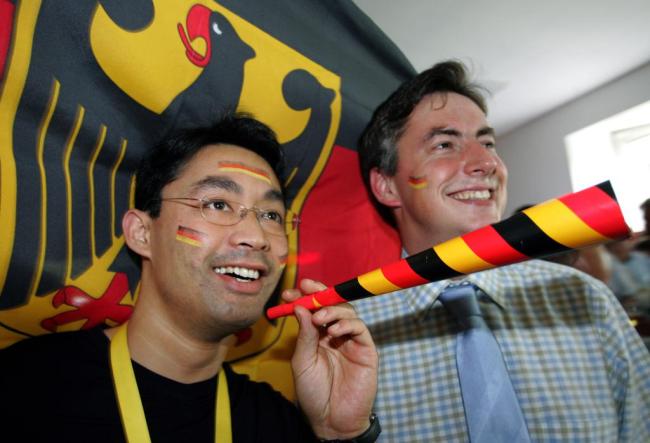
This (on the left) is former German vice chancellor - but he has no genetic markers typical for other Germans:

roesler2.jpg


He is German because he lives in the defined geographical area called "Germany". Right ???

Though if he is not an immigrant but was raised in German culture, then he is also ethnic German (but genetically he is still "specific").

Or are you really unable to comprehend a simple thing ??? :petrified:

was this genetic marker with the goths in their invasion of Roman lands?

No because the Goths never absorbed the Sarmatians - it was only your erroneous claim.

1) VL29 was not balto-slavic. It was wide Finno-Ugric claster. Only one specific lineage of his many children entered Balts.

Hence I wrote that maybe people of the Ananin Culture are ancestors of that one specific lineage.

Are you another one who cannot understand my posts ??? Please read carefully.

People of the Ananin Culture were just one of many groups of Ugro-Finnic peoples, with their own regional "Ananin" DNA.
 
Not all of ancient peoples living in the area defined as "Germania" spoke Germanic languages !!!

Just like not all of ancient peoples living in the area defined as "Sarmatia" spoke Sarmatian language !!!

Yet they can be called Germanic and Sarmatian simply because they lived in Germania and Sarmatia.

What Gervase of Tillbury meant is that Poles were Slavs, who expanded westward from Sarmatia. So they were originally Sarmatians, even though they expanded into Germania.

==================================

BTW - here is what I mentioned on page 10, the theory that there had been a Balto-Slavo-Germanic language:

Tree.png
 
Hence I wrote that maybe people of the Ananin Culture are ancestors of that one specific lineage.

Are you another one who cannot understand my posts ??? Please read carefully.

People of the Ananin Culture were just one of many groups of Ugro-Finnic peoples, with their own regional "Ananin" DNA.
Sorry, I thought you were saying Ananin culture entered BaltoSlavs 3700 years ago and created that particular lineage which is stupid.

When specific lineage entered Balto-Slavs, Ananin culture was long gone. But Ananin culture may have created Finnic tribes and some of those tribes entered Balto-Slavic after L1025 or even next mutation Nsmth was created. If that is what you are saying, then you are correct. If not you should think a bit more.
 
It has been already explained to you in this thread - twice - that Sarmatia (like Germania) was a defined geographical area:

Germania_Sarmatia2.png


Sarmatians have two meanings: 1) ethnic Sarmatians, 2) all inhabitants of Sarmatians.

Besides, Gervase of Tillbury had no knowledge of "genes", because he lived in the Middle Ages... :confused2:

This (on the left) is former German vice chancellor - but he has no genetic markers typical for other Germans:

roesler2.jpg


He is German because he lives in the defined geographical area called "Germany". Right ???

Though if he is not an immigrant but was raised in German culture, then he is also ethnic German (but genetically he is still "specific").

Or are you really unable to comprehend a simple thing ??? :petrified:


No because the Goths never absorbed the Sarmatians - it was only your erroneous claim.


Hence I wrote that maybe people of the Ananin Culture are ancestors of that one specific lineage.

Are you another one who cannot understand my posts ??? Please read carefully.

People of the Ananin Culture were just one of many groups of Ugro-Finnic peoples, with their own regional "Ananin" DNA.

I do not know where you got this fabricated map, but even germania is wrong

There was no germanic in modern south germany.
there was no Germanic in modern central germany - they where celts
there is no Germanic in east gemania as per map - that was other people - lusatians etc

who drew the map , is he locked up!

There is no " besides" and stop trying to deflect the issue and head for the medieval ages


http://books.google.com.au/books?id...epage&q=goths absorbed the sarmatians&f=false
 
I do not know where you got this fabricated map

From Claudius Ptolemy's "Geography".

There was no germanic in modern south germany.
there was no Germanic in modern central germany - they where celts
there is no Germanic in east gemania as per map - that was other people - lusatians etc

And I clearly wrote that not only Germanic people lived in the region called Germania...

If that is what you are saying, then you are correct.

I'm saying that L1025 probably developed from DNA which had been previously absorbed by Balto-Slavs from the Ananin Culture people.

I know that L1025 is younger than the Ananin Culture, but I mean that ancestor of L1025 was the DNA of the Ananin Culture.

If Balto-Slavs absorbed all surviving people of that culture then this explains why today this branch of N isn't common among Ugro-Finns.

=======================================

Some Ancient (or Medieval & Early Modern but based on Ancient sources) maps showing Sarmatia:

Pomponius Mela (very large map), the world (Sarmatia too):

http://postimg.org/image/miij9m03z/full/

According to Pomponius Mela, "Sauromatae" and "Sarmatia" were two distinct things, located in two different regions:

http://s23.postimg.org/77dbyry9l/Sauromatae_Sarmatia.png

"Sarmatia" according to Mela, was located along the Vistula River, while "Sauromatae" were far away to the south-east:

(note - this map has East in its upper part, West in its lower part, North to the left and South to the right):

Sauromatae_Sarmatia.png


European Sarmatia (based on Ptolemy, very large maps):

First: http://postimg.org/image/b6f4jb66n/full/

Second: http://postimg.org/image/lrpq4z9oz/full/

Germania Magna (based on Ptolemy, very large maps):

http://postimg.org/image/u743f29g5/full/

http://postimg.org/image/tqm7vcyp5/full/

Posidonius of Apameia (small map):

http://s21.postimg.org/zd40pc4xj/Posejdonios.jpg

Posejdonios.jpg


Map from 1507 AD showing situation at that time, but with use of Ptolemy's terms "Sarmatia" and "Germania":

Direct link to map: http://mapy.muzeum-polskie.org/avers.html

http://mapy.muzeum-polskie.org/kata...ngarie-boemie-ger-manie-rvssie-lithvanie.html

According to this 1507 AD map, the boundary between Germania and Sarmatia was roughly along the Oder:

As you can see, Germania ends east of the Elbis Fl. (Elbe River) and west of the Odra Fl. (Oder River):


Odra_Germania.png


Another good website with various antique maps:

https://www.raremaps.com/index.html
 
Germania was NOT inhabited only by Germanic people. And neither was Gaul inhabited only by Celtic people.

Already Julius Caesar wrote:

"Gallia est omnis divisa in partes tres, quarum unam incolunt Belgae, aliam Aquitani, tertiam qui ipsorum lingua Celtae, nostra Galli appellantur."

So - Gaul according to Caesar was inhabited by the Aquitani (who were Non-Indo-Europeans*), the Belgae, and by Celtic-speakers who called themselves Celts, but were called Gauls by the Romans.

*Possibly they spoke a language related to the Basque language:

http://en.wikipedia.org/wiki/Aquitanian_language
 
Germania was NOT inhabited only by Germanic people. And neither was Gaul inhabited only by Celtic people.

Already Julius Caesar wrote:

"Gallia est omnis divisa in partes tres, quarum unam incolunt Belgae, aliam Aquitani, tertiam qui ipsorum lingua Celtae, nostra Galli appellantur."

So - Gaul according to Caesar was inhabited by the Aquitani (who were Non-Indo-Europeans*), the Belgae, and by Celtic-speakers who called themselves Celts, but were called Gauls by the Romans.

*Possibly they spoke a language related to the Basque language:

http://en.wikipedia.org/wiki/Aquitanian_language

yes I know Aquitarian, was Vasconic language, then aquitanian, then gascon which was part of Occitan ..........name changes with some script changes.......I do not know where you are going with this
 
Back
Top