
-
Don't want to see ads? Install an adblocker like uBlock Origin or use a Europe-based privacy-friendly browser like Vivaldi or Mullvad.
You are using an out of date browser. It may not display this or other websites correctly.
You should upgrade or use an alternative browser.
You should upgrade or use an alternative browser.
Proto-Indo-Europeans were the Highlanders, who lived near the sea.
- Thread starter Robert6
- Start date

What is the current mainstream as to from which other language/languages proto-IE developed? It must have started as a dialect of something else, right?
There is not a mainstream. It has been seen as close to Uralic by some (mostly due to some grammatical elements), and as close to Caucasian (mostly because
of the phonology).
It is likely that it arose as a sisterlanguage to Uralic (and many more now extinct dialects) and that it came under influence of people from the Caucasus,
in which case the grammar remained, though the pronunciation became more Caucasian-like. In that case, I would project the language on the steppe, with
those Caucasian influences maybe through the Maykop people.
The traces are slim though!
An affiliation to Afro-Asiatic is unlikely.

Why do you hate Europe Goga? We brought the world modern medicine. That's gotta count for something.
*No that's not true early doctors were a subtropical people*
And how do you explain Uralic getting its word for domestic pig from the "Aryans"? And how do you explain the deep rooted similarities between Uralic and PIE? This is not made up, or some spinning of the data.
Do you really think that most experts in this field are retarded Nazis? If the PIE homeland you propose had a large body of supporting data don't you think that it would also have a large number of respected supporters?
"They were a desert people" "they were highlanders" etc. Seriously wtf. If this isn't the most blatant example pontificating. Please stop it.
Do you understand that the cultural differences you use to differentiate Andronovo from BMAC are the very things that would compel most leading experts to conclude that BMAC and its antecedents were non-IE?
You know in the Vedas the Aryans invoke divine support in their battle against their enemies (Dasa) to be accomplished with the help of their horses and chariots?
In the earliest part of the Avestas, The Gathas, the hymns describe a pastoralist way of life with no mention of anything remotely urban. Not until later sections do we see a sudden appearance of citadels and irrigation canals. And you might want to check on the non IE loan words in Iranian and Indic.
*No that's not true early doctors were a subtropical people*
And how do you explain Uralic getting its word for domestic pig from the "Aryans"? And how do you explain the deep rooted similarities between Uralic and PIE? This is not made up, or some spinning of the data.
Do you really think that most experts in this field are retarded Nazis? If the PIE homeland you propose had a large body of supporting data don't you think that it would also have a large number of respected supporters?
"They were a desert people" "they were highlanders" etc. Seriously wtf. If this isn't the most blatant example pontificating. Please stop it.
Do you understand that the cultural differences you use to differentiate Andronovo from BMAC are the very things that would compel most leading experts to conclude that BMAC and its antecedents were non-IE?
You know in the Vedas the Aryans invoke divine support in their battle against their enemies (Dasa) to be accomplished with the help of their horses and chariots?
In the earliest part of the Avestas, The Gathas, the hymns describe a pastoralist way of life with no mention of anything remotely urban. Not until later sections do we see a sudden appearance of citadels and irrigation canals. And you might want to check on the non IE loan words in Iranian and Indic.
Silesian
Junior Member
- Messages
- 738
- Reaction score
- 104
- Points
- 43
- Ethnic group
- Citizen of Earth.
- Y-DNA haplogroup
- R1b-BY593
- mtDNA haplogroup
- U5b2a2
WanderwörterAnd how do you explain Uralic getting its word for domestic pig from the "Aryans"? And how do you explain the deep rooted similarities between Uralic and PIE? This is not made up, or some spinning of the data.
How about invoking some divine support for tangible physical evidence, like a copper bead or arrow head or broken spoke of a wheel which belonged to a war chariot, even some horse bones or semi-kurgan burials . Showing some R1b-V88 maps, and words for Bear and snow in non PIE dialects; creative and really diversionary but nothing really tangible to back up your points. Do you have any tangible proof in the way of archeology to show your immigration/invasion theory, from Pontic-Steppe to Andronono to Sarasvati region?You know in the Vedas the Aryans invoke divine support in their battle against their enemies (Dasa) to be accomplished with the help of their horses and chariots?
In the earliest part of the Avestas, The Gathas, the hymns describe a pastoralist way of life with no mention of anything remotely urban. Not until later sections do we see a sudden appearance of citadels and irrigation canals. And you might want to check on the non IE loan words in Iranian and Indic.
bicicleur 2
Regular Member
- Messages
- 6,450
- Reaction score
- 1,488
- Points
- 113
I'm not ruling out that Haplogroup E is actually tied with the Afroasiatic language, but I refuse to believe the whole "one y-haplogroup = one ethnonlinguistic group" trope, because humans enjoy way too much intermingle with one another for that to be accurate in any way. If you ask it in the reverse way, is actually there a possibility that V88 is not tied with the Afroasiatic? If not, what's your alternative, that there is a Celtic substrate in Chadic?
The Chadic languages are clearly tied with the "northern" branches of Afroasiatic (Berber, Egyptian and Semitic): both as part of "North Erythrean" (after Ehret 1995) and as part of "North Afrasian" (after Militarev 2000). There is also the unsettled question if Proto-Afroasiatic itself (or, barring that, at a sub-branch of Afroasiatic) includes farming vocabulary - without further judgement on that affair, I would like to point out that both Diakonoff and Militarev think so, while in contrast Ehret does not. In any case, to me, this suggests that the Proto-Afroasiatic homeland was somewhere close to the Mediterranean (how else could the Chadic peoples have picked up R1b?), not at the Red Sea, and certainly not in East Africa, and if a Mediterranean homeland is accurate, then the Halaf Culture as bearers of early Semitic make sense.

R1b-V88 split from R1b some 15-20000 year ago, they have nothing to do with Celtic
IMO Afro-Asiatic is linked to E, R1b-V88 adopted Afro-Asiatic when they entered Africa. I guess this was some 8000 years ago, coming from Anatolia with cattle.
Berbers I guess split some 25-30.000 years ago from E1b1b, that was centered around Ethiopia.
[TD="width: 446"]http://www.aggsbach.de/2012/07/transitions-during-the-paleolithic-of-north-africa/
That makes Afro-Asiatic very old, and probably allready widespread by 8000 year ago[/TD]
bicicleur 2
Regular Member
- Messages
- 6,450
- Reaction score
- 1,488
- Points
- 113
R1b-V88 split from R1b some 15-20000 year ago, they have nothing to do with Celtic
IMO Afro-Asiatic is linked to E, R1b-V88 adopted Afro-Asiatic when they entered Africa. I guess this was some 8000 years ago, coming from Anatolia with cattle.
Berbers I guess split some 25-30.000 years ago from E1b1b, that was centered around Ethiopia.
http://www.aggsbach.de/2012/07/transitions-during-the-paleolithic-of-north-africa/
That makes Afro-Asiatic very old, and probably allready widespread by 8000 year ago
how about Proto-Afro-Asiatic words for cattle or farming, do they exist?
bicicleur 2
Regular Member
- Messages
- 6,450
- Reaction score
- 1,488
- Points
- 113
I think that R1a is a substratum for Andronovo culture.
I think that R1a belong to Keltiminar culture.
There is no other choice for Keltiminar culture besides the R1a.
Keltiminar culture also is parental to Pit–Comb Ware culture which was in North Eastern Europe
coalesence time for R1a +/- 5800 years ago, origin : northwest Iran?
http://www.eupedia.com/forum/threads/29701-New-R1a-Paper-by-Underhill-et-al-(2014)
I would be surprised that they became hunter-gatherers south of Aral Sea
bicicleur 2
Regular Member
- Messages
- 6,450
- Reaction score
- 1,488
- Points
- 113
You would be more accurate if you said 5000 BC, actually. In my opinion, Proto-Semitic is older than PIE (the vocabulary is consistent with that of a Neolithic language), and Afroasiatic as a whole (of which Proto-Semitic is but one branch) is substantially older than Proto-Indo-European. In my opinion, the Halaf culture is a very good candidate for the Proto-Semitic homeland, it has all the items reconstructable for Proto-Semitic (including snow and bears):

Both the trees that Sile posted show that Arabic is firmly within Central Semitic, why would they start out in Yemen and Ethiopia if their most closely related languages were in Syria, Lebanon and Palestine?
I see Halaf culture was a continuation of former culture.
The only charactersitic is the pottery style.
It is also ancestal to Ubaid.
If so, wouldn't you expect the Summerians would have spoken a semitic language too?
Very little is known about Halaf till now.
Taranis
Elite member
how about Proto-Afro-Asiatic words for cattle or farming, do they exist?
According to Militarev and Diakonoff, yes, according to Ehret, no, but I do think that Ehret concedes that a common cattle and farming terminology is reconstructable for the "northern" (Semitic + Berber + Egyptian + Chadic) branches of Afroasiatic.
R1b-V88 split from R1b some 15-20000 year ago, they have nothing to do with Celtic
IMO Afro-Asiatic is linked to E, R1b-V88 adopted Afro-Asiatic when they entered Africa. I guess this was some 8000 years ago, coming from Anatolia with cattle.
The fact that V88 is found with Chadic-speaking populations suggests however that Chadic originated somewhere in the vicinity of the Mediterranean and that they migrated southwards. And also, in any case, farming and pastoralist terminology is uncontestable for Proto-Semitic (common words for 'pig', 'flour', 'milk', 'goat', etc.). Not nomadic desert people, but a language of sedentary farmers.
Berbers I guess split some 25-30.000 years ago from E1b1b, that was centered around Ethiopia.
http://www.aggsbach.de/2012/07/transitions-during-the-paleolithic-of-north-africa/
That makes Afro-Asiatic very old, and probably allready widespread by 8000 year ago
25-30,000 is absurdly old for the language family, and its also an absurdly early date for Proto-Berber to split off. Do you really think that the language family would be even recognizable after such a long time? In my opinion, even if Ehret is correct I have my doubt that the language family is older than the late Mesolithic, and if Diakonoff and Militarev are correct, then Afroasiatic cannot be older than the Neolithic revolution.
Back to the Indo-Iranic languages (sorry for the excourse into Semitic languages, but when talking Near Eastern protohistory, you can't avoid the issue), I disagree with the idea of Iranic presence in Mesopotamia being older than Semitic, this is purely by attestation: Akkadian is attested from the mid-3rd millennium BC onwards, and East Semitic is the most divergent branch, and probably was the first branch of Semitic to split off (the situation is somewhat analogous to the Anatolian languages - such as Hittite - in Indo-European).
In contrast, the Indo-Iranic loanwords in Hurrian start showing up around ca. 1400 BC, which would make it roughly contemporary to Vedic Sanskrit, to which the Hurrian loanwords are very similar, by the way (the Mitanni-Hurrian word for 'seven' is 'šatta', where Sanskrit had "sapta", while Modern Persian, for example, has "haft", Avestan had "hapta", its a common innovation of the Iranic languages to have word initial *s- > *h-). An alternative interpretation (if you dissent the idea that these words are Indic) is that the Mitanni loanwords derive from an undifferentiated Indo-Iranic, but its impossible (based on phonological grounds, since as I said, the development *s- > *h- is a feature of Proto-Iranic) that they derive from Iranic. After the Mitanni, you have to go to several centuries later before Iranic peoples actually show up in the region.
Silesian
Junior Member
- Messages
- 738
- Reaction score
- 104
- Points
- 43
- Ethnic group
- Citizen of Earth.
- Y-DNA haplogroup
- R1b-BY593
- mtDNA haplogroup
- U5b2a2
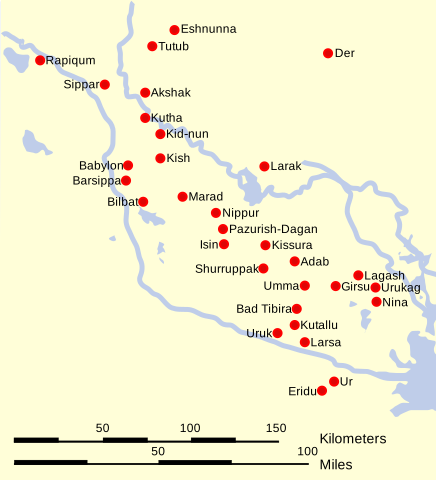
Taranis don't you think it is important to explain Goga's point of Akkadian deriving further south,[southern Mesopotamia ]? Let's say closer to Sumer? Is Sumerian one of the earliest attested non Semitic languages in the region?Did it have any contact with Akkadian sharing language? Maybe reason for no grape/wine entry?Back to the Indo-Iranic languages (sorry for the excourse into Semitic languages, but when talking Near Eastern protohistory, you can't avoid the issue), I disagree with the idea of Iranic presence in Mesopotamia being older than Semitic, this is purely by attestation: Akkadian is attested from the mid-3rd millennium BC onwards, and East Semitic is the most divergent branch, and probably was the first branch of Semitic to split off (the situation is somewhat analogous to the Anatolian languages - such as Hittite - in Indo-European).

Sile
Banned
- Messages
- 5,108
- Reaction score
- 582
- Points
- 0
- Location
- Australia
- Ethnic group
- North Alpine Italian
- Y-DNA haplogroup
- T1a2 -Z19945..Jura
- mtDNA haplogroup
- H95a1 ..Pannoni
Taranis don't you think it is important to explain Goga's point of Akkadian deriving further south,[southern Mesopotamia ]? Let's say closer to Sumer? Is Sumerian one of the earliest attested non Semitic languages in the region?Did it have any contact with Akkadian sharing language? Maybe reason for no grape/wine entry?
also need to state that the semetic language bordered on Luwian language roughly on the modern syrian-turkish border and north of Luwian ( its nieghbour) was the non-semetic kurdish language
this raises a very important point on what was this famous site's language
http://archive.archaeology.org/0811/abstracts/turkey.html
it is where semetic ended and luwian began
bicicleur 2
Regular Member
- Messages
- 6,450
- Reaction score
- 1,488
- Points
- 113
25-30,000 is absurdly old for the language family, and its also an absurdly early date for Proto-Berber to split off. Do you really think that the language family would be even recognizable after such a long time?
I agree, but genetically Berbers split that long ago : Berbers are E-M81, their forefathers E-M310 split from E-Z830, ancestral to the E-M34 Semitic branch
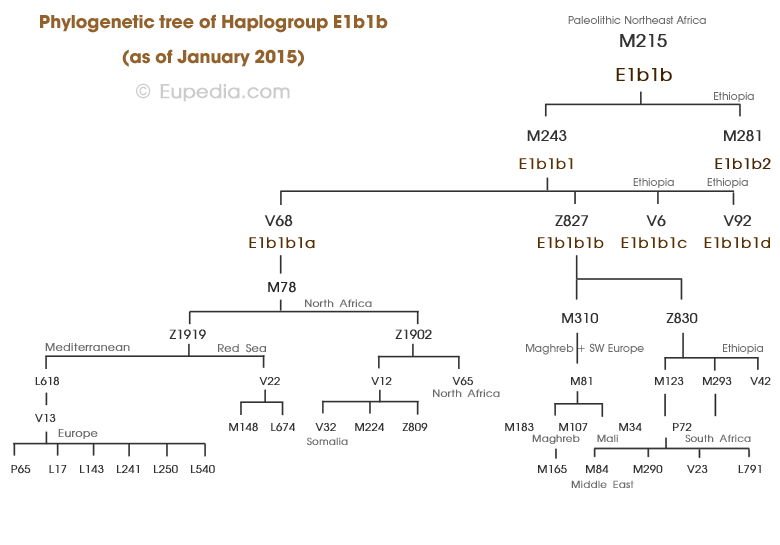
there are 106 known SNPs equivalent to E-M310 and 131 known SNPs equivalent to E-M81, totalling 237
genetically this branch is 30.000 years old
they moved toward the African Mediterranean coast 25000 years ago and lived in isolation there
they got cattle and became herders some 8000 years ago, probably after contact with R1b-V88
today they still are the majority of the population in the Atlas Mountain area, despite Arabic Islam invasion
when and how did they adopt Afro-Asiatic language?
bicicleur 2
Regular Member
- Messages
- 6,450
- Reaction score
- 1,488
- Points
- 113
OK enough with the Semitic languages digression. It's diluting the ownage.
this is my view :
6000 years ago, the Uruk (Summerian) world expanded, west to the Levant, north till Kaukasus and beyond (Maukop), south along the Persian Gulf and east into Iran
5600 years ago Semites invaded the Levant and expanded till Mesopotamia destroying the heart of the Uruk world (Akkadians)
that is when up north, a new world started to grow : the Indo-European world
MOESAN
Elite member
- Messages
- 6,372
- Reaction score
- 1,613
- Points
- 113
- Location
- Brittany
- Ethnic group
- more celtic
- Y-DNA haplogroup
- R1b - L21/S145*
- mtDNA haplogroup
- H3c
I'm sure that Afro-Asiatic languages are linked with 'E' Y-DNA. Berbers are NATIVE African people who belong mostly to 'E' Y-DNA and Berber languages are (North) African languages that are part of greater Afro-Asiatic languages. African Berbers are mostly Y-DNA 'E' and it's very ridiculous to say that Berbers are from Mesopotamia. And you like it or not, Afro-Asiatic people are desert people. ONCE AGAIN, they have also snow in South Levant! How is it possible you don't know this? It does even snow in AFRICA, in Morocco (Atlas Mountains), Tunisia, Algeria, Kenya (Mount Kenya), Tanzania (Mount Kilimanjaro) and even in Sahara .... !
as a whole and spite more and more mixings with subsaharian populations (in past it was with females, for the most) the core of berbers tribes is maid of "caucasian" people
whose selection and cristallization could occurs only inside the old population which gave Europeans, Near-Easternians and West-Asians AND Central-South Asians - the geographical area, as seem showing all our Y and mt DNA, would have bee centered around Levant-Near-Eastern South Caucasus, I think -
and Y-E could very well be a COME BACK in Africa...SO, it remains some possibilities aside the "dessert birthplace"
without taking any firm position in the debate
The Kurgan hypothesis, or the Proto-Indo-Europeans — R1b
In the publication "Two IE phylogenies, three PIE migrations, and four kinds of steppe pastoralism" is an American archaeologist David Anthony, a supporter of the Kurgan hypothesis says that the collapse of Proto-Indo-European language occurred 6500-4500 years ago in the Pontic-Caspian steppe.
Taking into account the archaeological evidence that the population of Pontic-Caspian steppe migrated from the east of the Southern Urals to the west in the Lower Volga and the North-West Caspian Sea in the period 8000-6500 years ago, and linguistic evidence that the ancestral homeland of the Indo-Europeans is typical mountainous landscape and coniferous forests, climate with four seasons and cold snowy winter, as well as that for the reconstructed Proto-Indo-European language notation for horses, bees and honey (and as you know, one of the versions of the horse was first domesticated in the southern Urals, in the same place to have survived wild population Burzyan bees who populated the current territory in the post-glacial period) it can be assumed that the Proto-Indo-European language carriers 8,000 years ago (before the separation of the branches) lived in the southern Urals.
When and where did the alleged ancestors of the Proto-Indo-Europeans in the Southern Urals can be said to explain the origin of the Neolithic and Mesolithic (primarily Romanovsko-ilmurzino) cultures of Southern Urals. There are two versions: 1) Mesolithic culture of the Southern Urals come from Upper Paleolitic of this regions, 2) Mesolithic culture of the Southern Urals emerged as a result of migration from Central Asia 14000-11000 years ago.
D. Anthony, based on linguistic data of Ringe leads the date of allocation of three branches: the Anatolian - 6400-6200 years ago, Tocharian - 5300-4800 years ago and complex - Italic, Celtic, Germanic - 5000-4800 years ago.
1. Thinking about the origin of the Anatolian branch, Anthony writes that the migration of Pontic-Caspian steppe in Anatolia could go through the south-eastern Europe (Transcarpathia), or through the Caucasus. But still leaning towards the route through Transcarpathia, Danube, as there are archaeological cultures found suitable time (6200-6000 years ago) - Cernavoda, Vinca and others.
At the same time, another American archaeologist James Patrick Mallory back in 1997 in the article "The Homelands of the Indo-Europeans" indicates that these archaeological cultures most likely belonged to a pre-Indo-population, the eastern boundary of the settlement which lies on the Dnieper River and the western boundary of the Indo-European reaches only up to the Tisza. Therefore it is doubtful the possibility of overcoming the barrier of the Dnieper Dniester by the Indo-Europeans so early a period. Therefore, a more likely route of Indo-Europeans (R1b-M269, R1b-L23, R1b-Z2103) of the Pontic-Caspian steppe in Anatolia via the Caucasus.
2. Anthony writes that carriers of proto-tocharian language migrated from the Pontic-Caspian steppe region in the Western Altai (Afanasievo culture) 5300-4800 years ago.
Given the preliminary data on afanasievo mans that "two of three afanasievo man and one okunevo man were R1b1 (M269), and one afanasyievo man - R1b, and the date on many afanasievo: calibers. 3000-2600 BC," does not remain doubts, that carriers of proto-tocharian were R1b-M269 (probably R1b-L23).
That "Tocharian problem" is a weak point of the hypothesis that proto-indo-europeans were R1a. Put forward different versions, for example, about the early (pre-Aryan) migration of carriers subclades R1a-Z93 to the Altai. However, they have not been confirmed.
3. The third migration, "breed" proto-germanic, -italic, -celtic (centum) languages, writes Anthony occurred 5000-4800 years ago.
Indo-europeans from pit-grave culture passed from the Northern Black Sea to the west and south-west, along the path of assimilating local non-indo-europeans cultures ("Old Europe"). Moreover, migration proto-celtics west was the southern route through the Danube, while proto-germanic went north through the Dniester.
Protoceltics, -italics, -germanics initially are likely to be carriers of subclades R1b-L51 (subclades age is estimated to be 4800-5000 years), which is chronologically consistent with the hypothesis Anthony almost one to one.
Isolation of the Greek-Armenian branch D. Anthony in a book published in 2007, "The Horse, The Wheel, and Language: How Bronze-Age Riders From the Eurasian Steppes Shaped the Modern World" refers to the period between the release of the Italo-Celtic languages (about 5,000 years ago) and before the collapse of Balto-Slavic and Indo-Iranian dialect continuum (about 4,500 years ago). Carriers Greek-Armenian languages it relates to Abashevo the culture of the Southern Urals, which is in contact with the east Sintashta culture - Indo-Iranians. We can conclude that in the Southern Urals there "Greco-Aryan" community due primarily areal proximity rather than genetic.
In general, the history and direction of migration of carriers proto-Greek-Armenian language can be traced archaeologically something like this:
5000 years ago - the pit-grave cultural-historical community (Pontic-Caspian steppe)>
4700 years ago - Poltavka culture (North Caspian Sea)>
4500 years ago - Abashevo culture (Southern Urals, Middle Volga Region)>
3700 years ago - Sabatinovo Culture (Northern Black Sea Coast).
Probably they were presented in the main subclades R1b-CTS7822, R1b-L584.
Carriers Proto-Greek language (R1b-L584, R1b-CTS7822) withdrew from the Northern Black Sea to the Balkans about 3,600 years ago, bringing the chariot and founded the Mycenaean civilization.
Carriers Proto-Armenian language - Mušker - 3300-2900 years ago migrated from the Balkans to the Armenian Highland.
Armenians R1b-L584 form a distinctive cluster age 3.3 thousand. Years, which appears to date comes from the flies. "Fraternal" the Armenian cluster subclade age 3600 years found among the Greeks. Armenians have even more ancient "Near Eastern" branch R1b-L584 age over 4,500 years, which probably was the result of migration of proto-Indo-Iranians to the Caucasus from the Black Sea steppes.
It can be assumed that part of the media subclades R1b-L584 (probably left after the departure of the other part of R1b-L584 in Anatolia 6000 years ago), located in the northern or eastern Black Sea coast. Then the 4700-4500 years ago, they were divided: one part with proto-indo-iranians (R1a-Z93 and others.) Went to the southeast across the Caucasus to Anatolia, and the other - went east to the Urals (Poltavka culture, Abashevo culture), later (3600 years ago), returned to the northern Black Sea region as Abashevo culture (R1b), has entered into collaboration with the Multi-cordoned ware culture (R1a, I2a) (which is separated from the Catacomb culture), and two stages left in the south-west, The Balkans: 3600 years ago (proto-greeks, Achaeans, Mycenaeans), and 3200 years ago (Mušker, proto-thrasians, Proto-Armenians) from the territory of Sabatinovo culture. Mušker further from the Balkans have gone to Anatolia on the Armenian Highland.
Two branches of R1b-L584 "reunited" in the Armenian highlands after about one and a half thousand years. Being probably originally centum, Armenian language was satemizied on Danube (in the period 3600-3300 years ago), or already in the Armenian highlands.
The collapse of the Balto-Slavic and Indo-Iranian dialect continiuums David W. Anthony refers to the late stage of Cucuteni-Trypillian culture from Dnieper-Danube interfluve - 4700-4500 years ago.
By this time the Indo-europeans from pit grave culture R1b-L51 (also R1b-L277) assimilate non-indo-europeans of Cucuteni-Trypillian culture (R1a, I2a, G2a, etc.) - So there formed satem proto-balto-slavic and proto-indo-iranian languages. Proto-indo-iranians belonging mainly to Subclades R1a-Z93 (as well as partially: R1a-Z283, R1b-L277, R1b-L584, R1b-CTS7763 / CTS8966), migrate to the east and south-east through the Caucasus to Asia. Proto-balto-slavic (R1a-Z280, I2a, R1b) are settled in Eastern Europe.
[Translated by Google Translate]
forum.molgen.org/index.php/topic,7553.0.html
In the publication "Two IE phylogenies, three PIE migrations, and four kinds of steppe pastoralism" is an American archaeologist David Anthony, a supporter of the Kurgan hypothesis says that the collapse of Proto-Indo-European language occurred 6500-4500 years ago in the Pontic-Caspian steppe.
Taking into account the archaeological evidence that the population of Pontic-Caspian steppe migrated from the east of the Southern Urals to the west in the Lower Volga and the North-West Caspian Sea in the period 8000-6500 years ago, and linguistic evidence that the ancestral homeland of the Indo-Europeans is typical mountainous landscape and coniferous forests, climate with four seasons and cold snowy winter, as well as that for the reconstructed Proto-Indo-European language notation for horses, bees and honey (and as you know, one of the versions of the horse was first domesticated in the southern Urals, in the same place to have survived wild population Burzyan bees who populated the current territory in the post-glacial period) it can be assumed that the Proto-Indo-European language carriers 8,000 years ago (before the separation of the branches) lived in the southern Urals.
When and where did the alleged ancestors of the Proto-Indo-Europeans in the Southern Urals can be said to explain the origin of the Neolithic and Mesolithic (primarily Romanovsko-ilmurzino) cultures of Southern Urals. There are two versions: 1) Mesolithic culture of the Southern Urals come from Upper Paleolitic of this regions, 2) Mesolithic culture of the Southern Urals emerged as a result of migration from Central Asia 14000-11000 years ago.
D. Anthony, based on linguistic data of Ringe leads the date of allocation of three branches: the Anatolian - 6400-6200 years ago, Tocharian - 5300-4800 years ago and complex - Italic, Celtic, Germanic - 5000-4800 years ago.
1. Thinking about the origin of the Anatolian branch, Anthony writes that the migration of Pontic-Caspian steppe in Anatolia could go through the south-eastern Europe (Transcarpathia), or through the Caucasus. But still leaning towards the route through Transcarpathia, Danube, as there are archaeological cultures found suitable time (6200-6000 years ago) - Cernavoda, Vinca and others.
At the same time, another American archaeologist James Patrick Mallory back in 1997 in the article "The Homelands of the Indo-Europeans" indicates that these archaeological cultures most likely belonged to a pre-Indo-population, the eastern boundary of the settlement which lies on the Dnieper River and the western boundary of the Indo-European reaches only up to the Tisza. Therefore it is doubtful the possibility of overcoming the barrier of the Dnieper Dniester by the Indo-Europeans so early a period. Therefore, a more likely route of Indo-Europeans (R1b-M269, R1b-L23, R1b-Z2103) of the Pontic-Caspian steppe in Anatolia via the Caucasus.
2. Anthony writes that carriers of proto-tocharian language migrated from the Pontic-Caspian steppe region in the Western Altai (Afanasievo culture) 5300-4800 years ago.
Given the preliminary data on afanasievo mans that "two of three afanasievo man and one okunevo man were R1b1 (M269), and one afanasyievo man - R1b, and the date on many afanasievo: calibers. 3000-2600 BC," does not remain doubts, that carriers of proto-tocharian were R1b-M269 (probably R1b-L23).
That "Tocharian problem" is a weak point of the hypothesis that proto-indo-europeans were R1a. Put forward different versions, for example, about the early (pre-Aryan) migration of carriers subclades R1a-Z93 to the Altai. However, they have not been confirmed.
3. The third migration, "breed" proto-germanic, -italic, -celtic (centum) languages, writes Anthony occurred 5000-4800 years ago.
Indo-europeans from pit-grave culture passed from the Northern Black Sea to the west and south-west, along the path of assimilating local non-indo-europeans cultures ("Old Europe"). Moreover, migration proto-celtics west was the southern route through the Danube, while proto-germanic went north through the Dniester.
Protoceltics, -italics, -germanics initially are likely to be carriers of subclades R1b-L51 (subclades age is estimated to be 4800-5000 years), which is chronologically consistent with the hypothesis Anthony almost one to one.
Isolation of the Greek-Armenian branch D. Anthony in a book published in 2007, "The Horse, The Wheel, and Language: How Bronze-Age Riders From the Eurasian Steppes Shaped the Modern World" refers to the period between the release of the Italo-Celtic languages (about 5,000 years ago) and before the collapse of Balto-Slavic and Indo-Iranian dialect continuum (about 4,500 years ago). Carriers Greek-Armenian languages it relates to Abashevo the culture of the Southern Urals, which is in contact with the east Sintashta culture - Indo-Iranians. We can conclude that in the Southern Urals there "Greco-Aryan" community due primarily areal proximity rather than genetic.
In general, the history and direction of migration of carriers proto-Greek-Armenian language can be traced archaeologically something like this:
5000 years ago - the pit-grave cultural-historical community (Pontic-Caspian steppe)>
4700 years ago - Poltavka culture (North Caspian Sea)>
4500 years ago - Abashevo culture (Southern Urals, Middle Volga Region)>
3700 years ago - Sabatinovo Culture (Northern Black Sea Coast).
Probably they were presented in the main subclades R1b-CTS7822, R1b-L584.
Carriers Proto-Greek language (R1b-L584, R1b-CTS7822) withdrew from the Northern Black Sea to the Balkans about 3,600 years ago, bringing the chariot and founded the Mycenaean civilization.
Carriers Proto-Armenian language - Mušker - 3300-2900 years ago migrated from the Balkans to the Armenian Highland.
Armenians R1b-L584 form a distinctive cluster age 3.3 thousand. Years, which appears to date comes from the flies. "Fraternal" the Armenian cluster subclade age 3600 years found among the Greeks. Armenians have even more ancient "Near Eastern" branch R1b-L584 age over 4,500 years, which probably was the result of migration of proto-Indo-Iranians to the Caucasus from the Black Sea steppes.
It can be assumed that part of the media subclades R1b-L584 (probably left after the departure of the other part of R1b-L584 in Anatolia 6000 years ago), located in the northern or eastern Black Sea coast. Then the 4700-4500 years ago, they were divided: one part with proto-indo-iranians (R1a-Z93 and others.) Went to the southeast across the Caucasus to Anatolia, and the other - went east to the Urals (Poltavka culture, Abashevo culture), later (3600 years ago), returned to the northern Black Sea region as Abashevo culture (R1b), has entered into collaboration with the Multi-cordoned ware culture (R1a, I2a) (which is separated from the Catacomb culture), and two stages left in the south-west, The Balkans: 3600 years ago (proto-greeks, Achaeans, Mycenaeans), and 3200 years ago (Mušker, proto-thrasians, Proto-Armenians) from the territory of Sabatinovo culture. Mušker further from the Balkans have gone to Anatolia on the Armenian Highland.
Two branches of R1b-L584 "reunited" in the Armenian highlands after about one and a half thousand years. Being probably originally centum, Armenian language was satemizied on Danube (in the period 3600-3300 years ago), or already in the Armenian highlands.
The collapse of the Balto-Slavic and Indo-Iranian dialect continiuums David W. Anthony refers to the late stage of Cucuteni-Trypillian culture from Dnieper-Danube interfluve - 4700-4500 years ago.
By this time the Indo-europeans from pit grave culture R1b-L51 (also R1b-L277) assimilate non-indo-europeans of Cucuteni-Trypillian culture (R1a, I2a, G2a, etc.) - So there formed satem proto-balto-slavic and proto-indo-iranian languages. Proto-indo-iranians belonging mainly to Subclades R1a-Z93 (as well as partially: R1a-Z283, R1b-L277, R1b-L584, R1b-CTS7763 / CTS8966), migrate to the east and south-east through the Caucasus to Asia. Proto-balto-slavic (R1a-Z280, I2a, R1b) are settled in Eastern Europe.
[Translated by Google Translate]
forum.molgen.org/index.php/topic,7553.0.html
Wanderwörter
How about invoking some divine support for tangible physical evidence, like a copper bead or arrow head or broken spoke of a wheel which belonged to a war chariot, even some horse bones or semi-kurgan burials . Showing some R1b-V88 maps, and words for Bear and snow in non PIE dialects; creative and really diversionary but nothing really tangible to back up your points. Do you have any tangible proof in the way of archeology to show your immigration/invasion theory, from Pontic-Steppe to Andronono to Sarasvati region?
Forgot about this one. Yes there is evidence that the decline of BMAC coincided with envelopment by Andronovans. We have pottery associated with derivative Andronovan populations that had become more sedentary, to the north of BMAC I believe, then as BMAC declines we not only see the appearance of this same pottery in later layers of former BMAC settlements, but we see it everywhere in and around the former BMAC settlements. Envelopment by Andronovan pastoralists is the most plausible explanation.

LeBrok
Elite member
- Messages
- 10,249
- Reaction score
- 1,621
- Points
- 0
- Location
- Calgary
- Ethnic group
- Citizen of the world
- Y-DNA haplogroup
- R1b Z2109
- mtDNA haplogroup
- H1c
Chinese Golden MonkeyForgot about this one. Yes there is evidence that the decline of BMAC coincided with envelopment by Andronovans. We have pottery associated with derivative Andronovan populations that had become more sedentary, to the north of BMAC I believe, then as BMAC declines we not only see the appearance of this same pottery in later layers of former BMAC settlements, but we see it everywhere in and around the former BMAC settlements. Envelopment by Andronovan pastoralists is the most plausible explanation.

Chinese Golden Monkey
Definitely R1b cattle driver. Do they have an autosomal comparison?