• Don't want to see ads? Install an adblocker like uBlock Origin or use a Europe-based privacy-friendly browser like Vivaldi or Mullvad.

Subdivisions of Polish people

To my knowledge, nobody studied the DNA of Polish Gorals so far. Generally regional differences in Poland are poorly studied (which is why there is this misconception that Poles are very homogeneous).

And many studies use ridiculous Polish samples from some "very fringe groups".

For example Kushniarevich 2015 study didn't even sample the core of Poland:

komzDFr.jpg
 
That's what I did, and I got 15 regions, which is just the right number.

If you go by modern administrative divisions, you get 16 voivodeships.

For everyone complaining on too many proposed Polish regions. Look at such not too big area compared to entire Poland like Benelux in Living DNA (15 regions)

https://www.livingdna.com/en-gb/one-family/research/benelux

or Scotland (20 regions)

https://www.livingdna.com/en-gb/one-family/research/scotland

So why Poland with nearly 40 mln people has to be discriminated in regions number??? If you want simplicity why small Switzerland has 10 regions?
https://www.livingdna.com/en-gb/one-family/research/switzerland

Or Ireland 13?
https://www.livingdna.com/en-gb/one-family/research/ireland
 
So why Poland with nearly 40 mln people has to be discriminated in regions number?

I will post approximate population size of each of my 15 regions. But I will post it based on population stats from ca. year 1900. So it will be demographic data from times when great-grandparents of present-day people lived.

At first for 6 northern regions (excluding Sudovia-Podlachia):

Region - approximate population in 1900:

Warmia-Masuria --------- 0,65 million
Prussian Oberland ------- 0,35 million
Northern Poland --------- 1,81 million
Pomerelia/Kashubia ----- 0,53 million
Pomerania --------------- 0,93 million
Neumark ----------------- 0,48 million

Later I will post similar data for other regions (for year 1900).
 
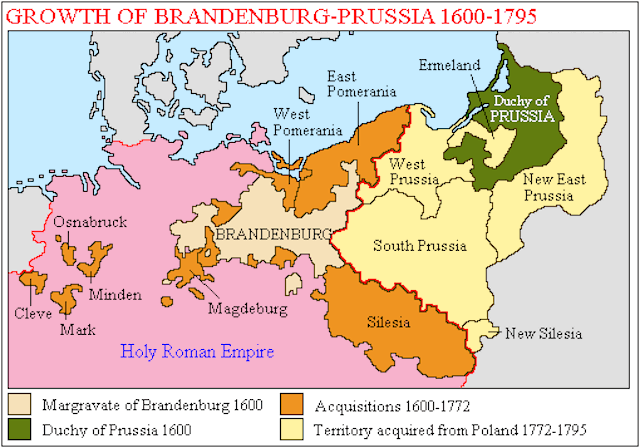
Not sure if East Prussia is a good name, because there will be no region called West Prussia (which is a recent name invented after the partitions of Poland of 1772-1795, and that is when Ducal Prussia was renamed East Prussia).

I think we should call it either Ducal Prussia, or just Prussia. Not East Prussia. It is the original, ethnic Prussia anyway. All other Prussias (including West Prussia) are simply "artificial" names.

There were also South Prussia and New East Prussia for a brief period of time:

https://en.wikipedia.org/wiki/South_Prussia

https://en.wikipedia.org/wiki/New_East_Prussia

Map: http://versaillescentury.com/vc/wp-content/uploads/2016/11/prussiamap.gif

prussiamap.gif


http://www.zum.de/whkmla/histatlas/germany/prussia17951803.gif

prussia17951803.gif


As for (East) Prussia:

Warmia (Ermland) was incorporated to it in 1772, and later there were only minor border changes:

http://media.web.britannica.com/eb-media/19/119-004-D5B02134.gif

119-004-D5B02134.gif

Prussia, or the part which is called the Kaliningrad Oblast, is fully Russian now. All of the native inhabitants, either the so-called Prussian Lithuanians, or German Prussian were wiped out. After the II WW, native population had to either run away, or were killed/deported to Gulags by the Soviet Army and NKVD, some ran to Lithuania, but had to change their names in order to stay alive. It is a very tragic story, the entire population being wiped out. So unfortunately no Prussian genetics (or even place names, or river names any toponymy) are to be found in the Kaliningrad Oblast. There are only new settlers here, who came from Russia. So it is Russia now, by any criteria.
What about Polish side of Prussia? Are there any original inhabitants left there? Or only the Polish settlers which came after the II WW?
 
Last edited:
Compared to borders of administrative counties as of year 1900:

https://i.imgur.com/A2UP9iJ.png

A2UP9iJ.png

Regarding what you call Polish "Sudovia" - here could be remains of West Baltic Jotvingiai found genetically (or larger than anywhere else Baltic influence). In Lithuania it is called Sūduva. According to Population genetics research* "South Aukštaičiai" have circa 62% R1a, compared to East Aukštaičiai, where R1a is only 35%).
*http://onlinelibrary.wiley.com/doi/10.1046/j.1529-8817.2003.00119.x/full

I presume even now Polish Sudovia genetically may be close to Lithuanian Sūduva. Regarding language preference, Lithuania acquired its national state only 100 years ago. Earlier anyone who wanted some, even primary, education had to speak Polish and Russian. In my family too. The genetic differences however, do not always follow the linguistic and cultural preference. Just to give you one fact - the use of the Lithuanian Latin script was prohibited in Lithuania by Tsarist government (one would go to prison if publishing/or holding a copy of any text in their own native language) from 1864 to 1904, so it was very difficult to keep the native language alive. The territories under independent Lithuania 1918-1940 turned to using Lithuanian at schools and in public life, however, those territories under your map above which were annex by Poland in 1922, spoke Polish, and continue to this day to speak Polish. The people however, majority of them for sure, did not move to these territories form Poland, they always lived there and I suppose genetically they will be like Southern Lithuanians which are in a very close proximity to them geographically. Well, this is just my guess, I hope there will be more of testing carried out with time and we will know for sure.
 
Last edited:
Thanks again.

It's nice that Living DNA has updated its Polish regions. I can only add that I tried to keep the number of regions rather small. I think that 15 regions is enough. But if we wanted, we could distinguish many small sub-regions within each of these 15 regions.

Many small ethnographic sub-groups can be distinguished. For example:

Powislans (Powiślanie) - Northern Poland
Krajniaks (Krajniacy) - Northern Poland
Kuyavians (Kujawiacy) - Northern Poland
Kociewiaks (Kociewiacy) - Northern Poland
Borowiaks (Borowiacy) - Northern Poland
Dobrzyniaks (Dobrzyniacy) - Northern Poland
Chelmniaks (Chełmniacy) - Northern Poland
Mennonites (Mennonici) - Northern Poland

Podlachians (Podlasianie) - Sudovia-Podlachia
Poleshuks (Poleszucy) - Sudovia-Podlachia
Lipka Tatars (Lipkowie) - Sudovia-Podlachia
Sudovians (Suwalszczanie) - Sudovia-Podlachia
Starovers (Starowiercy) - Sudovia-Podlachia

Lachs (Lachy) - Polish Mountains
Polish Gorals* (Górale Polscy) - Polish Mountains
Spisoks (Spiszacy) - Polish Mountains
Oraviaks (Orawiacy) - Polish Mountains
Dolinians (Dolinianie) - Polish Mountains
Lemkos (Łemkowie) - Polish Mountains
Boykos (Bojkowie) - Polish Mountains
Hutsuls (Huculi) - Polish Mountains

*Polish Gorals can be further divided into smaller subgroups.

Pogorzans (Pogórzanie) - PL Mountains / Lesser PL / Red Ruthenia borders
Deaf Germans (Głuchoniemcy) - PL Mountains / Lesser PL / Red Ruthenia

Krakowiaks (Krakowiacy) - Lesser Poland
Lasowiaks (Lasowiacy) - Lesser Poland
Zaglebiaks (Zagłębiacy) - Lesser Poland
Vilamovians (Wilamowianie) - Lesser Poland
Halcnovians (Hałcnowianie) - Lesser Poland
Lasowiaks (Lasowiacy) - Lesser Poland
Sandomirians (Sandomierzacy) - Lesser Poland
Posaniaks (Posaniacy) - Lesser Poland

Lubliniaks (Lubliniacy) - Red Ruthenia
Rusyns (Rusini) - Red Ruthenia
Galicians (Galicjanie) - Red Ruthenia
Zaborowiaks (Zaborowiacy) - Red Ruthenia
Rzeszowiaks (Rzeszowiacy) - Red Ruthenia

Paluczans (Pałuczanie) - Greater Poland
Hazaks (Hazacy) - Greater Poland
Chwalimiaks (Chwalimiacy) - Greater Poland
Wielen Mazurs (Mazurzy Wieleńscy) - Greater Poland
Biskupians (Biskupianie) - Greater Poland
Kaliszaks (Kaliszacy) - Greater Poland
Poznaniaks (Poznaniacy) - Greater Poland
Tastaks (Taśtacy) - Greater Poland
Porzeczans (Porzeczanie) - Greater Poland
Szamotulans (Szamotulanie) - Greater Poland
Gostynians (Gostynianie) - Greater Poland
Hanobers (Hanobrzy) - Greater Poland
Bambers (Bambrzy) - Greater Poland

Kurpies (Kurpie) - Masovia
Varsovians (Warszawiacy) - Mazovia
Poborzans (Poborzanie) - Mazovia
Lowiczans (Łowiczanie) - Mazovia
Karaims (Karaimi) - Masovia

Silesians** (Ślązacy) - Upper Silesia
Opolans (Opolanie) - Upper Silesia
Cieszyniaks (Cieszyniacy) - Upper Silesia
Silesian Gorals (Górale Śląscy) - Upper Silesia
Walachs (Wałasi Śląscy) - Upper Silesia

Kashubians** (Kaszubi) - Pomerelia
Slovincians (Słowińcy) - Pomerelia

**Both Silesians and Kashubians can be further divided into smaller sub-groups.

Leczycans (Łęczycanie) - Central Poland
Sieradzans (Sieradzanie) - Central Poland

Mazurians (Mazurzy) - Warmia-Masuria
Warmiaks (Warmiacy) - Warmia-Masuria

Sorbs (Łużyczanie) - Lower Silesia

Oder Wends (Wendowie) - Neumark

=====

In former eastern Polish lands, we can distinguish at least 2 major groups:

North Kresowiaks (Pn. Kresowiacy)
South Kresowiaks (Pd. Kresowiacy)

=====

In addition we can distinguish major ethnic-national minorities, such as:

Germans*** (Niemcy) - settled in most regions of Poland
Polish Jews (Żydzi) - once widespread throughout Poland
Dutch (Olędrzy) - mainly west and north of Poland
Armenians (Ormianie) - mainly south and east of Poland
Scots (Szkoci) - dispersed throughout Poland
Ukrainians (Ukraińcy) - south-eastern Poland
Belarusians (Białorusini) - north-eastern Poland
Lithuanians (Litwini) - north-eastern Poland
Russians (Rosjanie) - mainly Starovers but not only
Czechs (Czesi) - including Czech Brethren refugees
Slovaks (Słowacy) - in southern Polish borderland
Hungarians (Węgrzy) - some historical settlements
Roma (Romowie) - dispersed throughout Poland

***We can distinguish many ethnographic/regional groups among East Germans.

 
Surnames typical for Germans of Kosznajderia (Koschneiderei) region: Rhode, Panske, Senske, Rink, Pankau, Schwemin, Semrau, Latzke, Patzke, Janowitz, Wollschläger, Risop, Behrendt, Musolf, Nelke, Weinland, Papenfuss, Gersch, Brauer, Schreiber, Thiede, Theus, Gatz, Hoppe, Kuchenbecker, Scheffler, Schwanitz, Klinger, Schmelter, Warnke, Rosentreter, Isbaner, Fethke, Ruhnke, Folleher.
 
Back
Top