• Don't want to see ads? Install an adblocker like uBlock Origin or use a Europe-based privacy-friendly browser like Vivaldi or Mullvad.

The Celts of Iberia

Status
Not open for further replies.
Inaccurate, to put it mildly. The Gallaecians, Lusitanians (at the very least, Proto-Celtic) and Astures were hardly wiped out by the Romans. And then you had the Celtici in Southern Portugal. There is nothing to discuss.

I’m afraid you don’t have a point. Your territory isn’t recognised as Celtic nation cause no Celtic language has been spoken there in modern times and are sometimes identified as Celtic, just due to the unique culture of the region. Now you have the right to claim celtic heritage or identity as I have the right to claim olympus heritage although the Celtic cultural traces are as difficult to analyse as in the other former Celtic countries of Europe, because of the extinction of Iberian Celtic languages in Roman times…guess why…yes you’re right…because all the Celtic tribes recorded in these regions by the Romans were wiped out.
 
Completely false. Romans practiced "Romanization", what consisted in the acculturation of the native peoples to the Roman life style . So they weren't wiped out Mr. agenda, they simply changed the culture. Admixture analysis take a very good note of this.

Here you have the link explaining the fact, teached in schools all over the world (no mistery): http://en.wikipedia.org/wiki/Romanization_(cultural)

Time to go ;)
 
I’m afraid you don’t have a point. Your territory isn’t recognised as Celtic nation cause no Celtic language has been spoken there in modern times and are sometimes identified as Celtic, just due to the unique culture of the region. Now you have the right to claim celtic heritage or identity as I have the right to claim olympus heritage although the Celtic cultural traces are as difficult to analyse as in the other former Celtic countries of Europe, because of the extinction of Iberian Celtic languages in Roman times…guess why…yes you’re right…because all the Celtic tribes recorded in these regions by the Romans were wiped out.

Your comments do not correspond with the facts. This is a meaningless discussion and your (OBVIOUS) intentions are senseless. Trying to deny people a critical part of their ethnic heritage is morally wrong and, frankly, just plain bizarre. No one is listening...
 
I’m afraid you don’t have a point. Your territory isn’t recognised as Celtic nation cause no Celtic language has been spoken there in modern times and are sometimes identified as Celtic, just due to the unique culture of the region. Now you have the right to claim celtic heritage or identity as I have the right to claim olympus heritage although the Celtic cultural traces are as difficult to analyse as in the other former Celtic countries of Europe, because of the extinction of Iberian Celtic languages in Roman times…guess why…yes you’re right…because all the Celtic tribes recorded in these regions by the Romans were wiped out.
Seriously you are crazy, desperate and embarassing. There was no wiped out of the Celts of Iberia. These represented the vast majority of the population of Iberia. The celtic languages disappeared because of Romanization, the same happened in Gaulia (France).
 
Your comments do not correspond with the facts. This is a meaningless discussion and your (OBVIOUS) intentions are senseless. Trying to deny people a critical part of their ethnic heritage is morally wrong and, frankly, just plain bizarre. No one is listening...

I really respect your beliefs but that is not the central point. I know you consider yourself a descendant of the Celtiberians and I respect that but I'd like to understand why it's so important for you to belong to an extinct tribe whose only remains are ruins and its historical presence in several parts of Europe. On the other hand is not necessary to address this debate on ethical issues. you and I and everybody else have the intelligence to address this issue only from a professional point of view...are just bussiness...there's nothing personal.
 
For Knovas and Wilhelm:That is another mistake Iberians were Romanized...not the Celts: After its defeat by the Romans in the First Punic War (264-41 B.C.), Carthage compensated for its loss of Sicily by rebuilding a commercial empire in Spain. The country became the staging ground for Hannibal's epic invasion of Italy during the Second Punic War (218-201 B.C.). Roman armies also invaded Spain and used it as a training ground for officers and as a proving ground for tactics during campaigns against the Carthaginians and the Iberians. Iberian resistance was fierce and prolonged, however, and it was not until 19 B.C. that the Roman emperor Augustus (r. 27 B.C.-A.D. 14) was able to complete the conquest of Spain. Romanization of the Iberians proceeded quickly after their conquest. Called Hispania by the Romans, Spain was not one political entity but was divided into three separately governed provinces (nine provinces by the fourth century A.D.). More important, Spain was for more than 400 years part of a cosmopolitan world empire bound together by law, language, and the Roman road. Celts never gave up and so were wiped out.
 
The fact is they are not extincted as you claim, the only difference was a cultural change. The genetic has survived exceedingly well, admixture analysis show several individuals with a very high North Atlantic who can perfectly be an alive example of how Celtiberians looked like. 39% North Atlantic is very significant in my book, and 56% (top Iberian scorers) is the average you find in the most Celtic places of England. If they were killed as you say, it would be impossible to get such reports.

The only one with strange thoughts and remaining in continuous pathological denial in front an obvious thing like this, is you.
 
Seriously you are crazy, desperate and embarassing.

The only one with strange thoughts and remains in continuous pathological denial in front an obvious thing like this, is you.

Gentlemen. I'd like to reiterate what I said a while back: mind your language. No matter how severely you disagree with your vis-a-vis in a discussion, there's no reason to become impolite.
 
@ Atllia

Let's put it this way, I severely disagree with your notions on Celticity. As stated previously, they cut across the grain of logical thinking and accepted facts.
 
I definetely wasn't impolite, I exactly described the way he acts. This cannot inappropriate, more if we consider the extremely obvious agenda. Sorry, but I don't see nothing wrong in what I said.

It has been pointed perfectly that he wasn't right (all Celts wiped out? come on already!), but still trying...even more suspicious.
 
I definetely wasn't impolite, I exactly described the way he acts. This cannot inappropriate, more if we consider the extremely obvious agenda. Sorry, but I don't see nothing wrong in what I said.

It has been pointed perfectly that he wasn't right (all Celts wiped out? come on already!), but still trying...even more suspicious.

Well, let me say this. I absolutely agree with you that the idea that the Celts were completly wiped out is untenable, and that evidence speaks to the contrary. The fact alone that the main corpus of the Celtiberian language was produced about a century after the Numantian War is kind of self-evident. Atilla is definitely completely wrong there, and his insistence of the opposite eludes me. Unfortunately, I have no moderator powers here and as a result I cannot do much except giving informal advice.
 
Thanks for your observations, Taranis, it's enough for me.
 
Well, let me say this. I absolutely agree with you that the idea that the Celts were completly wiped out is untenable, and that evidence speaks to the contrary. The fact alone that the main corpus of the Celtiberian language was produced about a century after the Numantian War is kind of self-evident. Atilla is definitely completely wrong there, and his insistence of the opposite eludes me. Unfortunately, I have no moderator powers here and as a result I cannot do much except giving informal advice.


Thank you my friend.
 
@taranis. I try to based my beliefs on historical facts rather than personal desires. I’ll leave to insist when someone supporting their ideas with irrefutable facts. That is a debate for me. I couldn’t write the references before cause I didn’t have the required permissions as you can see my contributions are based on historical or scientific documents not mere wishes. About the celtiberian war: References: Appian: Wars of the Romans in Iberia (2000) by J. S. Richardson; Roman Spain: Conquest and Assimilation (1991) by Leonard A. Curchin; The Romans in Spain (1996) by J. S. Richardson; Hispaniae: Spain and the Development of Roman Imperialism, 218-82 BC (1986) by J. S. Richardson; Roman Spain (1988) by S. J. Keay; Spain: An Oxford Archaeological Guide (1998) by Roger Collins. Appian's Roman History (Vol I: The Wars in Spain) (1912) translated by Horace White (Loeb Classical Library); Polybius: The Histories (Vol VI) (1927) translated by W. R. Paton (Loeb Classical Library); Dio Cassius: Roman History (Vol II) (1914) translated by Earnest Cary (Loeb Classical Library); Lucius Annaeus Florus: Epitome of Roman History (1929) translated by Edward Seymour Forster (Loeb Classical Library); Livy: The War with Hannibal (1965) translated by Aubrey de Sélincourt (Penguin Classics); Cassius Dio: The Roman History (1987) translated by Ian Scott-Kilvert (Penguin Classics); Tacitus on Britain and Germany (1948) translated by H. Mattingly (Penguin Classics). About Romanization of Hispania: U.S. Library of Congress Regards.
 
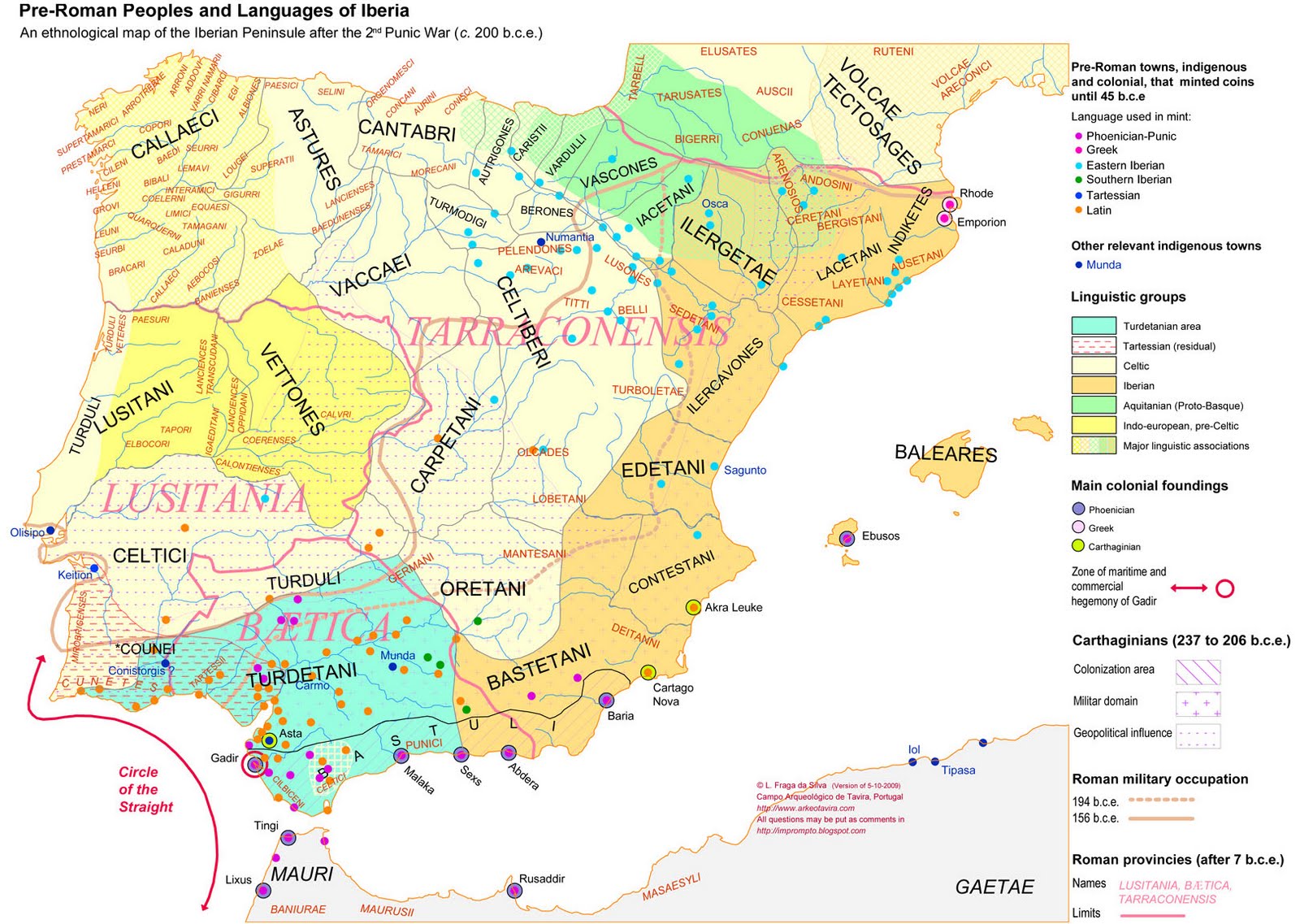
More than 200 celtiberian inscriptions, a pure celtic language, were written after the Numantia war. Like I said, see Numantia in the context of the whole Celtic peninsula :

MAPA.jpg
 
@taranis. I try to based my beliefs on historical facts rather than personal desires. I’ll leave to insist when someone supporting their ideas with irrefutable facts. That is a debate for me.

Wait, what? You are implying that my statement regarding the Celtiberian corpus is based on 'personal desires'? I'm sorry, but you are completely wrong. There is also a fair vocabulary of Celtic loanwords into Spanish (or, more broadly Iberian Romance) which would be impossible if the Celtic peoples were completely wiped out. On the balance, I have to agree that the image of Spain as a 'Celtic' nation is false and the Celtic ancestry of modern-day Spanish/Portuguese tends to be overstated against the non-Celtic elements. The modern-day Spaniards/Portuguese, like all other people, are the result of a melange of history. The significance of the ancient Celtic peoples in this history (at least, the modern-day situation) is fairly small. Modern-day Spain and Portugal principally have their roots in the Christian Reconquista, specifically starting in the Kingdom of Asturia that was established in northern Iberia in the wake of the conquest of the Visigothic Kingdom by the Umayyad Caliphate. However, no matter how big or how small the impact is for the situation today, the Celtic peoples (just like the ancient Iberians, Lusitanians, Tartessians, Phoenicians, Greeks and Romans) are part of Spanish (and Portuguese - well, the Greeks not so much) history, and I cannot blame anybody for being fascinated by it.
 
Wait, what? You are implying that my statement regarding the Celtiberian corpus is based on 'personal desires'? I'm sorry, but you are completely wrong. There is also a fair vocabulary of Celtic loanwords into Spanish (or, more broadly Iberian Romance) which would be impossible if the Celtic peoples were completely wiped out. On the balance, I have to agree that the image of Spain as a 'Celtic' nation is false and the Celtic ancestry of modern-day Spanish/Portuguese tends to be overstated against the non-Celtic elements. The modern-day Spaniards/Portuguese, like all other people, are the result of a melange of history. The significance of the ancient Celtic peoples in this history (at least, the modern-day situation) is fairly small. Modern-day Spain and Portugal principally have their roots in the Christian Reconquista, specifically starting in the Kingdom of Asturia that was established in northern Iberia in the wake of the conquest of the Visigothic Kingdom by the Umayyad Caliphate. However, no matter how big or how small the impact is for the situation today, the Celtic peoples (just like the ancient Iberians, Lusitanians, Tartessians, Phoenicians, Greeks and Romans) are part of Spanish (and Portuguese - well, the Greeks not so much) history, and I cannot blame anybody for being fascinated by it.

The regions that identify more as Celtic in Iberia are located along the Iberian Cornice and include Galicia, N. Portugal (together Gallaecia), Asturias, Cantabria and parts of Leon and Beira Alta (Portugal). Celticity is evident in music, folklore, etc.
 
Wait, what? You are implying that my statement regarding the Celtiberian corpus is based on 'personal desires'? I'm sorry, but you are completely wrong. There is also a fair vocabulary of Celtic loanwords into Spanish (or, more broadly Iberian Romance) which would be impossible if the Celtic peoples were completely wiped out. On the balance, I have to agree that the image of Spain as a 'Celtic' nation is false and the Celtic ancestry of modern-day Spanish/Portuguese tends to be overstated against the non-Celtic elements. The modern-day Spaniards/Portuguese, like all other people, are the result of a melange of history. The significance of the ancient Celtic peoples in this history (at least, the modern-day situation) is fairly small. Modern-day Spain and Portugal principally have their roots in the Christian Reconquista, specifically starting in the Kingdom of Asturia that was established in northern Iberia in the wake of the conquest of the Visigothic Kingdom by the Umayyad Caliphate. However, no matter how big or how small the impact is for the situation today, the Celtic peoples (just like the ancient Iberians, Lusitanians, Tartessians, Phoenicians, Greeks and Romans) are part of Spanish (and Portuguese - well, the Greeks not so much) history, and I cannot blame anybody for being fascinated by it.
I agree with everything, but we must put things in prespective : Phoenicians or Greeks were very small populations (settled in a few coastal towns as Sea traders), and their genetic impact is insignificant (example is the very low E-V13 in Iberia, which is a typical greek clade) or having amongst the lowest autosomal component west-asian/caucasus in Europe, which is very high in East-Meds. So, The bulk of the iberian populatin is Celto-Iberian (those who spoke celtic languages, and those who spoke iindigenous languages, that is iberians and proto-Basques). Archeology, linguistics, genetics, everything points to the same conclusion.
 
I have to agree that the image of Spain as a 'Celtic' nation is false and the Celtic ancestry of modern-day Spanish/Portuguese tends to be overstated against the non-Celtic elements.
I totally agree, spaniards have another class of genetic component after-effect of that melange mentioned above in your post and they know it very well.

Modern-day Spain and Portugal principally have their roots in the Christian Reconquista, specifically starting in the Kingdom of Asturia that was established in northern Iberia in the wake of the conquest of the Visigothic Kingdom by the Umayyad Caliphate.
In terms of political yes...In terms of genetics I have to disagree.


However, no matter how big or how small the impact is for the situation today, the Celtic peoples (just like the ancient Iberians, Lusitanians, Tartessians, Phoenicians, Greeks and Romans) are part of Spanish (and Portuguese - well, the Greeks not so much) history, and I cannot blame anybody for being fascinated by it.
I totally agree again however I think you are leaving behind a very important forefather...I'm going to give a clue..they were for eight hundreds years in Iberia.
 
I totally agree, spaniards have another class of genetic component after-effect of that melange mentioned above in your post and they know it very well.

In terms of political yes...In terms of genetics I have to disagree.

That goes without saying, doesn't it?

I totally agree again however I think you are leaving behind a very important forefather...I'm going to give a clue..they were for eight hundreds years in Iberia.

In that post was thinking about classical Antiquity here, not the Dark Ages or the Medieval period. The reason I excluded the Moors is the same that I excluded for instance the Visigoths: they weren't there in Antiquity. Otherwise, Moorish impact onto the Iberian penninsula also goes without saying, especially on language and architecture.

Random trivia here: 2011 is actually the 1300th anniversary of the begin of the Umayyad conquest of Iberia.
 
Status
Not open for further replies.
Back
Top