• Don't want to see ads? Install an adblocker like uBlock Origin or use a Europe-based privacy-friendly browser like Vivaldi or Mullvad.

The genetic history of Ice Age Europe

Ok. That's slightly different then. Still, as I said, from the paper:
"Second, we detect an excess of allele sharing with east Asians in a subset of Villabruna Cluster individuals— beginning with an ~13,000-year-old individual from Switzerland—as revealed by significant statistics of the form D(Test1, Test2; Han, Mbuti) (Fig. 4b and Extended Data Fig. 3). For example, Han Chinese share more alleles with two Villabruna Cluster individuals (Loschbour and LaBrana1) than they do with Kostenki14"
http://genetics.med.harvard.edu/reich/Reich_Lab/Welcome_files/FuQ_nature17993.pdf

They seem to me to be proposing that the direct Villabruna line doesn't have any, or appreciably any, of this ancestry, and instead it enters the cluster later and in a more northerly locale with Bichon. That would mean this ancestry either existed in those more northerly regions in the remnants of the prior groups, or this "East Asian" flow came west across the steppes in the very late stages of the LGM or post LGM. That makes much more sense to me from an archaeological point of view. I don't know of any evidence showing Mal'ta like influence in lithics etc moving west into central Europe, do you?

It used to be the pet theory of Alan of Anthrogenica. However, this is what he said:

http://www.anthrogenica.com/showthr...Ice-Age-Europe&p=157276&viewfull=1#post157276

Alan@Anthrogenica said:
The culture Mal'ta boy was a very late member of had a stone tool technology which was very different from the Gravetians of Europe. So, on that basis I looked to see if something similar to it appeared further south and west in the early LGM period when it was disappearing in Mal'ta boy's region. I found nothing.


My apologies to Kristiina if she reads this. The first mention of that idea that I remembered reading is from Rethel's post upthread.

I've been wondering about that too. I don't know if this makes sense but could it have something to do with the fact that "East Asian", as a group or cluster is really a Post LGM composite? I have never followed the population genetics papers relating to East Asia, so that could be totally off base. If it isn't, could it be that Mal'ta is so old that what it has is a lot of ENA, which is only part of what went in to make "East Asian"?

I also entertain myself with the idea it could be an undetected DNA deterioration or something similar. The fact that Villabruna loves a lot of past-LGM genomes over pre-LGM ones still is interesting. It might be something technical, some strange artifact we don't realize is there.

There were apparently lots of them. There were wild horses in various places around Europe. The numbers waxed and waned depending on the time period and the climate and flora. They apparently increased in places where there was open grassland, which we would assume, and when it was cooler and drier apparently.

Anyway, this is an old anthropology text which talks about caves in Italy being littered with horse bones. It's outdated in many ways, but I presume that horse bones are horse bones.
https://books.google.com/books?id=v...ge&q=Wild horses in Paleolithic Italy&f=false


This is a more recent text:
https://books.google.com/books?id=t...ge&q=Wild horses in Paleolithic Italy&f=false


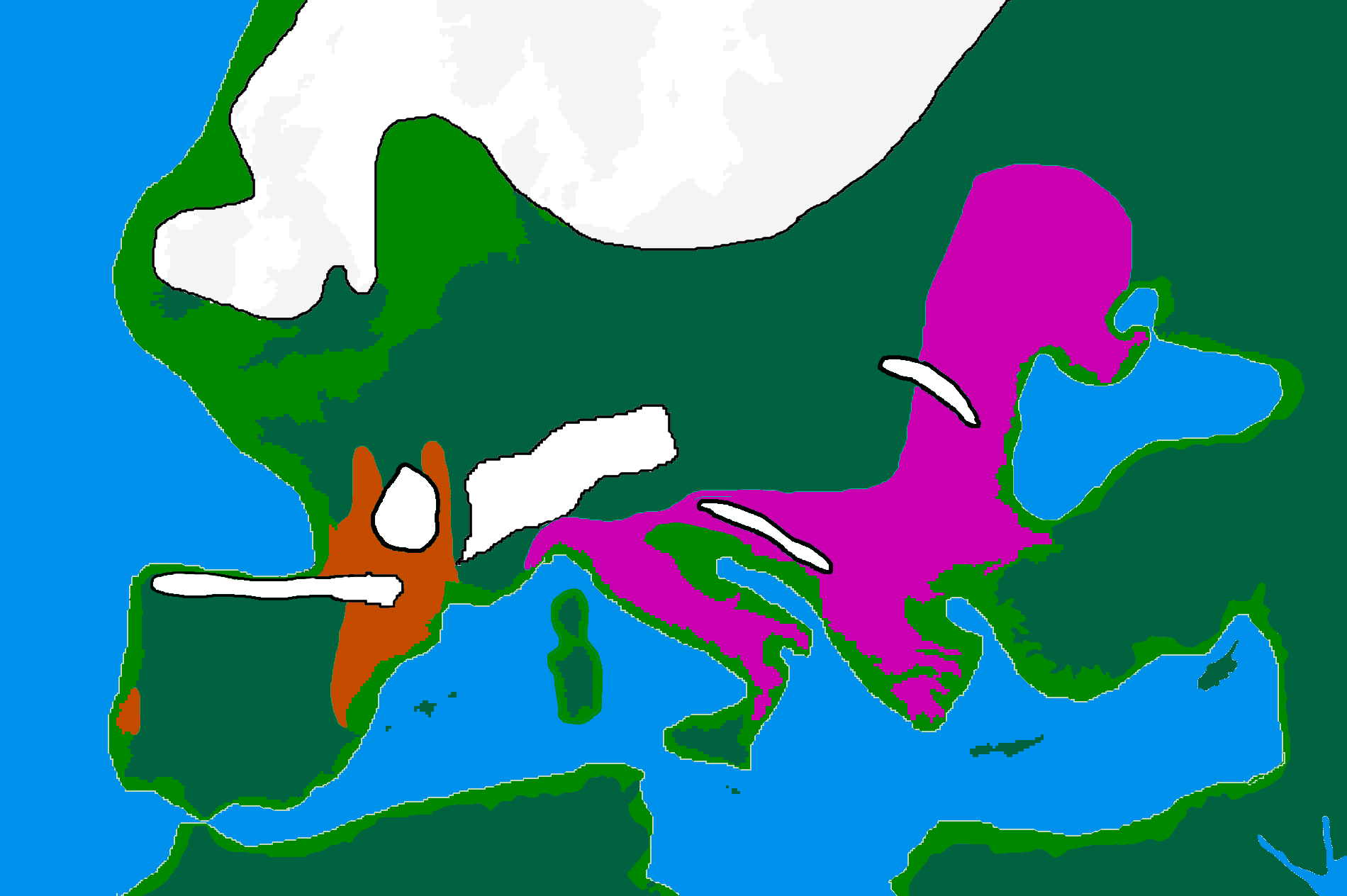
From the map, the ice cap didn't reach the coast. The coastal strip is marked as having vegetation, from the map legend, so how terrible could it have been? It may have been at certain periods, but certainly not in the period depicted on this map. We also don't know when these hypothetical proto-Villabrunians made their trek to northern Spain in time to create El Miron. If they made it at the time depicted in the map or one like it, I think it was hardly all that difficult a route, especially as they were always in reach of the sea and all those resources.

You can take a look at the paper from which it came. There's a wealth of data for all of Europe.
http://129.187.45.33/CartoMasterNew/fileadmin/user_upload/Jaunsproge_Report.pdf

Thanks. Horses are good. We now have a sensible link between the Italian Epigravettian and the Magdalenian.

PS: Did the reply in the message box reach you?
 
No problem with this. As long as people can find food on their way they can survive and travel. If big part of WHG food was of marine source they could easily cross Alps along the coast. As long as there was grass in summer they could have hunt deer, horse, rabbits, birds, etc.
I'm not sure why you doubt in ability of HGs to pass through?

I have this private own theory that these people followed herds. Kind of what until recently all kinds of arctic peoples such as Ket, Yakuts or Sami did: They followed reindeer herds. I don't doubt the ability of these people to travel anywhere. But the reindeer didn't and they didn't.

Until the 20th century, that is.
 
The Villabrunians don't look like Aurignacian people to me, though. They don't even look like Gravettians. Granted, you're hearing that from someone whose training in physical anthropology consists of one university class in it and whatever reading I've done on my own, so I'm no authority. :) That's why I keep posting pictures on the anthropology section and asking questions of Moesan, who knows a heck of a lot more about it than I do. Unfortunately there's no substitute for examining the remains, and even the pictures I find don't show all views, or the measurements aren't posted in the article. Then there's all the disagreement in the field itself.

http://www.eupedia.com/forum/threads/29518-Collection-of-skulls?p=480126#post480126

Still, all the indications to me are that Villabruna comes from a different looking bunch, shorter, with a different skull shape, narrower jaw, etc., adapted to a different climate and flora and fauna, I think. My hunch is that the majority of his ancestry is from a line that diverged pretty early from the prior inhabitants of Europe, although a couple of thousand years of drift could also explain it. He could well have some ancestry from the prior groups, of course.

As we discussed upthread somewhere, in the majority of cases a total change of subsistence strategy, technology, etc. comes with a major genetic change, i.e. new people.

I do think it's possible that this Villabrunian group moved north from Italy or from the Balkans or the Crimea or other Black Sea areas if they were also there. In terms of Italy, the majority of them could have gone around the east end of the Alps, or they could have gone into the marsh lands and then moved on from there.

In that regard, while we can't know precisely what the once marshy areas of the northern Adriatic were like during the LGM or early post-LGM period, if they were anything at all like modern marshy areas they would have been a cornucopia of good things to eat, from fish and birds to small game. I also don't think we know if, like modern marshy areas in places like Louisiana in the U.S., for example, there were bits of land above the water where shelters could have been built.
https://s-media-cache-ak0.pinimg.com/736x/d9/ae/c3/d9aec33480904420c0b9cef30d1656b2.jpg

Regardless, it could relatively easily be traversed.

I just realized that there is more than 7.500 years between the latest Gravettian find and the earliest Magdalenian find in the paper:

Goyet Q56-16 Belgium 26,600–26,040 Gravettian
El Mirón Spain 18,830–18,610 Magdalenian

That is the entire Solutrean period.
 
Parsimonious indeed, the notion needs work--a lot of work.

And thank you for the maps and thesis links, btw.

But I guess I have to like the idea that people, hanging out down in the south of Italy, or wherever it was, quietly (and probably quite flexibly) hunting and gathering timid little woodland creatures and fishing, would ultimately prevail, while their sexier, attention grabbing mammoth, bison, aurochs, reindeer and or whatever big game there was hunting cousins up north would ultimately hunt themselves out of food, and/or be unable to adapt quickly enough to changing climatic conditions... Gravettians, Solutreans and Magdalenians haven't made as significant impact upon the population genetics of modern Europe.

That could just be human nature, I suppose, that we get so overspecialized that we find ourselves redundant, or we're inflexible in the face of changing conditions we fail to learn new, adaptive behavior.

You're very welcome. I totally agree with you that the cultures which survive are the ones whose people have the ability to be flexible and to adapt to changing conditions. However, sometimes even native intelligence and flexibility aren't enough. I've seen speculation, whether it's true or not I don't know, that part of the problem for Neanderthals was that a difference in anatomy meant that homo sapiens sapiens had the ability to throw projectile spears at their prey, something that was more difficult for Neanderthals, and gave their competitors an advantage.

Then, hunter-gatherers in general had and have a difficult time in adopting the farming lifestyle, even the WHG. It's not so simple as just teaching them what to do. It's a whole different way of looking at the world, a whole new mode of life, requiring different skills and attributes. The Native Americans have not totally adapted in over three hundred years, and there are lots of other examples.

To get back to the WHG, the following is from a book on Paleolithic and Mesolithic Italy by Margherita Mussi:
https://books.google.com/booksid=0d...=onepage&q=site of Villabruna remains&f=false

It's difficult to get a totally complete and accurate picture from google books because so many pages are missing (so don't take this to the bank), but she seems to be drawing a picture where the changing subsistence strategy moved from south to north along with the climate change and the different animals.

By the time we get to the late Epigravettian in northeastern Italy we have people who first, and even later at hunting camps at higher altitudes hunted ibex, a type of wild goat. Later, as the land and climate changed, they hunted roe deer. They also fished a great deal, of which there apparently is much less evidence in the Gravettian, so perhaps they made advancements in the technology, like hooks, or nets, etc.

They carried pouches, and since there are remains that indicate they were increasingly consuming snails, mussels, and other shellfish, hazelnuts etc., they probably were making baskets.

All of the above can be found on page 338.

On page 315 she seems to be saying that up until 12,000 ybp they were hunting mostly ibex. After that, as the land changed, they switched to red deer. There were almost no equids, few bovines, whereas in other parts of Italy there were a lot of equids.

I get the picture of, as you said, a very flexible group of people who could vary their hunting styles and create new technology to take advantage of changing conditions.

This is another paper which says basically the same thing. It's about another Epigravettian site in northeastern Italy. In this one, the researchers describe a group of people who built a shelter or work space in the mountains, an area described as an open Alpine prairie where pines and larches were beginning to appear, for summer and fall hunting and the preparing of hides. They used grinding stones for this. At colder times of the year they utilized the conifer forests further down the mountain, and in winter the resources on the Brenta valley floor. In the mountains they hunted ibex, like Otzi thousands of years later, but also occasionally chamois, bear, caught birds, and fished.
http://www3.arch.cam.ac.uk/clark/PDFs/jfa37_1_Cristiani.pdf

This is the period called the Bolling and Allerod temperate interstadial discussed by the authors of the paper.
 
@Angela

The Alleröd interstadial is also when reindeer hunters appeared north to become the Ahrensburg Culture. This culture had the marks of Magdalenian culture, but was on the verge of the Mesolithicum.

Another piece of evidence: Apparently the fish harpoon was an Magdalenian invention.

https://books.google.nl/books?id=M_jWCgAAQBAJ
 
The Mussi book also gives some information about mammoths. According to her, the only (or perhaps the overwhelming number of cases, I can't tell because I don't have the whole book in front of me) evidence of mammoth hunting in Italy is in a Mousterian context. I don't know why that would be...

As a result, she maintains that the only ivory artifacts found are in Liguria, some ivory pendants at Arene Candide and 2 female figurines at the Balzi Rossi caves.

In fact, what she says on page 262 is that "ivory items are exceedingly rare and not found outside Liguria, the area adjoining the ice free corridor connecting the Italian peninsula to western Europe. They are not found in southeastern France either."

Before that last sentence I thought perhaps the ivory came through southeastern France, but perhaps not.

This talk about an ice free corridor is very interesting. That seems to bolster the findings by the map maker I referenced above who showed vegetation along the coast there even in the LGM.It wouldn't at all surprise me. Liguria's climate and floral and fauna is an anomaly even today. Alone in northern Italy it has a Mediterranean climate and flora and fauna, relatively warm in the winter, capable of growing oranges and lemons, etc., and yet a half hour drive to an hour drive inland and you are in areas where a "continental" climate prevails. It's the only area of northern Italy that is like this, and it is all due to the fact that it has the Apennines at its back, and faces the Sea.

There's a great deal in the book about disputes as to the grouping of lithics into various clusters. She takes exception to some of the classifications of the French researcher LaPlace. They both seem to feel that the Epigravettian starts around 20,000 ybp, and that the Early Epigravettian overlaps with the Solutrean. She disagrees with him though in part because she thinks that the latter part of the Early Epigravettian, the shouldered tools period, also overlaps with the Magdalenian, because those tools were made until 16,000 ybp.

Without the whole text in front of me I don't want to come to any grand conclusions. She does often seem to group the lithics of northwestern Italy with those of Provence. At a certain point there is a split, however. That's discussed around page 269. There seems to be a real break between Provence and Liguria when shouldered tools appeared in the Italian Epigravettian.

She makes a comment on page 207 that the Aurignacian has a different and wider distribution all over Italy, although they are concentrated on the Tyrrhenian coast starting with Liguria. I'm sure she talks about the distribution of the Gravettian geographically and perhaps talks about the earliest Epigravettian, but I couldn't find it. That would be good to know. I did see a statement to the effect that in Northern Italy between the Alps and the Appennines (i.e.northeastern Italy), there is no major campsite for the Early Epigravettian, although she acknowledges that a lot of areas are under the Po or the Adriatic. If I had the whole text and could nail that down, that would raise the interesting possibility that it did move south to north.
 
@Angela

The Aurignacian had retouched blades, relatively rough. The Solutrean however had some of the most splendid lithic craftmanship ever seen in Europe. These are unlike anything else. The Magdalenian however had even rougher lithic industry than the Aurignacian. Their excellence was bone artifacts and especially bone art.

On account of the south to north: 33.000 year old Paglicci133 clusters somewhat with Vestonice16. David lumped together the late Gravettian Paglicci108, which has less than the required 10.000 SNP harvested, with Paglicci133. We ran D-stats and it shows no discernible difference with just Paglicci133.

Mbuti Paglicci_combined ElMiron Vestonice16 Z=3.342
ElMiron, Vestonice16; Paglicci133, Mbuti Z=-3.5 <- From the paper.

If adding or removing Paglicci108 doesn't shift D-stats, it is similar to Paglicci133. That means that the Italian Gravettian basically continued unchanged to 28.000 years ago. And 14.000 years ago WHG appears. They weren't the same. Would France be a good origin? Or the Balkans?
 
@Angela

The Aurignacian had retouched blades, relatively rough. The Solutrean however had some of the most splendid lithic craftmanship ever seen in Europe. These are unlike anything else. The Magdalenian however had even rougher lithic industry than the Aurignacian. Their excellence was bone artifacts and especially bone art.

On account of the south to north: 33.000 year old Paglicci133 clusters somewhat with Vestonice16. David lumped together the late Gravettian Paglicci108, which has less than the required 10.000 SNP harvested, with Paglicci133. We ran D-stats and it shows no discernible difference with just Paglicci133.

Mbuti Paglicci_combined ElMiron Vestonice16 Z=3.342
ElMiron, Vestonice16; Paglicci133, Mbuti Z=-3.5 <- From the paper.

If adding or removing Paglicci108 doesn't shift D-stats, it is similar to Paglicci133. That means that the Italian Gravettian basically continued unchanged to 28.000 years ago. And 14.000 years ago WHG appears. They weren't the same. Would France be a good origin? Or the Balkans?

Oldest Gravettian in Italy is Paglicci, and that's only 28,000 years ago, so did it come to Italy late?*

Mussi says that there are "tentative" indications that a new people arrived in Paglicci, but I think she's talking about Early Epigravettian. Even if the time periods are close, it's very different lithics, yes?

As for France, what do you know about the Arenian? Mussi says that Provence and Liguria both had it until Liguria got the Early Epigravettian, not very sophisticated at that early stage, apparently.

I saw one statement from her about the Balkans and it was in the context of the Epigravettian. She seemed to say there were no sites there either in the early period, just like in Northeastern Italy, but again there's the caveat that some of it is now underwater.

Ed. Hold that thought.:) There doesn't even seem to be agreement about that. What a mess! That came from one paper. The one I just found (published in 2014) dates a Gravettian site in NE Italy to about 29,000 ybp.
http://www.ncbi.nlm.nih.gov/pmc/articles/PMC3997387/

When I get a chance to read it, I'll post.
 
The people who wrote this should go to the Supreme Court if they get tired of this profession; they also decline, on occasion, to address the thornier issues. :) Sahra Talamo et al
http://www.ncbi.nlm.nih.gov/pmc/articles/PMC3997387/

"One of the most debated issue is whether the Gravettian developed from a local Aurignacian [5][8] or results from immigration or cultural diffusion processes through various corridors between European regions [4], [9][11]. This paper will not enter into this broader issue, instead it will deal with the Northern Italian evidence and the role of two possible passageways, one from the west (France) and one from the east (Balkan region) [9], [12][14]
."

I guess it's up to genetics.

"The earliest Italian Gravettian groups is documented around 28,00014C BP in Paglicci Cave in the southern end of the Peninsula[15][17], and the majority of the sites, adjacent to the two opposite Italian coasts, are recorded at 26,000–24,000 14C BP (Figure 1) [12].

"
The earliest Italian Gravettian groups is documented around 28,00014C BP in Paglicci Cave in the southern end of the Peninsula[15][17], and the majority of the sites, adjacent to the two opposite Italian coasts, are recorded at 26,000–24,000 14C BP (Figure 1) [12]."

"
The earliest Italian Gravettian groups is documented around 28,00014C BP in Paglicci Cave in the southern end of the Peninsula[15][17], and the majority of the sites, adjacent to the two opposite Italian coasts, are recorded at 26,000–24,000 14C BP (Figure 1) [12]."

There aren't very many sites. Mussi seemed to say something about the Aurignacian being apparently better represented. I don't know if that's correct. This is what they have to say about the Gravettian in general:

"
The appearance of the early Gravettian in Europe predates the last phases of the Aurignacian [49]. Although some similarities have been detected with the Ahmarian assemblages of the Near East[49], a local development of the Gravettian technological innovations from the Aurignacian substrate was suggested at Geiβenklösterle in layer AH II [50] and at Abri Pataud in layer 6[51]. "

There doesn't seem to be anything about any mammoth hunters from far northern Eurasia. Again, as I said upthread, Mussi claims that they're only tied to the Mousterian in Italy. Also, there's the claim about the tie to the Near Eastern Ahmarian, which I've seen before.

The big point of the paper is that this northeast Italian site is, according to their testing, a little bit older than Paglicci.
 
Paleolithic and Mesolithic Italy by Margherita Mussi:

Thank You, again. I can get the print copy at a library I spend an inordinate amount of time at--tomorrow, I know right where to look on the shelf.

Also, I found this a rather interesting read, sorry I cannot post the link.

Borgia, V., et al., Bone and antler working at Grotta Paglicci (Rignano Garganico, Foggia, southern Italy),Quaternary International (2015),
 
@Epoch,
Someone should check what the authors of Fu et al claim about the archaeological context for the 33,000? YBP Paglicci sample. It might be in the supplement. I'm seeing papers that label only the 28,000 YBP sample as Gravettian. Even the central European Gravettian is only 29,000 YBP. The Epigravettian doesn't start until 20,000YBP. One paper seemed to be saying the Epigravettian sample at Paglicci, or at least the layer, is dated to 17,000 YBP, but it wasn't all that clear.
 
@Angela

Quoted from the supp info:

Human occupation at this site is attested during the Early Middle and throughout the entirety of the Upper Palaeolithic.
Paglicci is also important for the presence of the only Palaeolithic wall paintings discovered so far in Italy and for the most ancient evidence of flour production

paglicci01.JPG


http://naplesldm.com/paglicci.html

The main stratigraphic sequence is 12 meters thick. The Upper Palaeolithic layers yielded several human remains spanning from the
Early Gravettian to the Final Epigravettian. The three human remains used in ancient DNA analyses came from three distinct stratigraphic units.

We performed genetic analysis on Palgicci71, a right patella discovered in layer 8 whose 14 C date confirms the archaeological attribution to the Evolved Epigravettian, although this
sample was not used in our main analysis as it yielded fewer than 4,000 SNPs:
Paglicci71 at 19,250-18,210 cal BP (F-66 : 15,460 +/- 220 14 C) 19 (layer date, based on associated charcoal)

We also performed genetic analysis on Paglicci108, a phalanx discovered in layer 21B. A date from charcoal is consistent with the Evolved Gravettian material found in this layer:
Paglicci108 at 28,430-27,070 cal BP (F-52 : 23,470 +/- 370 14 C) 20 (layer date, based on associated charcoal)

We finally performed genetic analysis on Paglicci133, a tooth (M3 dx) found in layer 23C2, which is not directly dated but which can be associated on the basis of its stratigraphic position and the associated artifacts to the Early Gravettian culture:

Paglicci133 was found in a layer (23C2) whose chronology can be derived from the occurrence of tephra Codola elsewhere dated to around 33,000 years ago. Moreover this layer is located between layer 23A (Early Gravettian) with a date of 33,110-31,210 cal BP ( UTC -1415 : 28,100 +/- 400 14 C) and layer 24A1 (Aurignacian) with a date of 34,580-31,860 cal BP ( UTC -1789 : 29,300 +/- 600 14 C) 18. (both dates are based on charcoal in the layers above and below)

Considering Paglicci133 clusters with Vestonice16 I'd say he is Early Gravettian. He also is Y-DNA I
 
Last edited:
@Angela

Quoted from the supp info:


paglicci01.JPG


http://naplesldm.com/paglicci.html


Considering Paglicci133 clusters with Vestonice16 I'd say he is Early Gravettian. He also is Y-DNA I

Interesting. If Paglicci 133 at 33,000 YBP is Early Gravettian, and the earliest Pavlovian Gravettian of central Europe I've seen has dates around 29,000 YBP, then do really know the direction of the gene flow?

Anyway, in looking for things on the Epigravettian I found some interesting maps. The usual disclaimers apply, because I didn't scour each paper to figure out the level of reliability.

This is the proposed gene flow into Europe of Aurignacian people. It's from Matilda's anthropology blog, so the reliability is high, in my opinion. I just wish she hadn't cut down so much on blogging.
colonisation1.png

Aurignacian sites:
500px-Aurignacian_culture_map-fr.svg.png


Solutrean sites:
Homo_Sapiens_in_Europe_-_solutrean_distribution_map-fr.svg
 
Magdalenian and Epigravettian. The coverage of Italy for the Epigravettian is very poor, as they're missing quite a few sites. They don't even have the Arene Candide in Liguria! What is with these people? Amazing when you see how widespread the Magdalenian was that these people had so much less input into modern Europeans than the Villabruna type.

Homo_Sapiens_in_Europe_-_magdalenian_distribution_map-de.svg
 
This map shows the whole extent of the Epigravettian:
Europe20000ya.png


Just from skimming some of the papers on the Balkan sites, there's been a lot of recent redating and re-analysis of them, which is showing that in a lot of cases the sequences jump right from Aurignacian into Epigravettian, with no discernible Gravettian layers. That doesn't tell us if the Epigravettian started there and moved to Italy or not; in fact, the dates are consistently older in Italy.

The biggest Epigravettian sites in the Balkans seem to be the ones around the Iron Gates with which we're familiar, but I don't see very old dates for that. They all seem to be late epigravettian, whereas we have a lot of early Epigravettian in Italy.
https://www.academia.edu/24653474/L...chaeological_and_chronological_evidence_2016_

Coming to some definitive conclusion about all of this seems to me almost impossible without more ancient dna from the Near East and the Caucasus than has been published as of yet, or even from the Balkans.

I'm pretty comfortable with one conclusion, though: the Epigravettians are different from the Aurignacians and Gravettians, and that difference isn't because of some gene flow from far northern Eurasian hunter-gatherers. (That's not to say that the Villabrunian cluster doesn't have some admixture from these groups. There are no "pure" groups or ethnicities or whatever.) However, I think the majority of their ancestry is something else. Either they were always different and we haven't found their ancient "European" ancestors yet, or they were a later migration from the east/southeast.

Also, looking at the map above I can see how this "other" ancestry might be "related to" the CHG.
 
We have so far..

Proto-Aurignac:

Oase1, Romania, completely unrelated to any other genome (even Usht'Ishim, IIRC)

Aurignac:

Muierii2, Romania, relatively unrelated to WHG
GoyetQ116-1, Belgium, relatively related to WHG

The extent of the Epigravettian in the last map is very attractive as source area. However, if I understand it all right Epigravettian is a conglomerate of different cultures that all share the fact they emerged at the end of the Gravettian. IIRC even the Caucasus is considered Epigravettian. Now, there appears a clear WHG admixture into CGH. But all the genomes in this paper are more related to each other than to CHG.
 
Last edited:
I wonder if it would be worth exploring the "Uluzzian." A pre-Aurignacian culture near the heel of Italy that may have got it's start in Greece and followed the coast. These folks were modern human, according to Steffano Benazzi et al. In Nature no.479 , November 2, 2011.
 
I wonder if it would be worth exploring the "Uluzzian." A pre-Aurignacian culture near the heel of Italy that may have got it's start in Greece and followed the coast. These folks were modern human, according to Steffano Benazzi et al. In Nature no.479 , November 2, 2011.

Now that's a very interesting idea.

I'll post that link for you since you can't do it yet. The whole text is available for free Welcome, by the way. It's good to have you. :)
http://www.nature.com/nature/journal/v479/n7374/abs/nature10617.html

"The appearance of anatomically modern humans in Europe and the nature of the transition from the Middle to Upper Palaeolithic are matters of intense debate. Most researchers accept that before the arrival of anatomically modern humans, Neanderthals had adopted several ‘transitional’ technocomplexes. Two of these, the Uluzzian of southern Europe and the Châtelperronian of western Europe, are key to current interpretations regarding the timing of arrival of anatomically modern humans in the region and their potential interaction with Neanderthal populations. They are also central to current debates regarding the cognitive abilities of Neanderthals and the reasons behind their extinction1, 2, 3, 4, 5,6. However, the actual fossil evidence associated with these assemblages is scant and fragmentary7, 8, 9, 10, and recent work has questioned the attribution of the Châtelperronian to Neanderthals on the basis of taphonomic mixing and lithic analysis11, 12. Here we reanalyse the deciduous molars from the Grotta del Cavallo (southern Italy), associated with the Uluzzian and originally classified as Neanderthal13, 14. Using two independent morphometric methods based on microtomographic data, we show that the Cavallo specimens can be attributed to anatomically modern humans. The secure context of the teeth provides crucial evidence that the makers of the Uluzzian technocomplex were therefore not Neanderthals. In addition, new chronometric data for the Uluzzian layers of Grotta del Cavallo obtained from associated shell beads and included within a Bayesian age model show that the teeth must date to ~45,000–43,000 calendar years before present. The Cavallo human remains are therefore the oldest known European anatomically modern humans, confirming a rapid dispersal of modern humans across the continent before the Aurignacian and the disappearance of Neanderthals."


Did you see this? It's a bit of an overview.
http://popular-archaeology.com/issue/12012013/article/dating-the-uluzzian

They're referring to this 2014 paper:
"On the chronology of the Uluzzian", Katerina Douka et al
http://www.sciencedirect.com/science/article/pii/S0047248414000074
[h=2]"Abstract[/h]The Uluzzian, one of Europe's ‘transitional’ technocomplexes, has gained particular significance over the past three years when the only human remains associated with it were attributed to modern humans, instead of Neanderthals as previously thought. The position of the Uluzzian at stratified sequences, always overlying late Mousterian layers and underlying early Upper Palaeolithic ones, highlights its significance in understanding the passage from the Middle to Upper Palaeolithic, as well as the replacement of Neanderthals by modern humans in southeastern Mediterranean Europe. Despite several studies investigating aspects of its lithic techno-typology, taxonomy and material culture, the Uluzzian chronology has remained extremely poorly-known, based on a handful of dubious chronometric determinations. Here we aim to elucidate the chronological aspect of the technocomplex by presenting an integrated synthesis of new radiocarbon results and a Bayesian statistical approach from four stratified Uluzzian cave sequences in Italy and Greece (Cavallo, Fumane, Castelcivita and Klissoura 1). In addition to building a reliable chronological framework for the Uluzzian, we examine its appearance, tempo-spatial spread and correlation to previous and later Palaeolithic assemblages (Mousterian, Protoaurignacian) at the relevant regions. We conclude that the Uluzzian arrived in Italy and Greece shortly before 45,000 years ago and its final stages are placed at ∼39,500 years ago, its end synchronous (if not slightly earlier) with the Campanian Ignimbrite eruption."

The only thing is that it seems to come to a halt with the Campanian eruption. Unless there were some survivors, either in Italy or the Balkans, and they mixed with the Aurignacians to form the WHG?

I'd say it would be a good idea for someone to test samples from Cavallo, Fumane, Castelcivita and Klissoura. :) I wonder if they're already in the Reich Lab.
 
Couldn't the Uluzzian be a candidate for Oase1? Extinct and all? I mean, Oase1 is a problem in the fact it is really, really unrelated to anyone. Anyone but Neanderthals, that is.

But look at Ostuni2, one of the more or less outliers.

D(Oase1, GoyetQ116; Ostuni2, Mbuti) = -2.8
D(Villabruna, Vestonice16; Ostuni2, Mbuti) = -2.6

Also, if you take a look at Table S5.1, Vestonice cluster looks about as far from GoyetQ116 as from Villabruna.
 
Angela,


I have a lot of reading to do!


The "On the chronology of the Uluzzian" looks splendid.


Reich labs may like to tip their hand just to keep us guessing. Fu paper in May was foreshadowed by Posth back in March with the 'strange' new people at 14k BP, it seems.


Wonder when the next shoe will drop.


But the idea of an even older layer than Aurignacians is intriguing. Maybe it will turn out this pioneer population has a very strong affinity to the near east?


epoch,

Certainly could be another extinct branch--or maybe not. This group took a more southerly route, along the coasts.
 
Back
Top