
epoch
Elite member
- Messages
- 781
- Reaction score
- 187
- Points
- 43
Ok. That's slightly different then. Still, as I said, from the paper:
"Second, we detect an excess of allele sharing with east Asians in a subset of Villabruna Cluster individuals— beginning with an ~13,000-year-old individual from Switzerland—as revealed by significant statistics of the form D(Test1, Test2; Han, Mbuti) (Fig. 4b and Extended Data Fig. 3). For example, Han Chinese share more alleles with two Villabruna Cluster individuals (Loschbour and LaBrana1) than they do with Kostenki14"
http://genetics.med.harvard.edu/reich/Reich_Lab/Welcome_files/FuQ_nature17993.pdf
They seem to me to be proposing that the direct Villabruna line doesn't have any, or appreciably any, of this ancestry, and instead it enters the cluster later and in a more northerly locale with Bichon. That would mean this ancestry either existed in those more northerly regions in the remnants of the prior groups, or this "East Asian" flow came west across the steppes in the very late stages of the LGM or post LGM. That makes much more sense to me from an archaeological point of view. I don't know of any evidence showing Mal'ta like influence in lithics etc moving west into central Europe, do you?
It used to be the pet theory of Alan of Anthrogenica. However, this is what he said:
http://www.anthrogenica.com/showthr...Ice-Age-Europe&p=157276&viewfull=1#post157276
Alan@Anthrogenica said:The culture Mal'ta boy was a very late member of had a stone tool technology which was very different from the Gravetians of Europe. So, on that basis I looked to see if something similar to it appeared further south and west in the early LGM period when it was disappearing in Mal'ta boy's region. I found nothing.
My apologies to Kristiina if she reads this. The first mention of that idea that I remembered reading is from Rethel's post upthread.
I've been wondering about that too. I don't know if this makes sense but could it have something to do with the fact that "East Asian", as a group or cluster is really a Post LGM composite? I have never followed the population genetics papers relating to East Asia, so that could be totally off base. If it isn't, could it be that Mal'ta is so old that what it has is a lot of ENA, which is only part of what went in to make "East Asian"?
I also entertain myself with the idea it could be an undetected DNA deterioration or something similar. The fact that Villabruna loves a lot of past-LGM genomes over pre-LGM ones still is interesting. It might be something technical, some strange artifact we don't realize is there.
There were apparently lots of them. There were wild horses in various places around Europe. The numbers waxed and waned depending on the time period and the climate and flora. They apparently increased in places where there was open grassland, which we would assume, and when it was cooler and drier apparently.
Anyway, this is an old anthropology text which talks about caves in Italy being littered with horse bones. It's outdated in many ways, but I presume that horse bones are horse bones.
https://books.google.com/books?id=v...ge&q=Wild horses in Paleolithic Italy&f=false
This is a more recent text:
https://books.google.com/books?id=t...ge&q=Wild horses in Paleolithic Italy&f=false
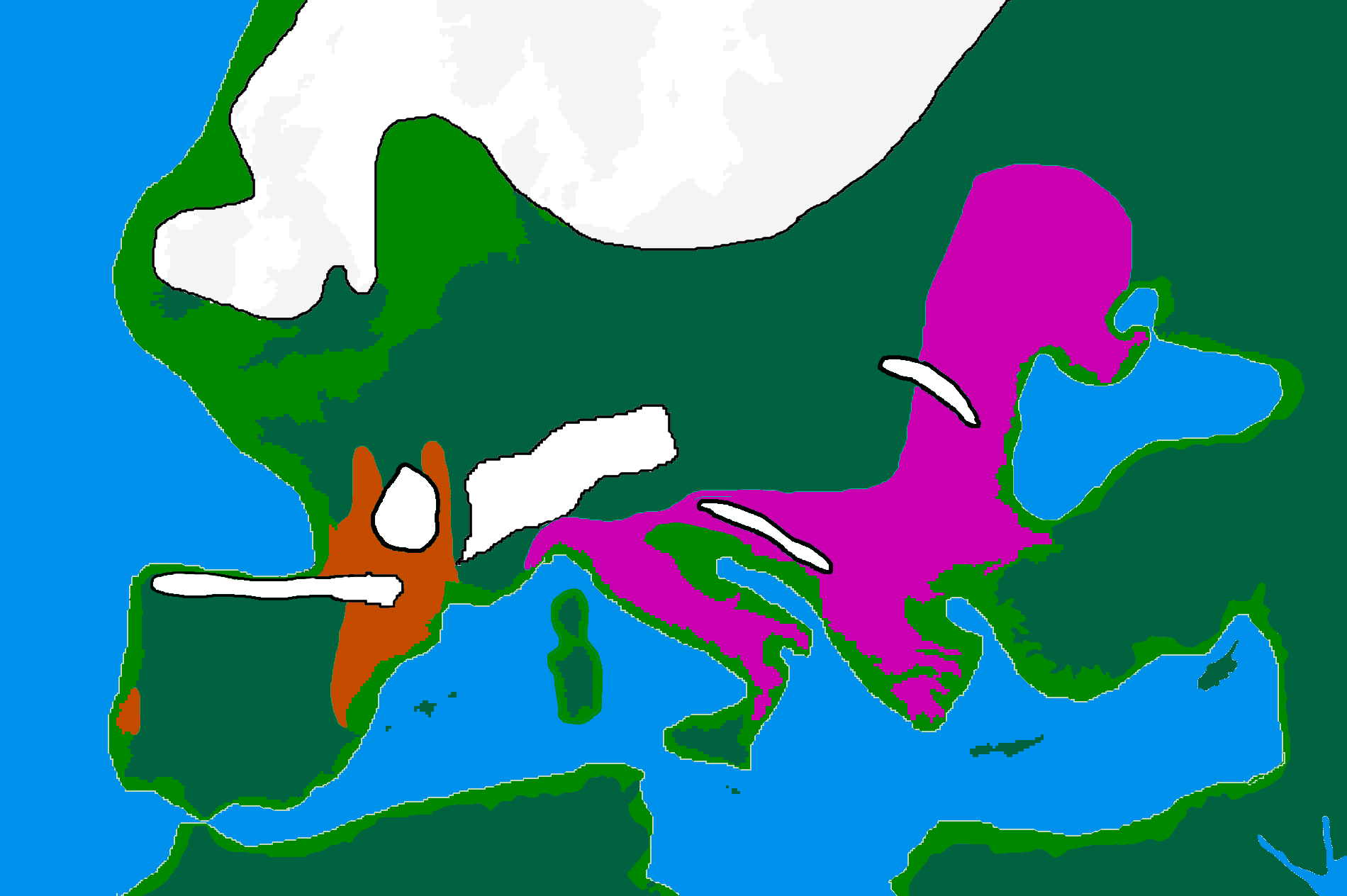
From the map, the ice cap didn't reach the coast. The coastal strip is marked as having vegetation, from the map legend, so how terrible could it have been? It may have been at certain periods, but certainly not in the period depicted on this map. We also don't know when these hypothetical proto-Villabrunians made their trek to northern Spain in time to create El Miron. If they made it at the time depicted in the map or one like it, I think it was hardly all that difficult a route, especially as they were always in reach of the sea and all those resources.
You can take a look at the paper from which it came. There's a wealth of data for all of Europe.
http://129.187.45.33/CartoMasterNew/fileadmin/user_upload/Jaunsproge_Report.pdf
Thanks. Horses are good. We now have a sensible link between the Italian Epigravettian and the Magdalenian.
PS: Did the reply in the message box reach you?
 That's why I keep posting pictures on the anthropology section and asking questions of Moesan, who knows a heck of a lot more about it than I do. Unfortunately there's no substitute for examining the remains, and even the pictures I find don't show all views, or the measurements aren't posted in the article. Then there's all the disagreement in the field itself.