• Don't want to see ads? Install an adblocker like uBlock Origin or use a Europe-based privacy-friendly browser like Vivaldi or Mullvad.

Veneti

Veneti were the most famous of the maritime tribes in gaul but I think all the tribes of the Atlantic façade had some maritime skills I put on the account of the precedent Megalithic populations which were not destroyed but rather assimilated by the Celts - I red somewhere Romans had had some of their ships built on the W-Gaul coasts (by the Pictons) before fighting against the Veneti - to verify -
 

I don't know what use you intent to do with these short abstracts? just for information?
I think sometimes in Phoenicians position in W-Europe but I have not the knowledeg in archeology to make my opinion, except i discard the link between the names PHOENICI AND VENETI -
that said, for DNA, if we search a trace of them, it would be surprisingly not so in Andalusia but in galicia: Galicians, mixed with influences of other places, show a strong enough "semitic" impact in some of their Y-E1b and Y-J2, subhaplogroups linked rather with the Sinai and surroundings than to North-Africa or Anatolia-Caucasus (it's true I rely here on old surveys without too deep "resolution")
 
Veneti were the most famous of the maritime tribes in gaul but I think all the tribes of the Atlantic façade had some maritime skills I put on the account of the precedent Megalithic populations which were not destroyed but rather assimilated by the Celts - I red somewhere Romans had had some of their ships built on the W-Gaul coasts (by the Pictons) before fighting against the Veneti - to verify -

I would like to say that I agree with you here: I find the claim that Celts supposedly had no maritime tradition quite absurd in the face that 1) how did the Irish get to Ireland and the Britons to Britain if both were speakers of Celtic languages, and Ireland and Britain are... you know... islands. :-p

I would also agree that probably the maritime traditions of the Atlantic seaboard date back to Megalithic times, and predate the introduction of Celtic languages in the seaboard.


That is absurd. First off, the name "Phoenicians" is an exonym (from Greek), and the Phoenicians probably refered to themselves as something akin to "Kana'anīm" ("Cana'anites", the same as the old testament land of Cana'an, which was the Hebrew name for Phoenicia). Secondly, Phoenician was beyond a doubt a Semitic language (closely related with Hebrew), while the Gaulish Veneti were beyond any doubt Celtic. The main town of the Gaulish Veneti was "Darioritum", with the *ritu- element being a cognate with Welsh "rhyd" (meaning 'ford' ) - also related Latin "porta", English "ford", German "Furt" - as in "Frankfurt" and "Oxford").
 
The main town of the Gaulish Veneti was "Darioritum", with the *ritu- element being a cognate with Welsh "rhyd" (meaning 'ford' ) - also related Latin "porta", English "ford", German "Furt" - as in "Frankfurt" and "Oxford").

This is ludicrous,
Latin term of Porta does not mean fort/ford.......it means entrance or gate........or are you trying to mean a passage which is Portus in Latin:disappointed:

Origin of ford

Middle English ; from Old English akin to German furt ; from Indo-European pṛtu, passage ; from base an unverified form per-, to transport from source fare, Classical Latin portus, Gothic an unverified form faran


Don't take this personal remark for you, but I think we are wasting time with this Gvozdanovic hypothesis - I already explained the phonetic peculiarities of the today 'vannetais' ('gwenedeg') dialect are far less striking than the Oil french phonetics so if the palatalizing facts putten as proves had some worth, the linguistical argument ought to be applied to all Gaul or almost, and we need no more distorsion of the poor 'veneti' name origin to explain this surprising theory - all Gauls were Veneti brethren then and all of them amber traders (at least all the tribes near the sea)...???
to go further on, I see yet NO PROOF of Veneti AS AN EXONYM - and 'bennozh' is a modern word in breton ('bennoh' in vannetais) and came surely from a loan on latin : welsh 'bendith' so close to 'benedict-us' for "blessed" - contrary to what is said in the little text, 'venet' does not mean 'blessed' in latine BUT the explanation OF THE CONFUSION could be that 'blessed' is rendered also by 'gwenn' in breton (by semantic picture: "white" >> "pure" >> "blessed") BUT 'gwenn' come from 'vindo' not from 'venet-'
I think someones write a lot of things based upon a too superficial study of facts (look at the theory linking Phoenicians and Veneti, already dismissed by a lot of people here, Taranis and me among them -
I repeat : making hypothesis is good and necessary very often, but proofs are required before becoming too affirmative -
&: I 'm amazed that someone could affirm that Veneti were Y-R1b-L513: have we found a lot of ancient Veneti DNA??? If true I ignored it!

good evening


it would seem this person has found a link between the brittany veneti and their L513 marker with an amber trail which is germanic and their L513 marker ..then again, amber went to the adriatic from 2 sources, from the Aestii on the baltic sea and from jutland
 
This is ludicrous,
Latin term of Porta does not mean fort/ford.......it means entrance or gate........or are you trying to mean a passage which is Portus in Latin:disappointed:

Origin of ford

Middle English ; from Old English akin to German furt ; from Indo-European pṛtu, passage ; from base an unverified form per-, to transport from source fare, Classical Latin portus, Gothic an unverified form faran

It is not ludicrous in the slightest. Please, read my previous post closely, because nowhere I stated that 'porta' actually meant 'ford'. It is, however, clearly the Latin cognate to the Celtic *ritu- and Germanic *furd-

The main town of the Gaulish Veneti was "Darioritum", with the *ritu- element being a cognate with Welsh "rhyd" (meaning 'ford' ) - also related Latin "porta", English "ford", German "Furt" - as in "Frankfurt" and "Oxford").
 
It is not ludicrous in the slightest. Please, read my previous post closely, because nowhere I stated that 'porta' actually meant 'ford'. It is, however, clearly the Latin cognate to the Celtic *ritu- and Germanic *furd-

yes you did and Porta is wrong for meaning a ford, the latin term is Portus.

Porta and portus , both Latin terms have different meanings, they are not related.
 
The Tribe Within
Search for DNA Tribe R1b-L513
By Anthony Murphy Barrett
Copyright — January 2014 — Updated April 2014 — Anthony Murphy Barrett
Version: 1.1
Smashwords Edition


Ptolemy says
they settled in both Scotland and Ireland. He states what he calls the Vennicnii tribe (formerly
Veneti) is now located in Donegal, Ireland. He also places Venicones (formerly Veneti) in east
Scotland close to where Edinburgh is now.
It is odd, modern historians telling Veneti’s story do not include Ptolemy’s findings of tribal
survivors settling in Scotland and Ireland. Historians seem to end the Veneti story in Brittany
thereby discouraging further exploration about this tribe.

It was only Ptolemy in his
book Geography which connects Veneti to geographical locations which supports historical and
DNA evidence of R-L513 surnames in the same geographic location in Ireland and Scotland.

Ptolemy’s book not only brings Veneti back to life, but connects a highly mobile Celtic tribe
with a violent, catastrophic past which now lines them up for a somewhat foreseeable future.


There is also a German branch of R1b-L513 [suspect Subgroup N] from the village Amber. The
Veneti controlled amber trade with the main area of operation located at a settlement called
Amber, down the river Elbe in Germany.
 
Ptolemy says
they settled in both Scotland and Ireland. He states what he calls the Vennicnii tribe (formerly
Veneti) is now located in Donegal, Ireland. He also places Venicones (formerly Veneti) in east
Scotland close to where Edinburgh is now.
It is odd, modern historians telling Veneti’s story do not include Ptolemy’s findings of tribal
survivors settling in Scotland and Ireland. Historians seem to end the Veneti story in Brittany
thereby discouraging further exploration about this tribe.

It was only Ptolemy in his
book Geography which connects Veneti to geographical locations which supports historical and
DNA evidence of R-L513 surnames in the same geographic location in Ireland and Scotland.

Ptolemy’s book not only brings Veneti back to life, but connects a highly mobile Celtic tribe
with a violent, catastrophic past which now lines them up for a somewhat foreseeable future.


There is also a German branch of R1b-L513 [suspect Subgroup N] from the village Amber. The
Veneti controlled amber trade with the main area of operation located at a settlement called
Amber, down the river Elbe in Germany.

No offense, but this is really absurd now, because you are again (or your source is, I can't tell here) magically dismantling ethnic names because they sound superficially like the name "Veneti", and extrapolate the existence of a mythical Venetic maritime "empire". About the name "Venicones", because according to Katherine Forsyth ('The language in Pictland', 1997), the Venicones are even found in the Welsh Gododdin (as "Maen Gwyngun"), and the name can be explained as "Utterly Celtic" (I'm quoting Forsyth there!), namely as "kindred hounds".
 
Please, I miss a Veneti-like people name in Syria from Hittite source. Anyone remember it? I think the name is listed by a French author.
 
He states what he calls the Vennicnii tribe (formerly
Veneti) is now located in Donegal, Ireland.

I'm pretty sure that the Irish name "Vennicnii" (Ουεννικνιοι) are related with the later term "fían" ('warrior band'). As I said, what you're doing here is you ignore the languages people in the specific areas are known to have spoken (like Irish in Ireland, Brythonic in Britain, Gaulish in Gaul), and focus on the superficial similarities of the name.

Please, I miss a Veneti-like people name in Syria from Hittite source. Anyone remember it? I think the name is listed by a French author.

Syria, too? :rolleyes2: What's next, "Veneti" in Mayan or Aztec sources?
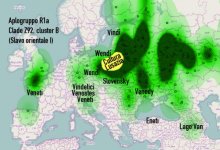
 
Syria, too? :rolleyes2: What's next, "Veneti" in Mayan or Aztec sources?
archeogenetica..Z92.Lusazia.jpg
As you can see on the map, Z92 spread also in the area of Lake Van, that is in the border with Syria.
 
it would seem this person has found a link between the brittany veneti and their L513 marker with an amber trail which is germanic and their L513 marker ..then again, amber went to the adriatic from 2 sources, from the Aestii on the baltic sea and from jutland

What I would have is the percentage of R-L513 found here and there, before making any hazardous statement... because today I never heard speaking of a study showing this marker, either in today Brittany population or among ancient Atlantic Veneti (if ever any DNA of these last ones has been extracted) - otherwise we are sepaking of WIND...

aside that:
the %s given by Maciamo concerning Galicia doesn'tconfirm the high levels of Y-J2 I found in the survey I mentioned -
 
What I would have is the percentage of R-L513 found here and there, before making any hazardous statement... because today I never heard speaking of a study showing this marker, either in today Brittany population or among ancient Atlantic Veneti (if ever any DNA of these last ones has been extracted) - otherwise we are sepaking of WIND...

aside that:
the %s given by Maciamo concerning Galicia doesn'tconfirm the high levels of Y-J2 I found in the survey I mentioned -

there is a strong presence of T in galicia............but zero in brittany....there cannot be any link
 
What I would have is the percentage of R-L513 found here and there, before making any hazardous statement... because today I never heard speaking of a study showing this marker, either in today Brittany population or among ancient Atlantic Veneti (if ever any DNA of these last ones has been extracted) - otherwise we are sepaking of WIND...

aside that:
the %s given by Maciamo concerning Galicia doesn'tconfirm the high levels of Y-J2 I found in the survey I mentioned -

you need to read the discussion the L513 and its downstrean L193 is NW french from at least 500BC, people are trying to say its norman, but its already proved the L513 is older than norman. it is found in NW france, cornwall, ireland and southern wales
 
there is a strong presence of T in galicia............but zero in brittany....there cannot be any link


apparently I was no clear enough:
I spoke of Galicians concerning a possible link with Phoenicians, genetically, all the way possible but not sure, because some forumer spoke about Phoenicians and Veneti - no link with the core of the discussion about L513, Veneti and Cy...its just a point without any global theory of mine concerning Galicia and Phoenicians -
 

apparently I was no clear enough:
I spoke of Galicians concerning a possible link with Phoenicians, genetically, all the way possible but not sure, because some forumer spoke about Phoenicians and Veneti - no link with the core of the discussion about L513, Veneti and Cy...its just a point without any global theory of mine concerning Galicia and Phoenicians -

But you already would know the phoenicans where trading through the brittany veneti for welsh and cornish tin.

As posted before, the phoenicians also tried to establish a foothold on ireland and cornwall with minimum success. it seems that the veneti became the only ones who could reach wales and ireland in those strong winds as they where the only people to use leather sails. likely scenario is that the phoenians had a trade agreement with the veneti in vannes or the veneti sailed to galicia to trade with the phoenicians
 
there is a strong presence of T in galicia............but zero in brittany....there cannot be any link


apparently I was no clear enough:
I spoke of Galicians concerning a possible link with Phoenicians, genetically, all the way possible but not sure, because some forumer spoke about Phoenicians and Veneti - no link with the core of the discussion about L513, Veneti and Cy...its just a point without any global theory of mine concerning Galicia and Phoenicians -
 
View attachment 6973
As you can see on the map, Z92 spread also in the area of Lake Van, that is in the border with Syria.
-


Here we are no more with Y-R1b (L513 or not) but with Y-R1a - and the map shows a gravity center in East slavic lands -
by lack of chance the ENETI area in N-Anatolia lacks completely of this Z92 - what are the different links? I'm confused
 
you need to read the discussion the L513 and its downstrean L193 is NW french from at least 500BC, people are trying to say its norman, but its already proved the L513 is older than norman. it is found in NW france, cornwall, ireland and southern wales

this L513 seems very close in time to Y-R1b-L21 typical of the Isles and Brittany so it is not so informative - its distribution spite the biases of genalogy seems at first Scottish and Irish, but common among Atlantic Celts as a whole - I don't see what very special and peculiar we can base upon this SNP???
I agree its birth has nothig to do with Normans - by the way it is absent in South France and South of it, and absent East germany on the continent (someones in Sweden) -
nothing to link it to this very thread (Veneti as an extent maritime people overspanning all Europe and more) except the celtic ones, in fine...


concerning Phoenicians I knew (to be more precise: I red! as you) they did trade in the Isles and in Brittany - it doesn't link their ethny to the Veneti's one - I spoke about them because I have some headache when I red unbased linguistic links made by some people - I hope you or somebody else are not giving birth to a new thesis where Phoenicians and Veneti are two branches of the same close family? in this thread I don't know what is coming next time about Veneti, Wendes, Amber, rambling ancestor, Van lake, R1b-R1a... sure I'm growing too old!
 
Back
Top