• Don't want to see ads? Install an adblocker like uBlock Origin or use a Europe-based privacy-friendly browser like Vivaldi or Mullvad.

What Are Slavic countries?

The same applies to modern Germans, who think they are 100% Germanic just like Mexicans think they are 100% Spanish. But the reality is that Germans are to a large extent Slavic (as well as Celtic, Roman, Baltic, etc.).

Just a simple look at frequencies of Y-DNA shows you, that Germans are among the most mixed nations in Europe. And there is nothing strange in this - after all they live in the very geographical middle of the continent.

When you look at autosomal DNA plots, you will also find out that Germans plot in the middle of all Europeans. Which shows that Germans are a mix of all people around them, plus of course a fair bit of their own flavour.

I never heard of Mexicans calling themselves 100% Spanish. The vast majority are Indians. Many prefer to be called "mestizo" because they are embarrassed of being a conquered people. As far as I know the Germans are composed of three types of DNA -- I1, R1b, and R1a in that order. Your claim that Germans are "to a large extent Slavic" is wrong. I have been to Poland several times and met Poles and they are very nationalistic. And you obviously seem to want to turn the Germans into Poles.
 
The Spanish also came to Mexico with their families.

Originally the Spanish did not come to Mexico with their families. 99% were males seeking to make a fortune. What they wanted was to exploit and make a lot of money and go back to Spain and marry some noble woman and live the good life. many did but most did not. After the conquest the ones who stayed kept concubines until the Spanish women arrived and then they dropped the Indians and married European women. But it took more than 50 years to consolidate their control. By then thousands of mestizos were born. The real immigration of Spaniards began during the middle of the 16th to the end of the 17th centuries.
 
But the Slavs were pagan and they had no rights whatsoever

The Sorbs (as well as that part of the Obotrites who lived east of the Elbe River - which included speakers of Draväno-Polabisch, a language that I mentioned above) were conquered by the HRE and converted to Christianity already in the 10th century. The same refers to the Pomeranians, who were conquered and converted to Christianity by Poland (some pockets of Paganism existed in Pomerania until the 12th century, but large part of the population were Christians) - Poland itself accepted Christianity from the Czechs in 966, and the Czechs accepted Christianity in 925 from the Eastern Franks (they and Moravians had been Christian already in the 800s, but later apparently returned back to Paganism for some time - see: http://en.wikipedia.org/wiki/Mojmir_I_of_Moravia#Reign).

The only two ethnic groups of Slavs who were still firmly Pagan in the late 11th and the 12th centuries, were the Western Obodrites (those living to the east of the Elbe River) and the Veleti (who lived between the Obodrites to the west of them and the Pomeranians to the east of them, the Veleti-Pomeranian boundary was roughly the Oder River), as well as the piracy-loving Rujani in the island of Ruegen and nearby coastal regions:

Religions_1060.png


The only areas were the Germans settled in large numbers during the 10-12th centuries was in Western Czech Republic and Western Poland.

Wrong. During the 10th to mid-12th centuries practically not a single German settler settled in Western Poland.

The first group of German immigrants arrived to Poland (to Silesia, which was part of Poland) no earlier than year 1180.

And until year 1300 that immigration was still relatively insignificant.

For example here is the data on origins of Silesian knights in 1300:

Total number of knights in Silesia around year 1300 mentioned by name in various sources - 1192, of them:

Polish knights - 1084 knights
German knights - 99 knights from 55 families (and most of them came in period 1270-1300)
Czech knights - 9 knights

Polish includes local knights from Silesia and immigrants from other Polish duchies ruled by the Piast Dynasty.

Those 99 German knights included also some knights who were themselves of Non-Germanic origin. For example father of certain Albrecht Bart (Albert Broda in Slavic) was a knight who was German-speaking (Germanized) but he was of Slavic - in that case Sorbian - origin. How do we know that he was of Slavic origin? Because he even described himself in Latin as "de genere Czurbanorum a Thethonia" (which translates: "by origin Sorbian from Teutonia").

Now officials in Silesia in 1300 - total number mentioned by sources was 260, of them:

Local officials - 247
Foreigners - 13

Data is from Marek Cetwiński's book:

"Knights in Silesia until the end of the 13th century. Ancestry (origins), economy, politics" (in Polish):

http://otworzksiazke.pl/images/ksia...ca_xiii_w_pochodzenie_gospodarka_polityka.pdf

Summary in German is on pages 239 - 243:

Cetwinski_Summary.png
 
Slavs were composed of four or five tribes and not heavily populated and very disorganized.

Obodrites, Veleti, Rujani, Sorbs, Pomeranians, etc. - those were not really tribes, but ethnic groups or tribal unions. There existed the Holy Union of the Veleti and the Grand Duchy of the Obodrites - both ruled by supreme dukes, and consisting of many tribes (those were unions of tribes, or tribal states). The number of tribes was several dozen, actually - and just in what is now East Germany. Ethnic groups (or tribal unions - for example in Silesia there existed 6 tribes):

Western_Slavs_B.png


The Grand Duchy of the Obodrites was known also as "Obodritenreich" in German:

Lutizen (also known as "Wilzen" or "the Wolfs") was a warlike Pagan tribal union of several Veleti tribes:

funde.jpg


Actual number of tribes (names of tribes from sources written in Latin - so Latinized spelling):

Plemiona_1.png


About ten tribes are missing from the map posted above, including the Ucrani (die Ukranen / Ukranians):

http://de.wikipedia.org/wiki/Ukranen

Names of Slavic tribes living near the border of the Holy Roman Empire come from several sources, but most of them were mentioned in the so-called "Bavarian Geographer" - which was a document of military intelligence of the Holy Roman Empire written during the 800s (around year 845) - it lists tribes and how many "civitates" each tribe had:

http://en.wikipedia.org/wiki/Bavarian_Geographer

The original Latin text of the "Bavarian Geographer" and the list of tribes with civitates in English:

Bavarian_Geographer.png


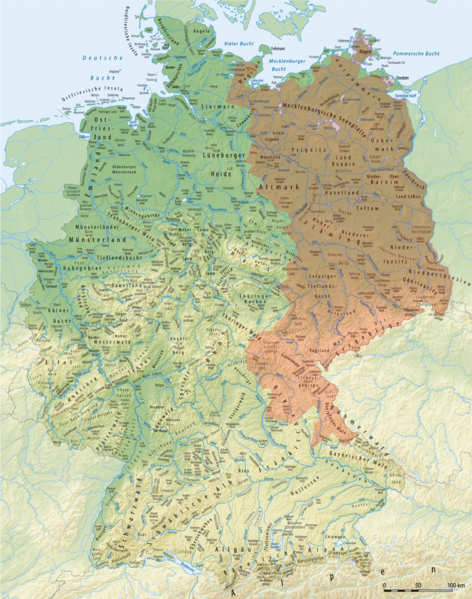
Many settlements in Germany have Slavic names. One of several kinds of such names were names with suffix -itz.

This map shows areas in Germany with Slavic settlement names ending with suffix -itz:

472px-Ortsnamenendung-itz.png
 
Last edited:
Smilar things must have taken place in the HRE, with gradual ethnic intermarriage over the centuries making most people "part-German part-Slavic", with numbers of both "purely German" and "purely Slavic" people declining. One thing which facilitated mixing in the HRE - compared to Mexico - is that you can't tell a German apart from a West Slav just by how they look, because they look very similar. By contrast Natives in Mexico are a "visible minority", both in pigmentation and in anthropological terms (they are less similar to all Europeans than Europeans are to each other).


After getting your information about the ethnic cleansing of the Germans by the Poles, Czechs, and Russians after WWII, I am beginning to think this increased the Slavic R1a that you showed me when they went back to Germany. So it makes sense that it would increase to 20%. Sure the eastern Germans mixed with Slavs. I am not doubting it. But it took a long time and it was limited. BUT I am not talking about just "Eastern" Germans -- Germans who lived in Poland, Ukraine., Russian, etc. -- I am talking about ALL Germans. And no: they are not Slavic or mostly Slavic.

By the way I visited Poland four times, been once to Czech Republic, Slovakia, (ten times) Ukraine, Russia and Lithuania, Croatia, Serbia, Bulgaria, Romania, and Hungary. I noticed many of the people there and found interesting results (my interpretations anyway). Yes some Poles looked very similar to Germans but many did not. They looked strikingly similar to Ukrainians. And they are very mixed. Some of the Czechs had strong Mongoloid features. Slovakians look exactly like Ukrainians and Poles. The Russians are shorter but more blonde. Ukrainians are a strange mix of east, south, and west -- they are generally tall and dark hair predominates, but many look like Greeks and Armenians. Lithuanians looked very similar to Poles and Russians. Serbs, Bulgarians and some Romanians looked exactly like southern Italians and Greeks (i.e., Semitic). The only ones whom I thought looked very similar to Germans were the Croats and Hungarians. Croats were generally tall and very attractive people. They resembled Austrians. Hungarians were strange because they look so similar to Austrians yet when they start talking its like something out of the Twilight Zone. So i disagree my friend. Slavs in general do not look like Germans.
 
Last edited:
IF they constituted 1 million, it would have been very difficult to defeat them.

And you claim that it wasn't?

It took the Franks (later the Germans that emerged from Eastern Francia) about 500 - 600 years to completely conquer all areas to the east of the Oder-Neisse line (or the present-day border of Germany). By contrast conquering the Saxons (who were also Pagans until they were forcibly converted by the Franks) took only several decades. You claimed that first evidence of Slavs in East Germany and Austria is from the 700s, but that's not true (see below - first archaeological evidence is from ca. 550-600, first written sources from the 600s). And when the Obodrites and the Veleti were first mentioned, they were already strong established tribal unions, so they must have existed for some time before that.

Below is the early timeline of the history of Slavs in Germany - until Charlemagne's death. From Charlemagne's death it took about 400 more years to conquer them (but for example the Veleti and the Obodrites were conquered by Germans already in 963, but in 983 they started the Great Slav Rising and became independent again - following that Great Slav Rising they were independent for the next 200 years, until 1150-1200, some of them even longer up to 1250, when Germans finally captured all areas to the west of the Oder-Neisse line, the present-day border of Germany):

http://en.wikipedia.org/wiki/Great_Slav_Rising

Early timeline of Slavs in Germany (until Charlemagne's death in 814; the next period from 814 to 1250 was even more interesting). Slavic colonization of what is now East Germany (and what used to be part of West Slavdom before the Northern Crusades) started in the 6th century.

Here is the timeline of the earliest phase of history of Slavs in Germany, from the beginning of historical record until the death of Charlemagne:

⦁ 512 - the Heruli migrate from middle Danube to North Germany and encounter territories already inhabited by Slavs on their way there (source: Procopius)
⦁ 6th century - Slavic settlement at Prague, Bohemia, numbers over 600 houses: http://www.archaeobotany.org/download/posters/novak_roztoky_abstract_whv2010.pdf
⦁ ca. 550 - Slavs start migrating into what is now East Germany
⦁ 595 - Slavs (probably ancestors of Slovenes or / and Croats) fight against Frankish-dependent Bavarian duke Tassilo in modern Austria and Bohemia
⦁ 596 - Slavs, probably allied with the Avars, defeat the Bavarians under Tassilo, killing 2,000 of them
⦁ 610 - battle of Aguntum (4 km to the east of present-day Lienz), Bavarians finally stop Slavic westward expansion in this region (source: Paul the Deacon)
⦁ 620s - a major war between Slavs and Avars (who had previously been allies)
⦁ 624 - a smuggler of weapons from the Frankish Empire, Samo (born near Sens at the Yonne river in central France), who had previously been illegally smuggling across the border and selling weapons to Slavs, enters Slavic lands, joins Slavs in their fight against the Avars, and due to his merits in battle, united Slavic tribes elect him their king (source: Fredegar's chronicle). Samo was probably a Gallo-Roman.
⦁ 630 - Walluk, duke of Carantanians (northern Slovenes), joins Samo's Federation.
⦁ 631 - Slavic Federation defeats the Frankish Empire in the battle of Wogastisburg
⦁ 631 - after the victory at Wogastisburg Slavic armies invade and plunder Thuringia
⦁ 632 - Dervan, duke of Surbi (Sorbs) joins the Slavic Federation under king Samo
⦁ 636 - Dervan is killed in one of battles against Randulf, governor of Thuringia
⦁ 661 - the federation disintegrates into many realms again after Samo's death. According to Fredegar's chronicle Samo had 12 Slavic wifes, 22 sons and 15 daughters.
⦁ 772 - Charlemagne invades Southern Saxons (who are Pagans)
⦁ 777 - the conquest of Southern Saxons by the Franks is completed
⦁ 780 - first Frankish contact with the Slavic Obodrites at the Middle Elbe
⦁ 782 - Slavic Sorbs raid and plunder Thuringia and Frankish-controlled Saxony
⦁ 782 - Saxon uprising against Franks, led by Saxon duke Widukind. Obodrites side with Franks
⦁ 785 - uprising squashed, Widukind surrenders and agrees to convert to Christianity in Attigny
⦁ 789 - Wieczan (Witzan) becomes the supreme duke (rex / princeps) of Obodrites
⦁ 789 - Obodrites mentioned as "old good allies" of Charlemagne (against Saxons)
⦁ 789 - Wieczan asks Charlemagne for assistance against his troublesome eastern neighbours, the Holy Union of the Veleti, under supreme duke Drogowit.
⦁ 789 - Charlemagne, allied with Frisians, Sorbs and Obodrites (under duke Wieczan), invades Veleti. Frankish army crosses the Elbe near modern Wolmirstadt. Allied forces besiege Brenna, the main stronghold of Veleti duke Drogowit. Seeing that resistance is pointless, Drogowit negotiates peace. Veleti pay a single tribute to Charlemagne. Charlemagne satisfied with tribute returns back to Francia.
⦁ 795 - Obodrite duke Wieczan (dux Witzan), ally of Franks against Nordalbingians (northernmost Saxon tribe, who remain independent from Frankish rule).
⦁ 795 - at the Elbe near Bardowick Nordalbingians ambush Obodrites, killing Wieczan
⦁ ca. 796 - Drozko elected new rex / princeps of the Obodrites. Drozko has a son named Czedrog (Chedrog). Drozko continues pro-Frankish policies of Wieczan and Charlemagne is his ally. Danes, Northern Saxons and Veleti are his enemies.
⦁ 795-798 - in revenge for Wieczan's death, Charlemagne raids Nordalbingians and carries out first forcible population transfers and deportations of Saxons.
⦁ 798 - battle of Swentana (Bornhöved) between Obodrites under Drozko and Nordalbingians (at the same time Charlemagne's army is near Minden, raiding Ostphalia). Obodrites win. About 3 - 4 thousand Saxons perish.
⦁ 799 - son of Charlemagne mediates in conflict between Obodrites and Veleti
⦁ 804 - conquest of Nordalbingians by Franks (with Veleti help) is completed, forcible deportation of over 10,000 Nordalbingian men, with families, to Gaul.
⦁ 804 - in Hollenstedt at the Elbe Drozko is crowned King by Charlemagne, he is also awarded Nordalbingia, which becomes part of the Slavic Obodrite realm (sources: Ann. Regni Francorum a 804, Chron. Moiss a 804). Archaeological evidence of Slavic settlements and Slavic pottery in Nordalbingia discovered in Hamburg and in Domplatz, dated to 8th-9th centuries (R. Schindler connects these with Drozko's reign).
⦁ ca. 805 - Charlemagne fortifies Frankish-Slavic border (limes sorabicus and limes saxonicus) and establishes permanent military posts along it. He introduces capitulare duplex in 805 - a kind of embargo for export of weaponry to Slavic lands (including even his allied Obodrites). Several places are chosen for trade with Slavs.
⦁ 805 - Franks invade the Sorbian-Lusatian tribe of the Glomaci
⦁ 805 - duke Lecho of the Bohemians (Czechs) dies in battle against Charlemagne
⦁ 806 - Sorbs (Siurbs) agree to pay tribute to Charlemgne after their duke - Miliduch (Milidouch / Milito) - is killed in a battle against Franks near modern Halle.
⦁ 808 - Drozko, king of the Obodrites. Godelaib, one of their minor dukes.
⦁ 808 - the Danes under duke Godfred (his realm is in Jutland), allied with the Veleti, invade the Obodrite realm (Jutland had previously become a refuge for Saxon refugees during Frankish-Obodrite invasions of Nordalbingia). Danes and Veleti manage to capture several Obodrite strongholds in the process.
⦁ 808 - at least two out of member-tribes of the Obodrite realm, Smolincy and Linianie, betray and unite with Danish-Veleti army. King Drozko is forced to abandon his realm and escapes to Francia. Godelaib is captured and executed. Godfred annexes Nordalbingia, two other Obodrite provinces - Obodrsko and Wagria - pay tribute.
⦁ 808-809 - Veleti wage offensive war against Obodrites and then against Franks
⦁ 808 - Charlemagne sends his son to crush the Veleti and Obodrite traitors, but he is defeated and has to retreat. Godfred proposes peace to Charlemagne, negotiations take place in Bandenflut at the Stör River, but they fail and war continues on.
⦁ 809 - Drozko returns from exile to his country. He signs truce with Danes in exchange for giving them one of his sons (maybe Chedrog) as a hostage. He allies with Saxons against Veleti and these Obotrite trines which seceded from his realm. Allied Obodrite loyalists and Saxons besiege a stronghold of Smolincy at Connoburg. The stronghold is captured and destroyed, power over rebellious tribes is restored.
⦁ 809 - Godfred violates the truce and invades Obodrites, he demolishes Slavic coastal town at Rerik (near modern Wismar), and deports local merchants to Haithabu (Hedeby), Denmark. Drozko is killed by Danish assassins at Rerik.
⦁ 809 - after the death of Drozko Charlemagne deprives the Obodrites of Nordalbingia (land of Northern Saxons) and incorporates it to his Empire. The land is depopulated due to war, disease and deportations, so he brings in new settlers from entire Empire. Charlemagne establishes three new castles to strengthen the defence of his borders: first is at Eselfeld at the Stör River, second is at Hamburg, third is at Hochbucki near Lenzen at the Elbe.
⦁ 810 - Veleti attack the Frankish Empire and destroy their new castle at Hochbucki
⦁ 812 - Franks and Obodrites (under their new grand duke, Slavomir) in retaliation invade Veleti territories and manage to force them to pay a tribute.
⦁ 813 - coronation of Louis I by Charlemagne in Aachen.
⦁ 814 - death of Charlemagne, Louis I takes power in the Empire. Those of Slavic tribes which had been paying tribute to Charlemagne, stop paying it.

 
If you read that timeline then you will see, that there was neither Slavic nor Germanic "solidarity".

The two main Slavic ethnic groups - the Obodrites and the Veleti - were "traditional enemies" of each other.

This is also evidenced by fact, that the name "Obodrites" comes from the Odra (Oder) River, but when they were first met by the Franks in year 780, they lived at the Elbe, far away to the west from the Oder, which was controlled by the Veleti, suggesting that the Veleti had been gradually pushing them westward in the late 600s - early 700s. When Franks met Obodrites in 780, Obodrites asked Charlemagne to help them defend their land against the Veleti.

"Ob-Odrites" means "ones who lived at the Odra" in Slavic. But they did not live at the Odra in year 800, because they had been pushed westward by the Veleti before that time.

In 1147 during the Slavic Crusade called by the Pope (he called it because Pagan Slavs practiced piracy in the Baltic Sea), Poles sided with Germans against Pagan Slavs as well.

The crusade of 1147 was - by the way - repulsed by Slavs. Only the next crusade in the 1160s succeeded.

=======================================

Saxons (who were divided into several tribes and were Pagan) were conquered by Charlemagne in years 772 - 804. So the conquest of Saxons lasted for around 30 years. Pagan Slavs resisted for a much longer time.

The Holy Roman Empire emerged from the Frankish Empire - the most powerful realm in Europe next to the Byzantine Empire. So you shouldn't be surprised that in the end those Slavic tribes were conquered.

And Denmark and Poland also played their roles in conquering them, they just didn't get the spoils.

Denmark controlled Mecklenburg-Vorpommern for some time, but later lost it to Germany. And the area was Germanized rather than Danishized (is there such a word?), and is not inhabited by ethnic Danes today!

Do you know that entire Schleswig used to be inhabited by ethnic Danes in the Early Middle Ages ???

Germans not only Germanized Slavic lands, but also Germanized more than half of Schleswig!
 
The territory that the Germans occupied during the Early Middle Ages was roughly the size of the former West Germany. Germany was heavily forested with swamps and bogs all over the place. Germans lived in small villages and towns were beginning to grow into cities. Also Germans were starting to clear the land for farming. Likewise the fecundity of the Germans has traditionally produced large populations

You have some very "Romantic" vision of the emerge of Germany.

Germany emerged from the Frankish Empire, after the Frankish Empire split into four (later three) parts. Germany emerged from East Francia. Western and southern parts of East Francia were not "heavily forested with swamps and bogs all over the place" - those were former territories of the Roman Empire, with thriving and juicy Roman cities located there. Those cities had not been destroyed by Germanic tribes, they just took control over them. Early Germany "inherited" from the Roman Empire such thriving cities as: Colonia Agrippina (Köln), Mogontiacum (Mainz), Bonna (Bonn), Augusta Treverorum (Trier), Noviomagus (Speyer), Augusta Vindelicorum (Augsburg), Castra Regina (Regensburg), Basilea (Basel), Constantia (Konstanz), Argentoratum (Strasbourg), etc., etc. Those were the oldest and the largest cities within East Francia (a precursor of the Holy Roman Empire) as of year 843. They were also post-Roman cities, which had been established already by the Romans - not by the Germans - but inherited by Germanic tribes.

West Slavs and Balts did not have such a "civilizational boost", as they did not live in areas of the Roman Empire.

The Germans established "Holy Roman Empire" not because the Pope ordered them, but because they saw themselves as continuation of the Romans - they inherited Roman lands, Roman population, and their cities as well.

I never said the motivation of the Saxons in attacking the Slavs was "hatred".

But the Saxons had every good reason to hate the neighbouring Slavs, especially the Obodrites!

After all, those Slavs had helped the Franks in subjugating and Christianizing the Saxons.

The popes allowed the crusaders to do so and they did it with questionable motives. Of course there was hatred as well -- the Slavs were pagan and spoke a different language -- but hatred was secondary.

The Pagan Slavs against whom the crusade was called in 1147 were not "innocent", they were annoying and dangerous for Christians around them. They were pirates in the 1000s and the 1100s (after Christianization of Scandinavia and the end of the Viking Age, the remaining Pagan Slavs became the next generation of the most dangerous pirates in the Baltic Sea - read for example book "The Northern Crusades" by Eric Christiansen - really good reading).

In the first half of the 1100s Pagan Slavs from what is now North-Eastern Germany and North-Western Poland regularly raided Denmark, North-West Germany, even Norway. And in year 1136 (or 1135 according to some historians) Pomeranians under Polish leadership (or at the request of Poland's Prince Boleslav III Wrymouth) also raided Norway - they even destroyed the fourth largest town in Norway, and enslaved ("enthralled") many Norwegians:

http://www.lodose.eu/wp-content/uploads/2013/06/013b-Bohus-Fortress-Kungahälla-Kungälv-eng.pdf

(...) At one time, Kungahälla was Norway's fourth largest town. It was Norway's outpost in the south and occasionally the residence of Norwegian kings. Kungahälla is mentioned early on in the Old Norse sagas where there are several accounts of its greatness and importance. (...) A service was being held in Kastala church in August 1135 when the news came that the Wends were heading towards the town. The Wends were a Slavic people from northern Germany and Poland. (...) One section of the Wendish army arrived by river, above Kungahälla, which meant that the town was attacked from two directions. They also brought horses with them, [they were] led by Duke Ratibor. The Icelandic chronicler, Snorri Sturluson, recounts how Kungahälla was looted and burned. The Norwegians became thralls [slaves] in the country of the Wends. Snorri was told this by his foster father, Jon Loptsson, who had been brought up by Andreas, a priest in Kungahälla. Snorri went to Norway in 1218 and became King Håkon Håkonsson's close confidant. He spent some time in Västergötland where he stayed with Eskil, the brother of Birger Jarl. (...)

Thralls was the word for slaves in Old Norse. Wends/Winds, etc. are terms for Slavs in Old Norse and German.

Check also:

http://en.wikipedia.org/wiki/Kungahälla

(...) Konghelle appears in writings by the English chronicler, Orderic Vitalis, who named the city as one of six Norwegian civitates. During August 1135, the city was attacked and sacked by the Pomeranians. After the destruction, the city was moved to a site slightly to the west of the original site. Snorri Sturluson, writing a century later, said that Konghelle never completely recovered.[2] (...)

In another raid - in October of 1134 (or 1135 according to some historians) - Slavs captured Roskilde in Denmark.
 
But the Slavs were pagan and they had no rights whatsoever. This is why they lost all their lands. Your confusing the Dark Ages with what happened after the Slavs were conquered. Later on yes the occupation of Slav territories was more cultural than racial.

They eventually converted to Christianity.

If the Slavs had "no rights", then why in Brandenburg there existed courts for the Slavs, and law for the Slavs? Slavs were recognized as one of ethnic groups with a separate law under the Sachsenspiegel.

Also check for example who ruled the Duchy of Mecklenburg-Schwerin until 1918 (it was a dynasty of Slavic origin, descended from Obodrite duke Niklot, or more precisely from his son, duke Pribislav).

Other ethnic groups (each with separate law) included the Franks, the Saxons, the Jews, etc.:

The Slavs were not the most privileged group, but they did have some rights, and had their own laws.

And I am talking about the 13th century code of laws in Saxony, known as the "Saxon Mirror" (Sachsenspiegel):

Sachsenspiegel.png


So Saxons and Slavs disliked each other and couldn't appear before a court together - OK.

Was that discrimantory against Slavs? Perhaps. But a Slav could appear with a Frank, or with a Jew.

They also had their own courts, specially for Slavs and for Slavic matters - see below:

Sachsespiegel_Slavs.png


============================

In Anglo-Saxon kingdoms there also existed separate law for Britons, and separate laws for Saxons, Angles, Jutes.

See for example private law of the Kingdom of Wessex (each person's value was expressed in money in that law - so called Weregild - but an ethnic Saxon was usually worth more money than an ethnic Briton). That was discriminatory against the Britons, but a Briton noble was still more privileged than an Anglo-Saxon commoner.

http://en.wikipedia.org/wiki/Weregild

The values of Weregild in the Kingdom of Wessex depended on both ethnicity and class:

Saxon noble - 1200 schillings
Briton noble - 600 schillings
Saxon commoner - 200 schillings
Briton commoner - 120 schillings

So value of a human in the Kingdom of Wessex was:

1 Saxon noble = 2 Briton nobles = 6 Saxon commoners = 10 Briton commoners

Of course that fine was applied for example if you killed someone in a fight between neighbours, etc.

If you killed a Saxon commoner, you had to pay 200 schillings, etc.
 
One of things which can be used in estimating the proportion of Slavic ancestry in each region, is the proportion of Slavic toponyms. In the Austrian region of East Tyrol 71% of place-names are Germanic, 17% Slavic and 12% Romance / Latin. By contrast in Germany's island of Rügen, only 21% of settlement names are Germanic and 79% are of Slavic origin. When population is replaced, toponyms are also replaced. When toponyms remain, population probably remained.

Also new settlements established by German immigrants had names of German origin, not of Slavic origin.

I have been to Poland several times and met Poles and they are very nationalistic.

Not even nearly as much as Germans.

Though many Germans are "hiding" their nationalism since 1945, as they don't want to be labeled as Neo-Nazis.

They pretend they are not nationalists.
 
Slavs in general do not look like Germans.

First of all even Germans do not look like each other. South Germans don't look like North-West Germans, East Germans don't look like West Germans, etc. And Austrians also look distinctly. West Slavs look similar to East Germans and Austrians.

Differences between various European looks are usually on a relatively microscopic level, though - especially if compared to differences between Native American looks and European looks. If you disagree, then find Slavic faces and / or German faces in this crowd of 912 people (mind you that this crowd includes Poles and Germans in equal proportion - but Germans are from all regions of Germany, not just from East Germany; Poles are only from Poland - Eastern Poles not included):

These are two sets of photos 456 each, and both sets include Poles and Germans - so please distinguish them (you can use MS Paint for example - put a mark on each face that you think is German and / or Polish) and send me back your answers:

http://s29.postimg.org/zcy1pjdo7/FACES_A.jpg

http://s30.postimg.org/9fsfcz44x/FACES_B.jpg

FACES_B.jpg

FACES_A.jpg


Please do not google search for answers in the internet - that would be unfair!
 
And they are very mixed.

Yes Poles are indeed of mixed ethnic origins (Slavic, Baltic, Germanic, Celtic, etc., etc.), but probably not as much mixed as Germans. Look for example at Y-DNA - in Poland there is a majority haplogroup (R1a), while in Germany no haplogroup has majority. Germans also in autosomal DNA plot in the middle between neighbouring European populations, which only confirms what Y-DNA says. Of course for example the Irish people are much more homogeneous.

76% of the Irish* have just one specific subclade of just one specific haplogroup, R1b-L21.

*(in a sample of 4700 Irish males, 3575 were R1b-L21, and many more were other subclades of R1b).
 
Johannes said:
some Poles looked very similar to Germans but many did not. They looked strikingly similar to Ukrainians.

No surprise - Eastern Poles historically assimilated many Ukrainians, but also many Ukrainians have Eastern Polish ancestors.

Moreover - perhaps you visited areas inhabited by Ukrainian Poles, who were ethnically cleansed from Ukraine after 1945 ???

The distribution of Polish people before World War 1:

(the ethnic division between Poles and Germans in Northern regions correlated - albeit with some notable exceptions, like ethnically Polish Mazurians in southern part of East Prussia - with Lutheran-Catholic division - that's because Lutherans in that area usually identified with German culture, while Catholics in that area usually identified with Polish culture - that was the case since the Counter-Reformation, which succeeded in Poland but failed in Prussia-Brandenburg):

https://en.wikipedia.org/wiki/Counter-Reformation

Cat_Prot1.png


The_Poles_Map.png


Ethno-linguistic situation in Eastern Galicia (Galicja Wschodnia) according to the Austrian census of 1910:

(Western Galicia - 96% Polish; Eastern Galicia - 40% Polish; entire Galicia as a whole - 59% Polish):

Galicia_by_county_jpg.jpg


Poles before WW2 in Belarus and Lithuania:

Pol_Cat.png


Religious composition of North-Eastern Poland in the census of 1931:

Roman Catholics = Poles, Belarusian-speakers (including bilingual Polish-Belarusian) with Polish national identity, and Lithuanians
Orthodox and Greek Catholic = mostly East Slavic speakers with either Belarusian, Russian, Polish, or no national identity
Judaistic = bilingual Yiddish-Polish speakers and monolingual Polish-speakers with mostly either Jewish or Polish national identity

Religions_Kresy_1.png


Poles shortly after WW2 in selected raions of Belarus:

attachment.php


Deportation of Polish population from areas annaexed by the Soviet Union after WW2:

(Ukrainian Poles were mostly deported to Lower Silesia; Lithuanian-Belarusian Poles to Pomerania & East Prussia):

2a99o35.jpg


In Lithuania and Belarus close to 50% of Poles were allowed to stay after WW2, but Western Ukraine was almost totally cleansed:

Shrinking_Poles.png


iwnckz.jpg
 
Last edited:
Poles with ancestry from Ukraine-Belarus-Lithuania-Latvia as percent of population in each region of modern Poland (in entire Poland 15% of population are descended from Poles expelled from areas annexed by the USSR in 1945):

1509264_680756405302300_857543543_n.jpg


The highest percent of people descended from Eastern Poles is in Lubuskie Voivodeship - 51%.

They are mostly Poles from Belarus and Lithuania in that region, as far as I know.

In Dolnoslaskie (Lower Silesia) % of Eastern Poles is 47% - they are mostly those from Ukraine.
 
SkyScraperCity Forum has a lot of present-day photos of places from former East Prussia:

You can see the difference between Polish and Lithuanian (Memel) parts; and Kaliningrad Oblast (Russian part):

"Former East Prussia/ Ostpreußen/ Rytų Prūsija/ Prusy Wschodnie/ Восточная Пруссия. Places & heritage":

http://www.skyscrapercity.com/showthread.php?t=1540294&page=94

Also a lot of photos of graves of East Prussians who died when the area was part of Germany.

Take a look at surnames from those graves. Lots of them had surnames of Polish and Lithuanian origin. Some had linguistically Old Prussian surnames as well (but generally surnames were introduced in this part of Europe as late as the Early Modern Era, by that time the majority of Old Prussians were already Germanized or Polonized, or Lithuanized, so they got German, Polish and Lithuanian surnames).
 
During the Reformation - in the 1500s and in the 1st half of the 1600s - Poland-Lithuania was a very religiously tolerant country. At that time Protestants persecuted in other countries - such as the Czech Brethren persecuted by the Habsburgs in Bohemia - en masse fled to Poland. The Czech Brethren were mostly ethnic Czechs, because Sudeten Germans were devout Catholics (the opposite of Germans from Prussia, where Lutheranism was considered the essence of German culture). Area where ethnically Czech Protestant refugees from the Habsburg Empire settled in Poland during the Thirty Years Wars (later those Czech immigrants became gradually Polonized):

http://atlasfontium.pl/index.php?language=en&article=project

http://s18.postimg.org/4g93d9nfd/Czech_Brethren.png

Czech_Brethren.png


Already in the 1400s Protestant movements were popular among Slavic Czechs (just to mention the Hussites) and later, when rabidly Catholic Habsburgs ruled Bohemia, the main bulwark of Czech identity also continued to be Protestantism. Such level of non-conformism wasn't present in lands to the north of Bohemia, where there were no such religious differences between Slavic and German speakers. That difference only started to the east of Poland's border, and only in the mid-to-late-1600s, when Poland became devout Catholic. Therefore Slavic population who adopted Lutheranism (which was associated with Germanness) was easily subjected to cultural Germanization.

Following the Reformation, Germanization (or rather Niemczenie - Deutschization) was strongly connected with Lutheranism. Luther's Bible is actually what introduced the modern Standard German (Hochdeutsch) literary and spoken language.

We can say that Lutheranism also caused "Hochdeutschization" (the adoption of Standard German) in areas in which many people had already spoken various Germanic dialects before. For example in the Hanseatic city of Gdansk (Danzig) Hochdeutsch replaced Platt (which was rather closer to modern Dutch than to High German) as official language at some point between years 1550 and 1563.
 
Johannes said:
the ethnic cleansing of the Germans by the Poles, Czechs, and Russians after WWII,

The majority of those Germans escaped on their own (or were evacuated by the Nazi authorities) during, not after, WW2. It was a mass migration and a mass flight triggered by the approaching Red Army and by fear of retaliation:

Read:

P. Eberhardt, "Political migrations in Poland 1939-1948", 2006 (72 pages):

http://www.igipz.pan.pl/en/zpz/Political_migrations.pdf

P. Eberhardt, "Political migrations on Polish territories 1939-1950", 2011 (228 pages):

http://rcin.org.pl/Content/15652/WA51_13607_r2011-nr12_Monografie.pdf

From the 2006 (shorter) publication:

Page_1.png

Page_2.png

Page_3.png

Page_4.png

Page_5.png

Page_6.png


To sum up:


moreshamefurdispray.png


The estimated number of refugees and evacuated persons (i.e. those who had left the area and escaped westward already during the war) amounted to around 7,5 million people according to the updated 2011 publication:

Refugees.png

Refugees_2.png
 
Johannes said:
Anglo-Americans expelled and massacred most of the Indians and the Indians were put in reservations (ethnically cleansed)

As I already wrote on previous pages - in the earliest phase of the Slavic Crusade, expulsions indeed took place.

Many of those Slavs from what is now East Germany, expelled from their homeland by the Germans during the 12th century, escaped eastward to the Polish realm, where they melted into Polish people - and their descendants moved back westward after WW2.

One such region about which we know for sure, that it was ethnically cleansed of Slavs through expulsion, was Wagrien (Wagria). But - as I also wrote before - some Slavs were allowed to stay there, because Helmold of Bosau (and other priests) came there to convert them to Christianity, as Helmold himself described in his "Slavic Chronicle" (https://en.wikipedia.org/wiki/Helmold). And indeed - I have found a master's thesis written by a German historian, who writes that in North-East Wagria a reservation for Wagrian Slavs was created:

http://www.feudalismus.de/magister.htm

(...) Anfangs kam es im slawischen Wagrien zu einer weitgehenden Trennung von Immigranten und einheimischer Bevölkerung durch die Zuweisung von Siedelgebieten. Die Slawen erhielten im Nordosten Wagriens eine als Reservat überlassene Region. (...) Die wagrischen Slawen unterstanden zudem einer gesonderten Rechtsstellung, dem „Wendenrecht". Da ihre Dörfer nicht in Hufe eingeteilt war, zahlten sie statt dem höheren Zehnt einen Bischofszins, der auf Grundlage der Pflüge erhoben wurde. „Wendengesetze" und Wendenvögte sorgten darüber hinaus in Friedland und Rostock dafür, daß die slawischen Bevölkerungsteile von vornherein nicht Vollbürger waren und ihnen der Zugang zum Bürgerrecht verwehrt wurde. (...)
 
Author of that dissertation also estimates, that in year 1000 AD there were around 250,000 independent Polabian Slavs in what is now North-Eastern Germany. Those 250,000 in year 1000 AD lived roughly in this yellow area shown as Pagan Slavic in year 1060:

Religions_1060.png


It doesn't include Slavs (Sorbs, etc.) in South-Eastern and Central-Eastern Germany, who had been conquered already by 963.

It also does not include those Slavs in North-Central Germany and in Bavaria who lived to the west of the Elbe (Drevani, Moinvinidi, Radanzvinidi, etc.), as those had been incorporated to the Frankish Empire already in the 700s and the 800s.

So my previous estimate, that the total number of Slavs within modern East Germany was 500,000 in the 10th century, is correct. And my estimate that another 500,000 lived in areas of Austria, north-western Poland (Pomerania) south-western Poland (Lower Silesia) and the Sudetenland in Bohemia - which were eventually Germanized until year 1900 - is also probably close to reality.

In total this gives around 1 million Slavs who lived around year 900 AD in those areas - the number which I mentioned before.

=========================================

About Slavs in Bavaria (who were peacefully converted to Christianity by the Frankish Empire already in the 800s), read:

Hans Losert, "Moinvinidi, Radanzvinidi und Nabavinida. Geschichte und Archäologie der Slawen in Bayern", 2007:

http://www.beier-beran.de/f_verl.html?blatt/v01/va01_52.html
 
Back
Top