
• Don't want to see ads? Install an adblocker like uBlock Origin or use a Europe-based privacy-friendly browser like Vivaldi or Mullvad.

Where does the Albanian language come from? [VIDEO]

Basically the area of Albania has different sources. There are the most ancient ones, I would assume they are largely R-Z2103 and otherwise fairly mixed, probably distantly related Greek-Armenian, and then there are two people coming in, associated with two of the main haplogroups modern Albanians carry.

The first group is J-L283 and it seems to have been associated with the Bell Beaker periphery, later transitioned into Tumulus Culture, in Pannonian into the Middle Danubian Urnfielders in part. Essentially, they came from the West and being culturally, as well as autosomally, strongly influenced by Southern Bell Beakers. This can be best illustrated by these images:
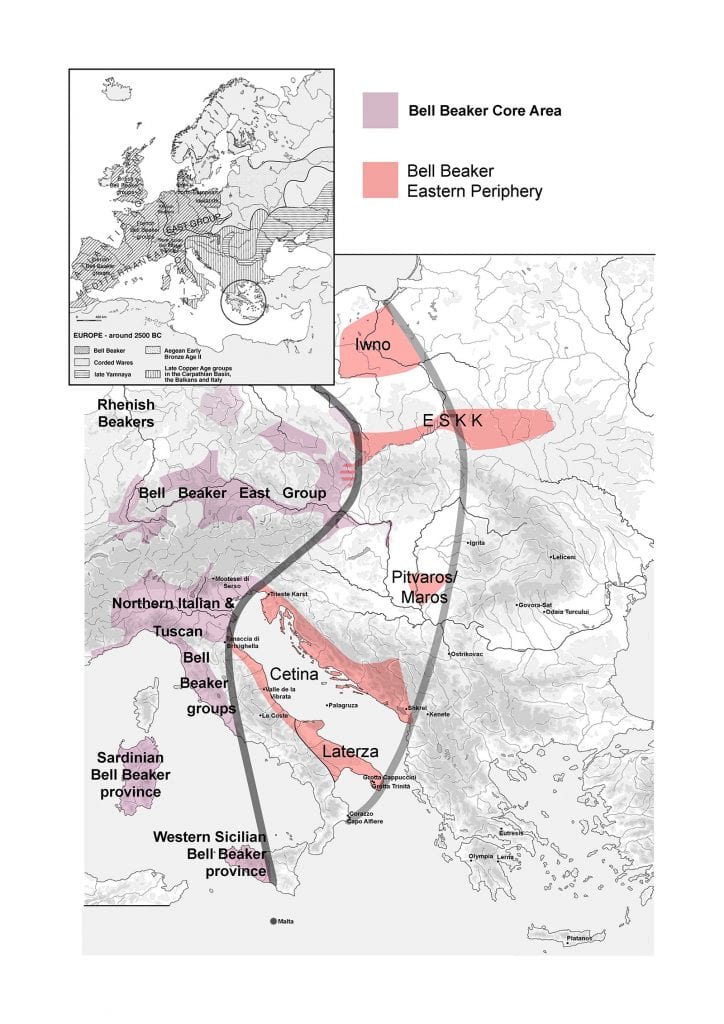
aegeobalkanprhistory_west-meets-east_2-724x1024.jpg


https://aegeobalkanprehistory.kreas.ff.cuni.cz/2008/03/06/when-the-west-meets-the-east/

This is the framework in which J-L283 expanded, most likely related to the Bell Beaker into Pannonian-Adriatic periphery, which transitioned into the Tumulus culture in Pannonia-Western Adriatic. I would associate this with the Proto-Illyrians.

The second group coming in the Bronze Age was Channelled Ware, and I want to give some hints as to what happened, I posted it before, but people might not know this quotations:

Alexandra Papazovska, Early Iron Age Settlements in Macedonia and Their Relationship to Cemeteries. From the printed version of:
https://www.academia.edu/43626649/S...Heilmann_Aleksandar_Kapuran_and_Marek_Verčík_

About the invasion of the Channelled Ware people in the area of (North) Macedonia (p. 142 ff.):


Things to note:
- The Channelled Ware people moved south along the river valleys and burnt a large fraction of the local peoples settlements down along their way.
- The local people did not disappear completely, but they retreated to upland fortified and hidden settlements.
- The Channelled Ware people did not leave, but primarily settled in the lowlands


The situation was really similar to some later Germanic and Slavic settlements in the Alpine and Carpathian zone. The end result was most likely a merged-fused population at some point, with one side keeping the upper hand on the long run. Genetically, the result was a mixture of course.

Now about the origin of Channelled Ware/G�va:

All the cultures from which Channelled Ware emerged have their counterparts or even origin in Romania. Many of the groups just have Hungarian and Romanian names or provinces. Take for example cultural formations I mentioned before, which need to be tested, like Cotofeni, Ny�rs�g, Mako, Livezile, Wietenberg, Otomani, F�zesabony, Berkesz, Suciu de Sus, Lapoș, Igrita etc. All these groups had either a presence Romania or a related group which reached it. In Hungary, the most interesting area for the earliest samples is the very corner North-East of Miskolc! Same goes for Slovakia, its only the Eastern part of the country, plus Transcarpathia, which is the main area of interest. In Romania, the groups are more widespread and cover larger territories, but its the North West primarily for the earliest periods.

I posted the mape numerous times by now, the G�va core being depicted in the first image (Abb. 2) in red: :
Gava-Kulturkreise-Eugen-Rung-2011.jpg


From this publication from Eugen Rung (2011):
https://www.academia.edu/2409522/E_Rung_Der_Gáva_Stil_

G�va is quite specific in this respect, because it led the thrust into the Balkans, or better primarily their main daughter group, Belegis II-G�va did. Kyjatice to the West, ("Late Piliny" on the map is their predecessor, this is an early stage map), is more in Slovakia-Northern Central Hungary. I suspect they got E-V13 too, but they don't have to, and so far we got J2a from them.

Many old authors, long before the new archaeological finds or any genetic ones, proposed G�va as the Proto-Thracian culture. Its simply the best candidate for later Daco-Thracians, because the core culture in the Iron Age for the Dacians and Thracians is one archaeological koine, that is the one of Psenichevo-Basarabi, which largely developed from Channelled Ware, when the dust settled down after the turbulent transitional period form the LBA to the EIA.

Kristian Kristiansen at least referred to that theory as well in one of his older books:
https://books.google.de/books?id=zAY4we4LKQMC&printsec=frontcover&hl=de#v=onepage&q&f=false

p. 388, note group and migration from "C":
Kristian-Kristiansen-1998-p388.jpg


https://ibb.co/LrprcJc

Also, the Daco-Thracian sphere (Carpathian-Lower Danube), later covered first by Channelled Ware, then Psenichevo-Basarabi in the early Hallstatt phase, p. 64 (note that the Danube bent is the borderline to the West!):

Kristian-Kristiansen-1998-p64.jpg


https://ibb.co/T1dW2Th

And he is by no means the only one, there is a long tradition of scholars to attribute the Thracian/Daco-Thracian ethnolinguistic groups with G�va/Channelled Ware. You can quote as many linguistic splitters as you like, but that won't change the fact they had one genetic (in a biological and cultural sense) origin, which is basically Channelled Ware into Psenichevo-Basarabi. No serious scholar can deny the koine which developed in the Iron Age, with the typical repertoire. And this is what persisted into the historical period.

Quotation from Kristiansen, p. 387, which just confirms the results from numerous archaeologists working on actual material from the region:


There were two waves: First individuals and smaller groups, but then came the tribes down and burnt everything which stood in their way to the ground while marching through the Morava and into the Vardar Valley. And its these people, which also migrated the Danube down and created the Fluted Ware horizon and Knobbed Ware groups in Bulgaria - out of which Psenichevo grew, while out of Belegis II-G�va with a transition and new influences, Basarabi emerged.
And at that point we already have evidence, from the Iron Age, for Thracian and Dacian speakers respectively, from those regions. Same archaeological origin, going back, ultimately, to the G�va core zone in North Eastern Hungary, Eastern Slovakia, Transcarpathia and North Western/Western Romania in particular.
This is all East of the Danube, in the early phase pretty much of it is clearly at the Tisza and East of the Tisza, especially along the Romanian tributaries too.

To sum it up: Both E-V13 and J-L283 have a clear and by now fairly obvious background story in the Bronze Age. They come from two spheres of influence: Bell Beaker/West Pannonians vs Epi-Corded/ East Pannonian descendants of Cotofeni & Co, of which most had increased WHG ancestry. J-L283 and E-V13 were kind of the regional "governors" for these wider spread networks in the Balkans.

G�va also introduced intensified millet consumption in wide areas of the Balkans. This is the same kind of millet/millet fed pork diet which appears in Tollense, in the Urnfield period. You can read it up here, it was spread by G�va down to Greece in the LBA:
https://jaha.org.ro/index.php/JAHA/article/view/656

This is a very systematic and well thought Riverman. In this context, i would say that the Proto-Illyrians were the Koszider hoard mentioned by Marija Gimbutas from somewhere from Hungary (some J2b2-L283 hoard who moved down to Glasinac finding there other J2b2-L283 subclades, who knows) who got assimilated by Hugelgraberkultur (R1b-L51) coming from Bavaria and on the way to Pannonian-Carpathian Basin during the whole Middle Bronze Age chronology. It might be right, but no conclusive evidences. It might be that Pre/Proto-Illyrians were already there in Eastern-Alps/Western-Balkans during whole EBA.
 
This is a very systematic and well thought Riverman. In this context, i would say that the Proto-Illyrians were the Koszider hoard mentioned by Marija Gimbutas from somewhere from Hungary (some J2b2-L283 hoard who moved down to Glasinac finding there other J2b2-L283 subclades, who knows) who got assimilated by Hugelgraberkultur (R1b-L51) coming from Bavaria and on the way to Pannonian-Carpathian Basin during the whole Middle Bronze Age chronology. It might be right, but no conclusive evidences. It might be that Pre/Proto-Illyrians were already there in Eastern-Alps/Western-Balkans during whole EBA.

What matters the most is that they participated in TC and profited from it. They could have been in the wider region for much longer indeed. Other groups however did not profit but were replaced, pushed to the East, especially the Encrusted Ware people, which moved to the Banat and from there to the Lower Danube, Bulgaria. So while J-L283 might have been present to the East also, early on, the main groups which did profit from this TC expansion had to live to the West of the Encrusted Pottery people rather. This leaves us with a fairly Western zone, the very West of Hungary and about Slovenia-Western Croatia as the most Eastern position I'd say.
The MBA-LBA expansion of J-L283 is unlikely to have started much more Eastern.

Similar things in the opposite direction can be said about E-V13, it can't have started West of the Banat-Tisza, this is just very unlikely. Basically the groups in between were crashed (Encrusted Pottery, most of Otomani-related groups etc.), those at the fringes (J-L283 Middle Danubians vs. E-V13 Channelled Ware) did prevail.
 
What matters the most is that they participated in TC and profited from it. They could have been in the wider region for much longer indeed. Other groups however did not profit but were replaced, pushed to the East, especially the Encrusted Ware people, which moved to the Banat and from there to the Lower Danube, Bulgaria. So while J-L283 might have been present to the East also, early on, the main groups which did profit from this TC expansion had to live to the West of the Encrusted Pottery people rather. This leaves us with a fairly Western zone, the very West of Hungary and about Slovenia-Western Croatia as the most Eastern position I'd say.
The MBA-LBA expansion of J-L283 is unlikely to have started much more Eastern.

Similar things in the opposite direction can be said about E-V13, it can't have started West of the Banat-Tisza, this is just very unlikely. Basically the groups in between were crashed (Encrusted Pottery, most of Otomani-related groups etc.), those at the fringes (J-L283 Middle Danubians vs. E-V13 Channelled Ware) did prevail.

But the Hugelgraberkultur rolled out the whole Carpathian basin, it's very late in Late Bronze Age when Gava beated them with the help of iron swords down the Danube where Tumulus and Encrusted and Gava merged and co-lived for a short time. It's hard to pinpoint what led to formation of all these people but the so called Channeled-Ware/Belegis-Gava seems to have prevailed in Central/Eastern Balkans indeed.
 
But the Hugelgraberkultur rolled out the whole Carpathian basin,

Yes, even the ancestors of Channelled Ware did adopt in part Tumulus Culture customs and became part of the network. This was kind of a "peace treaty" the surviving Northern Pannonians and Uneticians made with the TC people. And its because of this Urnfield emerged, because its the fusion of these two spheres, which spread the religion and burial rites, among other things, from the Eastern Pannonians to most of Europe. Like these was a mutual exchange.
Point is, they barely survived at the Upper Tisza, but soon after, they became culturally-ideologically-technologically one of the leading groups in this bigger network they were now part of. Urnfield brought these two groups together and the borderline was largely the Danube bent/West of the Tisza basin.
That's also the reason why the Middle Danubian Urnfielders largely move South directly and South West, the Channelled Ware/South Eastern Urnfield groups East and South East, into Moldavia-Ukraine and the Balkans. Like they did fight, but not as much as in the period before, its like they made clear whose sphere of influence was where. The split goes all the way down from Central Slovakia down to Albania.

it's very late in Late Bronze Age when Gava beated them with the help of iron swords down the Danube where Tumulus and Encrusted and Gava merged and co-lived for a short time. It's hard to pinpoint what let to formation of all these people but the so called Channeled-Ware/Belegis-Gava seems to have prevailed in Central/Eastern Balkans indeed.

Well, the origin of G?va is clearly at the Upper Tisza and that's why formations like Mako, Ny?rs?g, Livezile etc. for the earlier period, and F?zesabony, Wietenberg, Piliny, Berkesz-Demeter, Suciu de Sus, Lăpuș and Igrita etc. for the later periods are so important.

That's all about Hungary East/North of Miskolc, into Eastern Slovakia, Transcarpathia, North Western/Western Romania.

A couple of early HUN_LBA finds are already from the area of Miskolc, as are later E-V13 from Avar-Hungarian periods. But that's of course no proof for E-V13, we need a larger sample of local males from the various groups which were there before G?va or even part of the early/pre-G?va horizon. You can also search for the place names of these cultures, most being named after specific places, villages. They all cluster in a specific area which being marked red on the map for early G?va from Rung. One of those surely had a load of E-V13 at least, probably all had some.
 
Broder was clearly full of shit. He didn't even know my specific village and made up a bunch of mumbo jumbo about my family coming Struma in Bulgaria lol. Clearly he was being a tro
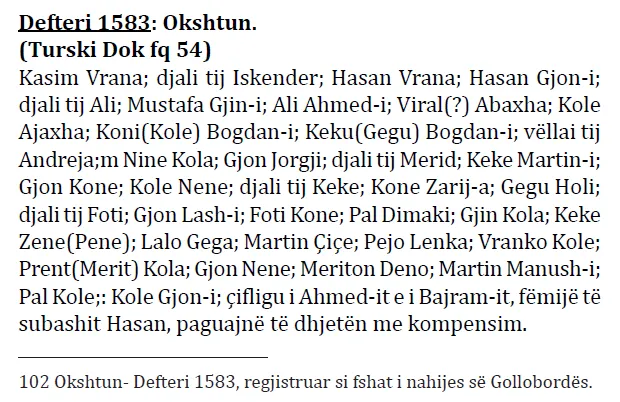
How was I full of shit man? I only responded to another member’s post where he posted the family names recorded in Okshtun and was stating how Slavic influence resisted there.

Here is what was recorded there, family names like Jandro Sosjapi, Dimitri, Bozhiq Vilkashini, Todec Strumahu, Ivoja, Gjuro Pavlovic and Todor Llukanovici.

Combine that with your cluster and it’s pretty self explanatory..
 
How was I full of shit man? I only responded to another member’s post where he posted the family names recorded in Okshtun and was stating how Slavic influence resisted there.

Here is what was recorded there, family names like Jandro Sosjapi, Dimitri, Bozhiq Vilkashini, Todec Strumahu, Ivoja, Gjuro Pavlovic and Todor Llukanovici.

Combine that with your cluster and it’s pretty self explanatory..

Did you bother looking at the defter from the 16th century?

Also, while I don't agree with the local legends and believe the cluster was already there, all of the families claim to have arrived from elsewhere in the 16th century. Stating the original inhabitants fled in the early 15th century due to constant blood feuding.

You're also ignoring that Orthodox Christian Albanians having Slavic names is nothing new under the sub. Unless you want to start claiming Albanians with Slavic names in the North West are Serbs?

My cluster has Albanians with no Origin in Okshtun either. And interestingly with how well the rest of Golloborde is tested, it's appeared in zero samples outside of Okshtun. Thus far they're in Okshtun, Upper Reka, Kruje, Struge, Kercove, Gostivar and they're all between 1100-1200 years with each other. None of them have recent relation and they all identify as Albanian. Theres no doubt the line was arriving with Slavic tribes. Your attempt to push its Slavic identity all the way up to a couple hundred years ago is based solely on Serbian and Bulgarian sources.

Interestingly, on the flip side, the dual linguistic villages are mostly paleo-balkan and have a big chunk of V13/J2b-L283.

Also there's still some 12 more(albeit much smaller brotherhoods) in Okshtun Valley that remain untested.

Keep in mind Okshtun village is what the defter was referring to. Okshtun Valley is made of a number of villages.
 
Man I have read all the literature related to Gollobord. The 16th century register may prove that those earlier inhabitants were either assimilated or dislocated. The first option seems a lot more plausible when factoring in your cluster.

I know about all the samples. Most seem to have expanded from Gollo region. The Kruja one for example have a tradition of originating from ‘Diber’..

Take it like a man and shut the hell up.
 
Last edited:
Man I have read all the literature related to Gollobord. The 16th century register may prove that those earlier inhabitants were either assimilated or dislocated. The first option seems a lot more pleasurable when factoring in your cluster.

I know about all the samples. Most seem to have expanded from Gollo region. The Kruja one for example have a tradition of originating from ‘Diber’..

Take it like a man and shut the hell up.

And a number of the other samples in the cluster don't have any tradition of coming from Diber. Your point?

Do you and Hawk attend the same keyboard warriors classes?

You can disagree without acting childish.

You have a tendency of lying. Especially when you claimed to fund a few kits which I paid for. So don't expect respect from me after that.

Yea plenty of literature from Serbs and Bulgarians. It amazes me how Albanians are quick to rely on their neighbors lying tongues when it suits their agenda.
 
But very far away from Italo-Celtic and Italic throughout this whole period. This speaks against the East Alpine Block of Illyrian languages, which had a closer relationship to Italic (even autosomally plot like North-Italians).

You've reached a quick conclusion. Illyrians do not plot in the same way as ancient North Italians (who belong to the Italic IA group), yet current North Italians cluster in the Balkans among Illyrians and Albanians. So, Illyrians are not similar to ancient Italic IA groups, although current Italians are close to ancient Balkan IA groups.

PCAchart.jpg


Since the IMG for some reason is blurry, here's the link; https://i.ibb.co/GdvyNPQ/close-view.png
 
And a number of the other samples in the cluster don't have any tradition of coming from Diber. Your point?
Do you and Hawk attend the same keyboard warriors classes?
You can disagree without acting childish.
You have a tendency of lying. Especially when you claimed to fund a few kits which I paid for. So don't expect respect from me after that.
Yea plenty of literature from Serbs and Bulgarians. It amazes me how Albanians are quick to rely on their neighbors lying tongues when it suits their agenda.

Even if my life depended on it, I wouldn’t like. Never have I lied in my life. Don’t confuse me with your slimy self and your ilk from across the border.

Those kits were paid by me and other admins and can be verified. And trust me, your slimy friends will pay me back. I give you my word. That I won’t forget.
 
Yes, even the ancestors of Channelled Ware did adopt in part Tumulus Culture customs and became part of the network. This was kind of a "peace treaty" the surviving Northern Pannonians and Uneticians made with the TC people. And its because of this Urnfield emerged, because its the fusion of these two spheres, which spread the religion and burial rites, among other things, from the Eastern Pannonians to most of Europe. Like these was a mutual exchange.
Point is, they barely survived at the Upper Tisza, but soon after, they became culturally-ideologically-technologically one of the leading groups in this bigger network they were now part of. Urnfield brought these two groups together and the borderline was largely the Danube bent/West of the Tisza basin.
That's also the reason why the Middle Danubian Urnfielders largely move South directly and South West, the Channelled Ware/South Eastern Urnfield groups East and South East, into Moldavia-Ukraine and the Balkans. Like they did fight, but not as much as in the period before, its like they made clear whose sphere of influence was where. The split goes all the way down from Central Slovakia down to Albania.


Well, the origin of G�va is clearly at the Upper Tisza and that's why formations like Mako, Ny�rs�g, Livezile etc. for the earlier period, and F�zesabony, Wietenberg, Piliny, Berkesz-Demeter, Suciu de Sus, Lăpuș and Igrita etc. for the later periods are so important.

That's all about Hungary East/North of Miskolc, into Eastern Slovakia, Transcarpathia, North Western/Western Romania.

A couple of early HUN_LBA finds are already from the area of Miskolc, as are later E-V13 from Avar-Hungarian periods. But that's of course no proof for E-V13, we need a larger sample of local males from the various groups which were there before G�va or even part of the early/pre-G�va horizon. You can also search for the place names of these cultures, most being named after specific places, villages. They all cluster in a specific area which being marked red on the map for early G�va from Rung. One of those surely had a load of E-V13 at least, probably all had some.

I think that you are right, the sudden appearance of E-V13 in Iron Age sites, and the lack of it in Balkans prior to that, archeologically the sudden appearance of Channeled-Ware seem to go hand in hand.

Bresto (Bulgaria) excavation, E. Ilieva and St. Ivanov. 23 During the LBA, Southwest Bulgaria was a scene of dynamic interactions and recognizableregionalism. With the end of the period most of the sites were abandoned or destroyed. Until now, theregion lacked reliable evidence for the following period, the transition to the EIA, characterized by theappearance of the Channelled (or Fluted) Ware. This changed with the excavations at the site of Bresto.

The early and sudden appearance of this new ‘foreign’ style, in the context of what is otherwise a ‘local’LBA pottery assemblage, raises questions about the chronological dynamics, communication routes andinteractions during the period. The aim of the analysis is both to examine in detail the physicalcharacteristics of the ceramics, and to gain a more profound insight to the cultural, economic and socialimplications reflected in the pottery assemblage.

Project on LBA aesthetics, mobility and materials, O. Ch. Aslaksen. 24 This project focuses on aesthetics, mobility and materials in the Southern Balkans (2015-2017,funded by the Bank of Sweden Tercentenary Foundation). Currently it is engaged with portable XRFanalyses of Bronze- and Early Iron Age ceramics in the Korçë Basin (Sovjan, with T. Krapf and M.Gori) and Epirus (Krya and Liatovouni, with E. Vasileiou), including matt-painted, Mycenaean,pointed, channelled and incised pottery.

https://www.academia.edu/44721956/T..._Bulgaria_in_HESPEROS_AEGAEUM_41_2017_279_286

I am just wondering if Channeled-Ware descendands could contribute in ethnogenesis of Southern Illyrians? That's something which aDNA can point us. The Kanellure in Albanian archeological context is given as deriving from Late Bronze Age Urnfield Culture from Central Europe. They don't precisely hint at which, they just broadly defined since probably they are very cautious on their assumptions.
 
Even if my life depended on it, I wouldn’t like. Never have I lied in my life. Don’t confuse me with your slimy self and your ilk from across the border.
Those kits were paid by me and other admins and can be verified. And trust me, your slimy friends will pay me back. I give you my word. That I won’t forget.

You absolutely did not pay for the Okshtun kits anf the Pershpalaj kit that you lied and claimed you did. You admitted as much to me when you reached out about the issue and tried explaining yourself. The other kits you referenced i cant comment on cause i didnt contribute for those. Maybe yiu did maybe you didnt but why should i believe you when you claimed to pay for kits i donated money for??. I specifically called you out on the Okshtun kits. So cut the bullshit. I specifically provided funds to the project for that purpose. And you know full well. Unless you're telling me my donations were not used for what I requested.

I've never lied. I'm not you. So speak for yourself. You're taking your gripes with the project out on me.

I tried to contribute to both projects and even made it clear to Flor i left because of your bs attacks and lies toward me.
 
Man that list was created by your slimy buddy. He is the one that kept that excel sheet, and can be verified by four other admins if you need to double check. But you won’t because you know the truth.

Now enough with this shit and bugger off, moron.
 
Man that list was created by your slimy buddy. He is the one that kept that excel sheet, and can be verified by four other admins if you need to double check. But you won’t because you know the truth.

Now enough with this shit and bugger off, moron.

You're the moron. You didn't pay for the kits I contributed for. And if you did, I would like to ask what you did with my money?

That's the obvious question if you will continue lying that you paid for the kits I contributed to, what was my money used for?

Now you bugger off.
 
You've reached a quick conclusion. Illyrians do not plot in the same way as ancient North Italians (who belong to the Italic IA group), yet current North Italians cluster in the Balkans among Illyrians and Albanians. So, Illyrians are not similar to ancient Italic IA groups, although current Italians are close to ancient Balkan IA groups.

View attachment 13100

Since the IMG for some reason is blurry, here's the link; https://i.ibb.co/GdvyNPQ/close-view.png

The red-brown group look like they are east-alpine area ( south austria and slovenia in modern maps) in relation to the other coloured groups
 
The other kits you referenced i cant comment on cause i didnt contribute for those. Maybe yiu did maybe you didnt

Since this "issue" is brought up again, the vast majority of the kits he referenced were indeed funded by Albanian Bloodlines - Gjenetika Shqiptare administrators and volunteers, including broder, and shouldn't have been removed when these guys split up the project and opened this "new one". The remaining kits were indeed funded by you, but even these were organized by Albanian Bloodlines - Gjenetika Shqiptare admins. For example, as you know, you were corresponding with me about the Pershali/Pershalaj kit and donated for it to Albanian Bloodlines Group at YSEQ.
 
Since this "issue" is brought up again, the vast majority of the kits he referenced were indeed funded by Albanian Bloodlines - Gjenetika Shqiptare administrators and volunteers, including broder, and shouldn't have been removed when these guys split up the project and opened this "new one". The remaining kits were indeed funded by you, but even these were organized by Albanian Bloodlines - Gjenetika Shqiptare admins. For example, as you know, you were corresponding with me about the Pershali/Pershalaj kit and donated for it to YSEQ Group Albanian Bloodlines.

At least you're being honest. You can scroll up and read where he still calls me a liar for calling him out his blatant lie claiming he paid for kits I paid for. Im stating it plainly and clear as day. He can't even admit that I paid for them. You had to. So thank you for being a man about it. The kits were more than pershpalaj. It included samples from Cidhen and Okshtun as well.

Regardless of you organizing the effort to gather them(which I'm thankful for), I still paid for them myself. And when someone calls me a liar by repeating like a broken record that they are not lying themselves, well, then what would you expect?

I saved our conversation between ourselves where you admit to me he didn't pay for those kits I called him out on. And now you're admitting it here so, respect to you for that.

As far as the other matters, again you know full well I wanted to continue contributing to both projects and didn't have any internal knowledge of your gripes. Im just a member. Nothing more. And you also know why I decided not to contribute and left Gjenetika.

And like you told me when we spoke, you understand completely.
 
I think that you are right, the sudden appearance of E-V13 in Iron Age sites, and the lack of it in Balkans prior to that, archeologically the sudden appearance of Channeled-Ware seem to go hand in hand.

Yes, especially the Knobbed Ware clearly comes from the Upper Tisza down to both Belegis II-G?va and the Lower Danube. However, its hard to tell how much was local adoptions vs. migration, but I obviously tend to the latter, in part simply because no E-V13 was found there so far and an radiation from the North, from the Upper Tisza, fits better into the modern distribution and phylogeny (timing and branches) of E-V13.

This is from an interesting publication on knobbed channelled ware:
It persisted in Bulgaria longer than in some Northern areas, actually, and transitioned fluently into Psenicevo-Basarabi. The ceramic was an important aspect of the identity of the Channelled Ware people:

With vessels like the ones from the hoards of Bodrog and Vajd?cska, the pottery from Lăpuş,
the vessel from Nova Zagora or indeed those from the burial mounds of the Sborjanovo cemetery it becomes evident that these knobs had a ritually and possibly religiously charged meaning and functioned
as symbol in a complex belief system. In Lăpuş and Sborjanovo conical necked vessels with horns on
their shoulders were used in a context of ritual feasting, sacri! cial violence in the context of burial rituals
and/or related ceremonies with an even more complex background.
It seems likely that the channelled horn which can be found as far south as Troy functioned as
a symbol of group identity and represents shared religious beliefs and similar ritual practices.
Although once and still de! ned as a cultural ?type fossil? for the G?va Culture, we may rather
say that this pottery symbol, in the course of time, transcended borders of regional and social identities which archaeologists call ?cultural groups? or even ?cultures? on the basis of distinct pottery styles.
Originally these vessels with channelled horns may have functioned as an identity marker of a smaller
cultural unit in the Lăpuş-Suciu-Maramureş depression and the Carei-Satu Mare plain.

It would be an interesting question to follow this line of though by looking at the spatial and
temporal distribution of red-and-black pottery, but this would be the topic of another article31

Distribution map of finds from this very specific G?va pottery style:

Metzner-Nebelsick-fig-4-p78.jpg


https://ibb.co/D1Ky3S1

Source:
https://www.academia.edu/3195938/Ch...a_and_beyond_ritual_and_chronological_aspects

The first finds from this area and a relevant time frame would indeed by the ones from Bulgaria, Kapitan Andreevo, where E-V13 was found in the Iron Age. Also its noteworthy that all areas in which so far a higher frequeny of E-V13 in the ancient DNA was found in later periods being covered by this distribution map and the shown sites. This includes Viminacium, Timacum minus, all the Eastern Hungarian Avar and early Magyar sites up to Miskolc/the Upper Tisza area.

The finds are earlier in the North, but last minimum as long and longer in the Southern areas of the Danube, to which the style expanded. As can be seen, Kapitan Andreevo would be a nice place to start for the South Eastern Lower Danubian groups:
KapitanAndreewo_Bulgaria_1994_CIA_map.jpg


I am just wondering if Channeled-Ware descendands could contribute in ethnogenesis of Southern Illyrians? That's something which aDNA can point us. The Kanellure in Albanian archeological context is given as deriving from Late Bronze Age Urnfield Culture from Central Europe. They don't precisely hint at which, they just broadly defined since probably they are very cautious on their assumptions.

It seems Channelled Ware did contribute to Illyrians as a whole, in two pulses, one by themselves in the transitional period, but probably more via Kyjatice which had closer ties to the Tumulus culture/Middle Danubians than G?va proper, and secondly due to the mixed context which emerged in their Southern expansion zone, especially around the Morava and Vardar river valleys. But yes, that's something which can, in detail, be answered by ancient DNA, both whether the general theory is right and how it influenced specific regions and provinces.

But we also have to consider that, if talking about Albanians, we need to know where Proto-Albanians lived to begin with. They must not have lived in the exact same territory as of now, and especially e.g. the Kosovo was more strongly influenced by Channelled Ware. Urnfielders from the Middle Danube did influence the regions too though.
 
At least you're being honest. You can scroll up and read where he still calls me a liar for calling him out his blatant lie claiming he paid for kits I paid for. Im stating it plainly and clear as day. He can't even admit that I paid for them. You had to. So thank you for being a man about it. The kits were more than pershpalaj. It included samples from Cidhen and Okshtun as well.
Regardless of you organizing the effort to gather them(which I'm thankful for), I still paid for them myself. And when someone calls me a liar by repeating like a broken record that they are not lying themselves, well, then what would you expect?
I saved our conversation between ourselves where you admit to me he didn't pay for those kits I called him out on. And now you're admitting it here so, respect to you for that.
As far as the other matters, again you know full well I wanted to continue contributing to both projects and didn't have any internal knowledge of your gripes. Im just a member. Nothing more. And you also know why I decided not to contribute and left Gjenetika.
And like you told me when we spoke, you understand completely.

Man you’re pathetic.

Didn’t we resolve this issue last time you accused me of lying? I emailed you the sheet that your buddy ran and I admitted that I could have made a mistake in one of those kits considering I didn’t compile that list (I had asked other admins to make a list for the kits we had sponsored that they withdrew).


Why don’t you post it here so everyone can see the kits they withdrew that we sponsored.
 
Back
Top