Slovakia Guide  |
|---|
|
| | Top Destinations |
|---|
|
| | Central Europe |
|---|
|
| | Europe Guide |
|---|
|
| | Travel Tools |
|---|
|
|
|
|
Interesting facts about Slovakia
| Interesting Facts about : |
|---|
| Interesting Facts about : |
|---|
|
|
Land & Geography
- Bratislava is the only capital city in the world that borders two countries, Austria and Hungary.
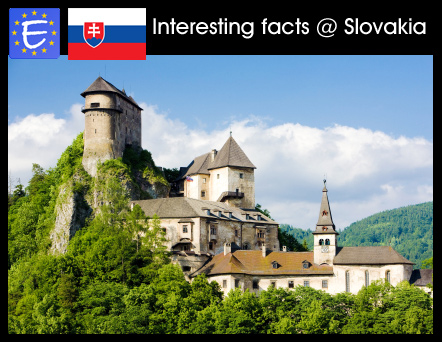
- Slovakia has the highest number of castles and chateaux per capita, with over 180 castles and 425 chateaux.
- The world's tallest wooden Gothic altar, standing nearly 19 metres high, is located in the Church of St. James in Levoča.
- Slovakia is home to the world's tallest sinter column, measuring 34 metres, found in Krásnohorská Jaskyňa Cave.
- Slovakia has over 7,000 caves, including the Ochtinská Aragonite Cave, one of only four aragonite caves accessible to the public worldwide.
- The Herľany geyser is a rare cold-water geyser that erupts every one and a half days, reaching heights of up to 15 metres.
People & Society
- 93% of Slovaks have completed at least secondary education - the highest score in the EU after Croatia (95%).
- Slovakia has become the most egalitarian country in the world, with a Gini coefficient of 23.2 as of 2019.
- Slovakia has one of the lowest level of healthcare funding in the EU, with only €1,743 per capita in 2021, less than half the EU average of €4,028.
- The Slovak village of ÄiÄmany is famous for its unique gingerbread-style wooden houses, recognised as the first folk architecture reserve in the world.
- Slovaks have a unique Easter tradition called "šibačka" and "oblievačka" where boys playfully whip girls with decorated willow branches and splash them with water, believed to ensure health and beauty for the upcoming year.
- Slovak cuisine is known for its regional variation, featuring dishes like Halušky (similar to Gnocchi) and hearty stews with meat, potatoes, and thick sauces.
- The country has a strong tradition in folk arts and crafts, including wood carving, fabric weaving, and glass painting.
- Slovaks celebrate Fašiangy, their version of Carnival, with lively celebrations, feasting, and a humorous ceremony called "pochovávanie basy" (burying of the bass) to mark the beginning of Lent.
- The best-known Slovak hero is Juraj Jánošík, often referred to as the Slovak equivalent of Robin Hood.
- Slovakia is renowned for producing exceptional ice hockey players, including NHL stars like Zdeno Chára and Marián Hossa.
- Some Slovak families still keep a live carp in their bathtub for several days before Christmas, believing it brings good luck and ensures the fish stays fresh for the holiday meal.
- On May Day, Slovak men traditionally erect tall trees as May poles, decorating the top branches with colourful ribbons to symbolise love, new life, and good growth.
Famous Slovaks
-
Tennis champion Martina Hingis (born in 1980), former World No. 1 and winner of five Grand Slam singles titles and nine Grand Slam women's doubles titles, was born in Slovakia to a Slovak father and a Czech mother.
- Supermodel and former "Miss Wonderbra" Adriana Sklenaríková (born in 1971), better known in many countries under her married name Adriana Karembeu, was born in Slovakia to a Slovak mother and Czech father.
- The most famous American of Slovak descent is probably pop artist Andy Warhol (1928-1987), whose parents immigrated from Miková in north-eastern Slovakia.
History & Language
- Štefan Banič(1870-1941) invented the first actively used parachute, patenting it in 1913.
- One of the most colourful character in Slovak history is Móric Beňovský (1746-1786), a nobleman who during his relatively short life managed to be an adventurer, globetrotter, explorer, colonizer, writer, chess player, a French colonel, Polish military commander, and Austrian soldier. Above all, he managed to get himself elected as King of Madagascar (!) by the natives in 1776. His memoirs were a bestseller at the turn of the of 18th and 19th centuries. His life was a source of inspiration for many writers, poets, and composers.
- The Kremnica Mint, founded in 1328, is the oldest continuously operating mint in the world.
- The first university in Slovakia, Academia Istropolitana, was established in Bratislava in 1467.
- Slovakia was part of the Habsburg Empire for over 300 years, from the 16th to the early 20th century.
- Bratislava served as the capital and coronation city of the Kingdom of Hungary for 150 years, from 1536 to 1783.
- The world's first technical university, the Mining Academy in Banská Štiavnica, was founded in Slovakia in 1762.
- Slovak national consciousness began to emerge in the 18th and 19th centuries, with the first codification of written Slovak occurring in 1847.
- Slovakia briefly existed as an independent state aligned with Nazi Germany from 1939 to 1945.
- The Slovak National Uprising against Nazi occupation in 1944 was a significant act of resistance during World War II.
- After World War II, Slovakia became part of Czechoslovakia and fell under communist rule from 1948 to 1989.
- The Velvet Revolution in 1989 led to the peaceful transition from communism to democracy in Czechoslovakia.
- Slovakia gained independence on 1 January 1993 following the peaceful dissolution of Czechoslovakia.
- Slovak people are mostly of Slavic descent, but many people can also claim partial Hungarian, German or Vlachs (Romanian) ancestry, due to the numerous migrations between the 11th and 15th centuries, and as a result of the country's 500 years within the Austrian Empire, as part of the Kingdom of Hungary. Nowadays, Hungarians are the largest ethnic minority, accounting for nearly 10% of the population (this of course does not include all people of mixed descent).
- The Slovak language, which emerged in written form at the end of the 18th century, belongs to the West Slavic languages and is mutually intelligible with Czech.
- Slovak and Czech languages are mutually intelligible to people accustomed to the other language's pronuciation, particularily people who have lived at the time of Czechoslovakia (the country split in 1993) .
Economy
- The GDP per capita of Bratislava is 173% of the EU average, making it the 7th richest region in the EU.
- Only 5% of all employed women in Slovakia do part-time work.
- Slovakia produces the most cars per capita globally, with a strong automotive industry as its economic backbone.
- Slovakia's manufacturing sector alone accounts for one-fourth of the country's GDP.
- The country's farmers harvested approximately 3.2 million tonnes of densely sown cereals in 2023, marking a 17% year-on-year growth.
- Slovakia became the second country from the former Communist block to adopt the Euro as its currency on 1 January 2009.
|


 Austria Guide
 Croatia Guide
 Czechia Guide
 Hungary Guide
 Poland Guide
 Slovenia Guide