• Don't want to see ads? Install an adblocker like uBlock Origin or use a Europe-based privacy-friendly browser like Vivaldi or Mullvad.

Sarmatians, Serbs, Croats and I2a2

it is not really possible to determine when mutation in a haplogroup happened...
they as everybody else just use some supposed models based on ad-hoc parameters... there is no way to verify such models and assumptions about parameters...

Can you provide some source which explains what you are saying about mutation rate?

I agree that reliability is not 100%, but disregarding this kind of analysis is very wrong. In fact genetic researchers always give range for their age calculations, precisely because they know that 100% accuracy is not possible.

Basically what you are saying is that all they are doing is useless. In that case you should not write on genetics forum, but you should offer you "name similarity" theories on some science-fiction forum.
 
Can you provide some source which explains what you are saying about mutation rate?

I agree that reliability is not 100%, but disregarding this kind of analysis is very wrong. In fact genetic researchers always give range for their age calculations, precisely because they know that 100% accuracy is not possible.

Basically what you are saying is that all they are doing is useless. In that case you should not write on genetics forum, but you should offer you "name similarity" theories on some science-fiction forum.

Shetop
How yes no
Ivan

Your discussion was excellent.

Things should be viewed from different angles and should argue, because it is the right way to approach the real flows in the past.


Shetop
(for methods)
I gave a post on the topic of the Berbers and the Albanians where estimates of different researchers are different for 10,000 and over years.
 
Can you provide some source which explains what you are saying about mutation rate?
I agree that reliability is not 100%, but disregarding this kind of analysis is very wrong. In fact genetic researchers always give range for their age calculations, precisely because they know that 100% accuracy is not possible.
Basically what you are saying is that all they are doing is useless. In that case you should not write on genetics forum, but you should offer you "name similarity" theories on some science-fiction forum.

Show me model that you believe in and I will find you weak points.

But I do not believe it is possible to make such a model. You can apply statistics and search for models and lets call it laws that determine randomness only when there is enormous number of events. However, YDNA is very small part of genes and haplogroups are defined on basis of very limited number of mutations. So any method based on statistics is unreliable. It is as knowing that average life length in some country is 70 years, and than applying that to single person you know from that country, telling it is impossible person died at age of 20 or 150 as life expectancy is 70.

I do not need any source to tell you that mutation rate is not something fixed. It largely depend on environment in which one lives. It is well known that there are in nature substances that can act as catalysts that speeds up mutation. E.g. you have two brothers Peter and Mike. Mike is bit adventurer and not so smart and he decides to travel on his bike through Chernobyl area to see how impact of radiation looks like. Now due to radiation being powerfuil mutagen he is likely to acquire and pass to his son in single generation more mutations than people who orign from Peter will in 10 generations. I bet no model takes into account influence of environment, as it is impossible to make a model that will take into account. And it's just not a factor whose influence can be considered negligible.

Furthermore, what is span between generations you would take into account when making a model... it is very culture dependent and trend changes with time....do people make kids in their high school, or in they 40s...
if they make children in age of 20 in average you have 5 generations in century, but if they make them at age of 35 you have around 3 generations per century..... we have no clue how this number have changed over history...

point is that any model that tries to calculate times when specific genetic mutation happened is flawed in its basis...well, it is much more ad-hoc estimation than e.g. trying to deduce exact time span of individual who lived 500 generations ago based on ideas about average life length now, as it tries to superimpose on top of that statistical law that will determine which person in these 500 generations is responsible for mutation that took place.... applying such a model to Peter and Mike, it may tell you that there was e.g. 200 generations between Mike and his son...
 
How Yes No,
If your theory was right,
-What do you think, what % were Serians compared to local population on arrival?

I think I2a2 Serians have already long time ago lived in area of Balkans and west part of Asia minor...what happened in 7th century was arrival of related Croats and arrival of small group of other Serians proto-Serbs.....

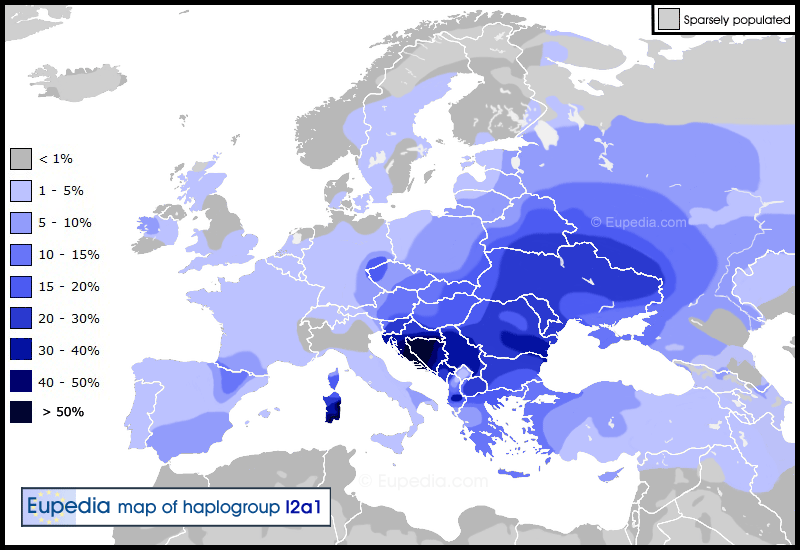
look at Lydia on this map and compare with I2a2 spread

Map_of_Lydia_ancient_times.jpg

Haplogroup_I2a.gif

key town of Lydia is Sardis
http://en.wikipedia.org/wiki/Sardis

Eneti are related I2a2 people who were much earlier kicked from Asia minor and settled along north Adriatic coast (Adriatic Veneti, btw. Liburnians were likely also Venetic), around Vistula (Vistula Veneti) and around Black sea (giving Sarmatian Venedi who are likely same as Antes tribe mentioned both as Sarmatian and as a tribe of Veneti race)

removal of Eneti from Paphlagonia is the reason why I2a2 in west of Asia minor is separated from island of I2a2 in east Asia minor.


800px-Anatolia_Ancient_Regions_base.svg.png


we know thatearly Slavs are identified by Jordanes as populous race of Veneti... and we can also see that known spread of early Slavs does match pretty well directions of spread of I2a2 (disregarding the Balkan spread)

Origins_500A.png

483px-Slavic_peoples_6th_century_historical_map.jpg


maybe I2a2-Dinaric South are Serians, while I2a2-Dinaric North are Veneti...

I2a2 Serians of Asia and Balkan might have been pushed somewhat towards west and north with advance of E-V13 Dardanians....they did retake some of the lost positions during Celtic expansion....


Serians of northwest China are also known by Greeks as Seres, which is identical name as town Serres in Greek Macedonia.

Sérres (Greek: Σέρρες, older form: Σέρραι Sérrai) is a city in Macedonia, Greece. ....
The Greek historian Herodotus mentions the city as Siris (Σίρις) in the 5th century BC. Theopompus refers to the city as Sirra (Σίρρα). Later, it is mentioned as Sirae, in the plural, by the Roman historian Livy. Since then the name of the city has remained in plural and by the 5th century AD it was already in the contemporary form as Serrae (Σέρραι). It is known as Ser in both Macedonian Slavic and Serbian, while in Bulgarian it is known as Syar (Сяр) or Ser (Сер), which can be deducted from the spelling before 1947 as 'Сѣръ', thus capturing both the 'ya' and 'e' sounds. The Katharevousa form for the name of the city was Sérrai (Σέρραι). It was known as Serez or Siroz in Turkish.
http://en.wikipedia.org/wiki/Serrai

The Scordisci (Greek,"Σκορδίσκοι") were an ancient Celtic tribe centered in what would become the Roman Provinces of lower Pannonia, Moesia and present-day Serbia at the confluence of the Savus[1] (Sava), Dravus[2] (Drava) and Danube rivers. They were historically notable from the beginning of the third century BC until the turn of the common era. At their zenith, their influence stretched over regions comprising parts of the present-day Austria, Croatia, Hungary, Serbia, Slovenia, Slovakia and Bosnia and Herzegovina. Their tribal name may be connected to the name of the Scordus[3] mountain (Šar mountain) which was located between the regions of Illyria and Paionia.]
...
The ethnic affiliation of the Scordisci has been debated by historians. Some refer to them as Celtic[4][5][6],Thracian[7] or Illyrian[8] or a Celtic mix of the above[9].The Scordisci were found during different timelines in Illyria,Thrace and Dacia sometimes splitting into more than one group like the Scordisci Major and the Scordisci Minor[10].
...
According to onosmatic evidence, Scordiscan settlements to the east of the Morava river were Thracianized[15].
http://en.wikipedia.org/wiki/Scordisci

Sar mountain is in areas of northwest Macedonia, north east Albania and southeast Kosovo and Metohija...


I think what happened in 7th century with supposed arrival of Serbs
was comparable with earlier arrival of Serdi from zone controlled by Scordisci...Some of Serians moved from one settlement area to another within their larger zone of influence....

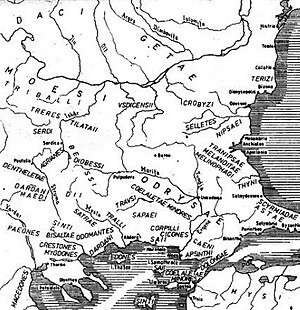
The Serdi were a Celtic tribe[1] inhabiting Thrace. They were located around Serdika,(Greek: Σαρδική or Σαρδῶν πόλις)[2]. They established themselves in this area during the Celtic migrations at the end of the 4th century BC. There is no evidence for their existence before the 1st century BC. They were gradually Thracianized over the centuries but retained their Celtic character up to a late date.

300px-ThracianTribes.jpg


http://en.wikipedia.org/wiki/Serdi
Sofia was originally a Thracian settlement called Serdica or Sardica (Greek: Σερδική, Σαρδική), named after the Celtic[1] tribe Serdi that had populated it.For a short period during the 4th century B.O.T, the city was possessed by Philip of Macedon and his son Alexander the Great.
http://en.wikipedia.org/wiki/Sardica

Now in Serdi we have both Thracian language and self-identification that can be source of tribal name Rascians to later Serb medieval state, and we have likely origin from likely I2a2 Scordisci..

language of Thracians is known to have been satem IE though it seems to have been closer to language of Balts than to the one of Slavs...
 
Until now no significant difference in haplotypes have been found among I2a2a-Dinaric in western Balkans, that is there is no such difference which would indicate two distant populations.
These people either came all together or maybe one group came several decades before the other.

Whether the following is evidence of a significant difference in haplotypes is up to debate, and, of course, it all depends upon whether one takes Ken Nordtvedt's work seriously. Admittedly, his observation that I2a2a-Dinaric with dys 19=14 is massively concentrated in Croatian populations rather than the 16, 15 or less commonly, 17, at dys 19 has not been published.

However, I cautiously view this definate pattern as possible evidence of 'two distant populations'. The pattern is there...
 
Whether the following is evidence of a significant difference in haplotypes is up to debate, and, of course, it all depends upon whether one takes Ken Nordtvedt's work seriously. Admittedly, his observation that I2a2a-Dinaric with dys 19=14 is massively concentrated in Croatian populations rather than the 16, 15 or less commonly, 17, at dys 19 has not been published.

However, I cautiously view this definate pattern as possible evidence of 'two distant populations'. The pattern is there...

as far as I know there is no publicly available data for actual markers of samples obtained in Croatia
but yes, what you say seems to be in correspondence with publicly available data for Serbia and Montenegro

http://onlinelibrary.wiley.com/doi/10.1002/ajpa.21235/suppinfo

where in data for Serbia only one of 69 I2a2 samples (out of 179 samples in total) has dys 19 = 14

and in data for Montenegro only 3 out of 120 I2a samples (out of 404 samples in total) has dys 19 = 14

btw. this also discards validity of recent invent of some politically motivated quasi-scientists from Montenegro and Croatia that people of Montenegro are red (south) Croats...
 
DYS 19 can be the same even in between groups in G2a and I2b1
 
as far as I know there is no publicly available data for samples obtained in Croats
but yes, what you say seems to be in correspondence with publicly available data for Serbia and Montenegro

http://onlinelibrary.wiley.com/doi/10.1002/ajpa.21235/suppinfo

where in data for Serbia only one of 69 I2a2 samples (out of 179 samples in total) has dys 19 = 14

and in data for Montenegro only 3 out of 120 I2a samples (out of 404 samples in total) has dys 19 = 14

btw. this also discards validity of recent invent of some politically motivated quasi-scientists from Montenegro and Croatia that people of Montenegro are red (south) Croats...

Yes, there is definately a pattern there that we can't ignore. I suppose that I have 'no dog in the fight' being English and of a different kind of I2a2 [I2a2b-Isles], but I would like to get to 'the truth' in these matters. The problem, as you suggest, is the violently political nature of the subject. The politics of ethnic identity in the Balkans is a most serious topic. After all, many have died for what they see as a fight to preserve their own ethnic identities.

Even if it can be proved that we have 'two distant populations' here, they are still ultimately related being I2a2, and ultimately of the wider I haplogroup 'clan'.The commonalities and close genetic relationship outweigh any differences in my mind. The problem is, many would dissent from my 'moderate' position, and I suppose it is easy for me to say this without experience of serious ethnic conflict.

Regards to you and to Shetop. :smile:
 
Whether the following is evidence of a significant difference in haplotypes is up to debate, and, of course, it all depends upon whether one takes Ken Nordtvedt's work seriously. Admittedly, his observation that I2a2a-Dinaric with dys 19=14 is massively concentrated in Croatian populations rather than the 16, 15 or less commonly, 17, at dys 19 has not been published.

However, I cautiously view this definate pattern as possible evidence of 'two distant populations'. The pattern is there...

As far as I've investigated dys 19=14 represents around 10% of all Croatian I2a2a-Dinaric variety. All of them are dys 448=19, thus they are all probably one branch of Dinaric South.

This pattern is indeed specific for Croatians but since it doesn't have high frequency it can't be said it distinguishes whole Croatian I2a2a-Dinaric from Serbian I2a2a-Dinaric.
 
What is the correlation between DYS 19 and time?

In calculating someones genetic distance there is no mention of this or any particular DYS.
It is calculated just as so called number of matching (not relating to any specific DYS), with percentages of possibility of sharing a common ancestor in a genealogical time frame with calculated mutation rate ( based on a University of Arizona's mutation rate study).
 
What is the correlation between DYS 19 and time?

In calculating someones genetic distance there is no mention of this or any particular DYS.
It is calculated just as so called number of matching (not relating to any specific DYS), with percentages of possibility of sharing a common ancestor in a genealogical time frame with calculated mutation rate ( based on a University of Arizona's mutation rate study).

DYS = DNA Y-chromosome Segment

More different DYSes two people have implies they are more genetically distant. Geneticists do use differences in these segments to calculate time to common ancestors for groups of people.

But this is not my profession so I can't tell you much more about it.
 
Considering so called Croatian haplotypes with DYS 19=14, the only thing that could be said that it is really tiny haplotype group which was probably extracted from some larger I2a2 Dinaric group. It could definitely form some cluster, but why to call that cluster Croatian, if there is also some Bosniaks and Serbs there. Actually it is really hard to divide I2a2 Dinaric in clusters and ethnic groups at all, and not to mention Serbian or Croat haplotypes.

I was writing much before that vast majority of Croat I2a2 members are actually Croats from Herzegovina an Dalmatia and it is surnames which fall in Bunjevci group. Since Bunjevci were considered as Serbs Catholics during all middle ages, I don' t see a single reason to consider medieval Croats as predominantly I2a2. On the contrary, some of the northern islands like Krk which preserved authentic croatian population from middle ages show drop in I2a2 and rise of R1a in comparison with southern Dalmatia which changed all of its population in 16. and 17. century.

We should know specific family history, recent migrations, history if we really want to extract some valid conclusions. I have seen more than hundred South Slavs surnames from y search, Croats, Serbs, Muslims and compare it with the etnic background they came from. The conclusion: there is no one specific Croatian surname of chakavian (originallly Croat) regions with I2a2 Dinaric. I would mention just a few: Barilović, Crnković, Kusanović, Degoricija, Horvatović, Jurčević, Juran, Jurašić, Karkić, Laslavić, Lončarić, Martinac, Nižetić, Trbuhović. This is all old Croatian surnames, before coming of Turks and migrations, and no a single is I2a2 Dinaric. In archeological point of view, early Croats was also clearly distinguishable from other Slavs on Balkan, including the Serbs. It would be worth of checking were the Croats some more R1a tribe comparing to more I2a2 tribe like Serbs was.

I believe that people from abroad, are not able to solve South Slav ethnic puzzle. For example, they very often can not make difference between regional, state and ethnic affiliation. They forget that for example, till 90s Dalmatia was half Serbian half Croatian in populatian, that in Bosnia, muslim Slavs called Bosniaks represent 45 % of total populatian ( with 35% of Serbs and 20% of Croats) and that Bosniaks are mostly Serbs or Croats converted on Islam in the time of Ottomans.

And finally, Word Game Show of how yes no has ruined till now several good topics on this forum, and I am really not sure is it worth for me to continue to participate in it.
 
I added this after some time so maybe you did not read it.


In calculating someones genetic distance there is no mention of this or any particular DYS.
It is calculated just as so called number of matchings with other people, (not relating to any specific DYS), with percentages of possibility of sharing a common ancestor in a genealogical time frame with calculated mutation rate ( based on a University of Arizona's mutation rate study).


I checked two of people from G2a and other I2b1 having the same DYS 19. I have the same DYS 19=17 with a G1 person.

G2a and G1 should be distant enough, even more than Serbs and Croats.

I was amazed to see the same DYS I share with other haplogroups particulary I2b1
 
...
We should know specific family history, recent migrations, history if we really want to extract some valid conclusions. I have seen more than hundred South Slavs surnames from y search, Croats, Serbs, Muslims and compare it with the etnic background they came from. The conclusion: there is no one specific Croatian surname of chakavian (originallly Croat) regions with I2a2 Dinaric. I would mention just a few: Barilović, Crnković, Kusanović, Degoricija, Horvatović, Jurčević, Juran, Jurašić, Karkić, Laslavić, Lončarić, Martinac, Nižetić, Trbuhović. This is all old Croatian surnames, before coming of Turks and migrations, and no a single is I2a2 Dinaric. In archeological point of view, early Croats was also clearly distinguishable from other Slavs on Balkan, including the Serbs
....
And finally, Word Game Show of how yes no has ruined till now several good topics on this forum, and I am really not sure is it worth for me to continue to participate in it.

the word game show that I do with tribal names, you seems to repeat with last names... tribal names tend to be preserved through timeline of nations, same as surnames tend to be preserved through timeline of families.... however many families of different ethnic origin and sharing same language vocabulary might have same or similar last names due to the point that last names are derived from words of same vocabulary...with tribal names this is less often as number of tribal names used is less and vocabulary is much larger and of different origins...

btw. I am interested to read more about early Croats being clearly distinguishable from other Slavs in archeological point of view... can you share the source?
 
the word game show that I do with tribal names, you seems to repeat with last names...
btw. I am interested to read more about early Croats being clearly distinguishable from other Slavs in archeological point of view... can you share the source?
Yes, of course, this the link
http://serbianforum.org/domace-knjige/8932-srpsko-pomorje-djordjejankovic-arheologija.html

And about last names, you may check in y search database. That is a real people which were tested. And it is not only about last name, because they all write place of origin, and if you do some history research of specific surnames in specific places you may at least find were they there at last 500 years. That is what we can know for sure. When the Austria made first list of people in Lika region in 1712. they clearly divided it in five group of people:
Serbs Orthodox, Serbs Catholics, Old Croats, some Turks converted to Catholicism and so called Kranjci (Slovenians, probably). The same surnames and same people is in Lika today, or was till 1995. So if someone like Crnković belongs to families of Old Croats, and tested as R1a, and is not the only example, then we can make also some conclusions considering that. I already told that Krk, where the oldest Croatian glagolitic document was written (Bascanska Ploca) is predominantly R1a.
 
When I checked my DYS with other people,

Among my G2a and G in general there were also I2b1, when comparing first 12 markers such as DYS 19. When comparing 12-25 and 25-37 I2b is excluded.
I was confused at first, but, as I understand it can mean that I2b1 share the same traits with me and our common ancestor. It just stayed there for such a long time that haplogroup of that man changed to IJK - IJ-I-...I2b1. Haplogroups are just mutations on specific SNP s that imply same place of origin and similar traits. Markers though seem as they can stay the same for a long time. What I am not sure yet is, does this happen more likely in just first 12 markers that maybe carry some rudimentary traits, since in 25-37 maching exclude those of I2b1.
Of course this is my interpretation and how I understood it.


So haplogroups do mean many similar traits, but markers from first group of 12 seem to be more democratic.

This DYS 19 could mean different people, but how long in time?
Is there some new theory on this?
Which DYS Serbs have?
 
And about last names, you may check in y search database. That is a real people which were tested. And it is not only about last name, because they all write place of origin, and if you do some history research of specific surnames in specific places you may at least find were they there at last 500 years. That is what we can know for sure. When the Austria made first list of people in Lika region in 1712. they clearly divided it in five group of people:
Serbs Orthodox, Serbs Catholics, Old Croats, some Turks converted to Catholicism and so called Kranjci (Slovenians, probably). The same surnames and same people is in Lika today, or was till 1995. So if someone like Crnković belongs to families of Old Croats, and tested as R1a, and is not the only example, then we can make also some conclusions considering that. I already told that Krk, where the oldest Croatian glagolitic document was written (Bascanska Ploca) is predominantly R1a.

how can I get access to the archives of Austria with lists of families adorned with nation and confession data without bothering to go to Austria?
 
When I checked my DYS with 200.000 other people,

I was confused at first, but, as I understand it can mean that I2b1 share the same traits with me and our common ancestor. It just stayed there for such a long time that haplogroup changed to IJK - IJ-I-...I2b1. Haplogroups are just mutations on specific SNP s that imply same place of origin and similar traits. Markers though seem as they can stay the same for a long time. What I am not sure yet is, does this happen more likely in just first 12 markers that maybe carry some rudimentary traits, since in 25-37 maching exclude those of I2b1.
Of course this is my interpretation and how I understood it.


So haplogroups do mean many similar traits, but markers from first group of 12 seem to be more democratic.

This DYS 19 could mean different people, but how long in time?
Is there some new theory on this?
Which DYS Serbs have?

Any DYS (not only from the first 12) could be equal for different haplogroups. There is some specific DYS which value can clearly separate two different haplogroups. You had to look at all seqence and not ot single DYS to find out which is your haplogroup. But the real designation to haplogroup is only with SNP testing which tests specific mutations on your genes.
 
Any DYS (not only from the first 12) could be equal for different haplogroups. There is some specific DYS which value can clearly separate two different haplogroups.
What is then DYS 19 being 14 in Croats have to do with genetic distance from Serbs?

What DYS 19 Serbs have?

But the real designation to haplogroup is only with SNP testing which tests specific mutations on your genes.
This is familliar
 
Back
Top