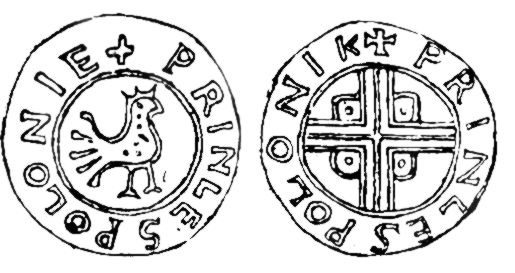
The most commonly accepted etymology for "Polanie" (and then "Polacy") is that from "pola" (plural), "pole" (singular).
Pola = flatlands or open fields. "Podlasie" and "Polesie" might be from "las" ("forest"), meaning "lands located near forests".
But it might be also from Lachy (Poles), meaning "lands located near territories of Lachy (Poles)". Probably this is more convincing, because Podlasie and Polesie were indeed regions bordering with Early Medieval Poland. Later Polish colonization of those regions started.
Let's remember that there were two tribes called Polanie - one at the Warta River, near Poznan and one at the Dnieper River, near Kiev.
Some scholars think that originally it had been one tribe, which later split in two groups and they migrated (or one migrated).
I think, as tribal names, "Po" must be included in root, and not meaning that the tribes lived to someone more important or older original inhabitants.
Maybe "Po" could mean not "after someone" but rather "descendants of someone" - as underlining connection to ancestors ???
Po Ljak

Someone living by/at/near Ljaks.
That would rather be "Podlak" not "Polak". Because by/at/near is rather "pod", not "po" (as in Podlasie).
"Po" can also be "after" in terms of geographical location - Polesie is "after" Poland, that is - located next to Poland (if you travel from west to east). But it could also be "after las" (behind las) - that is, located behind the Bialowieza Forests (or behind some other forests).
But more frequently "pod" will be used when we say that something is located near something.
And "po" is rather used as "later". Hence my idea that maybe it could be used as describing someone as "descendants of... ".
====================================
Mihaitzateo:
Well I do not understand one thing,how can Jogaila grant rule over Russia also,since he was King of Lithuania?
Jogaila was not a King but a Grand Duke of Lithuania.
"Russia" in this case refers to Russian lands / principalities which were parts of the Grand Duchy of Lithuania.
That "Russia" was Belarus and some parts of Ukraine.
Anyway,22 wives seems a little on the legend side.
22 might be exaggerated. But maybe not.
For example Polish duke Mieszko I had 7 Pagan wifes before he adopted Christianity in 966.
When he adopted Christianity he divorced with his 7 wives and married Czech princess Dobrawa.
He probably had many children with his Pagan wifes. I guess they became important figures in his realm, but they couldn't be heirs.
His heir was Bolesław I (the first king of Poland) - son of Mieszko and his 1st Christian wife, Dobrawa..
Mieszko also had sons with his 2nd Christian wife, Oda - who was German (he married her when Dobrawa died).
When Mieszko died, a struggle for power started in which Bolesław expelled all of Oda's sons, and took power.
=============================
Mieszko I had at least two brothers - one of them is known by name, he was Czcibor / Ściebor / Zdziebor (Latinized as Cidebur).
I wonder how many wifes and children did Czcibor (and other brothers of Mieszko - if he had more than two brothers) have.