• Don't want to see ads? Install an adblocker like uBlock Origin or use a Europe-based privacy-friendly browser like Vivaldi or Mullvad.

Poland, more Germanic or Slavic?

Should the article about Poland be rewritten?

  • Yes

    Votes: 10 71.4%
  • No

    Votes: 4 28.6%

  • Total voters
    14
Thanks Dagne. So we have:
Lithuanian - Lenkas (Lenkija - Poland)
Ukrainian - Liach
Romanian - Leach, Lesi

Ok, we have a pattern. So far it looks Balto-Slavic with possible root "Lech, Lek, Les", possibly something to do with forrest "Les" ("Po-les-ka" - Poland). Could be just Slavic and adopted by Lithuanians from Belarusians. Do you know of other nations using this term? I know Turkey does, Lechistan, but this was borrowed from others.
Btw - just a note.
Old name (attested in Russian chronicles and Byzantines as one of Kiev Princes) - Swentoslaw, new name Svjatoslav.
By analogy
Old name - Lenkas, new name Ljak. As in Lithuanian/Ukrainian.


Poljak - Po Ljak :) Someone living by/at/near Ljaks.

p.s.
Lenkti - in Latvian is archaic word to go around, or to surround, a method of hunting. Also sometimes used in Romantic manner (boyfriend can "lenkt" his potential wife for months or years before she gives up). But I am not sure if this has anything to do with ethnonime. Maybe a great hunter was the first ancestor, totally wild assumption.

sorry third edit - aplenkt is also military term. Aplenkums - siege. Ielenkt - encircle, besiege. Maybe they used encircle/surround by cavalry as their major attack method. Or maybe it has nothing to do with lenkt.
 
Last edited:
Interpretation by prof. Henryk Łowmiański of location of peoples along the Amber Road, based on Tacitus, "Germania":

http://postimg.org/image/58p49u0nh/

Amber_Road_people.png


From book (in Polish) "Dzieje Prusów" ("History of Old Prussians") by prof. Łucja Okulicz-Kozaryn.
 
Poljak - Po Ljak :) Someone living by/at/near Ljaks.
So who was Ljak to whom Poles lived close by?
There were Polanie and Podlasianie. Were they close to Lanie and Lasianie? I think, as tribal names, "Po" must be included in root, and not meaning that the tribes lived to someone more important or older original inhabitants.
 
Last edited:
So who was Ljak to whom Poles lived close by?
There were Polanie and Podlasianie. Were they close to Lanie and Lasianie? I think, as tribal names, "Po" must be included in root, and not meaning that the tribes lived to someone more important or older original inhabitants.
You used Podlasiane to claim that Po must be included in root. Are you sure pod or po in that word is part of root?
I can agree though that in most ethnonimes Po/Pa is used before natural or geographical term (forest, river, hill) rather than neighbor or dominant tribe.

Btw there are lingvists who noticed ya-en link. But they believe Lend was the original name. How lend could produce Lenk in Baltic or Leng in Hungarian is a good question. However Lenk can easily produce both Ljak, Lech or Leng.
 
The most commonly accepted etymology for "Polanie" (and then "Polacy") is that from "pola" (plural), "pole" (singular).

Pola = flatlands or open fields. "Podlasie" and "Polesie" might be from "las" ("forest"), meaning "lands located near forests".

But it might be also from Lachy (Poles), meaning "lands located near territories of Lachy (Poles)". Probably this is more convincing, because Podlasie and Polesie were indeed regions bordering with Early Medieval Poland. Later Polish colonization of those regions started.

Let's remember that there were two tribes called Polanie - one at the Warta River, near Poznan and one at the Dnieper River, near Kiev.

Some scholars think that originally it had been one tribe, which later split in two groups and they migrated (or one migrated).

I think, as tribal names, "Po" must be included in root, and not meaning that the tribes lived to someone more important or older original inhabitants.

Maybe "Po" could mean not "after someone" but rather "descendants of someone" - as underlining connection to ancestors ???

Po Ljak :) Someone living by/at/near Ljaks.

That would rather be "Podlak" not "Polak". Because by/at/near is rather "pod", not "po" (as in Podlasie).

"Po" can also be "after" in terms of geographical location - Polesie is "after" Poland, that is - located next to Poland (if you travel from west to east). But it could also be "after las" (behind las) - that is, located behind the Bialowieza Forests (or behind some other forests).

But more frequently "pod" will be used when we say that something is located near something.

And "po" is rather used as "later". Hence my idea that maybe it could be used as describing someone as "descendants of... ".

====================================

Mihaitzateo:

Well I do not understand one thing,how can Jogaila grant rule over Russia also,since he was King of Lithuania?

Jogaila was not a King but a Grand Duke of Lithuania.

"Russia" in this case refers to Russian lands / principalities which were parts of the Grand Duchy of Lithuania.

That "Russia" was Belarus and some parts of Ukraine.

Anyway,22 wives seems a little on the legend side.

22 might be exaggerated. But maybe not.

For example Polish duke Mieszko I had 7 Pagan wifes before he adopted Christianity in 966.

When he adopted Christianity he divorced with his 7 wives and married Czech princess Dobrawa.

He probably had many children with his Pagan wifes. I guess they became important figures in his realm, but they couldn't be heirs.

His heir was Bolesław I (the first king of Poland) - son of Mieszko and his 1st Christian wife, Dobrawa..

Mieszko also had sons with his 2nd Christian wife, Oda - who was German (he married her when Dobrawa died).

When Mieszko died, a struggle for power started in which Bolesław expelled all of Oda's sons, and took power.

=============================

Mieszko I had at least two brothers - one of them is known by name, he was Czcibor / Ściebor / Zdziebor (Latinized as Cidebur).

I wonder how many wifes and children did Czcibor (and other brothers of Mieszko - if he had more than two brothers) have.

 
The most commonly accepted etymology for "Polanie" (and then "Polacy") is that from "pola" (plural), "pole" (singular).

That is correct. There's a cognate for "Polanie" in Germanic, in the form of Westfalen. I think it was further Julius Pokorny speculated further that the Greek term "Pelasgian" (which he glossed as "flatland inhabitants") was also etymologically connected, so this goes back to a common Indo-European root.
 
You used Podlasiane to claim that Po must be included in root. Are you sure pod or po in that word is part of root?
I can agree though that in most ethnonimes Po/Pa is used before natural or geographical term (forest, river, hill) rather than neighbor or dominant tribe.

In geographical description of a landmark Po and Pod are not part of the root, Pod-lasie (by the forest). But the tribe name started already as "Podlasie", that's why I mean that we can't separate the prefix from the root in understanding the origin of the name. In geographical name yes, in tribal name no.


Btw there are lingvists who noticed ya-en link. But they believe Lend was the original name. How lend could produce Lenk in Baltic or Leng in Hungarian is a good question. However Lenk can easily produce both Ljak, Lech or Leng.
Lithuania dominated Belarus and Ukraine for few hundreds years, so Liech could be a borrowing from Lenk, theoretically.
 
Last edited:
Aestsexia, or Essex in England, &c. &c. &c.In the Periplus Wulfstani of king Alfred, published in the book of Arius De Islandia, edit. Bussaei, Hauniae, 1733, 4to. and elsewhere, we are told, 'the Vistula is a very large river, and near it ly Witland, and Vandalia. Witland belongs to the Esti.' It is hence clear that the Esti of Alfred's time were those of Tacitus, on the mouth of the Vistula, and far re∣mote from Estonia.. The Aestii were certainly in the peninsula beyond pre∣sent Dantzic, that is, as Tacitus describes, on the right hand as you sailed up the Suevicum mare, or south part of the Baltic, that was on the north of the Suevi. And he mentions the Aestii before he passes to the Sitones, or Swedes, of the opposite shore, and the Peukini, Venedi, and Fenni; be∣yond whom he had faintly heard of a people who were covered with skins of beasts, and thence went for beasts with a human face. The Fenni were infallibly, from the account of Tacitus, that they were divided from the Peukini, only by woods and hills, inhabited by Venedi, not the people of Finland, as dreamed, but the FINS, a great abo∣riginal people.


But the Sarmatians were a great and warlike nation; tho it appears, from the little mention of them in Greek and Roman history, that they yielded much to the Scythians in arms; and, from all ancient accounts, were also inferior in wisdom, and such rude arts, as early society affords, tho the peasantry of Poland and Russia be remarkably sensible and acute. The BASTERNAE, in this large extent of country, became so remarkable to the ancients, that Strabo, book VII. p. 305, classes them with the enormous names of SCYTHAE and SARMATAE, saying that the Scythae, Basternae, and Sarmatae, beyond the Danube, gradually emigrated north. He also in∣forms us that the Basternae were divided into four great nations, ATMONOI, 〈 in non-Latin alphabet 〉; the Atmoni, Sitones, Peukini, and Roxolani. Some of them, he observes, re∣mained still in Thrace, and their first habitations; while others moved north.
 
Lithuania dominated Belarus and Ukraine for few hundreds years, so Liech could be a borrowing from Lenk, theoretically.
It is not a borrowing, it is sound change from earlier form of Slavic. I dont know proper dating on sound changes, but I guess based on this word we could assess that Lechs/Lyaks known these days as Lenks (probably even calling themselves this way) were known by Balts and Hungarians/Magyars before en/ya change.
 
It is not a borrowing, it is sound change from earlier form of Slavic. I dont know proper dating on sound changes, but I guess based on this word we could assess that Lechs/Lyaks known these days as Lenks (probably even calling themselves this way) were known by Balts and Hungarians/Magyars before en/ya change.
I guess you referring to sound change in Lithuanian? Do we have any records of first mentioning Lechy in Polish, or perhaps from Russia/Kiev chronicles?
It would be hard to conclude that all regions, what is now Poland, called themselves Lechy/Lachy as an indication of one ethnicity. The Polish nationality started with Polanie, and after consolidation of Poland by Mieszko, we can talk about beginning of Polish nationality, which took way into 15th century. There are records indicating that Mazovians (Mazowsze) didn't call themselves Polacy till something like 14-15 century. I'm not sure about other provinces.
Why then there is such uniform naming for Polish nationality (Lachy/Lenkas) in the East and South? Unless it was an exonym for someone else, and later overlapped onto Poland?
I think the first mentioning of Polak is from some Silesian chronicles in 12 hundreds, but not Lech as nationality.
I wish our ancestors started writing in polish 500 years sooner. So many questions would have been answered. ;)
 
What is actually the proof that L550 or L1025 went to Sweden rather than staying on the southern shore of the Baltic Sea.

I found this (on another forum):

"As a matter of fact N1c-L1025 are of Baltic origin only. We can find this clade someware else, but in the Tawasts/Räihä family. But this branch is only a child branch to one of Baltic branches. (...) one of about thirty L1025 lines is the Tawasts/Räihä line. I propose they have some ancient West Baltic origin."

And also:

"The Finnish sublineage of N1c-L1025 was separated very early from the main branch that gave rise to the lineages found among Balts, and we cannot be sure whether this split happened it in today’s Baltic countries, in Finland, Northern Russia, or maybe somewhere in Scandinavia."

And your theory makes no sense according to members of that forum:

http://eng.molgen.org/viewtopic.php?f=24&t=844&sid=cb915a815cc91743113eadfb637f27f0&start=50

"He seems to think it's an ancient Finnic marker spread by a Scandinavian tribe (Goths?) into the Baltic states very recently. Of course this makes no sense, because all of that N1c1 in the Baltic states can't be of late Iron Age origin. N1c1 is a Boreal zone marker, and modern Balts took form when R1a from the Corded Ware zone (which is now Poland) moved into that N1c1 Boreal zone during the Bronze Age."

And also:

"Thus, if N1c-L1025 members were indeed present among the Balts at that early time (500 BC – 1 AD), I would expect that their sudden expansion would have taken place at the same moment (more or less) and not about one thousand years later."

But a response to this is:

"Those are the subclades, not L1025 itself. Their expansion is most likely related to the formation and growth of the Grand Duchy of Lithuania.
You are confusing the original East Baltic expansion with the formation and growth of the GDL. "

And more explanation why your theory makes no sense:

"Also, the very fact that the Varangian sister branch of L1025, having no specific SNP so far, hence usually described as L550(xL1025), is commonly considered to be derived from some Scandinavian (Nordic) population, makes the Northern origin of N1c-L1025 quite likely."


Debunking:

http://eng.molgen.org/viewtopic.php?f=24&t=844&sid=cb915a815cc91743113eadfb637f27f0&start=50

"No, that does not follow. One could just as easily reverse your statement's direction to say that "the usual association of L1025 with the South Baltic makes a similar origin of its sister Varangian branch quite likely." Your argument would carry some weight only if you could show that L550(xL1025) in Scandinavia is significantly older than the L550 (both L1025+ and L1025-) in the South and East Baltic."

=======================================

Well I'm not very familiar with new findings about N1c haplogroup so maybe I will just leave it alone.

But you need to back up your claims with archaeological and other kinds of evidence.

There is no any indication that ancestors of the Giedyminids came from Scandinavia.

There is even no evidence of Viking presence in Lithuania.

I googled "Vikings in Lithuania" and found an article, the first sentence of which says:

"(...) the Baltic Region is an area far less written about and understood about than continental and insular Viking activity. Even less is known about the Vikings in today's Baltic states of Estonia, Latvia and Lithuania. (...)"

So when you have no any other evidence then you can't speculate about such things.

Why isn't there any evidence of Scandinavian material culture in Lithuania ??? No evidence of migration or incursion to the region.


SNP-N-TREE.jpg
 
Thanks Dagne. So we have:
Lithuanian - Lenkas (Lenkija - Poland)
Ukrainian - Liach
Romanian - Leach, Lesi

Ok, we have a pattern. So far it looks Balto-Slavic with possible root "Lech, Lek, Les", possibly something to do with forrest "Les" ("Po-les-ka" - Poland). Could be just Slavic and adopted by Lithuanians from Belarusians. Do you know of other nations using this term? I know Turkey does, Lechistan, but this was borrowed from others.

It looks to be Germanic or Finnic, it clearly depicts the shoreline there.
 
I guess you referring to sound change in Lithuanian? Do we have any records of first mentioning Lechy in Polish, or perhaps from Russia/Kiev chronicles?
It would be hard to conclude that all regions, what is now Poland, called themselves Lechy/Lachy as an indication of one ethnicity. The Polish nationality started with Polanie, and after consolidation of Poland by Mieszko, we can talk about beginning of Polish nationality, which took way into 15th century. There are records indicating that Mazovians (Mazowsze) didn't call themselves Polacy till something like 14-15 century. I'm not sure about other provinces.
Why then there is such uniform naming for Polish nationality (Lachy/Lenkas) in the East and South? Unless it was an exonym for someone else, and later overlapped onto Poland?
I think the first mentioning of Polak is from some Silesian chronicles in 12 hundreds, but not Lech as nationality.
I wish our ancestors started writing in polish 500 years sooner. So many questions would have been answered. ;)
[TABLE="class: wikitable"]
[TR]
[TH]Late PIE[/TH]
[TH]Balto-Slavic[/TH]
[TH]Meaning[/TH]
[TH]Lithuanian[/TH]
[TH]Proto-Slavic[/TH]
[TH]Late Common Slavic[/TH]
[/TR]
[TR]
[TD]*ǵómbʰos[/TD]
[TD]*źambas[/TD]
[TD]"tooth"[/TD]
[TD]žam̃bas "sharp edge"[/TD]
[TD]*zą̄̂bu[/TD]
[TD]*zǫ̂bъ[/TD]
[/TR]
[TR]
[TD]*ǵenh₃tis[/TD]
[TD]*źénˀtis, *źénˀtas[/TD]
[TD]"son in law"[/TD]
[TD]žéntas[/TD]
[TD]*zę̄́tu[/TD]
[TD]*zę̀tъ[/TD]
[/TR]
[TR]
[TD]*deḱmtos[/TD]
[TD]*deśimtas[/TD]
[TD]"tenth"[/TD]
[TD]dešim̃tas[/TD]
[TD]*desę̄tu[/TD]
[TD]*desętъ[/TD]
[/TR]
[TR]
[TD]*lnHkom[/TD]
[TD]*lúnˀka[/TD]
[TD]"bast"[/TD]
[TD]lùnkas[/TD]
[TD]*lų̄́ka[/TD]
[TD]*lỳko[/TD]
[/TR]
[TR]
[TD] ?[/TD]
[TD]*kanjun(s)[/TD]
[TD]"horses" (acc.)[/TD]
[TD]—[/TD]
[TD]*kanjį̄[/TD]
[TD]*koňę̇[/TD]
[/TR]
[/TABLE]

Do you see the nasalization table?
Balto-Slavic *žentas -> Lithuanian "žentas", but East Slavic "zjatj"
If we go by same road, Balto-Slavic old name for Lech man was *lenkas, that produced Lithuanian "lenkas", East Slavic "ljak". Hungarian and Lithuanian versions of that name reflects the (old) reality, since non-Slavic folk did not have further common Slavic changes.

This nasal change is very visible to someone who speaks Latvian, Russian and knows bit of Lithuanian. I sometimes reconstruct Lithuanian words that I don't know by applying an, en, in where I feel appropriate (as in laimingas/laimīgs) :)
Ranka - roka - ruka (Lith-Latv-Rus)
Lankas - loks - luk
Žambas - zobs - zub
Swentas - svēts - svjat
Žentas - znots - zjat
by analogy if Latvians had old Polish name it would be Lēks:
Lenkas - Lēks/Loks - Ljak.

I do not insist about Polish ethnonime as arrising from Lechs, it was just proposal as Po-Ljak. But I do insist that Lechs initial Balto-Slavic term was Lenk(as) and they named themselves this way, when common proto-Balto-Slavic was spoken. If however we think it was Po-Ljak also for Polish ethnonime, then we should believe that Polish as nation was created after applicable Slavic sound change, but before West Slavic changed Ljak into Lech, whereas Lechs as tribe was known before, as in Balto-Slavic times and known to its Slavic (subject to nasal changes common to all Slavic languages), Baltic (no changes) and Hungarian (need to check if k-> g after n for Hungarian sounds changes) neighbors.
 
early 15c., "one of a series of rings or loops which form a chain; section of a cord," probably from Old Norse *hlenkr or a similar Scandinavian source (compare Old Norse hlekkr"link," Old Swedish lænker "chain, link," Norwegian lenke, Danish lænke), from Proto-Germanic *khlink- (cognates: German lenken "to bend, turn, lead," gelenk "articulation, joint, link," Old English hlencan (plural) "armor"), from PIE root *kleng- "to bend, turn."

c.1200, from Old English hleonian "to bend, recline, lie down, rest," from Proto-Germanic *khlinen (cognates: Old Saxon hlinon, Old Frisian lena, Middle Dutch lenen, Dutchleunen, Old High German hlinen, German lehnen "to lean"), from PIE root *klei- "to lean, to incline" (cognates: Sanskrit srayati "leans," sritah "leaning;" Old Persian cay "to lean;" Lithuanian slyti "to slope," slieti "to lean;" Latin clinare "to lean, bend," clivus "declivity," inclinare "cause to bend," declinare "bend down, turn aside;" Greek klinein "to cause to slope, slant, incline;" Old Irish cloin "crooked, wrong;" Middle Irish cle, Welsh cledd "left," literally "slanting;" Welsh go-gledd "north," literally "left" -- for similar sense evolution, see Yemen, Benjamin, southpaw).


"undulating sandy ground," 1728, from Scottish/Northumbrian link "sandy, rolling ground near seashore," from Old English hlinc "rising ground, ridge;" perhaps from the same Proto-Germanic root as lean (v.). This type of landscape in Scotland was where golf first was played; the word has been part of the names of golf courses since at least 1728

http://www.etymonline.com/index.php?term=link

http://www.etymonline.com/index.php?term=lean&allowed_in_frame=0

http://www.etymonline.com/index.php?term=links

In Finnish it is lenkki.
 
There are records indicating that Mazovians (Mazowsze) didn't call themselves Polacy till something like 14-15 century.

This is a rather doubtful information given that western Mazovia was part of Poland since the very beginning.

And eastern Mazovia was incorporated to the Polish realm shortly later, during the reign of Mieszko I.

I think the first mentioning of Polak is from some Silesian chronicles in 12 hundreds

Nope, already in the late 10th - early 11th centuries.

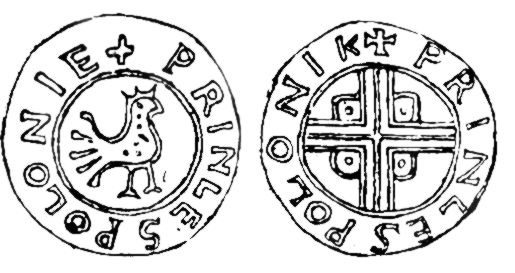
For example on coin PRINCES POLONIE / PRINCES POLONIK of duke Bolesław I Chrobry (born 967; reign 992 - 1025):

This type of denar was being minted in late 990s and early 1000s:

https://www.google.pl/search?q=Dena...=sb&tbm=isch&q=Denar+PRINCES+POLONIE&imgdii=_

Denar_rys_chrobry1.png


"Princes POLONIE" means "Prince of Poland" and "Princes POLONIK" apparently means "Prince of the Poles" (or "Polish Prince"?).

This and other types of prince Bolesław's coins (over a dozen types of coins were being minted by Chrobry during his reign):

http://www.denary.com.pl/boleslaw-chrobry-typologia.html

Another early recording of the name of Poles is from "Vita sancti Adalberti episcopi Pragensis" written in year 999 by John Canaparius:

http://en.wikipedia.org/wiki/John_Canaparius

He wrote about Czech prince Sobeslav who travelled with "Bolizlauo Palaniorum duce" ("Bolesław duke of the Polans"):

http://en.wikipedia.org/wiki/Soběslav_(died_1004)

BTW - is there any difference between prince and duke in English language? I'm not sure if I can use these terms interchangeably.

Why then there is such uniform naming for Polish nationality (Lachy/Lenkas) in the East and South?

There is a theory which says that this name is from one of Polish tribes.

That tribe was Lędzianie - Lendians (Lendisi / Lendizi / Lendzanenoi / Lendzaninoi / Landzaneh).

That tribe lived in South-Eastern Poland and Western Ukraine.
 
Do we have any records of first mentioning Lechy in Polish, or perhaps from Russia/Kiev chronicles?

The Primary Chronicle mentions the Poles under this name when describing events of year 981 (Russian attack on Grody Czerwienskie):

Grody Czerwienskie: http://en.wikipedia.org/wiki/Red_Cities

But the chronicle itself was written much later - around year 1113:

http://en.wikipedia.org/wiki/Primary_Chronicle

The Primary Chronicle (Old Church Slavonic: Повѣсть времѧньныхъ лѣтъ, Latin transliteration Pověstĭ Vremęnĭnyhŭ Lětŭ, often translated into English as Tale of Bygone Years) is a history of Kievan Rus' from about 850 to 1110, originally compiled in Kiev about 1113.

Here is the excerpt in question:

"In the Summer of year 6489 (981) Vladimir marched upon the Lyakhs (k Lyakbotri in original) and took their towns: Peremyshl, Cherven, and others."

But let's remember that although this excerpt describes events from year 981, it was written much later - around year 1113.

So it seems that the name "Poles" is older (late 9th / early 10th centuries) than the name "Lachs / Lechy" (12th century ???).

================================

Grody Czerwienskie - inhabited by the North-West Slavic tribe of Lendians - had been taken by expanding Poland around year 970.

But later in 981 forces of Kievan Rus' took the region from Poland.

This map illustrates the approximate course of the expansion of Poland between years 960 and 999:

Colorful markers show grody (fortified towns) either constructed or captured by Piast's realm in each period:

http://s27.postimg.org/giv97r1pv/Poland_960_to_999.png

Poland_960_to_999.png


When it comes to Cracow (Kraków) there is contradictory information as to when it was captured by Poland.

According to 11th century Czech chronicler Cosmas of Prague (link), Cracow was captured by duke Mieszko I in year 999.

The problem is, that Mieszko I died already on 25 May 992. So either captured was Captured by Mieszko before 992 (for example it could be in 989), or indeed in year 999 by duke Bolesław Chrobry. Cosmas confused either the person or the date.

=========================================

And here more maps showing the evolution of early Polish borders (between 960 and 1020 this time):

Territory of the Polish state around year 960 (at the beginning of Mieszko I's reign):

960.png


By ca. 970 extending Polish control into Pomerania, Land of Lublin and Grody Czerwienskie:

970.png


By ca. 981 Grody Czerwienskie captured by Kievan Rus:

981.png


By ca. 990 extending Polish control into Silesia and land of the Vistulans (western part of Lesser Poland):

990.png


By ca. 1003 conquering Bohemia (lost in 1004), parts of Saxon Ostmark (including Lusatia), Moravia and western Slovakia:

1003.png


By ca. 1020 extending Polish control into Grody Czerwienskie once again (1018) and into the region of Brest-Litovsk (1020):

1020.png
 
In my opinion the sonority of Polish Language is shifted towards the sonority of Lithuanian language,compared to Czech or Slovak,which are also West Slavic languages.
So I think,is a mix of Slavic and Balto-Slavic,as nation.
 
This is a rather doubtful information given that western Mazovia was part of Poland since the very beginning.

And eastern Mazovia was incorporated to the Polish realm shortly later, during the reign of Mieszko I.
I was surprised to. I wish I remembered to save the source of info. I think there was an informative thread about this on "Historycy.org". Looking at other nations, less mixed than Poland today, we can see aspiration of regions to have their own identity. After 500 years belonging to GB most Scots still feel Scottish not British, though they speak english now. Same with Catalonia in Spain, and many others around the world.


Nope, already in the late 10th - early 11th centuries.

For example on coin PRINCES POLONIE / PRINCES POLONIK of duke Bolesław I Chrobry (born 967; reign 992 - 1025):

This type of denar was being minted in late 990s and early 1000s:
Sorry, I meant Polak, as in polish language, not a translation.

"Princes POLONIE" means "Prince of Poland" and "Princes POLONIK" apparently means "Prince of the Poles" (or "Polish Prince"?).

This and other types of prince Bolesław's coins (over a dozen types of coins were being minted by Chrobry during his reign):
It is hard to be sure, as well it can mean Polanie/Polonie (spelling varied a lot from author to author), and not the name of whole conquered territory of future Poland.


He wrote about Czech prince Sobeslav who travelled with "Bolizlauo Palaniorum duce" ("Bolesław duke of the Polans"):
That's what I mean, Polanie as Wielkopolska (Greater Poland).


BTW - is there any difference between prince and duke in English language? I'm not sure if I can use these terms interchangeably.
I'm not sure, I never cared much about hereditary titles. ;) Perhaps one is english, one french?


There is a theory which says that this name is from one of Polish tribes.

That tribe was Lędzianie - Lendians (Lendisi / Lendizi / Lendzanenoi / Lendzaninoi / Landzaneh).

That tribe lived in South-Eastern Poland and Western Ukraine.
I was thinking along same line, proposing Pod-lasie for this honor.
 
The Primary Chronicle mentions the Poles under this name when describing events of year 981 (Russian attack on Grody Czerwienskie):

Grody Czerwienskie: http://en.wikipedia.org/wiki/Red_Cities

But the chronicle itself was written much later - around year 1113:

http://en.wikipedia.org/wiki/Primary_Chronicle


Here is the excerpt in question:

"In the Summer of year 6489 (981) Vladimir marched upon the Lyakhs (k Lyakbotri in original) and took their towns: Peremyshl, Cherven, and others."

Thanks for the info, it is quite ancient nevertheless. With interesting twist for Lyak, Lyakbotri. What is botri? Does this have any meaning in old Russian?


Poland_960_to_999.png


Right, beginning of Poland starts from tribe Polanie. It really pans nicely with etymology of name Polska. However I have my big doubts that as soon as Mieszko conquered all other tribes, these tribes automatically identified themselves as Polanie/Polacy. They had their own tribal names and identity. The question is how long it took for others to change their identity to Polish? 200 years, or more? Could be 400 for Mazowsze? And was it uniform transition or it happened first in ruling elite, and in peasants much much longer?
One is for sure, changing identity it is not an instantaneous event, it is a long process. In case of Scotland, it is 500+ years and process of changing identity is still not complete.


[/QUOTE]
 
Here some more stuff from wiki, as quoted from Hypatian Codex:
Словѣне же ѡви пришєдшє и сѣдоша на Вислѣ и прозвашасѧ Лѧховѣ а ѿ тѣхъ Лѧховъ прозвашасѧ Полѧне Лѧховѣ друзии Лютицѣ инии Мазовшане а нии Поморѧне
which translates as "the Slavs who came and settled along Wisla and were called Liakhove from whom descended Lechitic Polans, Lutici, Masovians, and Pomeranians"

and from same place about "en" vs "ya":
According to Pyotr Lavrovsky, the contemporary "я" in the word Liakh ("лях") replaced a former nasal "ѧ" (Polish: ę, en). He links "лѧх" with "лѧдина" (hence Lendians) which in Russian means clearing or pochinok (type of a settlement)
http://en.wikipedia.org/wiki/Lendians#Lendians_vs_Liakhy

This explains nicely the en-ya change, and why Lithuanians still call it Lenk, but how d in Lendians turned into k/h of Liaki/Lenki is still a bit of mystery.
Polane Ljachov means that apparently there were other Polanes that were not of Ljachov.

p.s.
If we go by same sound change then this is interesting piece:
Vjatichi - Ventichi...
 
Back
Top