• Don't want to see ads? Install an adblocker like uBlock Origin or use a Europe-based privacy-friendly browser like Vivaldi or Mullvad.

Veneti

The were from Turkmenistan....wow; well I guess this will radically change our perception of the ancient eneti's genetic lineages
 
Dr. Rossi-Osmida is now arguing about an origin of Veneti from Turkmenistan.
http://www.ilgiornaledivicenza.it/s...paleomito_dei_veneti_rinasce_in_turkmenistan/

Harvard University are doing a DNA on skeltons found in the area. summary is Veneti left Turkmenistan around 1300BC and headed west. more below form another article.

The Venetians came from Turkmenistan?

The discovery of a bone plate in the oasis of Adji Kui confirms the hypothesis of archaeologists

The legendary Paphlagonia, mentioned by Homer and Strabo, really exists. The Venetian in all probability came from the legendary land, located not far from Turkmenistan in the Caspian Sea. The latest confirmation comes from the discovery of a bone plate of the third millennium BC in the course of an excavation campaign in the oasis of Adji Kui, not far from the Caspian Sea. The small object is decorated with carved rosettes, a pattern that is found frequently in the objects of culture paleoveneta. The legend of the origin of the Asian Veneto comes from Homer, quoted by Strabo, who speaks of Paphlagonia, homeland of the ancient people of the Eneti, or the Venetians. It 'a quarter of a century that the mission of Gabriele Rossi Osmida is bringing to light some towns belonging to the "oasis of civilization", the caravan in the desert. And slowly recovers the history of the suggestions of the literature and confirms the reliability of ancient traditions. The next step, in collaboration with the Department of Anthropology at the University of Harvard, is the map of the DNA of the skeletons found.
 
Harvard University are doing a DNA on skeltons found in the area. summary is Veneti left Turkmenistan around 1300BC and headed west. more below form another article.

Which area; Veneto or Turkmenistan?
 
Which area; Veneto or Turkmenistan?

Turkmenistan

Are they west-asian or caucasian, maybe gedrosian...............which?
 
Paphlagonia was in Anatolia, not Turkmenistan. Maybe the objects found went from Anatolia to Turkmenistan.
 
Turkmenistan

Hopefully they will also test some Venetic corpses from the Este-culture for direct comparison;

Are they west-asian or caucasian, maybe gedrosian...............which?

I dont know;
In 1300BC (Bronze-age) Adji Kui and other parts of Turkmenistan were already Indo-European (Bactria-Margiana/Andronovo); And the Veneti (their supposed descendants) spoke a centum Indo-European language so that corresponds perfectly;

It will be very interesting as to what these Bronze-age corpses from Turkmenistan turn out to be closest to;
Apart from Boattini 2013 NE Italy always had a much higher R1a rate than direct neighbour regions;
 
Paphlagonia was in Anatolia, not Turkmenistan. Maybe the objects found went from Anatolia to Turkmenistan.

possibility, but that would have been mentioned, which it was not.

Turkmenistan, uzbekistan, tajikstan etc ......areas from caspian sea to Himalayas seems to be the epicenter of a lot of different haplogroups.............. and must have been also indo-european jump off point....i am unsure
 
Hopefully they will also test some Venetic corpses from the Este-culture for direct comparison;

Hope so, but most skeletons in este culture where woman and children bones as men where cremated ..............they must have a few though
 
There is one typical Venetic word which remained until today in Slovene language; Raca (Ratsa instead of "patka" or "utka") or a "duck"... :)
Or for example cult of Belin ("Belenus")- "white one", or mountain Triglav or Trimužiad in Venetic ("3-men") and mythology about the "deceased people who live behind the Moon"

" The souls of the deceased Lobyanci* departed after death to the »other, next world«, which meant to either the dark or the bright side of the Moon (e.g., in popular saying to be »beyond the Moon«). The worshipped stellar body acquired the divine name, Reitija(also could be "Rodilja" or "Rodia" (Rod; Root; "genus"; woman who is giving a "birth"), apparently due to the functional similarity to the common tool of farmers, the "porasta" (with pores; holes) »rejta« (a riddle). According to the beliefs of the ancestors, the transfer of souls to the other world or vice versa was accomplished by the holy birds (big or small tice or ptice). The Moon or the holy Reitija reflected and spread the light during the night and hence was designated as shajnata (i.e., shining). With time the attribute »shajnat« was acquired by all who served this holy stellar body and which was where they could continue the post-mortem life. So along with the Shajnata Reitija, we know also of the existence of »Shajnato Trimozhje« and of »Shajnata Tica« (known in Slovenian ancient mythology also as Zhar Tica). All the deities important for life on this or the next world and designated as »shajnata« were worshiped by our ancient ancestors who donated and offered to them a ransom, called »toler«.

The religious life of the old Slavic Lobyanci, ancestors of the present inhabitants of Western Lower Carniola left numerous and rather richly preserved traces. We can easily recognize them by carefully studying our living habits, our toponyms and onomastics of our vocabulary, and by observing and verifying nature, and by experiments. All the religious names for the worshipped nature have an onomatopoetic origin and possess a profound Slovenian sonority. During the very long period of formation of our ethnicity, Western Lower Carniola was rather isolated, without too many foreign influences and with rather small immigration. This can be a clue as to why the Lower Carniolan dialects are so rich on the preserved traces and proofs of our pre-historic period. The linguistic proofs of our relic and autochthonous existence in Central Europe become even more persuasive if one compares them with the existing archeological facts. Both of these proofs are in excellent agreement with the inscriptions written by the ancient Veneti over two thousand years ago." Lobyanci* or Lobici (Lobjanci, Lobiki) is a very old name for the inhabitants of the Western Lower Carniola (Dolenjska) "

"mego dona.s.to ša.i./nate.i. re.i.tiia.i. pora.i. /"
(jaz (mene) donesti šajnati porasti rejti )
(I am bringing shining pores Reitia).

But my personal readings are different. I am reading "porai" as "porejeti" in Slovene as "(po)rejeno", reja; "farming", "breeding", "feeding (children)" or 2. option; "po-rai" ("to paradise").

Ca65.gif

"Trumuzkatei toler hut.(or fiuto) t.o ?? vol tolariko u donom"

Trimožjadni (3-moški) toler ?? tolariti z darom ("tur" in Etruscan; donesti, donjeti, doto)

"3 men(Trimuziatei) ransom ... tolariko (probably a found, collection of a ransom - which was donated) in donation"


There is one typical Venetic word which remained until today in Slovene language; Raca (Ratsa) or a "duck"... :)
Or for example cult of Belin ("Belenus")- "white one", or mountain Triglav or Trimužiad in Venetic ("3-men") and mythology about the "deceased people who live behind the Moon"

" The souls of the deceased Lobyanci* departed after death to the »other, next world«, which meant to either the dark or the bright side of the Moon (e.g., in popular saying to be »beyond the Moon«). The worshipped stellar body acquired the divine name, Reitija(also could be "Rodilja" or "Rodia" (Rod; Root; "genus"; woman who is giving a "birth"), apparently due to the functional similarity to the common tool of farmers, the "porasta" (with pores; holes) »rejta« (a riddle). According to the beliefs of the ancestors, the transfer of souls to the other world or vice versa was accomplished by the holy birds (big or small tice or ptice). The Moon or the holy Reitija reflected and spread the light during the night and hence was designated as shajnata (i.e., shining). With time the attribute »shajnat« was acquired by all who served this holy stellar body and which was where they could continue the post-mortem life. So along with the Shajnata Reitija, we know also of the existence of »Shajnato Trimozhje« and of »Shajnata Tica« (known in Slovenian ancient mythology also as Zhar Tica). All the deities important for life on this or the next world and designated as »shajnata« were worshiped by our ancient ancestors who donated and offered to them a ransom, called »toler«.

The religious life of the old Slavic Lobyanci, ancestors of the present inhabitants of Western Lower Carniola left numerous and rather richly preserved traces. We can easily recognize them by carefully studying our living habits, our toponyms and onomastics of our vocabulary, and by observing and verifying nature, and by experiments. All the religious names for the worshipped nature have an onomatopoetic origin and possess a profound Slovenian sonority. During the very long period of formation of our ethnicity, Western Lower Carniola was rather isolated, without too many foreign influences and with rather small immigration. This can be a clue as to why the Lower Carniolan dialects are so rich on the preserved traces and proofs of our pre-historic period. The linguistic proofs of our relic and autochthonous existence in Central Europe become even more persuasive if one compares them with the existing archeological facts. Both of these proofs are in excellent agreement with the inscriptions written by the ancient Veneti over two thousand years ago." Lobyanci* or Lobici (Lobjanci, Lobiki) is a very old name for the inhabitants of the Western Lower Carniola (Dolenjska) "

"mego dona.s.to ša.i./nate.i. re.i.tiia.i. pora.i. /"
(jaz (mene) donesti šajnati porasti rejti )
(I am bringing shining pores Reitia).

But my personal readings are different. I am reading "porai" as "porejeti" in Slovene as "(po)rejeno", reja; "farming", "breeding", "feeding (children)" or 2. option; "po-rai" ("to paradise").

View attachment 6453

"Trumuzkatei toler hut.(or fiuto) t.o ?? vol tolariko u donom"

Trimožjadni (3-moški) toler ?? tolariti z darom (donesti)

"3 men(Trimuziatei) ransom ... tolariko (probably a found, collection of a ransom - which was donated) in donation"



since Archeology finds of the Venetic appear in abundance in Italy from 1150BC are you saying the slovenes where in Italy at that time?
 
No, SloVenes (Skolotoi+Ven) yet, but Venes(Veneti) were present, yes. At the coast with the Adriatic border there lived Latinized Vens or Veneti. But you could never prove to me that all words in so called Adriatic Venetic language belonged to only Latin diaspora.

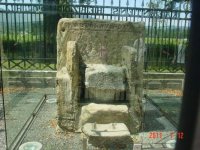
This is another example of the early Slovene language in Karantania which still used "Venetic" type of letters; Duke's chair (there are actually 2 of them; on other one are inscriptions in Slovene; "Sveti Veri" or "Holy faith" with "punctation" between several words- like was used in the Venetic language which was officially used until 1. c. "AD" )

ven.jpg

The famous "Sedes Tribunalis" (Tribunal seat); or "Sudonig Uhduk" (Sodnik Hudega (judge of the crime) in Slovene today)... The letter N and Y seems to drive similarities with Venetic alphabet; Y as "G". That's why some people speculate the chair was already made in times of Noricum.
 
since Archeology finds of the Venetic appear in abundance in Italy from 1150BC are you saying the slovenes where in Italy at that time?

If we consider the Veneti to be Illyrians (Italic/Keltic influence) centum Indo-Europeans akin to the Genauni/Breuni (linguistically attested) also Iapodes and Liburni than the Veneti and their kins are a much broader Alpine and Adriatic group;

The Iron-age cultures (Este and Krainer Hallstatt) all emerged from the Bronze-age Urnfield and thus show many similarities (the Situlae groups) and influences between each other;
greekbalkanscontactfc5.jpg


The Carni and Norici/Taurisci are however clearly described as Keltic which is manifested also by the deity Belenus which dedication inscriptions/shrines (Weihinschriften) was mostly found in Carni territory and Noricum;
 
The second name of Veneti was "Trojans" which derives from the term TOROI, which means "Torus, T(o)renje, roTation (inverted lingual root TR; RT), пов-Tорно, пов-Tорение, в-торник ("2nd"), "again, second, cyclic, rotational...)
The original term for Trojan (Paflagonian) Venetic city was VILUŠA (VILUSHA; "WHEEL-LUSHA"; The WHEEL (Torus) like city.

troy1.jpg


Etruscans often called themselves as "descendants of Trojan people". Their 3rd name was "Danav" (Also a name of rivers; Danube /Donava, Don, Dnieper, Dniester....), named after goddess Dana or Danica (or Zorya; "star") or Danu or Sara-Swati (this is Zorya Sveta; "Holy dawn"), which was mostly described as a white bird, a swan(Cygnus)...The famous "people from Don" (Dan) - coming from areas around Black sea, spreading into Anatolia, Egypt,... and from there pushed into the north, where they were establishing colonies (cities) for protection...


http://shrani.si/f/1G/pM/2VN1thMk/etruscan1.jpg


Etruscan inscription, "Tepharei" (Tevarey) Velianaz (Velianash (Viliunash; Viluash(Veliaz) " or Tefarei the Trojan in the Pyrgi tablets... From Toroi came the name of the "Tyrrhenian Sea" (Trojan (eTRuscan - Venetic sea)...
http://shrani.si/f/M/LF/25CHxpP0/tefarei-velianazh.jpg

Beautiful Trojan Helena in the Achean captivity... (this was also the whole point about the war for Trojan (Venetic) "Ilios" (Vilusha). Trojans wanted to secure their ancestry (women). That's why they have built a rounded city which was almost inaccessible. Second purpose of Tryo was meant to be a Calendar built on the ground, which they have inherited from their ancient ancestry...

helena3.jpg


(does this photo above remind you on somebody today, Ukraine?)

Arkaim (also compare with the city of Arkona) on the same geographical latitude as Stonehenge) as the fingerprint of the later city of Troy...


arkaim.gif
 
Last edited:
The second name of Veneti was "Trojans" which derives from the term TOROI, which means "Torus, T(o)renje, roTation (inverted lingual root TR; RT), пов-Tорно, пов-Tорение, в-торник ("2nd"), "again, second, cyclic, rotational...)
The original term for Trojan (Paflagonian) Venetic city was VILUŠA (VILUSHA; "WHEEL-LUSHA"; The WHEEL (Torus) like city.

troy1.jpg


Etruscans often called themselves as "descendants of Trojan people".


http://shrani.si/f/1G/pM/2VN1thMk/etruscan1.jpg


Beautiful Trojan Helena in the captivity... (this was also the whole point about the war for Trojan (Venetic) "Ilios" (Vilusha). Trojans wanted to secure their ancestry (women). That's why they have built a rounded city which was almost inaccessible. Second purpose of Tryo was meant to be a Calendar built on the ground, which they have inherited from their ancient ancestry...

helena3.jpg


(does this photo above remind you on somebody today, Ukraine?)

Arkaim (also compare with the city of Arkona) on the same geographical latitude as Stonehenge) as the fingerprint of later city of Troy...


View attachment 6493

Kobar
, may be hid-den in the name of the Slovene town Kobarid near
Italian border, which, judging by archaeological re-mains, was a cult place. Among other finds from the
Iron Age and the Hallstatt and Roman periods, the region of Kobarid treasures several offering plates
with Venetic inscriptions [15]. This fact indicates that the Venetes, with their presumed homeland in Anatolia
[16], may have worshipped the memory of Cybele and called their centre after her, altering the Phrygian
name. The Italian variant of this town’s name,Caporetto still bears some likeness, while German
Karfreit and Friulian Gaurêt do not. Moreover, the name of the metal
kobalt is derived from kobold , the name of a family spirit (brownie, “good fellow”) in
the German mythology since 13th c. AD. Its name may be easily associated with *
kobol , a variant of Cybele’s name, at the time when Germanic tribes got
acquainted with Venetic gods. A kind of evil spirit was called khobolos
in ancient Greece [17: s.v.el 27], possibly from the same source as
kobol , and a group of chthonic Greek deities, based on Hittite, Thracian,
Proto-Etruscan and Phrygian beliefs, were called kabeiroi
, whose Dossin name connected with Sumerian kabar ‘copper’.

or maybe even Norway

http://norik.net/PDF/ENGLISH SUMARY.pdf


and what about where the words came from
http://ladysbase.com/stream/Indoger...y_Indogermanisches_etymologisches_Wb_djvu.txt

 
"Kibela" derives from the older version of Sumerian Kubaba, Kubeba (the "Kuvava" in betatism) which contains the root "Baba", "older woman(mother, grand mother)", still used in Slavic languages, like was used also among Luwian and Lydian, Phrygian speakers in Anatolia. Slavic & Lithuanian readers will understand this word as Zemla, Zeme, Žemė or Zemlja, which means "Earth", the Etruscan (Trojan) form was Semele (Zemele). Kibela is a Latin and Greek version for Zemla or Semele.
Semele (Zemla) was a goddess of fertility and rebirth, an "earthly; gaia" goddess... It was related to the Patala (पाताल) Padova, "underworld" and "rebirth"...

Etruscan "Semele" (Zemla), from the right side

ogedalo.png

Apulu (Apollo) in the middle/second one from the right side; Apullu derives from Etruscan term "Starry, shining" (pulu-mxva), this means "paliti" in several Slavic languages or musPEL in old German (mus-PEL-heim (home))...
Second one from the left side is Fufluns ("Bacchus")... In Slovene dialects remained the term "Fuflunit" which means to "chatter", "over react" (also in food); "faflunit"...
 
Last edited:
Z280 Balto-slavic haplogroup is present in Veneto region (Italy), also its subclade CTS3402 - strictly Balto-slavic - is present in Veneto. We can argue a connection between Baltic region and Italian Veneto in ancient time (probably from Late Bronze age).
So the question about: is CTS3402, along with other sons of CTS1211, expanded in the Lusatian culture?
 
Hi Piero,

There is this lovely map.
http://f6.s.qip.ru/LHJwjnQR.png

With hotspots in ancient areas of Balt forest cultures, South Baltic region (Venedi), Brittany (Veneti Gaulic) and some traces to Italy (Venice) and other traces via Rumania (Dacia) on the way to Greeks. But I know only that this map is from molgen forum Russian version created by Semargl, dated 10-02-2014. They actually call this cluster on their forum veneti. I don't know though what this map is based on, apparently on modern frequencies of Z92+.

Seems suspiciously similar to where Venets were found, also amber trade routes. See also their frequency next to Finns/Estonians who still call Russia Venemaa/Venaja.

On other hand, I noticed the person who opened thread could find a similar map but claiming it for I2 :) So, could be false track.
 
Hi Piero,

There is this lovely map.
http://f6.s.qip.ru/LHJwjnQR.png

With hotspots in ancient areas of Balt forest cultures, South Baltic region (Venedi), Brittany (Veneti Gaulic) and some traces to Italy (Venice) and other traces via Rumania (Dacia) on the way to Greeks. But I know only that this map is from molgen forum Russian version created by Semargl, dated 10-02-2014. They actually call this cluster on their forum veneti. I don't know though what this map is based on, apparently on modern frequencies of Z92+.

Seems suspiciously similar to where Venets were found, also amber trade routes. See also their frequency next to Finns/Estonians who still call Russia Venemaa/Venaja.

On other hand, I noticed the person who opened thread could find a similar map but claiming it for I2 :) So, could be false track.

your scenario will only work if the veneti came from the baltic and took over the italian area from the indigenous bronze-age owners the Euganei

then again, if this happened , then why do we not see these markers you state all the way down the adriatic coast, in greece in crete and in the levant......venetians ruled these areas between 500 to 1100 years
 
I dont know Venetian history that well. When they were Venets amber traders and when they became Venetians Italians and what happened in between.
 
Back
Top