• Don't want to see ads? Install an adblocker like uBlock Origin or use a Europe-based privacy-friendly browser like Vivaldi or Mullvad.

Politics Future of Greece

Greeks monetary future:

  • Greeks will stay in Eurozone

    Votes: 13 52.0%
  • Greek will go back to Drachma

    Votes: 12 48.0%

  • Total voters
    25
And speaking of white collar crime, why isn't Schaubel in jail? This is the guy Merkel wanted to put in charge of Greek national assets?

Members of the ESM board can not be prosecuted.
 
There's no need to leave the union, because the U.S. government will bail them out one way or another. That's the difference between a real "union" and the pretend one in Europe. These are the differences between the two systems. (Rather than just rephrasing, I'll just quote. :))

"Common banking policies. US banks are regulated at the federal level, and the Federal Deposit Insurance Corporation guarantees banks in all 50 states. American regulators don't allow a bank in one state to hold too much of that state's debt. As a result, American states aren't vulnerable to local bank failures the way European countries are. A string of bank failures in Texas would mostly be a problem for the US government, not the government of Texas. Conversely, if an American state has a fiscal crisis, consumers don't need to worry that this will imperil the soundness of local banks.

Common fiscal policies.
In the United States, the federal government is responsible for a large share of overall government spending. That's not true in Europe, where the European Union's budget is much smaller than the combined budgets of EU member nations. This means that states are not as vulnerable to macroeconomic swings as European nations are.

"Retirees in Florida are paid out of the US Social Security system, not the Florida social security system "So if Florida gets into trouble, the retirees won't lose their benefits."

America's common tax and spending policies help to even out differences in states' economies. When a state is booming, the federal government collects more tax revenue from residents and businesses there. At the same time, demand for some government benefits declines. When a state's economy does poorly, the opposite occurs: tax revenue falls and federal benefit payments increase. These financial flows help to prevent the kind of extreme economic divergence we see in Europe right now.


A common labor market:
When some parts of the US have higher unemployment rates than others, people move to states where opportunities are better. Once again, this prevents extreme differences between state unemployment rates, contributing to an integrated national economy.

In theory, all those unemployed Greek people could move to Germany in search of work. But language and cultural barriers make that difficult in practice, and few Greek people have done so.

The euro could work with "ever closer union" — but that won't be easy


The currency's problems are by no means limited to Greece. Other countries in the Southern Europe, including Spain, Italy, and Portugal, have been suffering through years of unnecessarily high unemployment due in part to ECB policies.

And similar problems are going to crop up every time the continent experiences an economic downturn. The strongest economies will lobby against strong stimulus due to inflation fears, which will push weaker economies into unnecessarily long and severe recessions. Because most other European countries don't have Greek levels of debt, this may never produce a Greek-style financial crisis. But years of unnecessarily high unemployment is a humanitarian disaster in its own right.

The best way to avoid this outcome is the one we use in the United States: deeply integrate the economies of Eurozone nations so that a sharp divergence between European countries becomes impossible.


The EU has been working on proposals to better integrate the European banking system, though it's a long way from completing the job.

Developing a set of EU-wide taxing and spending policies — the counterparts to the US income tax and federally-funded benefits such as Social Security and Medicaid — will be a much bigger challenge. Every year, taxpayers in rich US states effectively subsidize federal benefits for people in poorer states; taxpayers in rich European countries are understandably wary of adopting a similar set of policies in Europe.

True labor market integration will be the hardest challenge of all, because here the problems are about language and culture more than government policy. The EU isn't going to have a shared language any time soon, so workers may never move around the EU as freely as they move around the US today.

But progress toward closer union has been slow, and there's reason to doubt whether it will ever be achieved. And if a more integrated Europe is out of reach, then the euro is a terrible idea that will impose needless suffering on millions of people for years to come. "

Conclusion: As long as the European Union remains a loose confederation of independent nations, the euro will be an economic menace

There is no way I believe that Germany or many other Euro countries really want the kind of union where when Detroit defaults, for example, the federal taxpayers still foot the bill so that the SSA benefits still get paid, the state still gives out food stamps, eventually the state or federal government come in and build everything up again. They want the benefits, but not the burdens.

We actually had many of the same kind of problems during the days of the Articles of Confederation, but they proved unworkable just like the Euro is unworkable, and so they were scrapped, and the founders drafted the Constitution of the United States, which still provides for some local controls but has an overlay of common banking, fiscal and labor policy on top of local ones. (The U.S. is still a republic and states and local municipalities still have power in ways that provinces and cities in a country like France do not.)

Part of the deal was that the debts of the individual states were absorbed by the new federal government. It was one of the more controversial elements but it had to be done.

Oh, he addresses the question of stimulus versus austerity too.

"Basic monetary theory says that when an economy is in a depression as severe as the one in Greece, the solution is aggressive monetary stimulus. So if you wanted to help Greece, you'd want to start printing more money in an effort to lower interest rates, boost demand, and bring down the country's unemployment rate. (The favorite stimulus of the American Republican party- Cut government spending, but put more money into circulation by cutting personal taxes. The favorite stimulus of the American Democratic Party-more government spending.)


On the other hand, if you were just focusing on the German economy, you'd reach the opposite conclusion. Germany's economy is already booming. The economy can't grow much faster than it already is. So more monetary stimulus will just produce inflation. You might even want to cut back to prevent the German economy from overheating.


The problem is that the ECB is responsible for both Greece and Germany — and 17 other countries as well. The right policy for Greece will be a disaster for Germany, and vice versa. Any policy the ECB picks will be either too tight for some European countries or too loose for others."
Probably path is first banking union, one of following steps can be fiscal union, and why not, as goal of long term process can be political union.

Of course, it is not easy, it can be uncertain and very long path.

But my opinion is that it is not utopia.
 
Yetos, we know you have a very strong opinion about genesis of this Greek crisis. Can you tell us what is the best solution for Greece in your mind?

there are many to be said,

many must change,

I just read what Albanians say,
they are right,
every one would like 'black working' work without pay the insurance ,
and each immigrant must pay the same tax as the citizen, and also pay the hospitals, and not cover behind poverty
 
Anxhela, I am sorry, but you are wrong about Greek economy. Probably you don't have information. In the past in Greece were a lot of jobs to do. Many Albanian emigrants worked there, because the Greeks refused to work . I am very informed about the Greek economy. I know from my friends working there, that Greeks don't like to work and they have a high standard of life. Why Greeks should have big pensions. All this anti German propaganda is disgusting. Germans are really hardworking people. Greece is fooling around with all Europe. I am sorry for my words but I am trying to be sincere . Thei need to reduce in maximum their pensions. To bring at 70 their pension age . To reduce in maximum their military budget. To reduce the administration salaries. And in the end they should sell some of their islands [emoji57]. Angela, I respect your opinion on the other threads, but here you are wrong, very wrong.


[emoji629]

Piro stop lying to yourshelf

Albanian worker are the most ignorant and stupid workers ever,
they 'know' everything, electronics, constructions, coffebars, agriculture, but they do all wrong,
I used few Albanians in my work, only to lift weights, and soon i kick them for their 'lazyness' they hide the irons inside concrete and structure had holes,
Albanians never care about stamps of insurance, so they worked in black works, droping prizes,
at 90's one good Albanian worker I had from Elbasan, he beg me to give him the stamps instead of state,
at 8 years he went back, he opened a tavern, and has a small hotel in Vlore,
he came back later and ask retirement cause he had some stamps and claimed he worked in fields,
they lived 4-6 persons in a 2 room flat, and all sell drugs
most of them illegal, and nobody did something cause of church which teach humanity.
which greek can live with other 6 in a 2 room appartment?

you never came to Greece to work so better stop.
you never know how Albanians live in Greece, what jobs they did, and what crimes they do,

it is like the first greeks who went in USA or Germany, they washed dishes at black working, or carry weights, and after 5-8 years when they came back they spoke about 'fairy tales'
making Americans and Germans stupid

and a question, if you are an Albanian, WHY YOU USE A GREEK NAME?


in Greece we say
ουδεις χειριστος παρα του ευεργετηθεντος
no one is worse than the one who got granted/grace
and
ουδεις βασιλικοτερος παρα της αυλης του βασιλεως
and worse than a bad king, are the 'royal' dogs
 
@Angela

to understand geopolitics and geostrategical

Angela the capital money) of Greeks are the ship owners (compare Agnelly wealth and position in Italy)
they are in uruguay/argentina and in London,

Greek culture is closer to Italy from all EU powers (Bulgaria Romania are not powers and Serbia Albania Turkey still out of EU)

But Greek heart/mind is France. and USA all right wings love England and France, and all left love USA and light left love Germany
I have said about Schauble and Tsochatzopoulos common

in Greek neighborhood is also Russia, but not in heart, lets keep good policies with neighbour, (it was not Russian at 1946, it was Communists :grin:)


anyway if Britain left Eurozone, Greece could be the puppy that follows, although that is uncertain but possible, since most capital is there,

now the 50 billion E Schauble ask can be a trap or a win,
it depends,
if germany takes 'free' the exit to East mediterennean, also takes control of balkans, which today seem to be under UN and OTAN, and gain not only the East North protectorates, but also the south East.


ANGELA WE WOULD BE OUTSIDE EUROPE NOW,
THE 'DON'T LEAVE FRANCE ALONE' and the 'NOT BACK TO USA like 1967' change everything... even the referendum
find date 23/07/1974

V G dE change it all
we pay back our morality depts

Tsipras signed worst paper, and tommorow might pass by parliament, no matter what referendum said,
cause he (VGdE) spoke, and Schauble with Lew had an 'interesting dialogue'
in Pythia plan 1 USA was planning to assasinate ex prime minister K karamanlis,
which all of a sudden Merkel made a fun party when he lost elections 7 years back :innocent:

Tsipras made a new branch in Greece,
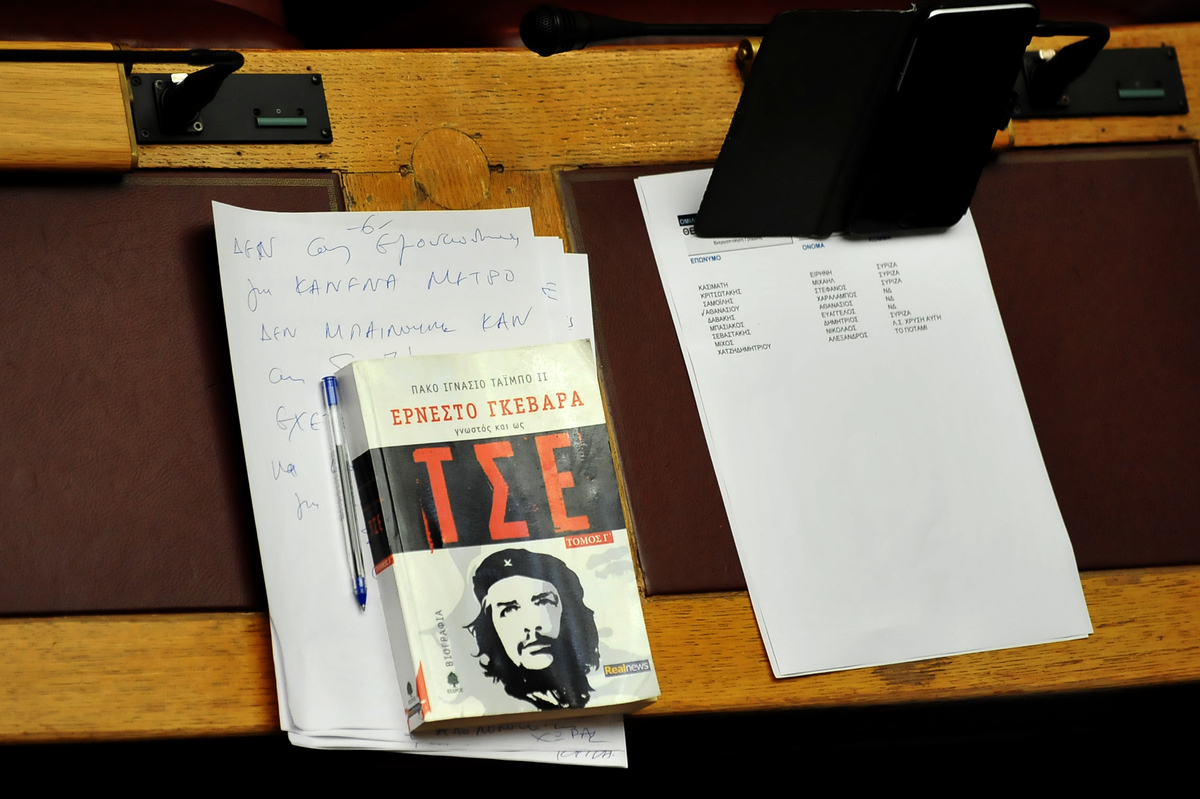
he used 'looneys' of CheGuevarra and might create a clear 'European' left, away from syndroms of 50-60's upon which 'looneys are sticked


slide_439756_5786818_free.jpg


Saturday night, the president of parliament chair,

and about Che, I admire him, and I consider him one of the greatest fighters for freedom,
but not a flag for Greece, and Greece is not to be governed by 'psychotics' who want revenge past.

that is why Dienekes said about 'looneys'

yet that move is dangerous, cause might bring back the known political 'mafi(l)ias' (familias)
some of them never worked just one hour outside politic


@ to all
I said before that Schauble won the fight, but not the war,
I am reading Tomas Piketty now from a translation,
i can not express the economical terms correct,
but in a chapter 'giving it back to English' he says that states unions etc must tax the very high capital to avoid hydrocephalic centralization,

my country has a small hydrocephalic problem, since Athens are more than 50% of population, and >46% of athens are fed by public or govermental issues
and at total was 43% before 7 years,
Hydrocephalic societies can survive only with expansion, (we know that past), maybe Piketty's proposal is a solution, to avoid wars from expasionism or imperialism, to survive an hydrocephalic society.
Anyway, I believe that international judges, and laws, must put an upper limit on states loan from privateers, and on how much a loan can be considered paid,
or better to forbid it at all, or what ever solution can be done,

anyway Fiscal union in EU is something that will be discussed for few years more, but I can not accept centralization,
 
Last edited:
Guys tomorrow I will give you some views that will never seen

Bicycler Elhorsto and Angela got good to the point

Elhorsto +1 for you understand the geopolitical and geostrategical, instead the stupid voices I heard many times for 'hard working'
I gave you 1 date 21/04/1967 did you find it?

Sorry, I missed this post of you. Thank you. Yes, I found that date.
 
As for Britain, we'll see what the British decide. This debacle may indeed impact the vote. I have no idea why Britain would ever consider joining, frankly. They're doing fine. If they want to join a larger union, they'd be better off and safer joining the US and adopting the dollar.

I think that would be very far fetched. Im not too sure if you are really aware of British phsycie? From my experience (I could be wrong too) the Brits have more concessions than any other EU member state and it still complains that its being strangled by Brussels. They have been saying it more or less since 1975. But knowing were Britian is coming from it is also understandable. Do you think they would like to be ruled by Washington? The Brits are still surrounded by the Empire aura which carries much pride. Believe it or not they carry much more affinity with France then the USA even thou they could look like sworn enemies. Use the odd French words buy French Fashion brands, drink French wine, eat french Cheese and you can consider yourself Elite. If they ever adopt the dollar then the Queen (from the house of Windsor derived from the German house of Wettin) needs to be printed. That would solve Hillary clinton case for having a women printed on the dollar bill :grin:. Dont forget the interest of a freetrade zone between the USA and the EU which will be much more beneficial for both.

This is sort of analogous to southern Italy wanting to secede from the north. It makes more sense in that Scotland has its newly discovered energy resources, so I suppose there's some hope that they could survive. However, wasn't the infrastructure built by outsiders? What is Scotland going to do? Nationalize it all? Who is going to capitalize them in the future, then? Does anyone know how much they pay in taxes versus how much they get in terms of benefits from the larger union? They'd better make sure they get more than they'll lose by all of this. What if "England" were to slap "tariffs" on whatever they produce? Every situation is different. What I do know is that decisions should be based on balance sheets and math, not fantasies of past "ethnic" glory.

Its not a straightforward situation like anything else. Scotland has resources. If England is out of the union and Scotland remains it will be in a better advantage then England to trade so it does not rely its life hood on England. Sometimes we seem to forget that there is freetrade between EU countries which brings about its own advantageous and a number of products would mean becoming noncompetitive when tariffs are put in place outside the free trade zone. So its a knife that cuts from both sides and one will always weighs the advantages to the disadvantages, but both needs to be identified as they are which is not always easy. Some are very tangible others not but still important.

I don't see it that way. It's the very fact that the EU is not more unified which is the cause of the fact that it isn't working, not for all countries.

Maybe before we judge if its working or not we should go back and find out from where all the countries are coming from and compare with 2015. ;)
It'salso true that within the EU itself there is a recognition of this fact. That'swhy there have been more and more laws passed to unify the banking system, for example. That's why there has been all that talk about trying to reach"more union". My point is that it's never going to happen.

Look at it this way. Some say that the EU survived and in my opinion was very successful for this very reason, that it was wise enough to respect its diversity and not slammed on the table some kind of dogmatic general agenda which were BIG mistakes with other leaders that had their own European agendas ;). That doesn't work with deep rooted old cultures anywhere in the world, so this tactic cannot be underestimated.


Maleth, you know how much I love my native country and its culture and the Italian people. It's just that I getvery frustrated when confronted by the unending "ethnic" conflicts and and even sub-ethnic conflicts and the constant harping on tribal differences that seems to torpedo any positive developments.


I agree with you but again it all depends from which angle one looks at things. See how recent example Italy and Germany were united. These conflicts would have spelt eternal violent conflicts in the past.Now they are fought in protests and in parliaments in elections and in referenda. Deep down everyone knows stability will bring process. Rebels wil lalways exist of course even ones that push agendas of hate and violence, but i would much think its the exception and not the rule when just up to a fewdecades ago it was the rule and not the exception. So in my opinion the EU is afantastic thing that has produced. Younger generations who think the world hasstarted with their birth should look back at how there fathers and fore fathers lived and what kind of Europe it was. That will maybe get them off their illusionary high horse.


Also,forgive me, visiting is different from living there. I will happily one dayretire there, and pay my taxes there, but would I want my children to re-locatethere or anywhere in Europe? If I have to be honest, no I wouldn't.
What you can do here in terms of individual betterment and self actualization if you have a brain and the willingness to work hard is not possible anywhere else, in my opinion, and you can do it without all this everlasting and destructive inter-European conflict, and before you say it, yes, we have our racial conflicts, but I am optimistic that we will solve those as well with enough good will on all sides.

Indeed. Lets not forget that the USA is a BIG place and not all opportunities are equal. New york is the captial of the world, but New York is not all USA. Not everyone has a grand lifestyle like everywhere else. We all know that Pron's can create Con's, and who is designing the calculator? Its good we talk about the best, but there is also a negative side which is very much under reported. Material gain does not always equal genuine contentment and satisfaction. But that is a totally different subject one can write volumes on. The Media swells situation out of proportion and the constant repetition of the same subject with same images creates false impressions in peoples minds...... Example CNN interviewed an American couple who was spending the honeymoon in Greece and said that if you do not watch the Media you would have thought that nothing is happening here if you get my gist. It dosent mean that challenges are not real, but the BOMBARDMENT of different arguments and Imagery can create false impressions in a persons mind.

(sorry if there are parts that are scribbled, because after writing all this the systme asked me log again in when i was logged in and in the process lost everything - V E R Y A N N O Y I N G :angry::grin:
 
Maybe you haven't read the whole thread. You certainly haven't read any of the articles to which I linked.

I excoriated the Tsipras government and him personally. I think I may have unwittingly offended some members by calling leftist economics "loony" or silly, but that's what I believe and it slipped out. I apologize for any offense.

If anything, I am a fiscal conservative. I believe that Greece should privatize its industries, employers should have the power to fire unproductive workers, incentives should be put in place to attract investment, and on and on. Also, the gamesmanship engaged in by Tsipras and his government without any real plan for an exit strategy was criminal, as I repeatedly said.

However, I have always thought, and now think, that the Eurozone was poorly conceived and flawed, and that countries would surrender their sovereignty to it, which would eventually mean surrendering their sovereignty to banks and financial institutions, at their peril. I also have always thought, and now think, that certain countries would be in better shape had they retained their own currencies. They would have been in much better shape had they not only retained their own currencies, but also instituted market oriented reforms.

This brings us to the debt itself. There has been double dealing and dishonesty on all sides from the very beginning. The Greek government was dishonest in hiding liabilities in order to meet entrance requirements. The investment bank was dishonest in helping them do it. The EU officials were dishonest in knowing it and looking the other way, and I don't buy that it was all because they didn't want Greece to fall into the Russian sphere. They wanted it because its always been about markets and flooding these countries with the goods produced by certain nations. Are some Europeans so deluded by the propaganda that they don't see it?

There's also a whole debate among economists as to what to do when nations go into debt. Yes, spending has to be brought under control, but the most important thing is to encourage growth, because the deficits would start to melt away in the face of growth. How much "austerity" is too much and will not only retard growth, but, perhaps, plunge a country into a depression? It's a delicate balancing act, and frankly I believe the Eurozone leaders have failed in this regard. Certainly, as has also been pointed out by numerous economists, lowering the interest rate and extending the payment period has NEVER worked. Piling more debt on top of the existing debt means that a country, in this case Greece, will never be able to pay it back. The face amount has to be reduced. I've yet to see any independent economist who doesn't advocate that.

I honestly don't totally understand what is going on in the minds of the leaders of the EU. I tend to decry and mock conspiracy theorists, but I am starting to wonder. This isn't sound business. Capitalism isn't a morality play. It's about getting the best deal. It's about keeping your eye on the ball, not plundering and punishing an entire country of human beings, for God's sake. .

I'm not even going to address all the B.S. in the founding documents of the Eurozone about European unity and helping one another grow as a community of nations. That was obviously pablum for the masses. That's never what it was about. That anyone could still believe that after this weekend is a testimony to ignorance, in my opinion, and the power of stereotypes and propaganda.

I sincerely hope that the British, for whom I have admiration, take heed and vote no in the coming referendum. The best thing for certain countries would be to negotiate an orderly exit from the Euro and institute more and deeper market reforms. Unfortunately, I don't think they have the ***** to do the first or the knowledge of how to manage an economy to do the second. If Eurozone populations think that there was or is now any real desire to create a "United States" of Europe, I think you're living in la la land.

Speaking of stereotypes and propaganda...I find it amusing in a rather grim way that you would be dealing in stereotypes when your own country can be and has been so easily stereotyped.

Will Europeans ever be able to look at any single phenomenon, economic, political, cultural whatever, without doing so through the prism of idiotic tribal allegiances and hostilities? These are the times I'm glad my parents took me the ****out of Europe.
As for my posts here on this thread and everywhere else, I try to examine every topic and issue with as much information as I can gather, and as much reason as I can muster, and, to the best of my ability, I try to divorce myself of any ethnic or personal considerations when I'm discussing history or genetics, or, in this case, economics. That's the way I was trained personally and professionally. It doesn't mean I'm always right, of course.

I agree with everything you write in this post. Except, like I said already, I is not fair to blame Tsipras only, and at the same time to spare Samaras, who created most of the situation (cheating into EURO, piling dept), just because his party is ideologically aligned with Schäuble's CDU. Politically I'm agnostic for the most. I also agree that austerity is good, and it must be constructive austerity, not destructive austerity. What was done to Greece is like allowing an alcoholic to buy booze, but not allow him to buy healthy food, education, and to force him to sell his laptop, car and accomodation such that he has more difficulties to find a job. This makes only the barkeeper happy.
I think even the IMF admitted that their austerity failed.
I also want to stress that this brainless destructive austerity costs also us germans tax payer's money. We have a vital interest to enable Greece to pay back as much as possible (the private lenders not anymore, they want to go shopping cheap once they are relieved by us tax payers). But I don't want my tax money to be wasted for irrational revenge and punishment. Afterall, Greece might not remain the last problematic country. Even Germany might eventually come into the same situation (unless it manages to become an empire, harharhar...<evil grin>).
 
I already posted this talk from G. Friedman (Stratfor) in another thread. Here it is again, because it is a must hear. I do not agree with everything, and he certainly skipped important aspects, yet it is probably the most insightful talk for anybody who is interested in geopolitics and european matters from US perspective. Among others he claims that Europe will return to it's "normal state of perpetual wars and conflicts", not like world wars, but something like 19th century. This reminds me of the promises about the "currency of peace". The last 15 min are most interesting, it is the Q&A. Here he starts talking about Germany:

[h=1]Europe: Destined for Conflict?[/h]"Germany is addicted to export...Merkel is bluffing..."

I agree with that and might add that there is no boom in Germany. The whole western world entered deflation/depression time since 2008 (some say 2001), as represented by record low interest rates, wars and quantitative easing in order to fight deflation, which is causing inflation only in the equity markets. Germany is just doing relatively well at the moment and I have no clue what comes next once the EU markets fade out and Russia is gone to China. The only remaining market might turn out to be the US at the end.
 
On the other hand, if you were just focusing on the German economy, you'd reach the opposite conclusion. Germany's economy is already booming. The economy can't grow much faster than it already is. So more monetary stimulus will just produce inflation. You might even want to cut back to prevent the German economy from overheating.


The problem is that the ECB is responsible for both Greece and Germany — and 17 other countries as well. The right policy for Greece will be a disaster for Germany, and vice versa. Any policy the ECB picks will be either too tight for some European countries or too loose for others."

Germany has neither boom nor inflation. To the contrary, the wage and price increase was and is the lowest in Europe. The point is that a hard EURO strengthens Germany, Finland and other northeners only when compared to the rest.
Look what Finland is doing now in order to fight deflation:

https://en.wikipedia.org/wiki/Basic_income#Finland

The Centre Party, one of Finland's four major parties, as well as the Left Alliance and Green League, have all expressed support for basic income.[82]
BIEN Finland launched a citizens' initiative.[83][dated info]

I also read somewhere that Switzerland (even more deflationary) plans a referendum next year about basic income. If I recall correctly, plans are to give 2000 EUR per month undconditionally to everybody!

In the US, Ben Bernanke was ridiculed as "Helicopter Ben" because he suggested dumping money from helicopters in case of depression, but some europeans got the idea.
 
Maleth;462462]I think that would be very far fetched. Im not too sure if you are really aware of British phsycie? From my experience (I could be wrong too) the Brits have more concessions than any other EU member state and it still complains that its being strangled by Brussels. They have been saying it more or less since 1975. But knowing were Britian is coming from it is also understandable. Do you think they would like to be ruled by Washington? The Brits are still surrounded by the Empire aura which carries much pride. Believe it or not they carry much more affinity with France then the USA even thou they could look like sworn enemies. Use the odd French words buy French Fashion brands, drink French wine, eat french Cheese and you can consider yourself Elite. If they ever adopt the dollar then the Queen (from the house of Windsor derived from the German house of Wettin) needs to be printed. That would solve Hillary clinton case for having a women printed on the dollar bill
grin.png
. Dont forget the interest of a freetrade zone between the USA and the EU which will be much more beneficial for both.

Malteth, I wasn't seriously suggesting that Britain adopt the dollar. I'm in favor of all countries maintaining their own currency, even if they have more or less free trade zones. A total union would be out of the question. I have too much respect for Britain's unique history and culture to ever suggest that they devalue it in any way. I was merely saying that, in my opinion, if Britain were ever to decide to adopt another currency, it would have much less to fear in a monetary union with us than in one with the Eurozone, whether all of them know it or not, and, in my experience, a lot of them do know it. Something like a million Brits work here, and more for American firms abroad. Many buy vacation homes here. Many, many Americans work in Britain or for British firms. The similarities between the two countries go way beyond what wine or food they consume; we share a language, a very similar legal system (ours derives from theirs), even, I would maintain, a similar social structure. The integration of British people here and Americans there is almost seamless. The experience of a British person moving here is very different from that of a Frenchman or an Italian. I am quite aware that some would hold that the "special relationship" is fraying, in part specifically because America is in favor of the Euro, but I think it's like a marriage, it has its ups and downs.:)
http://carnegieeurope.eu/strategiceurope/?fa=59867

As to the rest, Maleth, I am afraid that in this case we are going to have to agree to disagree. I think it's a very bad idea.

Oh, I feel your pain about losing posts. I try now to remember to copy everything before I click quick reply just in case the system has time me out, then sign in again, and paste in the work. It was either that or hurl the laptop across the room. :)
 
Last edited:
I already posted this talk from G. Friedman (Stratfor) in another thread. Here it is again, because it is a must hear. I do not agree with everything, and he certainly skipped important aspects, yet it is probably the most insightful talk for anybody who is interested in geopolitics and european matters from US perspective. Among others he claims that Europe will return to it's "normal state of perpetual wars and conflicts", not like world wars, but something like 19th century. This reminds me of the promises about the "currency of peace". The last 15 min are most interesting, it is the Q&A. Here he starts talking about Germany:

Europe: Destined for Conflict?

"Germany is addicted to export...Merkel is bluffing..."

I agree with that and might add that there is no boom in Germany. The whole western world entered deflation/depression time since 2008 (some say 2001), as represented by record low interest rates, wars and quantitative easing in order to fight deflation, which is causing inflation only in the equity markets. Germany is just doing relatively well at the moment and I have no clue what comes next once the EU markets fade out and Russia is gone to China. The only remaining market might turn out to be the US at the end.

Excellent video. I'll address the particulars later when I have more time.

Let me tell you, I know something about the real estate market in New York. The number of foreigners from EVERYWHERE, from Europe to Latin America to Asia coming in and dumping absolutely OBSCENE amounts of money to buy property in the area is staggering. They're also spending like there's no tomorrow in Florida and other vacation areas. (The Latin Americans and some Europeans love Miami, but Germans and Brits love Florida too. The local market in the area I visit now has a huge, long aisle devoted to their food and wine products. They come in summer, mainly, which amazes Americans...it's inhumanly hot and humid in summer.) Honestly, I can't believe it. Of course, it's also pricing these places totally out of reach for a lot of Americans as well, even if these people also spend money on everything else as well, putting more money into circulation.

Obviously, a lot of the 1 percent see it as the only really safe bet.
 
I already posted this talk from G. Friedman (Stratfor) in another thread. Here it is again, because it is a must hear. I do not agree with everything, and he certainly skipped important aspects, yet it is probably the most insightful talk for anybody who is interested in geopolitics and european matters from US perspective. Among others he claims that Europe will return to it's "normal state of perpetual wars and conflicts", not like world wars, but something like 19th century. This reminds me of the promises about the "currency of peace". The last 15 min are most interesting, it is the Q&A. Here he starts talking about Germany:

Europe: Destined for Conflict?

"Germany is addicted to export...Merkel is bluffing..."

I agree with that and might add that there is no boom in Germany. The whole western world entered deflation/depression time since 2008 (some say 2001), as represented by record low interest rates, wars and quantitative easing in order to fight deflation, which is causing inflation only in the equity markets. Germany is just doing relatively well at the moment and I have no clue what comes next once the EU markets fade out and Russia is gone to China. The only remaining market might turn out to be the US at the end.

Please. You shouldn't take Friedman serious. The guy is about as credible as the late Tom Clancy, with the difference Clancy actually explicitly wrote fiction and called it fiction. :laughing:

I honestly do not know how Friedman makes his money, because he's notoriously bad at predicting the future:
Back in 1991, Friedman wrote a book called "The Coming War With Japan", in which he predicted that Japan would rise as a superpower and challenge the United States in a war. Which, needless to say, didn't happen. Instead, which Friedman spectacularly managed to somehow overlook, China became the largest economy in Asia. But it doesn't stop there, because the guy didn't get any smarter: in 2009, he published a book called "The next 100 years", which is even more lunatic in its predictions: in the book, he "predicts" that Russia fragments, China returns into the Warring States period and Japan (again) re-establishes the Greater Asian Co-Prosperity sphere. He claims that Poland will become a superpower annexing large parts of Eastern Europe (including European Russia), and around circa 2050 he has a world war III between Poland, Turkey (or should I say, the New Ottoman Empire :wary2: ) and Japan on one side and the United States on the other. Which the United States, of course, win.

He's the chair of an so-called "intelligence" company but doesn't even understand basic economics, demographic developments (otherwise he would have noticed that Japan is facing a steep demographic decline), nor could he foresee the emergence of the Daeesh in Syria. And he would have noticed that 2015 Japan still is economically stagnant. In summary, if Friedman was actually honest with himself, and with the world, he should start writing techno thriller fiction like the late Clancy, and not pretend that he's a genius who has "figured it all out" with access to "secret information" that nobody else seems to have.
 
Excellent video. I'll address the particulars later when I have more time.

Let me tell you, I know something about the real estate market in New York. The number of foreigners from EVERYWHERE, from Europe to Latin America to Asia coming in and dumping absolutely OBSCENE amounts of money to buy property in the area is staggering. They're also spending like there's no tomorrow in Florida and other vacation areas. (The Latin Americans and some Europeans love Miami, but Germans and Brits love Florida too. The local market in the area I visit now has a huge, long aisle devoted to their food and wine products. They come in summer, mainly, which amazes Americans...it's inhumanly hot and humid in summer.) Honestly, I can't believe it. Of course, it's also pricing these places totally out of reach for a lot of Americans as well, even if these people also spend money on everything else as well, putting more money into circulation.

Obviously, a lot of the 1 percent see it as the only really safe bet.

His predictions have been totally off the mark, but that is exactly how a lot of American analysts view Europe and what is going on there.
 
Please. You shouldn't take Friedman serious. The guy is about as credible as the late Tom Clancy, with the difference Clancy actually explicitly wrote fiction and called it fiction. :laughing:

I honestly do not know how Friedman makes his money, because he's notoriously bad at predicting the future:
Back in 1991, Friedman wrote a book called "The Coming War With Japan", in which he predicted that Japan would rise as a superpower and challenge the United States in a war. Which, needless to say, didn't happen. Instead, which Friedman spectacularly managed to somehow overlook, China became the largest economy in Asia. But it doesn't stop there, because the guy didn't get any smarter: in 2009, he published a book called "The next 100 years", which is even more lunatic in its predictions: in the book, he "predicts" that Russia fragments, China returns into the Warring States period and Japan (again) re-establishes the Greater Asian Co-Prosperity sphere. He claims that Poland will become a superpower annexing large parts of Eastern Europe (including European Russia), and around circa 2050 he has a world war III between Poland, Turkey (or should I say, the New Ottoman Empire :wary2: ) and Japan on one side and the United States on the other. Which the United States, of course, win.

He's the chair of an so-called "intelligence" company but doesn't even understand basic economics, demographic developments (otherwise he would have noticed that Japan is facing a steep demographic decline), nor could he foresee the emergence of the Daeesh in Syria. And he would have noticed that 2015 Japan still is economically stagnant. In summary, if Friedman was actually honest with himself, and with the world, he should start writing techno thriller fiction like the late Clancy, and not pretend that he's a genius who has "figured it all out" with access to "secret information" that nobody else seems to have.

Yes, he possibly also expresses his wishful thoughts. I don't take him serious in that sense to believe his predictions. I hope he will be wrong again. But it is still very interesting, because he is respected and Stratfor is market leader. And some of what he says is still plausible. The risk of conflicts has obviously increased as EURO-countries start to blame each-other.

EDIT: And to save his honour, making predictions is always difficult, especially concerning the future. Most famous stock market predictors are also wrong most of the time. Yet their underlying arguments can be fundamentally sound. It's that reality remains chaotic to a large extent, regardless how good you analyze. But yes, at least his predictions for 2050 are most likely pure marketing buzz.
 
Last edited:
anyway Fiscal union in EU is something that will be discussed for few years more, but I can not accept centralization,

Yetos
I agree with Angela, monetary union without fiscal union cannot functioning properly. Common fiscal policies in Eurozone are necessary. Of course, you are right, is it require more centralization, yes, although solutions can be innovative. Fiscal union is logical path but not easy. Change should, among other things, redistribution spending from budgets countries members to the budget one currency union. It requires political decisions, not only economic. Countries members should be prepare for change and determined to carry it through to the end. If someone has vision of Federal Europe it requires much more things, but fiscal union is significant step forward.
 
Yes, he possibly also expresses his wishful thoughts. I don't take him serious in that sense to believe his predictions. I hope we will be wrong again. But it is still very interesting, because he is respected and Stratfor is market leader. And some of what he says is still plausible. The risk of conflicts has obviously increased as EURO-countries start to blame each-other.
It is mostly plausible to people who are naturally drawn to such disastrous scenarios. It is more about personality than reality. The unhappiness and disagreements obviously is high in EU at the moment, but it is huge exaggeration to imagine that it can end up with conflicts, military altercation or even war.

To go from massacre, poverty and hatred of WW2 to European Union of many cooperating nations and ethnicities in less than 50 years was an extraordinary achievement and evolution of European psyche. Such tremendous transformation of Europe denotes very powerful and natural forces consolidating it. Forces which can't be undermined by, minor or not, inconvenience of some people of members. Forces like economic cooperation, free movements of goods, services and people, granting freedom of work and location to people of EU, equalizing social and economic developments of members. EU gives people a pride to belong to such powerful Union (not unlike US citizens). How anyone can even speculate that European Union can disintegrate due to economic hiccups, stagnation in some countries, possible bankruptcy of Greece, or due to a notion that Europeans couldn't create a perfect Union in short 25 years of its assistance? Things which are rather minor, fixable and adjustable in grand skim of things. Members are free to stay and free to go. New members come since the recession and nobody leaves. Heck, even the communist government of Greece wants to stay!
Paraphrasing Star Wars: "EU force is strong".:grin:
 
It is mostly plausible to people who are naturally drawn to such disastrous scenarios. It is more about personality than reality. The unhappiness and disagreements obviously is high in EU at the moment, but it is huge exaggeration to imagine that it can end up with conflicts, military altercation or even war.

1. He was talking about Europe, not just EU.
2. It is already happening (Macedonia, Ukraine, Greece is very close if it defaults like Argentina 2001)

To go from massacre, poverty and hatred of WW2 to European Union of many cooperating nations and ethnicities in less than 50 years was an extraordinary achievement and evolution of European psyche. Such tremendous transformation of Europe denotes very powerful and natural forces consolidating it. Forces which can't be undermined by, minor or not, inconvenience of some people of members. Forces like economic cooperation, free movements of goods, services and people, granting freedom of work and location to people of EU, equalizing social and economic developments of members. EU gives people a pride to belong to such powerful Union (not unlike US citizens). How anyone can even speculate that European Union can disintegrate due to economic hiccups, stagnation in some countries, possible bankruptcy of Greece, or due to a notion that Europeans couldn't create a perfect Union in short 25 years of its assistance? Things which are rather minor, fixable and adjustable in grand skim of things. Members are free to stay and free to go. New members come since the recession and nobody leaves. Heck, even the communist government of Greece wants to stay!
Paraphrasing Star Wars: "EU force is strong".:grin:

That's all well and good, but my concern is not EU but the EURO, which is already showing it's failures that were predicted not only by Friedman.
 
Yes, he possibly also expresses his wishful thoughts. I don't take him serious in that sense to believe his predictions. I hope he will be wrong again. But it is still very interesting, because he is respected and Stratfor is market leader. And some of what he says is still plausible. The risk of conflicts has obviously increased as EURO-countries start to blame each-other.

EDIT: And to save his honour, making predictions is always difficult, especially concerning the future. Most famous stock market predictors are also wrong most of the time. Yet their underlying arguments can be fundamentally sound. It's that reality remains chaotic to a large extent, regardless how good you analyze. But yes, at least his predictions for 2050 are most likely pure marketing buzz.

Well, I certainly don't wish the Eurozone or any European country to fail, and neither does Friedman or any other American economic or political policy maker. It's in America's interest to have a prosperous Europe. He may be unduly pessimistic, but I don't see where, if you listen to the whole speech, you can find a flaw in his analysis of either European history or the Eurozone or how the Greek debt crisis should be handled.Also, nobody ever loses money being pessimistic about human behavior, and he is in the business of advising corporations and and wealthy people how to protect their assets.

I can tell you he speaks for many people in the markets. I realize it offends Europeans to hear it, and I apologize for that, but Americans have been wary of European fratricidal tendencies since the days of George Washington. It's also refreshing to hear the issues discussed with the kind of directness, clarity and no nonsense pragmatism which seem to me so sorely lacking in the expositions of continental European leaders.

To be brutally honest, I actually used to have more hope for Europe. Just one year of reading anthrofora disabused me of those notions. Scratch the surface and all that nonsense is still there.
 
Back
Top