• Don't want to see ads? Install an adblocker like uBlock Origin or use a Europe-based privacy-friendly browser like Vivaldi or Mullvad.

The genetic history of Ice Age Europe

Really which one? You mean Rise- 397? You think being so close to your theoretical homeland; we should find some in Iran highlands possibly? After all it is found as far away as Sardinia.
iyn4h5.jpg

Yes, whats wrong about that sample? You said there isn't any I said there is so sarcams isn't needed here. I haven't seen any Z2103 in ancient Sardinia yet but there is the possibility, why not? ;)


Also as Tomenable already pointed out we don't actually have any Bronze-Neolithic samples from anywhere beyond Anatolia. And as I said a milion times, I don't think Anatolia is where were we will find allot of R Haplogroups. Why should we? And why would that be such a big suprise for you? We are dealing here with two very different components just from Anatolia to Georgia (EF vs CHG)! How comes it is so hard to imagine very different Haplogroups from Anatolia to the Iranian Plateau?

But it isn't so hard to imagine the same scenario just in the North where in the Balkans we expect and see I and G Haplogroups and in Ukraine R Haplogroups in combination with other. The distance from Central Anatolia to Iranian Plateau is not smaller than the distance from Balkans to Ukraine or North Caucasus.
 
This touches on one aspect of the R1b argument imo - the people arguing aren't always talking about the same bit of R1b.

Exactly. R Haplogroups are so old I argue that they must have been widespred across Eurasia at least by Late Neolithic already. We find R1b v88 5500 BC in a Farmer sample from Iberia. Who is going to argue that this guy came from the Steppes? It obviously came from the Levant via the North Africa route.
 
Exactly. R Haplogroups are so old I argue that they must have been widespred across Eurasia at least by Late Neolithic already. We find R1b v88 5500 BC in a Farmer sample from Iberia. Who is going to argue that this guy came from the Steppes? It obviously came from the Levant via the North Africa route.

That guy may have came that way, but V-88 may very well have originated on the steppe 10k years prior.
 
There really is a vast gaping void in West Asia when it comes to ancient genomes.

I think we have some Mesolithic from Northern Iran on the way, Harrapan, Maykop etc., but it's hugely lopsided right now with all that we have from North Eurasia. It's impossible not to have biased models.
 
Yes, whats wrong about that sample? You said there isn't any I said there is so sarcams isn't needed here. I haven't seen any Z2103 in ancient Sardinia yet but there is the possibility, why not? ;)
Sorry I did not mean to come across as being sarcastic. I just wanted to emphasize, one of the pitfalls of broadly labeling under R1b-Z2103.
The Armenian sample Rise-397 is pretty decent quality.
It is actually Under R1b-CTS7763. Now see if you can find any samples in the regions you think it should be; for example your Iranian plateau theory?
It is found in Sardinia, Tabarassan's , Han Chinese, and around Bashkir region, beside the ancient Armenian sample from LBA Kapan 1048-855B.C. +/- Armenia.

Eurogenes plot showing the Armenian samples pulling toward Steppe.
x6lth1.jpg

http://eurogenes.blogspot.ca/2015/08/armenian-population-structure-across.html


Rise-397>R1b-2106>CTS7763+ Ancient Armenian sample from LBA Kapan 1048-855B.C. +/- Armenia.Found in present day populations of Sardinia, Tabarassan's , Han Chinese, and Bashkir region.

2i1o4qu.jpg


260sete.jpg


https://www.yfull.com/tree/R-CTS8966/
http://www.kumbarov.com/ht35/R1b1a2_ht35_project_tree_27_03_09_2016.pdf

....... How comes it is so hard to imagine very different Haplogroups from Anatolia to the Iranian Plateau?
Are you aware the R1b clade that is found among Lur's?
 
There really is a vast gaping void in West Asia when it comes to ancient genomes.

I think we have some Mesolithic from Northern Iran on the way, Harrapan, Maykop etc., but it's hugely lopsided right now with all that we have from North Eurasia. It's impossible not to have biased models.

Sometimes the samples have been tested but results not released. For example, we have known King Tut's blood type since 1969. However his ydna was never officially released. It would probably be pretty easy to retest his result's with up to date snp's. Just to glean more information, from different sources.
http://www.nature.com/nature/journal/v224/n5217/abs/224325a0.html


This would account for the allele sharing in meso-Euros (WHG) and near East, assuming CHG passed it on.


That could be why CHG is more related to WHG than other pre-Neolithic Europeans, but that probably isn't why modern Near Easterners are. Modern Middle Easterners are even more shifted towards WHG than CHG was. They probably have WHG ancestry, just as Neolithic Turkish did.
 
That could be why CHG is more related to WHG than other pre-Neolithic Europeans, but that probably isn't why modern Near Easterners are. Modern Middle Easterners are even more shifted towards WHG than CHG was. They probably have WHG ancestry, just as Neolithic Turkish did.

Apples and oranges. Moderns have had thousands of years for shit to happen.

Neolithic Turkish Lol that's like saying Neolithic American. But yeah I'm saying that in some way WHG contributed to both ENF and CHG no too long after the LGM.
 
Sorry I did not mean to come across as being sarcastic. I just wanted to emphasize, one of the pitfalls of broadly labeling under R1b-Z2103.
Ok than, it kinda appeared different to me.
The Armenian sample Rise-397 is pretty decent quality.
It is actually Under R1b-CTS7763. Now see if you can find any samples in the regions you think it should be; for example your Iranian plateau theory?
It is found in Sardinia, Tabarassan's , Han Chinese, and around Bashkir region, beside the ancient Armenian sample from LBA Kapan 1048-855B.C. +/- Armenia.

Eurogenes plot showing the Armenian samples pulling toward Steppe.
x6lth1.jpg

http://eurogenes.blogspot.ca/2015/08/armenian-population-structure-across.html


Rise-397>R1b-2106>CTS7763+ Ancient Armenian sample from LBA Kapan 1048-855B.C. +/- Armenia.Found in present day populations of Sardinia, Tabarassan's , Han Chinese, and Bashkir region.

2i1o4qu.jpg


260sete.jpg


https://www.yfull.com/tree/R-CTS8966/
http://www.kumbarov.com/ht35/R1b1a2_ht35_project_tree_27_03_09_2016.pdf


Are you aware the R1b clade that is found among Lur's?

in comparison to North Caucasians or CHG the BA Armenian samples doesn't pull more significantly towards the Steppes. Steppic ancestry is relative I have seen runs where the BA Armenia samples had zero Steppic ancestry. I don't doubt that Davids work will show anything but R1 samples pulling towards the Steppes ;)
 
None of our UP European genomes are the primary ancestor of WHG. Humans who lived in Central Europe and Southern Italy 30,000 years ago appear to be WHG's uncle or partial ancestor though. WHG's primary ancestors might not have been living in Western Europe till after 15,000 years ago, they could have been living in Eastern Europe or West Asia.

If El Miron has WHG admixture in 19.000 ya and WHG had mtDNA U5b while mesolithic Greeks had mtDNA K1c, and the first U5b found was Paglicci71 (18.000 ya), and archaeolology already considered Epigravettian Italy a distinct culture, you can safely assume that WHG originated in Italy. How it got its slight Middle-Eastern affinity as compared to the other UP Europeans? Who knows. Via Greece? Or is it an artifact, created by the decreasing Neanderthal affinity, as Chad Rohlfson suggested?

Mind you, all WHG had Aurignacian (GoyetQ116) ancestry.
 
Razib Khans opinion on this. Interesting allot of his points agree with my opinion.

Razib Khan said:
The Villabruna cluster ~14,000 years is a product of a massive expansion of a hunter-gatherer population from the Middle East. The original papers which posited that “Early European Farmers” (EEF) were admixtures between “Basal Eurasians” (BEu) and WHG, at 40% to 60% proportions, were somewhat misleading I suspect. Rather, WHG, the Mesolithic hunter-gatherers of Europe, derive predominantly from an expansion of Middle Eastern hunter-gatherers which had larger populations in the wake of the grueling climatic regime of the Last Glacial Maximum. The WHG in EEF was not European hunter-gatherer at all, but local Middle Eastern hunter-gatherer.

The WHG signal, as well as the Middle-Eastern signal is visible in the El Miron samples. El Miron itself lived at the end of the LGM. You have me believe then that Anatolian hunter-gatherers would massively overcome a desert in Anatolia, and an ice cap on the French alps, just to find a refuge?

I'v been pushing this story lately: HG's are not like pastoralists or agriculturalist. They follow the herds of what they hunt, whereas Yamnaya pastoralists take their herds with them. The transhumance wouldn't make any sense to a HG. That greatly impacts migrations. Take for instance Mammoths, the staple food on the Gravettians and ANE. Mammoths lived from France and Moravia up until Northern China and Mongolia. That fact alone makes it clear why Kostenki15 can be ancestral to Moravian Gravettians, why ANE contacted WHG, why ANE contacted East-Asians, why the resulting hybrids crossed Beringia at exactly that time.

The migration of herds explain why reindeer hunting Magdalenians [1] kept going north when the reindeer trekked north following the retreating ice caps and tundra, starting the Ahrensberg culture and beyond. It thus explains why they migrated all the way to the Baltics, where WHG admixture is high.

What hunting game trekked from West-Asia to Europe?

Also, read this: www.anthrogenica.com/showthread.php?7107-Ice-Age-Europe-Some-stats-and-opinions&p=155609&viewfull=1#post155609

[1] https://www.researchgate.net/public...in_Southwestern_France_during_the_Magdalenian
 
And the East Eurasian Han like ancestry is from a different event/source which is also atypical for EHG as well CHG but support a region in close range to East Eurasian ancestry. Something tells me this might possibly even be South_Central Asia.

The East-Asian signal is not found in all WHG samples. But in the ones it is, it is consistently accompanied by an American signal. That points to ANE admixture, maybe after its mingling with proto-Mongolians or maybe points to ANE admixture in East-Asians. It could even be an artifact of the fact that the Neanderthal admixture declines over time from 5% to 2%. Mind you, whatever it is: The paper clearly state that they also find an East-Asian signal in Mal'ta.

And in that respect it is noteworthy Hungarian HG KO1 and Afontova Gora 3 had the same extremely rare mtDNA haplogroup: R1b, or R3, which has only been described in one Finn, one Armenian (Family Tree database, http://www.familytreedna.com/) two Yakuts and one Bengali individual.

http://www.nature.com/ncomms/2014/141021/ncomms6257/extref/ncomms6257-s1.pdf
 
Last edited:
If El Miron has WHG admixture in 19.000 ya and WHG had mtDNA U5b while mesolithic Greeks had mtDNA K1c, and the first U5b found was Paglicci71 (18.000 ya), and archaeolology already considered Epigravettian Italy a distinct culture, you can safely assume that WHG originated in Italy. How it got its slight Middle-Eastern affinity as compared to the other UP Europeans? Who knows. Via Greece?

You're right. The high WHG affinity in Western Europe 19,000-15,000 years ago and the mtDNA U5b in Italy 18,000 years ago, is good evidence WHG is from Central or Western Europe. WHG's closest Upper Paleolithic relative from our collection of 25,000-37,000 years old genomes are the ones from Southern Italy(one is confirmed Y DNA pre-I). This makes the idea of an origin in Italy/Balkans(They were connected back then( more interesting.

WHG's Middle Eastern affinity can be explained by WHG/WHG-related ancestry in the Middle East via European migration to the Middle East. It doesn't have to go Middle East>Europe it can be Europe>Middle East.
 
You're right. The high WHG affinity in Western Europe 19,000-15,000 years ago and the mtDNA U5b in Italy 18,000 years ago, is good evidence WHG is from Central or Western Europe. WHG's closest Upper Paleolithic relative from our collection of 25,000-37,000 years old genomes are the ones from Southern Italy(one is confirmed Y DNA pre-I). This makes the idea of an origin in Italy/Balkans(They were connected back then( more interesting.

WHG's Middle Eastern affinity can be explained by WHG/WHG-related ancestry in the Middle East via European migration to the Middle East. It doesn't have to go Middle East>Europe it can be Europe>Middle East.

D(ElMiron, Vestonice16, Ostuni2, Mbuti) Z=1.2
D(Villabruna, Vestonice16, Ostuni2, Mbuti) Z=2.6

D(Villabruna, Vestonice16, Paglicci133, Mbuti) Z=2.7

When other WHGs are used both Italian Gravettians show a significant Z score towards fellow Gravettian Vestonice16. Still, it is very interesting. Both Italian Gravettians were found near the heel of the Italian boot.

EDIT: Those D-stats more or less show that Ostuni2 is as close to ElMiron or Villabruna as to Vestonice16, since the Z score is insignificant.
 
Last edited:
I apologize if this has already been covered and I just missed it, but I don't understand the statements proposing that some of these Ice Age Europeans possessed ANE.

From the paper:
"We also find no evidence for the suggestion that the Mal’ta1 lineage contributed to Upper Palaeolithic Europeans4 , because when we compute the statistic D(Test1, Test2; Mal’ta1, Mbuti), we find that the statistic is indistinguishable from zero when the Test populations are ANY pre-Neolithic Europeans beginning with Kostenki14, consistent with descent from a single founder population since separation from the lineage leading to Mal’ta1 (Supplementary Information section 9). A corollary of this finding is that the widespread presence of Mal’ta1-related ancestry in presentday Europeans15 is probably explained by migrations from the Eurasian steppe in the Neolithic and Bronze Age periods9 ."

I read that to include the Villabrunians, since the finding is said to apply to any pre-Neolithic Europeans. So, who has decided this group is incorrect about this, and why?

There are other statements in the paper that are in contradiction to what I've seen posted here:

"One possible explanation for the sudden drawing together of the ancestry of Europe and the Near East at this time is long-distance migrations from the Near East into Europe. However, a plausible alternative is population structure, whereby Upper Palaeolithic Europe harboured multiple groups that differed in their relationship to the Near East, with the balance shifting among groups as a result of demographic changes after the Glacial Maximum."

I've seen a statement, I can't remember from whom, that even the pre-Villabruna Ice Age Europeans had this "Near Eastern" pull. That's again in contradiction to the conclusions of the paper. They're talking about a sudden drawing together around 14,000 YPB.

Their alternative to a possible flow into Europe from the Near East at this time is population structure within Europe where the Villabrunians, or the majority component of the Villabrunians, had more of a "pull" toward the Near East even before then. In this scenario, after the LGM, this sub-group of European hunter-gatherers from Italy-Balkans moved north.

Nowhere in the paper do I see any suggestion that an alternative is that there was a large migration of WHG from Europe into Anatolia. Did I miss it? It's hardly likely that the same group that analyzed the ancient farmers both in Europe and in northwest Anatolia is unaware that the farmers were about what...7% WHG? So, yes, back migration did take place, but they seem confident it doesn't explain this "drawing together" around 14,000 YBP.

Furthermore, they're definitely talking about a gene flow into the WHG.

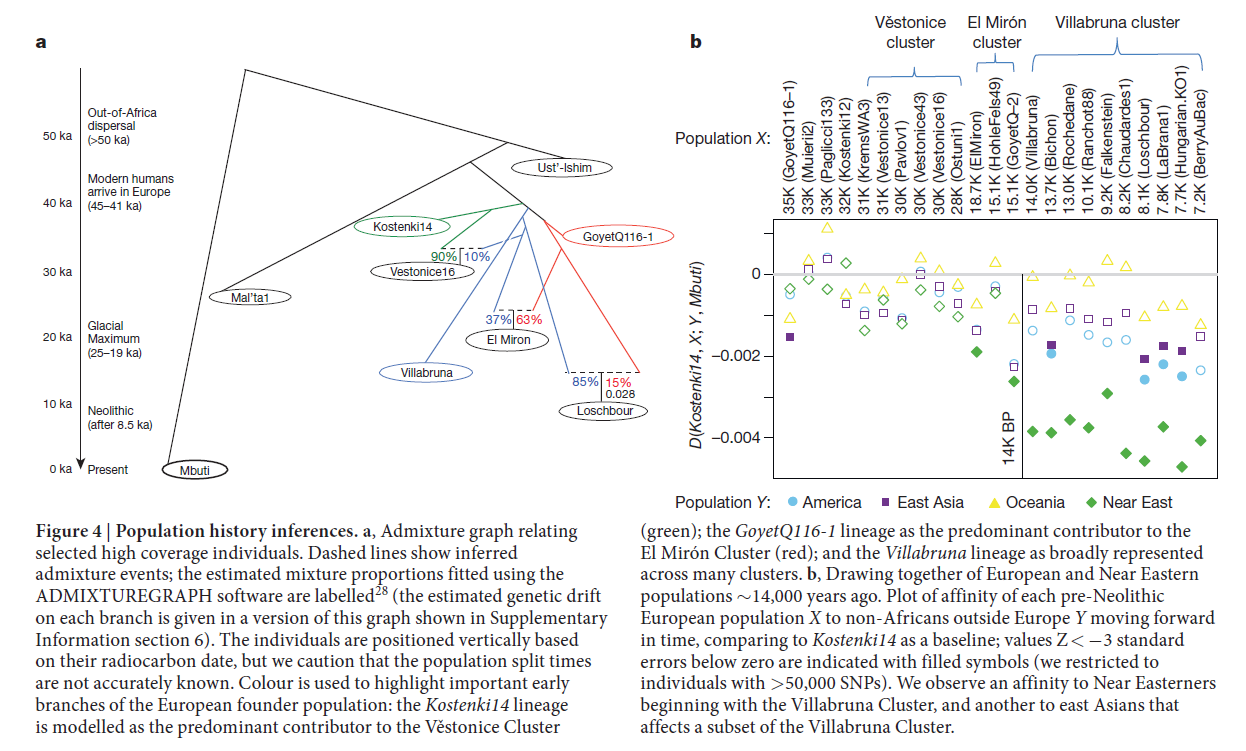
"Figure 4b shows that it is consistent with zero (|Z|<3) for nearly all individuals dating to between about 37,000 and 14,000 years ago. However, beginning with the Villabruna Cluster, it becomes highly significantly negative in comparisons where the non-European population (Y) is Near Easterners (Fig. 4b; Extended Data Fig. 3; Supplementary Information section 11). This must reflect a contribution to the Villabruna Cluster from a lineage also found in present-day Near Easterners (Fig. 4b).

That would also explain the change anthropologically in the Villabruna sample. It looks more "modern" to me than the other Ice Age Europeans.

As I said, maybe I didn't see the explanation for the contradictions, or didn't understand them.

Also, has anyone considered that there might be a "ghost" population living on the same latitude as the non-Basal Eurasian portion of the CHG, perhaps related to them, which moved into southern Europe at some early period before 14,000:YBP, and thus regional substructure in Europe is indeed the answer?

That leaves Basal Eurasian to be explained. Maybe it entered the Near East from further south near Arabia after that move, or could it perhaps have been somewhere around the Persian Gulf?

 
Also, has anyone considered that there might be a "ghost" population living on the same latitude as the non-Basal Eurasian portion of the CHG, perhaps related to them, which moved into southern Europe at some early period before 14,000:YBP, and thus regional substructure in Europe is indeed the answer?

In Terberger's "Le Dernier Maximum glaciaire entre le Rhin et le Danube, un réexamen critique" he seemed to float the idea of an 'eastern' origin of the Badegoulian techno-complex. Is there anything to this notion?

Also, it may reflect my limited understanding, but since El Miron, at around 19,000 bp shows a sizable "Villabruna" input, doesn't that imply the that at least an element of the Villabruna population was around Franco Cantabria before 19,000? And that mid-east element seems to be elevated in El Miron even.
 
I apologize if this has already been covered and I just missed it, but I don't understand the statements proposing that some of these Ice Age Europeans possessed ANE.

From the paper:
"We also find no evidence for the suggestion that the Mal’ta1 lineage contributed to Upper Palaeolithic Europeans4 , because when we compute the statistic D(Test1, Test2; Mal’ta1, Mbuti), we find that the statistic is indistinguishable from zero when the Test populations are ANY pre-Neolithic Europeans beginning with Kostenki14, consistent with descent from a single founder population since separation from the lineage leading to Mal’ta1 (Supplementary Information section 9). A corollary of this finding is that the widespread presence of Mal’ta1-related ancestry in presentday Europeans15 is probably explained by migrations from the Eurasian steppe in the Neolithic and Bronze Age periods9 ."

I read that to include the Villabrunians, since the finding is said to apply to any pre-Neolithic Europeans. So, who has decided this group is incorrect about this, and why?

D-stats by David on Eurogenes used AfontivaGora3 and not Mal'ta, then showed significance.

Mbuti MA1 Villabruna Kostenki14 -0.0124 -2.339 644492
Mbuti MA1 Villabruna Vestonice -0.0061 -1.388 531468

AfontovaGora3 Mbuti Villabruna Kostenki14 0.0281 4.465 218311
AfontovaGora3 Mbuti Villabruna Vestonice 0.0199 3.844 213665

http://eurogenes.blogspot.nl/2016/05/villabruna-cluster-near-eastern-migrants.html

There are other statements in the paper that are in contradiction to what I've seen posted here:

"One possible explanation for the sudden drawing together of the ancestry of Europe and the Near East at this time is long-distance migrations from the Near East into Europe. However, a plausible alternative is population structure, whereby Upper Palaeolithic Europe harboured multiple groups that differed in their relationship to the Near East, with the balance shifting among groups as a result of demographic changes after the Glacial Maximum."

I've seen a statement, I can't remember from whom, that even the pre-Villabruna Ice Age Europeans had this "Near Eastern" pull. That's again in contradiction to the conclusions of the paper. They're talking about a sudden drawing together around 14,000 YPB.

From the paper. See ElMiron and GoyetQ-2 in figure 4b. These are D-stats.

asgjb6.png


Their alternative to a possible flow into Europe from the Near East at this time is population structure within Europe where the Villabrunians, or the majority component of the Villabrunians, had more of a "pull" toward the Near East even before then. In this scenario, after the LGM, this sub-group of European hunter-gatherers from Italy-Balkans moved north.

Nowhere in the paper do I see any suggestion that an alternative is that there was a large migration of WHG from Europe into Anatolia. Did I miss it? It's hardly likely that the same group that analyzed the ancient farmers both in Europe and in northwest Anatolia is unaware that the farmers were about what...7% WHG? So, yes, back migration did take place, but they seem confident it doesn't explain this "drawing together" around 14,000 YBP.

Furthermore, they're definitely talking about a gene flow into the WHG.

True. But their 3-way model includes: Goyet116Q-1, something unique to WHG and something which gives a Han oriented affinity. See section 13 of the supplementary info: http://www.nature.com/nature/journal/vaop/ncurrent/extref/nature17993-s1.pdf

"Figure 4b shows that it is consistent with zero (|Z|<3) for nearly all individuals dating to between about 37,000 and 14,000 years ago. However, beginning with the Villabruna Cluster, it becomes highly significantly negative in comparisons where the non-European population (Y) is Near Easterners (Fig. 4b; Extended Data Fig. 3; Supplementary Information section 11). This must reflect a contribution to the Villabruna Cluster from a lineage also found in present-day Near Easterners (Fig. 4b).

That would also explain the change anthropologically in the Villabruna sample. It looks more "modern" to me than the other Ice Age Europeans.

As I said, maybe I didn't see the explanation for the contradictions, or didn't understand them.

Indeed the article states that, yet it didn't get worked out in the Supp Info. The Supp Info does, however, make clear that statiscally a unique WHG signal with two admixtures is preferable, and considers Goyet116 and Han as markers of these admixtures.

Also, has anyone considered that there might be a "ghost" population living on the same latitude as the non-Basal Eurasian portion of the CHG, perhaps related to them, which moved into southern Europe at some early period before 14,000:YBP, and thus regional substructure in Europe is indeed the answer?

But why don't we see any mtDNA that is related to CHG or Greek mesolithic popping up in WHG? We have quite a lot of that WHG mtDNA now. There is a Y-DNA J in EHG though. Mind you, this paper makes it clear that MA1/AG3 is not on the same clade as UP Europeans. That makes EHG almost certainly an admixture of WHG and ANE and therefore not a source for WHG. The perceived shared component in WHG and CHG is obviously a good candidate for ME affinity.

That leaves Basal Eurasian to be explained. Maybe it entered the Near East from further south near Arabia after that move, or could it perhaps have been somewhere around the Persian Gulf?
 
@Angela

Nowhere in the paper do I see any suggestion that an alternative is that there was a large migration of WHG from Europe into Anatolia. Did I miss it?

That's been a problem all along - the assumption that modern near/mid east is a proxy for ancient.

Why the assumption there's been no population turnover there - especially when we know about Sea Peoples and Hyksos etc?

Once you remove that assumption other logical possibilities immediately pop up.
 
Back
Top