I apologize if this has already been covered and I just missed it, but I don't understand the statements proposing that some of these Ice Age Europeans possessed ANE.
From the paper:
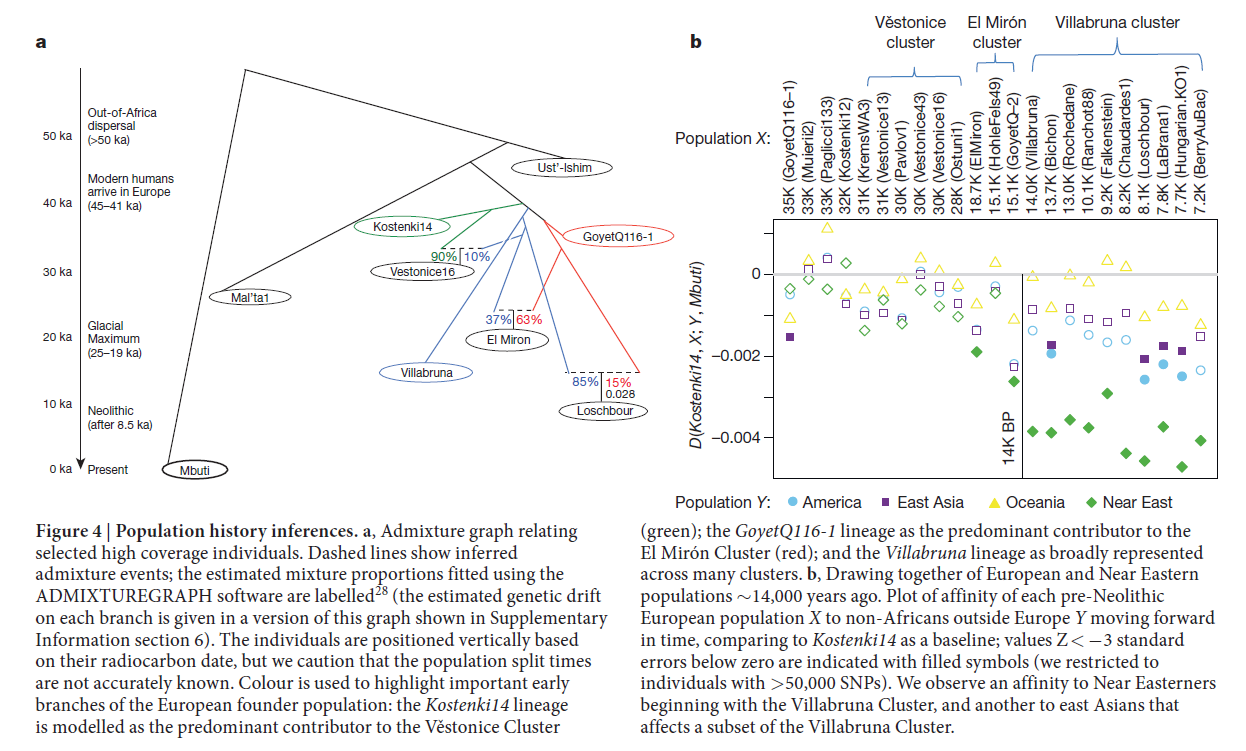
"We also find no evidence for the suggestion that the Mal’ta1 lineage contributed to Upper Palaeolithic Europeans4 , because when we compute the statistic D(Test1, Test2; Mal’ta1, Mbuti), we find that the statistic is indistinguishable from zero when the Test populations are ANY pre-Neolithic Europeans beginning with Kostenki14, consistent with descent from a single founder population since separation from the lineage leading to Mal’ta1 (Supplementary Information section 9). A corollary of this finding is that the widespread presence of Mal’ta1-related ancestry in presentday Europeans15 is probably explained by migrations from the Eurasian steppe in the Neolithic and Bronze Age periods9 ."
I read that to include the Villabrunians, since the finding is said to apply to any pre-Neolithic Europeans. So, who has decided this group is incorrect about this, and why?
There are other statements in the paper that are in contradiction to what I've seen posted here:
"One possible explanation for the sudden drawing together of the ancestry of Europe and the Near East at this time is long-distance migrations from the Near East into Europe. However, a plausible alternative is population structure, whereby Upper Palaeolithic Europe harboured multiple groups that differed in their relationship to the Near East, with the balance shifting among groups as a result of demographic changes after the Glacial Maximum."
I've seen a statement, I can't remember from whom, that even the pre-Villabruna Ice Age Europeans had this "Near Eastern" pull. That's again in contradiction to the conclusions of the paper. They're talking about a sudden drawing together around 14,000 YPB.
Their alternative to a possible flow into Europe from the Near East at this time is population structure within Europe where the Villabrunians, or the majority component of the Villabrunians, had more of a "pull" toward the Near East even before then. In this scenario, after the LGM, this sub-group of European hunter-gatherers from Italy-Balkans moved north.
Nowhere in the paper do I see any suggestion that an alternative is that there was a large migration of WHG from Europe into Anatolia. Did I miss it? It's hardly likely that the same group that analyzed the ancient farmers both in Europe and in northwest Anatolia is unaware that the farmers were about what...7% WHG? So, yes, back migration did take place, but they seem confident it doesn't explain this "drawing together" around 14,000 YBP.
Furthermore, they're definitely talking about a gene flow into the WHG.
"Figure 4b shows that it is consistent with zero (|Z|<3) for nearly all individuals dating to between about 37,000 and 14,000 years ago. However, beginning with the Villabruna Cluster, it becomes highly significantly negative in comparisons where the non-European population (Y) is Near Easterners (Fig. 4b; Extended Data Fig. 3; Supplementary Information section 11). This must reflect a contribution to the Villabruna Cluster from a lineage also found in present-day Near Easterners (Fig. 4b).
That would also explain the change anthropologically in the Villabruna sample. It looks more "modern" to me than the other Ice Age Europeans.
As I said, maybe I didn't see the explanation for the contradictions, or didn't understand them.
Also, has anyone considered that there might be a "ghost" population living on the same latitude as the non-Basal Eurasian portion of the CHG, perhaps related to them, which moved into southern Europe at some early period before 14,000:YBP, and thus regional substructure in Europe is indeed the answer?
That leaves Basal Eurasian to be explained. Maybe it entered the Near East from further south near Arabia after that move, or could it perhaps have been somewhere around the Persian Gulf?