• Don't want to see ads? Install an adblocker like uBlock Origin or use a Europe-based privacy-friendly browser like Vivaldi or Mullvad.

A Genome-Wide Study of Modern-Day Tuscans: Revisiting Herodotus's Theory on the Origi

Yes, very true.

Portrait of Etruscan Aule Metele (from Perugia, Umbria, or Cortona, Tuscany) in Etruscan-Roman style (so even more realistic than the previous ones).

I think you have to understand the art, where it came from, or in other words what influenced it, and how it changed before you can hope to use it to get clues as to phenotype.

This is the sarcophagus previously posted:
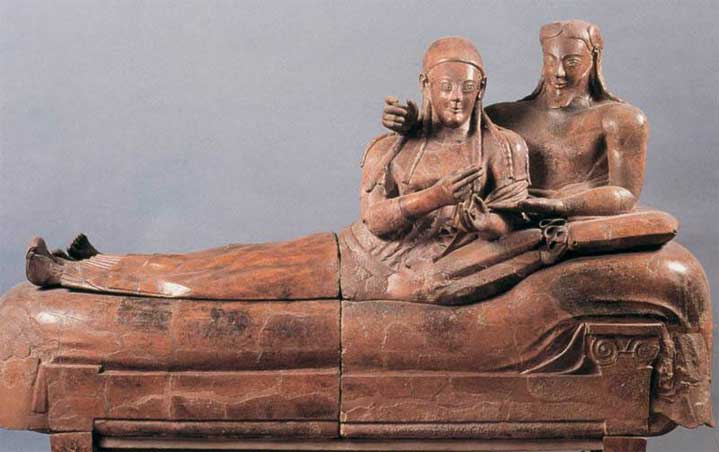
web_Etruscansarcophagus.jpg


This is the Apollo from Veii, carved by an Etruscan.
tumblr_mnpyj69lYg1qdoh4po7_500.jpg


This is a restored Ionian style Kore from Greece:
Archaic_Colours_01.png


The similarities are obvious. What does it tell us about what the Etruscans looked like? Or the Ionian Greeks for that matter? Who knows? It was a stylized representation. The place to look is at more "natural" presentations. I think, especially given these autosomal results, that people can stop wasting tons of verbiage "classifying" Tuscans as having "Asiatic" style eyes.:) At any rate, as the examples we have posted show, there were other "types" as well among the Etruscans.

I also think there's some confusion with nomenclature when discussing phenotypes in southern Europe in general and Italians in particular. To my eye, the Etruscans, and the Romans, for that matter, in the more "natural" portraits, look like southern Europeans. That means they look like a combination of more WHG types, early neolithic farmers and Indo-Europeans, even if the percentages are different than in northern Europe. As Moesan pointed out in a separate thread, modern Italians are by no means all classical "Mediterranean" in a traditional anthropological sense. There were other influences.
 
To my knowledge, from 800 BC to the present the only large scale migration into Anatolia was from the "Turks", as you say.

If that's incorrect, could someone correct the record?

How much are they supposed to have changed the Anatolian genome? As I asked upthread, isn't it supposed to be below 10%?

I just took a look at the Globe 13 spreadsheet, which has a number of Turkish populations as well as the Dodecad set. If I add the Siberian, East Asian and Arctic, some populations score around 6% of those components, and the highest score is around 8%.
https://docs.google.com/spreadsheet/ccc?key=0ArAJcY18g2GadF9CLUJnTUdSbkVJaDR2UkRtUE9kaUE#gid=2

The Turkish Cypriots, in contrast, only score about 2.2 % of those components, but I don't think it looks as if the elite Etruscans would cluster near them either.

The turkish influence on Anatolia ( modern Turkey ) is stated as between 6 to 10 %

There was no turks in anatolia until circa 1100 AD

But we need to ask to question ....Is Turkic and Turkish one of the same.....Is Central Asia and its Turkic ethnicity the same as current "Anatolian Turks."


hehe , LOL, for what it is worth...............DnaTribes states I originate from karbardino-Balkar from the bronze-age

Interpretome state I am Haraza or Burusho from the bronze-age

Otherwise .......Circassian ethnicity is difficult to analyse ..................Mamuluks where circassians
 
Mamluks were slave warriors. When Genghis Khan conquered Khwarazm Empire he sold many of the people to slavery.

many Khwarezmians survived by working as mercenaries in northern Iraq

The Khwarezmiyya, heading south from Iraq towards Egypt, invaded Crusader Christian-held Jerusalem along the way, on July 11, 1244. The city's citadel, the Tower of David, surrendered on August 23, the Crusader Christian population of the city was expelled. This triggered a call from Europe for the Seventh Crusade, but the Crusaders would never again be successful in retaking Jerusalem. After being conquered by the Khwarezmian forces, the city stayed under Muslim control until 1917, when it was taken from the Ottomans by the British.

Saladin was a Kurd. Now I wonder if the Khwarazms were Kurds.

The remains of the Muslim Khwarezmians served in Egypt as Mamluk mercenaries until they were finally beaten by al-Mansur Ibrahim some years later.

http://www.historytoday.com/james-waterson/mamluks

http://asianhistory.about.com/od/glossaryko/g/Who-Were-The-Mamluks.htm

http://en.wikipedia.org/wiki/Khwarazmian_dynasty
 
This new study is the smoking gun that Etruscans came from North of the Alps, as anyone with half brain already knew.

Now we have both mtdna and autosomal DNA.

Archeology and linguistics also point out to a Central European origin of Etruscans.

Anyone still blabbing about the Anatolian theory needs a doctor ASAP.
 
Modern Turks differ a lot from Iron Age Anatolians in that they have a considerable amount of Turkic/Mongolian and Central Asian (including assimilated Andronovo Indo-Europeans). Obviously modern Bulgarians also differ from Iron Age ones, but probably less (they have very little East Asian admixture, for instance).

Then, as always with migrations, you shouldn't expect people to remain pure and unadmixed when they move from one region to another. Iron Age Etruscans were a hybrid population, with part of their gene pool descended from Bronze Age Italy, and part from those hypothetical migrants from the Aegean or West Anatolia. Based on the high percentage of R1b-P312 and U152 in Tuscany today, and on the proximity of ancient Etruscans samples to modern Iberian ones, I'd say that the Bronze Age Italo-Celtic genetic heritage of the Etruscans could have been dominant on the Iron Age Aegean one.

We'll know more once these Etruscan samples will be run in the Dodecad and Eurogenes calculators. PCA charts have their limits.

You are making stuff here.

No serious scientist will ever take this stuff seriously.

The Lemnos people were Etruscan immigrants in Greece.

Bronze Age Greece was filled up with Etruscan and Italic mercenaries, merchants,....

Please read AN ‘ETEOCRETAN’ INSCRIPTION FROM PRAISOS AND THE HOMELAND OF THE SEA PEOPLES by Luuk de Ligt

Now go edit your Eupedia page about Italian genetics with all that bullsh!t about "Anatolian" Etruscans and similar sh!t.
 
Wow, this is incredible information! It seems to me that Etruscans were native Europeans after all! If they would be from Anatolia, they would be very close to Armenians or something.

If someone wants to know how ancient Anatolians looked like or how their aDNA looked like, I believe the best example would be the Armenians. because not all native Anatolians are gone and became part of a 'new race', I think that Armenians are still part of the ancient Anatolia race, but then again heavily mixed with the Iranians (Medes, Kurds, Persians etc.)


How close are Etruscans to the Armenians???
 
Anyone still blabbing about the Anatolian theory needs a doctor ASAP.
You might be right, and at this moment I believe you're right. But it's still too early to make conclusions.

Armenians are still the closest living creatures to the ancient Anatolians.


I want to see results of a comparison between Etruscans and Armenians first. Armenians have also lots of the so called mediterranean aDNA component in them..
 
I think you have to understand the art, where it came from, or in other words what influenced it, and how it changed before you can hope to use it to get clues as to phenotype.

This is the sarcophagus previously posted:
web_Etruscansarcophagus.jpg


This is the Apollo from Veii, carved by an Etruscan.
tumblr_mnpyj69lYg1qdoh4po7_500.jpg


This is a restored Ionian style Kore from Greece:
Archaic_Colours_01.png


The similarities are obvious. What does it tell us about what the Etruscans looked like? Or the Ionian Greeks for that matter? Who knows? It was a stylized representation. The place to look is at more "natural" presentations. I think, especially given these autosomal results, that people can stop wasting tons of verbiage "classifying" Tuscans as having "Asiatic" style eyes.:) At any rate, as the examples we have posted show, there were other "types" as well among the Etruscans.

I also think there's some confusion with nomenclature when discussing phenotypes in southern Europe in general and Italians in particular. To my eye, the Etruscans, and the Romans, for that matter, in the more "natural" portraits, look like southern Europeans. That means they look like a combination of more WHG types, early neolithic farmers and Indo-Europeans, even if the percentages are different than in northern Europe. As Moesan pointed out in a separate thread, modern Italians are by no means all classical "Mediterranean" in a traditional anthropological sense. There were other influences.

Yes, similarities are obvious as it's obvious they share a common artistic origin: "The pose of the kouros, a clear and simple formula, derives from Egyptian art and was used by Greek sculptors for more than a hundred years. From the very beginning, however, the Greeks depicted their male figures in the nude, while the Egyptians were normally skirted." It was just an artistic style in vogue at that time. At one point, the prestige of the Egyptians was so big that imposed some of their styles on many peoples of the Mediterranean.


Other examples of Greek Kouroi

RpTTSQ0l.jpg


From Attica, the region around Athens (Statue of a kouros (youth), ca. 590–580 b.c.; Archaic
Greek, Attic; now at the Met in New York)

http://www.metmuseum.org/toah/works-of-art/32.11.1

200-016.JPG


From Thebe

BJp1g7rl.jpg
 
Last edited:
To my knowledge, from 800 BC to the present the only large scale migration into Anatolia was from the "Turks", as you say.

How about Galatians? And hundreds of thousamds of Muhajirs from the Caucasus who were relocated to Turkey after Russian-Ottoman wars in the 19th century...
 
The turkish influence on Anatolia ( modern Turkey ) is stated as between 6 to 10 %

There was no turks in anatolia until circa 1100 AD

But we need to ask to question ....Is Turkic and Turkish one of the same.....Is Central Asia and its Turkic ethnicity the same as current "Anatolian Turks."

Thats the estimation of East Eurasian among modern Turks. Modern Turks have 6-12% East Eurasian DNA, but how much of Central Asian Iranic DNA did they brought with them? I have seen estimates of up to 30%!

Than we have the dozens of other admixture coming from Syria, Iraq, the Caucasus and the Balkans.

Anatolia today is definitely significantly different from Anatolia 1000, let alone 2000 years ago.
 
Last edited:
The turkish influence on Anatolia ( modern Turkey ) is stated as between 6 to 10 %

There was no turks in anatolia until circa 1100 AD

But we need to ask to question ....Is Turkic and Turkish one of the same.....Is Central Asia and its Turkic ethnicity the same as current "Anatolian Turks."


I wouldn't think anyone would need to ask after looking at the Dodecad analyis. Obviously, Central Asian "Turks" and the people who inhabit the modern country of Turkey are not the same. My question is, how much did the genome in Anatolia change from 800 BC to the present? Is the Central Asian input the only major change? Is around 10% a good estimate for their impact until we get some genomes tested?
 
Iranic DNA in Turks is not only from Central Asia. It's mostly from the Iranian Plateau (Medes, Kurds, Persians) and from the people (modern & ancient) related to the Caucasus, like Circassians. People in the Caucasus were already full of Iranic DNA even before the Turks arrived from the Altai. And Turks assimilated millions of Circassians (Adyghe people, Kabarday etc. ) and other people native to Caucasus. And those 'Caucasians' who still live in Northern Caucasus are still carrying a lot Iranic DNA in them.
 
I wouldn't think anyone would need to ask after looking at the Dodecad analyis. Obviously, Central Asian "Turks" and the people who inhabit the modern country of Turkey are not the same. My question is, how much did the genome in Anatolia change from 800 BC to the present? Is the Central Asian input the only major change? Is around 10% a good estimate for their impact until we get some genomes tested?
Before the 'Armenian' and Christian (including Eastern Greeks) GENOCIDE 100 years ago Anatolia was very similar to ancient Anatolia. After that it changed drastically, so even 100 year ago Anatolia looked very different from today.
 
I wouldn't think anyone would need to ask after looking at the Dodecad analyis. Obviously, Central Asian "Turks" and the people who inhabit the modern country of Turkey are not the same. My question is, how much did the genome in Anatolia change from 800 BC to the present? Is the Central Asian input the only major change? Is around 10% a good estimate for their impact until we get some genomes tested?

There are various studies about Central Asian input in Turkey, ranging from 8/9% to 30%.

http://www.eupedia.com/forum/thread...id-admixture-(-Turkish-people-autosomal-DNA-)
 
We should also not underestimated Semitic/Arabic DNA in Turkey. Even the wife of current president of Turkey (Erdogan) is an ethnic Arab. Erdogan himself has Circassian roots, LOL! And Prime-Minister of Turkey, Ahmet Davutoğlu, has Armenian roots, LMAO!!!

Turks are very mixed people and are a 'new modern race'. I think that Turks are the MOST mixed people in West Asia. (That's why most of them are ultra-nationalisitc and have a some kind of an identity crisis, they don't know who they 'really' are.)


That's why I'm telling you folks that Eastern Greeks and Armenians are the best representation for the ancient Anatolians, although Armenians are also heavily mixed with Iranic people. Armenians have been under Persian and Kurdish control/dominance for thousands of years.
 
You are making stuff here.

No serious scientist will ever take this stuff seriously.

The Lemnos people were Etruscan immigrants in Greece.

Bronze Age Greece was filled up with Etruscan and Italic mercenaries, merchants,....

Please read AN ‘ETEOCRETAN’ INSCRIPTION FROM PRAISOS AND THE HOMELAND OF THE SEA PEOPLES by Luuk de Ligt

Now go edit your Eupedia page about Italian genetics with all that bullsh!t about "Anatolian" Etruscans and similar sh!t.
Joyce (or whatever the spelling was) you are banned again.
IP 87.7.27.60
 
I think you have to understand the art, where it came from, or in other words what influenced it, and how it changed before you can hope to use it to get clues as to phenotype.

This is the sarcophagus previously posted:
web_Etruscansarcophagus.jpg


This is the Apollo from Veii, carved by an Etruscan.
tumblr_mnpyj69lYg1qdoh4po7_500.jpg


This is a restored Ionian style Kore from Greece:
Archaic_Colours_01.png


The similarities are obvious. What does it tell us about what the Etruscans looked like? Or the Ionian Greeks for that matter? Who knows? It was a stylized representation. The place to look is at more "natural" presentations. I think, especially given these autosomal results, that people can stop wasting tons of verbiage "classifying" Tuscans as having "Asiatic" style eyes.:) At any rate, as the examples we have posted show, there were other "types" as well among the Etruscans.

I also think there's some confusion with nomenclature when discussing phenotypes in southern Europe in general and Italians in particular. To my eye, the Etruscans, and the Romans, for that matter, in the more "natural" portraits, look like southern Europeans. That means they look like a combination of more WHG types, early neolithic farmers and Indo-Europeans, even if the percentages are different than in northern Europe. As Moesan pointed out in a separate thread, modern Italians are by no means all classical "Mediterranean" in a traditional anthropological sense. There were other influences.

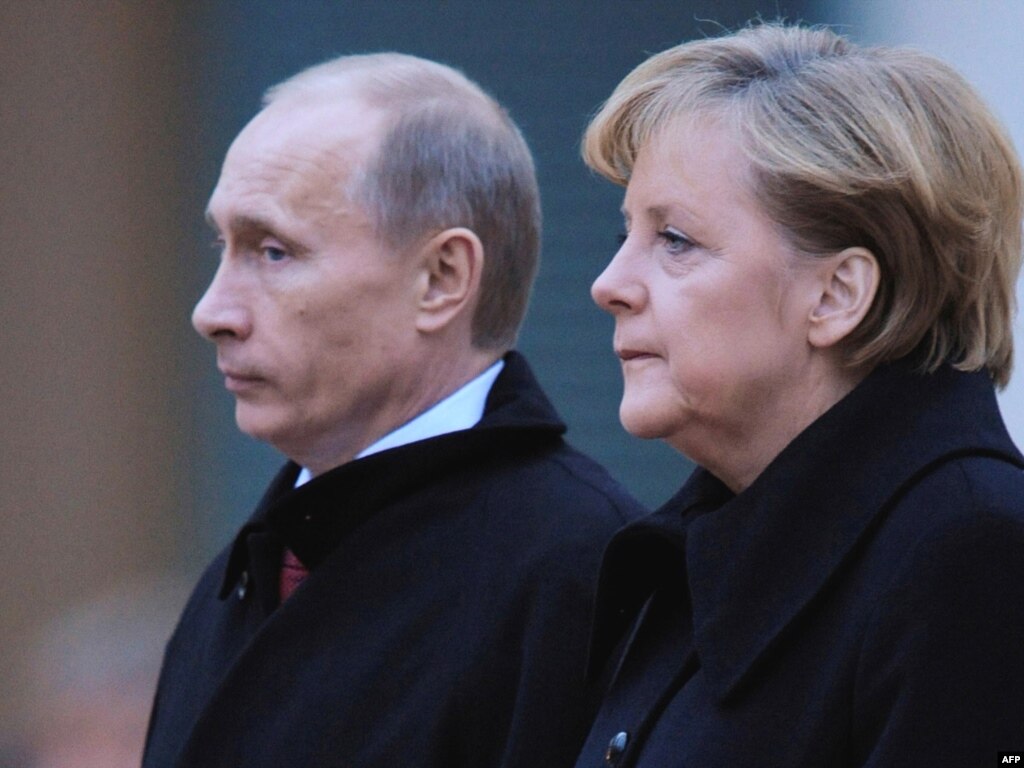
Yes, obviously there is style, tradition and artistic fashion involved in art. However if they had faces like Putin, they would never portray them as they did, no mater what style. Angela is much closer to Southern phenotype, where Putin would never blend in. He has typical Northern hunter gatherer phenotype, if it comes to shape of his head and nose.
9CC6F365-F319-4737-8DF6-B83A6EFA81B1_mw1024_mh1024_s.jpg
 
There are various studies about Central Asian input in Turkey, ranging from 8/9% to 30%.

http://www.eupedia.com/forum/thread...id-admixture-(-Turkish-people-autosomal-DNA-)
That was my point that if we take away the recent admixtures, the original Anatolians' aDNA was very close to all farmers around Mediterranean. In this case if Etruscans came from Anatolia way back, they would look the same, had similar culture and belonged to same language family, as residents of Italy. Having said that I think they most likely were overwhelmingly original farmers of Italian peninsula. After IE invasion of peninsula, original Etruscans, after some struggle, managed to come to the political top and rule over IE who settled in their region, and sustained their original language. It was completely reversed in Roman region, where IE dominated locals and established IE political class and their IE language.
 
Back
Top