• Don't want to see ads? Install an adblocker like uBlock Origin or use a Europe-based privacy-friendly browser like Vivaldi or Mullvad.

A Genome-Wide Study of Modern-Day Tuscans: Revisiting Herodotus's Theory on the Origi

Ancient Greeks called Anatolians every enemy because of every enemy of Italy remembered them the enemies of Aegean Anatolia.
It happened with many other indigenous Italians, even with the Romans but the science and the linguistic has shown that Etruscans (and the other so-called Trojan exiles in Italy) were basically an indigenous population if you see the cluster and the linguistical studies.
Anyway i really doubt that ancient Anatolians clustered with modern Bulgarians, it's true that they were related to the Thracians, and Phrygians came from the Balkans but modern Bulgarians have absorbed Slavic blood.
In my opinion ancient Anatolians were very close to modern Aegean islander population more than other.
 
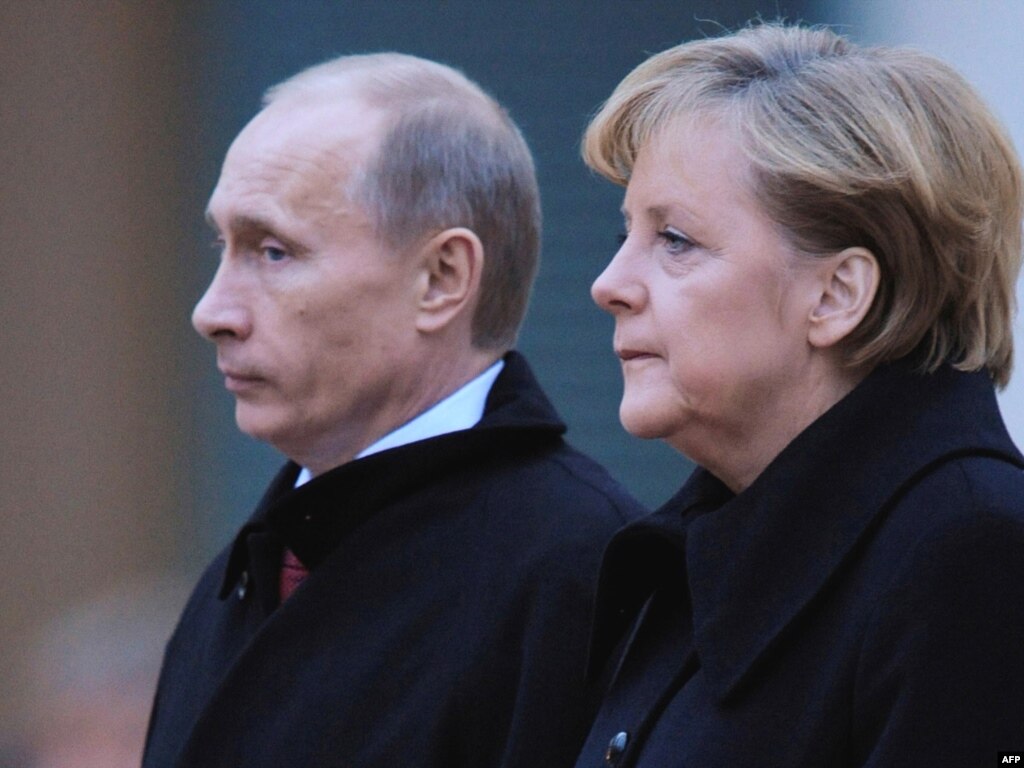
Yes, obviously there is style, tradition and artistic fashion involved in art. However if they had faces like Putin, they would never portray them as they did, no mater what style. Angela is much closer to Southern phenotype, where Putin would never blend in. He has typical Northern hunter gatherer phenotype, if it comes to shape of his head and nose.
9CC6F365-F319-4737-8DF6-B83A6EFA81B1_mw1024_mh1024_s.jpg


No one ever said that they looked like Putin. Why would they? Do even all Slavs look like Putin? I've known Poles from southwestern areas who wouldn't look out of place in northern Italy. One of my friends comes from right over the border in Czechoslovakia. In fact, they used to speak Polish in her ancestral area, and everybody thinks we're sisters when we go out and about. Granted, most people aren't trained or even amateur anthropologists! :) Angela Merkel looks to me like what she is...central European.

The point was that you can't use the statues in the well known "Kouri" stylized form current throughout the ancient world to get an idea of the common phenotypes among the Etruscans. For the same reason, you can't use the paintings obviously copied from Cretan originals.

You have to look at the totality of the more "naturalistic" representations of them. In those artifacts they exhibit the range of phenotype that can still be seen in Italy, from more "central European" leaning, to more "Greek" leaning phenotypes. In another words, they look like a cross section of modern southern Europeans, which is exactly where they plot genetically.
 
Some times I do wonder what termination Anatolian is and means in Linguistic in Geography in anthropology etc

ok for me term Anatolia is the inner land East of Phrygia, south of Pontus, North of Cilicia, West of Armenia and Kurdistan,
Generally the land today Konya Kappadokia etc

Linguistic Anatolian Language is Lydian, Tocharrian etc but Hettit? but Phrygian?
 
Ancient Greeks called Anatolians every enemy because of every enemy of Italy remembered them the enemies of Aegean Anatolia.
It happened with many other indigenous Italians, even with the Romans but the science and the linguistic has shown that Etruscans (and the other so-called Trojan exiles in Italy) were basically an indigenous population if you see the cluster and the linguistical studies.
Anyway i really doubt that ancient Anatolians clustered with modern Bulgarians, it's true that they were related to the Thracians, and Phrygians came from the Balkans but modern Bulgarians have absorbed Slavic blood.
In my opinion ancient Anatolians were very close to modern Aegean islander population more than other.


That is not truth,
Ancient Greeks also call minor Asians as Brothers or cousins etc
in Troyan war we see enemies the greeks and the Troyans,
BUT we see also allies the Arzawa/Assuwa with Achaians

in Persian wars we also see as enemy the Persians,
but as Greece the west minor Asia, and as Makedonia the Phrygian Gordion
in Xenophon we read about the Hostility among Atheneans and Pontus, but we also see religious and sacred respect and hospitality, so not to drop even a single drop of blood,
 
although Armenians are also heavily mixed with Iranic people.

Goga
Armenians don't have any admixture the last 3200 years. ;)
As a Ezdi You will know how religious isolation work.

However, genetic signals of population mixture cease after ~1,200 BCE when Bronze Age civilizations in the Eastern Mediterranean world suddenly and violently collapsed. Armenians have since remained isolated
http://biorxiv.org/content/early/2015/02/18/015396

Yes we share common ancestry with Iranians and Kurds but it is the result of much more complex events.
 
Goga
Armenians don't have any admixture the last 3200 years. ;)
As a Ezdi You will know how religious isolation work.


http://biorxiv.org/content/early/2015/02/18/015396

Yes we share common ancestry with Iranians and Kurds but it is the result of much more complex events.
I don't know what you mean, but since the Medes Armenians and the land where they live(d) has been under the Iranic dominance. It was part of the Median Empire, it was part of Sassanian empire, it was part of Safavid Empire, it was part of many independent Kurdish Kingdoms etc. Since the time of Urartu, Armenians had never again the true sovereignty of themselves.
 
I don't know what you mean

We are speaking genetics not politics. Marc Haber didn't find any admixture after 1200 BC. Do You have any other study proving the contrary?
 
We are speaking genetics not politics. Marc Haber didn't find any admixture after 1200 BC. Do You have any other study proving the contrary?
I can't say anything about it. I never specifically studied Armenian DNA myself.
 
No one ever said that they looked like Putin. Why would they? Do even all Slavs look like Putin? I've known Poles from southwestern areas who wouldn't look out of place in northern Italy. One of my friends comes from right over the border in Czechoslovakia. In fact, they used to speak Polish in her ancestral area, and everybody thinks we're sisters when we go out and about. Granted, most people aren't trained or even amateur anthropologists! :) Angela Merkel looks to me like what she is...central European.
Just an example that at some point phenotypical traits would trample over the style of art.

The point was that you can't use the statues in the well known "Kouri" stylized form current throughout the ancient world to get an idea of the common phenotypes among the Etruscans. For the same reason, you can't use the paintings obviously copied from Cretan originals.
Not one statue, same as one person is not the best representative of how general society look. However many of them would certainly bring out a statistical truth, a popular look. Even more so if timeline stretches through few centuries and few artistic styles.

You have to look at the totality of the more "naturalistic" representations of them. In those artifacts they exhibit the range of phenotype that can still be seen in Italy, from more "central European" leaning, to more "Greek" leaning phenotypes. In another words, they look like a cross section of modern southern Europeans, which is exactly where they plot genetically.
There is also a chance that the classical Greek nose was the idealized symbol of beauty, and portrait at every possible occasion.
 
Last edited:
There are various studies about Central Asian input in Turkey, ranging from 8/9% to 30%.

http://www.eupedia.com/forum/thread...id-admixture-(-Turkish-people-autosomal-DNA-)

I found the following exchange on that thread which seems to sum up the opinions.

Maciamo: "According to the Dodecad K12 and K12b admixtures, there is only about 6% of Mongoloid admixtures among the Turks."


Answer: "That is the average for instanbul and northern turkey but still you have some who are 12-15% Mongoloid other parts of Turkey are 10-15% Mongoloid on average."


Another answer: Turks with over 15% East Asian Genes are very rare. The average Turk has something around your 10%, some even less. But there are areas, for example Southwest and Central Turkey with almost 15%.


So, I don't think 30% is at all accurate for an average for East Eurasian even going by the data that was posted.

I also have some questions about the source of those figures.

I have my doubts that those figures came from 23andme, which is why there is a conflict between them and what shows up in Dodecad. The graphic posted shows that the Behar Turks score around 14% "Mongolian", yet the Dodecad analysis (Globe 13) has the Behar Turks at about 8% for a total of Siberian, Amerindian, East Asian and Arctic, and 9.5% if you add in South Asian. So, about 10%.

I'm assuming that it was the Behar Turks that Eurogenes added to that paper's PCA, yes? So, somewhere from the just under 10% of the Dodecad analysis to a high of 14%?

Perhaps though the 30% figure was meant to include the West Eurasian ancestry in these "Turkic" invaders. As to this perhaps 10-15% ancestry, I wonder how much of it was old ancestry "coming home", a back migration in a way? By that I mean didn't much of the "West Eurasian" in Central Asia come from Anatolia in the first place? Even in terms of the "Iranic" component, wouldn't that ancestry have been present in Anatolia before the Middle Ages, through Bronze Age migrations? That's why I thought that the only "new" ancestry brought by the "Turks" was the Siberian/Arctic/East Asian components.

Which brings me to the notion that Anatolians were basically indistinguishable from "Greeks" or "Italians" in 800 BC.

Given that we don't have a single ancient genome from Anatolia from any period whatsoever, I don't have much certainty about my own or any one else's opinion. We're all speculating here, but it's fun, so here goes...

I don't doubt that at some point in history the people in Anatolia, particularly in western Anatolia around the Aegean, were very EEF like. We know it changed with the "Turkic" invasions in the Middle Ages. However, the question is did it change before that, and if so, when. Also, was it uniform around Anatolia, and furthermore how much and when did that change affect southern Europe through gene flow from that area? In terms of a discussion of the Etruscans, did it change before 800 BC?

I think it did. There may have been ANE flowing into some eastern parts of Anatolia from a very early period, but certainly with the Bronze Age new peoples moved through the area and admixed. Some of that ancestry may have been a back migration of ancient Neolithic stock, but they also carried different ancestry from ANE rich or Gedrosia rich populations. I don't know what modern people would be a good model for the "new" Anatolians that lived in central Anatolia around 800 BC but I don't think they would still have been only EEF or Oetzi like. Perhaps they were more Armenian like, or more Kurd like? I don't know. For any certainty we're going to have to wait for some ancient genomes.

In terms of the Etruscan ethnogenesis, as has been said before in other places, Italy has been heavily populated since the Neolithic. If some Oetzi like people were still around in Iron Age Thrace, I don't think it's a stretch to say they would have been present in central Italy as well. Then you have to add in the migrations from north of the Alps, which is attested not only through archaeology, and language, but also now through genetics. I think this later ancestry was also on a north/south cline in Italy. That's the mix that would have existed in the area around 800 BC. I would also point out that the "upper classes" for want of a better word, although they would be mixed, would probably be higher in that more "northern" and "eastern", Indo-European component than the "lower classes". Wouldn't that produce a genome that would plot just about where these ancient genomes plot? Maybe some gene flow did arrive from Lydia or from the Greek islands in 800 BC, but it's not attested in the archaeology, and I don't see where it's necessary to explain where these samples plot even if Anatolians in 800 BC were still very EEF like. If they had already changed, then it either didn't take place at all, or it was a very small input. Ed. (If the gene flow actually came from the northern Aegean, it might have been more similar, but again, I don't think a migration from there is necessary to explain where these elite Etruscans plot.

The larger question to my mind is how do we explain the Caucaso/Persian or West Asian in all of Europe, not just in southern Europe, although obviously it's a bit larger in some parts of southern Europe. Here is the K=20 from Haak et al:
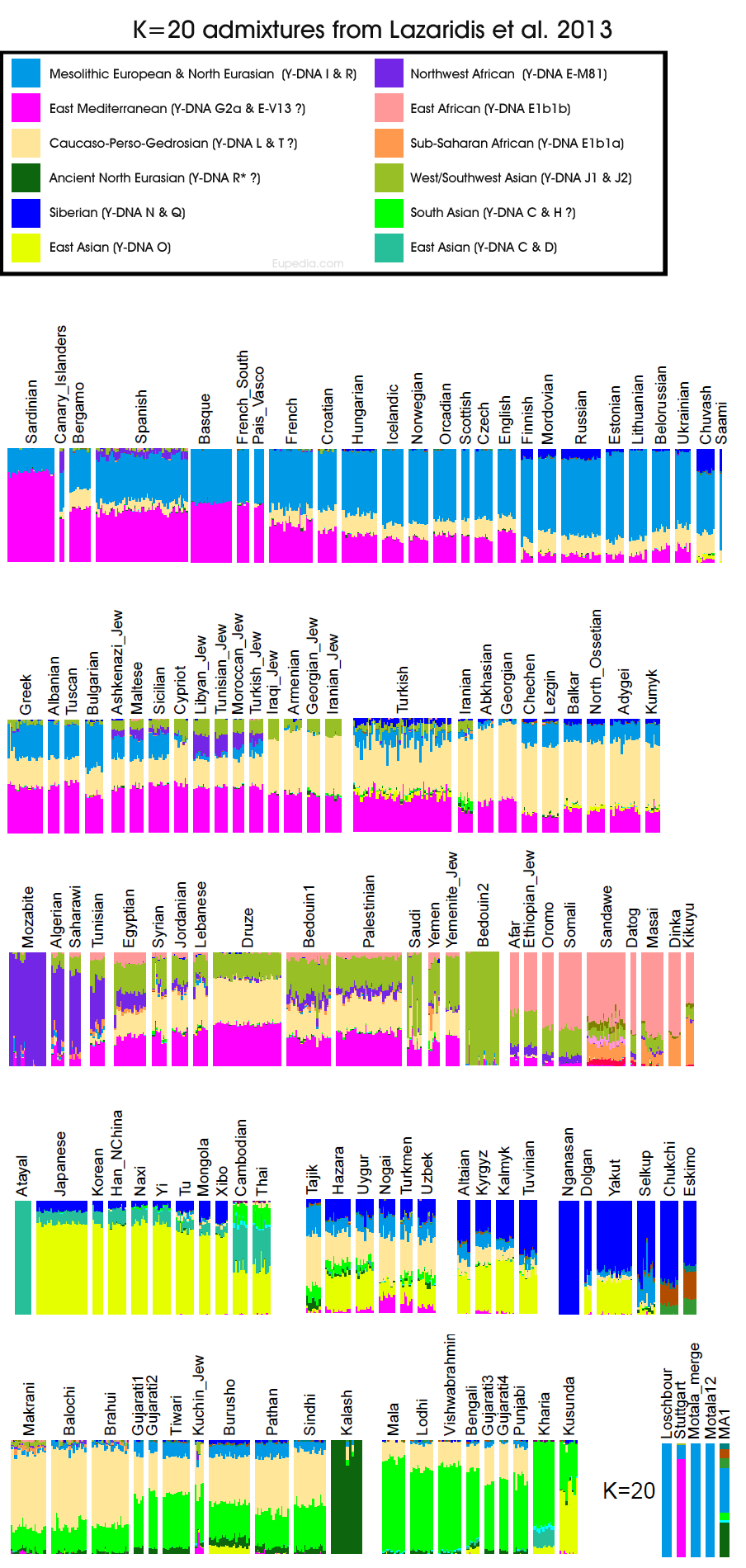
Admixtures-Lazaridis.png


The European groups who seem to have virtually none of it are the Basques and the Sardinians. The French South and Pais Vasco have a bit but minimal, then you start to get some with the Spaniards but still lower than the rest of Europe. So, there is a decided east to west cline with far southwestern Iberia having less of it. There are also very high levels around the Caucasus, predictably enough, which is why it was given that name. Just from eyeballing it, the levels in the Czechs and the Croatians aren't much different from the levels in Bergamo, or the Tuscans, and that, to me, implicates the Indo-European migrations in some way. I think it's just a different kind of farmer ancestry. The difference between southern and northern Europeans is not the Caucaso ancestry, it's the amount of the original early Neolithic ancestry that went into Europe from the coastal Levant, and southwestern Anatolia.

So, then, what does it mean to say that some southern Europeans are "West Asian" shifted? Not much, in my opinion, if by West Asian is meant that Caucaso/Persian component, because northerners and eastern European groups have it too. Southern Europeans who are said to be "West Asian" shifted have about the same amount of this Caucaso/Persian component (a bit more in some populations, but not very much, and not in all of them) as do a lot of other Europeans. They just have more of the original Neolithic component. So, maybe the presence of this component in the older calculators was just an artifact.

At the same time, it's possible that the Caucaso/Persian component arrived in southern Europe from the Indo-Europeans by a northern route, but that there was also gene flow through Anatolia into southern Europe, particularly south eastern and south/Central Europe during the Bronze Age that carried with it both the Caucaso/Persian component and some more EEF like genetic material.

That's why it's so important to have Mycenean genomes from the Bronze Age. Did they arrive in Greece directly via the Balkans, or was there a sweep through northern Anatolia? How much of the Caucaso/Persian did they carry? Then we need to see the genomes of the Cretans of the Bronze Age, and from the migrations right after the Bronze Age collapse and from the Greek migrants to Magna Graecia. In terms of Italian genetics, which is my main interest, perhaps an additional dose of farmer ancestry arrived in southern Italy through these later migrations and some of it diffused northwards.

I guess part of what I'm saying is that, in my opinion, people are conflating those issues with the specific one about Etruscan ethnogenesis in 800 BC due to a migration from Lydia.

A specific movement from Anatolia to central Italy around 800 BC doesn't explain the percentages of "West Asian" in the Balkans or southern Italy, where it is even higher than in Tuscans and northern Italians. There is a bigger process in play here, and with all due respect, I doubt the Phoenicians in northwest Sicily or some places in Iberia are enough to explain it. They wouldn't have affected the northern Greeks for one thing, who, without the input from the Slavic migrations, would, in my opinion, be even higher in "West Asian". This would also apply to the Bulgarians and the Romanians.


We need the genomes from these Etruscans. As Maciamo pointed out, there's only so much that a PCA can tell us, and especially one with not very many populations on it, and no other ancient samples. We also need samples from Anatolia from various time periods. We'll have to see how things shake out.

 
Last edited:
Yes, obviously there is style, tradition and artistic fashion involved in art. However if they had faces like Putin, they would never portray them as they did, no mater what style. Angela is much closer to Southern phenotype, where Putin would never blend in. He has typical Northern hunter gatherer phenotype, if it comes to shape of his head and nose.
9CC6F365-F319-4737-8DF6-B83A6EFA81B1_mw1024_mh1024_s.jpg

Lebrok, I'll split hairs here even if it's not the right topic t do it: yes Putin has some HGs heritage, but his too shallow lower jaw and other small details in his face could have been inherited from an 'uralic' ancestor (who would be a mix or at contrary an "insufficiently" evolved 'europoid-mongoloid': it's debated) - Angela (Merckel?) has a 'nordic' influence in her (roughly said very evolved recent -'mediterranean' type whose geographical cradle - if one - can be debated too)
 
Lebrok, I'll split hairs here even if it's not the right topic t do it: yes Putin has some HGs heritage, but his too shallow lower jaw and other small details in his face could have been inherited from an 'uralic' ancestor (who would be a mix or at contrary an "insufficiently" evolved 'europoid-mongoloid': it's debated) - Angela (Merckel?) has a 'nordic' influence in her (roughly said very evolved recent -'mediterranean' type whose geographical cradle - if one - can be debated too)

Well, I'm glad you said it this time and not me. When on another thread I said he and some other people from northeastern Europe who had been posted had what I called a slight Eurasian look, I got my head handed to me on a platter.:grin:
 
I found the following exchange on that thread which seems to sum up the opinions.

Maciamo: "According to the Dodecad K12 and K12b admixtures, there is only about 6% of Mongoloid admixtures among the Turks."


Answer: "That is the average for instanbul and northern turkey but still you have some who are 12-15% Mongoloid other parts of Turkey are 10-15% Mongoloid on average."


Another answer: Turks with over 15% East Asian Genes are very rare. The average Turk has something around your 10%, some even less. But there are areas, for example Southwest and Central Turkey with almost 15%.


So, I don't think 30% is at all accurate for an average for East Eurasian even going by the data that was posted.

I also have some questions about the source of those figures.

I have my doubts that those figures came from 23andme, which is why there is a conflict between them and what shows up in Dodecad. The graphic posted shows that the Behar Turks score around 14% "Mongolian", yet the Dodecad analysis (Globe 13) has the Behar Turks at about 8% for a total of Siberian, Amerindian, East Asian and Arctic, and 9.5% if you add in South Asian. So, about 10%.

I'm assuming that it was the Behar Turks that Eurogenes added to that paper's PCA, yes? So, somewhere from the just under 10% of the Dodecad analysis to a high of 14%?

Perhaps though the 30% figure was meant to include the West Eurasian ancestry in these "Turkic" invaders. As to this perhaps 10-15% ancestry, I wonder how much of it was old ancestry "coming home", a back migration in a way? By that I mean didn't much of the "West Eurasian" in Central Asia come from Anatolia in the first place? Even in terms of the "Iranic" component, wouldn't that ancestry have been present in Anatolia before the Middle Ages, through Bronze Age migrations? That's why I thought that the only "new" ancestry brought by the "Turks" was the Siberian/Arctic/East Asian components.

Which brings me to the notion that Anatolians were basically indistinguishable from "Greeks" or "Italians" in 800 BC.

Given that we don't have a single ancient genome from Anatolia from any period whatsoever, I don't have much certainty about my own or any one else's opinion. We're all speculating here, but it's fun, so here goes...

I don't doubt that at some point in history the people in Anatolia, particularly in western Anatolia around the Aegean, were very EEF like. We know it changed with the "Turkic" invasions in the Middle Ages. However, the question is did it change before that, and if so, when. Also, was it uniform around Anatolia, and furthermore how much and when did that change affect southern Europe through gene flow from that area? In terms of a discussion of the Etruscans, did it change before 800 BC?

I think it did. There may have been ANE flowing into some eastern parts of Anatolia from a very early period, but certainly with the Bronze Age new peoples moved through the area and admixed. Some of that ancestry may have been a back migration of ancient Neolithic stock, but they also carried different ancestry from ANE rich or Gedrosia rich populations. I don't know what modern people would be a good model for the "new" Anatolians that lived in central Anatolia around 800 BC but I don't think they would still have been only EEF or Oetzi like. Perhaps they were more Armenian like, or more Kurd like? I don't know. For any certainty we're going to have to wait for some ancient genomes.

In terms of the Etruscan ethnogenesis, as has been said before in other places, Italy has been heavily populated since the Neolithic. If some Oetzi like people were still around in Iron Age Thrace, I don't think it's a stretch to say they would have been present in central Italy as well. Then you have to add in the migrations from north of the Alps, which is attested not only through archaeology, and language, but also now through genetics. I think this later ancestry was also on a north/south cline in Italy. That's the mix that would have existed in the area around 800 BC. I would also point out that the "upper classes" for want of a better word, although they would be mixed, would probably be higher in that more "northern" and "eastern", Indo-European component than the "lower classes". Wouldn't that produce a genome that would plot just about where these ancient genomes plot? Maybe some gene flow did arrive from Lydia or from the Greek islands in 800 BC, but it's not attested in the archaeology, and I don't see where it's necessary to explain where these samples plot even if Anatolians in 800 BC were still very EEF like. If they had already changed, then it either didn't take place at all, or it was a very small input. Ed. (If the gene flow actually came from the northern Aegean, it might have been more similar, but again, I don't think a migration from there is necessary to explain where these elite Etruscans plot.

The larger question to my mind is how do we explain the Caucaso/Persian or West Asian in all of Europe, not just in southern Europe, although obviously it's a bit larger in some parts of southern Europe. Here is the K=20 from Haak et al:
Admixtures-Lazaridis.png


The European groups who seem to have virtually none of it are the Basques and the Sardinians. The French South and Pais Vasco have a bit but minimal, then you start to get some with the Spaniards but still lower than the rest of Europe. So, there is a decided east to west cline with far southwestern Iberia having less of it. There are also very high levels around the Caucasus, predictably enough, which is why it was given that name. Just from eyeballing it, the levels in the Czechs and the Croatians aren't much different from the levels in Bergamo, or the Tuscans, and that, to me, implicates the Indo-European migrations in some way. I think it's just a different kind of farmer ancestry. The difference between southern and northern Europeans is not the Caucaso ancestry, it's the amount of the original early Neolithic ancestry that went into Europe from the coastal Levant, and southwestern Anatolia.

So, then, what does it mean to say that some southern Europeans are "West Asian" shifted? Not much, in my opinion, if by West Asian is meant that Caucaso/Persian component, because northerners and eastern European groups have it too. Southern Europeans who are said to be "West Asian" shifted have about the same amount of this Caucaso/Persian component (a bit more in some populations, but not very much, and not in all of them) as do a lot of other Europeans. They just have more of the original Neolithic component. So, maybe the presence of this component in the older calculators was just an artifact.

At the same time, it's possible that the Caucaso/Persian component arrived in southern Europe from the Indo-Europeans by a northern route, but that there was also gene flow through Anatolia into southern Europe, particularly south eastern and south/Central Europe during the Bronze Age that carried with it both the Caucaso/Persian component and some more EEF like genetic material.

That's why it's so important to have Mycenean genomes from the Bronze Age. Did they arrive in Greece directly via the Balkans, or was there a sweep through northern Anatolia? How much of the Caucaso/Persian did they carry? Then we need to see the genomes of the Cretans of the Bronze Age, and from the migrations right after the Bronze Age collapse and from the Greek migrants to Magna Graecia. In terms of Italian genetics, which is my main interest, perhaps an additional dose of farmer ancestry arrived in southern Italy through these later migrations and some of it diffused northwards.

I guess part of what I'm saying is that, in my opinion, people are conflating those issues with the specific one about Etruscan ethnogenesis in 800 BC due to a migration from Lydia.

A specific movement from Anatolia to central Italy around 800 BC doesn't explain the percentages of "West Asian" in the Balkans or southern Italy, where it is even higher than in Tuscans and northern Italians. There is a bigger process in play here, and with all due respect, I doubt the Phoenicians in northwest Sicily or some places in Iberia are enough to explain it. They wouldn't have affected the northern Greeks for one thing, who, without the input from the Slavic migrations, would, in my opinion, be even higher in "West Asian". This would also apply to the Bulgarians and the Romanians.


We need the genomes from these Etruscans. As Maciamo pointed out, there's only so much that a PCA can tell us, and especially one with not very many populations on it, and no other ancient samples. We also need samples from Anatolia from various time periods. We'll have to see how things shake out.

Before I go out I thought I'd update this. Someone sent me a copy of the Etruscan PCA with both the Bulgarians and Oetzi added to the plot. I presume this was helpfully done by Eurogenes.

If this is correct, and not contradicted when we get the actual genomes, Oetzi lands right between the Tuscans and the Iberians, and south of the Etruscans. After 5,000 years and whatever various migrations actually flowed into Italy, the net result is that modern Tuscans are a bit northern and quite a bit eastern shifted versions of Oetzi. That would make sense if they are about 30% Indo-European, as Haak et al claims, yes? Northern Italians would plot north of them, and southern Italians a bit south of them...the Italian cline. So, we have this, we have Gamba et al which I already posted, and we have Ralph and Coop, all telling essentially the same story.

https://drive.google.com/file/d/0B9o3EYTdM8lQZFU0Vl8ySjJ3WkE/view

Ed. I hope it was alright for me to post this link. If there's a problem, someone just PM me and I will remove it.

To the usual suspect, no, as we've discussed before, here and at 23andme, Greeks from Thessaly don't plot precisely where Tuscans plot. In every PCA I've seen, some of them overlap the most southern plotting Tuscans and the rest are southeast of the Tuscans. Also, again, I would think that the northern Italians would plot very near to where the Bulgarians plot. That's been the case since the days of Cavalli-Sforza.
 
Alan and Goya

You guys, are these your personel ideas/theories, or do you have scientific sources?

check the "Eupedia Map of Late Neolithic Europe-Europeans Culture arounds 4000-3500BC" and see which haplogroups(ydna) popular in Anatolia

Still haplogroups j2-j1-g-r1b are in top five between Turks. T changed as E which can associated with Greek İnvasion and Hellenistic period of Anatolia and it is fourth common group.

so why you are think that current Anatolia is much more different then 1000-2000 years old Anatolia in genetic case?
 
Tuscan Etruscan heritage is part of an old and misleading cultural revival that has nothing to do with nowadays genetic composition of the Tuscan people which is mainly Western European R1b-U152 (52,5%) which peaks here to the top following Provence (city of Grasse). A large italo-celtic substrate with an important germanic (lombardic) contribution. J2 is the Y-DNA haplogroup referred to greco-roman-anatolian population and it is 11% of the tuscans just one point over of the rest of Northern Italy.
 
Before I go out I thought I'd update this. Someone sent me a copy of the Etruscan PCA with both the Bulgarians and Oetzi added to the plot. I presume this was helpfully done by Eurogenes.

If this is correct, and not contradicted when we get the actual genomes, Oetzi lands right between the Tuscans and the Iberians, and south of the Etruscans. After 5,000 years and whatever various migrations actually flowed into Italy, the net result is that modern Tuscans are a bit northern and quite a bit eastern shifted versions of Oetzi. That would make sense if they are about 30% Indo-European, as Haak et al claims, yes? Northern Italians would plot north of them, and southern Italians a bit south of them...the Italian cline. So, we have this, we have Gamba et al which I already posted, and we have Ralph and Coop, all telling essentially the same story.

https://drive.google.com/file/d/0B9o3EYTdM8lQZFU0Vl8ySjJ3WkE/view

Ed. I hope it was alright for me to post this link. If there's a problem, someone just PM me and I will remove it.

To the usual suspect, no, as we've discussed before, here and at 23andme, Greeks from Thessaly don't plot precisely where Tuscans plot. In every PCA I've seen, some of them overlap the most southern plotting Tuscans and the rest are southeast of the Tuscans. Also, again, I would think that the northern Italians would plot very near to where the Bulgarians plot. That's been the case since the days of Cavalli-Sforza.

Interesting post as usual, Angela.

According to wikipedia, Oetzi is attested to have spent his childhood in the area of Velturno (German Feldthurns), modern day South Tyrol, where there have been many interesting archaeological findings: burial site, megaliths... It's interesting because Velturno is one of the south Tyrolean toponyms that some scholar have linked with an Etruscan origin (from Velthur, Etruscan word very common in other place names).

Origin and Migration of the Alpine Iceman

http://www.sciencemag.org/content/302/5646/862.short
 
Tuscan Etruscan heritage is part of an old and misleading cultural revival that has nothing to do with nowadays genetic composition of the Tuscan people which is mainly Western European R1b-U152 (52,5%) which peaks here to the top following Provence (city of Grasse). A large italo-celtic substrate with an important germanic (lombardic) contribution. J2 is the Y-DNA haplogroup referred to greco-roman-anatolian population and it is 11% of the tuscans just one point over of the rest of Northern Italy.

I have no doubt that Tuscany was impacted by the migration of Indo-European peoples who came by way of central or central/eastern Europe. So, obviously, Tuscans are not a purely "Oetzi like" group. Then there's the fact that the Neolithic farmers themselves were migrants to this land to the best of our current understanding. Therefore, Tuscans are not in any way an "autochthonous" group, whatever that even means, and anyone claiming that I or anyone else is asserting that merely because we aren't sure how much, if any, migration from Anatolia in 800 BC affected them is making a straw man argument.

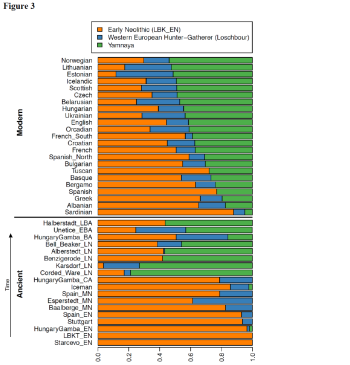
The percentages for the Yamnaya EN WHG components are clearly set out in Haak et al for Bergamo and Toscana, and the southern Italian figures are available elsewhere:
Haak_et_al_Fig_3_small.png


Tuscans are about 30% Yamnaya and 70% Early Neolithic farmer as based on the Stuttgart genome. Now, Yamnaya was about half farmer too, of a different variety, in my opinion, and the early farmers were perhaps 20% WHG, but that's a discussion for a different time.

Every "ethnic" group of people you are discussing as having made an impact in Tuscany would have been some combination of those groups. That Italic speakers came is clear from the archaeology and the language, and if, as seems likely, they carried U-152, we know that they had a genetic impact. Much of that 30% Yamnaya percentage probably cames from them. I don't know about the Langobardi. We need more and better analysis. If they carried mostly U-106 and I1 yDna lineages, then their input was minimal. If they carried some downstream clades of U152, perhaps a bit more.

In terms of the Etruscans, which is the subject of this thread, I have no idea how you can state that they had no genetic impact on the Tuscans. Everyone who settled or lived in this land had a genetic impact. The question is how much, what was their autosomal make-up, and how was that autosomal make-up created.

The interesting part of the poster and PCA from this latest study is that if the actual genomes tell basically the same tale, whatever their ethnogenesis, the Etruscans wound up looking like southern Europeans, not very different from Tuscans, and perhaps even closer to northern Italians. That is not what many expected.

What would help a great deal is an ancient genome from their predecessors in the area, but they burned their dead. Ancient samples from the same period, i.e. around 800-1000 BC from Anatolia might clarify matters. A lot would depend on what these people were like autosomally. We don't even know if the people of Anatolia in Neolithic times were EEF or Stuttgart/Oetzi like. It depends on whether the WHG/UHG, or whatever it was, was incorporated in the Near East or, say, in the Balkans. Then, we don't know how much affect the Bronze Age migrations, which of course took place before 800 BC, would have had on the area.

If the Lydians were "Armenian like" or "Kurd like" at that period, then if any migration took place, it would probably have been a minor elite one, or elite ancient Etruscan genomes, which would show the most influence, should presumably have been more "Armenian" like or "Near Eastern" like. I also have a problem with the idea of a "Lydian" central Anatolian mass migration or even 50% impact on the Tuscan genome because the Lydians spoke a Indo-European language, and if there was such a large migration, one would think they would have imposed their language on the population. The Saxons 1000 years later in Britain certainly did.

Of course, perhaps the migration from the east, if any, actually came from the Aegean. We would need a genome from there as well, for clarity, because the question again is what were they like autosomally in 800 BC, after the Bronze Age migrations, and also what languages did they speak? (Crete might have been very different from the northern Aegean, for example.)

When looking at the analysis of this paper around the web, it seems to me that many people are ignoring the fact that the population in the central Italy of that time was unlikely to have been entirely or even mostly "Indo-European". Why would it have been? Even in northern Europe, the Yamnaya ancestry portion is around 50% by current estimates, less in Central Europe. In southern Europe, always more densely populated, and to my knowledge not subject to the repeated population crashes of Central and northern Europe, why isn't an estimate of 30% reasonable for around 1000 BC until we get, hopefully, more ancient samples?

It's about 30% today in Tuscany. Northern Italy is actually a bit less, but has some additional WHG, additional to what is present in the EN, while Tuscany does not, according the Haak et al diagram above. The IBS samples also have 0 WHG in addition to what is present in EN. I think the jury is still out about the source of the additional WHG, or perhaps the "survival" of the additional WHG in Europe would be a better way to put it. I don't know whether there were WHG people who continued to live in Europe and who increased in number and admixed only with the Yamnaya migrations, or whether they existed only in isolated fringe areas and were incorporated in the Yamnaya like migrations, and/or they moved south with later migrations. Time will tell.

In terms of Italy, I know that there is precious little evidence so far for Mesolithic hunter gatherers in Italy, but the ones that are attested are on a north/south cline. There may have been a wipe out of hunter gatherers in southern and even central Italy with the coming of the Neolithic. The amounts that are present in northern Italy may partly be a survival and re-emergence, and/or may have come with later migrations from the north that petered out as the waves moved south. It's also possible, of course, that later migrations from the southeast diluted their presence in the genome in a south/north cline. Certainly this is a phenomenon that doesn't just affect Tuscans. It's also something that is present in southern Italy, so I don't see why it would all be down to a specific movement from Anatolia, or the Aegean, for that matter, to "Etruria" in 800 BC.

I think any more speculation should probably wait at least until the ancient Etruscan samples can be looked at more closely to see if they do cluster near northern Italians, and more importantly to see their percentages of EN, Yamnaya, and WHG. Then, we would need a similar analysis for genomes in Anatolia and the Aegean for the same period.
 
@ Angela

ok you are searching for Tuscans after 800 BC,
But if I follow the Hadria/Adria which might been an entrance, then we might speak about 1200BC about
have you thought the possibility of 1200 BC and Hadria colony city, which also shows mycenean and eastern marks?
 
@ Angela

ok you are searching for Tuscans after 800 BC,
But if I follow the Hadria/Adria which might been an entrance, then we might speak about 1200BC about
have you thought the possibility of 1200 BC and Hadria colony city, which also shows mycenean and eastern marks?

Yetos, are you speaking about Adria, in the Veneto?

So far as I know, the Wiki entry is pretty accurate. From 1200 BC to the 9th century it seems to have been inhabited by the Veneti tribes. From the 10th to the 6th century we have the Villanovans, centered around Bologna. Then come the Etruscans. The Greeks apparently started trading with the area in the 6th century, long after the Etruscans are attested on the Tyrhennian side of Italy.
http://en.wikipedia.org/wiki/Adria#Ancient_era

Do you think that's incorrect?

Ed. I was talking about 800-1000 BC, but 1200 BC is ok too.

The point is that the Bronze Age migrations would have already affected Anatolia and the Greek islands as well. Thrace too, of course.

I do think that one thing to consider in all of this is the fact that the Bronze Age collapse might have triggered movements from the East to the West. The question still remains, what would these people have been like autosomally, where specifically did they go, how many of them were there, and what was the autosomal composition of the people who already were inhabiting the regions where they settled.
 
It's about 30% today in Tuscany. Northern Italy is actually a bit less, but has some additional WHG, additional to what is present in the EN, while Tuscany does not, according the Haak et al diagram above. The IBS samples also have 0 WHG in addition to what is present in EN. I think the jury is still out about the source of the additional WHG, or perhaps the "survival" of the additional WHG in Europe would be a better way to put it. I don't know whether there were WHG people who continued to live in Europe and who increased in number and admixed only with the Yamnaya migrations, or whether they existed only in isolated fringe areas and were incorporated in the Yamnaya like migrations, and/or they moved south with later migrations. Time will tell.

Not a big problem but that Tuscan and Spanish samples have both 0 WHG it sounds a bit strange to me. Tuscans aren't an isolated population unlike the Sardinians (that instead have a bit of WHG). I'd be curious to see the results of the bordering regions: Liguria, Emilia-Romagna, Umbria and Lazio. I can't believe that there were never population exchange among these regions and Tuscany, not even a bit.


When looking at the analysis of this paper around the web, it seems to me that many people are ignoring the fact that the population in the central Italy of that time was unlikely to have been entirely or even mostly "Indo-European". Why would it have been? Even in northern Europe, the Yamnaya ancestry portion is around 50% by current estimates, less in Central Europe. In southern Europe, always more densely populated, and to my knowledge not subject to the repeated population crashes of Central and northern Europe, why isn't an estimate of 30% reasonable for around 1000 BC until we get, hopefully, more ancient samples?

Yes, not only in central Italy but elsewhere population was unlikely to have been entirely or even mostly "Indo-European".
 
Back
Top