• Don't want to see ads? Install an adblocker like uBlock Origin or use a Europe-based privacy-friendly browser like Vivaldi or Mullvad.

All Iberian men were wiped out by Yamna men 4,500 years ago

R1a is very much a minority lineage among Jews. It represents about 50% of the Levites, but only about 10% of Ashkenazi Jewish males in total, and is mostly Middle Eastern in origin.

See:
https://www.ncbi.nlm.nih.gov/pmc/articles/PMC5668307/

Yes, I agree entirely. The point I was making is that most of it seems to have descended from just a single ancestor who lived only several centuries ago.

If that can happen, then a whole host of Levantine J2 migrants from the first millennium BC onwards could certainly have given rise to much of the 10% or so of the Iberian population that is J2 today.
 
That is not correct. Before the Romans at least 75% of the Iberian Peninsula already spoke Indo-European languages (celtic or preceltic)
 
Data suggests that R1b-DF27 was the only significant extant factor in the wipeout of indigenous Iberian males (with a few exceptions, e.g. J-M413 and some Berber-like E1b). It looks like this wipeout happened gradually from 2,500 BC, rather than suddenly. These DF27 people had less EHG aDNA than in Northern Europe, probably because they were already the product of Cucuteni and RRBP females before they mated with native Iberian women.
 
which percent of EHG they had?
 

thanks

The first ancient sample clearly identified as of R1b-DF27 subclade is found in this paper, at the Late Bronze Age site Cueva de los Lagos. Although it is unidentified and has no radiocarbon date, the site as a whole is associated with the Cogotas culture and its Bouquique ceramic decoration.

that would make it Cogoatas I and >3ka
 
thanks

The first ancient sample clearly identified as of R1b-DF27 subclade is found in this paper, at the Late Bronze Age site Cueva de los Lagos. Although it is unidentified and has no radiocarbon date, the site as a whole is associated with the Cogotas culture and its Bouquique ceramic decoration.

that would make it Cogoatas I and >3ka

I also don't think it's the right place to look for precisely El Argar like remains.

Eventually they should find some samples from the right place and time, and we'll know for sure, but I've always thought that civilization doesn't at all look like something coming from Central Europe, whatever the y dna the men carried.

As for J2, it's possible it came all in the Iron Age and the post classical era with Muslim invaders, but I don't see anything ruling out the Bronze Age. It doesn't appear to be Neolithic at all.
 
As for J2, it's possible it came all in the Iron Age and the post classical era with Muslim invaders, but I don't see anything ruling out the Bronze Age. It doesn't appear to be Neolithic at all.

And large numbers of conversos...
 
I also don't think it's the right place to look for precisely El Argar like remains.
Eventually they should find some samples from the right place and time, and we'll know for sure, but I've always thought that civilization doesn't at all look like something coming from Central Europe, whatever the y dna the men carried.
As for J2, it's possible it came all in the Iron Age and the post classical era with Muslim invaders, but I don't see anything ruling out the Bronze Age. It doesn't appear to be Neolithic at all.

this is what the link says about Cogotas :
The Proto-Cogotas culture is associated with a Bell Beaker substrate influenced by either El Argar or Atlantic Bronze.

As for Muslim invaders, wouldn't they rather bring Y-DNA J1 instead of J2?

At the time of the Punic wars, mainland Iberia was mainly Celtiberian, which was formed by Hallstatt intruders 2,6 ka mixing with locals.
Appearantly R1b-DF27 was already present in Iberia before that time.

Hallstatt is often associated with R1b-U152, but their distribution in Iberia doesn't fit Celtiberians.
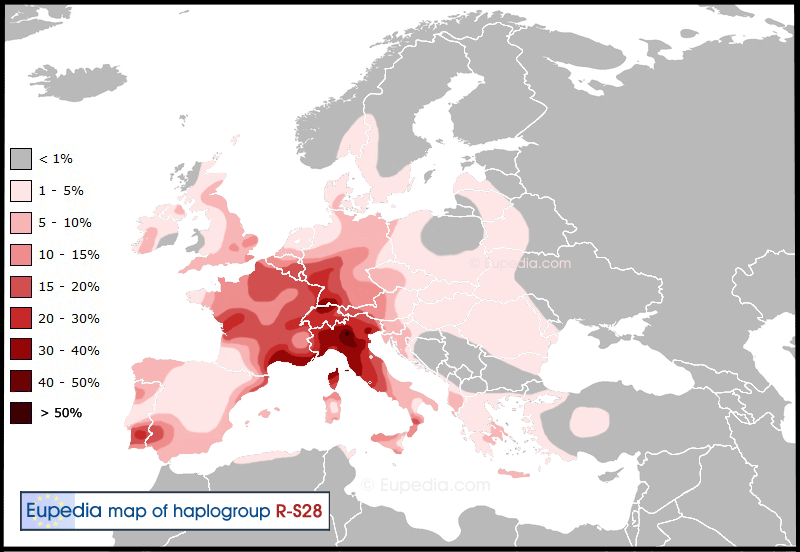
Haplogroup-R1b-S28.gif


It fits more with the mysterious Tartessians, but I can't think of any logical explanaition for that.
 
taking into accont that L51 is linked with BB I find the logics to find such numbers of U152 in the area were BB first came up.
 
taking into accont that L51 is linked with BB I find the logics to find such numbers of U152 in the area were BB first came up.
Actually not. That map is impressive. At least to what Portugal is concerned since it's a visual representation of what strabo wrote about celts. He wrote that since Alentejo had become a desert in bronze age the celts enter portugal trough Alentejo (the red blob in South Portugal) and that they joined the local TURDULI and eventually went to the BRACARI land (the blob in North).
So this is in fact a very accurate of how Roman and Greek historians described how celts got to Portugal.
I am impressed. Had never noticed this map that Bicicleur posted.
 
Actually not. That map is impressive. At least to what Portugal is concerned since it's a visual representation of what strabo wrote about celts. He wrote that since Alentejo had become a desert in bronze age the celts enter portugal trough Alentejo (the red blob in South Portugal) and that they joined the local TURDULI and eventually went to the BRACARI land (the blob in North).
So this is in fact a very accurate of how Roman and Greek historians described how celts got to Portugal.
I am impressed. Had never noticed this map that Bicicleur posted.


It also raises a diferent issue. The lusitanians, which were the ones speaking an IE language full of arcahism were the same as the rest of the Portuguese tribes such as the several turduli tribes themselves which is the rest of the Portuguese map where there is no U152...
So, celts were not IE speakers??
 
I also don't think it's the right place to look for precisely El Argar like remains.

Eventually they should find some samples from the right place and time, and we'll know for sure, but I've always thought that civilization doesn't at all look like something coming from Central Europe, whatever the y dna the men carried.

As for J2, it's possible it came all in the Iron Age and the post classical era with Muslim invaders, but I don't see anything ruling out the Bronze Age. It doesn't appear to be Neolithic at all.
There was a J2a1 in early 5th millennium BC Hungary.
Many of J2a-M419's clusters are too exclusively concentrated in Western Europe and have STRs that are too diverse for it to have arrived only in the Iron Age, in my opinion. I would say it was most likely Chalcolithic at the latest.
 
It will vary, of course, and depend on how it is measured, but as a very rough guide, perhaps 25%, instead of 35% for R1b-P312 further North.

so it's your stimation, nothing coming from a paper, right?
 
Of course, both earlier and later cultures in Iberia might mostly have involved a variety of subclades of DF27, each mainly emerging from different areas of France, and several of which appear to have Iberian associations. I cannot see any clear signs pointing to a significant early presence in Spain of U152 or other R1b.
 
Back
Top