• Don't want to see ads? Install an adblocker like uBlock Origin or use a Europe-based privacy-friendly browser like Vivaldi or Mullvad.

Illyrian-Albanian Continuity

Status
Not open for further replies.
Ike, you are totally wrong . I am busy now but i will answer you. OK.
Continue with geographical description of thr territory describe by this gentelman . In which modern states is located?
 
Ike, you are totally wrong . I am busy now but i will answer you. OK.
Continue with geographical description of thr territory describe by this gentelman . In which modern states is located?

Well, if you have ideas that would display a more certain etymology of Albanian name it's OK to present them.
 
Ike, you are totally wrong . I am busy now but i will answer you. OK.
Continue with geographical description of thr territory describe by this gentelman . In which modern states is located?

I insist.

BTW ,it's my opinion that serbian people are serious, not like greeks. I have a week here answering a greek member to tell me a greek hero in the Greek revolution against Othomans, and he couldn't give me a name . All heroes are arvaniti people , albanians. And he just jump from one argument to another. I hope you will make make the same.
You say me that serbian peoples are originary from North . What North, North Pole, North Dakota? You don't know your origine ?

P. S. And use some references. Thank you.
 
On the Kingdom of Rascia and how it could easily be conquered

I would like to come back to the Kingdom of Rascia to show how it could be conquered. Indeed, the desire to invade is all that is needed for the country to be taken. In order to make this clear, I would like to present a number of brief suggestions for an invasion and a number of easily fulfilled conditions for a conquest.
The said kingdom has few if any fortifications at all. All that exists are farmhouses and cottages devoid of moats and outer walls. The buildings and palaces, both of the king and of the nobles, are made of straw and wood. I have never seen a palace or home there made of stone or of brick except in the coastal towns of the Latins. The said kingdom is rich in grain, wine, oil and meat. It is a pleasant place with water from springs and rivers flowing through it, a delightful land with woods, meadows, mountains, plains and valleys full of various species of wild beasts. In short, everything that grows there is of choice quality, in particular in areas along the coast. In the said kingdom, there are indeed five gold mines and an equal number of silver mines in which expert miners toil without interruption. There are also mixed deposits of silver and gold, which have recently been discovered at various and sundry sites, and huge dense forests. Whoever owns this kingdom will have a veritable jewel in his possession, select and precious for all times.
One factor, among others, which makes this kingdom easy to conquer, is that it is inhabited by two peoples, i.e. the Albanians and the Latins who, in their beliefs, their rites and their obedience, both abide by the Roman Catholic Church. Accordingly, they have archbishops, bishops and abbots, as well as religious and secular clerics of lower rank and status. The Latins have six towns with bishops: firstly Antibarum (Bar), the seat of the archbishop, then Chatarensis (Kotor), Dulcedinensis (Ulcinj), Suacinensis (Shas) (2), Scutarensis (Shkodra) and Drivascensis (Drisht) (3), which are inhabited by the Latins alone. Outside the town walls, the Albanians make up the population throughout the diocese. There are four Albanian towns: Polatum Maius (Greater Pult) (4), Polatum Minus (Lesser Pult), Sabatensis (Sapa) (5) and Albanensis (Albanopolis) (6) which, together with the towns of the Latins, are all legally subject to the Archbishop of Bar and his church as their metropolitan. The Albanians indeed have a language quite different from Latin. However they use Latin letters in all their books (7). The sway of the Latins is thus confined to the limits of their towns. Outside the towns, they do possess vineyards and fields, but there are no fortifications or villages actually inhabited by the Latins. The Albanians for their part, the larger of the two peoples, could assemble over fifteen thousand horsemen for warfare according to the custom and manner of the country, who would be courageous and industrious warriors. Since the said Latins and Albanians suffer under the unbearable yoke and extremely dire bondage of their odious Slav leaders whom they detest - the people being tormented, the clergy humiliated and oppressed, the bishops and abbots often kept in chains, the nobles disinherited and held hostage, episcopal and other churches disbanded and deprived of their rights, and the monasteries in decay and ruin - they would all to a man believe that they were consecrating their hands in the blood of the aforementioned Slavs if a French prince were to appear before them whom they could make leader of their war against the said evil Slavs, the enemies of our true faith. With the help of the aforementioned Albanians and Latins, one thousand French knights and five or six thousand foot soldiers could without a doubt easily conquer the whole length and breadth of this kingdom.
Source: [Extract from: Recueil des historiens des croisades. Documents arméniens. Tome second. Documents latins et français relatifs à l'Arménie, Paris 1906, p. 478 485.]

The author speaks here for a territory under the rule of the King of Serbia. In this area cities are inhabited by Latins and the entire territory is inhabited by Albanians. About the city I can bring doccuments that prove that in the coastal cities had a certain amount Albanian inhabitants. All this inhabitants “suffer under the unbearable yoke and extremely dire bondage of their odious Slav leaders”.
Given your geographical knowledge can you tell me the said territory in which is of modern states is located?

As far as I know, in the time of Kingdom of Rascia there was no literature in today's Albanian language. The first book in Albanian was dated to 1555. and there probably were some scripts and fragments written on Latin or Greek letters some 100-200 years back, but you can't stretch it back to Kingdom of Rascia, which was long time gone.

Ok, one can argue that foreign authors continued to use the old name (Rascia) for Kingdom of Serbia, but that doesn't explain why he is referring to people as Slavs, while he is insisting on naming their kingdom as Rascia.

He also says that "Albanians indeed have a language quite different from Latin", while considering Albanian language of today would be more logical to say that Albanians have language similar to Latin.

From what he's saying in that quote, so far I can conclude only that either:
1. He is confused and is calling Rasican language an Albanian
2. He is lying because he has a great disgust towards Slavs, and wants to paint a false picture that would encourage Catholic rulers to send troops to wage war with Slavs.
 
I insist.
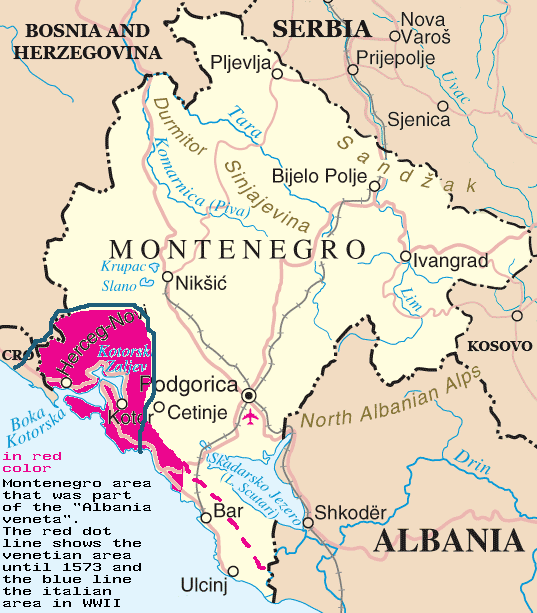
This is the geographical location that is discussed:

Albanian Veneta:


Montenegro_venezia.PNG


719px-Venezia_Montenegro.svg.png


Rest of the territories that are mentioned to be inhabited by "Albanians" could be most closely be related to these areas:
1006px-Venetian_seside_properties_in_Montenegro_1448.svg.png


BTW ,it's my opinion that serbian people are serious, not like greeks. I have a week here answering a greek member to tell me a greek hero in the Greek revolution against Othomans, and he couldn't give me a name . All heroes are arvaniti people , albanians. And he just jump from one argument to another. I hope you will make make the same.
You say me that serbian peoples are originary from North . What North, North Pole, North Dakota? You don't know your origine ?

P. S. And use some references. Thank you.

As far as we know Slavs came to Balkans in 6th century so they can't be the problem in Albanian-Illyrian continuity question. I'd leave them out of this story.
 
As far as I know, in the time of Kingdom of Rascia there was no literature in today's Albanian language. The first book in Albanian was dated to 1555. and there probably were some scripts and fragments written on Latin or Greek letters some 100-200 years back, but you can't stretch it back to Kingdom of Rascia, which was long time gone.

Ok, one can argue that foreign authors continued to use the old name (Rascia) for Kingdom of Serbia, but that doesn't explain why he is referring to people as Slavs, while he is insisting on naming their kingdom as Rascia.

He also says that "Albanians indeed have a language quite different from Latin", while considering Albanian language of today would be more logical to say that Albanians have language similar to Latin.

From what he's saying in that quote, so far I can conclude only that either:
1. He is confused and is calling Rasican language an Albanian
2. He is lying because he has a great disgust towards Slavs, and wants to paint a false picture that would encourage Catholic rulers to send troops to wage war with Slavs.

You think he is an albanian propagandist? Maybe Sali Berisha had give him a lot of money, what do you think ?
You are unable to tell me the origin of your nation , and from the other side you want to discuss about history.
Come on .
 
1332
Anonymous:
Initiative for Making the Passage


The 'Directorium ad passagium faciendum', which can be translated as 'Initiative for making the passage', is a mediaeval Latin manuscript (also available in an early French translation) attributed alternatively to a monk called Burcard (Brocardus Monacus / Frère Brochard) or to one William Adam (Guillelmus Adam / Guillaume Adam) (1). The author was at any rate a Dominican priest and Latin prelate in the Byzantine Empire and Armenia, whose aim was to persuade the Catholic armies under Philip VI of Valois (r. 1328-1350) to embark upon a holy crusade and conquer Serbian-occupied Albania, thus restoring the Catholic Church to its former power there and taking revenge upon the Orthodox Greeks for having destroyed the Latin Empire of Constantinople. In the text, the author makes reference to the Albanians as the majority population in Albania. It is also in the 'Directorium' that a much-quoted phrase about the existence of books in Albania occurs: 'licet Albanenses aliam omnino linguam a latina habeant et diversam, tamen litteram latinam habent in usu et in omnibus suis libris' (The Albanians indeed have a language quite different from Latin, however they use Latin letters in all their books).
On the Kingdom of Rascia and how it could easily be conquered
I would like to come back to the Kingdom of Rascia to show how it could be conquered. Indeed, the desire to invade is all that is needed for the country to be taken. In order to make this clear, I would like to present a number of brief suggestions for an invasion and a number of easily fulfilled conditions for a conquest.
The said kingdom has few if any fortifications at all. All that exists are farmhouses and cottages devoid of moats and outer walls. The buildings and palaces, both of the king and of the nobles, are made of straw and wood. I have never seen a palace or home there made of stone or of brick except in the coastal towns of the Latins. The said kingdom is rich in grain, wine, oil and meat. It is a pleasant place with water from springs and rivers flowing through it, a delightful land with woods, meadows, mountains, plains and valleys full of various species of wild beasts. In short, everything that grows there is of choice quality, in particular in areas along the coast. In the said kingdom, there are indeed five gold mines and an equal number of silver mines in which expert miners toil without interruption. There are also mixed deposits of silver and gold, which have recently been discovered at various and sundry sites, and huge dense forests. Whoever owns this kingdom will have a veritable jewel in his possession, select and precious for all times.
One factor, among others, which makes this kingdom easy to conquer, is that it is inhabited by two peoples, i.e. the Albanians and the Latins who, in their beliefs, their rites and their obedience, both abide by the Roman Catholic Church. Accordingly, they have archbishops, bishops and abbots, as well as religious and secular clerics of lower rank and status. The Latins have six towns with bishops: firstly Antibarum (Bar), the seat of the archbishop, then Chatarensis (Kotor), Dulcedinensis (Ulcinj), Suacinensis (Shas) (2), Scutarensis (Shkodra) and Drivascensis (Drisht) (3), which are inhabited by the Latins alone. Outside the town walls, the Albanians make up the population throughout the diocese. There are four Albanian towns: Polatum Maius (Greater Pult) (4), Polatum Minus (Lesser Pult), Sabatensis (Sapa) (5) and Albanensis (Albanopolis) (6) which, together with the towns of the Latins, are all legally subject to the Archbishop of Bar and his church as their metropolitan. The Albanians indeed have a language quite different from Latin. However they use Latin letters in all their books (7). The sway of the Latins is thus confined to the limits of their towns. Outside the towns, they do possess vineyards and fields, but there are no fortifications or villages actually inhabited by the Latins. The Albanians for their part, the larger of the two peoples, could assemble over fifteen thousand horsemen for warfare according to the custom and manner of the country, who would be courageous and industrious warriors. Since the said Latins and Albanians suffer under the unbearable yoke and extremely dire bondage of their odious Slav leaders whom they detest - the people being tormented, the clergy humiliated and oppressed, the bishops and abbots often kept in chains, the nobles disinherited and held hostage, episcopal and other churches disbanded and deprived of their rights, and the monasteries in decay and ruin - they would all to a man believe that they were consecrating their hands in the blood of the aforementioned Slavs if a French prince were to appear before them whom they could make leader of their war against the said evil Slavs, the enemies of our true faith. With the help of the aforementioned Albanians and Latins, one thousand French knights and five or six thousand foot soldiers could without a doubt easily conquer the whole length and breadth of this kingdom.
Source: [Extract from: Recueil des historiens des croisades. Documents arméniens. Tome second. Documents latins et français relatifs à l'Arménie, Paris 1906, p. 478 485.]

The author speaks here for a territory under the rule of the King of Serbia. In this area cities are inhabited by Latins and the entire territory is inhabited by Albanians. About the city I can bring doccuments that prove that in the coastal cities had a certain amount Albanian inhabitants. All this inhabitants “suffer under the unbearable yoke and extremely dire bondage of their odious Slav leaders”.
Given your geographical knowledge can you tell me the said territory in which is of modern states is located?

Listen , he is speaking about Kingdom of Rascia in years 1332, not about Albania Veneta or WWII. Try to be serious.
 
You think he is an albanian propagandist? Maybe Sali Berisha had give him a lot of money, what do you think ?

We don't even know what "Albanian" means for the author, so we can't accuse him of being a propagandist of something that we don't know about. If anything, I accused him as war-propagandist.

You are unable to tell me the origin of your nation , and from the other side you want to discuss about history.
Come on .
I've already told you where and when Slavs came to Balkan, and that's enough for this thread. Anything more about Slavs in Ukraine, in the BC era, or maybe Asia or Africa would be off topic.


Listen , he is speaking about Kingdom of Rascia in years 1332, not about Albania Veneta or WWII. Try to be serious.

During that time span (r. 1328-1350) this is how Serbian empire (supposedly Kingdom of Rascia) looked like:

663px-Serbian_Empire_1355_CE_relief_English.png


Why do you insist on talking about Rascian empire in these borders, when the author himself names the cities, which I mapped as precisely as I could in a previous post?
 
We don't even know what "Albanian" means for the author, so we can't accuse him of being a propagandist of something that we don't know about. If anything, I accused him as war-propagandist.


I've already told you where and when Slavs came to Balkan, and that's enough for this thread. Anything more about Slavs in Ukraine, in the BC era, or maybe Asia or Africa would be off topic.


During that time span (r. 1328-1350) this is how Serbian empire (supposedly Kingdom of Rascia) looked like:

663px-Serbian_Empire_1355_CE_relief_English.png


Why do you insist on talking about Rascian empire in these borders, when the author himself names the cities, which I mapped as precisely as I could in a previous post?

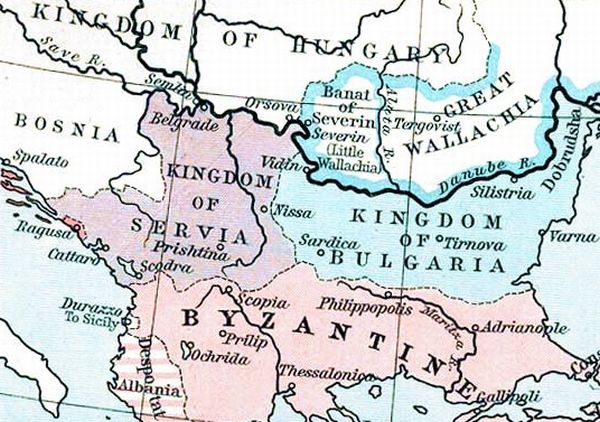
He is not speaking about Serbian empirebut about this:
http://en.wikipedia.org/wiki/Kingdom_of_Serbia_(medieval)
http://en.wikipedia.org/wiki/Kingdom_of_Serbia_(medieval)#mediaviewer/File:Balkans_1265.jpg

[h=1]File:Balkans 1265.jpg[/h] From Wikipedia, the free encyclopedia

No higher resolution available.

Balkans_1265.jpg ‎(600 × 422 pixels, file size: 75 KB, MIME type: image/jpeg)
 
He is not speaking about Serbian empirebut about this:)

But that's the map from 1265, and you clearly stated you wanted 1330-1350 period. Anyways...

1. What are you trying to achieve here? What's the point of this mapping? What are you trying to map?
2. The maps themselves are of no importance because those territories were battled for by Bulgarians, Serbian, Byzantines, and were taken over numerous times. They don't necessarily reflect the ethnicity.
 
But that's the map from 1265, and you clearly stated you wanted 1330-1350 period. Anyways...

1. What are you trying to achieve here? What's the point of this mapping? What are you trying to map?
2. The maps themselves are of no importance because those territories were battled for by Bulgarians, Serbian, Byzantines, and were taken over numerous times. They don't necessarily reflect the ethnicity.

It was you that started this game of maps. I just posted the map of Kingdom of Serbia mentioned by this gentelman . I agree with you let's concentrate in to the text.
So he said that in that kingdom the rulers were serbs, the cities were Latins and the whole territory by albanians. That's the story. What's the problem here ? It is all clear.
 
It was you that started this game of maps.
I have no problem with that, but why do you insist on it and then say that I was the one who started it?! What's with these previous posts:

Ike, you are totally wrong . I am busy now but i will answer you. OK.
Continue with geographical description of thr territory describe by this gentelman . In which modern states is located?

I insist.

BTW ,it's my opinion that .....

P. S. And use some references. Thank you.


Now to get back on your post:

I just posted the map of Kingdom of Serbia mentioned by this gentelman . I agree with you let's concentrate in to the text.
Useless map, but doesn't matter...

So he said that in that kingdom the rulers were serbs, the cities were Latins and the whole territory by albanians. That's the story. What's the problem here ? It is all clear.
So, you're claiming that this author was labeling medieval Serbs as Albanians?
 
So what we have discuss today?
In post #435 i think i explained you, cited two sources by the ancient "..John of Amida also known as John of Ephesus records that in 581” and [Cyril Mango, BYZANTIUM: THE EMPIRE OF NEW ROME] how arrived the slavs in Balcan. They came from? You didn`t tell us. OK


In post #431 i posted this:

1000 - 1018
Anonymous:
Fragment on the Origins of Nations
It can be seen that there are various languages on earth. Of them, there are five Orthodox languages: Bulgarian, Greek, Syrian, Iberian (Georgian) and Russian. Three of these have Orthodox alphabets: Greek, Bulgarian and Iberian. There are twelve languages of half-believers: Alamanians, Franks, Magyars (Hungarians), Indians, Jacobites, Armenians, Saxons, Lechs (Poles), Arbanasi (Albanians), Croatians, Hizi, Germans.

C:\DOCUME~1\SOKOLI~1\LOCALS~1\Temp\msohtml1\01\clip_image001.gif

[Extract from: Radoslav Grujic: Legenda iz vremena Cara Samuila o poreklu naroda. in: Glasnik skopskog naucnog drustva, Skopje, 13 (1934), p. 198 200. Translated from the Old Church Slavonic by Robert Elsie. First published in R. Elsie: Early Albania, a Reader of Historical Texts, 11th - 17th Centuries, Wiesbaden 2003, p. 3.]

In this document is mentioned,among others Albanian and Croatian language, but not Serbian, Montenegrin or Fyrom. You don`t like this, OK.

In post #436 I posted this;

1332
Anonymous:
Initiative for Making the Passage

The 'Directorium ad passagium faciendum', which can be translated as 'Initiative for making the passage', is a mediaeval Latin manuscript (also available in an early French translation) attributed alternatively to a monk called Burcard (Brocardus Monacus / Frère Brochard) or to one William Adam (Guillelmus Adam / Guillaume Adam) (1). The author was at any rate a Dominican priest and Latin prelate in the Byzantine Empire and Armenia, whose aim was to persuade the Catholic armies under Philip VI of Valois (r. 1328-1350) to embark upon a holy crusade and conquer Serbian-occupied Albania, thus restoring the Catholic Church to its former power there and taking revenge upon the Orthodox Greeks for having destroyed the Latin Empire of Constantinople. In the text, the author makes reference to the Albanians as the majority population in Albania. It is also in the 'Directorium' that a much-quoted phrase about the existence of books in Albania occurs: 'licet Albanenses aliam omnino linguam a latina habeant et diversam, tamen litteram latinam habent in usu et in omnibus suis libris' (The Albanians indeed have a language quite different from Latin, however they use Latin letters in all their books).
On the Kingdom of Rascia and how it could easily be conquered
I would like to come back to the Kingdom of Rascia to show how it could be conquered. Indeed, the desire to invade is all that is needed for the country to be taken. In order to make this clear, I would like to present a number of brief suggestions for an invasion and a number of easily fulfilled conditions for a conquest.
The said kingdom has few if any fortifications at all. All that exists are farmhouses and cottages devoid of moats and outer walls. The buildings and palaces, both of the king and of the nobles, are made of straw and wood. I have never seen a palace or home there made of stone or of brick except in the coastal towns of the Latins. The said kingdom is rich in grain, wine, oil and meat. It is a pleasant place with water from springs and rivers flowing through it, a delightful land with woods, meadows, mountains, plains and valleys full of various species of wild beasts. In short, everything that grows there is of choice quality, in particular in areas along the coast. In the said kingdom, there are indeed five gold mines and an equal number of silver mines in which expert miners toil without interruption. There are also mixed deposits of silver and gold, which have recently been discovered at various and sundry sites, and huge dense forests. Whoever owns this kingdom will have a veritable jewel in his possession, select and precious for all times.
One factor, among others, which makes this kingdom easy to conquer, is that it is inhabited by two peoples, i.e. the Albanians and the Latins who, in their beliefs, their rites and their obedience, both abide by the Roman Catholic Church. Accordingly, they have archbishops, bishops and abbots, as well as religious and secular clerics of lower rank and status. The Latins have six towns with bishops: firstly Antibarum (Bar), the seat of the archbishop, then Chatarensis (Kotor), Dulcedinensis (Ulcinj), Suacinensis (Shas) (2), Scutarensis (Shkodra) and Drivascensis (Drisht) (3), which are inhabited by the Latins alone. Outside the town walls, the Albanians make up the population throughout the diocese. There are four Albanian towns: Polatum Maius (Greater Pult) (4), Polatum Minus (Lesser Pult), Sabatensis (Sapa) (5) and Albanensis (Albanopolis) (6) which, together with the towns of the Latins, are all legally subject to the Archbishop of Bar and his church as their metropolitan. The Albanians indeed have a language quite different from Latin. However they use Latin letters in all their books (7). The sway of the Latins is thus confined to the limits of their towns. Outside the towns, they do possess vineyards and fields, but there are no fortifications or villages actually inhabited by the Latins. The Albanians for their part, the larger of the two peoples, could assemble over fifteen thousand horsemen for warfare according to the custom and manner of the country, who would be courageous and industrious warriors. Since the said Latins and Albanians suffer under the unbearable yoke and extremely dire bondage of their odious Slav leaders whom they detest - the people being tormented, the clergy humiliated and oppressed, the bishops and abbots often kept in chains, the nobles disinherited and held hostage, episcopal and other churches disbanded and deprived of their rights, and the monasteries in decay and ruin - they would all to a man believe that they were consecrating their hands in the blood of the aforementioned Slavs if a French prince were to appear before them whom they could make leader of their war against the said evil Slavs, the enemies of our true faith. With the help of the aforementioned Albanians and Latins, one thousand French knights and five or six thousand foot soldiers could without a doubt easily conquer the whole length and breadth of this kingdom.
Source: [Extract from: Recueil des historiens des croisades. Documents arméniens. Tome second. Documents latins et français relatifs à l'Arménie, Paris 1906, p. 478 485.]

You started to speak about conspiracy etc. After you started the game of maps. It`s all clear, hi is speaking about Kingdom of Rascia not about Serbian Empire. Also he describe that the said kingdom was inhabitated , cities by Latins and the kingdom by Albanians:
“that it is inhabited by two peoples, i.e. the Albanians and the Latins who, in their beliefs, their rites and their obedience, both abide by the Roman Catholic Church”.

“The Latins have six towns with bishops….. Outside the town walls, the Albanians make up the population throughout the diocese”.

And: Since the said Latins and Albanians suffer under the unbearable yoke and extremely dire bondage of their odious Slav leaders whom they detest - the people being tormented, the clergy humiliated and oppressed, the bishops and abbots often kept in chains, the nobles disinherited and held hostage, episcopal and other churches disbanded and deprived of their rights, and the monasteries in decay and ruin”.

According to wikipedia the Kingdom of Serbia is this:
http://en.wikipedia.org/wiki/Kingdom_of_Serbia_(medieval)
And this is the map of the said kingdom:
http://en.wikipedia.org/wiki/Kingdom_of_Serbia_(medieval)#mediaviewer/File:Balkans_1265.jpg

Again you don`t agree. OK.

In your post #434 you said:
“There are some indications that current Slavic population of Balkan has the same anthropological (skeletal) characteristics as the ancient one, but that has to be confirmed with other research. Until then I'm supporting the official version that Slavs settled in Balkans in 6th century”.
You speak about anthropology and and i quoted the father of antropology Carleton Stevens Coon:
“The Montenegrins, who are the tallest people in Europe, live on a barren limestone mountain upland, where they, for centuries, succeeded in maintaining their Christianity and their freedom while surrounded by the Turks. They, like the northern Albanians, preserve their old exog- amous clan organization, and their clan loyalties and feuds. They are linguistically Serbs, but there can be no question that they are to a large extent Slavicized Albanians; the cultural continuity between the two peoples is striking, the only real differences being those of language and re- ligion”. Stevens Coon Carleton The Races Of Europe page 591

Your answer was:
“I was talking about some other research, but it's of no importance today because we have DNA analysis which can prove for certainty if the hypothesis is right or wrong, so it's stupid to waste time on some 19th century methods”.
It`s not 19 century:
http://en.wikipedia.org/wiki/The_Races_of_Europe_(Coon)

About the so-called theory of Slavic settlements in Durres , I don’t want to los my time, I will make an copy paste from Milan von Šufflay:
[h=4]1912
Milan von Šufflay:
Mediaeval Albania[/h] Croatian historian, Milan von Šufflay (1879-1931), was born in Lepoglava, southwest of Varaždin, and studied history and classical philology at the University of Zagreb. From 1904 to 1908, he worked for the national museum in Budapest and, from 1912 to 1918, was professor for medieval history in Zagreb. Šufflay was forced into early retirement for political reasons in 1918 and lived thereafter as a publisher in Zagreb. He was often in open political conflict with the new Kingdom of the Serbs, Croats and Slovenes and, in 1921, was sentenced to three and a half years in prison. In 1928, he was offered the chair of southeast European history at the University of Budapest, but the government in Belgrade refused to let him accept the position. He was murdered by two Serb police agents in 1931.
Among Šufflay’s publications of Albanian interest, mention may be made of “Povijest severnih Arbanasa” (History of the Northern Albanians), Belgrade 1924, “Städte und Burgen Albaniens hauptsächlich während des Mittelalters” (The Towns and Fortresses of Albania, Primarily during the Middle Ages), Vienna 1924; and “Srbi i Arbanasi: njihova simbioza u srednjem vjeku” (Serbs and Albanians: Their Symbiosis during the Middle Ages), Belgrade 1925; as well as numerous articles. Together with Ludwig von Thallóczy and Konstantin Jireček, he published the important two-volume collection of Albanian historical documents entitled “Acta et diplomata res Albaniae mediae aetatis illustrantia” (Acts and Diplomatic Affairs illustrating the Middle Ages in Albania), Vienna 1913, 1918, covering the years 344 to 1406 A.D.
The present article was first published in a Viennese newspaper in November 1912, at a time when Serb forces had conquered Kosovo and occupied much of Albania. In it, Šufflay paints a picture of Albania in the Middle Ages with a view to showing that Serbia had no historical claim to the country.

In order to justify Serb claims to Albania, in particular to the ports of Durazzo [Durrës] and Alessio [Lezha], Serb politicians bring forth primarily historical arguments. According to Pašić and Gruić, Albania has no right to autonomy, the Albanian Malissors are actually Serbs, Albania belonged solely to the Empire of Dushan, and Durrës, Lezha and San Giovanni di Medua [Shëngjin] were formerly only Serb ports. To put it briefly, all of Europe should be aware that the Serbs want only that part of Albania that they once possessed exclusively.
The purpose of these lines is to draw an objective picture of Albania in the Middle Ages (before the arrival of the Turks) so that it is obvious to everyone: that Serb politicians would have done better not to mention a historical claim to the main Albanian port of Durrës that they intend to conquer.
Firstly, the eleventh-century Byzantine Theme of Dyrrhachion, ruled over by a Dux, was transformed by the Venetians (1204) into the Ducatus Dyrrhachii and by the Angevins (around 1272) into a Regnum Albaniae was still present on Albanian soil in the 17th century. Secondly, in the 13th century an Albanian dynasty (Principes) arose in and around Kruja (1200 to 1250). It carried on for several generations (Progon, Gin, Demetrius, Golem) and, although it was submerged (perhaps only to our eyes) under pressure from foreign powers, it resurfaced immediately on the collapse of the Serb empire and took on new names (Thopias, Dukagjini etc.)

Dushan, king of Serbia, was able to conquer all of the interior of Albania and the town of Kruja in 1343, as well as Vlora and Janina in the south, but Durrës itself remained in the hands of the Angevins (at that time, Durrës was under the nominal rule of King Louis of Hungary). In 1368, Durrës fell, though not to the Serbs, but to the Albanian dynasty of Charles Thopia. Later, though only for a brief period, Durrës was in the possession of Thopia’s enemies, the Balsha family, and in 1385 Balsha II bore the title of Duke of Durrës. In 1392, however, Durrës was surrendered to Venice, not by the Balsha, but by George Thopia. In 1396, the Balsha dynasty offered to Venice the towns of Shkodra and Drivast. The republic wondered for a while whether its acceptance of these towns would violate its peace agreement with Hungary (si intromittendo dicta loca contrafaceremus paci Hungariae). Lezha, of whose earlier fate we know little, fluctuated in the second half of the 14th century between Serb and Albanian rule, but then fell, like Durrës, to Venice, not out of the hands of the Serbs but of the Albanian dynasty of Dukagjini. Later, it was in the possession of the Castriota, who in origin and custom were certainly not Serbs. The only town that fell to the Turks (1417) directly from the Serbs, as a relic from the time of Dushan, was Vlora (Medua is little referred to in source material before the time of Scanderbeg as it was not much used as a harbour in the Middle Ages). The only town that actually never belonged to the Serbs was Durrës, the port of which is now claimed by the Serbs for historical reasons!

[Das mittelalterliche Albanien, first published in Neue Freie Presse, Vienna, on 28. November 1912, p. 26 sq. and reprinted in Illyrisch-Albanische Forschungen, edited by Ludwig von Thallóczy, Volume 1 (München & Leipzig: Düncker & Humblot, 1916), p. 282-287. Translated from the German by Robert Elsie.]
When the Slavs arrived in the Balkans they met a population, Albanians the descendants of Illyrian.
So, as you see all the evidences show that today South Slavs are an mixture of that accursed people named slav and Albanians at the beginning, and after the procces of assimilation of Albanians by slavs continued for centuries and still continue today in your country.
That's why the highlanders tribes in Montenegro are Albanian origine. And region inhabited by them, is named with the most tipical Albanian name: Kuç.

 
We know that Serbians Tsar have used all means to assimilate the Albanians:

1909
Edith Durham:
In the Debatable Lands


The celebrated Canon of Tsar Stefan Dushan throws light on the means employed to crush the conquered, when Great Servia was at its greatest. "Tsar Dushan, the Macedonian, Autocrat of Servia, Bulgaria, Hungary, Wallachia, and other countries... Laws established by the grace of God in the year 1349 at a meeting of the Patriarchs, etc.
Law 6. As to the Latin heresy, and those that draw true believers to its faith. The ecclesiastical authorities must strive to convert such to the true faith. If such a one will not be converted... he shall be punished by death. The Orthodox Tsar must eradicate all heresy from his state. The property of all such as refuse conversion shall be confiscated... Heretical priests of other communions who try to make proselytes will be sent to the mines or expelled from the country. Heretical churches will be consecrated and opened for priests of the Orthodox faith.
Law 8. If a Latin priest be found trying to convert a Christian to the Latin faith he shall be punished by death.
Law 10. If a heretic be found dwelling with Christians, he shall be marked on the face and expelled. Any sheltering him shall be treated the same way."
It appears also that certain pagan rites were still observed. Law 45 enacts that: "If there be heretics that burn the bodies of the dead, or dig them up for the purpose of burning them, the village where this takes place is to pay a fine, and the criminals be handed over to justice."
The fact that the whole 'village' is fined (just as the whole 'house' is excommunicated to-day, for the sin of concubinage with a sister-in-law), indicates that the whole village, if not wholly pagan, had pagan sympathies.
But history shows that the Latins in the districts we are considering must have been mainly Albanians. Persecution was therefore not merely religious but racial. And that special legislation was needed against the Latins, and the express mention of what is to be done with their churches, tends to show that even in the strongest Servian days they were numerous enough to have to be reckoned with as a danger. The Serb strove to stamp out - or, shall we say, Slavise - the Albanian.
Source: [Edith Durham, High Albania (London: Edward Arnold 1909, reprint London: Phoenix Press, 2000), p. 232-300.]

BTW for your curiosity there is an theory that Nemanjić dynasty were Albanian.
 
I have no problem with that, but why do you insist on it and then say that I was the one who started it?! What's with these previous posts:


Now to get back on your post:


Useless map, but doesn't matter...


So, you're claiming that this author was labeling medieval Serbs as Albanians?

Ikeeeee don`t be a greek.
 
So what we have discuss today?
In post #435 i think i explained you, cited two sources by the ancient "..John of Amida also known as John of Ephesus records that in 581” and [Cyril Mango, BYZANTIUM: THE EMPIRE OF NEW ROME] how arrived the slavs in Balcan. They came from? You didn`t tell us. OK

I really don't see that anywhere in that post is named the original homeland of Slavic migrants, nor do I see why is that important for this thread?

In post #431 i posted this:

1000 - 1018
Anonymous:
Fragment on the Origins of Nations
It can be seen that there are various languages on earth. Of them, there are five Orthodox languages: Bulgarian, Greek, Syrian, Iberian (Georgian) and Russian. Three of these have Orthodox alphabets: Greek, Bulgarian and Iberian. There are twelve languages of half-believers: Alamanians, Franks, Magyars (Hungarians), Indians, Jacobites, Armenians, Saxons, Lechs (Poles), Arbanasi (Albanians), Croatians, Hizi, Germans.

C:\DOCUME~1\SOKOLI~1\LOCALS~1\Temp\msohtml1\01\clip_image001.gif

[Extract from: Radoslav Grujic: Legenda iz vremena Cara Samuila o poreklu naroda. in: Glasnik skopskog naucnog drustva, Skopje, 13 (1934), p. 198 200. Translated from the Old Church Slavonic by Robert Elsie. First published in R. Elsie: Early Albania, a Reader of Historical Texts, 11th - 17th Centuries, Wiesbaden 2003, p. 3.]

In this document is mentioned,among others Albanian and Croatian language, but not Serbian, Montenegrin or Fyrom. You don`t like this, OK.
Serbian missing is of no big importance because Croatian is the same language, but where is Latin?

In post #436 I posted this;

1332
Anonymous:
Initiative for Making the Passage

The 'Directorium ad passagium faciendum', which can be translated as 'Initiative for making the passage', is a mediaeval Latin manuscript (also available in an early French translation) attributed alternatively to a monk called Burcard (Brocardus Monacus / Frère Brochard) or to one William Adam (Guillelmus Adam / Guillaume Adam) (1). The author was at any rate a Dominican priest and Latin prelate in the Byzantine Empire and Armenia, whose aim was to persuade the Catholic armies under Philip VI of Valois (r. 1328-1350) to embark upon a holy crusade and conquer Serbian-occupied Albania, thus restoring the Catholic Church to its former power there and taking revenge upon the Orthodox Greeks for having destroyed the Latin Empire of Constantinople. In the text, the author makes reference to the Albanians as the majority population in Albania. It is also in the 'Directorium' that a much-quoted phrase about the existence of books in Albania occurs: 'licet Albanenses aliam omnino linguam a latina habeant et diversam, tamen litteram latinam habent in usu et in omnibus suis libris' (The Albanians indeed have a language quite different from Latin, however they use Latin letters in all their books).
On the Kingdom of Rascia and how it could easily be conquered
I would like to come back to the Kingdom of Rascia to show how it could be conquered. Indeed, the desire to invade is all that is needed for the country to be taken. In order to make this clear, I would like to present a number of brief suggestions for an invasion and a number of easily fulfilled conditions for a conquest.
The said kingdom has few if any fortifications at all. All that exists are farmhouses and cottages devoid of moats and outer walls. The buildings and palaces, both of the king and of the nobles, are made of straw and wood. I have never seen a palace or home there made of stone or of brick except in the coastal towns of the Latins. The said kingdom is rich in grain, wine, oil and meat. It is a pleasant place with water from springs and rivers flowing through it, a delightful land with woods, meadows, mountains, plains and valleys full of various species of wild beasts. In short, everything that grows there is of choice quality, in particular in areas along the coast. In the said kingdom, there are indeed five gold mines and an equal number of silver mines in which expert miners toil without interruption. There are also mixed deposits of silver and gold, which have recently been discovered at various and sundry sites, and huge dense forests. Whoever owns this kingdom will have a veritable jewel in his possession, select and precious for all times.
One factor, among others, which makes this kingdom easy to conquer, is that it is inhabited by two peoples, i.e. the Albanians and the Latins who, in their beliefs, their rites and their obedience, both abide by the Roman Catholic Church. Accordingly, they have archbishops, bishops and abbots, as well as religious and secular clerics of lower rank and status. The Latins have six towns with bishops: firstly Antibarum (Bar), the seat of the archbishop, then Chatarensis (Kotor), Dulcedinensis (Ulcinj), Suacinensis (Shas) (2), Scutarensis (Shkodra) and Drivascensis (Drisht) (3), which are inhabited by the Latins alone. Outside the town walls, the Albanians make up the population throughout the diocese. There are four Albanian towns: Polatum Maius (Greater Pult) (4), Polatum Minus (Lesser Pult), Sabatensis (Sapa) (5) and Albanensis (Albanopolis) (6) which, together with the towns of the Latins, are all legally subject to the Archbishop of Bar and his church as their metropolitan. The Albanians indeed have a language quite different from Latin. However they use Latin letters in all their books (7). The sway of the Latins is thus confined to the limits of their towns. Outside the towns, they do possess vineyards and fields, but there are no fortifications or villages actually inhabited by the Latins. The Albanians for their part, the larger of the two peoples, could assemble over fifteen thousand horsemen for warfare according to the custom and manner of the country, who would be courageous and industrious warriors. Since the said Latins and Albanians suffer under the unbearable yoke and extremely dire bondage of their odious Slav leaders whom they detest - the people being tormented, the clergy humiliated and oppressed, the bishops and abbots often kept in chains, the nobles disinherited and held hostage, episcopal and other churches disbanded and deprived of their rights, and the monasteries in decay and ruin - they would all to a man believe that they were consecrating their hands in the blood of the aforementioned Slavs if a French prince were to appear before them whom they could make leader of their war against the said evil Slavs, the enemies of our true faith. With the help of the aforementioned Albanians and Latins, one thousand French knights and five or six thousand foot soldiers could without a doubt easily conquer the whole length and breadth of this kingdom.
Source: [Extract from: Recueil des historiens des croisades. Documents arméniens. Tome second. Documents latins et français relatifs à l'Arménie, Paris 1906, p. 478 485.]

You started to speak about conspiracy etc. After you started the game of maps. It`s all clear, hi is speaking about Kingdom of Rascia not about Serbian Empire. Also he describe that the said kingdom was inhabitated , cities by Latins and the kingdom by Albanians:
“that it is inhabited by two peoples, i.e. the Albanians and the Latins who, in their beliefs, their rites and their obedience, both abide by the Roman Catholic Church”.

“The Latins have six towns with bishops….. Outside the town walls, the Albanians make up the population throughout the diocese”.

And: Since the said Latins and Albanians suffer under the unbearable yoke and extremely dire bondage of their odious Slav leaders whom they detest - the people being tormented, the clergy humiliated and oppressed, the bishops and abbots often kept in chains, the nobles disinherited and held hostage, episcopal and other churches disbanded and deprived of their rights, and the monasteries in decay and ruin”.

According to wikipedia the Kingdom of Serbia is this:
http://en.wikipedia.org/wiki/Kingdom_of_Serbia_(medieval)
And this is the map of the said kingdom:
http://en.wikipedia.org/wiki/Kingdom_of_Serbia_(medieval)#mediaviewer/File:Balkans_1265.jpg

Again you don`t agree. OK.
If you remember I didn't agree or disagree, I was amazed that you suggested that author mistaken Serbs for Albanians, and is using term Albanian to refer to Slavic population.


In your post #434 you said:
“There are some indications that current Slavic population of Balkan has the same anthropological (skeletal) characteristics as the ancient one, but that has to be confirmed with other research. Until then I'm supporting the official version that Slavs settled in Balkans in 6th century”.
You speak about anthropology and and i quoted the father of antropology Carleton Stevens Coon:
“The Montenegrins, who are the tallest people in Europe, live on a barren limestone mountain upland, where they, for centuries, succeeded in maintaining their Christianity and their freedom while surrounded by the Turks. They, like the northern Albanians, preserve their old exog- amous clan organization, and their clan loyalties and feuds. They are linguistically Serbs, but there can be no question that they are to a large extent Slavicized Albanians; the cultural continuity between the two peoples is striking, the only real differences being those of language and re- ligion”. Stevens Coon Carleton The Races Of Europe page 591

Your answer was:
“I was talking about some other research, but it's of no importance today because we have DNA analysis which can prove for certainty if the hypothesis is right or wrong, so it's stupid to waste time on some 19th century methods”.
It`s not 19 century:
http://en.wikipedia.org/wiki/The_Races_of_Europe_(Coon)
His conclusions are just speculations. It is equally possible that Northern Albanians are Albanized Montenegrins, or that them both are assimilated Vlachs, Kelts or any of those ancient Balkanic tribes.
And who they both were before we will soon find out thanks to DNA.

About the so-called theory of Slavic settlements in Durres , I don’t want to los my time, I will make an copy paste from Milan von Šufflay:
1912
Milan von Šufflay:
Mediaeval Albania


Croatian historian, Milan von Šufflay (1879-1931), was born in Lepoglava, southwest of Varaždin, and studied history and classical philology at the University of Zagreb. From 1904 to 1908, he worked for the national museum in Budapest and, from 1912 to 1918, was professor for medieval history in Zagreb. Šufflay was forced into early retirement for political reasons in 1918 and lived thereafter as a publisher in Zagreb. He was often in open political conflict with the new Kingdom of the Serbs, Croats and Slovenes and, in 1921, was sentenced to three and a half years in prison. In 1928, he was offered the chair of southeast European history at the University of Budapest, but the government in Belgrade refused to let him accept the position. He was murdered by two Serb police agents in 1931.
Among Šufflay’s publications of Albanian interest, mention may be made of “Povijest severnih Arbanasa” (History of the Northern Albanians), Belgrade 1924, “Städte und Burgen Albaniens hauptsächlich während des Mittelalters” (The Towns and Fortresses of Albania, Primarily during the Middle Ages), Vienna 1924; and “Srbi i Arbanasi: njihova simbioza u srednjem vjeku” (Serbs and Albanians: Their Symbiosis during the Middle Ages), Belgrade 1925; as well as numerous articles. Together with Ludwig von Thallóczy and Konstantin Jireček, he published the important two-volume collection of Albanian historical documents entitled “Acta et diplomata res Albaniae mediae aetatis illustrantia” (Acts and Diplomatic Affairs illustrating the Middle Ages in Albania), Vienna 1913, 1918, covering the years 344 to 1406 A.D.
The present article was first published in a Viennese newspaper in November 1912, at a time when Serb forces had conquered Kosovo and occupied much of Albania. In it, Šufflay paints a picture of Albania in the Middle Ages with a view to showing that Serbia had no historical claim to the country.
I haven't made any claim about Durres, and I don't really care about it. It is an old Greek town which had huge geographic importance, so that it's of no importance who held it from ethnic point of view.

In order to justify Serb claims to Albania, in particular to the ports of Durazzo [Durrës] and Alessio [Lezha], Serb politicians bring forth primarily historical arguments. According to Pašić and Gruić, Albania has no right to autonomy, the Albanian Malissors are actually Serbs, Albania belonged solely to the Empire of Dushan, and Durrës, Lezha and San Giovanni di Medua [Shëngjin] were formerly only Serb ports. To put it briefly, all of Europe should be aware that the Serbs want only that part of Albania that they once possessed exclusively.
The purpose of these lines is to draw an objective picture of Albania in the Middle Ages (before the arrival of the Turks) so that it is obvious to everyone: that Serb politicians would have done better not to mention a historical claim to the main Albanian port of Durrës that they intend to conquer.
Firstly, the eleventh-century Byzantine Theme of Dyrrhachion, ruled over by a Dux, was transformed by the Venetians (1204) into the Ducatus Dyrrhachii and by the Angevins (around 1272) into a Regnum Albaniae was still present on Albanian soil in the 17th century. Secondly, in the 13th century an Albanian dynasty (Principes) arose in and around Kruja (1200 to 1250). It carried on for several generations (Progon, Gin, Demetrius, Golem) and, although it was submerged (perhaps only to our eyes) under pressure from foreign powers, it resurfaced immediately on the collapse of the Serb empire and took on new names (Thopias, Dukagjini etc.)

Dushan, king of Serbia, was able to conquer all of the interior of Albania and the town of Kruja in 1343, as well as Vlora and Janina in the south, but Durrës itself remained in the hands of the Angevins (at that time, Durrës was under the nominal rule of King Louis of Hungary). In 1368, Durrës fell, though not to the Serbs, but to the Albanian dynasty of Charles Thopia. Later, though only for a brief period, Durrës was in the possession of Thopia’s enemies, the Balsha family, and in 1385 Balsha II bore the title of Duke of Durrës. In 1392, however, Durrës was surrendered to Venice, not by the Balsha, but by George Thopia. In 1396, the Balsha dynasty offered to Venice the towns of Shkodra and Drivast. The republic wondered for a while whether its acceptance of these towns would violate its peace agreement with Hungary (si intromittendo dicta loca contrafaceremus paci Hungariae). Lezha, of whose earlier fate we know little, fluctuated in the second half of the 14th century between Serb and Albanian rule, but then fell, like Durrës, to Venice, not out of the hands of the Serbs but of the Albanian dynasty of Dukagjini. Later, it was in the possession of the Castriota, who in origin and custom were certainly not Serbs. The only town that fell to the Turks (1417) directly from the Serbs, as a relic from the time of Dushan, was Vlora (Medua is little referred to in source material before the time of Scanderbeg as it was not much used as a harbour in the Middle Ages). The only town that actually never belonged to the Serbs was Durrës, the port of which is now claimed by the Serbs for historical reasons!
[Das mittelalterliche Albanien, first published in Neue Freie Presse, Vienna, on 28. November 1912, p. 26 sq. and reprinted in Illyrisch-Albanische Forschungen, edited by Ludwig von Thallóczy, Volume 1 (München & Leipzig: Düncker & Humblot, 1916), p. 282-287. Translated from the German by Robert Elsie.]
What?! Who is claiming Durres? What are you talking about...

When the Slavs arrived in the Balkans they met a population, Albanians the descendants of Illyrian.
OK, that sentence we derive from the title. What else have you got to say on that particular subject?

So, as you see all the evidences show that today South Slavs are an mixture of that accursed people named slav and Albanians at the beginning, and after the procces of assimilation of Albanians by slavs continued for centuries and still continue today in your country.
No, I really had not seen a single evidence. I can accept that there was a mixture, but nowhere have you presented any evidence of Albanian presence on Balkans between 5-10th century.

That's why the highlanders tribes in Montenegro are Albanian origine. And region inhabited by them, is named with the most tipical Albanian name: Kuç.
Don't start with toponymics, because that's a lone example, while the whole territory of Albania majors in Slavic toponyms. Yet again, that doesn't say much about the thread topic.
 
We know that Serbians Tsar have used all means to assimilate the Albanians:

1909
Edith Durham:
In the Debatable Lands


The celebrated Canon of Tsar Stefan Dushan throws light on the means employed to crush the conquered, when Great Servia was at its greatest. "Tsar Dushan, the Macedonian, Autocrat of Servia, Bulgaria, Hungary, Wallachia, and other countries... Laws established by the grace of God in the year 1349 at a meeting of the Patriarchs, etc.
Law 6. As to the Latin heresy, and those that draw true believers to its faith. The ecclesiastical authorities must strive to convert such to the true faith. If such a one will not be converted... he shall be punished by death. The Orthodox Tsar must eradicate all heresy from his state. The property of all such as refuse conversion shall be confiscated... Heretical priests of other communions who try to make proselytes will be sent to the mines or expelled from the country. Heretical churches will be consecrated and opened for priests of the Orthodox faith.
Law 8. If a Latin priest be found trying to convert a Christian to the Latin faith he shall be punished by death.
Law 10. If a heretic be found dwelling with Christians, he shall be marked on the face and expelled. Any sheltering him shall be treated the same way."
It appears also that certain pagan rites were still observed. Law 45 enacts that: "If there be heretics that burn the bodies of the dead, or dig them up for the purpose of burning them, the village where this takes place is to pay a fine, and the criminals be handed over to justice."
The fact that the whole 'village' is fined (just as the whole 'house' is excommunicated to-day, for the sin of concubinage with a sister-in-law), indicates that the whole village, if not wholly pagan, had pagan sympathies.
But history shows that the Latins in the districts we are considering must have been mainly Albanians. Persecution was therefore not merely religious but racial. And that special legislation was needed against the Latins, and the express mention of what is to be done with their churches, tends to show that even in the strongest Servian days they were numerous enough to have to be reckoned with as a danger. The Serb strove to stamp out - or, shall we say, Slavise - the Albanian.
Source: [Edith Durham, High Albania (London: Edward Arnold 1909, reprint London: Phoenix Press, 2000), p. 232-300.]

BTW for your curiosity there is an theory that Nemanjić dynasty were Albanian.

You're just talking nonsense here, and we have to stop this. First you claim that Kingdom of Serbia was inhabited by Albanians, and now you claim that even the dynasty was Albanian.
Could you explain, why would an Albanian kings force Albanians to "become" Slavs? Do you even see the flaw in you thinking?
 
[h=4]1913
Leo Freundlich:
Albania's Golgotha:
Indictment of the Exterminators of the Albanian People[/h]
The Serbs Are Also Murdering Christians

On 20 March, the Reichspost published a letter from Albania, reading as follows:
The parish priest of the sanctuary of Cernagora or Setnica, Don Tommaso, was robbed by Serbian soldiers of all the funds belonging to the church. The soldiers drew their bayonets, forced him to open the safe and took out all the money belonging to the pilgrimage site.
The parish priest of Gjakova / Djakovica was threatened with death. He was told, "Either you give up your links with the Austrian protectorate or we will roast your brains!" The courageous reaction of the priest blew the wind out of their sails, however.
For three months now, the Serbs have been hindering the parish priest of Ferizaj / Uroševac in his freedom to exercise his office. They have been jailing anyone who talks to him or who goes to mass or confession. The same thing has happened to two priests from Prizren.
All imaginable pressure has been exerted against the Catholics of Janjeva / Janjevo (four hundred families, almost all of whom are ethnic Slavs) to convert to the schismatic church.
For hundreds of years now, about 8,000 Catholics, so-called Laramans or secret Catholics, have been living in this archdiocese. Because of Turkish persecution, they did not profess their faith openly. When the Serbs arrived, several hundred of these Laramans wanted to declare openly that they were Catholic. When a representative of the new government got word of this, they were ordered, "Either Moslem or Orthodox. Not Catholic!"
Near the sanctuary of Letnica is the village of Shashare (ninety families, all of them Catholic). Serbian soldiers took the village, assembled the men on a field and tied them up with ropes. They then looted the homes and brutally raped the women and girls.
Countless Albanian Catholics have been murdered. In Ponoshec / Ponoševac, for instance, thirty men were slaughtered one day while they were going about their business in the village. Their only crime was to admit that they were Albanian Catholics.
Near Zhur / Žur, entire families of innocent Catholic tribesmen who had come down to Prizren to purchase salt, oil, sugar etc. were treacherously murdered on their way. The same thing happened near Gjakova / Djakovica where a further seventy Catholics from the parish of Nikaj were slaughtered. The Catholics are persecuted, whereas the native Orthodox are left alone.
In the vicinity of Dibër / Debar and Monastir / Bitola, as well as in Kosovo, many villages have now been burnt to the ground. The looting is unspeakable. It is sufficient to note that sheep are now being sold at a price of two francs each because nobody knows what to do with them all. So many have been stolen from the Albanians by the Serbs and Montenegrins.
They are now trying to stop us from speaking Albanian. A number of schools teaching Albanian have already been closed down.
The letter ends with the words, "May God have mercy upon us, and may Europe come and save us. Otherwise we are lost!"
Slaughtered Priests
On 20 March, the Neue Freie Presse reported: On 7 March, the soldateska joined fanatic Orthodox priests in and around Gjakova / Djakovica to forcefully convert the Catholic population to the Orthodox faith. About 300 persons, men, women and children, among whom Pater Angelus Palic, were bound with ropes and forced under threat of death to convert. An Orthodox priest pointed to the soldiers standing by with their rifles in hand and said, "Either you sign the declaration that you have converted to the one true faith or these soldiers of God will send your souls to hell."
All the prisoners then signed the forms prepared for them which contained a declaration of conversion to the Orthodox faith. Pater Angelus was the last. He was the only one of them who had the strength, in a calm and dignified manner, to refuse to give up his faith. Pater Angelus stood by his word, even when ordered three times to convert and even when entreated by the other forcefully converted Catholics. The result was one of the most appalling scenes imaginable in twentieth-century Europe.
After a sign from the Orthodox priest, the soldiers fell upon the Franciscan, ripped off his tunic and began beating him with the butts of their rifles. Pater Angelus collapsed after several of his bones and ribs had been fractured. At this moment, the Orthodox priest stopped the soldiers and asked him if he was now willing to convert. Again he shook his head and said placidly, "No, I will not abandon my faith and break my oath." Pater Angelus was beaten with the rifle butts again until one of the soldiers plunged a bayonet through the priest's lungs and put an end to his suffering.
[Taken from Albaniens Golgotha: Anklageakten gegen die Vernichter des Albanervolkes. Gesammelt und herausgegeben von Leo Freundlich (Vienna 1913). Translated from the German by Robert Elsie. First published in R. Elsie, Gathering Clouds: the Roots of Ethnic Cleansing in Kosovo and Macedonia, Dukagjini Balkan Books (Peja 2002), p.11-46.]
 
At this moment, the Orthodox priest stopped the soldiers and asked him if he was now willing to convert.
 
Regarding a possible (North) Danubian origin of the Albanians:

{The last field of comparison is the anthropology. The field is “frozen” in Romanian archaeology (at least for early middle age), but some studies in neighbouring countries could provide interesting suggestions. The anthropological research on Avar period cemeteries confirms, on the one hand, the mosaic-like ethnical structure of nomad empires, very close to what the literary sources tell us, and brings, on the other hand, the missing elements, like the existence of a perhaps Romanized population (not Asiatic, not German and not Slavic), either as a “foederati inheritance”, or due to Roman captives from later times. The second interesting conclusion is the anthropological non-identity of male and female series, that suggesting that military agreements were sealed by matrimonial exchanges, that is crucial for the understanding of acculturation processes. Similar realities emerge from the anthropological studies made for northeastern Bulgaria (BOEV 1987). The funerary rituals for the same area confirms the cultural diversity in proto-Bulgarian society. The ethnic identity of the persons buried by the incineration rite with the cremated remains left directly in the pit remains an unresolved issue. Bulgarian scholars couldn’t make their minds up between Bulgarians and Slavs. In my opinion these graves (almost half of the cremations) can’t be assigned to either Bulgarians or Slavs, but to a Romanized population (some of them originated north of the Danube; consider here the Christian tombs in the seventh and eighth centuries!) or to a Baltic population eventually brought by Slavs in migration. The Baltic presence is difficult to illustrate, so I think the most part of these archaeological monuments are to be assigned to local elements, more or less Romanized, in a submitted position (they are associated in both Bulgarian and Slavs necropolis). This is the single hypothesis that explains the quick metamorphosis of the Roman pottery into the Slavic shapes. It is difficult to decide whether this population came from the north or south of the Danube. I guess that most of them should be of an origin north of the Danube, representing the Slav warriors’ families (“gained” near the Danube, not brought from faraway), or other submitted elements. The direct analogies between Capidava pottery (most of it not Slavic) and the Garvan-Popina shapes make me think also that some Roman people survived (but only to serve the new power!). It is possible to suppose that after the collapse of Roman authority the former Roman citizens abandoned the Christian beliefs, or at least the burial practices recommended by the Church.}

http://berberian11.tripod.com/miyatev_pottery.htm

http://en.wikipedia.org/wiki/Shqiptar

http://en.wikipedia.org/wiki/First_Bulgarian_Empire


It would explain why the Shqiptars considered themselves as "Slavs", though their culture and language are obviously related to those of the Romanians.


Anyway, the Romanized groups,whether of North-Danubian,South-Danubian, or of both origins,are clearly connected,both archaeologically and historically,to the Bulgars.
"Gesta Hungarorum" also recorded Bulgar and Vlach chieftains in Transylvania,before the Magyar's arrival.
 
Status
Not open for further replies.
Back
Top