• Don't want to see ads? Install an adblocker like uBlock Origin or use a Europe-based privacy-friendly browser like Vivaldi or Mullvad.

J2b2-L283 (proto-illyrian)

View attachment 13094

View attachment 13095

Pure speculation, but I keep seeing these screenshots posted here and at AG from a study on the Carpathian basin. It appears L283 pops up again in the Bronze Age in Hungary (second screenshot). There has been some talk about another (possible) L283 from Hungary dated to approximately 2000BC from Szeged, which is very near Mokrin, Serbia where this guy was discovered https://www.yfull.com/tree/J-Z615*/. The first screenshot shows a bubble for the “Maros” culture, which is positioned more towards eastern Hungary where Szeged is located. The ancient L283 Z615 from Mokrin is likely connected to this Bronze Age Maros Culture. So I think there’s a very real chance of another ancient L283 Maros sample joining the ranks.

Disclaimer: Again, this is pure speculation on my part, so take it fwiw.
 
View attachment 13094

View attachment 13095

Pure speculation, but I keep seeing these screenshots posted here and at AG from a study on the Carpathian basin. It appears L283 pops up again in the Bronze Age in Hungary (second screenshot). There has been some talk about another (possible) L283 from Hungary dated to approximately 2000BC from Szeged, which is very near Mokrin, Serbia where this guy was discovered https://www.yfull.com/tree/J-Z615*/. The first screenshot shows a bubble for the “Maros” culture, which is positioned more towards eastern Hungary where Szeged is located. The ancient L283 Z615 from Mokrin is likely connected to this Bronze Age Maros Culture. So I think there’s a very real chance of another ancient L283 Maros sample joining the ranks.

Disclaimer: Again, this is pure speculation on my part, so take it fwiw.

Thank you for this (can't open the links for some reason). We will see if your speculation will be verified. I am actually also hoping we might get the rumored Eneolithic J2b-L283 from Moldova any time soon.
 
View attachment 13094

View attachment 13095

Pure speculation, but I keep seeing these screenshots posted here and at AG from a study on the Carpathian basin. It appears L283 pops up again in the Bronze Age in Hungary (second screenshot). There has been some talk about another (possible) L283 from Hungary dated to approximately 2000BC from Szeged, which is very near Mokrin, Serbia where this guy was discovered https://www.yfull.com/tree/J-Z615*/. The first screenshot shows a bubble for the “Maros” culture, which is positioned more towards eastern Hungary where Szeged is located. The ancient L283 Z615 from Mokrin is likely connected to this Bronze Age Maros Culture. So I think there’s a very real chance of another ancient L283 Maros sample joining the ranks.

Disclaimer: Again, this is pure speculation on my part, so take it fwiw.

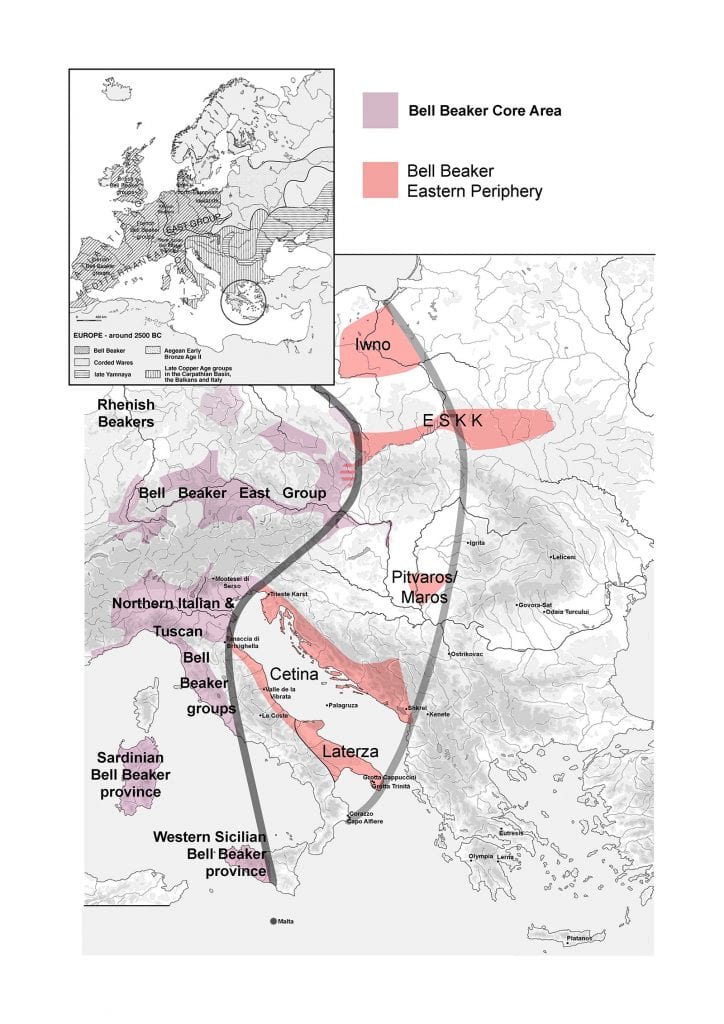
Its practically for sure it was in the Maros group. The question is however whether these were the lineages which did well later. For that I think we have to search for a cultural formation which had close ties from Bell Beakers to Tumulus culture, well into the Middle Danubian Urnfield group. This explains perfectly well the West Pannonian/West Balkan samples found so far. Cetina is a good candidate, but there are others from the Bell Beaker periphery, Maros being part too:


aegeobalkanprhistory_west-meets-east_2-724x1024.jpg

https://aegeobalkanprehistory.kreas.ff.cuni.cz/2008/03/06/when-the-west-meets-the-east/

But this means it could very well have spread with the Beaker expansion, and not just being local there. The Tumulus culture related groups in Pannonia-Balkans were quite Southern Bell Beaker like because of this, so either the J-L283 came from the East Alpine-Upper Danubian zone already, or they being picked up and integrated at a hub of the Bell Beaker periphery.
 
Thank you for this (can't open the links for some reason). We will see if your speculation will be verified. I am actually also hoping we might get the rumored Eneolithic J2b-L283 from Moldova any time soon.

That’s probably a user error on my end. I inserted an image, but it displays as an attachment for some reason.

I’m chomping at the bit as well regarding these ancient samples in the pipeline spanning from the NW Black Sea Region across the southern steppe to Sredny Stog and down into the Caucasus. That entire area is grotesquely under sampled and might offer up some valuable clues regarding how L283 expanded further westward into the Balkans and Central Europe.
 
Its practically for sure it was in the Maros group. The question is however whether these were the lineages which did well later. For that I think we have to search for a cultural formation which had close ties from Bell Beakers to Tumulus culture, well into the Middle Danubian Urnfield group. This explains perfectly well the West Pannonian/West Balkan samples found so far. Cetina is a good candidate, but there are others from the Bell Beaker periphery, Maros being part too:


aegeobalkanprhistory_west-meets-east_2-724x1024.jpg

https://aegeobalkanprehistory.kreas.ff.cuni.cz/2008/03/06/when-the-west-meets-the-east/

But this means it could very well have spread with the Beaker expansion, and not just being local there. The Tumulus culture related groups in Pannonia-Balkans were quite Southern Bell Beaker like because of this, so either the J-L283 came from the East Alpine-Upper Danubian zone already, or they being picked up and integrated at a hub of the Bell Beaker periphery.

Based on the available data so far, I’ve always been a strong supporter of the above hypothesis.
 
View attachment 13094

View attachment 13095

Pure speculation, but I keep seeing these screenshots posted here and at AG from a study on the Carpathian basin. It appears L283 pops up again in the Bronze Age in Hungary (second screenshot). There has been some talk about another (possible) L283 from Hungary dated to approximately 2000BC from Szeged, which is very near Mokrin, Serbia where this guy was discovered https://www.yfull.com/tree/J-Z615*/. The first screenshot shows a bubble for the “Maros” culture, which is positioned more towards eastern Hungary where Szeged is located. The ancient L283 Z615 from Mokrin is likely connected to this Bronze Age Maros Culture. So I think there’s a very real chance of another ancient L283 Maros sample joining the ranks.

Disclaimer: Again, this is pure speculation on my part, so take it fwiw.

Would you be so kind to use imgur, since attachments don't work for me. Really interesting stuff.
 
That’s probably a user error on my end. I inserted an image, but it displays as an attachment for some reason.

I’m chomping at the bit as well regarding these ancient samples in the pipeline spanning from the NW Black Sea Region across the southern steppe to Sredny Stog and down into the Caucasus. That entire area is grotesquely under sampled and might offer up some valuable clues regarding how L283 expanded further westward into the Balkans and Central Europe.

The sad part is, according to some mainstream article I read months ago, tumuli in the region have been flattened since Soviet times to make way for farming. The good news is that there are hundreds if not thousands of tumuli still left in the region. The bad news is that the political situation is so ******, that that anthropology is the last of the regions concerns.

This is the article if I am not mistaken.

https://www.nytimes.com/2021/05/09/world/europe/ukraine-burial-mounds.html
 
Are you telling us Vindobona (supposed Celtic name) was an Illyrian name or that the place named like that a time has become or had been before an Illyrian center?


going by Unesco 2005 world heritage site on the Port of Vienna

UNESCO designated the Port of Vienna as a World Heritage Site in 2005.

Port History

The Port of Vienna has seen many historic eras. Archeologists have found evidence of human occupation at the site of today's Port of Vienna that dates back to the Old Stone Age. In ancient times, the Illyrians lived there. Today's Vienna was founded as a Celtic settlement called Vindobona in about 500 BC.


So when the amber trade was running in the bronze age from the baltic sea .......it reached Vienna ( port of Vienna ) where the goods where exchanged to the illyrians, who moved these goods through Emona ( another Illyrian town ....now the capital of Slovenia ) and then to Istrian ports or to venetic centres through the Illyrian town of trieste or down to the Liburnian and Dalmatian coasts ................eventually some arriving through trade to Egypt

The only query is who exchanged these amber goods on the northern side of the Danube river to the Illyrians ..............was it celts or Lusitains

I would be surprised if there was not a trading town at the port of Vienna ....before Vienna was founded.............its is not what celts did on the south side of the Danube ...........even the town Vindelicorum was created by Augustus even though it has a celtic name
 
I'm tired of us using the vague term Illyrian.

"The name "Illyrians", as applied by the ancient Greeks to their northern neighbors, may have referred to a broad, ill-defined group of peoples. The Illyrian tribes never collectively identified as "Illyrians", and it is unlikely that they used any collective nomenclature at all.[3] Illyrians seems to be the name of a specific Illyrian tribe who were among the first to encounter the ancient Greeks during the Bronze Age.[4] The Greeks later applied this term Illyrians, pars pro toto, to all people with similar language and customs.[5]"

It's time to start figuring out which specific Illyrian tribes were J-L283.
View attachment 13108

.
 
I'm tired of us using the vague term Illyrian.
"The name "Illyrians", as applied by the ancient Greeks to their northern neighbors, may have referred to a broad, ill-defined group of peoples. The Illyrian tribes never collectively identified as "Illyrians", and it is unlikely that they used any collective nomenclature at all.[3] Illyrians seems to be the name of a specific Illyrian tribe who were among the first to encounter the ancient Greeks during the Bronze Age.[4] The Greeks later applied this term Illyrians, pars pro toto, to all people with similar language and customs.[5]"
It's time to start figuring out which specific Illyrian tribes were J-L283.
View attachment 13108
.
you mean like the iapodes ( japodes ) which became the Iagyians once they settled in Foggia Italy as the Daunians and Messapics?


Iapydes (or Iapodes, Japodes; Greek: Ἰάποδες) were an ancient people who dwelt north of and inland from the Liburnians, off the Adriatic coast and eastwards of the Istrian peninsula.
 
I'm tired of us using the vague term Illyrian.

"The name "Illyrians", as applied by the ancient Greeks to their northern neighbors, may have referred to a broad, ill-defined group of peoples. The Illyrian tribes never collectively identified as "Illyrians", and it is unlikely that they used any collective nomenclature at all.[3]Illyrians seems to be the name of a specific Illyrian tribe who were among the first to encounter the ancient Greeks during the Bronze Age.[4] The Greeks later applied this term Illyrians, pars pro toto, to all people with similar language and customs.[5]"

It's time to start figuring out which specific Illyrian tribes were J-L283.
View attachment 13108

.

Given the aDNA Illyrians were a IE group of people that mainly lived along the East Adriatic but also on the West Adriatic where they merged with Italic groups so there is definitely a factual basis that does not support a multiethnic complex.
 
Last edited:
I'm tired of us using the vague term Illyrian.

"The name "Illyrians", as applied by the ancient Greeks to their northern neighbors, may have referred to a broad, ill-defined group of peoples. The Illyrian tribes never collectively identified as "Illyrians", and it is unlikely that they used any collective nomenclature at all.[3]Illyrians seems to be the name of a specific Illyrian tribe who were among the first to encounter the ancient Greeks during the Bronze Age.[4] The Greeks later applied this term Illyrians, pars pro toto, to all people with similar language and customs.[5]"

It's time to start figuring out which specific Illyrian tribes were J-L283.
View attachment 13108

.

I think with this latest Patterson/Reich paper that we all know about by now, we can at least say that these guys are most certainly Iapodes: https://www.yfull.com/tree/J-Y86930/, an Illyrian tribe. I’m not sure what to think about this sample under Z38241 from Jazinka Cave, Croatia: https://www.yfull.com/tree/J-Z38241/

Most of the sampling so far has been heavily weighted towards northern “Illyrian” areas (Croatia and Slovenia), so there is definitely a bias towards Z38240 and downstream clades as a result. With additional sampling of ancient DNA, I have no doubt that a wide variety of different L283 lineages will be found amongst all Illyrian tribes. The Patterson paper was very telling. These Iapodes were very heavy on Y86930, which is just one of many branches underneath PH1602. PH1602 is not even a major branch. It’s not rare, but it’s not that common either.

We have all these guys underneath Z638 and Z1297 along with this huge find from Gudnja Cave in southern Croatia: https://www.yfull.com/tree/J-Z1297/. This Gudnja Cave sample is a harbinger of ancient samples to come, I think, as they start sampling areas with more southern Illyrian tribes. There are many samples in the pipeline it seems and once they drop, these guys who know a thing or two about various Illyrian tribes will help flesh out the details as to which tribes match up to specific L283 Z597 and below lineages.

I don’t have any Balkan autosomal ancestry. My American families all come from Wales (Celts), England, Poland and Germany. So, to me, the “Illyrian” thing is kind of cool. If I didn’t know I was L283, I’d have no clue that I had ancient ancestors down in the western Balkans 3000 or more years ago. Gives me a sense of kinship, in a way, with Balkan people that I otherwise wouldn’t have, if that makes sense. It’s the old homeland.
 
I think with this latest Patterson/Reich paper that we all know about by now, we can at least say that these guys are most certainly Iapodes: https://www.yfull.com/tree/J-Y86930/, an Illyrian tribe. I’m not sure what to think about this sample under Z38241 from Jazinka Cave, Croatia: https://www.yfull.com/tree/J-Z38241/

Most of the sampling so far has been heavily weighted towards northern “Illyrian” areas (Croatia and Slovenia), so there is definitely a bias towards Z38240 and downstream clades as a result. With additional sampling of ancient DNA, I have no doubt that a wide variety of different L283 lineages will be found amongst all Illyrian tribes. The Patterson paper was very telling. These Iapodes were very heavy on Y86930, which is just one of many branches underneath PH1602. PH1602 is not even a major branch. It’s not rare, but it’s not that common either.

We have all these guys underneath Z638 and Z1297 along with this huge find from Gudnja Cave in southern Croatia: https://www.yfull.com/tree/J-Z1297/. This Gudnja Cave sample is a harbinger of ancient samples to come, I think, as they start sampling areas with more southern Illyrian tribes. There are many samples in the pipeline it seems and once they drop, these guys who know a thing or two about various Illyrian tribes will help flesh out the details as to which tribes match up to specific L283 Z597 and below lineages.

I don’t have any Balkan autosomal ancestry. My American families all come from Wales (Celts), England, Poland and Germany. So, to me, the “Illyrian” thing is kind of cool. If I didn’t know I was L283, I’d have no clue that I had ancient ancestors down in the western Balkans 3000 or more years ago. Gives me a sense of kinship, in a way, with Balkan people that I otherwise wouldn’t have, if that makes sense. It’s the old homeland.

Do you think your j2b ancestor travelled to britain with the celts or was a roman legionary?
 
Do you think your j2b ancestor travelled to britain with the celts or was a roman legionary?

I think this question can be best answered subclade by subclade, because for J-L283 both is possible. But branches like this one are very likely to have come from Pannonia/Scythianised groups into the Celtic sphere and to migrate West.
https://www.yfull.com/tree/J-FT4047/

1 Czech (Central Europe) <-> 2 Iberian (2.600 yBP)
So we got from this subclade two branches which date back to 2.600 yBP from Iberia! Two independent ones!

One of which has more data, it split 450 AD in subclades.

But do you really think that this pattern is the product of pure chance and they came from the Balkans in the Roman era?

On FTDNA, the upstream branches follow a trail from Hungary -> Slovakia -> Austria -> Germany -> France -> England and Iberia

And its not the only branch which took this path.
 
I think this question can be best answered subclade by subclade, because for J-L283 both is possible. But branches like this one are very likely to have come from Pannonia/Scythianised groups into the Celtic sphere and to migrate West.
https://www.yfull.com/tree/J-FT4047/
1 Czech (Central Europe) <-> 2 Iberian (2.600 yBP)
So we got from this subclade two branches which date back to 2.600 yBP from Iberia! Two independent ones!
One of which has more data, it split 450 AD in subclades.
But do you really think that this pattern is the product of pure chance and they came from the Balkans in the Roman era?
On FTDNA, the upstream branches follow a trail from Hungary -> Slovakia -> Austria -> Germany -> France -> England and Iberia
And its not the only branch which took this path.
Polska has a different j2b line to this one
But in terms of this line if you go upstream to https://www.yfull.com/tree/J-CTS11760/

There is an italian from firenze (not too far from rome). Romans have a lot of early history in iberia and its one of the regions with a latin language + more genetic roman heritage than most other places in europe. However, the year on yfull puts this line at 600bc which predates roman expansion in iberia by nearly 400 years

In any case we already know that j2b lines existed in BC ancient italy so not all j2b was taken from south/central east europe to italy during roman period as some was already there but this line you bring up here looks like was mainly situated around central and even northern europe in BC around pannonia and further up within la tene?
 
Polska has a different j2b line to this one
But in terms of this line if you go upstream to https://www.yfull.com/tree/J-CTS11760/
There is an italian from firenze (not too far from rome). Romans have a lot of early history in iberia and its one of the regions with a latin language + more genetic roman heritage than most other places in europe. However, the year on yfull puts this line at 600bc which predates roman expansion in iberia by nearly 400 years
In any case we already know that j2b lines existed in BC ancient italy so not all j2b was taken from south east europe to italy during roman period as some was already there but this line you bring up here looks like was mainly situated around central and even northern europe in BC around pannonia and further up within la tene?

I know, I just used it as an example, because it has so many old lineages with no overlap with the South East that it seems to be me clear its Scythianised-Celtic related in time and space. Two independent branches of that age in Iberia and the latest common link with Czechia, while many brother branches are all the way through Central into Western and Eastern Europe. Its rather unlikely this was spread by the Romans, but rather into Italy imho. But of course, without having the actual ancient DNA or very dense sampling we don't know it for 100 %, but chances are high this was spread by Celts. This is the context from FTDNA for J-CTS11760:

J-CTS11760.jpg
 
I know, I just used it as an example, because it has so many old lineages with no overlap with the South East that it seems to be me clear its Scythianised-Celtic related in time and space. Two independent branches of that age in Iberia and the latest common link with Czechia, while many brother branches are all the way through Central into Western and Eastern Europe. Its rather unlikely this was spread by the Romans, but rather into Italy imho. But of course, without having the actual ancient DNA or very dense sampling we don't know it for 100 %, but chances are high this was spread by Celts. This is the context from FTDNA for J-CTS11760:

J-CTS11760.jpg

What makes you think it is scythian related?

Seems common in poland but has popped up in the latin world too (spain x2, italy x2, mexico). Poland has a lot more results on ftdna than italy and spain, 9000 to 2000/3000 and I already know that uk and germany are well represented. However, i cant see romans having a big genetic impact in poland as it was pretty much outside the roman borders - it does look like it was brought to italy from central/north europe through hallstatt or la tene - only other possibility is romans recruited some eastern pannonians who carried this line in late BC but again the dates on yfull dont suggest this yet
 
What makes you think it is scythian related?

Because both E-V13 and J-L283 have founder effects around the time of the Scythianised groups, predating the Celts and spreading beyond the Celtic sphere. We have ancient samples from Vekerzug too, but especially the archaeological context and later finds from Pannonia, from the Avar period, of the exact subclades which spread wide and far about 2.500 yBP.
The distribution is very clearly Celtic related, because it connects various Western European countries, with no clear Roman related pattern.

Seems common in poland but has popped up in the latin world too (spain x2, italy x2, mexico).

There are two independent branches in Iberia (at least) of that age, last common ancestor before in Czechia. That it was brought to Italy too is no suprise, but there is no concentration there by all means, with much more samples from the Northern part of the continent.

Poland has a lot more results on ftdna than italy and spain, 9000 to 2000/3000 and I already know that uk and germany are well represented.

Germany is rather underrepresented, its only specific areas which are well-represented because of the strong migration of Germans from these areas in the early US-American history. Like from Hessia and the Palatinate. Bavaria, Saxony or more Eastern provinces are much worse represented. That's even more true for YFull, where its more skewed than on FTDNA. That's why most YFull-data created maps, almost regardless of which haplogroup it is, has a hotspot around the Palatinate, because so many early German migrants to the USA came from there.

However, i cant see romans having a big genetic impact in poland as it was pretty much outside the roman borders - it does look like it was brought to italy from central/north europe through hallstatt or la tene - only other possibility is romans recruited some eastern pannonians who carried this line in late BC but again the dates on yfull dont suggest this yet

Yes, between Hallstatt and La Tene, but looking at the dating for the most prominent subclades participating, the peak around 2.500 yBP speaks for Scythianised groups into Celts imho. The earlier Basarabi-Hallstatt peak in E-V13 was carried by other clades.

What's also very typical: E-V13 and J-L283 were separated before, but they did both expand/backflow with Celts. That's very noticeable, so they were kind of conquered by Scythians and Celts, which mixed things more up than it was before. Before, they were more separated, but then they had a common label and leaders in Pannonia, to put it that way.
 
Back
Top