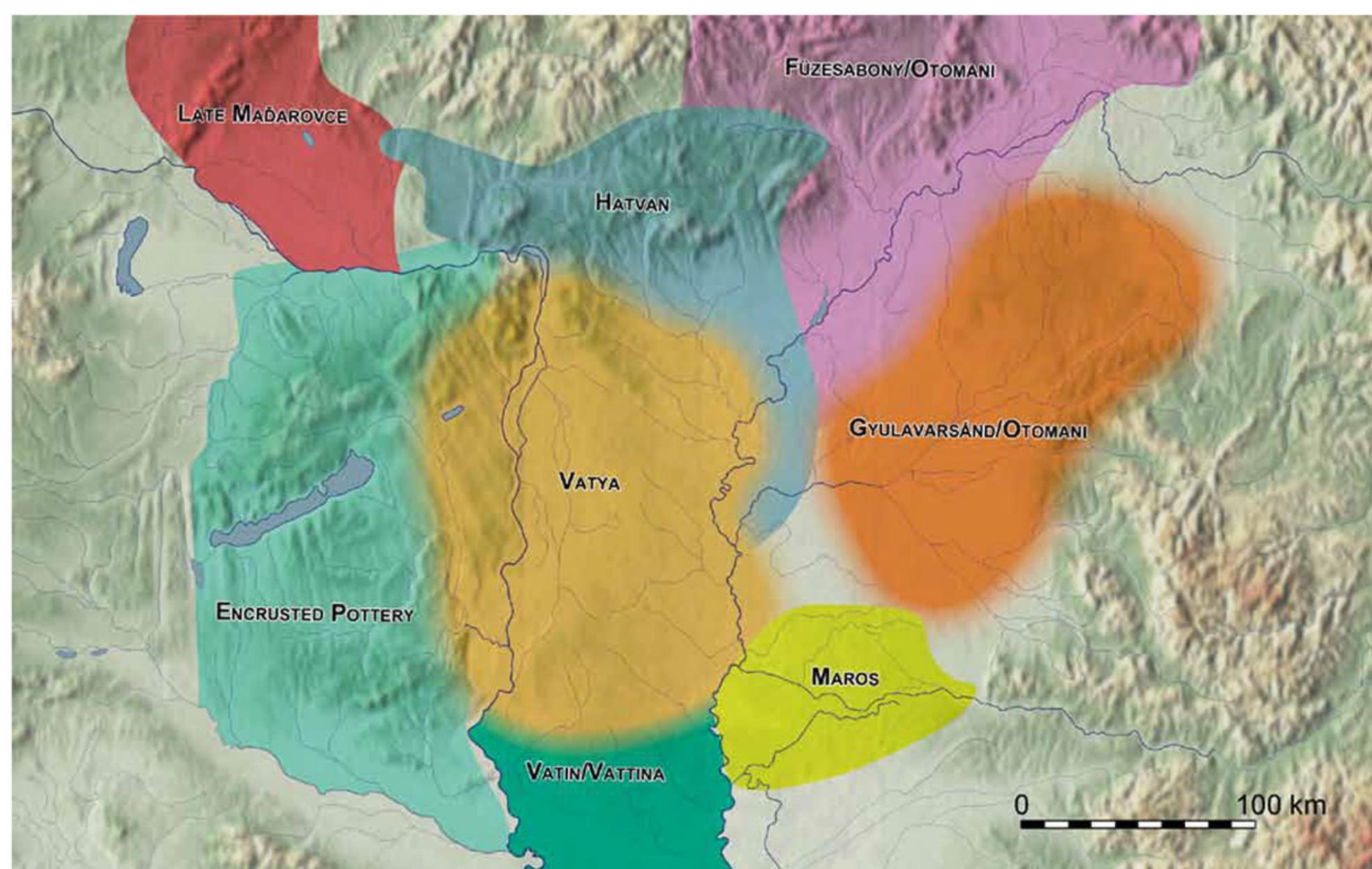
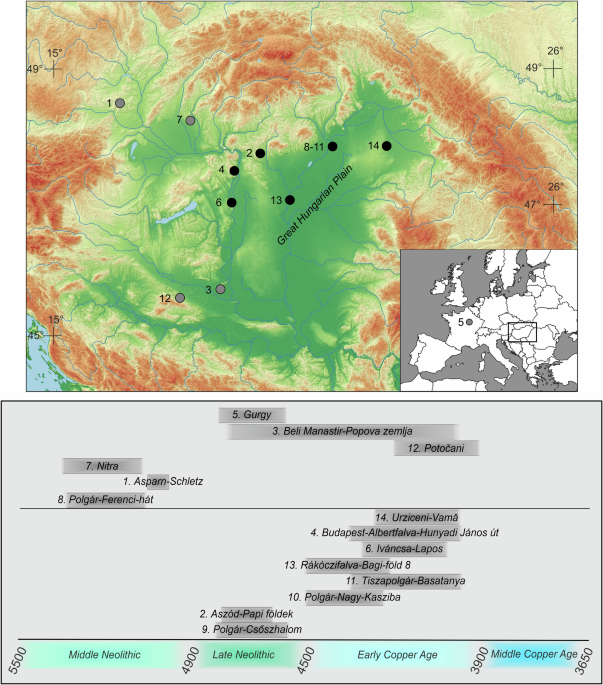
I found a great map for the MBA Carpathian basin before the Tumulus culture invasion (Koszider horizon):

Source: https://refubium.fu-berlin.de/bitst...szter_Fejer_Band_1.pdf?sequence=3&isAllowed=y
Note that all the relevant (even the rather mixed Gyulavarsand-Otomani) groups with Suciu de Sus and late Wietenberg were far to the East from the Tisza river.
The strongest influence of Wietenberg outside of the Inner Carpathians was found in Monteoru:
This is again a good supporting argument for the high EEF/ANF individuals (like SR025) from the county of Neamt, in Monteoru and subsequent Noua periods, being the result of admixture from Wietenberg, because the contacts were there!
Map for the period before the formation of Gáva:

Note the important groups for Gáva: Proto-Gáva territory (Northern Cehalut-Suciu de Sus/Lapus overlap, like Berkezs-Demecser group etc. which had additional Tumulus culture/Piliny influences). Igrita is largely Suciu de Sus derived too and has also some Wietenberg heritage. Basically all the Pre-/Proto-Gáva groups develop from the Cehalut-Suciu de Sus sphere of influence, they just got new impulses from the West (TC and Piliny), which are clearly-primarily cultural only.
The Pre-Gáva territory shows influences from the South, from Belegis too - which is why Vatin-Belegis could play a role as well:
Therefore the "Pre-Gáva" area being simply a mixed zone of interaction with influences from the Suciu de Sus sphere meeting Belegis influences, but also others from the West. I would describe it as an "experimental zone", in which new combinations based on diverse influences were kind of tested.
For the evolution of Gáva, the territory labelled as "Proto-Gáva" is most important, in which the primary influences are Suciu de Sus-Cehalut locals, which received new impulses from the Piliny and Southern mixed zone. But its there, at the Upper Tisza, the Gáva core evolved:
I think that area and possibly much of Lapus and Cehalut was dominated by E-Z5018 already in that time frame.
Based on sickle forms, the emerging Gáva-related groups had contacts to Noua, more intensive than their Western neighbours. So they had both Western (Tumulus culture, Piliny) and Southern (Belegis) as well as Eastern (Noua) cultural influences which they combined on their own.
Late phase of Gáva, when the Kalakacza horizon already began emerging in the South:

From this group (Kalakacza) we will get sacrificial pit samples, which however seem to be various individuals from different groups they could grab for the sacrifices:
While Mezocsat shows the Eastern steppe-Cimmerian influences, in much of the territory Gáva people were surviving:
Source: https://refubium.fu-berlin.de/bitst...szter_Fejer_Band_1.pdf?sequence=3&isAllowed=y
Source: https://refubium.fu-berlin.de/bitst...szter_Fejer_Band_1.pdf?sequence=3&isAllowed=y
Note that all the relevant (even the rather mixed Gyulavarsand-Otomani) groups with Suciu de Sus and late Wietenberg were far to the East from the Tisza river.
The strongest influence of Wietenberg outside of the Inner Carpathians was found in Monteoru:
Der Einfluss der Tei-, Monteoru-, und Verbicoara-Kulturen ist in Siebenbürgen bekannt, und in geringer Menge (besonders im
Gebiet der Monteoru-Kultur) wurden auch Funde der Wietenberg-Kultur außerhalb der Karpaten gefunden.
This is again a good supporting argument for the high EEF/ANF individuals (like SR025) from the county of Neamt, in Monteoru and subsequent Noua periods, being the result of admixture from Wietenberg, because the contacts were there!
Map for the period before the formation of Gáva:
Note the important groups for Gáva: Proto-Gáva territory (Northern Cehalut-Suciu de Sus/Lapus overlap, like Berkezs-Demecser group etc. which had additional Tumulus culture/Piliny influences). Igrita is largely Suciu de Sus derived too and has also some Wietenberg heritage. Basically all the Pre-/Proto-Gáva groups develop from the Cehalut-Suciu de Sus sphere of influence, they just got new impulses from the West (TC and Piliny), which are clearly-primarily cultural only.
The Pre-Gáva territory shows influences from the South, from Belegis too - which is why Vatin-Belegis could play a role as well:
Das Areal östlich von der Donau, die Ungarische Tiefebene besitzt kein einheitliches
archäologisches Material. Die Perioden BzD und HaA1 sind durch gemischtes Material der
lokalen Hügelgräberkultur, der transdanubischen Urnenfelderkultur und der Belegiš-Kultur
charakterisiert. Obwohl diese gemischte materielle Kultur früher nur in der südlichen Region
der Tiefebene bekannt war (Csorva-Gruppe), sind heutzutage auch mehrere Fundstellen in der
nördlichen Region lokalisiert, die unter dem Begriff pre-Gáva-Kultur zusammengefasst
werden.537
Therefore the "Pre-Gáva" area being simply a mixed zone of interaction with influences from the Suciu de Sus sphere meeting Belegis influences, but also others from the West. I would describe it as an "experimental zone", in which new combinations based on diverse influences were kind of tested.
For the evolution of Gáva, the territory labelled as "Proto-Gáva" is most important, in which the primary influences are Suciu de Sus-Cehalut locals, which received new impulses from the Piliny and Southern mixed zone. But its there, at the Upper Tisza, the Gáva core evolved:
Das Obere Theissgebiet trennt sich vom Material der Ungarischen Tiefebene. Die
archäologischen Funde der Periode BzD–HaA1 ähneln dem Material der jüngeren Gáva-
Kultur, es gibt sogar Fundensembles, die darauf hindeuten, dass die Gáva-Kultur in diesem
Raum bereits in der Epoche HaA1 entstand. Dementsprechend ist die Phase BzD als die
Epoche der proto-Gáva-Kultur bezeichnet.539 Ihre genaue chronologische und geographische
Begrenzung ist wegen der Einflüsse von den Kulturen der benachbarten Gebiete
problematisch, einerseits die Piliny-Kultur, andererseits die Hajdúbagos-Cehăluţ-Kultur und
die Suciu de Sus-Kultur haben bei der Genese der materiellen Hinterlassenschaft der proto-
Gáva bzw. der Gáva-Kultur mitgewirkt (Abb. 4.52).
Die beschriebene Gruppe befindet sich im Entstehungsgebiet der späteren Gáva-
Kultur, im Areal der sogenannten proto-Gáva-Kultur, die aus den Elementen der lokalen
Kulturen Hajdúbagos-Cehăluţ, Suciu de Sus, und Lăpuş I-II zusammensteht und für die
Zeitstufen BzD–HaA1 gekennzeichnet ist (Abb. 4.52).
I think that area and possibly much of Lapus and Cehalut was dominated by E-Z5018 already in that time frame.
Based on sickle forms, the emerging Gáva-related groups had contacts to Noua, more intensive than their Western neighbours. So they had both Western (Tumulus culture, Piliny) and Southern (Belegis) as well as Eastern (Noua) cultural influences which they combined on their own.
Late phase of Gáva, when the Kalakacza horizon already began emerging in the South:
From this group (Kalakacza) we will get sacrificial pit samples, which however seem to be various individuals from different groups they could grab for the sacrifices:
Am südlichen Rand der Gáva- und der Urnenfelderkulturen, in Syrmien und im Gebiet
südlich vom Fluss Mureş verändert sich die materielle Kultur: die Elemente der Belegiš II und
der Gáva-Kulturen erscheinen in diesem Areal, aber am Anfang der Periode HaB das Material
der Kalakača-Gornea (Kalakača-Bosut) Kultur charakterisiert die Funde des Raumes, und
wegen der Ähnlichkeiten der zwei Kulturen wird diese Zeitperiode als die erste Phase der
eisenzeitlichen Bosut-Kultur angesprochen.
While Mezocsat shows the Eastern steppe-Cimmerian influences, in much of the territory Gáva people were surviving:
Ab der Periode HaB2/3 wird östlich geprägtes Material innerhalb des
Karpatenbeckens stärker verbreitet. Die meisten Funde kumulieren in Ostungarn und im
Nördlichen Mittelgebirge, aber auch im östlichen und südlichen Teil von Transdanubien sind
sie bekannt. Gegenstände östlicher Herkunft sind in Depotfunden und in Gräbern mit lokalen
Objekttypen gemischt überliefert. Gräberfelder, deren Material zu einer osteuropäischen
Kulturgruppe gehört (Mezőcsát-Kultur), befinden sich ausschließlich in zwei ostungarischen
Regionen. Anscheinend war das Material der Gáva-Kultur in dieser Epoche (HaB2/3) in den
anderen Gebieten von Ostungarn immer noch präsent.739
Source: https://refubium.fu-berlin.de/bitst...szter_Fejer_Band_1.pdf?sequence=3&isAllowed=y




 OP39.SG__BC_2676__Cov_83.43%