



| Contents |
|---|

Introduction
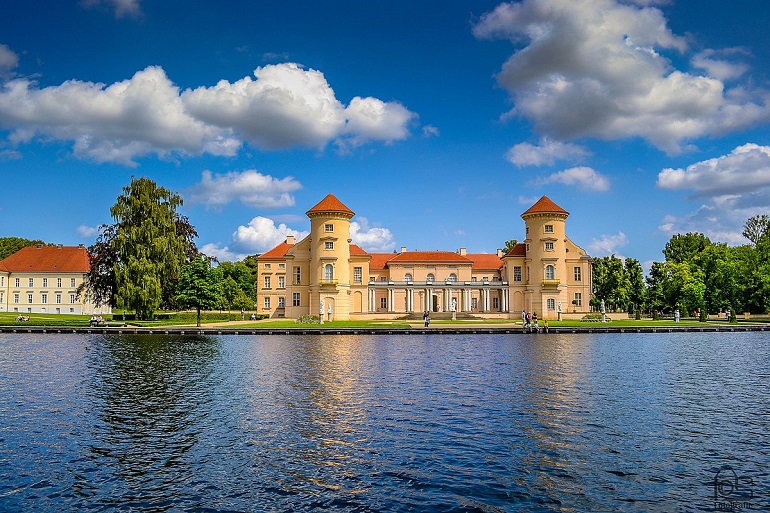
Rheinsberg Palace, or Schloss Rheinsberg, stands gracefully on the eastern shore of Lake Grienericksee in Brandenburg, forming a harmonious union of water, parkland and splendour. Its three-winged ensemble, punctuated by twin towers, embodies the refined elegance of early Frederician Rococo, complemented by later Neoclassical embellishments.
Originating as a Renaissance water castle in 1566, King Frederick William I of Prussia acquired it in 1734, and bestowed it to his 22-year-old son, the future Frederick the Great. The crown prince spent four years here, extending and remodelling the castle in the so-called Frederician Rococo style, which was to culminate in Sanssouci. Frederick described his years in Rheinsberg as the happiest of his life. After Frederick’s accession, his brother Prince Henry of Prussia continued the palace’s development, adding early Neoclassical interiors and extending the landscaped gardens. Today, the restored palace forms part of the Prussian Palaces and Gardens Foundation Berlin-Brandenburg, housing the Kurt Tucholsky Literature Museum, the Rheinsberg Music Academy and Chamber Opera, and serving as a venue for the annual International Opera Festival.
Interesting Facts about Rheinsberg Palace
- Rheinsberg Palace is set picturesquely on the banks of Lake Grienerick in Brandenburg and is renowned for its enchanting Rococo architecture.
- The palace was the beloved retreat of Frederick the Great when he was crown prince, who described his years there as the happiest of his life.
- Rheinsberg became a vibrant centre for the arts and culture under Prince Henry of Prussia, who introduced the palace’s famous court of muses.
- The palace’s unique gardens combine French formal and English landscape styles, making the grounds a pioneering example of landscape design in Germany.
- Rheinsberg Palace inspired renowned figures such as Theodor Fontane and Kurt Tucholsky, with both immortalising it in their literature.
- Inside, the palace houses exquisite Rococo interiors, with features such as the Marble Hall and the preserved Hall of Mirrors reflecting 18th-century elegance.
- The palace was once a flourishing musical venue—composer Carl Heinrich Graun’s operas were performed here, and the grand hall’s acoustics are considered exceptional for musical events.
- Prince Henry expanded the estate to over 300 hectares, adding architectural features like an obelisk commemorating overlooked heroes of the Silesian wars.
- Rheinsberg’s opulent porcelain collection remains one of the finest in Europe, offering insight into the tastes of its royal residents.
- Extensive restoration has retained much of the original Frederician and early Neoclassical interior decoration, allowing visitors to step back into the refined world of its historic inhabitants.
History
Rheinsberg Palace stands on the site of a medieval moated castle, evolving through centuries of ownership and architectural transformation. In the Middle Ages, the von Bredow family acquired the lordship of Rheinsberg through marriage in 1464 and constructed a water castle in Renaissance style in 1566. The structure suffered significant damage during the Thirty Years' War and passed through various hands, including Kuno von Lochow in 1618, before eventually being sold to Benjamin Chevenix de Beville. In March 1734, the Prussian King Frederick William I purchased the estate for 75,000 thalers and gifted it to his son, Crown Prince Frederick, later known as Frederick the Great, as a reward for his loyalty.
The palace's golden age began in 1736 when Crown Prince Frederick moved to the southern wing with his wife, Princess Elisabeth Christine. Between 1736 and 1740, Frederick commissioned architects Johann Gottfried Kemmeter and Georg Wenzeslaus von Knobelsdorff to extensively renovate and expand the castle, adding an upper floor to the single-storey building and extending the East Wing by 25 metres. Frederick transformed Rheinsberg into a vibrant court of muses, where he pursued his philosophical, literary, and artistic interests. The palace served as his testing ground for innovative design ideas that he would later implement with great mastery at Sanssouci. Frederick himself described his years at Rheinsberg as the "happiest of his life", and his time there ended in 1740 when he ascended to the throne.
Following Frederick's departure, the palace entered a new era under his younger brother Prince Henry of Prussia, who moved there in 1752 with his wife, Princess Wilhelmina of Hesse-Kassel. Henry continued the tradition of maintaining a court of muses and significantly enhanced the palace over half a century of residence. In 1774, he added a palace theatre to the cavalier house, hosting travelling drama groups and opera performances with improvised orchestras. Between 1785 and 1786, Georg Friedrich von Boumann completed the palace according to original plans and built two pavilions. Henry also commissioned the construction of the Rheinsberg obelisk in the early 1790s to honour the memory of his brother Prince Augustus William and officers who had served in the Silesian wars. After Henry's death in 1802, the palace remained with the House of Hohenzollern until government expropriation in 1945. During East German times, it housed a diabetes clinic before being transformed into its current role as a museum and home to the Kurt Tucholsky Literature Museum.
Description
Architectural Overview
Rising from a lakeside terrace, the palace presents a balanced façade of pale plaster and sandstone pilasters. The ensemble comprises:
- A central corps de logis with a gently sloping mansard roof, crowned by a modest belvedere.
- Two symmetrical side wings terminating in slender towers, their lantern caps lending a romantic silhouette against the sky.
- An open forecourt framed by wrought-iron gates and clipped lime trees, offering framed vistas across the water.
Subtle Rococo flourishes are evident in the curvaceous window surrounds and the delicate stucco festoons that adorn the eaves. The later Neoclassical refurbishment introduced more restrained mouldings and pilaster orders within the interior, creating an elegant dialogue between exuberance and clarity.
Interior Highlights
Visitors are immediately drawn to the Hall of Mirrors on the northern wing’s upper floor. This longitudinal salon is bathed in natural light, which dances off gilded stuccowork and a ceiling fresco by Antoine Pesne. Sweeping mirrors line one side of the room, visually doubling the ornate gilding and illuminating the soft pastel palette of Rococo ornament.
Adjoining chambers reveal a carefully restored sequence of salons:
- The Shell Salon (Muschelsaal), with its whimsical arabesques of mother-of-pearl and shell mosaics set into a pale blue backdrop.
- The Music Room, where parquet floors and painted wall panels evoke an intimate setting for chamber concerts.
- The Summer Apartment, showcasing early Neoclassical fireplaces of carved marble and understated cornices, reflecting Prince Henry’s later taste.
Throughout, original furnishings have been judiciously reinstated: slender chairs with cabriole legs, pier tables inlaid with floral marquetry, and gilt-wood consoles supporting porcelain vases. Paintings by court artists and delicate porcelain figures accentuate the domestic refinement of the 18th century.
The Gardens and Parklands
Rheinsberg’s grounds unfold as one of Germany’s earliest “sensitive” landscape gardens. Key features include:
- A gently curving pleasure garden laid out along the palace’s main axis, its clipped hedges forming a sculptural parterre.
- A long Perspektivallee—an imposing tree-lined avenue—drawing the eye through successive vistas to a distant obelisk.
- Terraced lawns that slope towards the lake, terminated by a scalloped quay where the water’s edge is softened by weeping willows.
- Romantic follies: a fieldstone grotto tucked beneath ancient oaks, and a neatly clipped hedge theatre where open-air performances once took place.
The integration of artful geometry with natural topography creates an impression of effortless elegance, inviting quiet promenades or contemplative repose by the water.
Cultural Atmosphere
Today, Rheinsberg Palace continues its tradition as a court of the muses. The pastel-toned rooms and acoustic clarity of the Hall of Mirrors make it a premier venue for chamber opera and classical recitals. Seasonal exhibitions in the side wings display decorative arts, while outdoor summer concerts in the park blend music and landscape in true 18th-century style.
The overall experience is one of tranquil refinement: the gentle lapping of lake waves, the rustle of lime-tree leaves, and the soft glow of gilded ornament all conspire to convey the palace’s enduring allure as a place where nature, art and architecture coalesce into a single, gracious ensemble.
Getting There
By train Rheinsberg Palace is easily accessible from Berlin by regional train. Board a train at Berlin Hauptbahnhof and travel north to Löwenberg (Mark), where you change onto a connecting train to Rheinsberg (Mark) station. From there, it’s approximately a 10–15 minute walk to the palace, or you can take a local bus for a short transfer.
By bus or coach Regular regional buses also serve Rheinsberg from neighbouring towns and cities, with lines such as the 764, 785, 788, and RB54 stopping at or near the palace. The bus stops ‘Rheinsberg Schloss’ and ‘Rheinsberg Bahnhof’ are both within walking distance, making this a convenient option if you’re coming from the surrounding region.
By car Travellers arriving by car can take the A24 autobahn north from Berlin, then follow signs for the Rheinsberg exit. From there, it's a straightforward drive directly to the palace, where visitor parking is available close by. The journey by car allows flexibility and offers scenic views of the Brandenburg countryside.
Best Time to Visit
The ideal time to visit Rheinsberg Palace is in the milder shoulder seasons of spring and early autumn, when the formal gardens are in bloom and the weather is pleasantly warm without the summer crowds. late April through June, daytime temperatures typically range from the mid-teens to low twenties Celsius, offering comfortable conditions for exploring the palace interiors and strolling through the lakeside park. Likewise, September and October bring crisp air and golden foliage, creating a tranquil atmosphere as the tourist season winds down and admission prices remain moderate. During these months, you can savour both the splendour of Frederician Rococo and the serene beauty of Grienicksee with fewer fellow visitors and without the higher humidity or frequent showers of midsummer.


