• Don't want to see ads? Install an adblocker like uBlock Origin or use a Europe-based privacy-friendly browser like Vivaldi or Mullvad.

All Iberian men were wiped out by Yamna men 4,500 years ago

As for Muslim invaders, wouldn't they rather bring Y-DNA J1 instead of J2?

Consistent with the rest of the Arabian Peninsula, haplogroup J is the most abundant component in Saudi Arabia embracing 58% of its Y-chromosomes. Its two main sub-clades (J1-M267 and J2-M172), show opposite latitudinal gradients in the Middle East. J1-M267 is more abundant in the southern areas, reaching a frequency around 73% in Yemen, whereas J2-M172 is more common in the Levant. Most probably, the significant higher presence of J2-M172 in Saudi compared to other Arabian populations is due to the larger northern boundary that Saudi Arabia shares with the Levant.

https://www.researchgate.net/public...sity_and_Its_Relationship_with_Nearby_Regions
 
this is what the link says about Cogotas :
The Proto-Cogotas culture is associated with a Bell Beaker substrate influenced by either El Argar or Atlantic Bronze.

As for Muslim invaders, wouldn't they rather bring Y-DNA J1 instead of J2?

At the time of the Punic wars, mainland Iberia was mainly Celtiberian, which was formed by Hallstatt intruders 2,6 ka mixing with locals.
Appearantly R1b-DF27 was already present in Iberia before that time.

Hallstatt is often associated with R1b-U152, but their distribution in Iberia doesn't fit Celtiberians.
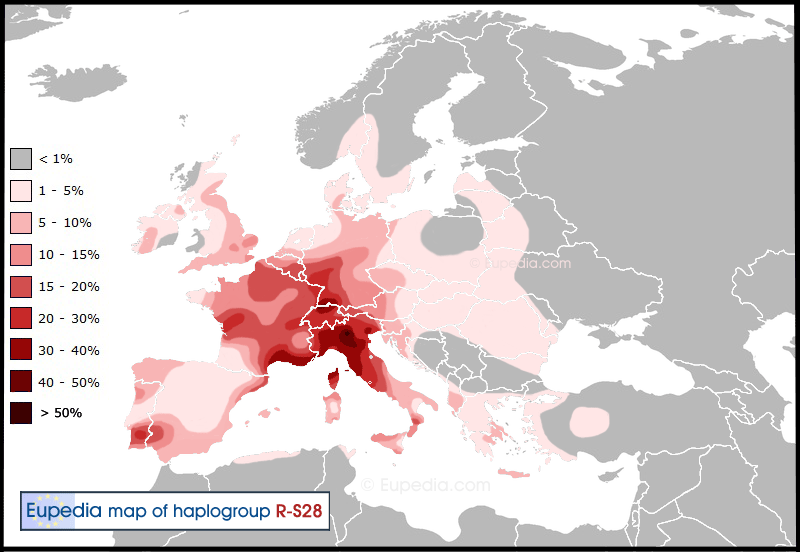
Haplogroup-R1b-S28.gif


It fits more with the mysterious Tartessians, but I can't think of any logical explanaition for that.

Looking at the map, R1b-S28 in Iberia looks more like Lusitanian, wich is sometimes believe to be related with Italic languages?
 
It also raises a diferent issue. The lusitanians, which were the ones speaking an IE language full of arcahism were the same as the rest of the Portuguese tribes such as the several turduli tribes themselves which is the rest of the Portuguese map where there is no U152...
So, celts were not IE speakers??

What is your point here? A joke? I cannot guess.
Celtic was spoken even in some places of the Tartessos territory but then we speak of relatively recent times. A lot of Celts and Belgae were already got down to SW Iberia. The fact that one group of tribes was IEan speaking doesn't exclude that a different group was speaking another kind of IEan; here all evidence points to a later input of U152, fater DF27.
But maybe I missed a good joke?
 
What is your point here? A joke? I cannot guess.
Celtic was spoken even in some places of the Tartessos territory but then we speak of relatively recent times. A lot of Celts and Belgae were already got down to SW Iberia. The fact that one group of tribes was IEan speaking doesn't exclude that a different group was speaking another kind of IEan; here all evidence points to a later input of U152, fater DF27.
But maybe I missed a good joke?

If I remember well, it is not known whether Tartessian is a Celtic language, but some Tartessian kings had Celtic names.
Can you provide a link about the presence of Celts and Belgae in SW Iberia?
 
We know that Mitanni was an Hurrite Kingdom dominated by an Indo-Aryan Elite. So why this rule could not apply to Tartessians? Obviously Tartessians weren't Celts themselves.
 
What's so new or fascinating about this? It's the sole reason why Iberia is highly dominated by R1b.

Simple logic.
 
If I remember well, it is not known whether Tartessian is a Celtic language, but some Tartessian kings had Celtic names.
Can you provide a link about the presence of Celts and Belgae in SW Iberia?

I don't find immediately the study I red about it but at least some writings in the Tartessian territory (rather West?) have been identified as fully Celtic;some authors have pretended a Celtic connexion for the Tartessian language itself but it seems not being the consensus. Even IE is doubtus. Some ancient states provided already more than an unique language, it is not new. Concerning Celts and Belgae in SW Iberia (and perhaps Germans before our era) there has been a thread here. I 'll search my old "files" but sure there has been a lot of sets of tribes coming there from N-E today France and Belgium before Roman Era, not always ful tribes but only some sets ("ver sacrum"?).
 
doubtus? new english! "doubtful"! Sorry
 
Given the massive population re-distributions undertaken by the Spanish crown both during and after the Reconquista to pacify the population, I've always thought that modern genetic distributions, including of uniparental dna, should be used quite cautiously.
 
I don't find immediately the study I red about it but at least some writings in the Tartessian territory (rather West?) have been identified as fully Celtic;some authors have pretended a Celtic connexion for the Tartessian language itself but it seems not being the consensus. Even IE is doubtus. Some ancient states provided already more than an unique language, it is not new. Concerning Celts and Belgae in SW Iberia (and perhaps Germans before our era) there has been a thread here. I 'll search my old "files" but sure there has been a lot of sets of tribes coming there from N-E today France and Belgium before Roman Era, not always ful tribes but only some sets ("ver sacrum"?).

I answer myself, and I moderate my first affirmation: there has not been a lot, the most of sets settled in Iberia (aside the Urnfields Celts who did not go too far south Catalonia apparently) stayed around Basque country and Meseta. But there has been Belgae in SW Iberia. I have to find my docs.
That said, I agree with Angela that the today distribution of Y-haplos is to be taken with caution when speaking about past. Iberia has known the tremendous reconquista we can see its influence in today Iberia autosomes. But IMO the great winner of the reconquista has been rather Y-R1b-DF27; I doubt the totality of today U152would be in debt to the lone Reconquista. A Roman hotspot? No clue.
 
@Halftap ? all iberians wiped... ? #653

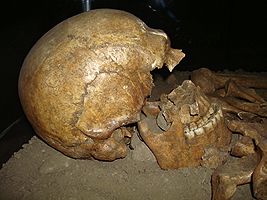
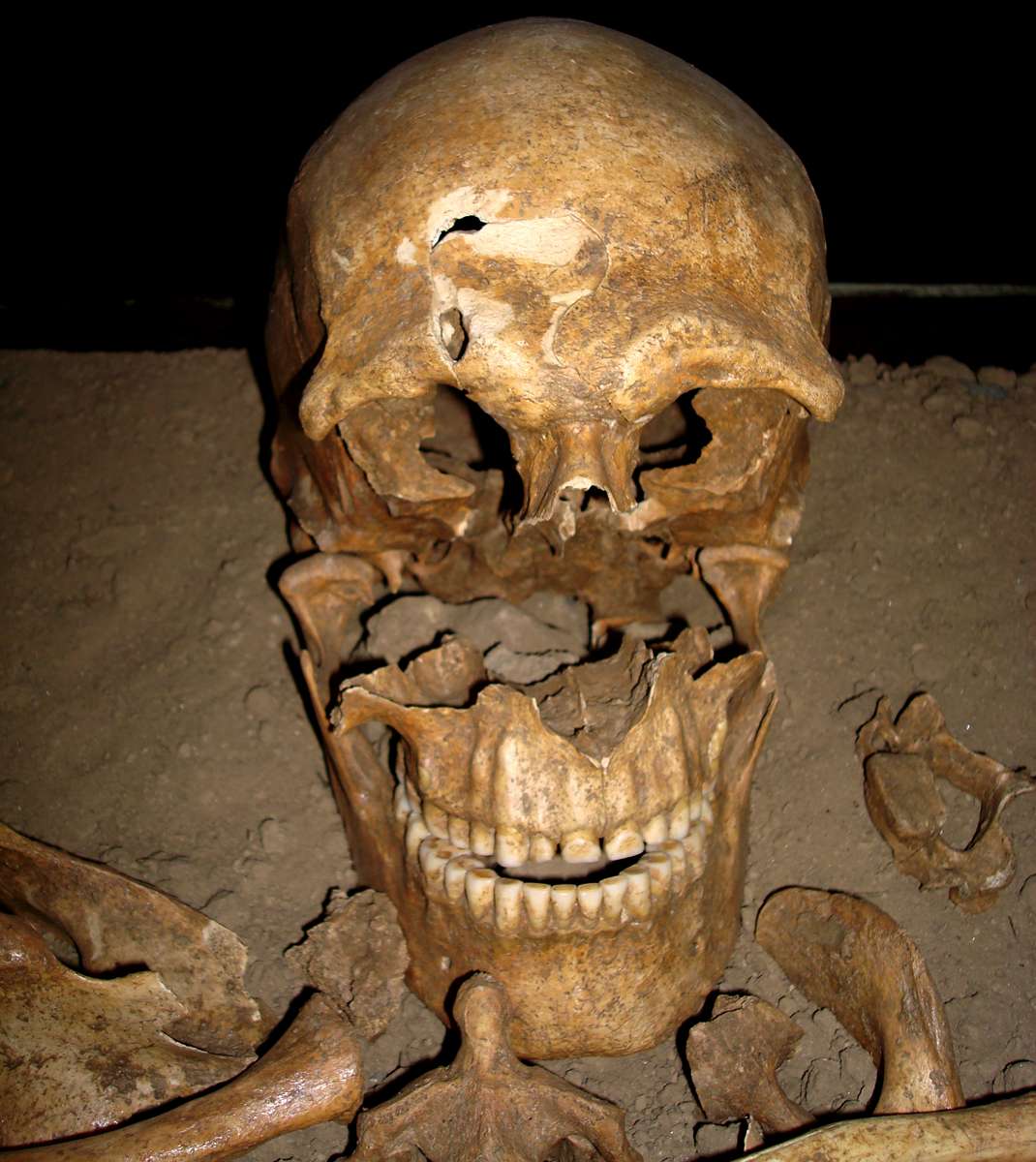
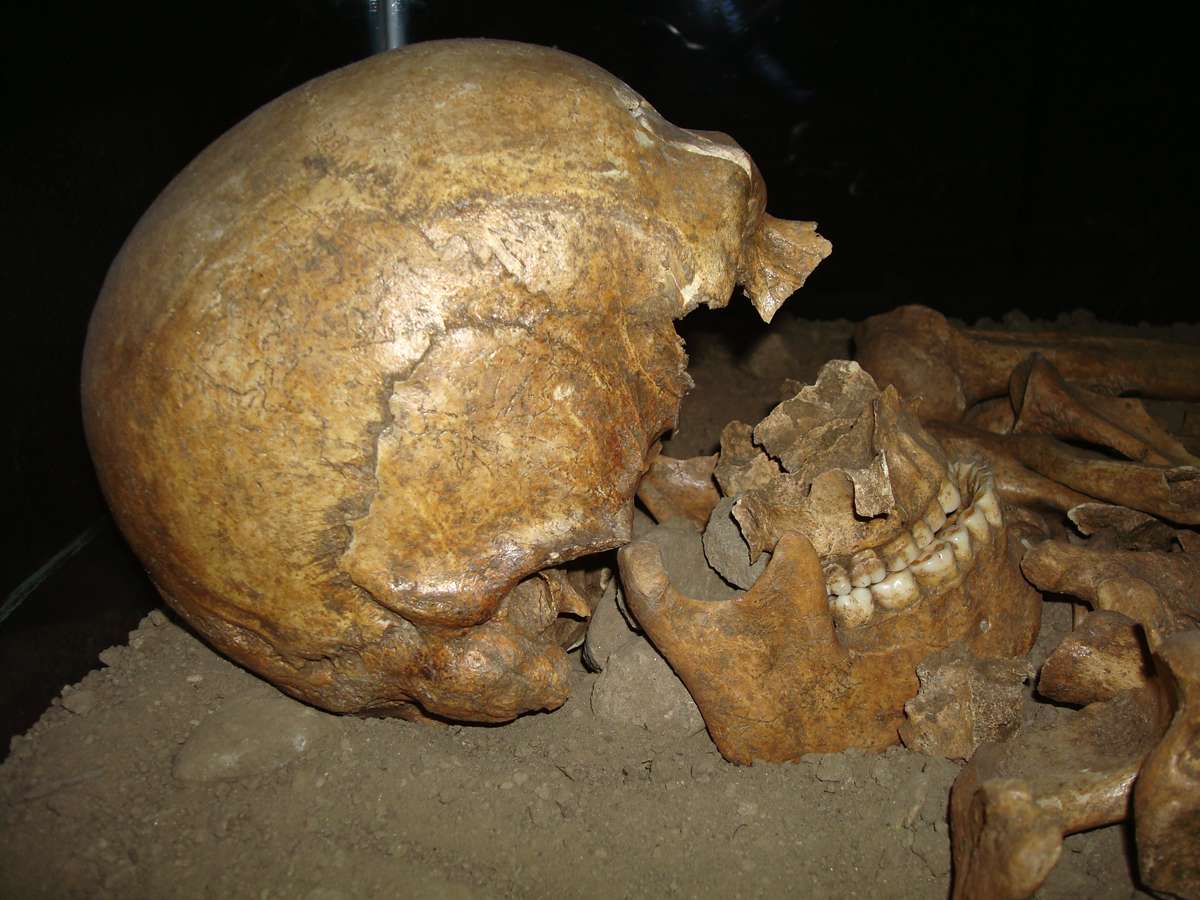
Can you look at the Schela Cladovei skull and tell me what you think about it? I know you have high physical anthropolgy knowledge.


? high physical anthropology knowledge ? is going too far ; rather a big interest in this matter. (I like drawing, so phenotypes).


Concerning the skeletons in Schela Cladovei, classified as Final Mesolithical, set on the romanian bank of the Danube River not far from the famous Iron Gates, I found only pictures of a lone skull, apparently a male ; nothing more, and the face is in a very bad state, missing both zygomatics, what caused the loss of the external parts of orbits ! Hard work.
Bets without true measures are only bets. Let?s try :
based upon profile vs frontal view, I find it rather mesocephalic than dolicho, maybe subdolicho because the angles are not lcear for profile ? Uneasy to say. The vault is high (for Mesolithics, more ?br?nnoid? than ?cromagnoid? in my namings) ? forehead not as receding as among ?br?nn? but as strong browridge, with kind of a ? cap visor ?, primitive trait (more ?br?nnoid? than ?cromagnoid?), seemingly large orbits (more ?br?nnoid? than ?cromagnoid?) of mean index (not so low as ?croma?) - narrow lower jaw with high enough chin (both traits : more ?br?nnoid? than ?cromagnoid?) :
surprisingly or not, a possible evolution of typically ?br?nnoid? in origin towards brachycephaly, so maybe sort of prototype for future ?dinarics? ??? Geographically it would not be amazing, but here it?s a statement of mine based upon ? snuffing method ? ! Or at least some future preponderant element in this so controversial type, homozygotic or not. I red somewhere, without any data, that some brachycephalisation had already been observed in Neolithical Vinca sites population.
Please don?t rely too much on my cephalic index guessings, they are based upon so little (it spites me). The other observation point very well toward a ?br?nn? heritage : no surprise : ancient scholars have noter that among Mesolithic pops of this region, some ? families ? were on a marked ?br?nn? side when others were on a marked ?cro-magnon? side. So the mixture of both phyla - which was already evident in other places of Europe ? was not the rule everywhere there, at least for a time.
ATW, mixture or not (I think : mixture!), the tendancy of Mesolithic Europe was rather toward the ?br?nnoid? shapes than ?cromagoid?(these shapes, inherited directly of ?br?nn? or of other pops come from East, were surely an heritage common enough among the diverse pops who rambled between western Europe and Central Asia, and who shares some ancient common ancestry, I think. Spite the volatility of Y-haplo?s connections to total autosomes, I keep on thinking that old ?croma? was rather Y-C1 and that in Europe the other more brutal types were present among later Y-I, maybe first Y-J ; first Y-R?s were maybe more on an undifferentiated side of the ancient nord-eurasian types, but here I?m far from the aim of this post, and it?s only pure (dangerous) speculation.

Do take all this with a taste of salt.
Here under, fund on the net :
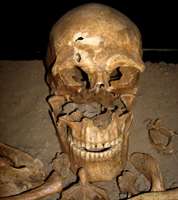


Sorry for this answer to Halftap which could have been posted in anthropology rather than here.
 
I also agree with taking a cautious approach, although we should be careful not to apply our caution selectively.
I have seen people dismiss all data from modern samples entirely, while coming to an overly assured conclusion based on single archaeological sample.

In fact, using data from modern samples has a number of advantages over using archaeological data - e.g. the dataset and coverage is very much larger, its readings are more detailed and reliable, it is publicly accessible, and it inherently relates to extant (rather than mostly extinct) lineages. The important things to be aware of are that this data has to be analysed very carefully, and that any conclusion to be drawn can never be 100% definitive and can only be a most likely estimate. However, we should not let our caution stop us from making our best estimates from the data available, just that we have to be ready to revise these estimates when further data becomes available.

On consideration, it looks like Reich is broadly right. However, I would not identify those doing the wiping out as Yamna men. They appear to have derived from just a small sub-section of a population explosion that most likely initiated in France, and this core population itself most likely only emerged from a pre-Yamna population at least two steps back (i.e. via a developmental period in the Balkans).

I suspect the situation in Iberia was most likely the result of what I think would be more accurately identified as an internal conflict between two strands of Bell Beaker, with the Northern EHG-infused (R1b-dominated) strand coming out on top. For various reasons I also suspect that this conflict arose only after a conflict between Bell Beaker and Corded Ware communities along Corded Ware's Southern and Western flanks.
 
Sorry for this answer to Halftap which could have been posted in anthropology rather than here.

You deserve an half tap on your shoulder! More seriously, i didn't know how to define the skull if brachycephale or mesocephale. But being a Mesolithic specimen, isn't it interesting to be in the spectrum of non-dolicocephaly this early? When Farming wasn't even a thing from the time? And knowing that Brachycephaly in Europe seems to come always from the Balkans...
 
You deserve an half tap on your shoulder! More seriously, i didn't know how to define the skull if brachycephale or mesocephale. But being a Mesolithic specimen, isn't it interesting to be in the spectrum of non-dolicocephaly this early? When Farming wasn't even a thing from the time? And knowing that Brachycephaly in Europe seems to come always from the Balkans...

cephalic index: breadth on length - here only bets because no tools and no skull in my hands! An index old scientists abused of spite a lot of other indexes have importance too, without to speak of shapes.
BTW signs of neat brachycephalisation appeared between 8000 and 6000 BC in western Alps too. The causes are still discussed. the French Charles thought 'dinaric' was an evolution of a 'br?nnlike' phylum in mountains close to sea (Western Balkans). Not the Coon 's opinion. I have only vague thoughts, no sound opinion.
 
Off-topic but reading about skull shapes in Anatolia, there doesn't seem to be a change until 2000 BC (brachy Hittites) well after Indo-European merchant names from Armi. Doesn't seem to be compatible with Balkan invasion theory.
 
I wouldn't use anything from the Quiles site as information; the man's anti-R1a bigotry is off-putting (seriously, did Razib Khan throw him into a garbage can when he was a teenager?), strident refusal to connect M417 to Proto-Indo-European is almost farcical; did the 'master race' R1b-L51 magically convert all the C. Europe Uralic hillbilly R1as to Indo-European and have no influence of their 'original' tongue on the resultant dialects that emerged. Uralic languages are very distinct and agglutinative; where is the trace of this on the Balto-Slavic-Indo-Iranian group?
 
It ain't gonna be R1a - I do think R1b is a possibility though, even if it isn't the most likely based on what evidence we do have. Also, Soqotri is a different case due to its obviously high levels of isolation. With the whole of Iraq, that argument doesn't hold on.

this , it was to be either R1b or R1a is a joke right !................there where many ydna haplogroups in the place where PIE was created, everyone under haplogroup IJK was between the 2 seas and the steppe
 
Back
Top