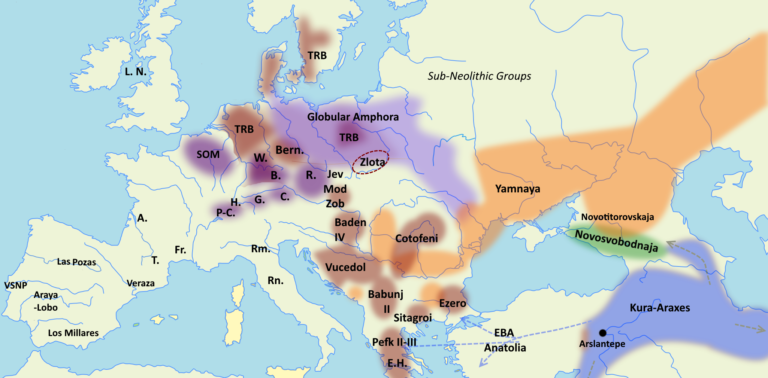
This dichotomy in the Carpathian basin's East has a topographic reason:
Source:
https://www.researchgate.net/figure...an-Mountains-form-an-arc-along_fig1_237475823
Yamnaya was centered in the lowlands, see the darker green, whereas the locals centre, like I mapped it above, was at higher elevation in lighter green into the yellow highlands. You can also see, how the Maros river creates a pathway into Transylvania South and East of the Apuseni mountains, where both Yamnaya and Scythians did move along, but also the Maros cultural group (with Yamnaya influence).
The Upper Tisza being a structured area, structured by rivers and swamps, at higher elevation and with a more sandy soil. That's not good territory for classical steppe pastoralists and the locals did specialise there. The very area were Slovakia, Hungary, Ukraine and Romania border each other, that's the largest area which was inhabited by locals in nearly all periods. And its also the centre for both Nyirseg-Sanislau culture, Eastern Otomani, Suciu de Sus and later Gàva. This is also a core area for Cotofeni and Makó in earlier periods. Therefore since the late Copper Age we deal with a Pre-Yamnaya steppe influenced (Usatovo-Gorodsk and Cernavoda connections) people which persisted into the Roman era the least, likely up to the late Germanic-Avar, possibly even into Slavic era.
Here is the Northern core zone (for the Southern refuge the earlier map, its basically Northern Oltenia and its neighbourhood):
What Yamnaya and the other steppe groups often did, was basically cutting the local sphere in half, into a Northern and a Southern one. Early Cotofeni core:
Yamnaya runs right through it, pushing the Cotofeni and related groups both North (Upper Tisza) and South (Oltenia) into their zones of retreat, resulting in Nyirseg (North, with Vucedol influences) and Glina-Schneckenburg (South), plus small regional groups which had varying degrees of Yamnaya influence (like Copaceni, Livezile etc.) in Transylvania in the middle.
The same area (where Slovakia, Hungary, Romania and Ukraine border each other respectively) was continuously inhabited by:
Cotofeni -> Nyirseg/Sanislau -> Eastern Otomani -> Suciu de Sus -> Lapus -> Gáva -> Sanislau group/Eastern Vekerzug -> La Tene influenced North Thracians -> Dacians
All these groups were mostly or even strictly cremating their dead.
Number 6 is the Nyirseg culture:
Number 7 is the Maros culture, which emerged right in the area into which Yamnaya broke into along the Maros river and being, while in contact with the locals (Proto-Nagyrev and Nyirseg, emerging Wietenberg being not shown, but to the East of Nyirseg) clearly distinct - though not as differentiated, by comparison, as the Kisapostag-Encrsuted Ware people to the West (4).
It is, in any case, amazing how archaeological records and genetic results align. Because again, no clear Yamnaya intrusion ever changed the Nyirseg and the Northern core zone I outlined. Plus even the tumuli which appeared, unless they were in the clear Yamnaya zone, like along the Maros river, were mostly done by locals of Cotofeni origin.
This explains why the high EEF locals persisted. Archaeological results already told us so.
Note there is a zone East of the Tisza which was taken by Yamnaya, but they didn't move through what is now the Hortobágy river and national park:
https://www.wikiwand.com/en/articles/Hortobágy_National_Park
This is an excellent territory for pastoralists, directly to its East starts the Nyirseg:
https://de.wikipedia.org/wiki/Nyírség
Also some ideas on the emergence of Cotofeni, which is the main candidate, the second being Vucedol:
The question of the origin of the Cotofeni culture should be viewed
within the framework of the emergence and expansion of Boleraz-Cernavoda
III and, for a somewhat later period, of Baden, as well. Numerous elements of
Cotofeni pottery, especially as found at Romanian sites, derive from the style
of Cernavoda III: the use of plastic bands, a rather coarse version of the
herringbone motif, and broad channelling. This kind of pottery from Romanian
sites (Petresti, Brateiu-NiSiparie, the earlier layers of Locusteni) 209 is dated by
P. Roman to phase I of the Cotofeni culture. This phase is also characterized
by the complete absence of Furchenstich decoration and of the motif of cuts
organized into chequer patterns in Kostolac manner (Herculana-Pestera-
Hotilor, Girbova de Sus).210 The presence of Boleraz-Cernavoda III elements
in the early phase of Cotofeni does not indicate, however, a direct evolution.
The Cotofeni culture probably came into being as a result of the very same
process which gave rise to Baden in the Pannonian Plain. Only their
autochthonous bases were different: in the case of Baden, the line followed was
Balaton-Boleraz-Baden, while the basis of Cotofeni was a combination of
Cernavoda III and Salcuta.
That idea is interesting, since Salcuta is more Southern than Tiszapolgar-Bodrogkeresztur, Petresti and Ariuszd/Tripolye-Cucuteni, which I consider more likely to have made the contacts with the steppe groups and evolve with E-V13.
But to elaborate on that, here some information on Salcuta:
About the Sălcuţa Eneolithic culture. The name of the Sălcuța eneolithic communities comes from
the eponymous settlement in Dolj County. The area in which it spreads comprises Oltenia, eastern Banat, north–
western Bulgaria, north–eastern Serbia, similar communities also being found in Macedonia and Albania.
Sălcuţa culture is part of a big Eneolithic complex, along with the Krivodol (Bulgaria) and Bubanj (Serbia)
groups. The best analogies for material culture elements can be found in Gumelniţa culture, phase B1.
Anthropomorphic plastics are well represented, along with copper tools. Sălcuţa communities’ evolution spans
over a three phases period, their ending being determined at the level of Herculane II-III – Sălcuţa IV cultures.
Needless to say we only have samples from Tiszapolgar-Bodrogkeresztur and Tripolye-Cucuteni/Usatovo-Gorodsk so far, with all sampled groups of relevance yielding E-L618 samples, proving the distinct possibility of an E-L618 centre nearby. Both Tiszapolgar-Bodrogkeresztur and Varna E-L618 samples were not related to the main group members sampled in the locality, making it possible they come from another group in the wider region.
Another interesting aspect is that we have Salcuta -> Cotofeni -> Glina-Schneckenburg -> Verbicoara-Tei -> Zimnicea-Plovdiv -> Bistreta -> Vartop-Gáva -> Basarabi in the same region (Oltenia). And again, if there is a region which can compete with or complement the Northern core, it is primarily Oltenia.
From Salcuta we have skeletal remains, which resemble Yamnaya-variants the most, which makes their affiliation dubious:
The anthropology analysis (A. Comșa,
1995) to an individual human being from M4
illustrated the robustness at the entire skeleton
level and well muscled. The sex is male, aged 40-
45 years old and the type is protoeuropoid with
northern influences. The highest affinities are at
tumulus graves with red ochre populations. We
cannot speak about an allogenic, since the
anthropological type is very present in the
Romanian space at Neolithic level.
On the other hand, similar characteristics were found by the E-L618 carrier from Usatovo-Gorodsk.
Contacts to Tiszapolgar-Bodrogkeresztur are very possible, since they have similar burial customs:
Most graves are east-to-west oriented, head facing east and feet to
the west with a slight deviation to east/north/
east-west/south/west. The most obvious analogies
can be detected in Bodrogkeresztur culture and
also in Tiszavalk, Magyarhomorog, Tiszapolgar,
Basatanya, Jászladány cemeteries.
Therefore contacts/similarities to the very people tested from the Tisza zone in the Eneolithic which had some, possibly migrant, E-L618 samples!
The ethnogenesis with steppe influences:
Undoubtedly, the Eneolithic cemetery from
Ostrovul Corbului (P. Roman, 1996) is one of the
most spectacular discovery on Romania’s
territory and portrays a phenomenon of local
culture synthesis which reflects a predefined
symbiosis of earlier ethno-cultural contacts,
which,according to the inventory, were located
in the Sălcuţa-Tiszapolgar-Cernavoda I.
The site in South Western Romania, Oltenia:

ro.wikipedia.org
Some irregular burials appeared:
In addition to these elements, practices which
cannot be classified as funerary were also attested
in the Sălcuţa area, such as human bones
occasionally discovered in domestically contexts.
They practised a strict gender/sex division:
Recent researches carried out in the southern
end of Lîga village (K. Randsborg et al., 2005) in
Bulgaria revealed seven tombs attributed to the
Krivodol group. All tombs were discovered in the
southern or south - western part of the Lîga hill.
Women were buried separately and children were
placed along with adult males. This division by
gender was also observed in a cemetery from the
Eneolithic period at Târgovişte (Bulgaria), where
11 graves were found out of which four were
attributed to men and another four to women. The
graves were placed separately.
Source:
https://www.researchgate.net/publication/359459633_About_the_Salcuta_Eneolithic_culture
Since Cotofeni has a centre in Oltenia, from which it spread, this scenaro of a Salcuta - Cernavoda fusion is a viable one, which can be considered for its origins. But again, I'm not as sure about the origin of the E-V13 ancestor before the steppe formation, but I'm pretty sure about its origins in the Cotofeni - Northern Vucedol sphere in the later Eneolithic period.