• Don't want to see ads? Install an adblocker like uBlock Origin or use a Europe-based privacy-friendly browser like Vivaldi or Mullvad.

Question Surprising h-m82 y haplogroup ?

gacal

Regular Member
Messages
5
Reaction score
0
Points
1
Hello Everyone,
I am a Balkan Turk of Gacal origin. Gacals are a Turkic community that has the same origin as the Gagauz people, but is known for being Muslim because of the Ottoman Empire. What my grandfather told me, and what his grandfathers told him, was that we were of Gacal origin. They lived in Tarnovo, Bulgaria. They are of Turkic origin, but I think we are very mixed with Slavs in terms of phenotype. All of my grandfather's relatives have blue eyes, most of them have blonde hair, and are 185+ cm tall. My grandfather's grandfather also has such a phenotype. Now that I have explained my family origins, I can come to my main question. I bought the kit from Myheritage and the results were as I expected, but the Y-Haplogroup I sent to the Morley site shocked me. The site told me I was H-m82 and I couldn't believe it. There is no India in any of my results including Gedmatch. The question in my mind is, could Morley DNA be wrong about this since MyHeritage has autosomal DNA? Will it make any difference if I buy FTDNA's Y-DNA haplogroup kit? I would be very grateful if anyone with knowledge could answer. Thanks.
 
Indian branch,But haplogroup H could originated in west Asia 10000 years ago
 
Heard a theory haplogroup H1 are elam civilizations, fled to India 10000-7000 years ago
 
Indian branch,But haplogroup H could originated in west Asia 10000 years ago
Thank you for your answer, are you saying that they could mix with the Turks in Central Asia in ancient times?
 
Hello Everyone,
I am a Balkan Turk of Gacal origin. Gacals are a Turkic community that has the same origin as the Gagauz people, but is known for being Muslim because of the Ottoman Empire. What my grandfather told me, and what his grandfathers told him, was that we were of Gacal origin. They lived in Tarnovo, Bulgaria. They are of Turkic origin, but I think we are very mixed with Slavs in terms of phenotype. All of my grandfather's relatives have blue eyes, most of them have blonde hair, and are 185+ cm tall. My grandfather's grandfather also has such a phenotype. Now that I have explained my family origins, I can come to my main question. I bought the kit from Myheritage and the results were as I expected, but the Y-Haplogroup I sent to the Morley site shocked me. The site told me I was H-m82 and I couldn't believe it. There is no India in any of my results including Gedmatch. The question in my mind is, could Morley DNA be wrong about this since MyHeritage has autosomal DNA? Will it make any difference if I buy FTDNA's Y-DNA haplogroup kit? I would be very grateful if anyone with knowledge could answer. Thanks.
Morley DNA predicted correctly my y-dna só i would assume that it is on fact tour ydna
 
In Bulgaria "gajal" is used also for the Turkish Roma/Gypsies, especially in North East Bulgaria. Your haplogroups H1a proves it as it is one of the Roma/Gypsies "founder lineages" they brought from India.
You can order the Big Y test at FamilyTreeDNA to confirm it is really the Roma branch.
https://www.yfull.com/tree/H-PH124/
 
In Bulgaria "gajal" is used also for the Turkish Roma/Gypsies, especially in North East Bulgaria. Your haplogroups H1a proves it as it is one of the Roma/Gypsies "founder lineages" they brought from India.
You can order the Big Y test at FamilyTreeDNA to confirm it is really the Roma branch.
https://www.yfull.com/tree/H-PH124/
I know some people call gacals "roma/gypsies", but this is a theory that has no scientific basis and is used to insult the Turks. "https://en.wikipedia.org/wiki/Gajal#cite_note-:0-2" Maybe MorleyDna is telling the truth, but what I am confused about is that I do not have any inherited cultural characteristics, family history and phenotype characteristics of this haplogroup. I have a lot of mixed ethnicity from different regions on my Mother's and Father's side. That's why the question in my mind was whether there was a mistake in the result when I sent my result from a site such as Myheritage, which only examines autosomal DNA, to sites that show y-DNA results.
 
I expected my result to be haplogroup N1, but at Morley this seemed like the only possibility. This is the haplogroup code that appears
N1a
N-M96 (N-CTS7095, N-P189)
 
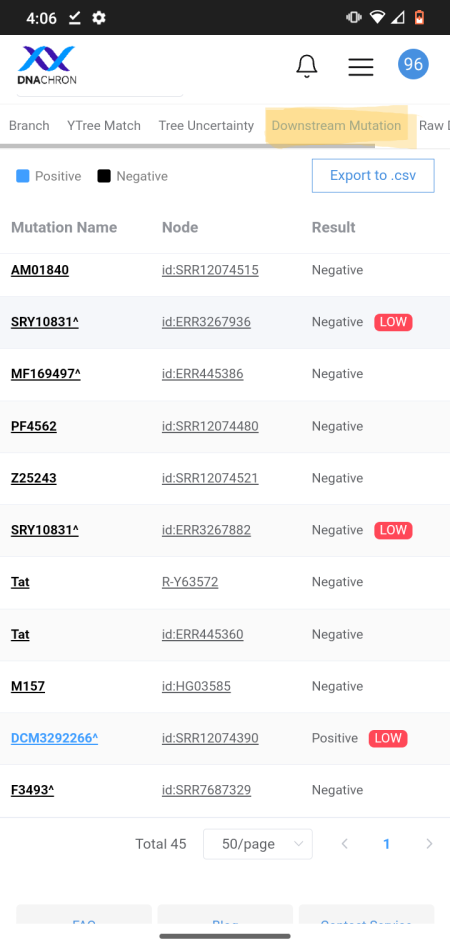
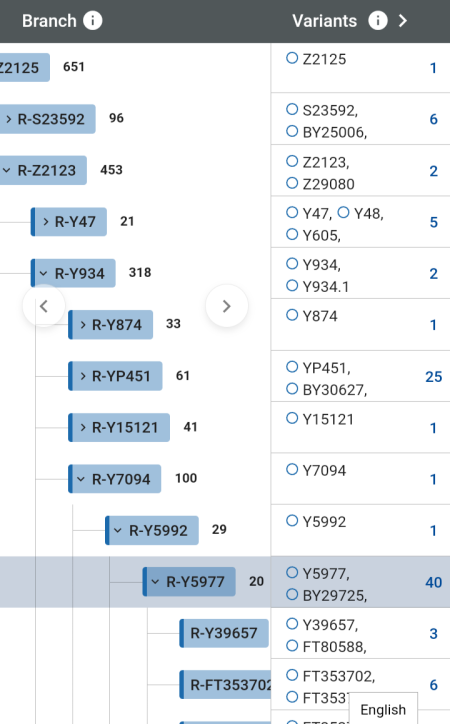
Just as another person with an unexpected haplogroup, if Big-y isn't your thing (it isn't mine) some tools for exploring clades with accuracy only slightly better than that of a horoscope

DNA Chron
Has a "downstream mutations" page helpful for possible subclades (without any degree of confirmation)

A bit more current than Morley

FTDNA autosomal transfer
For solid confirmation of a general haplogroup and lets you browse your SNPs for theorizing subclade

Yseq panel
About a quarter of the cost of big-y and without the resources, but will answer your subclade
 

Attachments

  • Screenshot_20241203-160706.png
    Screenshot_20241203-160706.png
    133.5 KB · Views: 293
  • Screenshot_20241130-215542.png
    Screenshot_20241130-215542.png
    146.5 KB · Views: 291
Of course, the haplogroup is only a small part of your ancestry. I know a few Bulgarians with the Roma/Gypsy H1a, who have no such connection autosomally. This is because it entered their ancestry a long time ago and autosomally it has been diluted to no detection.
However, even a small Roma conection is detectable among Europeans not only with the combination Middle East/South Asia, but with the big number of known Roma individuals, who appear as relatives. This is the so called "Ashkenazi effect" when the population originated from a small number of "founding fathers", but has expanded considerably not long ago, combined with endogamy and isolation. This way a big number of identical segments circulate in their gene pool and the relatives look closer than they really are.
So you can see if you have a Roma connection by having even a small precent of South Asia in your results, which is not typical for the European Turks. Some Anatolian Turks do have it, but brought by different demographics in Central Asia, which is combined usually with East Asian.
You can transfer your MyHeriatge resuts to FamilyTreedNA for free and then order even the cheaper 37 STR test. The Roma H1a haplotype is very specific and it is evident even by this simpler test.
 
Of course, the haplogroup is only a small part of your ancestry. I know a few Bulgarians with the Roma/Gypsy H1a, who have no such connection autosomally. This is because it entered their ancestry a long time ago and autosomally it has been diluted to no detection.
However, even a small Roma conection is detectable among Europeans not only with the combination Middle East/South Asia, but with the big number of known Roma individuals, who appear as relatives. This is the so called "Ashkenazi effect" when the population originated from a small number of "founding fathers", but has expanded considerably not long ago, combined with endogamy and isolation. This way a big number of identical segments circulate in their gene pool and the relatives look closer than they really are.
So you can see if you have a Roma connection by having even a small precent of South Asia in your results, which is not typical for the European Turks. Some Anatolian Turks do have it, but brought by different demographics in Central Asia, which is combined usually with East Asian.
You can transfer your MyHeriatge resuts to FamilyTreedNA for free and then order even the cheaper 37 STR test. The Roma H1a haplotype is very specific and it is evident even by this simpler test.

Well, thank you for your answer, you helped me understand a little better. I will try FTDNA
 
Recent DNA test of the Gagauz people proved that the old theory they are descendantas of Cumans and other Turcic people from the steppe is not correct. They are purely Balkan population with no East Asian whatsever, which is typical for the Turcic origin. Their language is in fact some old Ottoman dialect, which is not preserved in the official Turkish language today. In fact many ethnic Turks in North Eastern Bulgaria have some Crimean Tartar connenction, which is characterised with more East European combined with East Asian and have many close relatives with Russian and other Slavic names.
 
Back
Top