-
Don't want to see ads? Install an adblocker like uBlock Origin or use a Europe-based privacy-friendly browser like Vivaldi or Mullvad.
You are using an out of date browser. It may not display this or other websites correctly.
You should upgrade or use an alternative browser.
You should upgrade or use an alternative browser.
Where does the Albanian language come from? [VIDEO]
- Thread starter Johane Derite
- Start date
J2b and V13 are patchy when it comes to Albs. Bulgarians have just as much L283, in their project actually they have more L283 samples than Z2705We know the Slavs migrated to the Balkans. I have yet to learn when Albanians migrated to western Bulgaria and how they forgot to bring J2bs with them. Which year was this.
PaleoRevenge
Well-known member
- Messages
- 1,529
- Reaction score
- 1,344
- Points
- 113
Serbian project alone is likely 2k or more. Probably the highest number of raw samples for any Balkan country.
PaleoRevenge
Well-known member
- Messages
- 1,529
- Reaction score
- 1,344
- Points
- 113
They don't have Alb specific branches(branches that prove connection to Albanians), and certainly no parallel splits from 400-750 AD from Albanian branches.J2b and V13 are patchy when it comes to Albs. Bulgarians have just as much L283, in their project actually they have more L283 samples than Z2705
PaleoRevenge
Well-known member
- Messages
- 1,529
- Reaction score
- 1,344
- Points
- 113
Out of the Daco-Thracian sphere where do you think proto-Albanians hailed from? I read recently about your old brygian posts and came to think that after Illyrians expanded into this area they had acquired at least to a greater extent more doric loanwords, which according to Huld have entered proto-Albanian secondarily via intermediary this would place proto-Albanians somewhere west of Dardania (assuming they are glasinac-mati derived linguistically) and north of Ancient Macedonians as these loanwords are direct. Glasinac-mati would be the intermediary responsible for these loanwords as chronology of events adds up with the proposed timeframe that they entered proto-Albanian. IMO I think proto-Albanians are Daco-Thracian because multidisciplinary work compliments that argument more than the Illyrian theory. To narrow it down the Bessi/Triballi seem more plausable in my perspective.
Illyrian from linguistic point of view is not worth discussing, has no merit whatsoever.
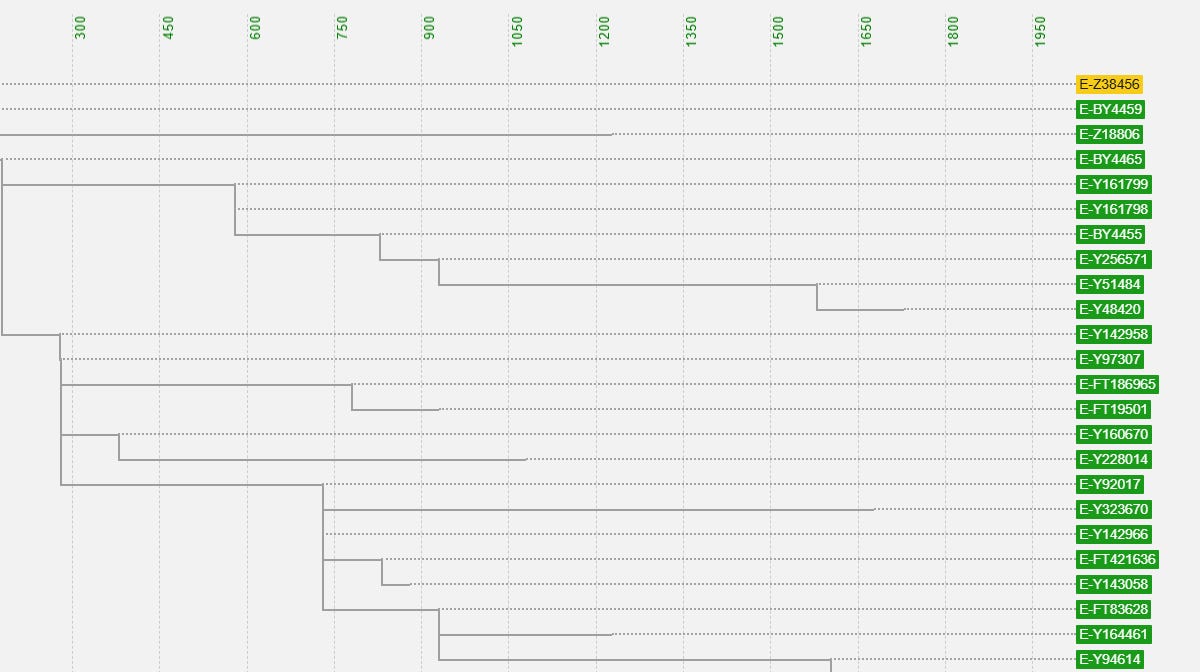
They lack both V13 and L283 major Alb branches. Only some random singleton matches, four I can think of around those dates. Only Bulgarian that’s close to a major cluster is this one here: https://www.yfull.com/tree/E-Y142958/They don't have Alb specific branches(branches that prove connection to Albanians), and certainly no parallel splits from 400-750 AD from Albanian branches.
He is probably Alb in origin too. So, your argument is irrelevant. A random Kosova Serb village probably has more Z2705 than all of Bulgaria combined..
PaleoRevenge
Well-known member
- Messages
- 1,529
- Reaction score
- 1,344
- Points
- 113
One of the biggest E-V13 branches among Albanians
 Written by a Illyrian jihadi, ends up providing evidence for Bessian hypothesis, details bounce of the skull and somehow ends up claiming Illyrian "autochthonousism".
Also the Roman period upstream is in Bulgaria too 100-200 AD
 www.yfull.com
E-Y160670 may reflect both earlier Late Proto-Albanian-Balkan Romance contacts during late antiquity and later migrations. This branch shares a MRCA who lived between c. 375-506 CE and is split into three main branches: 1) E-Y160670* found in an Albanian and Romanian sample, 2) E-BY190444 found in an Albanian and Bulgarian sample, and 3) E-Y228014 identified in a single Ukrainian sample. In the first case, the earlier TMRCA shared between the Romanian and other samples does suggest that this specific subclade may have been assimilated into the ProtoRomanian ethnos during Late Antiquity or shortly thereafter. Regarding E-BY190444, the Albanian and Bulgarian share a MRCA dating to the late-8th century.

Also the Roman period upstream is in Bulgaria too 100-200 AD
E-Y142958 YTree
Dude that’s just one sample and as I said he most likely has Alb roots, look at the two parallel Alb branches above.
This is such a simple problem to solve guys when you don’t use bythen to think with. What days are we saying this supposed Bessi migration occurred, 400/500 CE?
It’s simple. Have a look at CTS10228 data. We know when Slavs migrated so for example we shouldn’t find Greek, Serbs, Albs etc related to Poles and other northern Slavs within the 1400 year period. Exactly what we find on the tree! Amazing right? There are two exceptions with a Bosnian and one Ukrainian, Ukrainian may have Balkan origin and the Bosnian more recent northern origin. What do we see with these Bulgarians, 10 of them if they are that many? They vary, few have 500ybp tmrcas, another three or four at 1450ypb, another three or four at 950ybp…
If such a supposed migration happened, and these are the remnants, you wouldn’t see such a discrepancy on their tmrca’s…
This is such a simple problem to solve guys when you don’t use bythen to think with. What days are we saying this supposed Bessi migration occurred, 400/500 CE?
It’s simple. Have a look at CTS10228 data. We know when Slavs migrated so for example we shouldn’t find Greek, Serbs, Albs etc related to Poles and other northern Slavs within the 1400 year period. Exactly what we find on the tree! Amazing right? There are two exceptions with a Bosnian and one Ukrainian, Ukrainian may have Balkan origin and the Bosnian more recent northern origin. What do we see with these Bulgarians, 10 of them if they are that many? They vary, few have 500ybp tmrcas, another three or four at 1450ypb, another three or four at 950ybp…
If such a supposed migration happened, and these are the remnants, you wouldn’t see such a discrepancy on their tmrca’s…
Last edited:
Also, reason why some of those samples correspond sometimes with those dates is because those are our major expansion nodes, right after the Roman empire started weakening. Not because some supposed Bessi migration from Bulgaria heading west. Of course in our neighbors and regions we influenced they would be more common among Z2705 just based on the sheer size of that subclade and even distribution. You find a similar thing with Greeks too, they just haven't tested as much. The American guy i mentioned I think has Greek roots.
A lot of our V13 clusters have similar expansion dates dates too, and they actually don't differ a lot with major L283 clusters:
www.yfull.com
www.yfull.com
www.yfull.com
V13 for comparison:
www.yfull.com
www.yfull.com
www.yfull.com
www.yfull.com
www.yfull.com
www.yfull.com
www.yfull.com
R1b-PF7563
www.yfull.com
www.yfull.com
www.yfull.com
R1b-Z2705
www.yfull.com
A lot of our V13 clusters have similar expansion dates dates too, and they actually don't differ a lot with major L283 clusters:
J-Y20899 YTree
J-Y82533 YTree
J-Y166564 YTree
V13 for comparison:
E-FT17132 YTree
E-Y92017 YTree
E-Y133830 YTree
E-Y173822 YTree
E-Y146085 YTree
E-PH2180 YTree
E-Y159601 YTree
R1b-PF7563
R-Y168201 YTree
R-FGC14376 YTree
R-FGC40202 YTree
R1b-Z2705
R-Z2705 YTree
PaleoRevenge
Well-known member
- Messages
- 1,529
- Reaction score
- 1,344
- Points
- 113
We are witnessing the genetic confirmation of the inevitable Bessian origin of the proto-Albanians, much to the horror of some Albanian J2b2 carriers.. All your lies and effort for nothing..
Recently a BigY of a North Macedonian was done, and he is positive for all SNP's at the E-Y140828 level, except for the Y146090.
So Y140828 is now divided into:
-North Macedonian from Shtip
-Albanians
Shtip being one of few early toponyms of Albanian origin means this Macedonian is a proto-Albanian who stayed home, whereas most others migrated to the West. Their TMRCA is just around 1000 ybp.
Additionally, Bulgarian BigY profiled E-BY147386, a new clade under Z5018 with a German. Here belongs the Albanian Nivica cluster.
Very close to this Bulgarian is 849049 on the Albanian project, I guess this is some Westerner without origin idea, as he is so close to the Bulgarian. Multiple other Bulgarians belong to E-BY147386, but importantly, there is a subcluster under E-BY147386 defined by dys391=11, Nivica cluster has this value, Bulgarian with BigY doesnt, all other Bulgarians do. So this would imply that Nivica migrated to Albania around 1000+ years ago..
^^^^ So at one point a eastern Mac Slav was tested a parralel clade within R-Y140828, that tore another major E-V13 branch, with the same peculiar geography, the trilateral border region of Bulg-Mac-Serbia.
Not sure if this is from Yfull or familyDNA, the pattern holds true, as it should.
dubsteroaks
Regular Member
- Messages
- 42
- Reaction score
- 7
- Points
- 8
Vlachs in Greece, Macedonia, Montenegro, Herzegovina and Albania aren't some different groups but are part of Romanian speakers and seperated from Romanian speakers around 9th century:
Source: Origins: Serbs, Albanians and Vlachs - Malcolm
This is what we see even partially in genetics such as E-BY446 , a proto-Albanian lineage, includes also Serbs, Bosnian Serbs, Romanians, Greeks and even some clades shared with a Romanian and Greek under E-BY446. R-Z2705 also has Bosnian Serbs, Romanians, South Slavs etc. One of the Bosnian Serbs under R-Z2705 has a much older TMRCA and formation than any Bulgarians. If we apply your logic here, that lineage must of come from Bosnia but we know it's not and came there only in the Ottoman period regardless of what the TMRCA says. Bosnian Serbs are Orthodox Slavs + Serbianized Romanians/Vlachs that settled Bosnia in the Ottoman period from what is today Serbia and Montenegro/Herzegovina etc. Hence they brought R-Z2705 and E-BY446 clades to Bosnia through Serbianised Vlachs/Romanians and Vlachs probably got it from Proto-Albanians or some they got from Serbianised Albanians/Vlachs in Serbia, Kosovo, Montenegro/Herzegovina area. Prior to Ottoman occupation Bosnia proper itself was entirely Catholic and had almost no Orthodox. The Orthodox element was only located in Herzegovina.
Only the remnants of a Latin-speaking population survived in parts of the central and west-central Balkans; when it re-emerges into the historical record in the tenth and eleventh centuries, we find its members leading a semi-nomadic life as shepherds, horse-breeders and travelling muleteers. These were the Vlachs, who can still be seen tending their flocks in the mountains of northern Greece, Macedonia and Albania today. The name 'Vlach' was a word used by the Slavs for those they encountered who spoke a strange, usually Latinate, language; the Vlachs' own name for themselves is 'Aromanians' (Aromani). As this name suggests, the Vlachs are closely linked to the Romanians: their two languages (which, with a little practice, are mutually intelligible) diverged only in the ninth or tenth century. While Romanian historians have tried to argue that the Romanian-speakers have always lived in the territory of Romania (originating, it is claimed, from Romanized Dacian tribes and/or Roman legionaries), there is compelling evidence to show that the Romanian-speakers were originally part of the same population as the Vlachs, whose language and way of life were developed somewhere to the south of the Danube. Only in the twelfth century did the early Romanian-speakers move northwards into Romanian territory.
Source: Origins: Serbs, Albanians and Vlachs - Malcolm
This is what we see even partially in genetics such as E-BY446 , a proto-Albanian lineage, includes also Serbs, Bosnian Serbs, Romanians, Greeks and even some clades shared with a Romanian and Greek under E-BY446. R-Z2705 also has Bosnian Serbs, Romanians, South Slavs etc. One of the Bosnian Serbs under R-Z2705 has a much older TMRCA and formation than any Bulgarians. If we apply your logic here, that lineage must of come from Bosnia but we know it's not and came there only in the Ottoman period regardless of what the TMRCA says. Bosnian Serbs are Orthodox Slavs + Serbianized Romanians/Vlachs that settled Bosnia in the Ottoman period from what is today Serbia and Montenegro/Herzegovina etc. Hence they brought R-Z2705 and E-BY446 clades to Bosnia through Serbianised Vlachs/Romanians and Vlachs probably got it from Proto-Albanians or some they got from Serbianised Albanians/Vlachs in Serbia, Kosovo, Montenegro/Herzegovina area. Prior to Ottoman occupation Bosnia proper itself was entirely Catholic and had almost no Orthodox. The Orthodox element was only located in Herzegovina.
Last edited:
dubsteroaks
Regular Member
- Messages
- 42
- Reaction score
- 7
- Points
- 8
Except for E-V13, Vlachs also have a good amount of J-L283 and R1b.
I don't think placing the separation on the 9th century is accurate we see the Byzantines mention the Vlachs moving to feed their animals to from Bulgaria to Greece in the 11th century while we also see in the 10th century a settled Vlach population in the Theme of Hellas probably referring to Thessaly. So I think while geographically they had separated probably in the 9th century or even earlier they were still in contact with each other probably until the 12th-13th century and being separated either due to the formation of the Romanian principalities or the chaos of the Francocracy if not both.Vlachs in Greece, Macedonia, Montenegro, Herzegovina and Albania aren't some different groups but are part of Romanian speakers and seperated from Romanian speakers around 9th century:
I won't speak about the ones in the more northern regions as we have very little information about them other than that they were orthodox and that they assimilated.
dubsteroaks
Regular Member
- Messages
- 42
- Reaction score
- 7
- Points
- 8
Sorry, I meant E-BY4465 , a proto-Albanian lineages which has Romanians, Bosnian Serbs, Kosovo, Serbs, Bulgarians, Croats, and most of these people are most likely of Albanian and Romanian origin. In Croatia there were Istro-Romanians and in Herzegovina morovlachs. same for R-Z2705. Obviously confirms who the pre-Slavic inhabitants of Kosovo, North-Macedonia and Southern Serbia were, obviously Albanians and Vlachs, at least in the late antiquity before the arrival of Slavs.
I agree the split could of occurred earlier, different groups could of split different times. some of these groups might not of survived. the quote was merely about Romanian and Aromanian or what survived of it. Even linguists believe the Gheg and Tosk split occurred before arrival of Slavs or somewhere during that period and that the split happened not in Albania but in the central Balkan, Gheg speakers seperated from Tosk speakers already in late antiquity and Ghegs had already occupied Southern Montenegro-North-Central Albania-Western Kosovo-Western-Macedonia area whereas Tosk speakers could have not and were in the central Balkans for longer with Romanian speakers or even here different splits could of occurred through different times but sped up later. Or some proto-Albanian speakers just like Vlachs simply never survived the Slavic migrations. People also migrated out of the Balkans etc. Romanised etc. Regardless, that the Vlachs did not originate from a common group of people or do not have a common origin has no basis. It's like claiming Ghegs and Tosks have nothing to do with each other. Aromanians and other Vlachs and Tosks were probably pushed south by Slavs or the Slavic incursions triggered some of these migrations southwards whereas the Romanian migration to Romania was later triggered by Serbs or sped up after the Serbs expanded into the central Balkans.
I agree the split could of occurred earlier, different groups could of split different times. some of these groups might not of survived. the quote was merely about Romanian and Aromanian or what survived of it. Even linguists believe the Gheg and Tosk split occurred before arrival of Slavs or somewhere during that period and that the split happened not in Albania but in the central Balkan, Gheg speakers seperated from Tosk speakers already in late antiquity and Ghegs had already occupied Southern Montenegro-North-Central Albania-Western Kosovo-Western-Macedonia area whereas Tosk speakers could have not and were in the central Balkans for longer with Romanian speakers or even here different splits could of occurred through different times but sped up later. Or some proto-Albanian speakers just like Vlachs simply never survived the Slavic migrations. People also migrated out of the Balkans etc. Romanised etc. Regardless, that the Vlachs did not originate from a common group of people or do not have a common origin has no basis. It's like claiming Ghegs and Tosks have nothing to do with each other. Aromanians and other Vlachs and Tosks were probably pushed south by Slavs or the Slavic incursions triggered some of these migrations southwards whereas the Romanian migration to Romania was later triggered by Serbs or sped up after the Serbs expanded into the central Balkans.
Last edited:
dubsteroaks
Regular Member
- Messages
- 42
- Reaction score
- 7
- Points
- 8
Daunians were Messapic speakers and part of Iapygian groups, all Iapygian groups were Messapic speakers (Daunians, Peucetians and Messapians)
dubsteroaks
Regular Member
- Messages
- 42
- Reaction score
- 7
- Points
- 8
Even in the Timok Valley in Serbia you still have Romanians, and Aromanians and Vlachs were probably historically more numerous in Serbia, Kosovo, North-Macedonia. In Macedonia, Greece you still have Vlachs like Aromanians, Megleno-Romanians / Macedo-Romanians. Some have become Bulgarized/Macedonized/Albanised/Slavicized etc. but Vlachs themselves are considered by many Romanised proto-Albanians. In Herzegovina, Montenegro, Croatia there were Vlachs there that migrated there or had been established there just like in Bosnia and became Slavicized or Islamised. Regardless, Eastern Latin speakers did not develop south of the jirecek line nor in the West Balkan Adriatic coast nor in Romania which was itself unde Roman occupation for only 150 years.
Almost definitely not the Adriatic coast we have other latin speaking groups in the region and it seems as though albanian created a barrier between them and the balkan Latin showing also in how albanian's latin does not seem to be mediated through a vlach population. However south of the Jirecek line has become in my opinion increasingly possible with how our understanding of albanian expansion has increased as they seemed by late antiquity to have been on top of the line making any south western or central homeland for vlachs or including those regions within it require them to be south of the line. Only an eastern to central homeland exclusively would have them only be north of the line and I have explained the the actual thread on the vlachs why the record shows that latinisation was actually also south of the line. I am suspect however that as the research in albanians progresses so will our understanding of vlachs and vice versa I don't want to go into a vlach discussion just because I came here to add a small piece of information of the vlach split I am more interested in looking at the albanian discussion in this thread rather than participating due to not knowing enough about what is going on with albanian.Even in the Timok Valley in Serbia you still have Romanians, and Aromanians and Vlachs were probably historically more numerous in Serbia, Kosovo, North-Macedonia. In Macedonia, Greece you still have Vlachs like Aromanians, Megleno-Romanians / Macedo-Romanians. Some have become Bulgarized/Macedonized/Albanised/Slavicized etc. but Vlachs themselves are considered by many Romanised proto-Albanians. In Herzegovina, Montenegro, Croatia there were Vlachs there that migrated there or had been established there just like in Bosnia and became Slavicized or Islamised. Regardless, Eastern Latin speakers did not develop south of the jirecek line nor in the West Balkan Adriatic coast nor in Romania which was itself unde Roman occupation for only 150 years.
dubsteroaks
Regular Member
- Messages
- 42
- Reaction score
- 7
- Points
- 8
^^^^ So at one point a eastern Mac Slav was tested a parralel clade within R-Y140828, that tore another major E-V13 branch, with the same peculiar geography, the trilateral border region of Bulg-Mac-Serbia.
Not sure if this is from Yfull or familyDNA, the pattern holds true, as it should.
E-BY5617 from what I know has no Bulgarians although yfull might not uploaded all samples,there is a Romanian under E-PH2180 I believe ... One southern Albanian is under the basal clade while in the north its mostly E-PH2180 ... the foreigners there are most likely of Albanian origin, including an ancient sample from Hungary, a Serb from Rashka, Kosovo Serb, Algerian etc. Not sure how that supports your Bessi theory.... some clades we find only in northern Albanians, some only in the south, some across all speakers, possibly as a result of the Gheg-Tosk split. J-L283 has Bulgarians too, including one dominated entirely by Albanians. If the proto-Albanians were the Bessi tribe that then moved to Dardania and then to Albania one would of expected much more Ancient Greek loanwords. Serbia-Macedonia area was not inhabited by the Bessi originally. The Maedi, Triballi and other Thracian tribes and Paeonians bordered Dardanians, and Paeonian tribes lived all the way into Thrace. Thunatae, one of the Dardanian tribes, are considered by some to of been Thracian in origin or influenced by them. That is not to say the proto-Albanians were not in contact with such populations as the Bessi etc. Also lineages can be assimilated and haplogroup percentage can change as a result of their diversity being lost or fusion of different groups that then migrated into another area and also entered foreigners etc. Not every lineage needs to have a proto-Albanian association or pre-Proto-Albanian. Everything speaks that the early Albanians were in an area with strong Latin influence but also close enough to of recieved some Ancient Greek loanwords from Doric and Macedonian which definitely does not fit with your Bessi theory. The total lack of R-CTS1450, R-PF7563 and J-L283 lineages in Iron Age Thrace so far supports that too which even exist among Vlachs.
Last edited:
dubsteroaks
Regular Member
- Messages
- 42
- Reaction score
- 7
- Points
- 8
You did not reply when you were asked if you had tested because we all know you're I2a1b from southern Albania. Not that it even matters to me but should be taken into consideration when we have these debates.LMAO everyone has conceded the Barç sample is not modern. It has zero IBDs with moderns, your buddies on twitter and even your friend dapallapagou, this is in the paper(supplemental #8).
The barc samples is a medieval sample as has been confirmed by carbon dating, at this point it's obvious you're a troll. In fact the medieval samples from Albania show us that the Albanian cluster had already taken shape back then and the medieval samples had the same east-west variety as you see in Albanians today and they plot similar to modern Albanians, only modern Albs were shifted more north due to a later balto-slavic input. This is also what the genetic paper on Albanians concluded.
As for Illyrian and Albanian, even Matzinger claims it's related to Illyrian since many words in Illyrian are only explained through Albanian (dimale, taulantii etc) . You can find similarities with both Illyrian and Thracian, by far the closest are with Messapic than any other language. R-CTS1450 and R-PF7563 lineages further strengthens that Messapic thing. Matzinger considers Messapic to be the closest language to Albanian. As for J-L283, that one exists among Vlachs, Bulgarians etc. J-L283 should of been a major lineage in the central Balkans at one point as we have seen even among the Timacum Minus samples. The central Balkans is where different cultures met, Bronze Age, Iron Age, Roman period etc. J-Z631 was probably a major J-L283 lineage in the central Balkans somewhere although we don't have samples from Western Serbia, Bosnia, Western Kosovo etc.
dubsteroaks
Regular Member
- Messages
- 42
- Reaction score
- 7
- Points
- 8
The medieval samples from Albania are all from the medieval period.
The closest language to Albanian is by far Messapic and has much closer correspondence with Albanian even compared to Daco Thracian. That whole Messapic thing debunks your Daco Thracian theory or supposed no connection to Illyrian.
That is most definitely not what it is, its just a projection from your part. Also, according to Matzinger Albanian is not Thracian or Daco-Thracian yet interesting how you keep pushing for that Daco-Thracian theory .... Albanian is a language related to Illyrian and Messapic. Illyrian proper and Messapic were languages related to Albanian as both are also paleo-balkan while English did not even come from the British Isles hence it's rather a laughable comparison. If the proto-Albanians developed in the central Balkans, the Illyrians in Albania simply developed different since they did not have the Thracian influence or other influences. Matzinger does not even consider Iapodes and Dardani as Illyrians yet considers the Brygi illyrians or only those of the Illyrian kingdom or Illyrian proper. Also based on Matzingers research E-V13 could never represent a pre-proto Albanian population alone and could not of been speaking proto Albanian alone and R-Z2705 and E-V13 could not of spoken the same language, meaning they only fused later. Maybe in the Iron Age.Iron Age Cinamak cluster could potentially be a source of Illyrian paternal component in Albanian, but it cannot have been proto-Albanian speaking.
Albanian shares deep relationship with Baltic that is explained by a Proto-Albanian - Baltic symbiosis sometime in the past.
While there are feasible scenarios in which such a relationship could develop among proto-Albanian speakers if they descend from a daco-thracian group that had contacts with baltic speakers around the carpathians sometime in the MBA-EIA period , there are no feasible scenarios for how such features developed in Albanian if the descend from the yamnaya package that has been in the west balkans since the EBA. The relationship had to happen sometime after the steppe, so it cannot be explained away by claiming it is some old relationship before they migrated out of the steppe.
The relationship of Illyrian to Albanian is like that of the Celtic language of Brittonic to English.
It represents the language spoken by the local indigenous people before the Germanic language of the Anglo-Saxons migrated to England.
In this comparison the Anglo-Saxons were the Daco-Thracian speaking proto-Albanians.
The closest language to Albanian is by far Messapic and has much closer correspondence with Albanian even compared to Daco Thracian. That whole Messapic thing debunks your Daco Thracian theory or supposed no connection to Illyrian.