This is compared to the male samples. The point is that they are quite comparable to most other samples at Gomolava, including the Northern outliers. So it does not point to any specific region, and there might still be other reasons for this than provenance.By the way, rafc made the observation that the Southern shifted individuals had probably a more millet-rich diet. Considering that Gava-related groups and generally the Eastern Carpathian to Aegean sphere produced more millet since Noua-Sabatinovka-Coslogeni, this could point to something.
Because it would combine the autosomal with a dietary shift in the same (Thracian) direction - away from regular Illyrians.

-
Don't want to see ads? Install an adblocker like uBlock Origin or use a Europe-based privacy-friendly browser like Vivaldi or Mullvad.
You are using an out of date browser. It may not display this or other websites correctly.
You should upgrade or use an alternative browser.
You should upgrade or use an alternative browser.
Where does the Albanian language come from? [VIDEO]
- Thread starter Johane Derite
- Start date
This is compared to the male samples. The point is that they are quite comparable to most other samples at Gomolava, including the Northern outliers. So it does not point to any specific region, and there might still be other reasons for this than provenance.
Rather not, because even if e.g. a person would have had more meat and fish only, it should be noticeable if they ate a lot of millet too. If (like you said) there is a trend towards more vs. significantly less to no millet intake, it points to different settlements at the very least. More likely to a more different provenance even.
We can observe the same pattern e.g. in later Iron Age Czechia-Slovakia, with the areas more influenced by Thracians (Slovakia) having higher millet intake than the Western areas with local Hallstatt into newly arriving La Tene people:
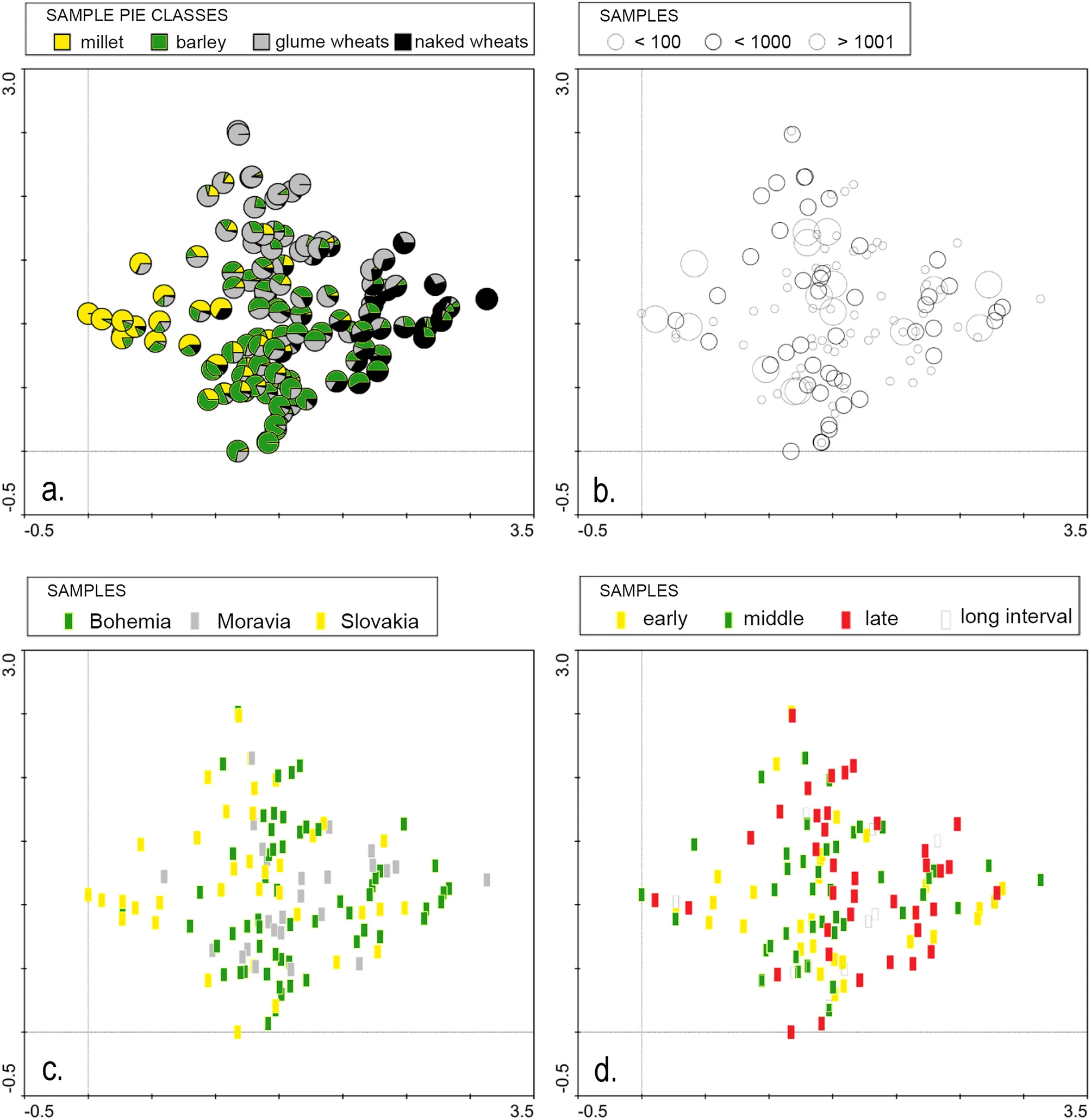
Source: https://www.nature.com/articles/s41598-025-25274-z
There is a pretty straightforward correlation between provenance (Slovakia) and high millet intake vs. Bohemia with low levels of millet consumption. The geographical correlation is way stronger than the chronological one, which is truly astonishing.
If the results at Gomolava have the same kind of clear cut, strong correlation, associated with more South/Thracian autosomal shift, this would be a very strong indication.
Gáva and Kyjatice were among the top spreaders of millet based subsistence patterns in the LBA-EIA. And it stuck with their home regions all the way into the La Tene period - even the incoming Celts, coming into their territories and mixing with the locals, did adopt the pattern.
It might point to a more mixed background of those millet consuming individuals in Gomolava at the very least.
That the Northern Kyjatice outliers would have the same profile would just strengthen the pattern. Because while Kyjatice and Gáva might have been genetically more separated, culturally they were very close. And we already saw mixed Kyjatice-Gáva patterns in Mezocsat, which is basically the same time frame.
Sk33 and Sk14 are with high probability Thracian : Kyjatice mixed individuals. I know some users argued Sk33 is lower coverage, but Sk14 has basically the very same pattern, so its not just that. They might have very low levels of actual Illyrian-related ancestry.
If that's correct, it would make 2 Kyjatice shifted individuals, 2 which are Thracian-Kyjatice and another 3-4 which are more strongly Thracian shifted. The R-BY250 male shave an intermediate position still closer to the main cluster, but they overlap on the PCA the most with Thracian-admixed indiviudals (E-V13 Himera duo, Mezocsat Balkan-shifted female with Thracian IBD, Srem group).
The whole sample is just mixed, that's very obvious. And the main ingredients are Vucedol/Cetina/Illyrian, Kyjatice and Thracian-like/BSK-rich. _Whether the later comes from actual Bosut people and is coming from Gáva-related is worth to contemplate about. That the Southern ones are probably better aligned with the Northern outliers (Kyjatice) would make it a distinct possibility, because Kyjatice and Gáva/Belegis did mix.
Last edited:
Can you point to the source or tell me which other samples are with them?The point is, as I put above, that the high Millet ones are the rule, not the exception. The males are to the left, which is less crowded.
The samples are nearly all marked on the graph here:Can you point to the source or tell me which other samples are with them?
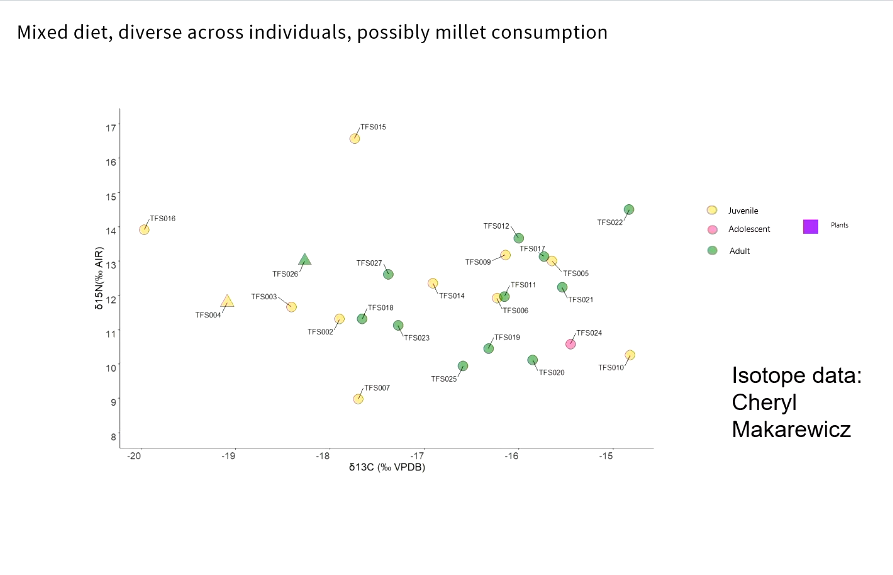
As I understand it, higher 13C points to Millet, and higher 15N points to more meat/fish.
It's in the EBI data in one of the columns. There is no reason that would be different between DNA and Isotopes.How do you know who's who from the DNA samples? The labels are different and the numbers might be different too for the isotopic profiles, no?
TFS001=SK8, 2=18, 3=24, 4=26, 5=32, 6=33, 7=36, 8=41, 9=42, 10=46, 11=53, 12=60, 13=61, 14=70, 15=72, 16=74, 17=4, 18=14, 19=16, 20=22, 21=23, 22=50, 23=51, 24=52, 25=54, 26=56, 27=69
Last edited:
It's in the EBI data in one of the columns. There is no reason that would be different between DNA and Isotopes.
TFS001=SK8, 2=18, 3=24, 4=26, 5=32, 6=33, 7=36, 8=41, 9=42, 10=46, 11=53, 12=60, 13=61, 14=70, 15=72, 16=74, 17=4, 18=14, 19=16, 20=22, 21=23, 22=50, 23=51, 24=52, 25=54, 26=56, 27=69
Going by that, this is the list from left (low) to right (high) millet intake:
Code:
Position    TFS #    Sk #    Assignment
1    TFS016    Sk74    Main
2    TFS004    Sk26    R-BY250
3    TFS003    Sk24    Main
4    TFS026    Sk56    R-BY250
5    TFS002    Sk18    UNASSIGNED
6    TFS015    Sk72    R-BY250
7    TFS007    Sk36    Southern_shifted
8    TFS018    Sk14    Southern_shifted
9    TFS023    Sk51    UNASSIGNED
10    TFS014    Sk70    Main
11    TFS025    Sk54    UNASSIGNED
12    TFS019    Sk16    Main
13    TFS006    Sk33    Southern_shifted
14    TFS011    Sk53    Southern_shifted
15    TFS009    Sk42    Main
16    TFS012    Sk60    Northern_shifted
17    TFS020    Sk22    Main
18    TFS017    Sk4    UNASSIGNED
19    TFS005    Sk32    Main
20    TFS021    Sk23    Northern_shifted
21    TFS024    Sk52    UNASSIGNED
22    TFS022    Sk50    UNASSIGNED
23    TFS010    Sk46    Southern_shifted
The lowest are all R-BY250 and main cluster members. The main cluster on the image starts with TF007. 007 is the first Southern one.
The rest is pretty mixed, but its clear that both Southern and Northern outliers tend towards higher millet compared to the main/R-BY250 average still.
The deviation of the R-BY250 clan is indeed the strongest, they look like being from a quite distinct group genetically and by diet.
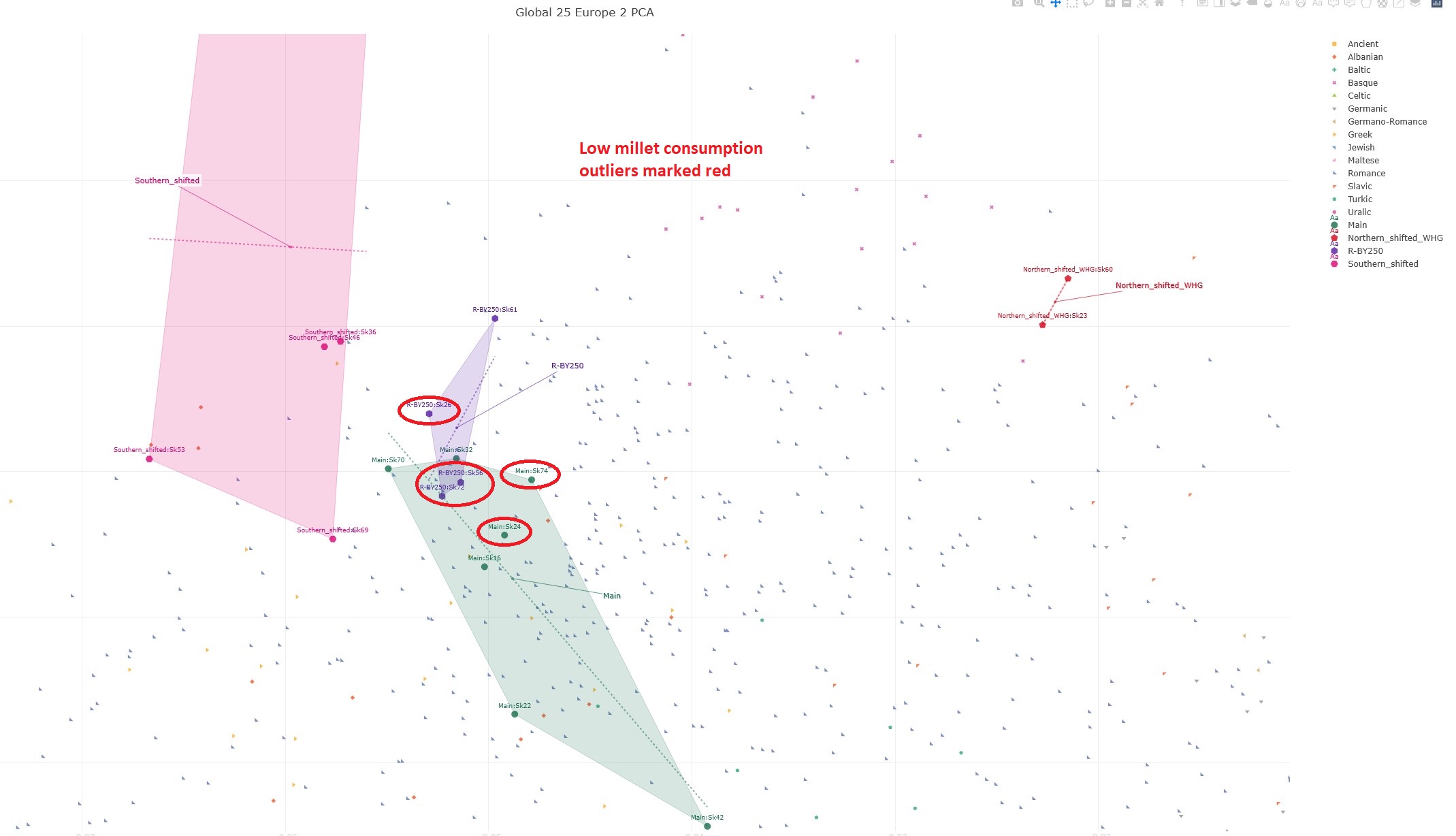
Interestingly Sk74, which has the lowest value for millet consumption, is also among the closest females to the R-BY250 individuals, so part of their group, most definitely. Same applies to Sk24.
Sk70, which is close genetically to the R-BY250 clan on the other hand is more central by diet and Sk32 which is very close to the clan is already in the high millet-intake group.
Going by these results, the R-BY250 clan and a couple of main cluster (Illyrian) females are all low millet diet individuals, coming from a different group with differing subsistence pattern and diet, while the larger range (genetically speaking) rest, which includes a much wider range of ancestries and admixture, including Kyjatice (WHG-rich) and Thracian (Gáva-related? BSK-rich) most prominently, has a higher millet consumption.
Obviously it is way more likely that the millet-high individuals are from Dalj into Srem group and Kalakacza-Bosut, than the R-BY250 clan, which likely being associated with Glanisac-Mati/related Illyrian groups in my opinion. I also think these groups did "intermarry" one way or another in the borderzone, which includes Gomolava and its wider range neighbourhood.
The top low millet consumption outliers form a very tight cluster on the PCA (one R-BY250 individual was not on the dietary-isotopic plot):
Last edited:
dubsteroaks
Regular Member
- Messages
- 42
- Reaction score
- 7
- Points
- 8
Imagine using some Armenians on X ''debating a Thracian origin'' as an argument. It just shows how nonsensical this troll is. R-Z2705 which represents at least 14% of Albanians today and is spread across all Albanian speakers is a clade alone that is more massive than any E-V13 and definitely is not of Thracian origin nor Paeonian going by all ancient DNA so far. Compared to this one many E-V13 clades are geographically restricted and are not even close to being as massive. Even the Berisha-Sopi is mostly found in the north and is a recent founder effect. E-PH2180 is mostly in the north, there is a southern Albanian under the same branch upstream but still nowhere close to being as massive. Even some J-L283 have a Romanian/Aromanian-Albanian association. There are Albanians under every major J-L283 branch and they all definitely did not come from only Romanised populations in Albania but could of come from different tribes or people outside of that area, some maybe there. J-PH4679 is already confirmed to be Illyrian with an Illyrian profile found in IA Italy. J-L283 is even found in the south. In the south there is a lot of J2a and I2a. There are even J-L283 Albanians under same branches as the ones found in Croatia/Montenegro. J-L283 exists even in Romanians/Aromanians and even Bulgarians. Romanians and Vlachs have R-CTS1450 too. Some R-PF7563 clades clearly have a Romanian/Aromanian-Albanian association too.
While there are similar words with Thracian/Dacian and many IE languages and such influence maybe in general, we do have inscriptions, words and placenames from Thracian/Dacian due to that such an origin has been rejected by both Matzinger and Vermeer that claim proto-Albanians did not originate from Iron Age Thrace. Actually by far the closest cognates are with Messapic. Even the word 'white' in Thracian/Dacian was different from Albanian (in Albanian closer to Messapic with the same origin) which is basically a standard word where in most Indo-European languages it is not a loanword but go all the way back to IE roots. You seem to love to talk out of your ass peanut brain. Nish-Shtip area was not proper Thracian territory but was at the Thraco-Illyrian-Paeonian contact zone. As for Bessi, they lived in an area originally under Greek influence whereas Albanian has much more Latin, the ancient Greek loanwords are mostly few and of Doric and Macedonian origin.
While there are similar words with Thracian/Dacian and many IE languages and such influence maybe in general, we do have inscriptions, words and placenames from Thracian/Dacian due to that such an origin has been rejected by both Matzinger and Vermeer that claim proto-Albanians did not originate from Iron Age Thrace. Actually by far the closest cognates are with Messapic. Even the word 'white' in Thracian/Dacian was different from Albanian (in Albanian closer to Messapic with the same origin) which is basically a standard word where in most Indo-European languages it is not a loanword but go all the way back to IE roots. You seem to love to talk out of your ass peanut brain. Nish-Shtip area was not proper Thracian territory but was at the Thraco-Illyrian-Paeonian contact zone. As for Bessi, they lived in an area originally under Greek influence whereas Albanian has much more Latin, the ancient Greek loanwords are mostly few and of Doric and Macedonian origin.
Last edited:
Is there any source I can read on this view? I knew about the origins of Romanians from the Bulgarian vlachs but this is the first I hear of a resettlement to Epirus I thought it was more in the general region of Roman Macedonia where latin was already spoken. Also doesn't this timeline match the increase of haplogroup diversity that that one study found in Albania?A current view is that the inhabitants of the central-north Balkan provinces were re-settled by the Empire further south, at least those which had not already been killed or captured. This would have begun c. 400 AD, then another round soon after 600 AD (with the final collapse of the Danube limes).
Many from Moesia Superia & Dacia Ripensis were moved to northern Epirus & adjacent areas, enlarging the existing populations there and contributing to the development of the Komani-Kruja culture.
'Romanians' began developng later in the 12th century, as Vlachs - already heavily present in post-collapse 'Bulgaria' - moved into Wallachia in Moldova as vassals of the Hungarian kings.
PaleoRevenge
Well-known member
- Messages
- 1,529
- Reaction score
- 1,344
- Points
- 113
Kelmendi branch of E-V13 just got a Russian from Oryol oblast.
 www.yfull.com
This branch was hailed as the Illyrian savior of E-V13s because of a parallel branch exists in Korca. Turns out the Korca branch has a cousin in Orel Russia. Between these two locations is the country of Romania. Further upstream there are branches in Poland and Norway. The branching supports a Dacian homeland. Unlucky and just pure coincidence.
E-FT17132 YTree
This branch was hailed as the Illyrian savior of E-V13s because of a parallel branch exists in Korca. Turns out the Korca branch has a cousin in Orel Russia. Between these two locations is the country of Romania. Further upstream there are branches in Poland and Norway. The branching supports a Dacian homeland. Unlucky and just pure coincidence.

Johane Derite
Regular Member
- Messages
- 1,968
- Reaction score
- 1,062
- Points
- 113
- Ethnic group
- Albanian
- Y-DNA haplogroup
- E-V13>Z5018>FGC33625
- mtDNA haplogroup
- U1a1a
Paleorevenge shared an interesting paper about a pretty clearly Albanoid toponym in Moesia of Berakela related to Albanian. Bërrakë [muddy pool, pond, swamp]View attachment 18606
Some of the interesting implications of the high number of Albanian concordances that appear in the Daco-Thracian languages.
For now this collation focuses on concordances only among placenames.
This is not an exhaustive list, just collation of a few easier to access linguists.
One of the first implications is that there are far more secure concordances with Albanian in the Daco-Thracian territories than there are in Illyria.
By secure I mean undeniable ones like "Mal, Karpë, Burrë," and so on.
The distribution of these placenames can also be used to infer something else.
Namely, that this region of clear Albanoid presence, i.e. a language not necessarily ancestral to Albanian, but a clear phylogenetic cousin of it, is far outside the reach of J2b-L283.
J2b-L283 is totally negligible in this domain.
What this means is that there is a negative signal for relation between J2b-L283 and the Albanoid linguistic family.
E-V13 is the only plausible candidate here for this spread of Albanoid linguistic influence given its prevalence among the Daco-Thracians.
By611 is less clear.
"Abstract:
This study deals with the epithet and ktetic Βερακεληνός, Berakelian on a votive plaque, dedicated to Apollo and Asclepius from the village of Krupac which is some eight kilometers from the town of Pirot. Taking into consideration the opinions presented in the literature, the study presents the
following thoughts on the topic:
The ancient name of the village of Krupac is Thracian and it reads Berakela (*Bερακέλ(λ)α, *Bερακέλ(λ)η) which would literally mean dark spring or muddy spring and before it became the name of the place, it was the name of the fracture, mostly thermo-mineral spring of Krupačka banjica near Krupačka swamp which is a (fish)pond today, created by the water release.
Link: Berakel Paper
I wasn't aware of this Berakela when I made this map of Albanoid toponyms appearing in Daco-Thracian Placenames (below) but it is a very strong and pretty clearly proto-Albanian toponym that should be added to the list.
Obviously Pirot is quite a long way away out of the influence of Illyrian so it is another of the many nails in the coffin.
PaleoRevenge
Well-known member
- Messages
- 1,529
- Reaction score
- 1,344
- Points
- 113
Kela is a known Thracian toponym, AI is good a digging the history of etymological proposals.
cella variant is interesting as it implies a connection to Albanian çel, though the variant the Thracians used is no longer alive in Albanian.
Thracian toponyms with the ending
-kela or -cella (derived from the Indo-European root *gʷelnā) generally signify a "spring" or "source".
Key examples of these toponyms include:
- Kellai
: A settlement name derived directly from the root meaning "spring".- Syracella
: A village in Turkish Thrace (modern Malgara). The name is a compound meaning "salty spring" (from Syra- "salty/bitter" and -cella "spring").- Saldokela
: A reconstructed Thracian place name (Saldo-kela) where the suffix denotes a spring.- Kypsela
: An ancient city in Thrace (modern İpsala, Turkey) located on the Hebrus river.
Etymology and Parallels
The ending is linguistically related to:
- German: Quelle ("spring").
- Old High German: quella.
- Indo-European: Root *gʷel- ("to flow," "to drip," or "spring").
cella variant is interesting as it implies a connection to Albanian çel, though the variant the Thracians used is no longer alive in Albanian.
Kela is a known Thracian toponym, AI is good a digging the history of etymological proposals.
cella variant is interesting as it implies a connection to Albanian çel, though the variant the Thracians used is no longer alive in Albanian.
Since you guys are the experts, are there any Daco-Thracian toponyms in the area of Transcarpathia, Subcarpathia and Moldova? Other than the names for the mountains Carpathians and Beskids themselves. I know from Austria that the Slavic replacement erased many placenames, nearly everywhere. Way more than the Germanic land taking, but I still wonder.
Johane Derite
Regular Member
- Messages
- 1,968
- Reaction score
- 1,062
- Points
- 113
- Ethnic group
- Albanian
- Y-DNA haplogroup
- E-V13>Z5018>FGC33625
- mtDNA haplogroup
- U1a1a
I don't have any particular in depth knowledge of the toponymy of these regions specifically beyond toponyms I've mentioned before in the thread.Since you guys are the experts, are there any Daco-Thracian toponyms in the area of Transcarpathia, Subcarpathia and Moldova? Other than the names for the mountains Carpathians and Beskids themselves. I know from Austria that the Slavic replacement erased many placenames, nearly everywhere. Way more than the Germanic land taking, but I still wonder.
The name "Moldova" itself has been argued to be Dacian origin as in Mol (possibly related to "Mal" as in Dacia Maluensis or Albanian. Mal) + Dova (as in the -Dava suffix seen in countless Dacian toponyms).
About more systematic resources I asked Grok:
General/Overarching Works Covering Multiple Regions:
- Toponimia slavă și preslavă în sud-estul european (Slavic and Pre-Slavic Toponymy in Southeastern Europe) by Sorin Paliga (2003). This monograph compiles lexicons of pre-Slavic place names across the Balkans, Carpathians, and adjacent areas, emphasizing Thracian and Illyrian substrates in Romania, Moldova, eastern Hungary (near Transcarpathia), eastern Slovakia (near Subcarpathia), and southern Ukraine. It highlights river names like Tisa/Tisza (pre-Slavic Indo-European root for "flowing") and discusses Thracian relics in Moldova and the Carpathians, suggesting late survival until the 6th–7th centuries CE. Key references include Duridanov (1975) on Thracian toponymy and Georgiev (1960) on Balkan substrates.
- Slavic on the Language Map of Europe: Historical and Areal-Typological Dimensions edited by Andrii Danylenko and Motoki Nomachi (2019). This volume explores areal linguistics, with chapters on "Carpathianisms" and "Balkanisms" that touch on pre-Slavic substrates in Slavic varieties. It discusses contact-induced features in southwestern Ukrainian (Transcarpathia) and eastern dialects (near Moldova), including relic prepositions and phonology potentially from Thracian or Finno-Ugric substrates. Chapter 11 proposes a Carpathian-Balkan macroarea where pre-Slavic elements influence analytic tendencies.
Works Focused on Transcarpathia
- Changes of Place Names in the Territory of Present-Day Transcarpathia from 1898 to 2000 by Valéria Tóth (2009). Examines multilingual toponymic layers, noting that pre-Hungarian conquest (pre-896 CE) names—potentially pre-Slavic—are scarce and ambiguous, reconstructed mainly from river names showing ancient continuity (e.g., Tisza from Indo-European substrates). It highlights the Slavic base encountered by Hungarians but implies underlying pre-Slavic elements in the Carpathian Basin.
- Toponymic Unity of the Carpathian Region by Grzegorz Chromik (2024). Lists 26 common toponyms across the Carpathians, including Transcarpathia, with some argued as pre-Slavic substrates (e.g., oronyms from Thracian-Illyrian roots like Arva/Arba for "white river"). It emphasizes unity predating Slavic dominance.
Works Focused on Subcarpathia
- Homeland on Foreign Maps: Toponymy of Western Ukraine on Austrian, Interwar-Polish, and Soviet Topographic Maps with Special Focus on Toponymy of the Carpathian Mountains by Mykhaylo Kapral (2023?). Analyzes toponymy in western Ukraine (bordering Subcarpathia), including Carpathian features, tracing polonized forms back to pre-Slavic substrates. It examines 1,741 toponyms, noting non-Slavic roots in oikonyms (settlement names) from Austrian maps, with continuity from ancient times.Pre-Slavic elements here overlap with broader Carpathian studies, as Subcarpathia shares hydronyms like Wisła/Vistula (from Indo-European "flowing").
Works Focused on Moldova
- Rusin Toponymy of Carpatho-Dniestrian Land as a Source of Information on the Ethnic Composition of the Moldavian Principality by unspecified author (2018; ResearchGate publication). Focuses on East Slavic (Rusin) toponyms in Carpatho-Dniestrian areas, including Moldova, but implies pre-Slavic substrates through ethnic layering, such as Thracian influences in river names like Dniester (ancient Tyras, potentially "rapid" from Indo-European).
- Toponymic Approach to the Geographical Research of Cultural Heritage: The Cases of Three Moldavian Localities by A. Herzen and N. Herzen (2023). Explores toponyms in modern Moldavia and neighboring Romania/Ukraine, identifying pre-Slavic features (e.g., Thracian roots) in major geographical names within Moldova's borders.
Adjacent or Foundational Works with Relevance
- Slavic Toponymic Connections in the Romanian Carpathian Mountains by Adelina Emilia Mihali (2026). Studies Slavic and pseudo-Slavic toponyms in Maramureș and Rodna Mountains (northern Romania, bordering Transcarpathia and Subcarpathia), with pre-Slavic substrates inferred from appellatives like prislop (pass) showing ancient Indo-European layers. It notes broader Carpathian unity with Poland, Slovakia, and Ukraine.
- Foundational references often cited in the above: Ivan Duridanov’s Thrakisch-dakische Studien (1969–1976) on Thracian toponymy in Moldova and Carpathians; Vladimir Georgiev’s Trakite i tehniyat ezik (1977) on Balkan substrates; and Lajos Kiss’s Földrajzi nevek etimológiai szótára (1980) on Carpathian hydronyms.
Links to the some of the works above:
(Slavic and Pre-Slavic Toponymy in Southeastern Europe) by Sorin Paliga (2003)
Slavic on the Language Map of Europe: Historical and Areal-Typological Dimensions
CHANGES OF PLACE NAMES IN THE TERRITORY OF PRESENT-DAY TRANSCARPATHIA FROM 1898 TO 2000
Toponymic unity of the Carpathian region
Johane Derite
Regular Member
- Messages
- 1,968
- Reaction score
- 1,062
- Points
- 113
- Ethnic group
- Albanian
- Y-DNA haplogroup
- E-V13>Z5018>FGC33625
- mtDNA haplogroup
- U1a1a
You may find this interesting/relevant.Since you guys are the experts, are there any Daco-Thracian toponyms in the area of Transcarpathia, Subcarpathia and Moldova? Other than the names for the mountains Carpathians and Beskids themselves. I know from Austria that the Slavic replacement erased many placenames, nearly everywhere. Way more than the Germanic land taking, but I still wonder.
Russian linguist/scholar Oleg Trubachyov argued that the toponyms Dniepr & Dniestr entered Slavic through Dacian (Highlighted in green).
He argued that if it was just a directly Iranic etymology that sound form doesn't match and that Dacian mediation into Slavic is necessary (although the original *danu is iranic in origin)
PaleoRevenge
Well-known member
- Messages
- 1,529
- Reaction score
- 1,344
- Points
- 113
Since you guys are the experts, are there any Daco-Thracian toponyms in the area of Transcarpathia, Subcarpathia and Moldova? Other than the names for the mountains Carpathians and Beskids themselves. I know from Austria that the Slavic replacement erased many placenames, nearly everywhere. Way more than the Germanic land taking, but I still wonder.
You have to keep in mind Albanian was not traditionally considered a Daco-thracian language, it's pretty obvious today this was a giant blunder, whether intentional or not. In the Hutsul lands alone one can see through google satellite various toponyms that are clearly Albanoid
- Beskyd river
- Gorgany
- Grehit mountain
- Dzembronya
- Dzembreny stream (there's two of them)
- Dzembronka stream
- Parkulyn waterfall
- Parkulyn river
- Perkalab river
- Cârlibaba river (Romanian spelling of gerlah)
- At least two settlements named Brustury
Last edited:
PaleoRevenge
Well-known member
- Messages
- 1,529
- Reaction score
- 1,344
- Points
- 113
You have to keep in mind Albanian was not traditionally considered a Daco-thracian language, it's pretty obvious today this was a giant blunder, whether intentional or not. In the Hutsul lands alone one can see through google satellite various toponyms that are clearly Albanoid
I'm sure more can be found when reassessed through the new understanding.
- Beskyd river
- Gorgany
- Grehit mountain
- Dzembronya
- Dzembreny stream (there's two of them)
- Dzembronka stream
- Parkulyn waterfall
- Parkulyn river
- Perkalab river
- Cârlibaba river (Romanian spelling of gerlah)
- At least two settlements named Brustury
There are also two rivers named Zvarash, both drain into Siret river, very likely related to Albanian zvarash - creeping, crawling, painstakingly, in this case slow-moving, "dragging" stream

PaleoRevenge
Well-known member
- Messages
- 1,529
- Reaction score
- 1,344
- Points
- 113
Prut river. In antiquity, the river was recorded by the Greeks as Pyretus (Πυρετός), a name directly linked to the Greek word for "fire" (pyros) or "fever". Herodotus and later Romans used the name Poratus or Porata, which is also interpreted as meaning "rapid" or "stormy".
The river is not hot, known for any hot springs, or any reddish colors in it's geological features, it likely refers to turbulent motion.
There is simlar word listed in Polish-Hutsul dictionary posted in my thread: prut/prutum - steam bath, and clearly same family as Albanian pruth - readhead. Both these words are likely related to the etymology of river Prut, which Greeks equated to fiery river.
The river is not hot, known for any hot springs, or any reddish colors in it's geological features, it likely refers to turbulent motion.
There is simlar word listed in Polish-Hutsul dictionary posted in my thread: prut/prutum - steam bath, and clearly same family as Albanian pruth - readhead. Both these words are likely related to the etymology of river Prut, which Greeks equated to fiery river.
Last edited:
Johane Derite
Regular Member
- Messages
- 1,968
- Reaction score
- 1,062
- Points
- 113
- Ethnic group
- Albanian
- Y-DNA haplogroup
- E-V13>Z5018>FGC33625
- mtDNA haplogroup
- U1a1a
Update on The University of Basel's Department of Ancient Civilisations research project "The Albanian Language in Antiquity":
I posted about this project when it first started in 2022 when I was still running Albhistory, but I thought I'd do an update considering it's projected to be completed later this year ( runtime 01.08.2022 - 31.07.2026 )
The project's description:
"Within the Indo-European language family, to which most of the languages of Europe belong, Albanian forms a branch of its own. Along with Greek and the Romance languages, Albanian is the only direct descendant of those languages spoken in the Balkans in ancient times. Content and aim of the research project Albanian has only been known from written sources since the 16th century AD. Therefore, we do not know exactly what the language looked like in ancient times and in the early Middle Ages. It is also disputed in which region of the Balkans the precursor of Albanian, called Proto-Albanian, was spoken. Our project tries to find an answer to the questions of what the precursor of the Albanian language looked like between 1500 and 2000 years ago, and where this precursor was spoken. This can only be answered indirectly. The linguistic-historical comparison of words and the grammar of Albanian with other related languages allows certain conclusions about the earlier linguistic state of Albanian. In addition, the project is investigating the extensive ancient Greek and Latin vocabulary that Proto-Albanian borrowed, as well as the Proto-Albanian words that were incorporated into early Romanian. This will also allow us to determine the shape of Proto-Albanian more precisely. Scientific and social context The project aims first and foremost at the linguistic and cultural history of Albanian. The results will also be relevant for Greek, Latin, Romance and Indo-European linguistics. Furthermore, our results will contribute to a more balanced linguistic and cultural history of the Balkan Peninsula."
General description :
This project is inspired by the ongoing work of various colleagues on the grammatical description of Old Albanian texts and current work on Albanian etymology. Thanks to generous 4-year SNF funding (100012_208245; CHF 916’708,-), we can now address some of the most urgent research questions systematically: the lack of a complete and reliable reconstruction of Proto-Albanian, the absence of a consensus on the localization of Proto-Albanian in time and space, and the need for a reliable survey of the earliest loanwords into and from Proto-Albanian. Ultimately, our project seeks to determine what the precursor of the Albanian language looked like in Antiquity and where this precursor may have been spoken.
Set-up
Principal Investigator Michiel de Vaan
This research is divided into three complementary sub-projects that are carried out by the senior postdoctoral researcher PD Dr Sergio Neri and by the two PhD students Gerard Spaans and Alexander Herren:
SP1 (Sergio Neri): Elaborate a new and full reconstruction of Proto-Albanian; elaborate a relative chronology of the Latin loanwords into Albanian.
SP2 (Gerard Spaans): A study of Language contact between Greek and Albanian in Antiquity and the Early Middle Ages.
SP3 (Alexander Herren): A study of Language contact between Romanian and Albanian in the Middle Ages.
SP4 (the entire team): Elaborate a corpus of early loanwords into Albanian, that will be complementary to the Munich project Digitales philologisch-historisches Wörterbuch des Altalbanischen (15.–18. Jh.). < https://www.dpwa.gwi.uni-muenchen.de/>
The project outcome will be an academic monograph (or a series of longer articles) on the reconstruction of Proto-Albanian, two PhD theses (on Greek and Romanian as contact languages for Albanian), several collaborative, international peer-reviewed articles, and conference proceedings.
In addition, we will create an etymological database of Latin/Albanian, Albanian/Romanian, and Albanian/Greek lexical correspondences that will complement the Munich etymological database of Old Albanian."
OFFICAL PAGE LINK
The project is said to be completed by the 31st of July this year, hopefully this means that the resulting academic monograph and articles, conference proceedings, etc, don't lag too far behind, as I'm sure this is a very welcome and needed addition. The etymological database of Old Albanian from University of Munich is already an incredible resource, so I'm sure if it is up to that standard, and considering De Van's previously published work, it should be, then it should not be disappointing.
Hopefully they don't play it safe and try to appease vested interests and such.
Now, can we speculate about whether they will make any actual concrete claims about where Proto-Albanian was spoken?
In post #4,402 of this thread I shared some information from a talk given by Alexander Herren, who is heading sub-project 3 of this research project, so potentially we do have a sneak peek of at least some of the results of their study.
I'll repost it below:
"Very interesting new development:
This Tuesday at the 43rd edition of the International Seminar on Albanian Language, Literature, and Culture held in Prishtina, linguist and researcher Alexander Robert Herren gave a fascinating presentation of his new article about Proto-Albanian.
Mostly it was about comparing how "Proto-Albanian" is actually defined differently across the works of many different scholars and an attempt at giving a more updated and rigorous definition of what constitutes the Proto-Albanian language as well as timing its linguistic contacts with Eastern Romance more precisely.
This was a really interesting lecture but what really stood out for me was a short preview of a dissertation that he is working on that has huge ramifications.
Specifically, he gave us a sneak peek into some of the conclusions from his upcoming dissertation which i have put below:
"There are up to 120 lexemes in Daco-Romanian (and far fewer in the sub-Danubian Eastern Romance varieties, i.e. Aromanian, Megleno-Aromanian, and Istro- Romanian)."
So this is huge as it infers geographic information about the Proto-Albanian community, namely that it must have been closer and in more intense contacts with the proto-Romanians then the more southern proto-Aromanians, Megleno-Aromanians, etc.
This means Proto-Albanian must have been north of them.
Also very interesting is that certain phonological mismatches in the proto-albanian loans into Daco-Romanian shows that the period of contact when this intense cohabitation/exchange could have happened was when Proto-Albanian was undergoing internal phonological changes in its sound system."


So at least one of the subprojects does seem to place the proto-Albanian language more northeast of Albania, at least based on this sneak peek.
What about the other subprojects?
For SP1 there doesn't seem to be any info out there, as for SP2, based on publications from 2024 by Gerard Spaans concerning Albanian and Greek contacts, there isn't anyway to say one way or the other as these articles are only reviews of the current evidence of Ancient Greek words in Albanian, without any further discussion.
However, considering that it didn't seem like any major new loanwords look like they have been claimed to be discovered, the position of Matzinger will most likely be taken here (that the low number of Greek loanwords, and that they primarily concern vegetables, spices, fruits, animals, tools, i.e. market items, that it is from greek merchants in the balkan hinterland).
Until the results are published this remains only speculation though.
Nonetheless, something to look forward to.
I posted about this project when it first started in 2022 when I was still running Albhistory, but I thought I'd do an update considering it's projected to be completed later this year ( runtime 01.08.2022 - 31.07.2026 )
The project's description:
"Within the Indo-European language family, to which most of the languages of Europe belong, Albanian forms a branch of its own. Along with Greek and the Romance languages, Albanian is the only direct descendant of those languages spoken in the Balkans in ancient times. Content and aim of the research project Albanian has only been known from written sources since the 16th century AD. Therefore, we do not know exactly what the language looked like in ancient times and in the early Middle Ages. It is also disputed in which region of the Balkans the precursor of Albanian, called Proto-Albanian, was spoken. Our project tries to find an answer to the questions of what the precursor of the Albanian language looked like between 1500 and 2000 years ago, and where this precursor was spoken. This can only be answered indirectly. The linguistic-historical comparison of words and the grammar of Albanian with other related languages allows certain conclusions about the earlier linguistic state of Albanian. In addition, the project is investigating the extensive ancient Greek and Latin vocabulary that Proto-Albanian borrowed, as well as the Proto-Albanian words that were incorporated into early Romanian. This will also allow us to determine the shape of Proto-Albanian more precisely. Scientific and social context The project aims first and foremost at the linguistic and cultural history of Albanian. The results will also be relevant for Greek, Latin, Romance and Indo-European linguistics. Furthermore, our results will contribute to a more balanced linguistic and cultural history of the Balkan Peninsula."
General description :
This project is inspired by the ongoing work of various colleagues on the grammatical description of Old Albanian texts and current work on Albanian etymology. Thanks to generous 4-year SNF funding (100012_208245; CHF 916’708,-), we can now address some of the most urgent research questions systematically: the lack of a complete and reliable reconstruction of Proto-Albanian, the absence of a consensus on the localization of Proto-Albanian in time and space, and the need for a reliable survey of the earliest loanwords into and from Proto-Albanian. Ultimately, our project seeks to determine what the precursor of the Albanian language looked like in Antiquity and where this precursor may have been spoken.
Set-up
Principal Investigator Michiel de Vaan
This research is divided into three complementary sub-projects that are carried out by the senior postdoctoral researcher PD Dr Sergio Neri and by the two PhD students Gerard Spaans and Alexander Herren:
SP1 (Sergio Neri): Elaborate a new and full reconstruction of Proto-Albanian; elaborate a relative chronology of the Latin loanwords into Albanian.
SP2 (Gerard Spaans): A study of Language contact between Greek and Albanian in Antiquity and the Early Middle Ages.
SP3 (Alexander Herren): A study of Language contact between Romanian and Albanian in the Middle Ages.
SP4 (the entire team): Elaborate a corpus of early loanwords into Albanian, that will be complementary to the Munich project Digitales philologisch-historisches Wörterbuch des Altalbanischen (15.–18. Jh.). < https://www.dpwa.gwi.uni-muenchen.de/>
The project outcome will be an academic monograph (or a series of longer articles) on the reconstruction of Proto-Albanian, two PhD theses (on Greek and Romanian as contact languages for Albanian), several collaborative, international peer-reviewed articles, and conference proceedings.
In addition, we will create an etymological database of Latin/Albanian, Albanian/Romanian, and Albanian/Greek lexical correspondences that will complement the Munich etymological database of Old Albanian."
OFFICAL PAGE LINK
The project is said to be completed by the 31st of July this year, hopefully this means that the resulting academic monograph and articles, conference proceedings, etc, don't lag too far behind, as I'm sure this is a very welcome and needed addition. The etymological database of Old Albanian from University of Munich is already an incredible resource, so I'm sure if it is up to that standard, and considering De Van's previously published work, it should be, then it should not be disappointing.
Hopefully they don't play it safe and try to appease vested interests and such.
Now, can we speculate about whether they will make any actual concrete claims about where Proto-Albanian was spoken?
In post #4,402 of this thread I shared some information from a talk given by Alexander Herren, who is heading sub-project 3 of this research project, so potentially we do have a sneak peek of at least some of the results of their study.
I'll repost it below:
"Very interesting new development:
This Tuesday at the 43rd edition of the International Seminar on Albanian Language, Literature, and Culture held in Prishtina, linguist and researcher Alexander Robert Herren gave a fascinating presentation of his new article about Proto-Albanian.
Mostly it was about comparing how "Proto-Albanian" is actually defined differently across the works of many different scholars and an attempt at giving a more updated and rigorous definition of what constitutes the Proto-Albanian language as well as timing its linguistic contacts with Eastern Romance more precisely.
This was a really interesting lecture but what really stood out for me was a short preview of a dissertation that he is working on that has huge ramifications.
Specifically, he gave us a sneak peek into some of the conclusions from his upcoming dissertation which i have put below:
"There are up to 120 lexemes in Daco-Romanian (and far fewer in the sub-Danubian Eastern Romance varieties, i.e. Aromanian, Megleno-Aromanian, and Istro- Romanian)."
So this is huge as it infers geographic information about the Proto-Albanian community, namely that it must have been closer and in more intense contacts with the proto-Romanians then the more southern proto-Aromanians, Megleno-Aromanians, etc.
This means Proto-Albanian must have been north of them.
Also very interesting is that certain phonological mismatches in the proto-albanian loans into Daco-Romanian shows that the period of contact when this intense cohabitation/exchange could have happened was when Proto-Albanian was undergoing internal phonological changes in its sound system."
So at least one of the subprojects does seem to place the proto-Albanian language more northeast of Albania, at least based on this sneak peek.
What about the other subprojects?
For SP1 there doesn't seem to be any info out there, as for SP2, based on publications from 2024 by Gerard Spaans concerning Albanian and Greek contacts, there isn't anyway to say one way or the other as these articles are only reviews of the current evidence of Ancient Greek words in Albanian, without any further discussion.
However, considering that it didn't seem like any major new loanwords look like they have been claimed to be discovered, the position of Matzinger will most likely be taken here (that the low number of Greek loanwords, and that they primarily concern vegetables, spices, fruits, animals, tools, i.e. market items, that it is from greek merchants in the balkan hinterland).
Until the results are published this remains only speculation though.
Nonetheless, something to look forward to.