That's beautiful and all, but Albanians are only 20-25% E-V13, the rest is R1b, R1a, I, and J. Based on the Albanians that I know, I can say that 1/2 of their R1b is from Northern/Western Europe (not the Romans), and that makes like 10% of the population. You factor in there I1, I2b, some R1a, plus paleolithic all-european mtdna, and you get a semi-nordic semi-south-European population. It's not as simple as these hamitic tales.

-
Don't want to see ads? Install an adblocker like uBlock Origin or use a Europe-based privacy-friendly browser like Vivaldi or Mullvad.
You are using an out of date browser. It may not display this or other websites correctly.
You should upgrade or use an alternative browser.
You should upgrade or use an alternative browser.
Illyrian-Albanian Continuity
- Thread starter Finalise
- Start date
- Status
- Not open for further replies.
adamo
Junior Member
- Messages
- 2,120
- Reaction score
- 76
- Points
- 0
- Y-DNA haplogroup
- T1a1a3 (T-PF7443)
- mtDNA haplogroup
- H
Garrick your views on the Hamitic race and all this is so distorted...that its giving me a panic attack after I smoked that good, making me wonder wether you where produced WITH or without a brain..."The Nimrod was the first king on earth thus creating the royal E-V13 bloodline" he says. What is E-V13 to you, some paint product or something? God, it's so bad. And at the worst, the genealogy chart you showed pus there seems to be a TROJAN line of descent as I see Dardanus of the Dardanelles region of turkey, king Priam is there, Anchises of Troy who migrated to Latium is there; it's a Trojan bloodline man.
adamo
Junior Member
- Messages
- 2,120
- Reaction score
- 76
- Points
- 0
- Y-DNA haplogroup
- T1a1a3 (T-PF7443)
- mtDNA haplogroup
- H
A jumble of incoherent nonsense based not on legitimate genetic information but on inaccurately researched and presented mythology, that to be honest, has nothing to do with the haplogroup itself in any way. Yes of course, "Nimrod" is the answer for all this; I mean who WOULDN'T have guessed that it was him all along?
@Garrick
All this nimrod stuff you have put is is strange. Its illogical nonsense. Incoherent. You said all this after i said theres no connection between illyrian and Slavic. Whats wrong with being Slavic? Are you denying yourself who you are or your forefathers? If you think you are descendant of illyrians, then stop speaking serbian because serbian is a Slavic language. Second go find out what illyrian langauge was, and if you are not able to find that out, which im sure you wont because illyrian is dead, then go learn latin, because illyrians spoke latin after they were conquered by rome. You also contradict yourself a lot. First you say original illyrians were E-V13 sfter FBS suggested that to you, then you say others were R1a and I2a. How can the others be different from the originals? Out of the originals come forth the others. How can a child be different from his parents? His genes derive from those of his parents
All this nimrod stuff you have put is is strange. Its illogical nonsense. Incoherent. You said all this after i said theres no connection between illyrian and Slavic. Whats wrong with being Slavic? Are you denying yourself who you are or your forefathers? If you think you are descendant of illyrians, then stop speaking serbian because serbian is a Slavic language. Second go find out what illyrian langauge was, and if you are not able to find that out, which im sure you wont because illyrian is dead, then go learn latin, because illyrians spoke latin after they were conquered by rome. You also contradict yourself a lot. First you say original illyrians were E-V13 sfter FBS suggested that to you, then you say others were R1a and I2a. How can the others be different from the originals? Out of the originals come forth the others. How can a child be different from his parents? His genes derive from those of his parents

Ike
Regular Member
- Messages
- 1,128
- Reaction score
- 93
- Points
- 48
Of course it's very strange. And it's not Garrick's idea. There are many more similar, although this one is the most fantastic of them all 
It's interesting that you didn't caught it up before.
Anyway Garrick is totally logical. He is claiming that Illyria was a territory, and that not all tribes of Illyria were of same ethnicity (and they spoke different languages). Some of Illiric tribes were R1a/I2 origin ans some were of E-V13. All were referred as Illyrians by Romans, but not all did speak the same language. It is not hard to understand that. Only new thing he proposed, is to call them Hamitic and Dinaric. I'm not sure if terminology is perfect, but the idea is good.
I suppose he used the term "original Illyrians" because it's logical to think that Greek (first to mention Illyrians) had first contacts with E-V13, and not with Dinaric ones, when they first came to Balkans. It's simple geography thing. I don't think it' OK to call any of them original Illyrians, until we're certain. Dienekes claimed not so long ago that E-V13 was spread by the Greeks.
It's interesting that you didn't caught it up before.
Anyway Garrick is totally logical. He is claiming that Illyria was a territory, and that not all tribes of Illyria were of same ethnicity (and they spoke different languages). Some of Illiric tribes were R1a/I2 origin ans some were of E-V13. All were referred as Illyrians by Romans, but not all did speak the same language. It is not hard to understand that. Only new thing he proposed, is to call them Hamitic and Dinaric. I'm not sure if terminology is perfect, but the idea is good.
I suppose he used the term "original Illyrians" because it's logical to think that Greek (first to mention Illyrians) had first contacts with E-V13, and not with Dinaric ones, when they first came to Balkans. It's simple geography thing. I don't think it' OK to call any of them original Illyrians, until we're certain. Dienekes claimed not so long ago that E-V13 was spread by the Greeks.
That's beautiful and all, but Albanians are only 20-25% E-V13, the rest is R1b, R1a, I, and J. Based on the Albanians that I know, I can say that 1/2 of their R1b is from Northern/Western Europe (not the Romans), and that makes like 10% of the population. You factor in there I1, I2b, some R1a, plus paleolithic all-european mtdna, and you get a semi-nordic semi-south-European population. It's not as simple as these hamitic tales.
No, Geg Albanians have the biggest share of E haplogroup in Europe.
In Kosovo is peak, carriers of E haplogroup are 45,6%, according Pericic et al (Kosovo Albanians are almost all Geg Albanians).
In Albania Geg Albanians have 42% E haplogroup according Ferri et al.
Tosk Albanians have significantly less share of E haplogroup, 28,1% according Ferri et al.
You can see in this Albanian website authors claim that share of E haplogroup (E1b1b1a2 or E-V13) is 75% in Albanian areas.


These Hamitic Albanian authors know that E-V13 is older in Balkans from another Albanian haplogroups.
Maybe expansion of Middle East haplogroup J2 was going along with E-V13, but there are indicators that it was later, especially that J2 carriers later joined core of ancestors of Geg Albanian population E-V13.
R1b ht35 came late from Anatolia/Caucasus. Maybe within the Byzantine or with Turks. Perhaps earlier but later than E-V13.
R1b ht35 is Armenian haplotype. This haplotype has nothing with Celts.
You can see maps of Celtic haplogroups, there are no in Geg Albanians and a bit in Tosk Albanians.
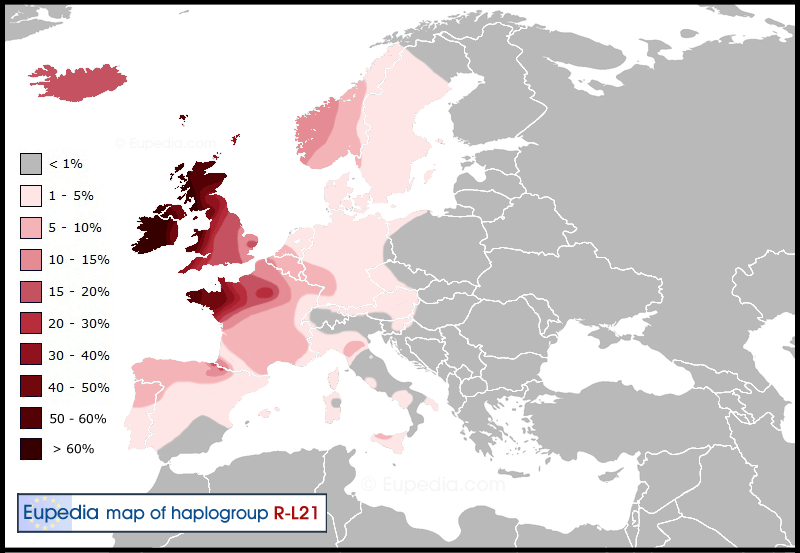
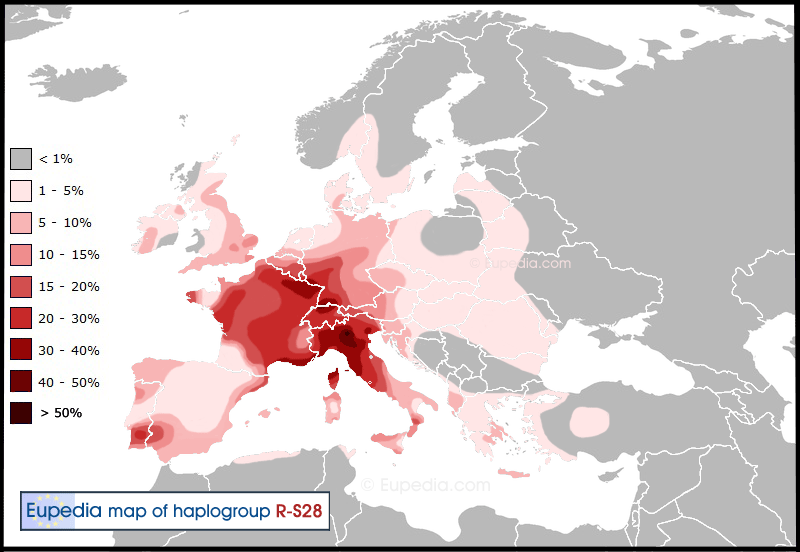
Geg Albanians are E-V13 core and these Hamitic Albanians authors know it. J2 in Albanians is big question when it occurs. Appearance R1b ht35 in Geg population is the question.
Another haplogroups in Geg Albanians are not much represented. Somewhat R1a and I1.
It is mystery why the most common Balkans haplogroup I2a is almost non existent in Geg Albanians (in Kosovo Albanians only 2,7%) and much more represented in Tosks (about 20%).
To summarize:
Geg Albanians are mostly E-V13 (Hamitic origin), this is their core haplogroup, and probably tha part of Illyrian tribes, those who were close to Greeks, were E-V13 carriers. These Illyrians are Hamitic Illyrians an this is correct name for that tribes.
J2 carriers (Middle east origin) possible that they were with E-V13 but there are researchers who think that these carriers came late in acestors of Geg Albanian population, maybe these carriers are less important when we speak about Illyrians.
R1b ht35 carriers (Armenian/Anatolian) are more later entered in ancestors of Geg Albanians and probably they have nothing with Illyrians.
Another haplogroups in Gegs (R1a, I1, etc) are result of assimilation.
No, Geg Albanians have the biggest share of E haplogroup in Europe.
In Kosovo is peak, carriers of E haplogroup are 45,6%, according Pericic et al (Kosovo Albanians are almost all Geg Albanians).
In Albania Geg Albanians have 42% E haplogroup according Ferri et al.
Tosk Albanians have significantly less share of E haplogroup, 28,1% according Ferri et al.
Maybe Kosovars are 45% E-V13, but not all Geg Albanians, because Geg is everybody above Tirana, and all studies in Tirana show E-v13 in the 20-s percentage; Tirana is about 50% geg, 50% tosk. Even Peloponesian Greeks have more E-v13 than people in Tirana. So 45% would be Tropoja and up till you reach Serbia. That's why Serbia has ~20% E-v13 too, because you have incorporated part of this northern Albanian population.
Just by looking at the distribution of E-v13, one can tell that another population has inserted itself in the middle of this old Balkanic hg in the area of today's Albania, that's the people that brought the Illyrian IE language from North-West Europe.
Ike
Regular Member
- Messages
- 1,128
- Reaction score
- 93
- Points
- 48
Just by looking at the distribution of E-v13, one can tell that another population has inserted itself in the middle of this old Balkanic hg in the area of today's Albania, that's the people that brought the Illyrian IE language from North-West Europe.
There's no proof that E-V13 is older than other Hg's of Balkan. More than that, connection of E-V13 with the diffusion of agriculture is disputable since analysis of Albanian language origin has shown that the words for plants and animals characteristic of mountainous regions are entirely original, but the names for fish and for agricultural activities are borrowed from other languages.
@Garrick
Are you denying yourself who you are or your forefathers? If you think you are descendant of illyrians, then stop speaking serbian because serbian is a Slavic language. Second go find out what illyrian langauge was, and if you are not able to find that out, which im sure you wont because illyrian is dead, then go learn latin, because illyrians spoke latin after they were conquered by rome. You also contradict yourself a lot. First you say original illyrians were E-V13 sfter FBS suggested that to you, then you say others were R1a and I2a. How can the others be different from the originals? Out of the originals come forth the others. How can a child be different from his parents? His genes derive from those of his parents
Facts are that numerous Illyrian tribes were I2a/R1a carriers and they have nothing with Hamitic E-V13 carriers, of course it is possible that somewhere was mix.
It is possible that root of word Illyrian is Hamitic, ie Cushitic or Egyptian:
In Cushitic il, ila, ili=eye, of which can be derived light, star etc.
but maybe it is coincidence.
Albanian authors love to play with words. But this with Cushitic and Egyptian words there is reason to be associated with Illyrian name.
But there are words I2a/R1a carriers who was comprised numerous Illyrian tribes, and these words are the same roots as Slavic, can be linked with Illyrian name.
The root of Illyrian name can be founded in Slavic (South Slavic) languages.
For example, in Serbian/Croatian: ilo, ila = loam
Loam is type of soil consisting of sand, silt and clay. Loam is a suitable soil for serpents. In Serbs/Slavic/Dinaric people was strong cult of serpent. Serpent is related with female goddess. Also, loam is Good material for pottery and construction of houses (it is the famous indigenous Illyrian pottery).
Of course someone can linked Cushitic/Egyptian eye with Chorus and Wadjet etc. Wadjet was serpent goddess, associated with soil and depicted as cobra).
I can suppose why Greeks made inadvertent mistake and challenge confuse:
Hamitic Illyrians (E-V13 carriers)
and
Dinaric Illyrians (I2a/R1a carriers)
had a similar name, similarly called himself.
Maybe difference was in one or two letters (voices).
Greeks thought it is the same and E-V13 carriers were close to them and they call all tribes Illyrians and whole territory Illyria, although I2a/R1a tribes and E1b1b1a2 (E-V13 tribes) did not have anything in common.
the words for plants and animals characteristic of mountainous regions are entirely original, but the names for fish and for agricultural activities are borrowed from other languages.
Even if that was true, it would be only natural. The coast and lowlands were Roman/Byzantine metropolitan areas for milleniums. I never denied that the Albanian language borrows heavily from Latin and some from Greek.
Garrick your views on the Hamitic race and all this is so distorted...that its giving me a panic attack after I smoked that good, making me wonder wether you where produced WITH or without a brain..."The Nimrod was the first king on earth thus creating the royal E-V13 bloodline" he says. What is E-V13 to you, some paint product or something? God, it's so bad. And at the worst, the genealogy chart you showed pus there seems to be a TROJAN line of descent as I see Dardanus of the Dardanelles region of turkey, king Priam is there, Anchises of Troy who migrated to Latium is there; it's a Trojan bloodline man.
Sorry not even; it's even worse, it seems to be a fabricated or mythological bloodline lol that may not even be secured by actually family related births.
A jumble of incoherent nonsense based not on legitimate genetic information but on inaccurately researched and presented mythology, that to be honest, has nothing to do with the haplogroup itself in any way. Yes of course, "Nimrod" is the answer for all this; I mean who WOULDN'T have guessed that it was him all along?
Nimrod the father of all Albanians "posts picture of nimrod to validate point" L.O.L
Four paragraphs. But why you addressed to me. It is from the Albanian website.
Ike
Regular Member
- Messages
- 1,128
- Reaction score
- 93
- Points
- 48
If E-V13 are the claimed Neolithic farmers, it would be normal to guess that they were the ones who presented terminology upon others. It is not logical to assume that surrounding tribes, which later came in contact with E-V13, picked up the trade from them, but invented their own terms and inflicted them back to E-V13.Even if that was true, it would be only natural.
Ike
Regular Member
- Messages
- 1,128
- Reaction score
- 93
- Points
- 48
@Garrick Interesting to add this:
Ilion was a city in South-Eastern Thrace. Duridanov explains the meaning as coming from Indo-European il - mud, which is to be found in Greek ιλυς - mud. Old Church Slavonic ИЛЪ - mud, preserved today in Russian ил (il) and Slovene ilo, as well as jul in its Tolminski dialect. Hittites named it Wilusia. Ilion (Troy) was located indeed in marshy area, so the name Muddy is quite logical.
from: " ETYMOLOGICAL ANALYSIS OF THRACIAN TOPONYMS AND HYDRONYMS", P. Serafimov
Ilion was a city in South-Eastern Thrace. Duridanov explains the meaning as coming from Indo-European il - mud, which is to be found in Greek ιλυς - mud. Old Church Slavonic ИЛЪ - mud, preserved today in Russian ил (il) and Slovene ilo, as well as jul in its Tolminski dialect. Hittites named it Wilusia. Ilion (Troy) was located indeed in marshy area, so the name Muddy is quite logical.
from: " ETYMOLOGICAL ANALYSIS OF THRACIAN TOPONYMS AND HYDRONYMS", P. Serafimov
If E-V13 are the claimed Neolithic farmers, it would be normal to guess that they were the ones who presented terminology upon others. It is not logical to assume that surrounding tribes, which later came in contact with E-V13, picked up the trade from them, but invented their own terms and inflicted them back to E-V13.
I'm saying the coming Illyrian IE tribes fused with E-v13 in the Balkans to form the Illyrian language. Then the Romans came and added a latin layer to Illyrian. This latin layer would mostly be seen on words that relate to the coast or agriculture because the coast and lowlands were the areas occupied by the Romans. The highlanders were and remained shepherds.
Ike
Regular Member
- Messages
- 1,128
- Reaction score
- 93
- Points
- 48
I'm talking about the other part of the sentence(in bold), which is most crucial for Albanian/E-V13/Neolithic farmer connection.
If we assume E-V13 were the original Neolithic farmers, it turns out that Romans/Greeks drove them out of coastal and fertile plains and that long dwelling in the mountains made them forget their own language, so that they had to import foreign words for rediscovered agriculture.
It is plausible. But what is interesting is that none of the surrounding IE language groups, that supposedly imported agriculture from E-V13 (assumed path is from Greece> Balkan>Europe) had also imported any of the original E-V13 agricultural terminology.
If we assume E-V13 were the original Neolithic farmers, it turns out that Romans/Greeks drove them out of coastal and fertile plains and that long dwelling in the mountains made them forget their own language, so that they had to import foreign words for rediscovered agriculture.
It is plausible. But what is interesting is that none of the surrounding IE language groups, that supposedly imported agriculture from E-V13 (assumed path is from Greece> Balkan>Europe) had also imported any of the original E-V13 agricultural terminology.
E-v13 when it came from Anatolia as Neolithic farmers probably did not speak proto-IE, and when IE spread everybody had already adopted farming for a few milleniums. I would not expect farming words from the Neolithic to show up in IE languages of modern times, but nobody can be sure that they don't.
Ike
Regular Member
- Messages
- 1,128
- Reaction score
- 93
- Points
- 48
Why not expect it? There's just a 100 years window between the two.
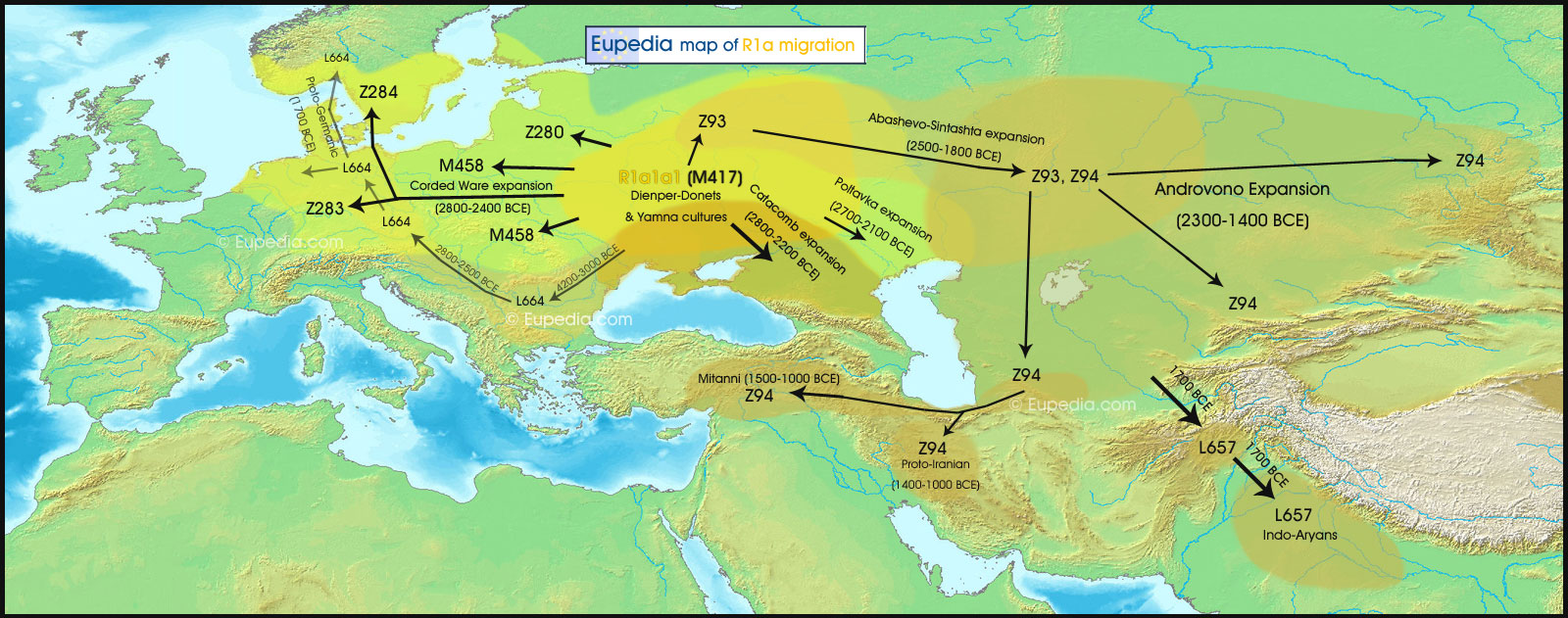
Diffusion of farming to Pontic-Caspian steppe happened from 4800-4300 BC.
Suspected invasion of IE speakers to Balkan happened from 4200-3000 BC.
I'm not claiming that it did actually happen this way or that numbers are correct, but for now there are lot of reasons to be suspicious.
Diffusion of farming to Pontic-Caspian steppe happened from 4800-4300 BC.
Suspected invasion of IE speakers to Balkan happened from 4200-3000 BC.
I'm not claiming that it did actually happen this way or that numbers are correct, but for now there are lot of reasons to be suspicious.
My dates are a bit different. I'm reading from wiki:"Remains of food-producing societies in the Aegean have been carbon-dated to around 6500 BC at Knossos, Franchthi Cave, and a number of mainland sites in Thessaly. Neolithic groups appear soon afterwards in the Balkans and south-central Europe. The Neolithic cultures of southeastern Europe (the Balkans, Italy, and the Aegean) show some continuity with groups in southwest Asia and Anatolia"
The Bronze age IE invasions started no earlier than 3500 BC, with the Illyrians amalgamating with the native Pelasgians around 3000-2000 BC.
The Bronze age IE invasions started no earlier than 3500 BC, with the Illyrians amalgamating with the native Pelasgians around 3000-2000 BC.
- Status
- Not open for further replies.