Ancient times
London was founded by the Romans as Londinium shortly after their invasion of 43 CE. Geoffrey of Monmouth tells in his Medieval mythology that London was founded by Brutus the Trojan in the Bronze Age, and was known as Troia Nova, or New Troy, but archeological excavations have revealed no evidence of a major pre-Roman settlement.
Queen Boudicca of the Celtic Iceni tribe sacked Londinium in 60, but the city continued to grow normally after that. By the end of the 3rd century, Londinium had a population of 30,000.
The Romans left around 410 and London was subsequently abandonned for 150 years. It was then resettled as an Anglo-Saxon port (then known as Lundenwic). When the 7 Anglo-Saxon kingdoms became united under one king in the 9th century, the first capital of England was not London (albeit the largest city in the country), but Winchester, the previous capital of the kingdom of Wessex.
Edward the Confessor built Westminster Abbey just a few years before the Norman invasion of 1066, establishing a royal palace in London in addition to Winchester.
The Capital of England
After taking control of the country, William the Conqueror build the Tower of London, Baynard's Castle and Montfichet's Castle to deter possible rebellions. His son, William II, began the construction of 'Westminster Hall', the oldest part of the Palace of Westminster, which are have housed the English (then British) Parliament since 1265. London quickly replaced Winchester as the capital of England.
Through plague and blaze
In 1348, bubonic plague was brought to England from the Continent, killing one third of London's population of 100,000. The hardships that followed the Black Death led to the Peasants' Revolt in 1381, when boy king Richard II tried to impose a poll tax. London was stormed by the angry peasants, who executed the Lord Chancellor, Archbishop Simon Sudbury, and the Lord Treasurer, looted the city and and set fire to numerous buildings. Richard II negotiated a truce with the rebels, and once things had calmed down, the peasant's leaders were executed.
There were 15 more outbreaks of plague until 1665, when the Great Plague wiped out a fifth of London's population - although the epidemic was not as widespread as that of the mid-14th century.
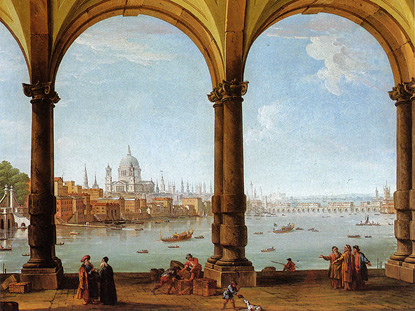
The next year came another calamity, the Great Fire of 1666 that destroyed almost entirely the city. Architect Christopher Wren was commissioned with the reconstruction of the City, including St. Paul's Cathedral, this time entirely built of stone to prevent further fires. The destruction of the City encouraged citizens to move outside the walls, and by 1700 London had become Europe's largest city with 600,000 inhabitants.
The Capital of an Empire
In the 18th century London had become an artistic capital, which is reflected in the numerous Georgian buildings in posh areas such as Bloomsbury or Knightsbridge. London also experienced a massive influx of poorer workers from outside, who moved primarily to the east and south of the City. This resulted in the social division between the middle and upper-class west and north, and the working class east and south still existing nowadays.
In 1800, London had reached a population of 1 million, and was the capital of the fast-expanding British Empire.
London's first railway was built in 1836, connecting London Bridge to Greenwich. The great termini were built soon afterwards : Euston station (1837), Paddington station (1838), Fenchurch Street station (1841), Waterloo station (1848), King's Cross station (1850), and St Pancras station (1863). The first lines of the London Underground were constructed in the 1850's.
Between 1846 and 1849, the Irish potato famine brought hundreds of thousands of Irish refugees to London, who at one point made up over 20% of the city's population.
The Great Exhibition of the Works of Industry of all Nations, or First World Fair, was held in London's Hyde Park in 1851 and was a tremendous success. The Great Exhibition made a surplus of £186,000 which was used to found three of London's greatest museums, the Victoria and Albert Museum, the Science Museum and the Natural History Museum, all side by side in Kensington.
Victorian London was a world of extreme wealth and poverty. The life of the have-not's was epitomised by Charles Dickens in such novels as Oliver Twist or David Copperfield.
A massive system of sewers was built from 1855 in response to epidemics (like cholera) due to polluted drinking water from the Thames.
The 20th century
By 1900, London's population had grown to 6 million people and peaked in 1939 at around 8.6 million.
During WWII, London was bombed extensively by the Luftwaffe, killing 35,000 people and injuring another 50,000. The worst hit areas were the Docklands in the East End.
The 1948 Summer Olympics were held at Lodnon's Wembley Stadium. From the 1960's, London became an epicentre for the world-wide youth culture, first with popular bands such as the Beatles, then the New Wave and Punk eras of the 1980's.