Introduction
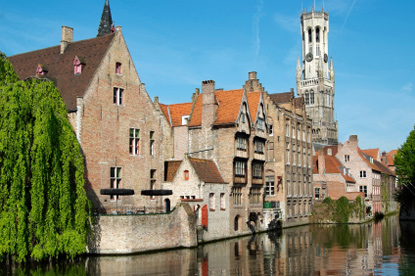
Bruges is the capital of the West Flanders region and has a population of approximately 110,000. It is renowned for its exceptionally well-preserved medieval city centre, which has been designated a UNESCO World Heritage Site. Bruges was once a major trading hub in Europe, particularly during the Middle Ages, and it hosted the world's first stock exchange. The city's historic architecture, including its canals and Gothic buildings, attracts numerous tourists each year. Visitors can explore the city's charming streets, visit notable landmarks such as the Church of Our Lady and the Belfry, and enjoy traditional Belgian cuisine like waffles and chocolate.
Interesting Facts about Bruges
- Bruges is often called the "Venice of the North" due to its extensive network of picturesque canals.
- The city is home to over 50 artisanal chocolate shops, earning it the nickname "Chocolate Paradise".
- Bruges' iconic swans were allegedly mandated by Emperor Maximilian of Austria as perpetual punishment after locals executed his advisor.
- De Halve Maan brewery operates the world's first underground beer pipeline, transporting ale 3km through medieval streets.
- Climbing the 366 narrow steps of the 13th-century Belfry tower rewards visitors with panoramic city views.
- The Church of Our Lady houses Michelangelo's marble Madonna and Child - his only sculpture to leave Italy during his lifetime.
- Bruges hosted the world's first stock exchange in 1309, established by Italian merchant families.
- Minnewater Park features the "Lake of Love", where legend says couples who walk across its bridge experience eternal romance.
- The Frietmuseum celebrates Belgium's crisp golden chips, complete with historical potato gadgets and tasting opportunities.
- Bruges' medieval core became a UNESCO World Heritage Site in 2000 for its exceptionally preserved architecture.
- Four historic windmills still stand along the city ramparts, including the 1770-built Sint-Janshuysmolen that remains operational.
- 15th-century Bruges birthed the Flemish Primitives art movement, pioneered by Jan van Eyck's revolutionary oil painting techniques.
History
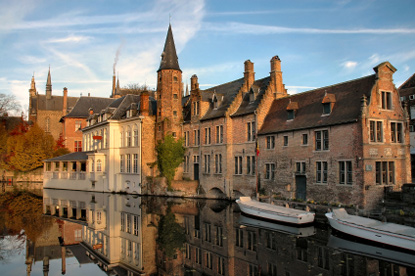
Bruges was founded in the 9th century by a group of Danish Vikings. The name 'Bruges' probably comes from the Old Norse word Bryggja, which means 'landing stage', or 'mooring place'.
Towards the end of the 9th century, Baldwin the Iron Arm, first Count of Flanders, fortified the city, ironically to protect it against other raiding Vikings.
Bruges developed as a port, directly accesible from the sea until about 1050 CE. Then the natural waterways silted up, but Bruges remained connected to the sea via the Zwin canal until the 15th century, though via outports like Damme and Sluis.
Bruges grew as one of the main textile manufacturing and trading centres in Europe, along with Ghent and Ypres.
In 1300, Flanders was annexed to France by King Philip IV the Fair. The king visited Bruges the next year, and his wife, Joanna of Navarre, was so impressed by the prosperity and opulent attires of the locals that she said "I thought I alone was queen, but I see that here I have 600 rivals".
In 1302, Philip IV imposed a new tax on Flanders, and even took the two sons of the Count of Flanders, Guy of Dampierre, in hostage. This caused great unrest in Flanders and in the morning of 18 May 1302, the citizens of Bruges murdered all the Frenchmen in their city, identifying them by their pronuciation of the Flemish phrase schild en vriend ("shield and friend"). Everyone who had a problem pronouncing that, was killed. The massacre is known as "Brugse Metten" ("Bruges' Morning").
Philip the Fair angrily sent 10,000 well-armed knights to punish the citizens of Bruges, but they were defeated by a militia of Flemish guildsmen near Kortrijik at the Battle of the Golden Spurs on 11 July 1302.

In the 1300's, Bruges became the Headquarters of the Hanseatic League of 17 cities, and became so international that one could find almost any exotic product and hear English, French, Italian, German or Spanish spoken in the streets of the city.
Bruges' golden age continued in the 15th century under Burgundian rule. The city sprouted great Flemish painters like the Van Eyck brothers and Hans Memling.
By 1500, Bruges' population had boomed to 200,000, twice the size of London at the time - and twice its size now. It is in Bruges that the first ever printed English book was published in the Renaissance.
But in the 16th century, the Zwin had now completely silted and the headquarters of the Hanseatic League and the merchants moved to Antwerp. The split from the Netherlands in 1584 led to the final decline of Bruges. From 1600 Bruges had become a backwater (without pun intended) and was to remain that way for the next three centuries.
In 1907, the construction of the Baldwin Canal between Bruges and Zeebrugge ("Sea Bruges"), 15 km north, gave a new impulse to the city.
Attractions
Grote Markt
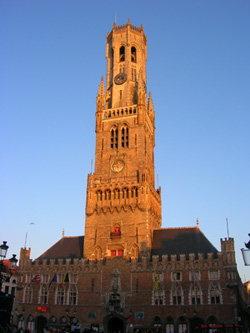
As with other major Flemish city, the Grote Markt (market square), Belfort (belfry) and Lakenhalle (cloth hall) are not to be missed.
The 83m tall Belfort was built in 1240 and is listed by the UNESCO as World Heritage Site. Visitors can climb to the top using the 366 steps staircase and admire the 47-bell carillon from the 18th century. The size of the cloth hall under the belfry is a witness of Bruges' past active economy. In 1399, there were 384 sales stands inside the hall.
The statues of Jan Breydel and Pieter de Coninck, heroes of the Battle of the Golden Spurs, stand in the centre of the square.
The Burg
Take Breidel Street south-east of the Grote Markt, and you will reach Burg Square, the former administrative centre of the city. There once stood Bruges' castle and St. Donatian Cathedral. The castle was constructed in the 10th century by Count Baldwin I, while the cathedral was even older, founded in 900, replaced by a 12th century Romanesque structure, which was eventually torn down by French Revolutionaries in 1799.
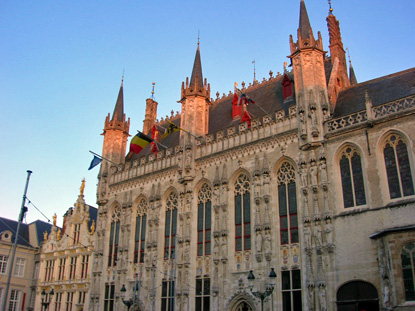
The Gothic Stadhuis (town hall), built between 1376 and 1420, is arguably the most beautiful town hall in Belgium. There are 48 niches and replicas of the statues of counts and countesses of Flanders. The original were destroyed during the French Revolution.
Next to the town hall, the Brugse Vrije ("Liberty of Bruges") was an administrative building erected in 1531. The enormous chimney piece in the Renaissance Hall is remarkable.
The Romanesque Basilica of the Holy Blood owes its name to the relics of Christ's blood brought back from the Holy Land by crusaders the late 12th century.
Other buildings embraces all architectural styles, from the Renaissance Old Civil Registry to the Baroque Deanery and Neo-classical former Court of Justice.
Top Museums
Musea Brugge
Musea Brugge is a collective of thirteen museum locations, each offering a unique perspective on Bruges' cultural and artistic history. The collection spans from Flemish Primitives to contemporary art, including classical fine arts, archaeological finds, furniture, tapestries, and more. Many of these artifacts are still located in their original settings, providing a unique historical context.
Groeningemuseum
Internationally renowned for its early Netherlandish paintings, the Groeningemuseum is a must-visit for art enthusiasts. It houses masterpieces by Jan van Eyck, Hans Memling, and other Flemish masters, offering insights into the artistic evolution of the Low Countries during the late Middle Ages and early modern times.
Sint-Janshospitaal (St. John's Hospital)
This former hospital, now a museum, showcases medical instruments, archival materials, and artworks, including six paintings by Hans Memling. The well-preserved historical setting makes it a fascinating visit for both art and history enthusiasts.
Gruuthusemuseum
Located in a 15th-century mansion, the Gruuthusemuseum features a collection of decorative arts, applied arts, and historical objects. Its interior, with wooden beams and an oak chapel, retains much of its original charm.
Choco-Story Museum
For those with a sweet tooth, the Choco-Story Museum offers an engaging journey through the history of chocolate. Visitors can enjoy live demonstrations and tastings, making it a fun experience for families.
Historium Brugge
Situated in a neo-Gothic building on the Markt, Historium Brugge provides an interactive experience tracing the city's history through the adventures of a young apprentice to Jan van Eyck. It also includes a panoramic terrace and a beer bar.
Volkskundemuseum (Folk Museum)
This museum offers a glimpse into traditional life in Bruges, showcasing folk culture and everyday life in the past. It's a great place to learn about the city's social history.
Diamond Museum
Located in a historic building, the Diamond Museum explores the history and craftsmanship of diamond cutting, a significant industry in Belgium. It provides an interesting look at the art and science behind diamond polishing.
Frietmuseum
For a quirky experience, the Frietmuseum celebrates the history of Belgian fries, offering a unique perspective on a beloved national dish.
Local Cuisine
Bruges offers a delightful array of traditional Flemish cuisine that showcases the city's rich culinary heritage. The local speciality, moules-frites (mussels and chips), features fresh mussels cooked with onions and celery, accompanied by twice-fried Belgian chips traditionally prepared in ox fat. Another must-try dish is stoverij, a hearty beef stew slowly cooked in dark Belgian beer, creating a sweet and rich gravy. The city is also renowned for its Belgian waffles, particularly the fresh ones made to order with a dusting of icing sugar, and its waterzooi, a creamy dish that can be prepared with either fish or chicken and seasonal vegetables. Seafood features prominently in local dishes, with specialities like Jefke (herring fillets with beans and shallots) being particularly popular in warmer months. The cuisine is complemented by world-famous Belgian chocolate, whilst the city's numerous bistros and traditional restaurants serve these dishes alongside an impressive selection of local Belgian beers.
Shopping
Shopping in Bruges centres around the bustling area between 't Zand and Markt Square, with Steenstraat and Geldmuntstraat serving as the main retail arteries. Whilst the city may not rival Brussels or Antwerp for variety, it offers a delightful mix of high-street chains, independent boutiques, and speciality shops. The city is particularly renowned for its chocolatiers, traditional lace shops, and local markets. The Wednesday morning food market in Markt Square and Saturday's clothing market at 't Zand are particularly worth visiting. Most shops operate from 10:00 to 18:00, and visitors can find everything from artisanal Belgian chocolates and handmade lace to local beers and the unique 'Bruges Fourchette' - a Belfry-shaped chip fork that makes for a distinctive souvenir. For the best shopping experience, venture beyond the tourist-heavy centre to discover charming independent boutiques and specialist retailers offering authentic Belgian craftsmanship.
Nature in and around Bruges
Bruges offers a delightful blend of natural attractions that complement its medieval charm. The urban domain of Beisbroek, together with the adjacent Tudor and Chartreuzinnenbos, encompasses over 160 hectares of lush forests and grasslands, providing perfect terrain for leisurely walks. The serene Minnewater, known as the Lake of Love, stands as a picturesque spot where visitors can enjoy tranquil waters and verdant surroundings. Nature enthusiasts will particularly appreciate De Fonteintjes nature reserve, renowned for its diverse flora, including beautiful orchids. The city's iconic canals meander through the landscape, offering stunning vistas at every turn, whilst the surrounding polders and coastal areas present additional opportunities to explore unspoilt Belgian landscapes. Whether one chooses to stroll through peaceful parks or wander along the historic waterways, Bruges presents an enchanting fusion of nature and history that captivates all who visit.
Getting Around
Public transport in Bruges primarily consists of buses, which run every 5 minutes between the railway station and the city centre. The main bus operator, De Lijn, offers comprehensive coverage of the city and its suburbs, with tickets costing €3.00 for unlimited travel within a 60-minute period. The two major transport hubs are the railway station and 't Zand Square, where all bus lines converge. For those seeking a more tourist-oriented experience, the city also offers horse-drawn carriages and boat rides. Additionally, Bruges provides a free electric shuttle bus service that operates daily from 7 AM to 7 PM at 20-minute intervals, connecting the railway station to various key locations throughout the city centre.
Bruges can be easily accessed by train from Ghent (22 to 38min), Antwerp, (1h20min) or Brussels (50min to 1h).
Best Time to Visit
The ideal time to visit Bruges is during the shoulder season in May or September, when you can enjoy pleasant temperatures and fewer crowds whilst still experiencing the city's charm. May offers delightful spring blooms and temperatures reaching up to 18°C, making it perfect for exploring the medieval streets and canals on foot. September maintains mild weather and is reportedly one of the sunniest months, providing excellent conditions for sightseeing. Whilst summer (June to August) brings peak tourist crowds and higher accommodation prices, and winter (December to February) can be quite cold with temperatures dropping to 1°C, these shoulder months strike an optimal balance between comfortable weather and manageable visitor numbers. The spring flowers in May are particularly spectacular, especially in the Beguinage, whilst September's heritage days offer unique opportunities to explore the city's cultural treasures.


 Luxembourg Guide
 Netherlands Guide