Introduction

Hainaut (Dutch: Henegouwen) is the westernmost province of Wallonia. It borders on (clockwise from the North) the Belgian provinces of West Flanders, East Flanders, Flemish Brabant, Walloon Brabant and Namur, and France. Its capital is Mons.
It has a surface area of 3800 km², a population of 1,287,000 inhabitants, and is divided into seven administrative districts (arrondissements in French) which contain 69 municipalities.
According to the fiscal statistics of the Belgian government, the province of Hainaut is the poorest in the country.
The name Hainaut (sometimes spelt Hainault in English) comes from the river Haine (formerly spelt Hayne or Haÿne), which runs between Anderlues (south of Charleroi) and Condé-sur-l'Escaut (north-east of Valenciennes). The Flemish name of the river is Hene, hence Henegouwen for the province/county. The German translations are Henne and Hennegau, respectively. The Flemish -gouw(en) and German -gau come from an old Frankish term that literally means province. They are the equivalent of the English -shire.
Famous people born in the province of Hainaut include (chronologically):
- Merowech (c. 411–458), King of the Salian Franks and founder of the Merovingian dynasty.
- Childeric I (437–481), King of the Salian Franks.
- Clovis I (466–511), first king of the Franks to unite all of the Frankish tribes and conquered most of modern France. He is considered the first King of France (a.k.a. Louis I).
- Édouard Empain (1852–1929), engineer and industrialist, whose company constructed the Paris Métro and railway lines in Egypt.
- Jules Bordet (1870–1961), immunologist and recipient of the Nobel Prize in Physiology or Medicine (1919).
- Georges Lemaître (1894-1966), originator of the "Big Bang" theory of the origin of the universe.
- René Magritte (1898–1967), surrealist painter.
History

It is in the region of Tournai that the Merovingian dynasty originated (=> see History of the Franks).
The County of Hainault was created during the Carolingian period. It comprised most of the present province of Hainaut, as well as the adjacent region of France (Valenciennes, Maubeuge, Bavay...).
Upon the split of the Carolingian Empire in 843, it became the kingdom of Lotharingia, eventually to be ceded to the kingdom of France in 870. In 925, the County of Hainault became an independent state within the Holy Roman Empire.

The Counts of Hainault were also Counts of Mons (964-1051) then Counts/Margraves of Valenciennes (964-1045). Baldwin VI of Flanders (1030-1070), also known as Baldwin I of Hainault, was the first count of the combined Flanders & Hainault .
The family of Hainault was one of the most important in medieval Europe. Baldwin VI of Hainault (1172-1205) led the Fourth Crusade and became the first emperor of the Latin Empire of Constantinople, a title held by his progeniture until 1383. From John II (1237-1304), the House of Hainault also ruled over Holland. Let's also mention Isabelle of Hainaut (1170-1190), who became the queen consort of Philip II Augustus of France, and Philippa of Hainault (1314-1369), who married Edward III of England.
In 1425, the Hainault passed to the Duchy of Burgundy by marriage. In 1477, the Habsburg inherit it. The western half of the county was annexed to France by Louis XIV in 1678 through the Treaty of Nijmegen, while the eastern half remained part of the Southern Netherlands until the French Revolution.
Home of the princes
The province of Hainaut was the cradle of many ducal and princely families, such as the Dukes of Enghien, the Princes of Croÿ, the Princes of Chimay, the Princes of Ligne and the Princes of Barbençon - a number unequaled by any other Belgian province, and probably also by any European region of that size.
Among the princely castles still standing, let's note those of Beloeil, Antoing, Le Roeulx, Chimay and Ecaussines-Lalaing, all of which are open to the public at least some time of the year.
Selected beers from the province of Hainaut
- Aulne Abbey
- Authentique
- Blanche de Charleroi
- Binchoise
- Bonne Espérance Abbey
- Brunehaut
- Cambron Abbey
- Chimay Abbey
- Cuvée des Trolls
- Double Enghien
- Forest Abbey
- Frasnoise
- Goliath
- Hercule
- Moinette
- St Feuillien
- Saint-Ghislain Abbey
- Saint-Martin Abbey
- Tournay
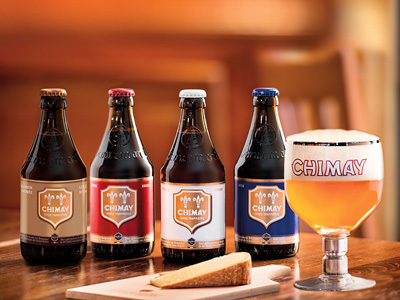
Brewed in the southern tip of the province, Chimay is Belgium's most famous and best-selling trappist beer.
Attractions
| Strépy-Thieu boat lift |
|---|

 Strépy-Thieu boat lift Strépy-Thieu boat lift
|
Related pages


 Luxembourg Guide
 Netherlands Guide




 Mons
Mons

 Beloeil Castle


 Antoing Castle


 Charleroi
